






Abstract

Over the last few years, clinical laboratories have been placed under increasing pressure to improve cost-efficiency and productivity, while maintaining high quality and managing ever-increasing volume without adding staff. A major breakthrough toward meeting these demands was achieved with the concept of workstation consolidation. Workstation consolidation allows more analytes to be run on the same system, thus minimizing manual steps such as sample splitting and reducing the number of analyzers in the lab. With advances in computers and robotics, the next step, lab integration, is now becoming a reality.
The concept of lab integration addresses the diagnostic needs of a serum sample in its totality, with the goal of delivering the necessary information without handling the sample once it enters the system-the serum work area. This serum work area encompasses pre-analytical, chemistry and immunodiagnostic operations and has one operator interface, one sample entry point, one integrated patient report and one host connection.
The serum work area is the rationale behind the Roche/Hitachi MODULAR SYSTEMS platform. By providing uninterrupted processing of all pre-analytical to analytical steps, the MODULAR SYSTEMS platform eliminates manual intervention, thereby simplifying operation, reducing turnaround time (TAT) and dramatically increasing efficiency while expanding capacity.
According to J. A. DuBois, Ph.D., University Hospitals Laboratory Services Foundation, Cleveland, Ohio, “Over the last two fiscal years, our sample volume increased more than 30%. Workstation consolidation using MODULAR SYSTEMS enables us to add the necessary capadity while holding costs constant. The rsesult is higher productivity and lower cost per billable.”
Key Factors for Success
During development and introduction of the MODULAR SYSTEMS platform, a number of beta-site laboratories have evaluated the performance of the platform. In reviewing the results from the performance evaluations and interviewing the investigators, three key factors of success in implementing lab integration have been identified. The first factor lies in the inherent design of the MODULAR SYSTEMS, which encompasses Intelligent Process Management and a two-lane, bi-directional sample transport core, to maximize efficiency in sample handling. The second is in optimizing system configuration to meet a lab's specific workflow needs. The third consideration is the breadth of menu, which has a direct impact on workflow.
The MODULAR SYSTEMS platform
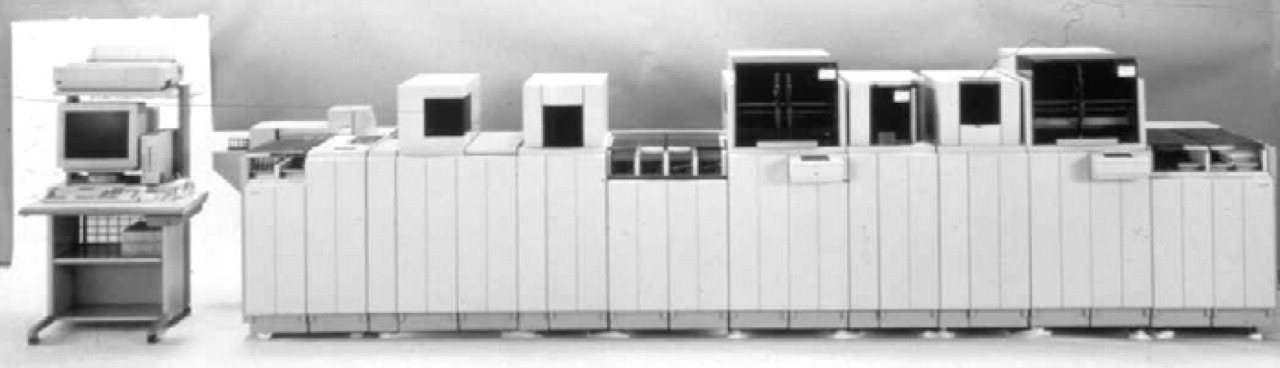
The MODULAR SYSTEMS platform includes basic modules that can be configured in a wide variety of combinations to meet the laboratory's test menu, throughput, workflow and space requirements. When and if those needs change, the instrumentation can easily be reconfigured with minimal disruption in the laboratory.
The control unit uses a Windows NT®-based user interface and is capable of controlling up to six analytical modules. The integrated, two-lane, bi-directional sample rack transport system is based on proven CLAS™ technology. Pre-analytical modules automate decapping, aliquoting, centrifuging, barcoding, recapping and sorting operations. Analytical modules handle electrolytes, clinical chemistry, proteins, TDMs and immunodiagnostics.
Maximizing Efficiency: Design Considerations
The goal of lab integration is to provide clinicians with test results as quickly as possible for clinical decision making, while making testing as cost-efficient as possible. By design, the MODULAR SYSTEMS platform helps laboratories meet this goal with the system intelligence to prioritize and direct samples and the mechanics to allow efficient transport of samples within the system.
These design considerations result in two features unique to the MODULAR SYSTEMS platform: Intelligent Process Management and a two-lane, bi-directional sample transport core.
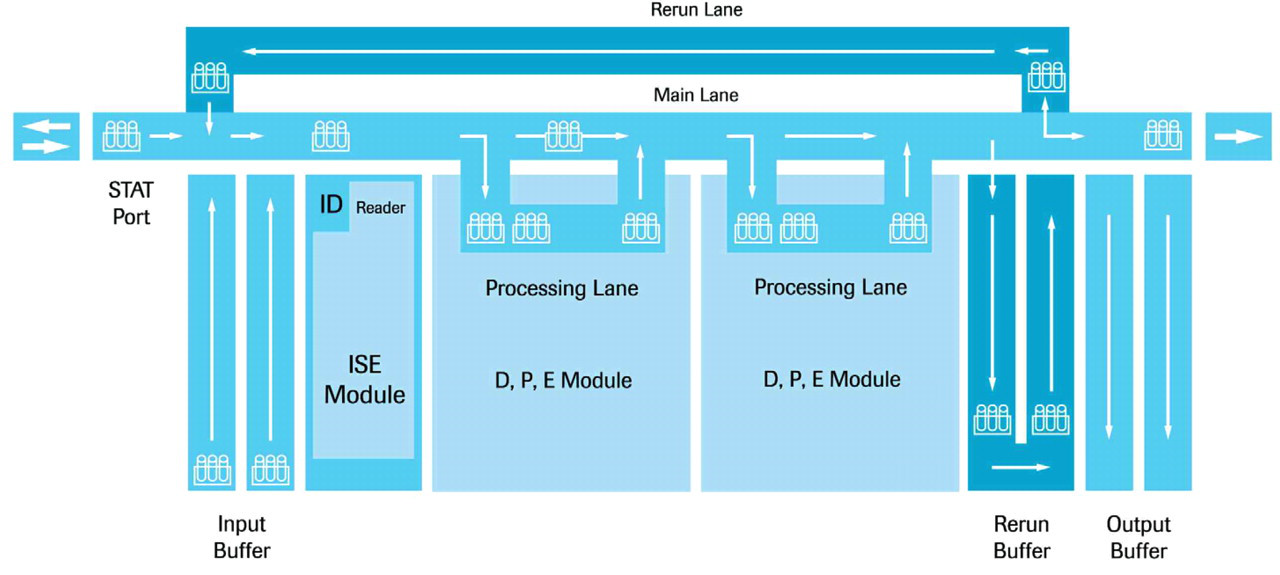
Together these design features allow true STAT prioritization and the automation of rerun and reflex testing. Samples are routed from the input buffer (see diagram above) through the main lane and to the first available module. A second lane is dedicated to automatic rerun and reflex testing. Processing lanes within each module keep both transport lanes running freely, eliminating rack jams and ensuring optimal turnaround time. A third-generation track-driven system and advanced queuing software ensure efficient sample routing.
Determining the Optimal Configuration
The experiences of beta-site laboratories have shown that choosing the right combination of modules is key to fully realizing the potential of the MODULAR SYSTEMS platform. Some of the factors to be considered include the types of tests performed, the volume, anticipated number of tubes that need to go to more than one instrument module and the number of modules required to complete all tests ordered within a typical 24-hour period.
With this information, it is possible to select the MODULAR SYSTEMS modules that will provide maximum workflow efficiency and cost benefits. It is also important to remember that, when sample volume and test repertoire change, MODULAR SYSTEMS can easily be reconfigured and/or expanded.
For example, the MODULAR SYSTEMS offers a choice of three MODULAR ANALYTICS modules for chemistry. The ISE module for electrolytes offers throughput options of 900 or 1800 tests/hour. The D 2400 module is designed for high-throughput (2400 tests/hour) profiles and panels. The P 800 workstation consolidation module provides 44-channel versatility and 800-test-per-hour throughput.
By optimizing module selection and sample routing based on workflow requirements, it is possible to improve throughput and TAT in excess of what may be expected by the number of modules. For example, Johns Hopkins Medical Institutions evaluated a MODULAR ANALYTICS system configured for general chemistry and TDM previously performed by multiple general chemistry and toxicology workstations. The configuration consisted of one ISE, one D 2400 module, and one P 800 module. The system consistently posted results in 30 minutes less time than previously required by three general chemistry workstations.
The Menu Advantage
Often, delays occur when samples are transferred from one system to another because all the tests ordered by the clinician cannot be performed on the same system. In addition to inherent design considerations for improving system efficiency, the test menu available on the MODULAR SYSTEMS platform offers a significant advantage.
The MODULAR SYSTEMS' broad menu of over 100 analytes covers 98% of testing needs. “With the MODULAR SYSTEMS, the majority of serum samples can be processed in one pass,” noted G. L. Horowitz, M.D., Beth Israel Deaconess Medical Center, Boston, Massachusetts. This gives the lab the confidence to make commitments on TATs for test results, improving service to clinicians by giving them a level of assurance on when results can be expected and eliminating the need for clinicians to check back with the lab. “As long as analytical performance standards are met, labs should place higher emphasis on menu as opposed to differences in analytical performance of individual assays,” said Dr. Horowitz.
Reducing Cost with Pre-Analytic Automation
As it stands today, labor accounts for the largest portion of total lab costs, and most labor costs are associated with pre-analytical operations. By minimizing time-consuming and repetitive sample preparation tasks such as decapping, centrifuging, aliquoting and recapping, MODULAR PRE-ANALYTICS can reduce labor considerably and, in doing so, increase laboratory productivity.
MODULAR PRE-ANALYTICS is available in six basic units, which can be configured with the MODULAR SYSTEMS platform in any combination, depending on lab needs. These units include centrifuge, decapper, aliquoter, barcode reader, recapper and aliquot sorter.
Using MODULAR PRE-ANALYTICS with MODULAR ANALYTCS modules, laboratories have demonstrated how integration can reduce staffing and labor costs while increasing sample volume. The result can be a dramatic increase in productivity and a corresponding increase in cost-efficiency.
Elecsys(tm): The Immunodiagnostics Solution
In addition to MODULAR ANALYTICS with the modules described above, an E 170 (Elecsys) module will be available for the MODULAR SYSTEMS platform that incorporates electrochemiluminescent immunoassay technology with high sensitivity and broad dynamic range. The module is designed to perform up to 170 assays per hour and carries up to 25 assays on board, including cardiac markers, (CARDIAC T®, CK-MB, myoglobin), tumor markers (PSA, CEA, CA 125), thyroids and fertility assays.
Reliability: A Key Consideration
Integrating important test operations on one system offers significant benefits in terms of cost-efficiency, service and safety. At the same time, however, the reliance on a single, integrated system makes reliability all the more important.
The MODULAR SYSTEMS platform embraces reliability as a paramount design consideration. The mechanical components of each analyzer reside inside the modules, not in the sample transport core. As a result, the main and rerun lanes are free, eliminating rack jams and ensuring continuous operation and optimal TAT.
A related consideration is that the engineering, components and technology behind the MODULAR SYSTEMS have been proven in Hitachi systems and CLAS installations. Just as important is Roche Diagnostics' global customer support organization and the experience base it offers.
Conclusion
“Healthcare providers are demanding faster service and lower cost while maintaining the highest standard of quality. The MODULAR SYSTEMS offers the technology labs need to compete successfully in this environment,” noted R. W. McLawhon, M.D., Ph.D., University of Chicago Hospitals and Health Systems, Chicago, Illinois. The concept of integrating pre-analytics, clinical chemistry and immunochemistry on a single platform offers the throughput and cost-efficiency needed to address laboratory needs today, with the flexibility to adapt to changing requirements.
footnote
MODULAR SYSTEMS, CLAS, Elecsys and CARDIAC T are trademarks of a member of the Roche Group. Windows NT is a registered trademark of Microsoft Corporation.