







Abstract

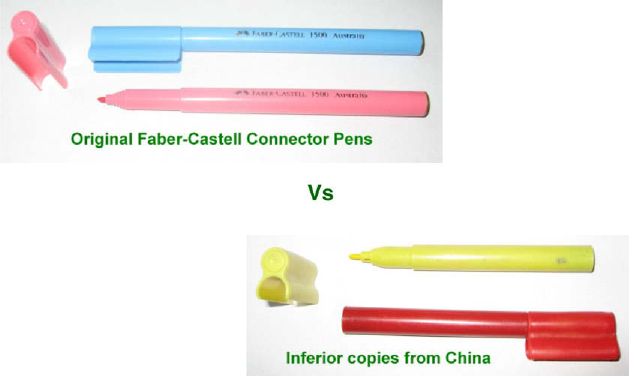
This case study explores the significance of intellectual property in today's business environment by examining successful legal actions taken by Faber-Castell Australia to defend its best-selling product, the Connector Pen, from explicit copies.
Key learning points include:
Defining intellectual property and recognising its value in marketing strategy as a source of competitive advantage The importance of protecting a company's intellectual property and the means to do so Evaluating whether or not legal action is necessary in order to defend a company's intellectual property.
Faber-Castell AG is a multinational enterprise specialising in writing and art materials with its head office in Germany. The company was founded in 1761 and remains privately owned. With 6,000 employees and 16 production facilities worldwide, it is currently the world's largest pencil manufacturer.
Faber-Castell is a competency based business specialising in writing and art materials. There are five market sectors that it has identified as its “Five Fields of Competence”.

Products and most product components are manufactured by company-owned and managed factories in various international locations. Faber-Castell Australia was founded in 1965 and over the years has established itself in all Five Fields of Competence in local markets. The company runs a small production facility in NSW specialising in markers which are distributed primarily in Australia.
Connector Pens
Andy Faber-Castell, Managing Director of Faber-Castell Australia, 1 is a child at heart. He has always had a keen eye for toys and games, not only for his own children but also for himself. It is no wonder then, that despite negative feedback from head office in Germany, he saw potential in what was to become FC Australia's best seller – the Connector Pen.
In the balance of the case study, all Faber-Castell International affiliates will be referred to as ‘FC’, e.g. FC Australia, FC Germany.
The Connector Pen is essentially a children's colour marker. What is particularly unique about this product is its untraditional cap design which consists of the cap with a partial cylinder attached. The original intention of this feature was safety – not only is the cap extremely difficult to swallow due to its rather bulky size, but if it is swallowed and becomes lodged in a child's throat, the cylindrical attachment allows air to pass so the child will not choke. Furthermore, the pen's components are made from durable, non-toxic plastic that will not dislodge and cut the child's throat if swallowed.
While safety was of prime importance for pen designers, the cap design came with an added bonus which actually ended up being the pens’ major selling point – the cylindrical attachments allow the pens to clip together and act as construction toys (see Fig. 1). Children can create castles, trees, airplanes, arm bands or whatever takes their fancy with the pens. The clipping feature, as well as the cap shape which prevents rolling, also makes the pens difficult to lose thus eliminating a common problem with cylindrical colour markers.

Connector Pens – wallet pack and helicopter construction.
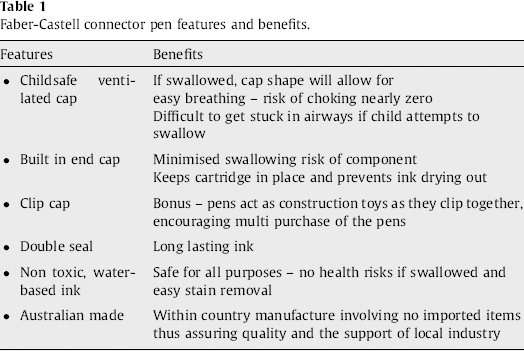
Other special attributes of the connector pens include non-toxic water-based ink which further enhance the child safety features and make for easy stain removal; superior inkfill and reservoir size allowing for longer writing and colouring; and an airtight double seal which helps prevent drying out. These features and marketing advantages are summarised in Table 1.
Faber-Castell connector pen features and benefits.
Having worked for many years in the printing industry, Andy Faber-Castell first entered the family business in a hands-on role as Managing Director of FC Australia in 1992. At the time the company was waning due to the decline in demand for office supplies and graphic design equipment – then prime areas of focus – a consequence of the increasing use of computers. Andy saw Connector Pens as an excellent opportunity for company expansion into the children's play and learning field and as a way to compensate for lost revenue and growth elsewhere. After all, despite the widening use of technology, children would still need to learn to write and their desire to colour, draw and be creative would certainly continue.
Furthermore, Andy saw great opportunity in the timing of Connector Pens’ introduction into the Australian market. It was high time a company launched a quality children's colour marker onto the market. By the mid-1980s, thanks to rigorous cost-cutting by all producers and sourcing from factories in low-cost labour countries such as China and India, the product on offer had been devalued and there was a conspicuous gap in the market for high quality, durable items of this kind.
FC Germany had already launched Connector Pens under name Clic Clac onto the local (German) market but had received a lukewarm response. Sales targets were far from met and costs were too high. Consequently the product was pulled from production and distribution. When Andy enthusiastically requested the now idle machines from the German factory be shipped to Australia, his request was met with words of warning from his brother, Toni, in the German head office.
Aware of the risks involved, the FC Australia marketing team drew up a thorough plan for the new product which included a great deal of primary market research. They observed children using the products and many youngsters were surveyed in the process of choosing an appropriate name for the product. Of the options suggested, “Connectables” came up the clear winner, followed by “Click Clack”. Unfortunately both these names were associated with already trademarked products. “Connector Pens” was the best available option and so it was registered and the company prepared for launch.
Connector Pens take off
In 1993, shortly after Andy stepped into his new role at FC Australia, the company launched Connector Pens. The product launch corresponded with a “high impact” 2 television advertising campaign which visually demonstrated the pens’ unique play aspect. Even Andy's 10 year old son partook in the action with his Connector Pen constructions featured on packaging and in advertising and promotional material.
[anonymous] “Connect with success with Faber-Castell”, Australian Newsagent and Stationer, The Australian Trade Journal, October 1993, cover page.
Sales took off immediately and very soon Connector Pens became the company's top seller, easily overtaking their popular fluorescent markers, Textliners, and allowing FC Australia to reposition itself as a major player in the area of children's play and learning products. Connector Pens could be found not only in newsagents and the stationery sections of large retailers, but also in toy departments and specialty children's stores.
Crayola, FC Australia's nearest competitor in the playing and learning colouring category, brought out a similar dual-featured product in an attempt to capture some of the market. However, the company was disadvantaged by its late entry and small-scale product launch. Their competing product did not take off and was quickly withdrawn. As both markers and toys, Connector Pens had no substitutes.
For a couple of years, it was clear sailing for Connector Pens. The company had secured its competitive advantage with their unique selling points and enjoyed virtually no direct competition and a continually regenerating target market.
Intellectual property is at the heart of competitive strategy 3
Ian Harvey, CEO of BTG, an intellectual property and technology commercialisation company, Jeremy Philpott and Adam Jolly., Handbook of Intellectual Property Management: Protecting, Developing and Exploiting Your IP Assets. London: Kogan, 2004 p3.
Records of the valorisation of intellectual property in business can be traced as far back as 1474 in the Republic of Venice. Leaders recognised that significant new technologies were being developed throughout the civilised world and that these were unavailable in Venice. Enterprising citizens were therefore encouraged to travel and acquire associated intellectual property to which they would have exclusive rights upon return. The Venetians developed the concept of patents and copyrights and soon these concepts spread throughout Europe, being adapted to individual countries.
Today, due to the rise of globalisation in businesses, products can be produced anywhere in the world, therefore knowledge is now the “true source of competitive advantage” (Perrott, 2007). Furthermore, product development costs are high and the introduction of new products or innovations is a risky business with a mere 30% success rate (Nasheri, 2005).
On the other hand, the cost of copying successful products, that is, the theft of intellectual property, is relatively low and, thanks to globalisation and the ease and speed of information flow, a company can easily email product details or send prototypes to research teams and manufacturing locations for duplication. Therefore it is imperative companies recognise the value of their intellectual property and take actions to protect it.
Connector Pens’ competitive advantage lay in the intellectual property associated with product design and production. With the proper know-how and ingredients they could actually be produced anywhere in the world leaving room for threat from importations from countries whose production costs were lower than those in Australia.
Fortunately, Andy and his team recognised the value of the intellectual capital behind their top selling product and duly applied for an Australian Registered Trademark. Further to the company's advantage, the Australian government made substantial changes to trademark laws in its Trade Marks Act of 1995 broadening the characteristics of possible distinguishing product or service features to include discerning marks such as 3D shapes, sounds and smells on the condition they could be represented in writing.
In 1996 FC Australia took advantage of these changes and modified their trademark using more explicit detail. Documents from the Register of trademarks state:
“The trade mark consists of the shape of a pen and pen cap, the pen cap having a protrusion in the form of a partial cylinder such that the protrusion runs parallel to the length of the pen cap, as depicted in the representation…” 4 [A diagram was also attached as part of document.]
Further limiting the incentive for local producers to copy the design was the tort of passing off law linked to the Trade Practices Act which prevents other parties from passing off their products for those of others (Baldwins Australia, 2008). This, as well as copyright taken out by the company, protected the distinctive packaging and promotional graphics and text associated with Connector Pens. However these factors could not prevent factories in lower-cost, less protected locations from attempting to duplicate FC Australia's pride and joy.
In June 1997 a company associate notified FC Germany that a factory in China was producing markers suspiciously similar to Connector Pens yet of much poorer quality. Shortly after, FC Australia's Sales Director was browsing the stands at the Melbourne Toy and Gift Fair when he noticed an importer's display containing these products.
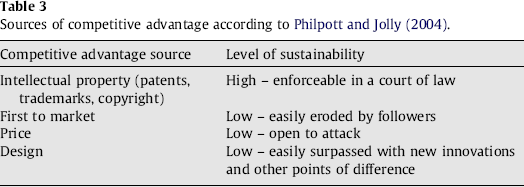
The imitations held an uncanny resemblance to the originals. However, due to inferior product design and production know-how as well as the producers’ clear intention to keep costs down, all product features came with risks to the consumers which could translate into serious risks for FC Australia. These included reputation damage resulting in decreased market share if mistaken for FC products, as outlined in Tables 2 and 3.
Comparing original connector pens with inferior imitations.
a
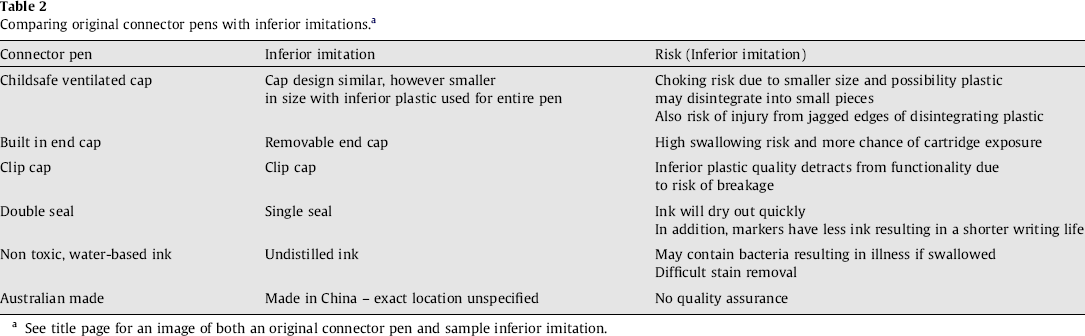
Comparing original connector pens with inferior imitations. a
See title page for an image of both an original connector pen and sample inferior imitation.
Sources of competitive advantage according to Philpott and Jolly (2004).
Even if these imitations were not mistaken for Faber-Castell Connector Pens, the company still risked loss of market share mainly due to their extremely low price point – recommended retail price $2 for a double pack of 24 colours versus $7.95 for a pack of 10 Connector Pens – this may lure more price sensitive consumers away from the FC product.
Andy, being a man of action and concerned that these markers might pave the way for further copies, was anxious to meet his challengers head on. These products were in clear breech of FC Australia trademarks and he did not want them to reach consumers. However, company lawyers advised he was not yet in a position to act. More evidence was needed to present an effective case if court action was to be necessary.
In November that year, the inferior copies hit the shelves of 2 chains of discount stores. FC employees in both Brisbane and Sydney purchased packs and company representatives from several states picked up brochures promoting the offending products. Packaging and graphics were suspiciously similar and promotional material even referred to the copies as “connector pens”. Now there was not only physical evidence of the sale of imitation Connector Pens in Australia, but also evidence that it was taking place across the country.
Eager to defend the product he was so passionate about Andy was ready to take both the importer and distributors to court. Nevertheless, despite his conviction that the case was a clear cut winner there were still pros and cons of taking legal action.
Rather than reacting hastily, companies must carefully analyse the situation and clearly discern what they hope to achieve when deciding whether or not to take legal action against intellectual property theft (Frank, 2006). Andy weighed up the following factors:
Unlikelihood of cost to company – Infringing parties were in clear breech of trademark so it is virtually certain FC Australia will win a case. Acts as a disincentive for other copies – To not challenge copies would imply that FC Australia would turn a blind eye to breeches of its trademark. This could encourage other parties to enter the Australian market with cheap imitations of FC products. Protect market share – A percentage of consumers will purchase cheaper products above the more expensive FC brand name goods. Risk of further and wider distribution of copies if left alone could result in further loss of business. Genuine concern for final users – Major safety issues with copies certain to cause harm to some users.
Are infringing markers truly a threat?
FC Australia prides itself on its quality products and brand prestige. FC brand recognition is primarily associated with quality and brand reputation. These copies are of dismal quality – the clip cap is inferior, pens are smaller with reduced ink capacity making for shorter writing life and reduced construction possibilities. In addition, low quality plastic makes them more fragile, with easy breakage further diminishing functionality. The majority of the target market will certainly prefer original Connector Pens. The discount stores in question do not stock other FC products and FC has no plans to distribute stock via their channel as it goes completely against their brand positioning. Given this, there is no immediate threat of lost orders. Will it really dent brand image? – Discount stores are known to stock cheap, inferior merchandise. These outlets are full of replicate products and even brand name products from low-cost locations. Consumers are aware of this so it is less likely they will be disappointed with lower quality from purchases made there. Legal action may actually harm brand image – Publicity from a court case could highlight wide price gap between copies and originals leading to consumer backlash. People, unaware of production costs, may feel ripped off by FC Australia. Competitors could use price as a motive to attract consumers back to traditional colour markers. Is it worth the time and effort? – Despite a clear case, time will need to be spent on preparations and possibly attending hearings. In the unlikely case of a court defeat, there will be costs to the company.
After careful consideration, Andy and his team decided to take action. Lawyers for FC Australia drafted letters of demand telling the importer and the two chains of discount stores carrying the imitation markers to stop importing and selling the product (Davies Collison Cave Solicitors, 1997). When solicitors responded denying any wrongdoing and refusing to cease their actions, FC Australia took the matter to court.
The makers and importers of the infringing Connector Pens may have genuinely felt justified in defending their position. This would explain why they refused to discontinue trade in the imitation markers preferring to fight it out in court.
Nasheri (2005) has noted two sets of conflicting social values in relation to intellectual property. On one side there are those, like Andy, who seek to protect their right of ownership through legal measures, on the other side there are those who argue that society should be able to benefit from the basic principles of freedom from boundaries, the free flow of information and freedom of expression.
These conflicting values occasionally clash within the legal system when intellectual property rights contradict competition policies (Anderman, 2007). Where intellectual property laws seek to reward the innovator with exclusive use and exploitation rights, competition authorities seek to regulate monopolies, mergers and commercial agreements in order to uphold effective competition in the various markets. In some cases there appears to be a fine line between exclusive rights to intellectual property and a lack of free competition.
Both aspects are valid. Intellectual property laws provide incentive to creators and entrepreneurs for further product development and innovation and, through the registration of patents, trademarks and copyrights, innovative information that would otherwise remain trade secrets, can be brought into the public domain. Competition laws, on the other hand, prevent monopolisation allowing for healthy market growth and consumer benefit. Moreover, additional innovation from outside parties may result in improvements and the introduction of new technologies that might not otherwise be developed by the original innovator within a highly sheltered, non-competitive environment.
FC Australia reaps the benefits of protecting intellectual property
Maxwell (2002) found that many businesses, despite taking action to protect intellectual property, actually undermine its value by filing faulty or incomplete patent applications. It is essential that trademarks, patents and copyrights are comprehensive and complete. FC Australia's trademark and copyright applications for its Connector Pens are exemplary of efficient protection measures and the advantage of keeping informed of changes to corresponding laws.
The fact that the company took advantage of improvements to the Trade Marks Act by including the 3D aspects of their product along with a comprehensive diagram, as well as taking measures to protect value-adding product characteristics such as packaging and promotional graphics and text, put them in a powerful position to protect their product's unique selling points.
The court case was very straight forward and rulings were made in the company's favour. The court found the importers and two discount store chains guilty of:
Infringing 2 Australian registered trademarks (design and packaging) Using the phrase “connector pens”, property of FC Australia, in relation to importation, sale or promotion by any means of marker pens Infringing copyright in photos and text on packaging and in promoting Passing off inferior product for FC Australia product (Davies Collison Cave Solicitors, 1997).
All parties were ordered to cease import and sales of the infringing markers as well as reveal the names and suppliers of all the offending products.
Thanks to solid legal advice and swift action once sufficient evidence was collected, FC Australia suffered minimal damage from the inferior “Connector Pens”. In fact, strong sales results showed no evidence of their brief presence on the market.
Due to firm trading terms and aware of the legal implications of stocking imitations, orders from the main category of stockist of Connector Pens, major retailers, remained steady where smaller specialty art and children's stores preferred to stick with Connector Pens for the brand prestige and product quality. 5
Market Research (Asset Research, Year 2006) has shown that, as market leader in colouring, consumers’ main reason for choosing Faber-Castell products is quality/durability (27% of sample) followed closely by brand reputation (24% of sample).
Today, Andy and his team have expanded their Connector Pen product range to include a jumbo version, Big Tip Connector Pens; Metallic Connector Pens and a series of children's creativity craft packs. Packaging remains a key element in the product mix and the marketing team is constantly working with customers to come up with innovative and unique packaging designs often for exclusive distribution. While business in office supplies is becoming marginal, activity in children's playing and learning is strong and Connector Pens continue to be the company's top seller.
Conclusion
A fundamental part of marketing is recognising the value of intellectual capital and taking measures to protect it. Philpott and Jolly (2004) in a study in the British Isles confined to England, found that intellectual capital actually underpins up to 70% of England's private sector Gross Domestic Product (GDP) thereby concluding that it is the difference between commercial success and failure. They noted that patents, trademarks and copyright are powerful competitive advantages. Due to corporations and individuals’ ownership of these, they can be legally enforced whereas other sources of competitive advantage are less resilient.
This case is a good example of why intellectual property protection is an essential part of marketing strategy. By registering with the Australian Register of Trade Marks and taking copyright on key elements of packaging and promoting, FC Australia avoided risks including:
Loss of market share due to increased competition from substitutes Price wars and decreased profits due to cheaper alternatives Damage to brand image due to inferior product being misattributed to the brand through similar packaging and promotional materials Harm to final users due to inferior safety features of imitations resulting in decreased demand in product category
By protecting and then defending its intellectual property, Faber-Castell Australia retained its market share, kept its reputation in-tact and, to Andy's delight, successfully pursued its expansion into children's playing and learning. Its success has been demonstrated in recent market data which confirmed its position as market leader as shown in Fig. 2.
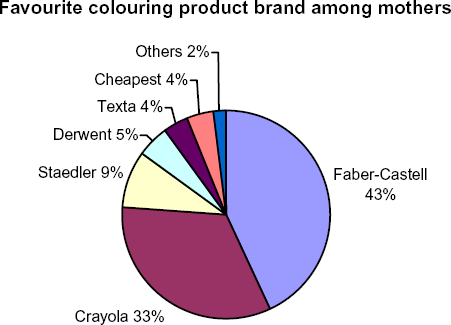
Based on primary data provided by Asset Research (2006).