







Abstract
Drawing on Social Facilitation theory and Affiliative Conflict theory, this three study paper investigates the social and spatial influence customers have on other customers present in a social servicescape–cafes. Unobtrusive, naturalistic observation is used to identify, categorise and evaluate the behaviour of customers on other customers across two empirical studies. In total 242 episodes were observed and analysed from 40 separate observation sessions, ranging from 60 to 150 min across three settings. A third study, comprised of four focus groups explores the why of the observed behaviours of Studies 1 and 2, and supports their key findings.
Our findings show not only that the presence of customers influences the duration of the stay (social influence) of other customers, but also that customers influence other customers spatially (spatial influence). Specifically, individual customers and couples chose to be spatially close to other customers present for non-business meetings. Conversely, for business meetings customers tend to choose to be spatially apart from other customers.
Managers and service personnel need to understand that customers influence other customers present even when there is no direct contact. First, service providers should recognise the occasion (business/social) and nature of the party (single/couples/group). Second, customers like to be spatially near other customers when they are on their own or as a couple and when they are there for a social, rather than business, occasion. Third, the duration of stay can be influenced either positively or negatively by other customers.
Introduction
The influence employees have on customers is well established (Bowen, 1990; Grizzle et al., 2009; Pugh, 2001). The influence of customers on employees is receiving some attention (c.f. Harris and Reynolds, 2003; McColl-Kennedy et al., 2009). Certainly, the direct influence customers can have on other customers through customer to customer communication (Davies et al., 1999; Harris and Baron, 2004), through positive (Walsh et al., 2004) or negative word of mouth (Lee and Youn, 2009; McColl-Kennedy et al., 2009), via market mavens (Clark and Goldsmith, 2005; Feick and Price, 1987), as early adopters (Rogers, 1976), and most recently through blogs (Mangold and Faulds, 2009) and twittering (Bielski, 2009; Smith, 2009) is important to organisations.
Customer to customer influence through communication is perhaps not surprising as the interaction is often direct, such as through face to face interactions, or less direct by phone, email, texting, or blogging. In contrast, customer to customer influence where there is no interaction is not well understood. However, many services are performed in the presence of other customers and the indirect influence of customers on other customers by being merely present warrants investigation.
With the exception of research into crowded retail environments (e.g. Eroglu et al., 2005; Hui and Bateson, 1991; Machliet et al., 2000; Zhou and Soman, 2003), where the spatial aspects of customer control and the influence of social presence on product choice receives some attention (e.g. Argo et al., 2005; Dahl et al., 2001), the social and spatial elements of the customer's environment are largely ignored. This paper seeks to address this gap by investigating first hand through observations, and through focus groups, the impact customers have on other customers present in a social servicescape where there is no direct or intentional interaction between the customers.
Our study contributes in three important ways. First, as the only empirical study of customer to customer influence where there is no direct interaction, we offer insight into how customers have a social and spatial influence on other customers in the servicescape, by observing first hand these influences across three cafes in a major Australian city (Studies 1 and 2) and through four focus groups (Study 3). Second, by drawing on Social Facilitation theory and Affiliative Conflict theory we show how the influence is different depending on whether: (1) the customers are ‘singles’, ‘couples’, or groups; and (2) the occasion is primarily social or business. Third, we discuss the implications of our findings for practice.
Literature review
Customers as social influencers
The inclusion of customers in the servicescape is particularly important given that many services are performed in the presence of other customers (Baker, 1987; Price and Arnould, 1999). Even when customers do not interact, the mere presence of others elicits monitoring of social behaviours of others (Zajonc, 1965) which subsequently results in modification of the customers’ own attitudes and behaviour. Social Facilitation theory suggests that, because of the awareness of the social aspects of the environment, the mere presence (or absence) of individuals (e.g. spectators) has an effect on human behaviour (Platania and Moran, 2001; Zajonc, 1965). Zajonc's (1965) drive-based view of social facilitation suggests that the presence of others increases the drive state or level of arousal within the individual, which in turn enhances the expression of dominant responses. By increasing the likelihood that dominant responses (i.e. behaviours, feelings or moods) are enhanced, the performance of a task is facilitated or hindered by an audience (Geen and Bushman, 1989). The presence of other customers may therefore enhance or diminish the service experience (Grove and Fisk, 1997). For example, the ability to join in on the excitement of the other fans present at a sports match facilitates the spectators’ enjoyment of being at the stadium (Ng et al., 2007). On the other hand, a feeling of pressure to keep moving along the aisles in a crowded supermarket may hinder behaviours such as product evaluation and choice (Grossbart et al., 1990). Thus, the extent to which other customers may influence the behaviour of customers appears to depend on the context of the service experience. The context or occasion for which the service is purchased may be specific to the environment (e.g. sports event) or specific to the individual (e.g. a social meeting within the same environment).
Tombs and McColl-Kennedy (2003) adopt this view of social facilitation in their social servicescape. In the social servicescape the service is provided in the presence of both the employee(s) and other customers. Mehrabian and Russell's (1974) approach-avoidance framework suggests that social stimuli (such as other customers) increases the intensity (arousal) of emotions and hence approach-avoidance behaviours (whether to remain and explore an environment or leave). The effects of conformity to social norms, given the context, may also explain this phenomenon. For example, a control systems approach (Carver and Scheier, 1981) suggests matching the standard behaviour of others, so that “…even in the passive presence of another person, responding can become socially directed, even if the person present does not overtly direct or cue the subject, because there are more general social expectations about how people should perform” in different social settings (Guerin, 1993, p. 68). Empirical evidence shows social facilitation effects in bars (e.g. Sommer, 1965), and coffee houses (e.g. Sommer and Sommer, 1989), specifically that groups (where there is a high level of social interaction) stay longer than individuals (where there is a low level of social interaction).
Literature in psychology, sociology, education, and organisational behaviour demonstrates the need to feel a sense of belonging, whether this is at a national level, community level, work, home or personal level (i.e. Mewett, 1999; Bendek, 2002; Southerton, 2002). There is some evidence in marketing that customers feel a sense of belonging to stores and professional services, for example, my dentist, my doctor, my beautician, my bookshop, my (department) store, and my café (Barnes, 2000). Rosenbaum (2006) in explaining the concept of the “third place” shows that staff and other customers even provide social and emotional support to customers. Given this, we argue that customers may feel a sense of belonging to a café and go there even on their own not merely to eat and or to drink but also to feel that they are among friends even though they will not speak face-to-face with any of the other customers. That is, being in a café surrounded by similar customers to themselves appears to give customers a sense of belonging. That is, an outcome of social facilitation is an increase in customers’ sense of belonging. Therefore it is proposed that customers will have a social influence on the other customers present and that they will stay within the environment because of the mere presence of other customers (Proposition 1).
Customers as spatial influencers
Given that an individual customer is likely to feel a sense of belonging and social affiliation with other customers within a café setting we may also assume that the service encounter will involve some form of social interaction. An individual's desire to affiliate with or avoid others within a particular setting will influence their spatial behaviour (Argyle and Dean, 1965; Knowles, 1980, 1989). Affiliative Conflict theory (Knowles, 1989) suggests that an individual will feel greater discomfort the further they are from others if there is an assumption of interaction with those other individuals. The contra side to this is that the individual will feel less discomfort the further they are from others if there is the assumption that they will be alone. Therefore any discomfort felt due to interpersonal distance is likely to motivate the individual to adjust that distance in order to reduce the level of discomfort (Knowles, 1989). This motivation to find a comfortable distance in relation to others within a service setting may depend upon the degree of affiliation or isolation sought. It may also act as a determining factor in the self-selection of seating and hence influence the spatial arrangements within the environment. Moreover, seeking a comfortable distance may also conform to Osmond's (1957) notion of sociopetal and sociofugal forces on behaviour where customers are drawn together or driven apart, respectively. This may however, be contingent upon the context or occasion for which customers use the servicescape. Therefore it is proposed that customers will be spatially influenced by the other customers present in the social servicescape (Proposition 2).
Methodological approach
In light of the above discussion, three studies were undertaken to investigate customer to customer social and spatial influence. Study 1, a field observation study, was aimed at investigating the social and spatial influence of customers on other customers within the social servicescape. Study 2, again a field observation study, was designed to further investigate issues raised in Study 1, in particular the relationships between group size and social affiliation, and purchase occasion and social affiliation. This follow up study was conducted within the same settings. The aim of this study was to confirm that an increase in social affiliation influences other customers by encouraging these customers to stay longer within the servicescape. Finally, Study 3, a study of four focus groups, comprising 24 participants, was undertaken with the aim of supporting the findings and explaining the assumptions of the field observation studies.
Study 1
Aim
The aim of this study was to investigate the social influence of customers on other customers within the same environment as they experience a service encounter. Because services are often characterised by perishability and intangibility (Shostack, 1977; Zeithaml et al., 1985) the dynamic nature of service experiences is often difficult to investigate through traditional quantitative research methodologies (Grove and Fisk, 1992). Hence, this study employed unobtrusive naturalistic observation techniques. This technique allows the researcher to enter into the complexity of a world where the connections between people, correlations in behaviour, and causal relationships can be observed as they occur (Adler and Adler, 1994). The advantage of this process is that it captures the actual phenomenon rather than relying on reconstructed or contrived versions of it (Grove and Fisk, 1992). Moreover, individuals may be more responsive to others and the setting than they are consciously aware (Rust, 1993). Therefore observation may uncover more data than could be explained by the individual customer. Observation of behaviour in natural settings also allows the researcher “to realise the importance of time, which is typically underestimated in laboratory experiments” (Levy-Leboyer, 1988, p. 785). The ability of observation methods to capture the time component of behaviour was crucial in this study because the findings of earlier studies, that associate the length of stay in a dining situation with group size (Clendenen et al., 1994; Sommer and Sommer, 1989; Sommer and Steele, 1997), suggested that duration within the social servicescape would be an outcome of social facilitation due to the presence of other customers.
Procedure
Observations were made unobtrusively. The observer sat at a side table that allowed clear vision of the entire dining area, ordered coffee and behaved simply as a customer. Adler and Adler (1994) described this methodology as simply following the flow of events where behaviour and interaction continues as it would without the presence or intrusion of the researcher thus, neither manipulating the environment nor stimulating the participants. All of the observations were made during weekdays rather than evenings or weekends as it is not uncommon for daytime customers in these cafés to be sitting on their own and writing onto sheets of paper. Hence the observations and note taking by the researchers went unnoticed by other customers and staff. Although observation sessions were undertaken on all days of the working week no discernable differences in behaviour were observed between these days. The observations ranged from 60 to 150min each over 15 separate sessions.
One of the strengths of unobtrusive observation is that the researcher can study human behaviour in a non-reactive way (Kellehear, 1993). This entails observing human behaviour in a public place without the knowledge of the subject, thus ensuring that they do not react to the researcher but continue with their natural behaviour. An implicit assumption here is that by being in a public place, an individual's behaviour is open to observation and scrutiny by others in the same environment. However, as the customers who were observed in the cafés were complete strangers to the observer, and no method of capturing their identity was used, their anonymity was protected. Furthermore, as these were public environments the customers could freely leave or avoid the observation.
Setting
Cafés were chosen as the setting for this study as they represent a social servicescape: an environment where the consumption of the service is generally undertaken on the premises and in the presence of other customers (Tombs and McColl-Kennedy, 2003). Cafés are also well suited to unobtrusive observation as they fall into the social psychological classification of open regions “in which people have the right to make contact with others and have a general obligation to be open to contact from others” (Sommer and Sommer, 1989, p. 653).
The observations took place in three medium priced, medium quality cafés in a major Australian capital city. Equal numbers of observations were conducted in each location. Observations were conducted during the day. Each café was of similar format: fully open to the street with no visual barriers between the customers and passersby. Customers therefore sat in these cafés in full knowledge that others (both other customers and the passing public) could observe their behaviours. Importantly, in these cafés the customers made their own table selection rather than the wait staff directing them to a table. The self-selection of seating arrangements was important to this study as it enabled the researchers to observe the customers’ desired spatial affiliation or isolation.
Data collection
The data collected for this study were detailed descriptions of the actual behaviour and spatial movement of customers as they entered, seated themselves at tables within the café, placed an order with the wait staff, consumed food and/or beverages and exited. The movement, location and orientation of the customers were also sketched onto a floor plan of the café (see Fig. 1). The field observations and accompanying notes were initially coded into the observations that related to the social interactions within the customers at each table (social behaviour) and the behaviour that related to where customers chose to sit within the café itself (spatial behaviour) using manual thematic analysis. A second round of coding identified differences within each of the two classifications thus, providing clearer understanding of the actual behaviours within the social servicescape. To ensure consistency, a representative sample (10%) of the field notes was coded by a second observer. Very high (97%) inter-coder reliability was obtained.
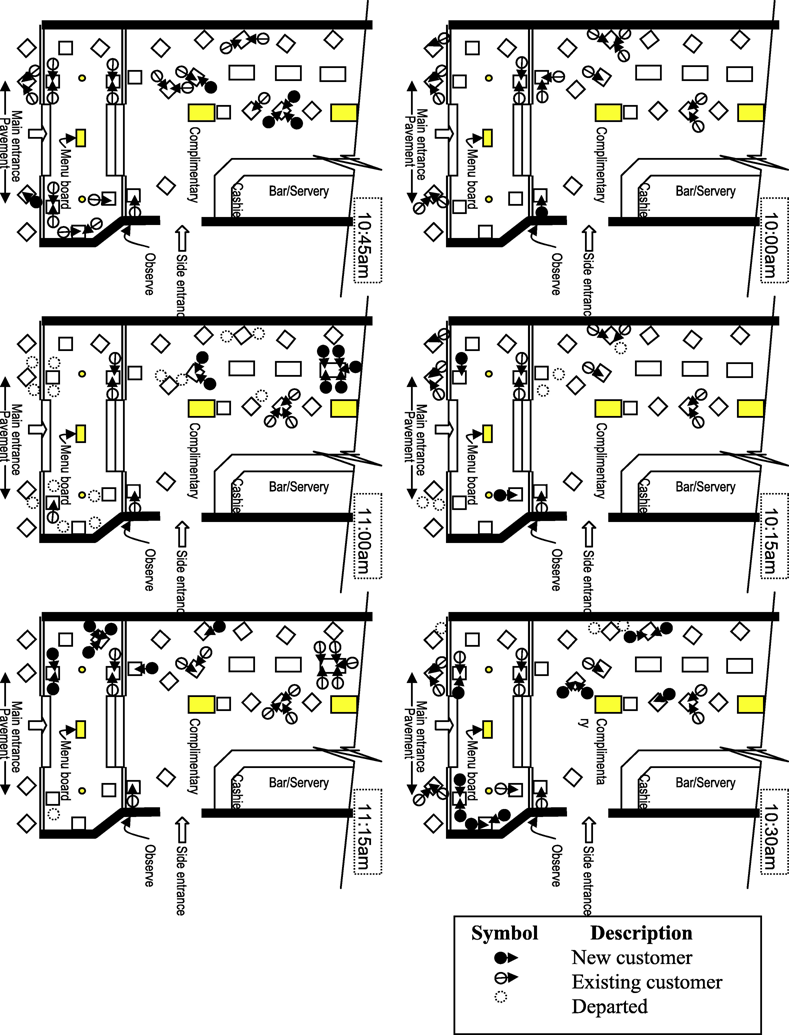
Café – time sequenced floor layout 10.00am–11.15am.
Analysis of the field notes revealed factors relating to the social and spatial influence of customers on other customers. First, in terms of the social influence of others, customers appeared to use the cafés for one of three distinct purchase occasions: (1) social meetings, (2) business meetings and (3) personal “time-out” episodes.
In social meetings with groups of two or more customers, the primary focus of attention was on the members within the group, although customers also appeared to take notice of the other customers within the café. An almost continuous stream of conversation accompanied the consumption of food and or beverages. As expected, the volume of conversation appeared to increase with group size. These meetings appeared to be non-private and non-confidential purchase occasions. An example of social meetings is provided in this extract from the field diary.
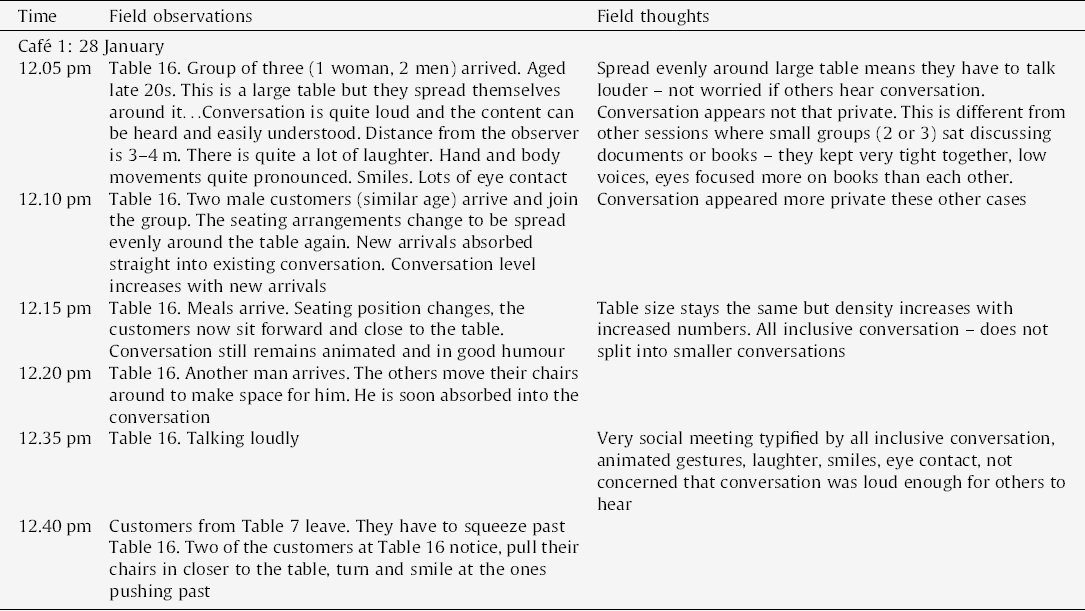
There were a few instances when materials or props (shopping bags, articles of clothing, handbags, phones, and occasionally magazines) used by the customers were seen on the table, although once placed on the table they were generally not used. The nature of props provided one method of distinguishing between social and business meetings.
Business meetings were operationalised as situations where the participants’ apparent purpose for using the café was to work rather than socialise or just have a quiet break. They were also typically comprised of groups of two or more customers. They were distinguished from social meetings both by the type of props on the table and the behaviour of the customers. Unlike the personal items that accompanied social meetings the props in business meetings comprised documents, diaries, folders and laptop computers. Also, unlike the social meeting groups these materials were used during the dining episode. The focus of the customers’ attention appeared to alternate between the props and the other members of the group. These customers also took little notice of the other customers in the café. They tended to sit around the periphery of the dining areas or away from the other customers. These meetings appeared to be more private and confidential than the social meetings. The following field diary extracts describe two observations typical of small groups of customers using the café for the purchase occasion of a business meeting.
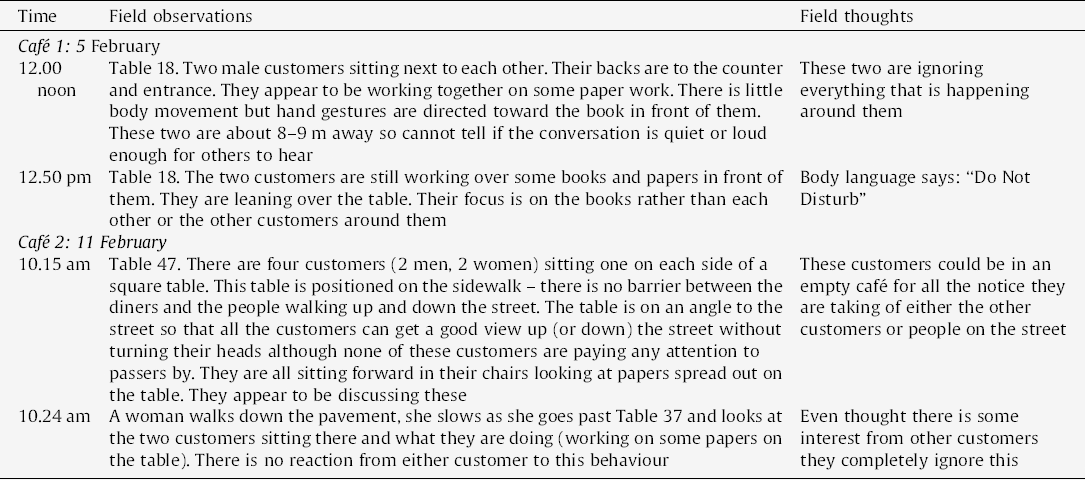
The main differences between the social and business occasions were observed to be the customers’ body posture, level of conversation and focus of the customers. In the business meetings customers appear to be physically oriented inward toward the tables, speak quietly and remain focused within the group. They are in an environment open to the public but appear not to be interested in anything happening around them, nor do they appear to welcome any intrusion from others. These customers give the distinct impression that this is consumption occasion is private.
Social meetings on the other hand appear far more relaxed, the level of conversation is generally louder yet these customers do not seem concerned about other customers overhearing them. Although interaction between the different social groups was observed only occasionally, customers showed no signs that they do not welcome any intrusion. The difference, therefore, appears to lie in the observed degree of openness to others. The social meeting customers appear to enjoy being part of a larger group occasion.
In addition to social meetings and business meetings, a third purchase occasion was observed: “time-out” occasions. During time-out occasions customers tended to sit and consume alone, although occasionally couples exhibited similar behaviour. The customers would come in and survey the entire dining area before making a table selection. Despite there being a large selection of tables available they would tend to choose a seat near existing diners. These customers appear to position themselves at a table so as to get the greatest view of the other diners and passing pedestrians, sit quietly and either observe the activities within the café or read. Many of these customers used some form of reading material (newspapers, magazines or books). Often the customer appeared to use a newspaper to obscure him/her self from the other customers, hence, enabling the customer to subtly observe others without being observed themselves. For example the following field diary notes show how props are used by time-out customers.
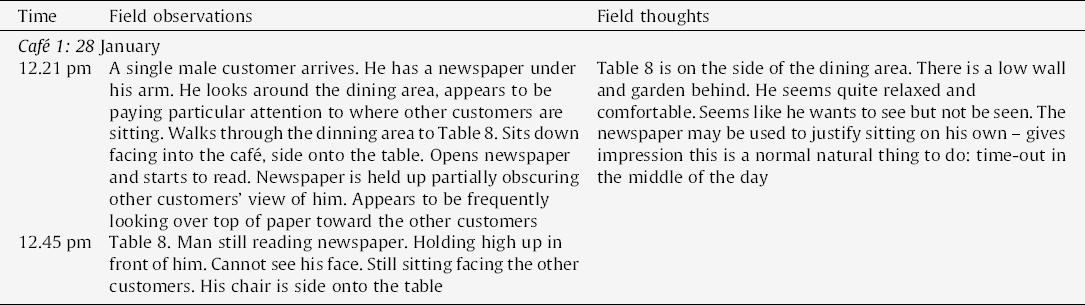
The behaviour of customers using the café for time-out occasions appeared similar to the social group in their openness to others. The way these customers tended to seat themselves near to other customers suggests an attempt to blend into or appear to blend into a larger group rather than sit conspicuously out on their own. Being seen as part of a larger group may have added to a sense of belonging and it was this group experience that they sought. As the physical layout and table arrangement of the cafés remained constant across all observations the patterns of customer behaviour can be regarded as being dependent on group size and purchase occasion rather than the physical layout of the environment. Therefore other customers appeared not only to have some social influence on customers but also some spatial influence.
Findings – spatial influence
Spatial influence of others, i.e. the patterns of behaviour related to the distance and seating arrangements of customers within the environment, appeared to be driven by the purchase occasion. The two most observable patterns follow Osmond's (1957) notion of sociopetal (where people are drawn together) and sociofugal (where people are kept apart) spatial arrangements. The physical proximity and orientation of individuals appeared to either facilitate (sociopetal) or impede (sociofugal) interaction. Sociopetal seating arrangements encouraged interaction and facilitated affiliation (Forsyth, 1999). While direct affiliation was evident between customers sitting at the same table, direct interaction between customers at different tables was not common. However, there did seem to be some degree of unspoken affiliation as the cafés filled concentrically around existing customers. For example:
A single female customer enters; she stands near the centre of the café and looks around at the other customers already seated there. Time about 13 s. Finally she goes over and sits at table 14. This (table) is next to one occupied table (three customers) and three vacant tables. She is still looking around, doesn't seem settled. Now gets up and shifts to table 16. This one has occupied tables on three sides and a vacant one on the other. She sits back in her chair waiting for her order. Appears quite relaxed. Looks back into café and other customers. (Field note: Café 1, 31 January, 12.25pm)
On a number of occasions, especially when the density of customers in the café was low, the researchers observed customers choosing a table adjacent to existing customers rather than out on their own. This behaviour appeared to be most common with lone individuals and couples rather than groups. These individuals and couples also tended to fit the same profile as the ‘time-out’ customers. An implication drawn here is that although these customers visit the café to relax and have a break from their regular activities there is still a need for a sense of belonging that brings them into the café and to sit near other people. Hence, we use affiliative conflict theory (Knowles, 1989) to explain this behaviour. To reduce internal conflict they clearly appeared to want to be seen as part of the larger group of café customers. Fig. 1 provides a time sequenced floor layout for café 2. Each floor plan represents the change in customer numbers and location that occurred within the previous 15min period.
Sociofugal seating behaviour describes a choice of table that separated the arriving customer(s) from the existing customers in the café. In contrast to the behaviour associated with sociopetal patterns, sociofugal patterns are more likely to discourage interaction and can in some cases drive participants out of the situation altogether (Forsyth, 1999). This behaviour appeared most common in individuals and couples rather than groups. However the difference appeared to be largely related to the customers’ purchase occasion, that is, these customers tended to fit the same profile as the ‘business meeting’ customers. This may not be surprising considering their conversation topics were more likely to be private and confidential. Many of the individuals in this category appeared to carry out business meetings on their mobile phones (phone conversations while writing into folios or diaries), so again located themselves at a table away from others, where their conversations could not be overheard. The field diary notes below provide an example of a business meeting.
10:23am Single man arrives. Stands near the entrance and looks around the café briefly as if deciding where to sit. Sits down at table 41 back to side of café, facing toward entrance. There are no other customers at any of the adjacent tables. Opens out a diary or folio on the table and makes a phone call. Starts writing into the diary. Pays no attention to other customers or passing pedestrians. 10:35am Man still on phone. Appears to be concentrating on papers in front of him. 10:42am Man stands up, picks up phone and folio, looks around and then walks further back into the café. Sits back down at table 22. Nearest customer 4 tables away. Makes another phone call. (Field note: Café 2, 14 February, 10:23am)
The third form of spatial behaviour related to larger groups (three or more customers). These groups appeared to sit at random in the café without any reference to other customers. These customers tended to fit the same profile as the ‘social meeting’ customers. The lack of reference to the other customers appeared to be largely due to the group size being large enough to meet the social needs of the customers, being a self-contained social unit. While they had little interaction with the other customers they did attract the sociopetal customers to tables adjacent to these groups.
While previous studies have shown that behaviour such as affiliation and communication may be determined by manipulating seating arrangements (Sommer, 1965; Patterson et al., 1979) the observational nature of this study prevented any intervention by the researchers. Customers themselves determined the behaviour and seating arrangements. As both sociopetal and sociofugal behaviours appeared to occur simultaneously within the same environment these observations suggest that spatial density within areas of the cafe is more likely to be determined by the context (purchase occasion) than the physical layout of the café environment. This suggests also that the mere presence of other customers has some influence on the spatial behaviour of customers. Thus the occasion acts as the internal driver, in Affiliative Conflict theory (Knowles, 1989), that determines a customer's comfort level relative to the closeness of others. The observation that larger groups tended to show no such patterns supports observations by Burgess (1983) that distances between strangers in shopping malls were essentially random. Moreover, these observations also suggest that while groups are self-contained, having their social needs fulfilled within the group, they had a social influence on couples and individuals, providing a sense of belonging.
Study 2
Aim
To further investigate issues raised in Study 1, in particular relationships between group size and social affiliation, and purchase occasion and social affiliation, a follow up study in the same settings was conducted. Study 2 aims to investigate more deeply if couples’ behaviour differed from that of groups in terms of social and spatial influence.
Method
The behaviour of customers, the location of tables within the café, the customer's choice of table in relation to tables occupied by existing customers, the gender, apparent age and activity (eating, reading, drinking) of the customers were recorded using a behavioural mapping chart designed for this purpose. The arrivals and departures of customers and the number of people seated at each table were also recorded. As we were interested in customers’ choice of seating in relation to other customers (spatial influence) we limited our observations to times when the cafés were less than 60% full. Observation sessions ranged from 60 to 150min each over 25 sessions. A total of 242 completed episodes where the entire service process was recorded (customers arrived, consumed the service and departed) were obtained. A further 115 observations were made where the customers stayed in the café longer than the observer. In these latter observations all items were recorded except duration of stay. The location and group size of the customers who were in the café at the time each observation session started were recorded. However as the duration and table choice of these customers could not be determined these observations were not included in the analysis. While we could not obtain an accurate age from observed participants they were classified by apparent deciles. Customers between 30 and 39years made up the greatest percentage of those observed (33%) followed by 40–49years (28%), 20–30years (21%), 50–60years (16%) and over 60 (2%). Where length of time was recorded the only significant difference in duration of stay was between the 60+ cohort and the other cohorts. There were no significant differences in duration between any of the other cohorts. The gender mix of observed customers was 56% female, 44% male. There were no significant differences in duration between genders. The quantifiable data were analysed using SPSS.
Findings
The episodes were analysed in terms of whether social facilitation (social influence) influenced the duration of the café experience and whether the location of other customers (spatial influence) affected where customers chose to sit. Building on Study 1, we classified the occupants of each table according to the size of the group at the table. Namely, “isolates” (customers sitting alone), “couples” (groups of two), “groups” (three or more customers) and “joined parties” (these were where other customers joined existing customer(s) at the same table). This classification followed Sommer and Sommer's (1989) study of social facilitation in coffee houses with the exception that in that study couples were included in the group classification. Our study viewed couples as a separate classification following the findings of Study 1 where it was observed that couples tended to sit at tables adjacent to or near existing diners, whereas groups appeared to select tables more randomly. Therefore, Study 2 aimed to investigate more deeply if couples’ behaviour differed from that of groups in terms of social and spatial influence.
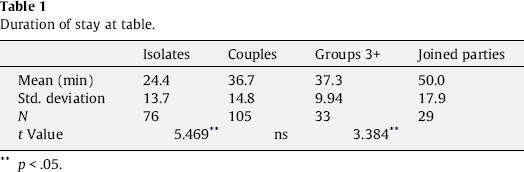
Table 1 clearly shows that in situations where the customers had some form of social interaction (groups of 2 or more) they stayed longer than those who did not (isolates). Surprisingly however this trend did not continue as groups became larger. There was no significant difference in duration between couples and larger groups. In situations where others joined existing customers the duration was double that of the isolates and 35% longer than the non-joined couples and groups.
Duration of stay at table.
Duration of stay at table.
p < .05.
These findings show a very similar pattern to the Sommer and Sommer (1989) study although the mean times for all groups are significantly longer for the current study. The findings support Proposition 1 that customers will have a social influence on the other customers present and that they will stay within the environment because of the mere presence of other customers.
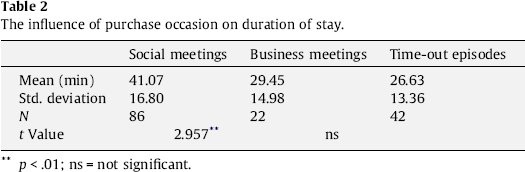
The findings shown in Table 2 also confirm that social interaction has an influence on the duration of the service encounter. Again those episodes that involved social interaction (i.e. social meetings) were over 50% longer than those that appeared not to (i.e. time-out episodes).
The influence of purchase occasion on duration of stay.
p < .01; ns = not significant.
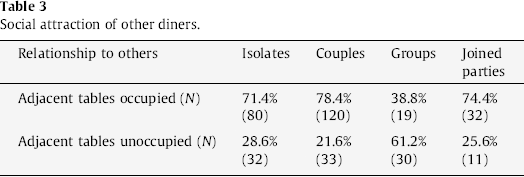
To determine whether singles and couples appeared to seat themselves adjacent to other customers, an analysis of table selection relative to existing customers was undertaken. The findings shown in Table 3 confirm this observation with 71.4% of isolates and 78.4% of couples choosing to seat themselves at tables adjacent to others rather than out on their own. In contrast, groups displayed the opposite tendency with 61.2% choosing to sit at a table away from other customers. The joined groups showed a tendency similar to that of the isolates and couples but this may be due to the original customers being either isolates or couples before others joined them. These findings support Proposition 2 that customers will be spatially influenced by the other customers present in the social servicescape.
Social attraction of other diners.
Aim
The aim of this study was to explore explanations for the observed behaviours in Studies 1 and 2. While field observation has particular advantages in recording the naturalistic behaviour of customers it does rely on the skill of the observer to interpret these observed behaviours. The observer can answer who, when, where, what, how, and how much questions relating to behaviour but can only make inferences on why customers behaved in the way they did. Study 3 therefore, reports on the findings of four focus groups with customers, in order to answer the why question and rule out alternative explanations for the behaviour that was observed.
Participants
All four focus groups were conducted with members of the general public (n = 24). Each group had no more than seven participants. The focus groups consisted of 14 female and 10 male participants ranging in age from 20 to 55. They were recruited using a snowball sampling method. The criterion for inclusion in the focus groups was based on recent (within the last two months) personal experiences of dining at either a café or restaurant. The discussion format was based on a semi structured interview. This ensured that the main concepts of social and spatial influence were discussed, while enough latitude was allowed for the discussion to explore all the commonalities and differences in the subjective meanings the participants attached to these concepts. The focus groups lasted between 60 and 90min. The data was analysed using manual thematic analysis.
Findings
The focus groups not only confirmed that customers use commercial public spaces for social meetings, business meetings, and personal “time-out” episodes but also revealed how customers felt about the presence of other customers for the different occasions. Although other customers within the environment were seen as influencers by the participants, the influence of others however, was most noticeable when customers talked about visiting cafés by themselves or in small groups. For example, one participant notes how the other customers influenced her choice of café when she is on her own:
In a strange café I'd look around, if the café was like open I could see in, and if there were other people there, I feel that I would be comfortable and I'd go in. But if the café [frontage] was closed and you had to open the door and walk in and then look around and oh you'd be sitting there by yourself, couldn't do that. (Female, aged 49, FG2) Because I was there by myself… I wasn't interested in joining a group I just wanted to be part of the scene. (Male, 21, FG4) When we got there we were put at a little table for two sort of tucked away. I said, “can we sit somewhere else please?” to get back into the main part of the restaurant because I like that sense of being involved. (Female, 52, FG3) …there was only one other group, a family, and the rest of the restaurant was vacant. That was noticeable and did influence us. We were probably more mechanical in a way, we just ate and went,…and that did influence mood too, it sort of felt like the absence of mood in a lot of ways. (Male, 30, FG3) I can recall an occasion when we were travelling at Christmas. We went for Christmas dinner in a restaurant and it was empty and I had second thoughts about staying because for Christmas I felt like I would like to have a festive atmosphere and I need people. I was wrong as all the other tables were reserved because within an hour there was such a Christmas atmosphere that we stayed until midnight. But my first impression was no, but it was just because we were hungry that we decided to stay but the other people saved the evening. I guess we were expecting a certain type of mood, which other people provide. (Female, 50, FG3) You can have too few people in a restaurant. Especially if you're looking to go out with a bunch of people to celebrate something like a birthday or something like that. There's nothing worse than being in a quiet empty place. I find, what would usually be the case when there's only say four or five tables being used and people are kind of scattered a little bit and everybody's fairly subdued. Perhaps because there's no background noise to drown out what you are saying so I guess people kind of direct their conversation quite inward to the group. I mean if you are there with a group of 10 people, for a mate's birthday, and you know you want to be quite loud but you become quite self-conscious of your conversation blaring out to everybody else so perhaps you become a little bit subdued. (Male, 24, FG3) I feel a lot more self-conscious when I go out by myself, especially in the evening, during the day it's easier unless you go to a special restaurant. It is not so much what I feel because I feel very comfortable myself but I sense what the waiting staff and the other customers may be feeling. Sometimes I feel that I bring another element in and they are not comfortable with that. If it is like a romantic restaurant everybody sitting there in twos and then I am sitting at my table just writing or something and I sense the people around me are a little bit uneasy. (Female, 50, FG3)
Just as too few customers will affect an individual's reaction to an environment, too many customers will also have a negative influence on the individual customer and so influence the duration of their stay.
The thing that stands out in my mind is it was horribly crowded. I think normally it's not such a big deal, especially with a group and the group can sit around the table and kind of talk amongst themselves and it doesn't matter what else is going on. But on this occasion we were only two. It wasn't very pleasant at all. (Male, 24, FG3)
It appears from this quotation that it was the purchase occasion that made the social density seem too high. In a group occasion the customer would not have perceived the density as problematical: “…it's not such a big deal”. Likewise the customer affect generated would not have been negative. This response to the busy environment reflects much of the crowding literature: “…under some conditions and for some people a given level of density will lead to crowding, while in other conditions and for other people, it may not” (Dion, 2004, p.251). The crowding literature associates the perception of crowding with the level of perceived personal control (Dion, 2004; Hui and Bateson, 1991; Leong et al., 1997; Ward and Barnes, 2001). The perceptions of crowding and the negative affect generated in private purchase occasions may therefore be due to the lack of personal control. The intrusion by others may decrease personal control imposing some constraint or hindering attainment of personal goals (such as a quiet conversation of others). This concept of control emerged when talking about being uncomfortable in crowded supermarkets and food courts.
It's chaos. You can't control who is going to sit next to you. (Female 22, FG4) No, you can't. I know my sister, she hates sushi and if we go to the food court and anyone sits near her with sushi she takes off, she can't stand the smell of it. It's the whole thing about you can't control it. (Female, 21, FG4) I think what makes it, that sort of atmosphere…You can just sort of sit there comfortably, make a lot of noise if you want to and do what you want, which is a good atmosphere. That's why we've gone back. I think that's what attracts me to the places like that: there are no set rules. (Male, 22, FG4) You didn't really mind that it was noisy because you were with a group; everyone was talking loud so you just talk louder. (Female, 22, FG1). But with the group I would notice [other customers] less, like the outing last Friday we didn't even notice that the restaurant filled up. If I were there by myself, or just the two of us, we maybe would not have lingered enough for the restaurant to fill up. (Female, 50, FG3).
As identified in Studies 1 and 2 business meetings appeared to be self-contained with little regard for other customers:
Yeah, I think initially and at the end you do [notice other customers] but in the middle you don't because it is actually the business you are there to discuss. It's like a giant pantomime, you know you are out there, you know everyone knows why you are entertaining over here. (Male, 52 FG2) There is a point where I take a book because there is that awkward moment, you know, from the time where you order as quick as you could do to when your entree arrives. It says I'm not alone, I'm on a business trip. (Male, 22, FG4) I would require a prop in that sense probably, to be more comfortable. Not that it's that big a deal, but I certainly used them on those occasions when I have been on my own. (Male, 30, FG3)
Purchase occasion also appears to influence the optimal social density desired by customers. Even within the same environment the density of other customers changes with the purchase occasion.
But if we're going out for a celebratory thing then busy situations, loud fun type things are usually better. And then if we're going out for a romantic thing, something where there is a few…you know, where the restaurant is full but well spaced out and private in that context that's how I would say maybe best too. (Male, 30, FG3) I think that there is a subconscious feeling that if you are by yourself or you are just a small group you're are not going to sit in the open space in the middle. The groups don't have that problem. …so they [individuals and small groups] kind of try to sit against the wall and it gets them all in the same place…so that they are not sitting out on their own. (Female, 28, FG1) …I tended to go towards where other people were. There weren't that many. There might have been three or four tables. I gravitated towards them, but far enough away so I didn't listen to the intimate details of the conversations but close enough so that I was socially part of a group I guess. (Female, 42, FG3).
Discussion
The three linked studies make three key contributions: (1) social facilitation theory can be applied to marketing to explain the behaviour of customers within the social servicescape, (2) the purchase occasion appears to determine the customers’ tolerance/acceptance of other customers within a purchase environment, and (3) both sociopetal and sociofugal behaviours can occur within the same environment even at the same time rather than being environmentally specific.
First, we demonstrate that the presence of other customers in a social servicescape positively influences the duration of stay (social influence), even when there is no direct contact. We also show that the purchase occasion will determine the customers’ tolerance/acceptance of other customers within a purchase environment and hence influence their behaviour and attitude to that establishment. Given the combined influence of other customers and purchase occasion on customer behaviour the findings reveal that social facilitation theory can be adapted to explain the behaviour of customers within the social servicescape. This theory reinforces the notion that the presence of other customers will generate social facilitation effects in terms of enhancing the individual's dominant responses (Geen and Bushman, 1989; Zajonc, 1965). Hence, given a choice, customers will stay longer in a social servicescape that they feel they belong to. In a sense, the customers “purchase” the whole environment including the atmosphere created by all the other customers within it, even if they are just having a cup of coffee.
Finally, we also show that both sociopetal and sociofugal behaviours can occur within the same environment even at the same time. The expectation of affiliation with other customers appears to be dependent on purchase occasion. For example, individual customers and couples tend to want to be spatially close to other customers in this service setting for non-business meetings (spatial influence). This observation suggests the desire for a sense of belonging through an association with others in the servicescape, whereas larger groups appeared to be self-contained having the social need fulfilled within the group. Conversely, the business meeting customers did not desire others around them. Indeed, the customers in these latter groups appeared to be uncomfortable if they were spatially close to other customers. These observed behaviours are in accord with Affiliative Conflict theory (Knowles, 1989). That is, customers need to feel a sense of belonging, or a sense of separation, is fulfilled by being spatially close or spatially distant from other customers, depending on the context.
Managerial implications
Managers and service personnel need to understand that customers influence other customers present in the servicescape even when there is no direct contact. First, service providers need to recognise the occasion (business/social) and nature of the party (single/couples/group). Our findings suggest that customers appear to increase the comfort of other customers as well as facilitating a sense of social belonging within the social servicescape. For example, placement of specific size groups of customers in specific areas by the wait staff may assist in attracting passing customers. While experienced restaurateurs may know the benefits of customer placement it is not capitalised on in many cafés. It is therefore important that this knowledge is passed onto to the wait staff – especially where the establishment employees casual or transient staff. But importantly, customers who are using the café for a business meeting need to be catered for too by enabling them to sit away from other customers. Indeed, understanding the significant role that customers play, both socially and spatially in this setting is critical and should be incorporated into staff training. Wait-staff should be trained to recognise if customers are coming into the café for a business or a social meeting. Customers coming in for a social meeting, whether they are individuals or small groups, are likely to desire to be located close to other customers. Conversely, business meeting customers are likely to desire privacy and thus be located away from other customers.
Managers should be aware of the influence of customers on other customers in terms of maximising or minimising the duration of customers in the servicescape. A balance is needed between staying in an environment long enough to potentially spend the maximum for the occasion and customers staying longer than their capacity to consume the service. This is expected to depend on the service/product being offered. For example, a customer is likely to order a dessert and or a coffee in a restaurant where they stay longer because of the social environment, yet most customers will not buy more than one cup of coffee in a café regardless of the length of time they occupy the table. Therefore from a manager's perspective there are benefits of encouraging social facilitation and making customer stay longer in a restaurant but this behaviour may prevent potential sales if customers linger in cafés.
Limitations and future research
As with any research, we acknowledge limitations. Although the findings of social facilitation, that relate to group size and duration of stay, follow a similar pattern of earlier studies (e.g. Sommer and Sommer, 1989; Sommer and Steele, 1997) the time each group stayed within the environment was significantly longer in this study. This may reflect differences in culture. Future research could consider whether cultural differences affect the behaviour of customers using a social servicescape such as a café. Furthermore, observations may be different during more formal evening dining situations to those observed in the current study. Likewise the findings may be different in other settings, such as retail shops.
A limitation of observation research is the limited ability to discover the reasons behind the observed behaviour. This limits the inferences that can be made from the findings. It does however, allow behavioural patterns to be captured in a way that no intervention can. Future research could test the spatial behaviour of customers by experimental means (manipulating the environmental layout).
Our research highlights a third dimension of the environment that future research could investigate, that is, the purchase occasion. Differing behaviours associated with different purchase occasions were observed even when all of the other environmental variables remained constant. Environmental psychology researchers particularly, acknowledge context in behaviour settings (e.g. Barker, 1968; Wicker, 1992) and place (e.g. Cantor, 1986). Thus, researchers are encouraged to consider purchase occasion and context of the service setting in future studies.
Notwithstanding, this research demonstrates that customers do indeed influence other customers in the servicescape, socially and spatially. In applying Social Facilitation theory and Affiliative Conflict theory to help better understand the influence of customers on other customers in an experiential (social) service setting. This research highlights the importance of conceptualizing the service environment in terms of both social and physical elements and acknowledging customers as playing an important role in the servicescape. Therefore, rather than viewing customers merely as passive recipients of a service, they can and do impact on other customers present even when there is no direct contact.