







Abstract
Choices can be difficult and emotion-laden when decision making involves trade-offs between valued goals (Luce et al., 1997). This research examines dejection and agitation emotions aroused subsequent to choices. The rationale of this research is that if the choices people make fit in with their goals, they will be more satisfied than if the choices do not fit in with their goals. This research aims to investigate relationships between choice-goal compatibility, post-choice dissonance and decision satisfaction. We used an experimental survey design in the context of Chinese consumers. We found that choice-goal compatibility reduced post-choice dissonance which, in turn, enhanced decision satisfaction. The research reported here has important implications. For example, marketers often use dissonance reduction strategies to enhance customer satisfaction. In doing so, marketers should first know which type of negative emotions they are coping with, agitation or dejection. More importantly, marketers need to consider goal attainment in pre-choice, choice and post-choice stages of consumption.
Keywords
Introduction
It is well established in the literature that consumer goals are the “most motivational aspects relevant to decision making” (Bettman et al., 1998) (p. 192). Failing to attain the valued goal can cause psychological disharmony and tensions known as dissonance (Festinger, 1957). Any inconsistency between attitudes and behaviours can cause dissonance which, in turn, will motivate consumers to engage in dissonance reduction strategies to alleviate the aroused discomfort (Mao and Oppewal, 2010). In order to understand how dissonance is aroused in a purchase decision, consider a dessert menu from which the consumer can choose to order full cream icecream (hedonic) or low fat icecream (utilitarian). The consumer can choose either option, but when the choice is made, emotional discomfort can be aroused with the forgone alternative and their unique desirable attribute (Mao and Oppewal, 2010).
The choice scenario of choosing between full cream icecream and low fat icecream is an example of choice conflict between heart and mind (Shiv and Fedorikhin, 1999, 2002). Very often consumers are presented with a choice set of a hedonic vice option (full cream icecream) and a utilitarian virtuous option (low fat icecream). The final choice depends on whether the consumer is willing to sacrifice hedonic benefits for functional ones or vice versa. Researchers argue that trade-offs between hedonic versus functional attributes are essentially trade-offs between valued goals these attributes help attain (Luce et al., 1997, 2001). Prominently featured in the literature are promotion and prevention goals (Higgins, 1998). Researchers argue that trading utilitarian attributes for hedonic ones helps attain promotion goals, whereas trading hedonic attributes for utilitarian ones helps attain prevention goals (Chernev, 2004; Chitturi et al., 2007).
Research interest in hedonic versus functional choice has persisted for more than a decade with an exclusive focus on the choice outcome (Dhar and Wertenbroch, 2000; O'Curry and Strahilevitz, 2001; Okada, 2005; Scarabis et al., 2006). Prior research indicates that consumer choice was goal-compatible (Chernev, 2004; Chitturi et al., 2007). Specifically, promotion focused individuals relied on hedonic attributes, whereas prevention focused individuals relied on utilitarian attributes in decision making. Compared to the flourishing interest in the choice outcome, little is known about the influence of hedonic versus functional trade-offs on post-choice dissonance and satisfaction. To date, the scant literature in this area concerns researchers’ arguments that resolving conflicts between hedonic and functional attributes and between the valued goals that these attributes help to attain evokes negative emotions (Luce et al., 1997, 2001). To the best of our knowledge, no prior research has investigated the relationships between choice-goal compatibility, post-choice dissonance and satisfaction in a systematic framework.
Within a proposed framework we examined two types of psychological discomfort aroused subsequent to the choice decision. Specifically, we measured dejection versus agitation emotions as consequences of functional versus hedonic trade-offs. We also investigated the role of promotion versus prevention in influencing choice and post-choice dissonance. Finally we examined whether dissonance negatively influence decision satisfaction.
Literature review and conceptual development
Fig. 1 demonstrates the conceptual framework and the hypothesised relationships between choice and decision satisfaction as mediated by two types of emotional discomfort, namely dejection versus agitation emotions. Fig. 1 also demonstrates that self-regulatory focus, as a consumer goal variable, influences consumer choice of hedonic versus utilitarian attributes and moderates the intensity of post-choice dissonance.
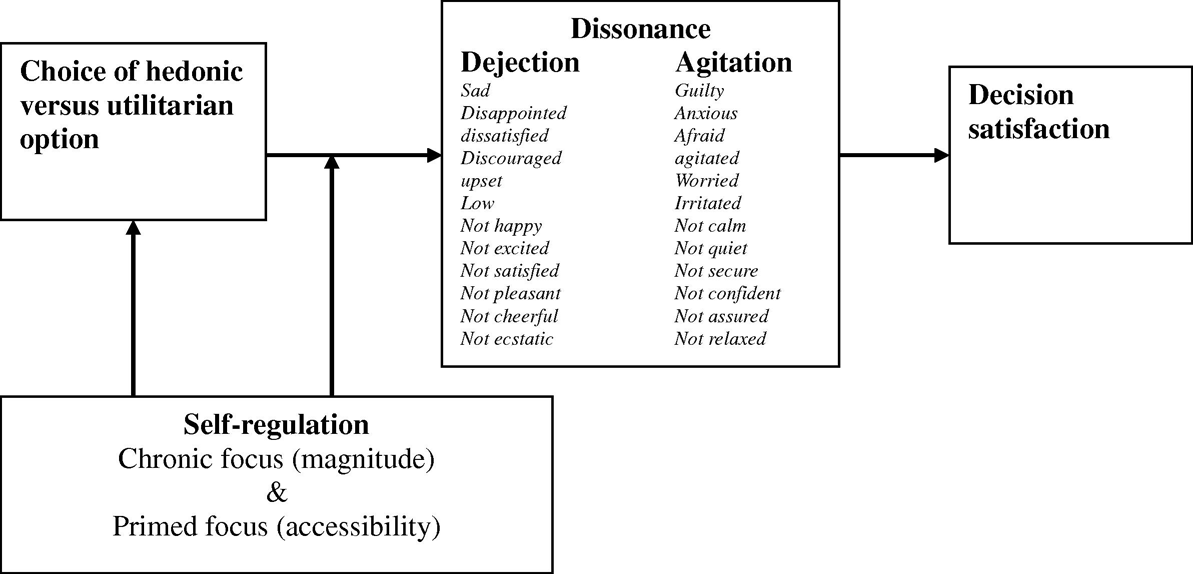
Self-regulation, choice and post-purchase affect.
Consumers are known to act in accordance with distinct self-regulatory strategies and needs (Higgins, 1987). Prominently featured in the literature are two types of self-regulatory orientations, which are termed promotion focused and prevention focused. Promotion focused individuals centre their thinking on ideals reflected through their hopes, aspirations or wishes (Higgins et al., 1994). Prevention focused individuals centre their thinking on oughts reflected through their duties, obligations or responsibilities (Higgins et al., 1994).
Based on the self-discrepancy theory (Higgins et al., 1986), there are three distinct facets of the self or self-images: the actual self, the hopeful, ideal self, and the dutiful, ought self. Each domain of the self represent a set of attributes that the person believes he/she actually possess, would like to possess, or ought to possess. Higgins, Bond, Klein and Strauman (Higgins et al., 1986) argued that people are motivated to reach a condition where their actual state matches their ideal and oughts states. Specifically, matches between actual and ideal selves tap into a chronic promotion orientation and matches between actual and ought selves tap into a chronic prevention (Higgins et al., 2001; Pham and Avnet, 2004). In this research we consider the role of magnitude and accessibility of promotion versus prevention focus in relation to choice and post-choice dissonance (see Fig. 1). Magnitude of promotion versus prevention refers to the matches between the actual self-state and each of the self-state guides (ideal self and ought self) (Higgins et al., 1986). Accessibility means whether ideals are more accessible than oughts or vice versa. Given that ideals and oughts co-exist in a consumer, priming techniques can be used to manipulate accessibility of ideals versus oughts (Pham and Avnet, 2004).
Several lines of arguments would suggest that promotion versus prevention focused individuals should prefer hedonic versus utilitarian attributes in decision making. First, Chernev (Chernev, 2004) found that in a binary choice context, individuals with a predominant promotion focus gave excessive emphasis to hedonic, performance-related and attractive attributes, whereas utilitarian, reliability-based and unattractive attributes were given undue weight by individuals with a predominant prevention focus. In a similar vein, Pham and Avnet (Pham and Avnet, 2004) demonstrated that when given a print advertisement about a dictionary, consumers whose ideals were primed relied on affective information of the advertisement (e.g. attractive versus unattractive layout), whereas consumers whose oughts were primed focused on substantive information of the advertisement (e.g. weak versus strong claims). Finally, researchers argue that trade-offs between hedonic and functional attributes are essentially trade-offs between valued goals these attributes help attain. Research found that choosing the hedonically superior alternative helped attain promotion goals, whereas choosing the functionally superior alternative helped attain prevention goals (Chernev, 2004; Chitturi et al., 2007). Building on prior research we posit the following hypotheses:
How self-regulatory focus moderates post-choice dissonance
Negative emotions can be evoked when individuals fail to obtain their goals and desires (Luce et al., 1997, 2001). The self-discrepancy theory (Higgins et al., 1986), for example, proposes that dejection emotions are evoked when individuals fail to strive for a congruency between their actual self and their ideal self. Although dejection represents a broad range of emotions, prior research tested only sadness and disappointment as consequences of unfulfilled ideals. For example Chitturi et al. (2007) found that individuals reported feeling sad and disappointed when trading hedonic attributes for utilitarian ones. Dejection, by definition, describes a psychological state that is sad, unmotivated and dissatisfied (Higgins et al., 1986). Thus in this research we examine twelve dejection-related emotions, including six negative emotions (sad, disappointed, low, blue, dissatisfied, discouraged) and six positive emotions (happy, excited, satisfied, pleasant, cheerful, ecstatic).
Dissonance research in the marketing domain has largely ignored consumer differences in their vulnerability to emotional discomfort aroused subsequent to decision making. For this reason, this research seeks to examine consumer differences in reporting their feelings after hedonic versus functional trade-offs. Higgins et al. (1986) argue that individuals high (versus low) in promotion focus are more vulnerable to dejection emotions. Following Higgins et al. (1986), it is expected that trading hedonic attributes for utilitarian ones evokes dejection emotions, especially for consumers with a predominant promotion focus. Thus the following hypotheses:
The self-discrepancy theory (Higgins et al., 1986) proposes that agitation emotions are evoked when individuals are failing to strive for a congruency between their actual self and their ought self. Although agitation represents a broad range of emotions, prior research tested only guilt and anxiety as consequences of unfulfilled oughts. For example, Chitturi et al. (2007) found that individuals reported feeling guilty and anxious when trading utilitarian attributes for hedonic attributes. Agitation, by definition, describes a frightened, threatened, and nervous state of an individual (Higgins et al., 1986). Thus in this research we examine twelve agitation-related emotions, including six negative emotions (guilty, anxious, fearful, afraid, agitated, desperate) and six positive emotions (calm, quiet, secure, confident, assured, relaxed).
Next we examine the moderating role of self-regulatory focus on post-choice agitation emotions. Higgins et al. (1986) argue that consumers high (versus low) in prevention focus are more vulnerable to agitation emotions. Following Higgins et al. (1986), it is expected that trading utilitarian attributes for hedonic ones evokes agitation emotions, especially for consumers with a predominant prevention focus. Thus the following hypotheses:
How dejection versus agitation emotions influence decision satisfaction
While most prior research focused on consumer product satisfaction (Mao and Oppewal, 2010) and consumer retailer satisfaction (Hunt, 1970), this research focuses on consumer decision satisfaction. Fitzsimons et al. (1997) argue that “consumers also form satisfaction judgements concerning the decision making process they experience before product purchase” (p. 2). Empirical research shows that decision satisfaction leads to consumption satisfaction and positively influences post-choice behaviour such as loyalty, word-of-mouth and willingness to recommend (Heitmann et al., 2007).
It is well established in the literature that post-choice dissonance and satisfaction are two distinct constructs with dissonance being an important antecedent of satisfaction (Sweeney et al., 1996). Sweeney et al. (2000) separated the construct of dissonance into a cognitive component (retrospection of the wisdom of purchase) and an emotional component (psychological discomfort). More importantly, recent research (Mao and Oppewal, 2010; Gelbrich, 2009) shows that it is the emotional component of dissonance (e.g. anger and helplessness) that influences consumer satisfaction. We argue that post-choice dejection and agitation emotions should negatively influence decision satisfaction. Thus the following hypothesis:
Research method
Subjects and design
Chinese consumers were the primary interest of this research. Compared to more than 50-year's intensive research on Western consumerism, relatively little is known about Chinese consumers’ choice and post-choice behaviour (Ouyang et al., 2000). To the best of our knowledge, this research is the first to apply concepts of self-regulatory focus, hedonic versus functional trade-offs, post-choice dissonance, and decision satisfaction in the context of Chinese consumers.
One hundred and thirty-five undergraduates were recruited from a north eastern university of China. To fulfil the research purposes we adopted an experimental survey design. Subjects were asked to fill out a measure of self-regulatory focus a few weeks before the experimental survey. Of the 135 subjects who were in invited to participate in this research, 120 completed the measure of ideals and oughts. The 120 subjects also provided their contact details when asked whether they were willing to be contacted for future university research. Four weeks later, the 120 subjects were invited to complete either a “hopes and goals” survey or a “duties and obligations” survey. The assignment of the 120 subjects into the two priming conditions was random. Of these, 112 completed and returned their experimental surveys; specifically, 57 had filled out the “hopes and goals” survey and 55 had filled out the “duties and obligations” survey. Only the results for these 112 subjects are reported.
Procedure and measures in self-regulation survey
The measure of chronic ideals and oughts was adopted from Higgins et al. (1986). Operationally we used a checklist of personality traits from which subjects selected 10 attributes associated with their different self-states. The checklist was based on Block's (Block, 1978) Q set. Zentner and Renaud (2007) adapted Block's (Block, 1978) Q set for the adolescent population. We used Zentner and Renaud's (2007) Q set and adapted it for our purposes. After a pilot study with 10 undergraduate students, we removed 6 original items that the pilot sample indicated they could not comprehend or were struggling to comprehend. We then added 4 new items that the pilot sample indicated were of particular significance to them, including honest, loyal, faithful, and materialistic, money-oriented. The final checklist contains 76 personality traits/attributes and is displayed in the Appendix. When the measure of self-regulatory focus was administered, the 135 research subjects were instructed that they should select attributes only from this checklist to describe each type of the person they think that they actually, ideally, and ought to be. Specifically, the subjects were instructed to select 10 attributes they actually possess, 10 attributes they would like ideally to possess, and 10 attributes they believe they should or ought to posses.
Data analysis was based on the two-stage process proposed by Higgins et al. (1986). First, the actual self-state (10 attributes) was compared to each of the self-state guides (10 attributes for the ideal self and 10 attributes for the ought self) to determine which attributes matched (including synonyms) and which mismatched (including antonyms). Second, the ideal (or ought) score was calculated by subtracting the total number of mismatches from the total number of matches. Using this procedure we obtained an ideal score and an ought score for each subject.
Procedure and measures
The second survey was the experimental survey where subjects were primed with ideals versus oughts before they were presented with a choice decision between a hedonic option and a utilitarian option. The priming condition was coded as 1=ideals priming and 2=oughts priming. After choice, subjects indicated the types of emotions they had experienced on the basis of their choice and their decision satisfaction.
For the priming manipulation we used two separate tasks to prime the relative accessibility of ideals versus oughts. First, subjects were asked to write down either their hopes and goals (ideals) or their duties and obligations (oughts). Pham and Avnet (2004) demonstrate that the former manipulation is likely to prime a promotion orientation, whereas the latter manipulation is likely to prime a prevention orientation. Next, subjects were asked to complete a mouse & maze exercise (Chernev, 2004). In the ideals priming condition, a mouse was depicted trying to get to the centre of the maze where there was a big wedge of cheese. Subjects were instructed to guide the mouse through the maze toward the cheese. The outcome of this process is the activation of promotion orientation of moving towards success and gains (Chernev, 2004). In the oughts priming condition, a mouse was depicted running for her life from a cat. Subjects were instructed to guide the mouse through the maze, away from the cat, toward the mouse hole. The outcome of this process is the activation of prevention orientation of avoiding danger and losses (Chernev, 2004).
Upon completion of the priming task, subjects were presented with a binary choice scenario where they decided between two alternatives, one of which was superior on a utilitarian attribute and the other was superior on a hedonic attribute. We used an apartment renting decision scenario because it was used by previous research with undergraduate students (Dhar and Wertenbroch, 2000). The two alternatives were apartments defined by distance to work (10-min walk versus 50-min drive) and view (view of a large construction site versus breathtaking view of sunset and city skyline). Apartment One was superior on the hedonic dimension (coded as 1), and Apartment Two was superior on the utilitarian dimension (coded as 2). Dhar and Wertenbroch (Dhar and Wertenbroch, 2000) found that the two attributes differed in hedonic and utilitarian contents and were perceived as equally important for consumers (undergraduates) in renting.
Next, we used a checklist of emotions (Higgins et al., 1986) to gauge subjects’ emotional responses toward the choice decision. Subjects were given a list of positive and negative emotional adjectives from which they were asked to select at least five that best described their feelings about the choices they had made. Of the emotions listed, 12 were dejection-related (sad, excited, disappointed, cheerful, low, ecstatic, happy, discouraged, satisfied, upset, pleasant, dissatisfied) and 12 were agitation-related (calm, secure, agitated, confident, desperate, relaxed, guilty, afraid, quiet, anxious, assured, irritated). The positive emotions were scored 1 if not checked and the negative emotions were scored 1 if checked. Thus higher scores indicated greater discomfort (Higgins et al., 1986). This process allowed us to obtain a dejection score and an agitation score for each subject.
Finally, subjects answered three questions regarding their decision satisfaction. Based on the work of Fitzsimons et al. (1997) and Heitmann et al. (2007), the three measurement items tapped into decision satisfaction, including “I found the process of deciding which apartment to choose frustrating”, “I found the process of deciding which apartment to choose interesting” and “I was satisfied with my experience of deciding which apartment option to choose”. Subjects answered all three questions on seven-point scales from 1=strongly disagree to 7=strongly agree. During data analysis, the negatively worded decision satisfaction item was reverse coded. Responses were then averaged into a single decision satisfaction index ranging from 1 (least satisfied) to 7 (most satisfied).
Results
Preliminary analysis
Table 1 shows the descriptive statistics of the variables used in this research. Preliminary analysis revealed that ideal scores measuring the magnitude of promotion focus and ought scores measuring the magnitude of prevention focus were positively correlated (r= .369, p<.001). In addition, subjects’ ought scores were significantly higher than their ideal scores (t=4.616, p<.001), indicating that Chinese consumers were more attuned towards prevention focus than they were towards promotion focus.
Descriptive statistics of variables used in this research.
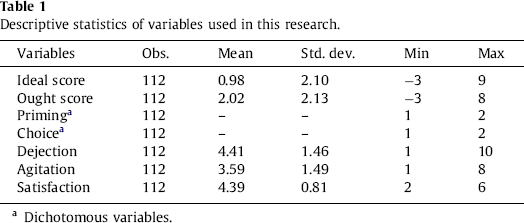
Descriptive statistics of variables used in this research.
Dichotomous variables.
We used logistic regression to examine whether self-regulatory focus influences consumer choice between hedonic and utilitarian products. In Table 2 we included ideal score, ought score and accessibility of promotion versus prevention in one model to predict choice of the hedonically superior versus functionally superior apartment. The results revealed that accessibility (priming) had a significant impact on choice (β=1.304, x2=9.100, p<.01). Specifically, ideals primed subjects (coded as 1) were more likely to choose Apartment I (hedonic option coded as 1), whereas oughts primed subjects (coded as 2) were more likely to choose Apartment II (utilitarian option coded as 2). We also found that chronic ideals (β=−.449, x2=10.550, p<.01) and chronic oughts (β= .300, x2=5.634, p<.05) were both significant predictors of choice. Specifically, the greater the ideal (ought) score, the more likely the individual chose the hedonic (utilitarian) option in the binary choice set. The results provide evidence to support H1 and H2 that consumer preferences for hedonic versus utilitarian product are influenced by the predominant promotion versus prevention focus.
Logistic regression analysis of Hedonic versus utilitarian choice (H1 & H2).
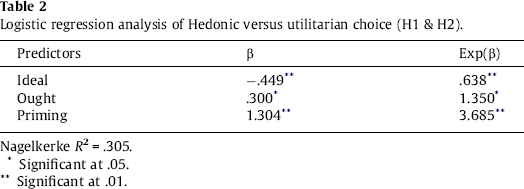
Logistic regression analysis of Hedonic versus utilitarian choice (H1 & H2).
Nagelkerke R
Significant at.05.
Significant at.01.
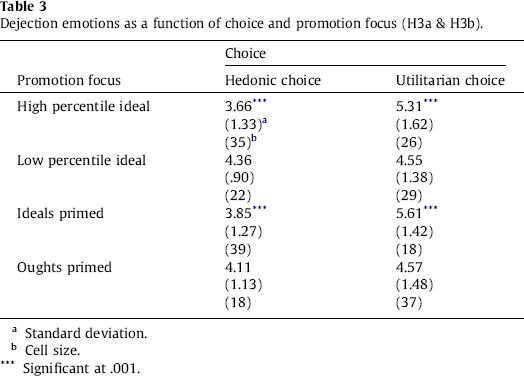
H3 predicted that dejection emotions are evoked by trading hedonic attributes for utilitarian ones, especially for promotion focused individuals. To test H3a, we first divided the 112 subjects into high and low promotion focus groups on the basis of a median split of their ideal scores. We then used the intensities of dejection as within-subject dependent measures and choice of apartments (1=hedonic alternative; 2=utilitarian alternative) and promotion orientation (1=low percentile group of ideals; 2=high percentile group of ideals) as between-subject predictors. Table 3 displays cells means for dejection emotions as a function of choice and promotion focus. As predicted, the results revealed a significant main effect of choice (F(1, 108)=12.695, p<.01) on dejection emotions. We found that dejection emotions were more intense among subjects who chose the utilitarian alternative (M=4.91) than among those who chose the hedonic alternative (M=3.93). A significant choice x promotion interaction effect also emerged for dejection (F(1, 108)=8.032, p<.01). Follow-up analyses revealed that subjects who were high (versus low) in promotion focus felt more dejected when they chose the utilitarian option (M=5.31) than when they chose the hedonic option (M=3.66, F((1, 59)=19.118, p<.001). Such patterns confirm the moderating role of promotion focus (high versus low magnitude) on post-choice dejection emotions (see Fig. 2(A)).
Dejection emotions as a function of choice and promotion focus (H3a & H3b).
Standard deviation.
Cell size.
Significant at.001.
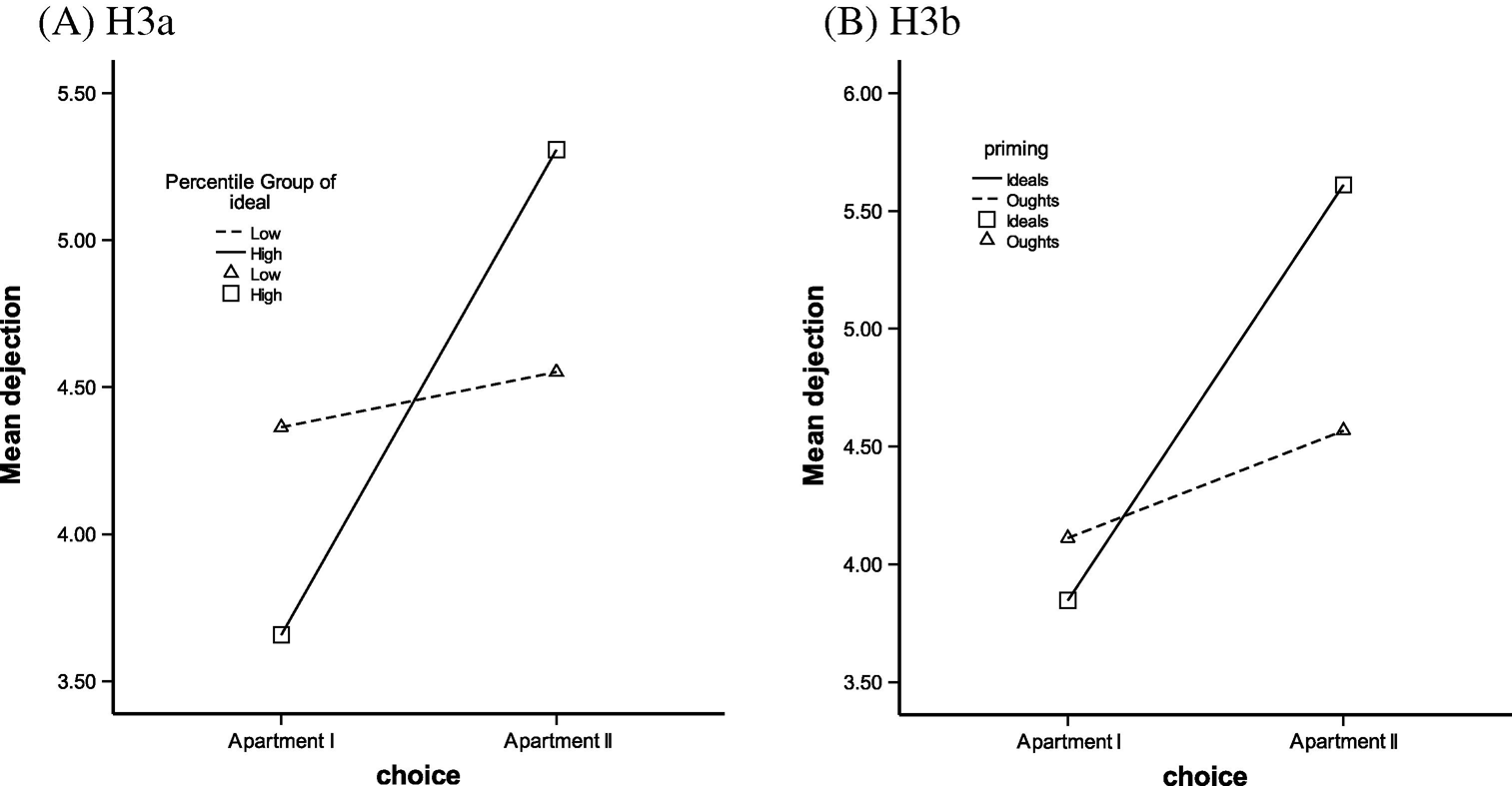
Promotion goal attainment and dejection emotions.
To test H3b, the intensities of dejection were used as within-subject dependent measures and choice of apartments (1=hedonic alternative; 2=utilitarian alternative) and priming (1=ideals; 2=oughts) were between-subject predictors. Table 3 displays cells means for dejection emotions as a function of choice and priming (ideals versus oughts). As predicted, the results revealed a significant main effect of choice (F(1, 108)=16.584, p<.001) and a significant choice x priming interaction effect (F(1, 108)=5.754, p<.05) on dejection emotions. Follow-up analyses revealed that subjects who were primed with ideals (versus oughts) felt more dejected when they chose the utilitarian option (M=5.61) than when they chose the hedonic option (M=3.85; F(1, 55)=22.128, p<.001). Such patterns confirm the moderating role of promotion focus (high versus low accessibility) on post-choice dejection emotions (see Fig. 2(B)).
H4 predicted that agitation emotions are evoked by trading utilitarian attributes for hedonic ones, especially for prevention focused individuals. To test H4a, we first divided the 112 subjects into high and low prevention orientation groups on the basis of a median split of their ought scores. Next the intensities of agitation were used as within-subject dependent measures and choice of apartments (1=hedonic alternative; 2=utilitarian alternative) and prevention orientation (1=low percentile group of oughts; 2=high percentile group of oughts) were between-subject predictors. Table 4 displays cell means for agitation emotions as a function of choice and prevention focus. As predicted, the results revealed a significant main effect of choice (F(1, 108)=25.323, p<.001) on agitation emotions. We found that agitation emotions were more intense among subjects who chose the hedonic alternative (M=4.25) than among those who chose the utilitarian alternative (M=2.91). Furthermore, a significant choice x prevention interaction effect emerged for agitation (F(1, 108)=30.922, p<.001). Follow-up analyses revealed that subjects who were high (versus low) in prevention focus felt more agitated when they chose the hedonic option (M=4.96) than when they chose the utilitarian choice (M=2.51, F(1, 62)=60.355, p<.001). Such patterns confirm the moderating role of prevention focus (high versus low magnitude) on post-choice agitation emotions (see Fig. 3(A)).
Agitation emotions as a function of choice and prevention focus (H4a & H4b).
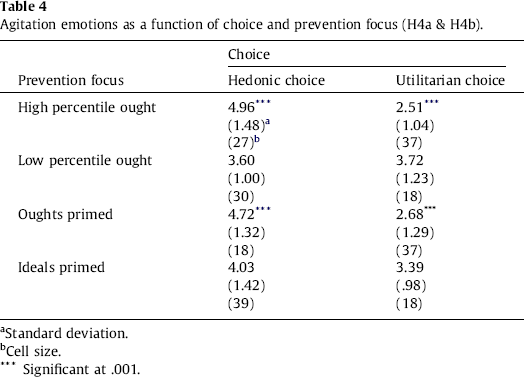
Standard deviation.
Cell size.
Significant at.001.
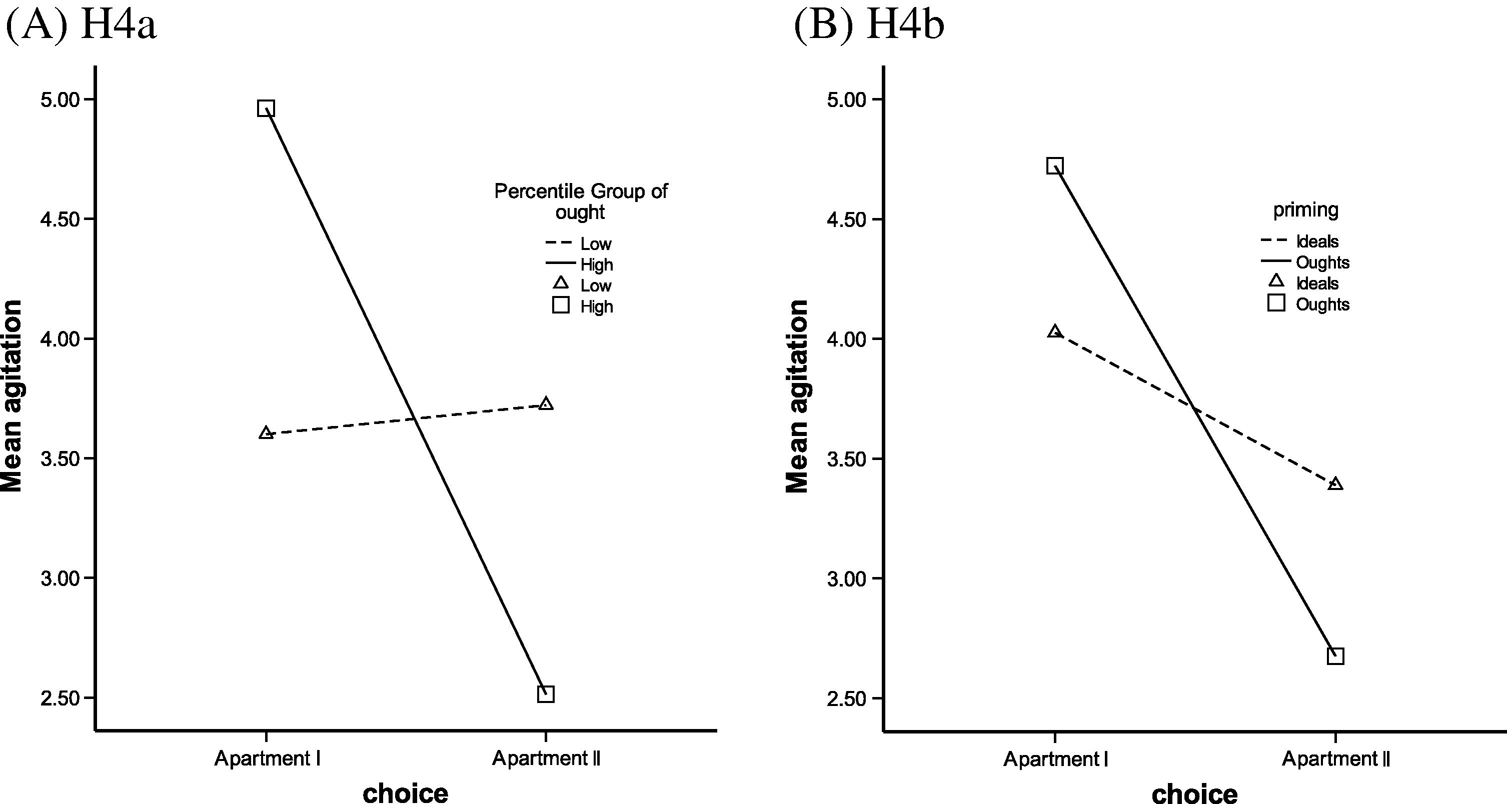
Prevention goal attainment and agitation emotions.
To test H4b, the intensities of agitation were used as within-subject dependent measures and choice of apartments (1=hedonic alternative; 2=utilitarian alternative) and priming (1=ideals; 2=oughts) were between-subject predictors. As predicted, the results revealed a significant main effect of choice (F(1, 108)=25.949, p<.001) and a significant choice x priming interaction effect on agitation emotions (F(1108)=7.163, p<.01). Follow-up analyses revealed that subjects who were primed with oughts (versus ideals) felt more agitated when they chose the hedonic option (M=4.72) than when they chose the utilitarian option (M=2.68, F(1, 53)=29.960, p<.001). Such patterns confirm the moderating role of prevention focus (high accessibility versus low) on post-choice agitation emotions (see Fig. 3(B)).
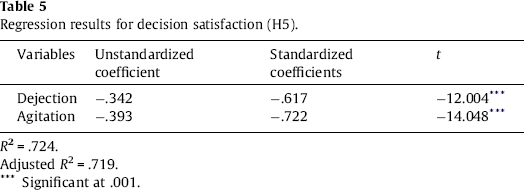
The final hypothesis (H5) predicted that psychological discomfort regarding choice negatively influences consumer decision satisfaction. Results of the regression analysis are displayed in Table 5. As predicted, the results revealed that dejection negatively affected decision satisfaction (β=−.342, p<.001) and agitation negatively affected decision satisfaction (β=−.393, p<.001). Thus as hypothesised, felt discomfort of choice negatively affected decision satisfaction.
Regression results for decision satisfaction (H5).
R
Adjusted R2= .719.
Significant at.001.
In the statistical analyses all hypothesised relationships regarding the theoretical framework (Fig. 1) were supported. This research confirms that self-regulatory goal attainment during decision making affects post-choice dissonance and decision satisfaction. Further, this research confirms the mediating role of dissonance between choice decision and decision satisfaction.
Prior research suggests that accessible ideals versus oughts alter consumer reliance on affect versus cognition in judgement and decision making (Chernev, 2004; Pham and Avnet, 2004). Our results complement prior research, showing that magnitude and accessibility of ideals versus oughts predict hedonic versus utilitarian choice. Our results suggest that goal attainment motivate consumer choice. In other words, consumers prefer the product that helps attain their predominant self-regulatory focus. Take apartment renting for example, prevention focused individuals should rely on attributes such as “security” and “distance to work”, whereas promotion focused individuals should focus on attributes such as “view” and “distance to the beach”.
Our research complements prior research (Chitturi et al., 2007) by taking into consideration different types and intensities of psychological discomfort aroused subsequent to choice. The emotional component of dissonance has been known as a “psychological uncomfortable state” (Festinger, 1957), being linked to 15 emotional items (Sweeney et al., 2000). Our research indicates that consumers are exposed to two general types of psychological discomfort, namely dejection and agitation. Further, our results confirms prior research (Higgins et al., 1986) that consumers are different in their vulnerability to psychological discomfort regarding choice, depending on the predominant self-regulatory focus. These findings have significant implications for marketers because it is the emotional component of dissonance that affects consumer satisfaction towards the firm and the product (Mao and Oppewal, 2010; Hunt, 1970). To enhance consumer satisfaction, marketers need to focus on effective dissonance reduction strategies. In doing so, marketers should first know which type of negative emotions they are coping with, agitation or dejection. Marketers can also benefit from the knowledge that promotion focused consumers are vulnerable to dejection emotions, whereas prevention focused consumers are vulnerable to agitation emotions.
In the marketing literature, researchers argue that dissonance reduction strategies should be used to enhance consumer satisfaction. For example, Hunt (1970) found that a reassurance letter from a store to customers after they had purchased a durable product, such as a refrigerator, resulted in a more favourable store image. Similarly, (Mao and Oppewal (2010) found that in service contexts, such as university education, choice reinforcement information effectively reduced dissonance and increased satisfaction. Our research shows that simply providing choice reinforcement regardless of choice-goal compatibility can be misleading, because reinforcing the choice incompatible with the predominant goal can only aggravate psychological discomfort. Our results have significant implications for marketers using reassurance letters to enhance their store image. These marketers need to consider consumer goal attainment (promotion versus promotion) in pre-choice, choice and post-choice stages of consumption. They need to decide when, for who and how to use hedonic attributes (versus utilitarian attributes) and affect-laden communications (versus reason-based communications) in different stages of consumption. In the long run, marketers can benefit from mass-customisation based on their in-depth understanding of their customers (Buttle, 2009).
Limitations and future research
Hedonic versus functional trade-offs are considered emotionally difficult decisions (Luce et al., 1997, 2001). To examine negative affect regarding choice, this research used experimental surveys with hypothetical decisions. The results, however, should be interpreted with care, because “constructs such as negative affect…are experienced differently when people are faced with decisions that have actual consequences rather than with hypothetical decisions in a lab settings” (Luce et al., 2001) as citied in Heitmann et al. (2007) (p. 238). Thus future research should gather data from actual buyers in real settings. Okada (Okada, 2005), for example, observed customers’ choices of desserts (hedonic versus utilitarian) at different times in a restaurant.
In this research we did not measure dissonance as a latent construct. Instead, we measured dejection versus agitation emotions regarding choice. Measures used in this research were developed in a Western culture and were modified and applied in an Eastern culture. Our approach was based on the assumption that measures of ideals versus oughts, dejection versus agitation and decision satisfaction were not cultural sensitive. If the assumption is correct, the same results should be obtained when future research is conducted in different cultural contexts.
Conclusion
This research provides empirical evidence that hedonic versus functional trade-offs are emotion-laden decisions. We found that choice-goal compatibility reduces post-choice dissonance which, in turn, increases decision satisfaction. This research echoes a growing body of evidence (Chernev, 2004; Pham and Avnet, 2004) suggesting that consumers may follow different paths to respond to a decision task depending on the content of their accessible goals. Further, this research confirms and extends prominent research, demonstrating goal-compatible behaviour (Chernev, 2004) and confirming that consumer goals are “the most motivational aspects relevant to decision making” (Bettman et al., 1998) (p. 192).
Footnotes
Appendix
The personality checklist.