







Abstract
Although youth smokefree campaigns have featured several themes, recent evidence suggests a norms-based approach that demonstrates the negative social consequences of smoking is most effective. The “Smoking – Not Our Future” campaign drew on both social identity theory and stereotype priming theory, and used youth role models to promote smokefree attitudes and behaviours among adolescent and young adult New Zealanders. Findings from the campaign evaluation suggest it strongly reinforced non-smokers, though had less effect on current smokers. We suggest future youth-oriented campaigns could employ stronger negative social consequences to target committed youth smokers, whose smoking-related attitudes and behaviour are more intractable.
Introduction
Internationally, smoking is the leading cause of preventable morbidity and mortality (Centers for Disease Control and Prevention, 2009) and even tobacco companies now recognise that smoking causes several serious and often fatal health problems (British American Tobacco, 2009a,b). Yet although widespread general awareness of harms caused by smoking now exists, each year many young people experiment with tobacco, become addicted to nicotine, and struggle to return to a smokefree lifestyle (Biener and Albers, 2004).
Continued smoking initiation rates have caused concern as recent data suggest smoking prevalence among young people is higher than among other population groups. For example, the 2006 NZ Census showed that, while regular smoking among 15-year-olds was 10% among females and 7% among males, this doubled to 19% among 15–19-year-olds and tripled to 30% among 20–24-year-olds. Thus, while smoking among younger teenagers has decreased, an increasing proportion (above half) of smoking uptake in New Zealand now occurs among 16–24-year-olds (MoH, 2008). Australian data show very similar patterns; in 2005, among 15-year-olds, overall smoking prevalence was 12%, but 2007 figures show this had escalated to 30% among males and 26% among females within the 25–29 age group (Scollo and Winstanley, 2010).
Several factors may explain why smoking initiation continues among young people. Despite restrictions on tobacco advertising and sponsorship, the tobacco industry has maintained other communication media that still reach both current and potential smokers (Freeman and Chapman, 2008; Hoek, 2004; Sepe and Glantz, 2002). Vehicles used include product placement that locates smoking in evocative contexts (Glantz et al., 2004); retail point-of-sale displays that heighten the salience of smoking (Paynter et al., 2009); branding, which conveys attractive and aspirational imagery to youth (Freeman et al., 2008), and social media, which have wide reach among youth (Freeman and Chapman, 2010). Collectively, these marketing activities pair smoking with desirable connotations, imply that smoking is still a widely practised behaviour, and raise doubts about its longer term health consequences (Biener and Albers, 2004).
Regulatory responses to tobacco marketing
Regulators have responded to the tobacco industry's continued marketing by attempting to de-normalise smoking. They have taken three approaches; first, they have introduced environmental changes, such as reducing the spaces where smoking may occur by designating these smokefree. The introduction of smokefree bars and restaurants in both Australia and New Zealand, and the decision by some Australian states to require cars carrying people aged less than 16 to be smokefree illustrate this policy direction (Edwards et al., 2008; Government of South Australia, 2007). These approaches explicitly acknowledge the toxicity of tobacco smoke and reduce non-smokers’ exposure to second-hand smoke in enclosed spaces.
The second policy option has restricted marketing options that remain open to tobacco manufacturers. Measures include the removal of tobacco retail displays, as several studies have found these enhance the salience of smoking, suggest smoking is “normal”, and increase non-smokers’ susceptibility to smoking experimentation (Paynter et al., 2009; Wakefield et al., 2006). Removing tobacco retail displays not only eliminates the implication that tobacco is a normal product, but it changes the ecological design of stores and means confectionary items can no longer be used to create a visual frame for tobacco products.
While the introduction of graphic health warnings (GHWs) was designed less to restrict marketing opportunities than to promote knowledge of smoking's harmful effects, GHWs also disrupt tobacco branding. By deflecting attention from brand imagery GHWs question the connotations this creates and help prevent the positive associations created by brand livery being transferred to smoking. Plain or generic packaging would further reduce the power of packaging to promote smoking and is the subject of current policy debate (Anonymous, 2010; Department of Health, 2008; Freeman et al., 2008).
Both these approaches – increasing smokefree areas and reducing or disrupting the marketing opportunities still available to the tobacco industry – require regulatory intervention. However, although policy initiatives may bring about dramatic environmental change, introducing new regulations is often a long and complex process as it requires extensive consultation and may result in legal challenges, both of which may be expensive and time-consuming (Pollay, 2004). Smokefree campaigns represent an alternative means of addressing residual tobacco marketing and promote smokefree behaviours as desirable and appropriate. More specifically, they attempt to develop new social norms that are not compatible with smoking, and create a climate that is more receptive to new regulatory proposals (Chapman and Freeman, 2008).
Social marketing challenges to tobacco marketing
Social marketing responses to smoking have targeted several groups and recognised that each of these uses smoking to achieve varied ends. Programmes that target youth are an important component of comprehensive tobacco control strategies, though the success of these programmes has varied greatly (Schar et al., 2006). For example, campaigns developed by the tobacco industry, such as Philip Morris’ “Think, Don't Smoke” campaign, which suggested smoking was for adults, do not appear to have promoted smokefree behaviours (Sebrié and Glantz, 2007). While ostensibly designed to prevent young people from smoking, campaigns describing smoking as an adult behaviour appeared instead to suggest it was a “forbidden fruit”. Research evaluating industry anti-smoking campaigns criticised these for promoting smoking as a mature (and thus desirable) behaviour (Landman et al., 2002; Pollay, 2000; Wakefield et al., 2006), reducing perceptions of its harmfulness (Wakefield et al., 2006), and employing messages that lacked credibility (Pechmann et al., 2003). Furthermore, these activities enabled tobacco manufacturers to argue that government regulation of their industry was not required, since they had voluntarily engaged in socially responsible behaviour (Wakefield et al., 2006).
Although de-normalisation programmes undertaken by health agencies have taken quite different approaches, there is on-going debate over the most effective message to use in smokefree promotions for youth and young adults. Goldberg and Glantz reported that industry manipulation and second-hand smoke themes were highly effective and short term (adverse social) effects were moderately effective with youth (Goldberg and Glantz, 1998). However, Biener et al. recommended emphasising the serious health consequences of smoking (Biener et al., 2002; Murphy-Hoefer and Higbee, 2009), although recent studies suggest young people find health messages lack salience (Hammond, 2005).
In an attempt to reconcile the conflicting findings that were emerging and ensure these were not due to methodological variations, Pechmann et al. tested adolescents’ response to alternative smokefree messages (Pechmann et al., 2003). These included death and disease, posing danger to others, negative cosmetic changes, negative social consequences, positive refusal skills, resistance to marketing tactics, industry manipulation, and a combination of the above messages. Three themes (posing danger to others, negative social consequences, and positive refusal skills) significantly increased respondents’ intention not to smoke relative to a control message. As a result, Pechmann et al. recommended that smokefree campaigns employ norm-based appeals, particularly those that emphasised the social unacceptability of smoking (Song and Glantz, 2008).
Some social marketers have responded to these findings by drawing on social identity theory to recognise the interaction between tobacco brands and young smokers’ construction of their public persona. Campaigns such as “Truth” de-normalise the tobacco industry, expose identities that young people find neither appealing nor aspirational, and thus reduce the fashionable connotations linked to smoking. However, other approaches use role models who young people emulate and hold them up as examples of desirable smokefree lifestyles. Campaigns based on this reasoning recognise the social and psychological benefits smokers derive from smoking and offer alternative identities.
The following section examines social identity theory and develops the theoretical background that informed a major youth smokefree campaign: Smoking – Not Our Future, which was designed to promote smokefree behaviours and identities among New Zealanders aged 12–24years (Health Sponsorship Council, 2008). This demographic is deliberately broad and recognises the important transitions young people make during adolescence and early adulthood as these represent points at which social identities may change, and where smokefree behaviours may be introduced or reinforced.
Social identity theory
Amos et al. discussed the “important, if complex, relationship between the image of smoking and the images that young people hold of themselves and to which they aspire” (Amos et al., 1997) (p. 848). Their comments highlight the role smoking imagery can play in shaping identity and suggest social identity theory provides an appropriate framework to develop and review smokefree youth initiatives. The remainder of this section explores social identity theory, particularly the importance of group alignment, the fluidity of group membership, and the link between social identity and stereotype priming theory.
Social identity theory considers how individuals see themselves as both a collection of personal attributes and as members of wider social groups (Taifel and Turner, 1979). Depending on the specific circumstances, individuals may focus more on their personal norms and less on the group's views, and vice versa (Kobus, 2003). This theory posits that individuals adopt behaviours and attitudes to align with the group's norms; as Kobus noted:
“where status as a ‘smoker’ or ‘non-smoker’ is central to the social identity of the group, members of the group are likely to be similar to one another in their smoking habits” (p. 40) (Kobus, 2003).
However, adoption of group norms is not a blind act of faith; instead, it recognises the important role social relationships play in contributing to individuals’ sense of identity, particularly the dialectic between personal and social identity. Moffat and Johnson had earlier noted the importance of image development to adolescents and suggested smoking created opportunities to test and review membership of different groups (Moffat and Johnson, 2001). Group relationships are especially important to young people and may explain why youth smokers often describe themselves as “social smokers” and believe they are not addicted to smoking (Moffat and Johnson, 2001). Social identity theory thus suggests smoking enables youth smokers to identify and bond with a group, and differentiate themselves from other groups (Fry et al., 2008; Stewart-Knox et al., 2005).
Pierce et al. (1996) developed and validated a smoking susceptibility scale that enables researchers to classify individuals according to their smoking (or smokefree) behaviours and identities. However, his three groups: dedicated non-smokers; susceptible non-smokers, and smokers (explained further in Section 5) are not static, which raises the possibility that group membership can be challenged or confirmed by external interventions. Haslam et al. (1999) re-iterated this point when they concluded that the socially-constructed identities derived from group membership were both relative in their importance and fluid in their status. Individuals may therefore find that their need to identify with a particular group, and their alignment with different groups, varies over time.
This reasoning implies individuals’ identities can be shaped by social influences that promote group comparisons, particularly if alternative groups offer more attractive membership benefits. Norms-based social marketing campaigns reflect this logic and prompt individuals to review their group membership, the commonalities and differences this reinforces, and whether membership of other groups might prove more rewarding.
Social identity theory aligns theoretically with stereotype priming theory (Pechmann, 2001; Pechmann et al., 2003), which suggests messages should increase the salience of positive stereotypes about people who follow the advocated behaviour pattern and heighten negative stereotypes about people who fail to do so (p. 193). Pechmann et al. (2003) suggested messages should stimulate recipients to consider: “If you behave in this way, what will others think of you, and how will you feel about yourself?” (p. 195). This question encourages reflection on behaviours that would strengthen or undermine group norms, and the value of group membership in fostering personal identity.
This theoretical framework is highly relevant to youth smokefree campaigns as it implies that smokefree promotions depicting smoking as physically and socially unattractive will promote a re-analysis of group membership where smoking is a unifying trait. Stereotype priming theory suggests smokefree promotions that challenge the perceived social status conferred by membership of a smoking group will stimulate recall of negative smoking stereotypes, consolidate less positive perceptions of smoking, and reinforce behaviours consistent with these.
The New Zealand “Smoking – Not Our Future” campaign drew on both social identity and stereotype priming theory to promote smokefree lifestyles as aspirational and desirable. The advertisements evoked negative stereotypes of smoking, promoted a positive smokefree stereotype, and fostered and reinforced positive smokefree attitudes (Health Sponsorship Council, 2008). Fig. 1 outlines the overall campaign strategy, which the Health Sponsorship Council plans to implement over time.
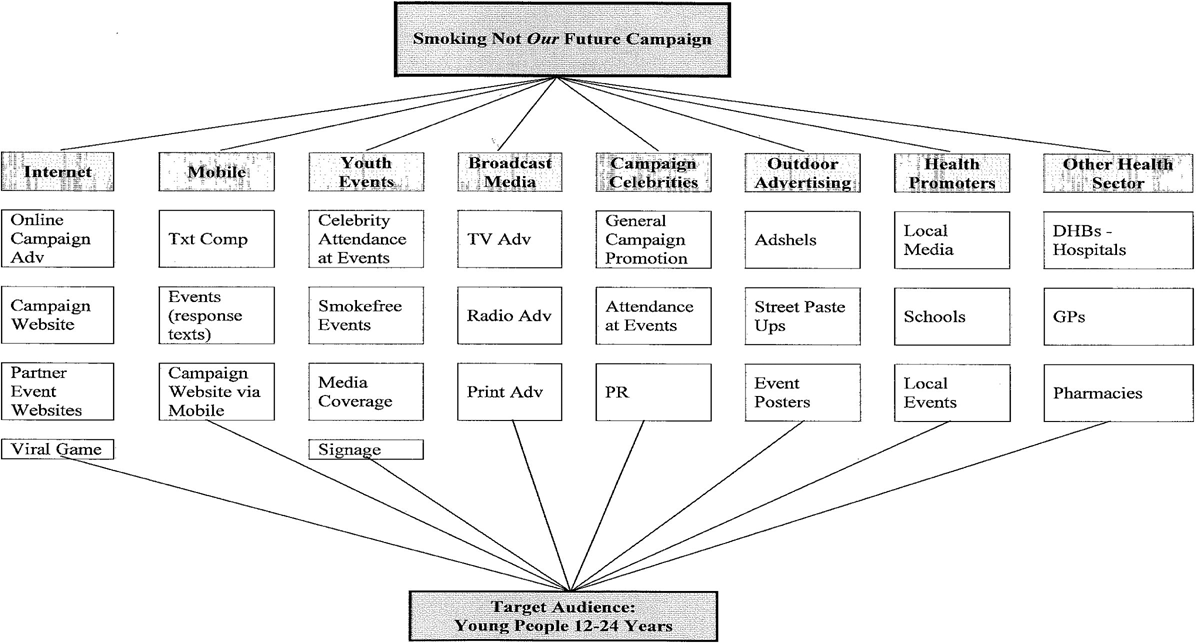
Campaign design.
Elements of the campaign implemented to date have used youth role models to challenge personal and social norms relating to smoking. The comments featured in advertisements were testimonials and therefore unscripted and authentic, and corresponded with several of the smokefree themes Pechmann and her colleagues reviewed. In addition, the campaign placed a particular emphasis on promoting individual and collective smokefree identities. Fig. 2 contains examples from the campaign.
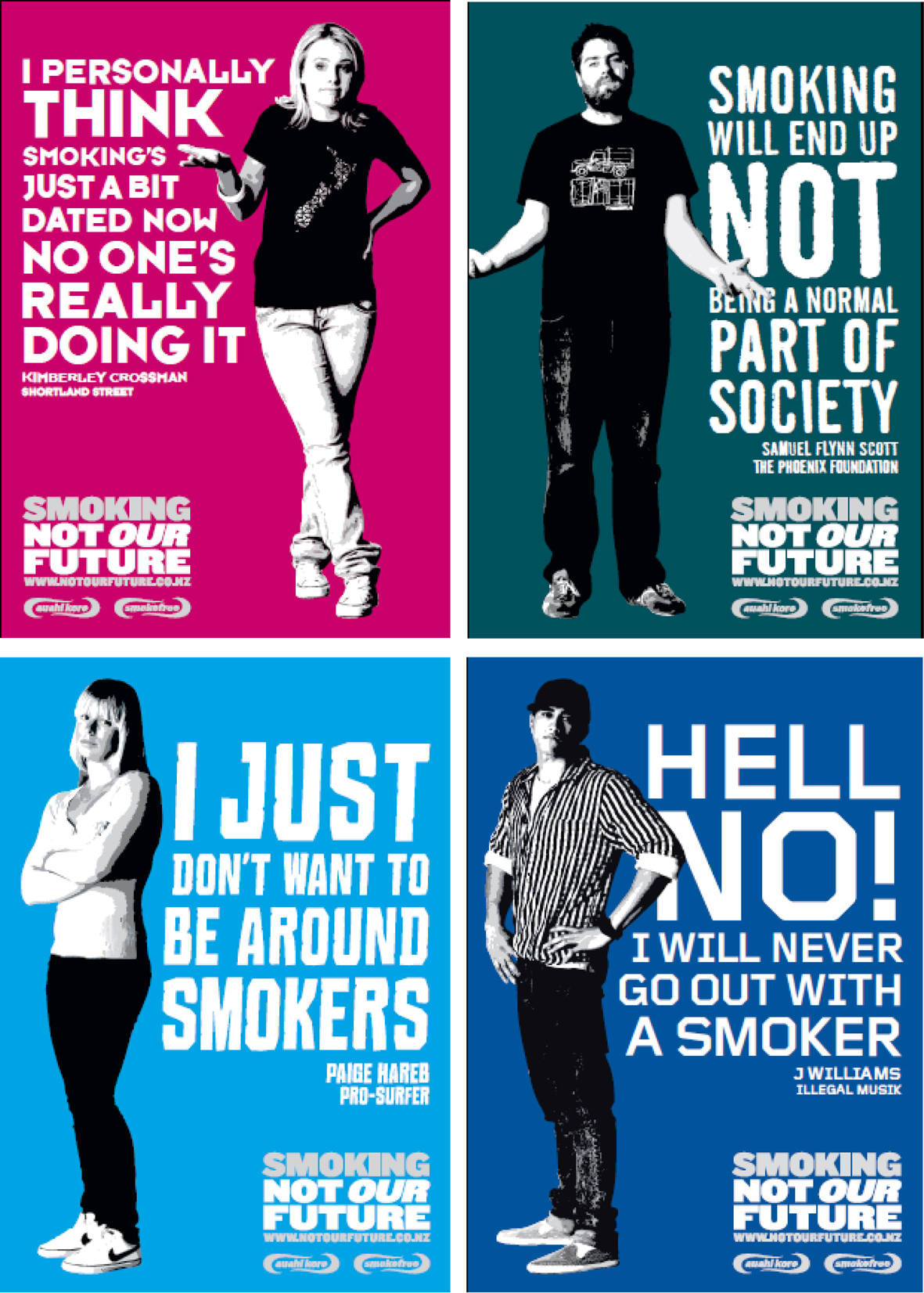
Examples of smoking – Not Our Future advertisements.
The campaign promoted smokefree lifestyles by reinforcing non-smokers, moving non-smokers who are susceptible to smoking experimentation closer to dedicated non-smokers, and prompting cessation attempts among smokers. Pierce et al.'s three groups, each corresponding to different smoking behaviours, illustrate the possible changes in group membership that could occur (Pierce et al., 1996). Dedicated non-smokers are resilient in their determination not to smoke and unlikely to smoke, even when their peers invite them to do so. Susceptible non-smokers are currently smokefree, but indicate they may either accept a cigarette in social situations or see themselves as smoking in the short-term future. The campaign communicated messages relevant to each group, but was particularly concerned to consolidate the smokefree status of susceptible non-smokers and move them along the smoking susceptibility continuum so they were more strongly aligned with dedicated non-smokers.
The youth role models featured in the campaign included non-smokers, smokers and ex-smokers to promote message credibility, particularly when challenging social identities based on smoking. All role models, including smokers, highlighted the negative social consequences of smoking and promoted smokefree social identities as desirable. As well as strengthening smokefree identities, the campaign also promoted cessation and encouraged support for quit attempts.
Although Pierce et al. conceived of smokers as a single group, social identity theory suggests they may differ in their commitment to smoking (Pierce et al., 1996). Reported quit attempts provide a measure of smokers’ desire to transition to a smokefree group and represent another criterion that may be used to explore group membership.
Research objectives
A campaign impact evaluation examined the messages communicated, explored engagement with these, and estimated their impact on the three smoking groups noted above. To test the effectiveness of the campaign, the research examined variables consistent with both social identity theory and stereotype priming theory, namely perceptions of smoking, relevance of the messages, and intended smoking behaviour. The evaluation focussed on the television advertising, which comprised a substantial proportion of the media expenditure, and explored how respondents believed the messages had affected their attitudes and behaviour, and those of their peers.
We examined the overall hypothesis that responses to the campaign would vary according to young people's social identity and the importance of smoking within this. We were especially interested in susceptible non-smokers and surmised they would have more malleable perceptions of desirable social and personal identity in relation to smoking, would engage more with the campaign, and would be more responsive to it than current smokers. More specifically, we tested the following hypotheses:
Methodology
A telephone survey of 939 young people was undertaken in June and July 2008. The questionnaire examined respondents’ awareness of the ‘Smoking – Not Our Future’ advertisements, their perceptions of the messages communicated and the perceived impact of these. In line with social identity theory, outcome measures included generalised beliefs about and attitudes towards smoking, and intentions or behaviour measures in relation to smoking.
Of the initial sample, 796 respondents recalled the campaign and were classified using Pierce et al.'s validated smoking susceptibility scale into the three groups discussed above: non-susceptible non-smokers, susceptible non-smokers and current smokers (Pierce et al., 1996). The results reported below are based on this sub-sample, which was weighted by ethnicity, gender, and age to ensure it was representative of New Zealand's 12 to 24-year-old population.
Results
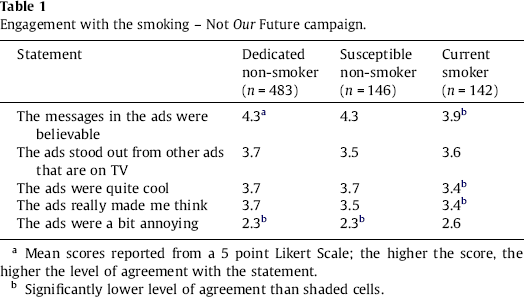
Respondents’ engagement with the campaign was estimated using 5-point Likert scales and enabled examination of the campaign's salience to participants’ personal and social norms. We had hypothesised that the campaign salience would decrease as respondents’ susceptibility to smoking increased. Table 1 contains the results of these analyses.
Engagement with the smoking – Not Our Future campaign.
Engagement with the smoking – Not Our Future campaign.
Mean scores reported from a 5 point Likert Scale; the higher the score, the higher the level of agreement with the statement.
Significantly lower level of agreement than shaded cells.
Table 1 supports the hypothesis that engagement with the campaign would decline as participants’ susceptibility to smoking or actual smoking behaviour increased. Both non-smoker groups were significantly more likely to see the messages as believable and cool, and were less likely to regard them as annoying. Dedicated non-smokers were also more likely than smokers to agree that the advertisements made them think. Overall, there was no difference in the groups’ view on whether the Smoking – Not Our Future advertisements stood out from other advertisements.
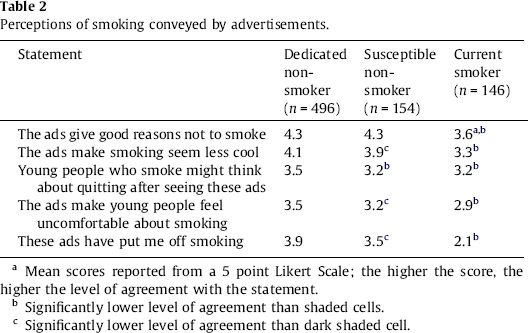
We next examined the impact of the advertisements and the relationship between respondents’ perceptions and their smoking status. Table 2 contains these results.
Perceptions of smoking conveyed by advertisements.
Mean scores reported from a 5 point Likert Scale; the higher the score, the higher the level of agreement with the statement.
Significantly lower level of agreement than shaded cells.
Significantly lower level of agreement than dark shaded cell.
Table 2 shows that, as hypothesised, the impact of the advertisement varied strongly according to respondents’ smoking status. Current smokers had consistently lower impact scores and weaker perceptions than either of the non-smoker groups; in nearly all cases these differences were significant. Clear differences also emerged between susceptible and dedicated non-smokers, with the former giving significantly lower scores than dedicated non-smokers for three of the five statements.
More specifically, all groups agreed the advertisements provided good reasons not to smoke, although current smokers were significantly less likely to agree that the advertisements made smoking appear “less cool” and dedicated non-smokers were significantly more likely to agree with this statement. Participants weakly agreed that the advertising would make young people who smoke think about quitting, although dedicated non-smokers were significantly more likely to agree with this statement. Agreement over whether the advertisements would make young people feel uncomfortable about smoking varied in relation to smoking status, with significant differences evident between each group. The sharpest differences emerged in response to the final statement: current smokers disagreed that the advertisements had put them off smoking, while both non-smoking groups agreed with this statement.
To examine the final research hypothesis, we used ANOVA to compare responses from the 223 smokers who had and had not made a quit attempt in the last 12months. Table 3 contains these responses.
Perceptions of smoking by quit attempt status.
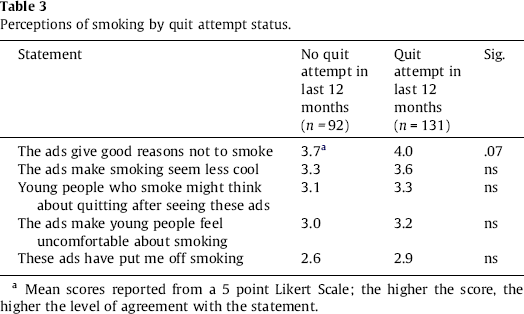
Mean scores reported from a 5 point Likert Scale; the higher the score, the higher the level of agreement with the statement.
Table 3 shows weak to moderate agreement with all statements except “these ads have put me off smoking”. Responses across the statements reveal a similar pattern: those who had made a recent quit attempt were consistently more likely to agree with the statements, particularly the suggestion that the advertisements had given “good reasons not to smoke”. Although the individual level differences were not significant at p<.05, the likelihood that this pattern of results arose from chance was very small.
While neither group agreed that the advertising had put them off smoking, those who had made a recent quit attempt were more likely to agree that the advertisements had made them think they should try to quit smoking (77% cf. 40%, p<.001), led them to quit smoking (48% cf. 18%, p<.09), and led others they knew to quit smoking (53% cf. 29%, p<.001).
Social identity theory suggests respondents’ behaviour offers insights into the social groups with which they affiliate and provides a logical basis for examining responses to a norms-based social marketing campaign. The results support each of the hypotheses as respondents’ engagement with the campaign and the impact this had on them varied with their smoking status. The campaign reinforced smokefree norms and consolidated identities linked to these among both non-smoking groups.
Predictably, current smokers’ responses to the campaign were less positive, although smokers who had recently made a quit attempt were more positive than those who had not. While this finding requires replication, it suggests the campaign may support those who are already trying to relinquish their identity as smokers. However, it is important to note that the estimates of quit attempts are self-reported rather than actual behaviour. Nevertheless, the differences between those who had made a quit attempt and those who had not were sufficiently large to suggest advertising that challenges the benefits of a smoking identity supports cessation attempts amongst young people who are re-considering their smoking status. However, those whose identity as a smoker was stronger and who had not recently attempted to quit were less responsive to the advertising, and different measures may be required to modify their behaviour.
Stereotype priming theory also affords some insight into these findings; it suggests that role models representing smokefree stereotypes may evoke and reinforce existing smokefree perceptions and consolidating smokefree identities rather than change perceptions held by established smokers or prompt them to consider smokefree identities. This raises important questions about the interventions that could be more effective at changing smokers’ identities and behaviours.
Pechmann suggested advertising that emphasised social risks may complement stereotype priming messages and recommended approaches such as more direct industry de-normalisation could also be used to reach hard-core youth smokers (Pechmann, 2001). Messages that highlight how smoking reduces physical and social attractiveness may also be more salient than medical warnings to young people.
As well as developing more youth-oriented smokefree messages, environmental changes, such as the removal of tobacco retail displays and the introduction of progressively higher excise tax on tobacco products, may also be required. These will reduce the accessibility and visibility of tobacco products as well as promote smokefree norms. Promoting cessation products and increasing the availability of these may also help create a climate more conducive to quitting. Developing strategies to reach less responsive youth smokers will require further research but should be an urgent priority, given the evidence that smoking rates among young people are higher than those among other age groups.
Future research questions could examine factors that maintain the normality of smoking; for example by assessing markers of de-normalisation discussed by Chapman and Freeman (2007). Detailed exploration of messages that would challenge these factors could draw on Pechmann et al.'s (2003) findings and examine whether more explicit negative social consequences would increase message salience and effectiveness, and reduce the benefits smoking identities appear to offer.
Conclusions
Smoking de-normalisation campaigns are an important means of reinforcing smokefree norms and the “Smoking – Not Our Future” campaign elicited stronger responses from non-smokers than from smokers. Importantly, susceptible non-smokers had more in common with non-susceptible non-smokers than with current smokers. This suggests that, by heightening the salience of smokefree lifestyles, de-normalisation campaigns may reduce the influence of environmental factors that increase some young people's propensity to become smokers. Stronger messages may be required to induce behaviour change among current youth smokers, particularly among those who have not made a recent quit attempt. In particular, initiatives removing factors that make smoking appear “cool” could reduce the ambiguity that still surrounds smoking for some young people, and would enable clearer communication of smokefree messages. Further research could test the most effective strategies for promoting quit attempts amongst committed youth smokers and explore how these could be integrated with de-normalisation campaigns to establish sustainable smokefree lifestyles as the aspirational norm for young people.
Footnotes
Acknowledgment
We would like to acknowledge Research New Zealand, which was contracted by the Health Sponsorship Council to collect the data used in this paper.