







Abstract
This paper develops and empirically tests a theoretical model integrating the predictors and consequences of relationship trust and commitment behaviour concerning consumer and B2B goods importers in an Asian developing market setting. A sample of 93 B2B and 139 consumer goods importers is used to test the model employing structural equation modelling. The results provide clear evidence that transaction-specific investment, environmental volatility and communication have varying impacts on trust and commitment and thus affecting international buyers’ relationships and their international exchange operations. The findings broaden and deepen our understanding of how consumer and B2B goods international exchange partners’ varying relationship outcomes can help reinforce their international relationships with foreign suppliers. These findings have strategic implications for maintaining effective relationships between B2B and consumer goods importers which are highlighted in this paper.
Keywords
Introduction
The purpose of this paper is to develop and test a research model that integrates the predictors and consequences of relationship trust and commitment behaviour of importers of consumer and business goods (B2B) in an Asian developing country setting. Over the last three decades research in the fields of international marketing and purchasing as well as industrial marketing and purchasing (IMP, 1982) have focused on international supplier–customer relations, apart from emphasising the buyer–seller interactions and relationship marketing paradigm (Ford and Håkansson, 2006; Wiley et al., 2005). In particular IMP research addressed a number of issues related to the relationship marketing paradigm especially in the context of buyer–seller interactions in industrial exchange settings at the national and cross-cultural level (Wiley et al., 2005).
The extant literature provides empirical evidence concerning exporters’ trust and commitment behaviours mostly in the context of economically developed countries (e.g., Abdul-Muhmin, 2002; Coote et al., 2003) focusing on buyer–seller relationships in the retail context. Relatively little research has been conducted on issues concerning international trade practices and importers’ perspectives (Johanson and Vahlne, 2006). Furthermore, studies examining the predictors of importer trust and commitment concerning consumer goods or B2B goods are limited. Interestingly, an extensive search of the international literature revealed that research has yet to compare consumer and industrial importer trust and commitment in any developed or emerging country. Therefore, this study has integrated some unique predictor variables of trust and commitment and their outcomes in a new research framework. In this paper, an attempt is made to compare the findings in terms of consumer and B2B importers’ perceptions in an Asian developing market. Testing the model is likely to produce evidence that will help refine, broaden and deepen our understanding of: firstly, the complexities and dynamics of the critical issues concerning consumer and B2B goods importers; and secondly, external suppliers’ relationships in an emerging market.
The rationale for the study
Most prior studies have examined the commitment of distributors who deal in consumer goods only (e.g., Jonsson and Zineldin, 2003; Morgan and Hunt, 1994; Ruyter et al., 2001) while others have investigated business distributors’ trust and commitment to their suppliers (e.g., Coote et al., 2003; Kim and Oh, 2002). However, the fact that earlier studies did not investigate the relationship behaviour of both consumer and business goods importers in a comparative setting has prompted this research. Numerous studies considered trust as both a predictor and outcome variable (e.g., Kwon and Suh, 2004; Rodríguez and Wilson, 2002) including export-related studies (e.g., Zhang et al., 2003). However, research on the behavioural aspects of importers has seldom considered this issue. The drivers of importers’ commitment and their consequences have been examined using the relational paradigm of the distributor–supplier relationship (Skarmeas et al., 2002) where trust could be included as an interacting variable.
In broadening our theoretical understanding of the predictors and outcomes of relationship trust and commitment, this study strives to integrate a comparative analysis and findings regarding importers of consumer and business goods in a developing economy. Research shows that importer trust in a foreign supplier is effective when suppliers are competent and provide relatively superior facilities, as opposed to opportunistic disposition in developing countries such as Bangladesh. This study is timely because Bangladesh is currently committed to liberalising its importation of consumer and business goods that will increase the nation's internal consumption. Sound research will contribute to enhancing importers’ knowledge of the relational complexities, dynamics and their impact in a developing country. Thus it is worthwhile exploring if there are any differences between the behaviour of importing firms in an Asian developing country and those in developed countries.
Literature review
The main purpose of the review of the extant literature is to develop a theoretical grounding and identify the antecedents and outcomes of importer trust and commitment. Numerous models integrating such a relationship paradigm have been reported in the international business literature. The examination, extension, and validation of relational theories are explicit in organisational science in general and inter-firm relationships in particular. Some examples of relevant theories include agency theory (Ross, 1973), transaction cost economics (Williamson, 1979), and network theory (Axelsson and Easton, 1991; Ford, 1990). Wilkinson and Young (2002) and Williamson (1979) raised some issues concerning communication, learning and knowledge generalisation, and opportunistic behaviours that are linked to trust and commitment in inter-organisational relationship structures. Some theories have gained momentum concerning trust and commitment and their consequences. These theories are considered relevant for the integrated model used in this paper. For example, transaction cost (TC) economics (Williamson, 1985) emerged as a mainstream theory and has been used extensively to examine inter-firm relationships (e.g., Geyskens et al., 1996; Morgan and Hunt, 1994). The theory asserts that there are human and environmental aspects where interpersonal behavioural domains and socio-cultural environmental diversity/changes affect international business relationships.
The trust and commitment theory (Morgan and Hunt, 1994) signifies that the parties’ abilities to judge circumstances rationally are affected by opportunism. Such an attitude leads to decreased trust and commitment in the relationship. Environmental volatility is an ingredient in a transacting party's proclivity to be opportunistic which is likely to occur if terms and clauses in a resulting contract are unspecified, thus leading to reduced commitment (Skarmeas et al., 2002). Of the large number of contextual factors that contribute to relationship success/failure, trust and commitment are central to a successful relationship outcome (Kim and Oh, 2002; Morgan and Hunt, 1994). Most of the above variables discussed in the relevant literature explaining the international distributors’ trust and commitment seem quite relevant. However, such literature appears to have overlooked or underestimated the potential comparative context of the commitment of business and consumer goods importers in developing countries.
While a number of antecedents and consequences of commitment have been examined using the Internationalisation Process (IP) theory from the exporters’ point of view, no study has yet used knowledge and experience as a potential predictor of importer commitment. Therefore, examining the effect of consumer and business goods importers’ knowledge and experience on their trust and commitment is likely to foster greater outcomes regarding the relationship issues discussed above (Ramasamy et al., 2006).
Numerous studies have investigated the predictors and/or outcome of business buyer/distributor trust/commitment (e.g., Coote et al., 2003; Kim and Oh, 2002; Ruyter et al., 2001). Some studies examined the commitment of distributors of consumer products (e.g., Morgan and Hunt, 1994; Skarmeas et al., 2002). The review also revealed that some studies addressed the distributor–supplier trust simultaneously (e.g., Ruyter et al., 2001; Siguaw et al., 1998). Other studies (Doney and Cannon, 1997; Selnes, 1998) investigating the antecedents and consequences of trust found mixed support for the relevant variables. Of the above studies, only Skarmeas et al. (2002) examined the drivers of importers’ commitment irrespective of the broad classifications of importers. The findings emerging from these studies suggest that trust and commitment are vital issues for exporters’ and importers’ positive relationship outcomes, including relationship quality and performance (Skarmeas and Robson, 2008). The importance of these issues in a B2B relationship is reflected in recent research addressing specific B2B situations (Berthon et al., 2008). These studies encapsulate the importer–exporter relationship and help ease task complexity, high uncertainty, and contractual rigidities – all influence long-term relationship success (Cullen et al., 2000). However, no follow-up studies appeared to have empirically tested the above mentioned new paradigm of importer in an Asian developing economy.
It should also be noted that there is no unanimity as to the predictors of trust and commitment in extant studies. For example, Moore (1998) examined one predictor (equity) of trust, Selnes (1998) examined two (competence and communication) predictors of trust, and Skarmeas et al. (2002) examined four (transaction-specific investment, opportunism, environmental volatility and cultural sensitivity) predictors of commitment. These studies found mixed support regarding the relationship between the above theoretical variables. Furthermore, some studies (e.g., Jonsson and Zineldin, 2003; Kim and Oh, 2002; Miyamoto and Rexha, 2004) used trust and commitment as criteria variables against some interrelated and exogenous variables in different contexts. The variables commonly used in these studies include transaction-specific investment, communication and opportunism. However, as remarked earlier, knowledge and experience in the relationship have also been examined in the context of exporter commitment (Chetty and Eriksson, 2002). This is equally important for the importers if they want to maintain a successful relationship with their suppliers. This may be relevant to include in a trust-commitment model in the importer–supplier setting.
Importer commitment
Commitment has emerged as the key success factor in the international business literature because it is strongly linked to the development and maintenance of successful long-term importer–supplier relationships (Gundlach et al., 1995). Commitment is defined as “a bilateral expectation regarding the continuity of the relationship and reflects intended allegiance to a channel relationship” (Gençtürk and Aulakh, 2007, p. 97). The literature further revealed that the term ‘commitment’ has been examined in-depth in export marketing studies (Cox and Walker, 1997). It can be explored further in terms of the importer perspective in the context of the importer–supplier relationship.
The literature review also revealed that there has been little attempt to explore the importer–exporter perspective in a developing country. Studies on relationship marketing, outsourcing, international joint ventures, supply chain management, export–import behaviour and inter-organisational relationships have also largely overlooked this area as a potential research topic. However, it is now emerging as an important issue because importers in developing countries are increasingly becoming influential buyers wanting to satisfy growing local demand. Therefore, analysing importers’ commitment to suppliers in developing countries will allow us to better understand the relationship commitment between importers and their foreign suppliers.
Some studies focused on the distributor–supplier commitment relationship and its antecedents but documented mixed findings (e.g., Coote et al., 2003; Kim and Oh, 2002; Skarmeas et al., 2002). It should be further noted that Wiley et al. (2005) theorised international supplier–customer relations and examined the impact (including the reverse impact) of commitment on performance in a comparative (Western and Chinese) setting. Mixed findings were revealed. Such studies are empirically based with deep theoretical groundings in explaining the causal relationship between/among the factors which have a significant impact on commitment. However, the importers’ perspective still remains a largely disregarded yet eminently important area of investigation.
Importer trust
The concept of trust is often discussed in transaction cost (TC) economics as well as in the context of economic exchange. The TC theory-based concept has been used in organisational literature, and it suggests that confidence on the part of the trusting party results from a firm's belief that the trustworthy party is reliable and has high integrity (Morgan and Hunt, 1994). Although TC is ambivalent about trust where it helps to preclude opportunism in the relationship, trust in turn acts as a safeguard for opportunism. In other words, trust leads to building relationship success while opportunism leads to control of trust in the relationship (Atuahene-Gima and Li, 2002). Scholars consider Williamson's (1975, 1979) work on transaction costs as well explaining the role of trust in relationship marketing and argue that uncertainty could be reduced by the acquisition of information about the transacting parties’ trustworthiness (Young and Wilkinson, 1989). Trust as a construct has also been extensively used in studies relating to the distributor–supplier relationship where trust was treated as an explanatory/criteria variable. In some studies trust was used in different contexts (country and industry) revealing equivocal findings. Several recent studies (e.g., Kumar et al., 1995; Morgan and Hunt, 1994; Rodríguez and Wilson, 2002; Walter and Ritter, 2003) examined trust as a dependent variable. The results revealed mixed findings ranging from positive to negative and linear to curvilinear relationships. Variables such as communication, conflict, satisfaction, shared value, cooperation, uncertainty and opportunism were used in more than one study as independent variables of trust that also revealed mixed results. While these variables have theoretical and empirical support in the trust model, scholarly research is needed to examine trust in the importer–supplier context because it is an integral ingredient of relationship success and performance. Furthermore, some of the most legitimate and logical explanatory variables could also be included as possible predictors of trust.
Relationship performance
A buying firm's trust and commitment to a relationship with a supplier has been found to be linked to relationship outcomes (Kumar et al., 1995). Buyer/distributor performance is defined as the extent to which the buyer's relationship with the overseas supplier is productive and rewarding (Bucklin and Sengupta, 1993). Performance consequence is the relationship outcome perceived and generated through trust and commitment in the relationship. Although little attention has been paid to investigating the effect of trust on performance in the buyer–seller relationship, a few studies examined the effect of the importer's commitment on their performance that revealed strong theoretical support (Skarmeas et al., 2002). In a different context, Doney and Cannon (1997) found several antecedents of trust and examined the impact of trust on a buyer's future purchasing intentions. They found that the buying firm's trust in the supplier firm positively helped their relationship building which in turn influenced the buyer's anticipated future interactions with the supplier. Other studies also investigated the impact of trust on the relationship outcome and found significant support for relationship effectiveness (Moore, 1998), intention to stay in the relationship (Ruyter et al., 2001) and performance outcomes (Siguaw et al., 1998). These distinctive relational foci constitute an eclectic approach and could be elaborated on and validate the findings in specific importer–supplier contexts.
The above overview of the mainstream relational norms such as trust, commitment and their consequences for performance, has established that there are some factors which instigate trust and commitment. These in turn stimulate firms’ desire to attain long-term business success. The review enabled this study to create a new theory out of the variables of interest and apply it to the importer–supplier context. The study considered the following: firstly, communication, knowledge and experience, opportunism, environmental volatility and transaction-specific investment as antecedent variables; secondly, trust and commitment as mediator behavioural dimensions; and thirdly and finally, performance consequence as the most important dependent factor that is relevant to the international (consumer and business) importer–exporter channel.
Proposed research model and hypotheses
Fig. 1 depicts a model for the antecedents of trust and commitment and their consequences for the two categories of importers. The model is set in the consumer and business importer–supplier context and consists of four exogenous and four endogenous variables. In essence, the model states that the communication of information, knowledge and experience, and supplier opportunism influence the extent to which importers are trustworthy. Accordingly, the factors such as knowledge and experience, opportunism, environmental volatility, and transaction-specific investment influence the degree to which importers are committed to the supplier in the relationship. Consequently, both trust and commitment influence importer performance, in terms of relationship outcomes.
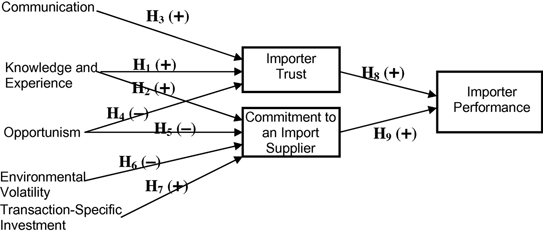
A model for antecedents and consequences of trust and commitment.
The proposed study consolidates and focuses on relevant studies where most of the identified variables have been examined from different perspectives. This has provided support to the variables in conceptualising the emerging context.
The theoretical links between the variables are discussed in the following subsections.
While the terms “knowledge and experience” are widely used in internationalisation process theory to explain how firms become international in their outlook and processes, the theory does not precisely define knowledge and experience. However, having a focus on the knowledge-gathering process (i.e. learning-by-doing) signifies that knowledge can help build trust and commitment in the relationship management. The knowledge-gathering process in the international market allows buying firms to make better purchases of quality products, resulting in reduced costs and increased profits in the importer–exporter relationship (Homburg et al., 2002). This suggests that an importer's knowledge and experience of consumer and/or business goods is essential for quality consumption and/or high standard reproduction. Ultimately this affects importers and their suppliers’ relationship in terms of the degree of trust. It is therefore theorised that international business firms’ knowledge and experience foster exporter market commitment to international suppliers (Johanson and Wiedersheim-Paul, 1975). However, it is essential for consumer and business goods importers to establish long-term relationship commitment in which trust and commitment play a parallel role (e.g., Siguaw et al., 1998).
In view of the above the following four hypotheses are worth exploring:
Communication vs importer trust
Research suggests that frequent, high quality and timely communication of information results in greater trust (Mohr and Sohi, 1995; Morgan and Hunt, 1994). Findings concerning the effect of communication on distributor/retailer trust in both consumer and business distributor–supplier relationships are conclusive. Some studies (e.g., Kwon and Suh, 2004; Morgan and Hunt, 1994) found significant positive support for the above assertion while others found insignificant results in a different context (Moore, 1998). Anderson and Narus (1990) found significant support in both manufacturers’ and distributors’ perspectives where communication leads to greater trust in the distributor–supplier relationship. Furthermore, scholars outlined that frequent informative communication between importer and supplier could be an important tie for a trustworthy relationship (Saleh and Ali, 2009). Therefore, the following hypotheses are proposed for testing.
Opportunism vs trust and commitment
Opportunism is defined as ‘self-interest seeking with guile’ (Williamson, 1985: 6). It seems that opportunism acts to withhold or distort information and evade obligations that ultimately lead to breaches of promise in a contract between parties. An overseas supplier may be involved in opportunistic behaviour in order to obtain an undue advantage over its trading partner by ignoring the principle of fair transaction and contract (Wathne and Heide, 2000). This means that when a party believes that the other transacting partner is acting opportunistically, such a perception will lead to a decline in trust. Accordingly, if one party in a relationship perceives that the other party is no longer trustworthy due to the other party's opportunism, this drift will lead to decreased commitment to the relationship (Morgan and Hunt, 1994). Such mistrustful behaviour and cunning will provoke resentment in the affected international importing firm. An overseas supplier's opportunistic tendencies are perceived as deliberately compromising the generation of trust (Atuahene-Gima and Li, 2002) and the development of importer commitment to the relationship (Skarmeas et al., 2002). The extant findings are also equivocal and inconclusive in terms of the influence that opportunism has on trust. Earlier studies have unanimously agreed that opportunism has a negative impact on trust and commitment. However, none of these studies developed an integrated approach to validate these findings from a consumer and business import-supply perspective. Hence, four hypotheses are suggested for testing:
Environmental volatility vs commitment
Environmental volatility refers to the uncertainty surrounding transactions between parties where problems are exacerbated due to people's limited capacity to judge issues or otherwise bounded rationality. Bounded rationality, environmental volatility as well as uncertainty preclude the writing of contracts, lead to higher transaction costs, and create uncertainty in obtaining appropriate responses from the transacting partner (Williamson, 1985). Rapid volatility in international markets exaggerates the uncertainty of the demand and supply situation because of one party's imprecise predictions concerning the future direction/outcome of the potential transaction. It is contended that environmental volatility creates threats and/or otherwise opportunities for transacting firms (Saleh and Ali, 2009). This suggests that volatility in the international market surrounding import–export transactions makes it impossible for importing firms to predict appropriate future action which in turn undermines importing firms’ intention to remain committed in their relationships with their suppliers (Skarmeas et al., 2002). Further volatility profoundly diminishes the willingness of proper responses and affects the commitment of the parties involved (Saleh and Ali, 2009). Such turbulent environmental events have an impact on consumer and business product importers’ commitment to their relationships but these have not been tested in any context. Therefore the following hypotheses are proposed for testing:
Transaction-specific investment vs commitment
Buyers’ assets that are specific to transactions with a particular supplier are referred to as a ‘transaction-specific investment’ (Williamson, 1975). As this investment is idiosyncratic, non-redeployable, specialised and unique to a task and sustains its value only to that specific exchange (Williamson, 1985), it has a ‘lock in’ effect for the owner of the investment. A review of the related consumer and business buyer–seller studies revealed that some studies (e.g., Kim, 2001; Kim and Oh, 2002; Skarmeas et al., 2002) examined the effect of transaction-specific investment. All found a positive significant relationship between the transaction-specific investment and their commitment (including importer commitment). Such unanimous support suggests that consumer and business goods importers’ transaction-specific investments tie them to a relational path and compel them to commit to long-term success. Since all of these studies were conducted in developed countries, further validation in an Asian developing market setting using a comparable research methodology may enhance the generalisability of TSI's impact on importer commitment. The following hypotheses are developed for testing:
Trust vs performance consequences
In the preceding sections, hypotheses 1, 3 and 4 stated the predictors of trust. However, the effectiveness of trust depends on how factors facilitating the relationship enhancement process resulted in relationship outcomes. The performance outcomes of trust have been conceptualised in different ways in various contexts. For example, from an inter-organisational perspective, performance consequence is theorised and measured as: firstly, relationship effectiveness (Moore, 1998); secondly, intention to stay in the relationship (Ruyter et al., 2001); and thirdly, consumer product distributor's satisfaction with financial performance (Siguaw et al., 1998). Some researchers found that trust and commitment have a positive impact on relationship satisfaction in the dealer–supplier long-term relationship concerning consumer products (Jonsson and Zineldin, 2003). Geyskens et al. (1996) found that the impact of trust and interrelationship between dealer and supplier vary according to the nature of commitment examined. However, there is paucity of empirically based evidence of the impact of importers’ trust on their relationship performance in the extant literature. It seems that our understanding is limited in conceptualising trusting behaviour and its consequences for consumer and business goods importer–supplier relationships. As such, the logical sequence suggests that trust is equally important for the consumer and business goods importer–supplier relationship and may have an influence on the performance of importers. Therefore, the following hypotheses are proposed:
Commitment vs performance consequences
Some studies used commitment to explain a variety of outcome variables including relationship profitability (Holm et al., 1996), satisfaction (Jonsson and Zineldin, 2003), and relationship performance (Skarmeas et al., 2002; Wiley et al., 2005) in different business and consumer product buyer–seller relationships. Furthermore they found a positive effect on these performance indicators. Importer performance is defined as “the extent to which the importer's relationship with the overseas supplier is productive and rewarding” (Skarmeas et al., 2002: 764). To measure performance, Bucklin and Sengupta (1993) focused on “the perceived effectiveness of the relationship” which is defined to the extent to which the involving firms are committed and found it “to be productive and worthwhile” (p. 33). Wiley et al. (2005) examined the reciprocal effects of relationship commitment on relationship performance which revealed mixed findings. One study (Skarmeas et al., 2002) examined the impact of importer commitment on relationship performance and it provided much-needed empirical evidence.
The required evidence is in the form of the likely ‘pay-offs of commitment relationship’ with the exporter. With the aim of testing the expected outcomes of importers’ commitment to their relationships with exporters, this study strives to validate the findings of Skarmeas et al. (2002). The context concerns that of consumer goods and business goods importers in a developing country. In particular, the current study investigates how both consumer and business importers’ perceptions are functioning. Therefore, the following hypothesis is proposed for testing:
Method
Empirical research setting
This study endeavoured to examine accord and discord in the perceptual behaviour of consumer and B2B goods importers in an Asian developing economy, Bangladesh. This is an important topic of research because Bangladesh is experiencing rising internal consumption of goods and services, and the magnitude of its current trade deficits has led to businesses becoming involved in both importing and exporting. Subsequently, consumer product importers play an important role in meeting local demand and business importers are trying to improve the balance of trade by exporting more manufactured goods. Importing firms provide advantages for overseas exporting firms in the foreign supply market. An investigation into the trust and commitment behaviour of such an importing country is also important in reducing macro environmental diversity. This diversity exists in developed and other developing countries and it will facilitate the testing of a new model and generalisability of the extant findings. To validate the complex issues of trust and commitment, this study initially integrated both qualitative and quantitative findings, of which the quantitative ones (with some validated arguments) are discussed here. However, in the model refinement process the qualitative findings were critically analysed to develop a quantitative framework in a new research milieu.
Given the research setting, the Export–Import Control Bureau of Bangladesh (EICBB) was used as the focus of this study. EICBB has a list of 8460 registered consumer product and 665 business product importers operating in Bangladesh. An active list of around 1600 importing firms was selected as the initial target. To specify key respondents and solicit their participation in the proposed survey, the chief executives of 990 consumer and 450 business goods importing firms were contacted randomly. The study identified 514 consumer and 220 business goods importing firms as potential informants. The multi-item measures for respective constructs were developed and included in the study instrument. The development of measures began with a review of previously published studies. Personal in-depth interviews with both groups of importers were undertaken, firstly in Australia and then in Bangladesh using two sets of questionnaires, an English version and a Bengali version.
Taking into account the concerns for the methodological issues in cross-cultural relationship research (Wilkinson and Young, 1999), translation and test and pre-test of this questionnaire in the native language made it possible to attain some degree of uniqueness (Brislin, 1970). Accordingly, the translated Bengali version of the questionnaire was checked by a committee of Bangladeshi academics working in Australian universities to ensure consistency with the English version and to ensure clarity of response. The questionnaire items were also subjected to an item-sorting assignment governed by a panel of experts drawn from the relevant fields.
To reduce common method bias in the responses (Podsakoff et al., 2003), we used reverse coded scales such as semantic differential scales and a 7-point Likert scale. It was also expected that a single specific factor or one general factor would emerge out of the factor analysis and explain most of the covariance in the predictor and criteria variables so that we could evaluate if common method variance represented a serious problem in this study. Accordingly, factor analysis on scale items associated with all constructs was performed and no general or separate factor was evident in the factor structure where even factor 1 explains less than 11% of the variance. Hence, the questionnaire design and the post hoc analyses indicated that common method variance was not an issue in this study. Some minor revisions to the measurement instrument were made in terms of wording and themes to the scales based on a pretesting, using a sample of 50 firms following Hair et al. (2010). The final instrument was then mailed to a total of 734 target respondents consenting to participate in the study. Respondents were asked to identify one of their most significant suppliers and then asked to respond to the questions concerning the major supplier relationship. A total of 91 and 67 responses were collected from consumer and business goods importers respectively, totalling 158 responses.
After 2weeks 440 questionnaires were mailed to the 300 consumer and 140 business importing firms who did not respond in the first round. The second mail-out generated 69 and 41 responses from consumer and business importers respectively, totalling 110 responses. After eliminating those questionnaires that had more than 20% unanswered or partially answered questionnaires (Hair et al., 2010), the usable total response rate for consumer goods and business goods stood at 149 and 96 respectively. An examination of normality and outlier cases, mean, standard deviation, kurtosis, skewness, univariate and multivariate assessment was conducted, resulting in thirteen extreme cases being identified and excluded from the analysis. Finally, the responses of 139 (27.04%) consumer and 93 (42.27%) business goods importers were included in the final data set to test the measurement models and conceptual model using structural equation modelling (SEM). The software employed for this analysis was AMOS version 18.
Following Armstrong and Overton (1977) a non-response bias test was conducted by comparing early and late response patterns. An independent sample t-test revealed that there were no issues regarding non-response bias. A post hoc check was employed on informants’ competency in terms of their comments on the importer–supplier relationship (see Gençtürk and Aulakh (2007). Three open-ended questions were included at the end of the survey instrument asking key respondents to indicate how long they had imported goods from their major supplier, level of their educational qualifications, and the duration of the firm's importing activities. As Table 1 shows, 88% of respondents have graduate to postgraduate qualifications.
Sample characteristics.

Sample characteristics.
We have used multi-item measurement scales to operationalise the dependent and independent variables. The psychometric properties in the scales are illustrated in Table 2. To measure the variables in the proposed model, we used extant measures apart from knowledge and experience and have in fact developed new construct measures.
Results of model estimation.
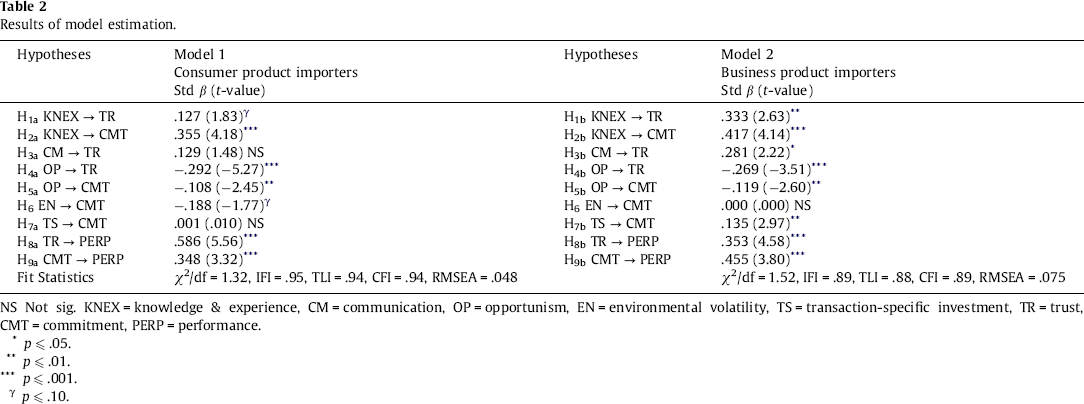
Results of model estimation.
NS Not sig. KNEX=knowledge & experience, CM=communication, OP=opportunism, EN=environmental volatility, TS=transaction-specific investment, TR=trust, CMT=commitment, PERP=performance.
p≤.05.
p≤.01.
p≤.001.
p≤.10.
The independent variables (IV) in the model include communication, knowledge and experience, opportunism, environmental volatility and transaction-specific investment. We operationalised importers’ communication with suppliers using a five-item Likert scale applied by Coote et al. (2003), Selnes (1998) and Jonsson and Zineldin (2003). The scale items incorporated the degree to which the importer and supplier communicated information to each other in terms of regular business changes, benefits, prospects and problems. We defined “knowledge and experience” as the degree to which the importing firm is well-informed and experienced in dealing with products, market demand, marketing experience, buying procedures and the technical features of a supplier's products. Since parallel studies on the import side of the import–export dyad are rare, we utilised the modified scales that Celly and Frazier (1996) and Ozanne et al. (1992) employed in their studies.
Following the seminal work of Skarmeas et al. (2002), we adopted five items and conceptualised “opportunism” as the importers’ perception of supplier unscrupulousness while the exchange relationship and negotiation lasted. To measure environmental volatility, we used a five-item semantic differential scale that Celly and Frazier (1996) and Ganesan (1994) used. The operational definition states the degree to which the international market is volatile in terms of changing market trends, forecasting, market share, demand predictability, complexity, and variability in marketing action. Following the work of Skarmeas et al. (2002) and Ganesan (1994), we adopted three items from both studies to measure transaction-specific investments. The measure imitates importers’ perceptions of their investment which is specific to the supplier relationship.
Mediating variables
In our proposed model, trust and commitment play mediating roles between the previously mentioned independent variables and ultimate dependent variable. We define trust in the importer–supplier relationship as an importing manager's expectation and perception that their supplier will be honest, open in business dealings, truthful, reliable, have a high level of integrity, and subsequently not require close supervision. We measured trust on a six-item scale adopted from three relevant studies (Coote et al., 2003; Jonsson and Zineldin, 2003; Mavondo and Rodrigo, 2001). We operationalised commitment on a six-item Likert scale adopted from two major studies (Jonsson and Zineldin, 2003; Skarmeas et al., 2002). The importer commitment scales incorporate the expectation for devotion to the relationship, nature of response, future expectations of purchase, relationship continuity, strengthening the relationship and level of satisfaction with the relationship.
Dependent variable
We operationalised the performance consequences for the importer using a four-item scale that described the degree to which the importer relationship with their supplier is productive, worthwhile, effective and rewarding. For this construct, we adopted all items from Skarmeas et al.'s study (2002).
Measurement validation
We undertook confirmatory factor analysis (CFA) and tested the model using structural equation modelling (SEM). Then we conducted CFA for eight multi-item factors separately to estimate measurement models (for both samples separately and combined) applying the maximum likelihood method to identify the items for domain specification. A few items were dropped from different scales due to low loading scores, misspecification between error terms and low item-to-total correlations. Upon their exclusion, all construct measures achieved adequate levels of fit with significant loading (p<.001), and composite reliability scores ranged from.69 to.91 which is well above the standard.60 cut-off (Gençtürk and Aulakh, 2007). By co-varying all latent variables (the DV and IVs) with each other, the CFA model was then tested to verify its adequacy and to examine the covariance structures for all latent variables. While the χ2 values for the confirmatory model were significant for the data concerning both consumer goods importers (676.75 with 532 d.f, p= .000) and B2B importers (811.43 with 532 d.f, p= .000), the overall fit to the data for both samples was good regarding level of fit and in making a baseline comparison.
Taking sample sensitivity and model complexity effect into account, χ2/df (CMIN/DF), IFI, TLI, CFI, and RMSEA are considered here to evaluate fit indices (Hulland et al., 1996). The analyses revealed that the χ2/df for both samples were adequately below the recommended level (1.27 for consumer goods importer data and 1.53 for business goods importer data), and IFI (.95 for consumer data and.89 for business data), TLI (.94 for consumer data and.87 for business data), CFI (.95 for consumer data and.89 for business data) were above and close to the parsimonious level of fit (.90). Furthermore RMSEA in both data sets (.044 for consumer goods importers’ data and.076 for B2B importers’ data) achieved below.08 cut-off.
By following Steenkamp and Baumgartner (1998) procedure, a measurement invariance test was conducted to verify the theoretical constructs and their adequacy of cross-study equivalence (consumer and B2B data sets). Test of measurement invariance for the measures revealed that the difference between the consumer and B2B data sets is non-significant, indicating that the unconstrained model is equal with the factor loading constrained.
Validity of the measures
Convergent and discriminant validity of the measures were checked. To confirm the convergent validity of the constructs, we examined the factor loadings in CFA and found that all loadings were highly significant for both the consumer goods importers (lowest t-value=6.90, p<.001, loading>.57) and business goods importers (lowest t-value=5.83, p<.001, loading>.58) data sets. Furthermore, average variance extracted (AVE) was estimated and it revealed that all AVEs were greater than.77 for both consumer and business goods importers’ data, thus confirming the measures’ convergent validity (Kim and Oh, 2002). However, we assessed discriminant validity of the constructs in two ways: firstly, by comparing AVE and construct correlations; and secondly, with χ2 difference tests. The average variance extracted (AVE) is greater than all corresponding construct correlations which is indicative of the constructs’ discriminant validity (Fornell and Larcker, 1981). Additionally, all χ2 differences between the pairs of constructs for both data sets were significant, demonstrating the measures had discriminant validity (Gençtürk and Aulakh, 2007).
Analysis and results
For comparison and validating purpose, we followed Kim and Oh's (2002) procedure for analysing two categories of samples. The analysis was undertaken in two stages. First, the proposed structural model was tested using consumer goods importers’ data set and industrial importers data set separately. Second, the results of hypotheses testing were compared for both consumer and business goods importing categories to identify the variations and similarities. The SEM findings for consumer and business goods importer samples are illustrated in Table 2.
The model estimation results and model fit statistics for the two models are presented in Table 2. Although IFI, TLI, and CFI for model 2 show marginal fit, the other fit indices and other two models achieved adequate as well as parsimonious fit. However, such marginal to modest fit usually suffers from a small sample size (Kim, 2001). For import category-level analysis, five pairs of hypotheses were accepted and found to be highly significant for both samples (H1a and b, H2a and b, H4a and b, H5a and b, H8a and b, H9a and b). In addition, H3b and H7b are significant for business importers and H6a is significant for consumer product importers. Findings relating to hypothesis 1: H1a suggests that knowledge and experience has a marginally positive (β= .13, p<.10) significant effect on consumer importer trust, but it is related significantly (β= .33, p<.01) and positively to importer trust in the business importer category (supporting H1b). Thus, H1 is partially supported. H2ab suggests that importer knowledge and experience is related to importer commitment to an import supplier (β= .36, p<.001 for consumer importer, and β= .42, p<.001 for business importer). Therefore, H2 is fully supported. Communication between importer and supplier is not significantly (β= .13, NS) related to consumer importer trust (H3a) but it is related positively (β= .28, p<.05) to business importer trust (H3b). Thus, H3 is supported partially. However, as expected, the results revealed that a supplier's inclination to be opportunistic has a negative significant effect on both importers’ trust (β=−.29, p<.001 for consumer importers, and β=−.27, p<.001 for business importers) and commitment (β=−.11, p<.01 for consumer importers, and β=−.12, p<.01 for business importers). Hence, H4 and H5 are fully supported.
We hypothesised that environmental volatility has a negative effect on importer commitment. The results suggest that environmental volatility has a marginally significant (β=−.19, p<.10) effect on consumer importers commitment (H6a) but it has no (β= .00, NS) effect on business importers commitment (H6b). Consequently, H6 is partially supported. We also hypothesised that importer transaction-specific investment is positively related to consumer and business importers’ commitment to their import suppliers. The results suggest that it is not significant (β= .01, NS) in the consumer importer context (H7a) but is significant (β= .14, p<.01) for the business importer context (H7b). Thus, H7 is supported partially. H8 and H9 suggest that importer trust (β= .59, p<.001 for consumer importers and β= .353, p<.001 for business importers) and commitment (β= .348, p<.001 for consumer importers and β= .455, p<.001 for business importers) have positive and significant effects on importer performance consequences. As a result, H8 and H9 are fully supported.
Apart from the above investigative outcomes, the results of two samples show some variations. The one-sided significant effect of knowledge and experience and communication on trust in the business importer sample suggests that the perceptions of consumer product importers differ from those of business product importers. It should also be noted that most of the insignificant findings (four hypothesised paths) are related to consumer goods importers’ perceptions. The likely interpretation for such results is that most consumer goods importers are engaged in trade-in on an ad hoc basis and as such they may be reluctant to develop continuing relationship with foreign suppliers. These results may point to the fact that consumer goods importers are not overly fretful with their knowledge content and experience, communication of information, and transaction specific-investment. However, the effect of volatility does not represent an issue for both consumer and industrial goods importers in maintaining commitment.
Discussion and research implications
Based on extant assertions in the academic literature, we proposed that the trust and commitment behaviour and their instigating factors are alike in two importer categories. They have the same consequential impacts. Accordingly, this study makes significant contributions to an understanding of importer–supplier patterns of trust and commitment in terms of IP and TC theories. In this sense, this study can be considered an advancement over previous studies. The findings revealed some specific variations and they have contextual, practical and managerial implications.
The results clearly suggest that knowledge and experience are primary tools that boost consumer and business product importers’ commitment to their relationship and lend support to the recent arguments put forward by pioneers of the IP approach (Johanson and Vahlne, 2006). However, the assertion that a high degree of knowledge and experience builds trust is not validated by the consumer product importers. This indicates that such importing firms in general are not concerned with enhancing international business knowledge and experience so that they can build a trusting relationship with suppliers. Similarly, the null effect of bilateral communication between the importer and supplier on importer trust signifies that the mechanism and importance of communication for consumer product importers are different from business product importers. The former are likely to be reluctant in developing trust to maintain their long-term importer–supplier relationship. Nevertheless, communication of information plays a strong role in augmenting business importers’ trust and reinforces the point that importer–supplier communication is the key to constructing successful relationships (Coote et al., 2003; Mohr et al., 1996). This also extends previous research findings by ascertaining the robust effect of communication on trust in research on business product importers in a developing country. This finding was also validated by the (qualitative) statement made by the respondents below:
Communication is one of the key factors for success of our business. Effective communication ensures initial transaction to take place which is then followed by a series of successful transactions towards building trust. The trust building process involves development of confidence, trustworthiness, truthfulness and, sincerity. The final outcome of this process is commitment.
This example of qualitative evidence suggests that the communication between importer and supplier helps build trust and further enhances commitment to the relationship.
As expected, the effect of supplier opportunism on importer trust and commitment implies that when the importer believes that supply partners have a proclivity for opportunism, this perception leads to loss of trust in both the samples and total sample. Correspondingly, as previously postulated, such an opportunistic drift of suppliers results in a diminished commitment to the relationship because importers believe it is not feasible to trust their suppliers in a long-term relationship (Morgan and Hunt, 1994). This finding lends support to what has been found in previous studies (Skarmeas et al., 2002), and suggests that if a supplier's guile and self-interest-seeking stance is axiomatic, the long-term relationship will be compromised and importer transaction costs with such a supplier will increase (Williamson, 1985). As a result, importing firms need to be cautious when establishing contracts and agreements with the supplier by clarifying all terms and conditions to avoid situational advantage due to vague provisions and stipulations in the transaction.
The non-significant results regarding the impact of environmental volatility and partially significant results for the transaction-specific investment (TSI) are contributory evidence for practitioners. The results clearly suggest that this volatile situation could encourage partners to collaborate and improve their transaction-specific investment processes to maintain a long-term relationship (Skarmeas et al., 2002). The results may also imply that importing firms operating in similar countries and gaining experience from managing business in internally volatile environments are in a position to handle international business efficiently. This finding contributes to the evidence that supports business importers TSI and their commitment. The result of the business importers sample suggests that TSI is an attachment bond for such committed importers, pledging transacting parties in a dedicated relationship, since this investment is non-redeployable and unique to a specific transaction (Kim, 2001; Kim and Oh, 2002).
Rather than positing a relationship between environmental volatility and TSI, the results suggest that volatility is not a significant factor for both categories of importers. It may therefore imply that foreign investors can invest in TSI mood where business importers are inclined to maintain long-term committed relationships. This further suggests that a long-term committed relationship is a prerequisite for them to gain a relationship advantage. In contrast, consumer product importer TSI has no effect on their commitment, suggesting that they maintain an ad hoc relationship with their supplier and are likely to switch frequently from one supplier to another. As expected the results relating to the ultimate outcome are consistent with the extant findings.
The significant link between trust and importer performance consequences revealed in this study adds to knowledge to the international business domain. This conjecture about the relationship has been borrowed from various contexts (Saleh and Ali, 2009), and so far had not been tested empirically. This provides support to similar findings in previous research such as logistics alliance relationship effectiveness (Moore, 1998), long-term intention to stay in the relationship (Ruyter et al., 2001) and financial performance in the distributor supplier relationship (Siguaw et al., 1998). Consistent with specific importer commitment behaviour literature (Skarmeas et al., 2002), our research lends empirical support to and validates the notion that importing firms’ commitment is an essential and decisive building block to enhance how well they perform in the importer–supplier relationship. The qualitative findings further provide support as to concerning how importers’ commitment to suppliers develops. As two importers’ commented:
––it has taken a long time to develop commitment as the relational process involved verification and observation of their trustworthiness.
At early stage of our relationship, I have observed my suppliers’ trustworthiness on the basis of reliability of the products supplied their sincerity and promise keeping records. The positive findings of these tests rendered me commit to my suppliers.
The quantitative research outcome reinforces the contention that commitment is also critical for developing effectiveness, productivity, relationship usefulness and obtaining rewards. Our sample mean (consumer=10.54, business=9.92) and the effect of commitment on performance indicate that commitment pays off not only in terms of outstanding benefits to importers but also to exporters in the dyad context. Commitment is, in effect, an enduring outcome of the relationship. Exporting firms may also want to develop an affiliation with import distributors in order to buttress their foreign markets. In other words, this process is an interplay between the developments of knowledge about foreign markets and operations on one hand and an increasing commitment of resources to foreign markets on the other.
Contribution to theory and practice
This study contributes to the theory and provides some useful practical directions for import managers when dealing with both consumer and business products. They may then better comprehend the dynamics and complexities of trust and commitment in building effective relationships with their foreign suppliers.
Firstly, this study has constructed a model for the concept of commitment and trust where importers of consumer and business goods perceive their foreign suppliers in different ways. Specifically, constructs have been articulated concerning the relationship dynamics for: foreign suppliers’ opportunism; communication between importers and suppliers; importers’ knowledge about and experience of the process and products they deal in; transaction-specific investment; and environmental volatility.
Secondly, the research extends the tenets about existing transaction costs and internationalisation processes by refining a theory on trust and commitment in a novel research setting, i.e. Bangladesh, which is an emerging market economy. Thirdly, this study contributes to the body of knowledge by comparing consumer and business product importers’ perceptions of their suppliers in this country.
Fourthly, the findings will make it possible for manufacturers of consumer and industrial goods to develop guidelines on how they can strengthen their relationships with their counterparts in developed countries. Fifthly, the findings of this research suggest that importers in developing nations are equally trustworthy as foreign suppliers and committed to making their relationships successful. Sixthly, the governments of emerging economies depending on imports to support their infrastructure and industrial productivity would benefit from the findings of this study in terms of developing policies that encourage importing firms to maintain effective relationships with their foreign suppliers to ensure regular flows of goods.
Finally, this study highlights the need to integrate new constructs in future empirical models that examine the relationships between outcomes and the added constructs developed and tested here. In particular the deeper insights into the complexities of relationship dynamics emerging in Bangladesh – which is the main focal point of contemporary foreign suppliers – constitute a major basis for designing international export strategies for foreign suppliers.
Limitations and future research directions
This study tested a theoretically grounded model integrating some of the key antecedents of relational governance. However, other variables have a direct and indirect association and impact. As an integral part of performance outcome, financial/economic aspects represent another dimension that could make the measure more accurate. In this research predictors and linkages were investigated from a foreign distributor–supplier relationship perspective. Also behavioural intension of willingness is a critical facet of trust's conceptualisations because if one believes that a partner is trustworthy without being willing to rely on that partner, trust is limited. Thus, our study needs further replication, extension and critical evaluation in this direction. Further research should examine the predictors and linkages from both manufacturers’ and distributors’ perspectives where and when these converge (Gençtürk and Aulakh, 2007). The sample of consumer and business importers is not reasonably distributed. Research in the future can overcome this issue by minimising the differences between the two groups. Furthermore, longitudinal data from both manufacturers and distributors in the consumer and business product importer–supplier category may provide additional insights into the process of relational exchange. This exchange concerns both parties’ feedback circle which should be compared and validated.
Future research should be based on larger samples drawn from several developing countries with advanced economies to provide wider insights into the issues examined in this paper. Although this study did not incorporate macro-relational issues such as a country's culture into the theoretical model, our comprehensive framework exploring the micro-relational aspects may not have affected the generalisability of the findings across emerging economies.