







Abstract
Purpose
Increasingly the company websites, along with the intermediary websites such as portal sites have become an integral component of the firms brand strategy. This study emphasises the importance of website service elements within portal sites and the impact on e-retailer brand attitudes and brand identity in an ever more competitive digital market-space.
Design/methodology/approach
The research employs structural equation modeling technique to capture the relationship among website attitude, e-service quality, brand attitude and brand identity.
Findings
The results from the study indicate consumer attitude perceptions toward portal website and e-service elements combine to increase brand attitude and also brand identity for e-retailers.
Originality/value
Although there has been a plethora of studies evaluating corporate websites and branding interactions there is limited comprehension of the impact of intermediary portal sites. Moreover, the literature is limited in validating the link between e-services with brand attitude and brand identity within a portal website context. This study develops a framework that highlights the important influence of e-services within portal websites and the impact on the firm's brand.
Introduction
Consumer purchase behaviour online has been the subject of considerable research in past years. Li et al. (1999) point out that online consumer attitude is influenced by experience aspects of the website, which are also linked to the outcomes for the firm's brand such as loyalty. To create a successful brand, online firms must balance a mixture of consumer belief and experience associations (Allen and Fjermestad, 2001). Research has shown that the quality of service is the key successful factor of on-line purchase (Parasuraman et al., 2005). Further, Berry et al., 2010 argues for the need to look more closely at service innovation in multi channel retail environments as these areas have become complex and are in need of illumination. Hence, brands must combine consumer experience as well as expectations of performance. Thus, building a history of experience for the consumer is vital for building a brand online (Reynolds, 2000).
As Keller (2010) suggests channels such as interactive channels play a key role in consumer attitudes toward the brand. Further, there is a need to better understand these environments such as the impact of changing marketing channels like multimedia retail channels and the effects on the brand (Keller, 2010). For example, although there is prevalent use of portal sites by companies there is little known about the potential impact the portal site experience (Gounaris and Dimitriadis, 2003). That is, it is yet to be established as to how portal website experience influences brand elements for the company's e-brand. A portal website is also known referred to as a gateway as portals are “web sites that serve as starting points to other destinations or activities on the World Wide Web” (Holland and Menzel Baker, 2001, p. 36). The focus of this study is to evaluate the impact of portal websites on the end e-brand of the company using the portal to generate traffic.
The objectives of this study are: (1) to examine the effect of portal website ease of use and usefulness on on-line brand attitude; (2) to examine web site service quality on brand attitude toward e-branding. (3) Further, does the brand attitude mediate brand identity in a portal website context?
The paper firstly examines a conceptual model and hypotheses of the interrelationships between portal website attitudes toward ease of use and usefulness, e-service quality, as well as the impact on e-brand attitude and e-brand identity. Secondly, the evaluations of the results are presented. Lastly, the paper concludes with the contributions to the research body, limitations, and future research opportunities. The conceptual model will be examined next.
Conceptual framework and hypotheses
This study analyses e-branding by using perceived website attitude (usefulness and perceived ease of use), website service quality as antecedent variables, e-brand attitude, and e-brand identity as dependent variable. The conceptual framework is depicted in Fig. 1.
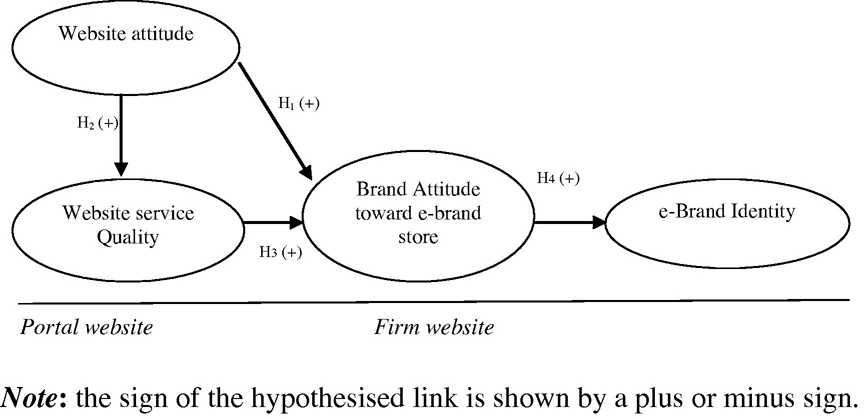
The conceptual model.
Companies have responded to the call for consumers wanting more control by providing various site features like internal search engines and recommender systems to enable consumers to easily find what they need, learn more about the products, and purchasing products with ease. Consumers’ shopping, purchasing behaviour and the relationship between the consumer and supplier have changed as the number of vendors available has increased dramatically due to the Internet (Korner and Zimmermann, 2000) and hence the consumer has much more choice. Compare to other traditional purchase store channels, consumers should hold certain abilities and resources in order to purchase in Internet (Li et al., 1999). That is, there is a level of capability needed by consumers to interact with the company and their product in an online environment. However, this consumer Internet capability is becoming less of an issue as consumers become more experienced and Internet technology becomes more consumer orientated.
Usually, companies themselves are the main source of information with respect to their brands. However, in online environments consumers obtain information about the brand from many third party sources such as portals. Consumer attitudes and purchase intentions towards a brand could be influenced by a mass-media promotion or campaigns backed by sustained and expensive public relations programs. More recently, consumers are seeking product and brand information from other sources or other consumers such as online social networks (Brown et al., 2007). In a website context, consumers can easily broadcast their opinions in real time and virtual space to a large number of like minded people, which has the potential of positively or negatively impacting the brand (Brown et al., 2007).
Perceived usefulness and perceived ease of use of websites are also influenced by factors such as visual attraction, information content, reliability and reflection, and in turn influences consumer attitude toward using and actual system using intention (Davis et al., 1989; Lin and Lu, 2000; van der Heijden, 2003). Early work by Davis (1989) suggests that if consumers can accept new information technology such as e-mail when it is perceived as easy to use and there is a perceived usefulness to the user. Lin and Lu (2000) found that website consumers were more likely to prefer and return to a website if the website delivered information quality, quick response times, and accessibility. Further, consumers beliefs of the perception of the ease or use and usefulness of the website mediated consumer preference of the website and influenced re-use of that website (Lin and Lu, 2000).
van der Heijden and Verhagen (2004) suggest that website ease of use and usefulness not only positively impact the purchase intention of the consumer, but also positively impact the firms brand image. The study of a Dutch online bookstore website found that brand elements for the firm are intrinsically linked to online purchase intentions of consumers and should be investigated further (van der Heijden and Verhagen, 2004).
More recently, website attitudes by consumers have been shown to positively impact the brand attitude of that consumer (Hwang et al., 2011). A study of 375 South Korean hospitality consumers found that consumer attitudes were mediated by the website attitude in purchase intention of consumers in a website related context (Hwang et al., 2011). Certainly the relationship between positive website usability elements and favourable brand attitudes has been established (Bellman and Rossiter, 2004). Bellman and Rossiter (2004) found that perceptions of ease of use elements of the website such as navigation and attitudes toward the website showed a positive influence on the strength of the brand. However, it is yet to be established as to whether this relationship can be extended from the portal site to the end brand of the firm using the portal site. Therefore, it is hypothesised that:
Although ease of use and usefulness of a technology, in this case a website has been shown to influence website preference, re-use of the website and e-commerce (Lin and Lu, 2000; Pavlou, 2003). Recently Mazaheri et al. (2011) when studying Canadian and Canadian (Chinese) consumers’ emotion in website usage found the link between website perceptions and service attitude. More specifically, Mazaheri et al. (2011) showed the importance of including consumer service attitude elements in studies focused on website perceptions, as site attitudes were found to be positively related to service attitudes. Yang et al. (2005) highlight the differences between on-line shopping service metrics and service quality of the web portal. Further, these researchers also argue that service quality can be viewed as a mediator to website perception and satisfaction when evaluating websites (Yang et al., 2005).
Traditional retail shopping research shows a relationship between service quality and purchase intention (Cronin et al., 2000), and more recently service quality, brand image, and purchase intention (Wu et al., 2011).
Compared to a physical store, on-line shopping (a virtual store) is without face to face service functions. Company service functions take on a different form when embedded within the website. Portal intermediary websites service quality has shown to play a pivotal role in directing digital consumers to the e-commerce provider (Gounaris and Dimitriadis, 2003). That is, essentially portal sites are gateways for e-retailers. Portals are different from corporate websites (Gounaris and Dimitriadis, 2003), although the distinction between the portal and the e-retailer is becoming ever more blurred due to the speed between both portal and e-retailer consumer experiences. That is, the time between portal and e-retail experience is almost simultaneous. As Internet technologies and firm capabilities improve websites and these service functions are becoming more sophisticated in delivering service quality, for example, online live service assistance and 24h booking systems. According to Parasuraman et al. (2005), highlight these electronic service quality functions (E-S-QUAL), which encompass phases of consumer interactions with a website. Some researchers have found it fruitful to adapt traditional service quality for e-service quality measures for websites (Kaynama and Black, 2000). However, Gounaris and Dimitriadis (2003) argue that within portals service quality should be viewed with a slightly different lens to websites. Therefore, it is imperative to understand more about service quality within these digital platforms.
Therefore, it is hypothesised that:
Developing online brands are based on a changing new business model that can create a different level of interaction between consumer and company, giving the possibility for enhanced consumer experience (Davis and Buchanan-Oliver, 1999; de Chernatony, 2001). For example, firms with personalised and speedy responses to consumer enquiry due to the Internet can generate a significantly improved value equation for consumers (de Chernatony, 2001). The practice of identity and branding online has not changed dramatically from offline as differentiation and trust still form the foundation. However, the difference is that there are fewer impediments with the information relationship between principal and end user (consumer). Therefore, the need for quality and quick interaction is essential for future branding endeavours of the organisation (Aaker and Joachimsthaler, 2000). These hyper interactions between the intermediary and the corporate website are blurring the link between experience and brand and are in need of further exploration.
The relationship between how the firm interacts with consumers through a website such as navigation and interactivity elements within the site have been shown to impact the firms brand elements such as brand and loyalty toward the brand (Merilees and Fry, 2002). Therefore, firms that can develop interactivity in a website that positively influences the target website consumer will benefit through greater brand attitude and loyalty from that consumer. Further, Gammans et al. (2001) highlight the potential relationship and need for more research on the interrelationship between website elements, customer service, and the brand.
Bauer et al. (2002) investigate internet marketing elements of the portal website and argues that there is a positive relationship between functions within the site such as constant availability, efficient transfer of information, interactivity, customer individually, integration of communication with the end transaction. Previous studies have shown that the service quality of the website will influence customers’ repeat buying rates (Bennett and Barkensjo, 2005; Park and Kim, 2006; Thorbjornsen et al., 2002). Therefore, it is suggested that if the portal website can provide an excellent service quality, the consumer will form a positive brand attitude toward the website not only for the portal site but also for e-retailers linked to the portal. Therefore, the following hypothesis is established:
In this sense, within the digital brand environment, the audience plays a much more active role in the process of branding. In an online environment the consumers interacts with the brand and the community within the website to generate a bond (de Chernatony, 2001). The unique properties of the Internet need to be incorporated into the brand-building program to help build these bonds. Interactive properties through activities such as e-mail, digital notice boards, suggestion feedback and chat rooms can lead to a richer more personalised experience for the consumer (Aaker and Joachimsthaler, 2000)2001. This level of interaction within the website can create strong experiential associations that give the consumer a sense of community thereby encouraging loyalty and a return visit (Aaker and Joachimsthaler, 2000; de Chernatony, 2001).
Mackenzie and Spreng (1992) found that stimulus such as an advertisement has direct a positive impact on the consumer brand attitude. It is suggested that other stimulus such as an interactive website, the experience of the website and the e-service delivery within the website would also have an impact on the brand attitude of the consumer. The marketing mix activities such as communications, in this case the Internet plays an important role in establishing the brand identity or distinctiveness of the firm (Nandan, 2005). Keller (2008) advocates that for firms to build the brand it is critical for the brand to have brand identity elements such as memorability, meaningfulness and transferability. Further, these brand elements are necessary to distinguish the brand from others in the marketplace (Keller, 2008), something which is becoming a more competitive digital environment. Consumers use their own interpretations of a brand and will respond differently to different brands. If a consumer has formed a positive perception or attitude of the e-brand, then he/she may have higher perception of the e-brand identify elements of that brand. Therefore, it is proposed that:
According to the report by the Market Intelligence, and Consulting Institute in Taiwan (2009) online shopping grew nearly 30% in 2009. This growth represents approximately NT 3,116 million or $US 104 million, in Taiwan. In accordance with the reports of IX Survey (InsightXplorer Limited, 2011) and ACNielsen, the numbers of uses of web portal grew fastest among the four main types of websites (i.e., web portals, community, search engine, and the online shopping centres). The portal is important because it could provide many functions, such as on-line information and service exchange, search engine function, communication platform for website user and the website operator (e.g., Google talk, Skype, and Yahoo messenger), and shopping platform, etc. (Yang et al., 2005). As suggested by Guin et al. (2012) in recent year's participation rates in online surveys have dramatically fallen due to the volume of invitations. Consequently, data was collected in an offline environment where the questionnaire was given to participants and collected the following day. Participants were screened to make sure that they have online shopping experience. If they do not have online shopping experience we stopped the survey procedure. Moreover, this approach gave us the ability to explain the purpose of the survey to participants and highlighted the importance of honesty in their answers. The respondents are asked to answer the questions in accordance with the website which is most frequently visited. The portal websites are illustrated in Table 1. Respondents had a concentrated use of a narrow range of portals including, Yahoo, PChome Online, Ichiba, ETMall, MOMO, PayEasy and books.com.tw.
The cross table of portal website selected by gender.
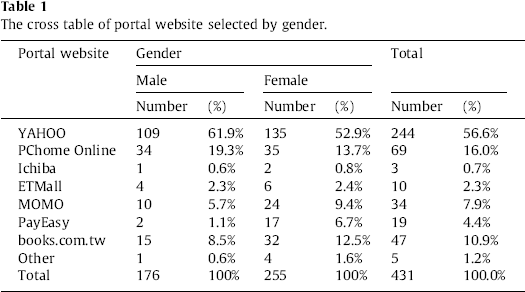
The cross table of portal website selected by gender.
The questionnaires were distributed by quota sampling approach. The questionnaires were distributed in accordance with consumers’ online shopping rate reported by Insight Xplorer (2011) and in line with Internet usage by age group in Taiwan. The survey interview was conducted in person. After giving appropriate instructions concerning how to proceed with the questions, the questionnaire was left with the respondent and collected the next day.
Out of a total sample of 500, 431 questionnaires were returned giving a response rate of 86.2%. The demographic profile is shown in Table 2, indicates 40.8% of the participants were male and 59.2% female participants. Further, participants came from a range of occupations including civil service (5.3%), labour and skilled professional (13.7%), business (47.8%), students (13%) and other (15.5%). The vast majority of participants were college graduates (73.8%) with all making at least 5 purchases online each year.
Variables definition and measure.
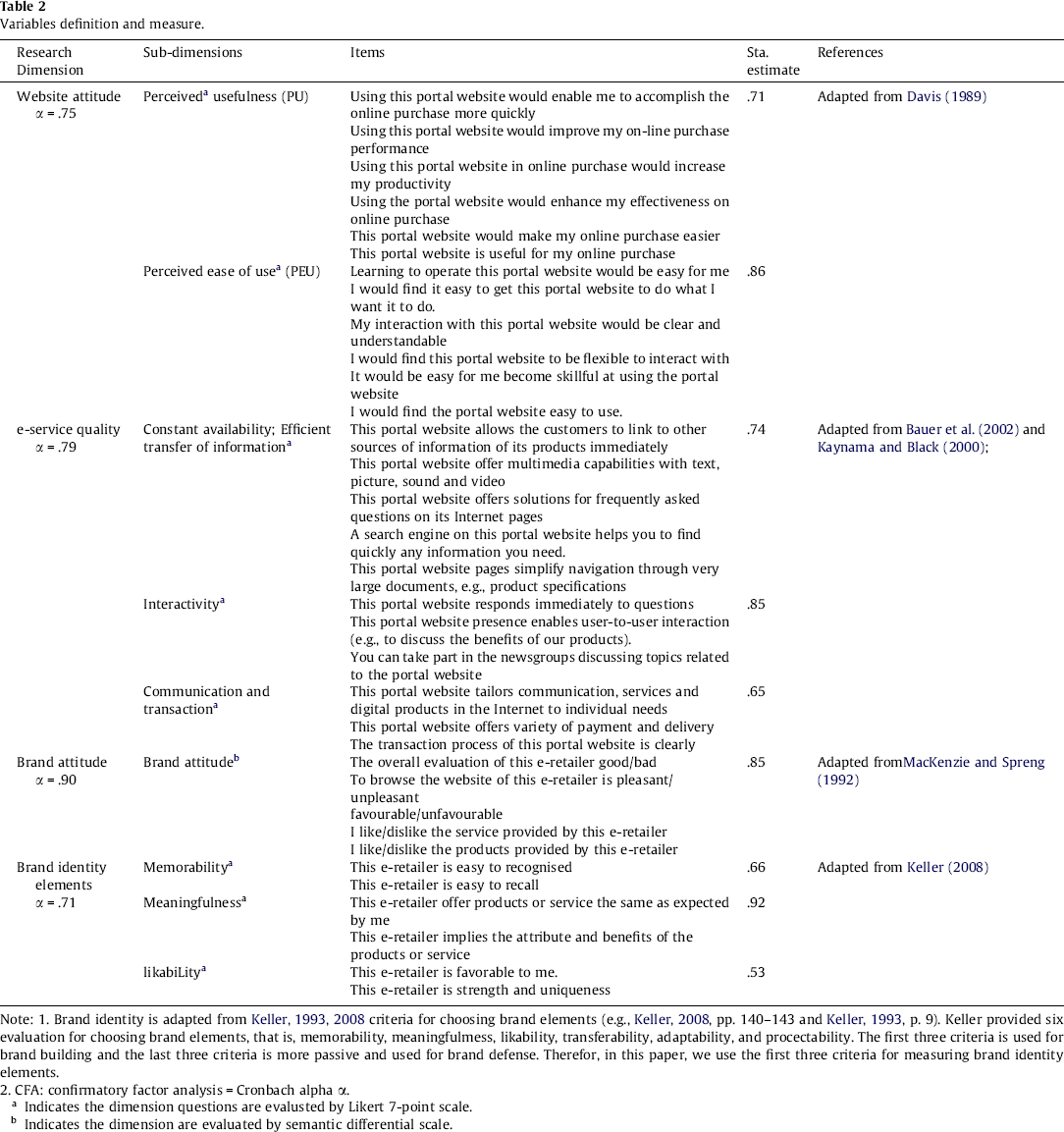
Note: 1. Brand identity is adapted from Keller, 1993, 2008 criteria for choosing brand elements (e.g., Keller, 2008, pp. 140–143 and Keller, 1993, p. 9). Keller provided six evaluation for choosing brand elements, that is, memorability, meaningfulmess, likability, transferability, adaptability, and procectability. The first three criteria is used for brand building and the last three criteria is more passive and used for brand defense. Therefor, in this paper, we use the first three criteria for measuring brand identity elements.
2. CFA: confirmatory factor analysis=Cronbach alpha α.
Indicates the dimension questions are evalusted by Likert 7-point scale.
Indicates the dimension are evaluated by semantic differential scale.
To assess the internal consistency of the scales used in the present research, Cronbach alpha reliability coefficients were calculated for each predictor item. Reliability estimates are values between 0.6 and 0.8 and are generally considered sufficient for research purposes (Hair et al., 2006 thus; the scales used in this study can be regarded reliable.
Accordingly, the variables of the research scale are shown in Table 2. Research scales were adapted from established scales.
The measurement model will be estimated by the AMOS (version 17 software). The parameter estimates for measurements of observed exogenous and endogenous variables, parameter estimates for causal model, and goodness of fit measures for the whole model are exhibited in Table 3. Before discussing the hypothesised relationship, assessments about the overall fit of the model to the data are made. The goodness-of-fit measures of the proposed model are: (CMIN/DF=438.674/100=4.397; GFI= .887; CFI= .917; TLI= .901; AGFI= .847; NFI= .896; RMSEA= .089; SRMR= .058) (Browne and Cudeck, 1993; Byrne, 2001; Hair et al., 2006; Hu and Bentler, 1999; McDonald and Ho, 2002). All model fit indices highlight the model is a poor fit. A competing model better represents the data with no statistical relationship between website attitude and brand attitude.
Parameter estimates and GFI measure (completely standardized solution).
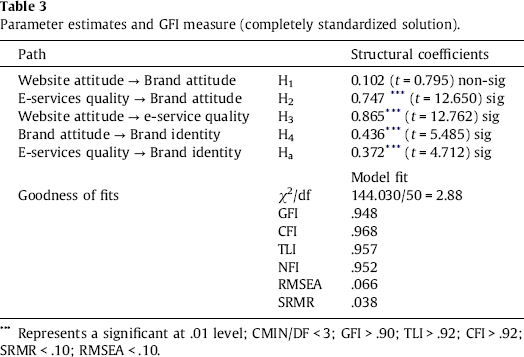
Parameter estimates and GFI measure (completely standardized solution).
Represents a significant at.01 level; CMIN/DF<3; GFI>.90; TLI>.92; CFI>.92; SRMR<.10; RMSEA<.10.
Further, an additional path between e-service quality and brand identity was also identified. Further, five items were excluded from the model for parsimony. Consequently, this competing model better explains the data theoretically and statistically hence, strengthens all model fit indices. For example, for the competing model considers there to be a direct relationship between e-services and brand identity and an overall better model fit of the data as illustrated in Table 3 (CMIN/DF=2.88; GFI= .948; CFI= .968; TLI= .957; AGFI= .918; NFI= .952; RMSEA= .066; SRMR= .038).
According to hypothesis H1, the portal website attitude has a positive impact on brand attitude of portal site. As can be seen from Table 3 that H1 is not significant (β=0.102 and t=0.795), therefore, hypothesis H1 is rejected. It indicates that the portal website attitude has no statistically significant direct effect on brand attitude. Conversely, H2, the portal website attitude has a positive relationship with portal e-services delivery, β=0.865 (t=12.762); H3, positive relationship between portal e-services and e-retailer brand attitude, β=0.747 (t=12.650); According to H1, H2, and H3, it is concluded that portal website attitude have indirect effect on e-retailer brand attitude through portal e-service quality. H4, the e-retailer brand attitude has a positive relationship with e-retailer brand identity, β=0.436 (t=5.485), and the additional path between portal e-services and e-retailer brand identity, β=0.372 (t=4.712) are significant, therefore hypothesis H2, H3 and H4, are all supported.
Firstly, portal website attitude by itself is not sufficient in assisting in positively impacting brand attitudes, as portal e-services are more important in evaluating consumer outcomes for e-retailers. That is, previously website attitude elements of ease of use and usefulness have been used to substantiate the positive impact of websites on brand attitude. However, this study highlighted those portal intermediary site e-services components such as e-service quality impacts the e-retailer brand. This study shows that portal website attitudes along with portal e-services lead to positive brand outcomes for the e-retailers, as seen in Fig. 2. Mazaheri et al., 2011 found website attitude linked with website service attitude lead to greater purchase intention. However, the study of portal sites shows that these two key portal website elements (portal website attitude and website services) can lead to important brand outcomes for e-retailers, an extension to the current understanding in the body of knowledge.
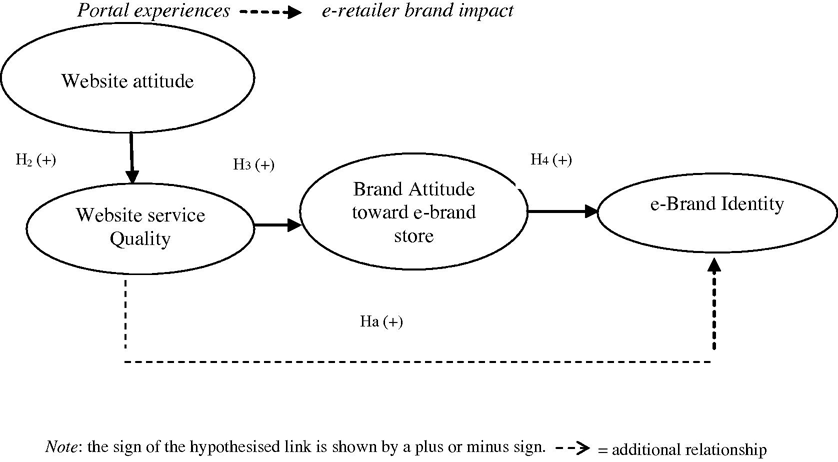
Modified model.
Fig. 2 here A key finding of this study is that marketing managers should be cautious about which portal site they use to generate traffic. That is, marketing managers should consider the importance of portal sites service quality. Specifically, when considering which portal site to choose, marketing managers should evaluate the service quality delivery of the portal site as this will have an effect on the firm's e-brand. This study has shown that portal sites influence the e-retailers brand attitude and e-retailer brand identity. These findings are both interesting for marketing academics and practitioners to consider when evaluating the impact of portal third party sites.
Chiou and Shen (2006) found that satisfaction of consumers experience in portal sites is based on the service quality elements of the portals website, which in turn lead to greater levels of brand loyalty to the portal site. Our study extends this concept by suggesting that the service elements of the portal site may also lead to greater brand attitudes and brand identity of the firm's e-retailer.
This study has shortcomings in terms of research design, which may limit the generalisability of the findings. The shortcomings include (1) the limited factors of antecedent variable are examined. For example, some personal factors may influence the brand attitude of the web site such as emotion and personality traits. (2) As we tested both portal websites and e-retailers that were frequently used by the consumer there was some evidence of common method bias, although it was minimal, it is a limitation of the study. (3) This research only examined well-established portal site only, (4) the nature of the sample being solely Taiwanese. For future research this study should be re-tested and also tested with data from other countries with different cultures, Internet e-retail penetration and different levels of economic development which could make findings relating to these topics more fruitful.