







Abstract
As a value proposition connects firms and customers, it becomes one of the central marketing concepts. Currently it has remained de-contextualized. Drawing on service-dominant logic, practice theory and consumer culture theory, this study aims at contextualizing value propositions by investigating theoretically how consumers experience and evaluate value propositions in practices. It pinpoints what their essence is in customers’ lives; the ability of offerings to help customers to enact desirable cultural discourses into experience in practices. Hence the study constructs value propositions as firms’ proposals that integrate sign value (the meanings of value propositions addressing desirable cultural discourses), experience value (sign value materialized into experience in a practice), exchange value (financial and non-financial sacrifices), and resources needed to address and materialize sign value. In general this study extends understanding on the socio-cultural and situational character of value propositions, value creation and value co-creation.
Keywords
Introduction
“The customer determines who the business is” (Drucker, 1977, p. 56). In the language of contemporary marketing one can rephrase Drucker's suggestion as follows: firms can only offer value propositions (Vargo and Lusch, 2008) – it is always a customer or any other beneficiary who accepts them. Thus firms get an opportunity to co-create value with their customers with the help of the value propositions (Grönroos, 2008). As the value proposition ties firms and their customers together, it becomes one of the central concepts of marketing. At the same time, only less than 10 per cent of firms have managed to successfully develop and communicate their value propositions (Frow and Payne, 2011).
Since the introduction of the concept of a value proposition by Lanning and Michaels at McKinsey & Company in the 1980s (Ballantyne et al., 2011), marketing research has emphasized its resonance with customers and other beneficiaries. It has meant dividing the value proposition into generic benefit and sacrifice categories: economic, functional, emotional and symbolic benefits, and monetary and nonmonetary sacrifices (e.g. Rintamäki et al., 2007; Flint and Mentzer, 2006; Day, 2006; Payne et al., 2005; Kaplan and Norton, 2004; Keeney, 1999; Aaker, 1995). Furthermore, service-dominant logic-informed researchers have conceptualized it as a process of designing reciprocal value (e.g. Ballantyne et al., 2011; Cova and Salle, 2008; Ballantyne and Varey, 2006; Flint and Mentzer, 2006). In an information technology services context the value proposition has been viewed as “a request from one service system entity to others to run a procedure or an algorithm” (Maglio and Spohrer, 2013, p. 367). The value generation potential of these relationships is known to depend on client characteristics, vendor characteristics, and the vendor-client relationship (Levina and Ross, 2003). Even though scholars have acknowledged that the value propositions relate to specific users and use situations (e.g. Ballantyne et al., 2011; Cova and Salle, 2008; Johnson et al., 2008; Lusch et al., 2007; Grönroos, 2007, 2009; Arnould et al., 2006; Flint and Mentzer, 2006; Lanning, 1998) they have not examined the implications further – with the exception of Arnould et al. (2006). These researchers argue for establishing meaningful links between the value propositions and consumers’ goals and resources so that by using the value propositions the consumers can better perform their life projects and roles in different cultural environments. Despite the contribution of Arnould et al. (2006), the value propositions have largely remained de-contextualized.
The objective of this study is to contextualize value propositions in customers’ practices. The approach is to investigate theoretically how consumers experience and evaluate the value propositions in their practices, based on the research contributions within service-dominant (S-D) logic (e.g. Vargo and Lusch, 2004, 2008), practice theory (PT) (e.g. Schatzki, 1996), and consumer culture theory (CCT) (e.g. Arnould et al., 2006; Venkatesh et al., 2006). More specifically, this study investigates consumer value creation in everyday situations: repetitive occasions which consumers perceive neither extraordinary nor dramatic, such as having supper. In the examination, value propositions are regarded as signs to which consumers ascribe intersubjective meanings while experiencing them in different socio-cultural, spatio-temporal and material contexts. More specifically, this study looks for conceptual explanations to three questions: (1) what is the essence of value propositions as signs that are experienced and evaluated by the consumers in their practices; (2) on what basis do the consumers evaluate the value propositions as signs; and (3) what implications can been drawn for further development of the value proposition concept?
S-D logic, CCT and PT were chosen as the key theoretical foundations of this study because they, by complementing one another, make it possible achieve the research objective in the best possible way. S-D logic research has highlighted the importance of the concept of the value proposition in the co-creation of value (e.g. Ballantyne et al., 2011; Frow and Payne, 2011; Vargo and Lusch, 2004, 2008). Furthermore, it has conceptualized and examined how value is co-created in value networks in which different stakeholders, such as consumers and firms, integrate resources and exchange service for service (e.g. Lusch et al., 2009; Vargo and Lusch, 2004, 2008). Thereby S-D logic helps examine the role of the value propositions in the consumers’ value-creating practices. However, S-D logic studies have not focused on investigating why different stakeholders are willing to participate in value co-creation in different contexts. CCT research in its turn has widely evidenced how cultural discourses, such as ideologies and cultural ideals, drive consumption choices in different socio-cultural and historical settings where consumers use their culturally situated understandings to buy things for what they mean (e.g. Arnould, 2006; Arnould and Thompson, 2005). Consequently, CCT research has accumulated theoretical knowledge on why consumers choose to consume certain offerings in different socio-cultural contexts. Thereby CCT assists in understanding why the consumers accept or do not accept value propositions. However, CCT scholars have not focused particularly on examining how the practical material and temporal context of everyday life impacts consumer choices. Here PT closes the circle; its research unit, a practice, ties consumer value creation to a specific socio-cultural and spatio-temporal and material setting (Schatzki, 2005). In practices, offerings are not important for their own sake but for carrying out practices (e.g. Korkman et al., 2010; Schau et al., 2009a; Warde, 2005).
This study is positioned ontologically and epistemologically within critical realism. Critical realism acknowledges the existence both natural and social worlds and argues that they differ from one another. Unlike the natural world, the social world depends on human thought and action for its existence and meaning: it is socially constructed discourse in social practices where people produce and reproduce discourses (Fairclough, 2005). Human-beings are social agents who make sense of discourses, draw upon them and act on them (Fairclough, 1992). As individuals have different experiences and resources, they interpret discourses and act on interpretations in different ways (Fairclough, 1992). Social construction is constrained by extra-discursive elements, such as materiality and social structures (Sims-Schouten and Willig 2007; Fairclough, 2005; Nightingale and Comby, 2002), Social structures and conventions shape and constrain discourses, their production and interpretation (Fairclough, 1992). Fairclough (2005, p. 916) conceptualizes discourses as “the linguistic/semiotic elements of social events and the linguistic/semiotic facets of social structures and social practices”. Critical realism does not privilege between human agency and social structures (Fairclough, p. 2005; Fleetwood, 2005). They reciprocally presuppose each other (Johnson and Duberley, 2000): “one is what it is, and can exist, only in the virtue of the other” (Fleetwood, 2005, p. 216). In other words, while social structures govern the everyday activities of human-beings, the human-beings reproduce and transform social structures in daily life.
The study starts by examining what the essence is of value propositions as signs for consumers. It continues by investigating on what basis the consumers experience and evaluate value propositions in their everyday life. Next, the implications for the contextualized value proposition concept are derived from two perspectives: the customers’ and value co-creation design perspectives. In the end the study pinpoints contributions and suggests areas for further research.
What is the essence of value propositions as signs?
This study starts by examining how consumers experience and evaluate value propositions as signs in their practices based mainly on the research contributions within S-D logic, CCT and PT. The findings introduce two standpoints.
Value propositions as firms’ proposals for consumers’ resource integration in practices
S-D logic perceives consumers as resource integrators who, in order to enhance their value creation in their daily lives, acquire, use, change, and integrate resources, including offerings where offerings refer to goods, services and solutions (e.g. Vargo and Lusch, 2004, 2008; Arnould et al., 2006). Customer resource integration refers to “the processes by which customers deploy their resources as they undertake bundles of activities that create value directly or that will facilitate subsequent consumption/use from which they derive value” (Arnould, 2005). Lusch et al. (2007, p. 13) relate value propositions, at least implicitly, with offerings: “A value proposition can be thought of as a promise the seller makes that value-in-exchange will be linked to value-in-use. When a customer exchanges money with a seller s/he is implicitly assuming the value-in-exchange will at least result in value-in-use that meets or exceeds the value-in-exchange”. The value-in-use concept means that value is created in use rather than being embedded in offerings (Vargo and Lusch, 2004, 2008). In addition to the financial sacrifices, non-financial sacrifices, such as time costs and search costs, have been shown to influence the perceived value of offering (e.g. Zeithaml, 1988).
According to Korkman et al. (2010), enhancing value creation is about providing customers with resources that fit with the other elements of customer practices: places, tools, images, physical spaces, and actors. Consequently, they conceptualize the value propositions as resource integration promises. The promised value is derived from resource integration rather than using offerings in isolation. Additionally, they locate resource integration within practices, the examples of which are cooking and working. Finally, Arnould et al. (2006) stress that consumers may derive value from offerings creatively in ways which vary from firms’ intents. The above theorizing invites one to draw the following conclusion: value propositions are firms’ proposals on how consumers can derive value from integrating offerings with their other resources. What does the conclusion imply?
Firstly, consumers have the power to accept value propositions or not (Vargo and Lusch, 2008). Acquiring an offering is an explicit sign of the acceptance of the value proposition. It signals that the anticipated use value at least meets financial and non-financial sacrifices from the consumers’ perspective. Secondly, because deriving value from the offerings always requires resource integration from consumers, a value proposition is invariably linked with more consumer resources than a specific offering only. Therefore, the value proposition includes a specific offering and an explicit or implicit suggestion of how to integrate this offering with other consumer resources in their practices. For example, the shape and the wrapping of a food item implicitly inform consumers how to eat it: manually or using cutlery. Furthermore, the value proposition includes hints about in which practice(s) the consumers could use it. For example, in a workplace restaurant, priced food and drink products, layout and furniture, and the lack of electricity plugs and wireless Internet connection guide employees to use the restaurant for eating practices only. Finally, the value proposition can invite using the offering before its purchase. Co-developing design drawings of kitchen fitments illustrates this case.
Thirdly, consumers can choose to follow the firms’ suggestion on how to integrate the offerings with their other resources, or they can choose to pursue their own plan. As with experiencing value (Vargo and Lusch, 2008), consumers experience and evaluate the value propositions idiosyncratically: subjectively in each specific resource-integration context. Here the context informs resource integration: resources are more valuable in certain contexts and less valuable in others (Chandler and Vargo, 2011). For example, the value of the chocolate bar as the only source of energy is very high for a hungry hiker on the mountain, which is not the case at the party where the same hiker can choose among a wide selection of desirable food and drink offerings, including the same chocolate bar. When evaluating the value propositions, the consumers judge how they can fit the value proposition-related offerings with their other resources in order to derive value from their use. Because consumer goals and resources vary by consumer or by consumer network (Epp and Price, 2011; Arnould et al., 2006), and by context in the case of the same consumer (Holttinen, 2010a), the consumers might imagine different uses and resource integrations for the same value propositions. Thus consumers can apply value propositions flexibly and mold them to fit with their own value-creation circumstances. “Consumers can then weave their own combination of products and services to satisfy their specific needs and desires – to get what they like, when and how they like it” (Prahalad and Ramaswamy, 2004, p. 13).
Customers may also need new knowledge and skills to be able to integrate the new offering effectively with their resources (Hibbert et al., 2012). Then the role of firms is to support customer learning so that the customers can materialize the desired value (Payne et al., 2008; Arnould, 2005). For example, mobile operators organize voluntary, free-of-charge courses during which consumers learn to use and benefit from mobile devices and their applications more holistically in their everyday lives. Consequently, the scope of value propositions varies according to the resource integration needed to derive the desired value from integrating the offering with other consumer resources in a specific context. The scope is unique to each value proposition and to each resource integration context. Finally, firms can and do control the scope of the consumers’ resource integration. For example, the limited selection of locally-produced and organic food offerings at the nearby groceries narrows the weekday dinner meal choices of households (Holttinen, 2010b).
Meanings as the primary source of value of the proposed resource integration
Sydney Levy (1959) introduced the idea that consumers are buying meanings in (or through) offerings. The underlying assumption was that market actors are socio-cultural interpreters who assign intersubjective meanings to signs (such as offerings) and act upon them (such as buying or not buying offerings) (Mick, 1986). According to Kleine and Kernan (1991), a meaning is a perception or an interpretation of any object. The interpretation has two dimensions: what the object is and what it can perform. The interpretation is not inherent to the object but rather arises from the interaction among the object, interpreter (e.g. a consumer) and a context.
CCT research in particular has illuminated the symbolic role of possessions and brands in identity projects (e.g. Schau et al., 2009b; Holt and Thompson, 2004; Belk and Costa, 1998; Schouten and McAlexander, 1995; Belk, 1988) and group identity projects (e.g. Martin et al., 2006; Kates, 2004). Identity projects refer to the projects of constructing a sense of self (Arnould and Thompson, 2005). They inform consumer life goals, consumer narratives, doings, and consumption choices (Thompson and Tambyah, 1999). For example, a Nike shoe as a value proposition is not a highly functional sports shoe but “a vehicle to “just do it”” (Arnould et al., 2006, p. 95). Thus Nike shoes help the consumers to achieve their fitness goals in their keeping fit project by offering functional shoes and by enhancing their self-confidence and fitness identity. The meanings of possessions are not only linked to the identity projects; offerings as symbols comprise multiple layers of meanings dependent on social groups and cultural contexts (Venkatesh et al., 2006).
Consumer studies have evidenced how consumers, in addition to symbolic benefits, look for different types of value from offerings, such as hedonistic experiences, emotions, and functional and economic benefits (e.g. Sánchez-Fernández and Iniesta-Bonillo, 2007; Khalifa, 2004; Woodall, 2003; Woodruff, 1997). Holbrook (2006) has proposed a customer value typology which is based on two dimensions: extrinsic value (consumption experience serves a further end) versus intrinsic value (consumption experience is valued for its own sake), and self-oriented value (consumption experience is valued for one's own sake) versus other-oriented value (consumption experience is valued for the others’ sake). His typology includes economic value, social value, hedonic value and altruistic value. Grönroos concludes: “consumers look for value in terms of becoming ‘better off’ in some way” (Grönroos, 2011, p. 285).
To summarize, consumers are the co-creators of meanings, and they selectively interpret and use them for their own purposes (e.g. Arnould, 2005; Peñaloza, 2001; Firat and Venkatesh, 1995). Consequently, a value proposition is a source of many potential meanings related to the value that the consumers want derive from it. A chocolate bar, for example, can be a source of many potential meanings, such as ‘a vehicle for a fascinating taste sensations’ (providing hedonic value), ‘this dark chocolate provides us both healthiness and pleasure’ (helping consumers in their identity project of ‘́having a healthy and fit body’ and providing hedonic value) and, ‘such a high-esteem chocolate brand – a perfect gift to my friend’ (helping consumers in the identity project of ‘being close friends’ and thus providing social value).
Irrespective of the type of value that consumers are seeking, evaluating value propositions always involves signification: each value proposition as a sign conveys meanings which the consumers interpret idiosyncratically from their personal and situational circumstances, either consciously or unconsciously. The potential array of meanings makes value propositions dynamic; consumers choose which meanings they use in their value creation. Consumers are not loyal to the value propositions but to the meanings that the consumers co-produce with firms while integrating offerings with their other resources (according to the firms’ proposal or their own plan). “It is not to brands that consumers will be loyal, but to images and symbols, especially to images and symbols that they produce while they consume” (Firat and Venkatesh 1995, p. 251). Notice that consumers may not perceive every meaning in the accepted value proposition as desirable. For example, impurity and lack of freshness are not valuable meanings in the ready-made food value propositions for the Finnish households (Holttinen, 2010b). However, when feeling tired or busy, households can purchase the ready-made food for another valuable meaning: convenience.
On what basis do consumers experience and evaluate value propositions?
What makes certain value propositions more acceptable and desirable than others? Venkatesh et al. (2006) give priority to meanings and values over signs: when market actors exchange signs for signs, such as the offerings for money, the meanings and values ‘give the signs their currency’. Research on cultural values has evidenced a strong link between cultural values and the organization of social life: how people choose their actions, evaluate others, things and events, and how they explain their actions and evaluations (e.g. Schwartz, 1992; Rokeach, 1973). Cultural values refer to shared, trans-situational conceptions about the desirable end states and behaviors: they are guiding principles in people's lives (Schwartz, 1992). Edvardsson et al. (2011, p. 333) have introduced the concept of “value-in-social context”. This notion emphasizes the intersubjective nature of value and that social forces guide value creation.
Acknowledging the influence of cultural values (e.g. Schwartz, 1992; Rokeach, 1973) and situational factors (e.g. Belk, 1975) on consumer behavior, means-end-theory has drawn a link between the perceived value of offerings, their consumption consequences, and cultural values in different end-use situations (e.g. Overby et al., 2005; Woodruff, 1997; Gutman, 1982). Consumer value is a consumer's evaluation of the offering attributes and its perceived consumption consequences that enable (or do not enable) consumers to materialize desired end-states in a specific consumption context (e.g. a hotel room) where the desired end-states refer to consumer goals and needs (Overby et al., 2005; Woodruff, 1997; Zeithaml, 1988; Gutman, 1982). Some researchers equate end-states to universal cultural values (Overby et al., 2005). However, means-end theory has not focused on examining how a particular socio-cultural use context informs which end-states are desirable except for Overby et al. (2005). They acknowledge that what desired end-state means and symbolizes for consumers differs across cultures; each offerings is perceived via “a cultural lense”, (Overby et al., 2005, p. 147).
A group of CCT studies have operationalized cultural values as cultural discourses and illuminated how they inform consumption in a specific socio-cultural context (e.g. Fischer et al., 2007; Holt and Thompson, 2004; Thompson and Tambyah, 1999): for example, how the cultural discourse of biological parenthood influences the persistent goal-striving of parenthood (Fischer et al., 2007), and how the cultural ideal of American masculinity as a cultural discourse informs males’ masculine identity construction and thereby consumption (Holt and Thompson, 2004). Cultural discourses refer to informal norms and tacit understandings which frame what people desire, say, and do (Holt and Thompson, 2004). Discourses are determined by the social rules, norms and conventions of a specific socio-cultural setting (Wodak, 2008; Fairclough, 2005). Cultural discourses are produced in social interactions via language and other symbolic systems (Wodak, 2008).
CCT studies have also evidenced how firms drawing on cultural discourses intentionally spread them via offerings and norms and evaluative standards in order to reach their ideological and competitive goals (e.g. Peñaloza and Mish, 2011; Thompson, 2004; Peñaloza, 2000; McCracken, 1986). In summary, the research contributions of CCT suggest that cultural values in the form of cultural discourses inform consumers of what kind of meanings to seek and not to seek from the value propositions. They act as formal and informal norms for consumers by informing what identity projects, goals, and doings consumers perceive as desirable and acceptable in different socio-cultural contexts. However, CCT studies have not focused on examining the influence of micro-level contexts on evaluating value propositions: a situation, and material and spatial surroundings.
An integrative practice as an ontological unit ties consumer behavior to a specific socio-cultural, spatio-temporal and material context (Schatzki, 1996). Most practice theorists agree that a practice is a meeting point for mind, activity, and society (Schatzki, 2001). The notion emphasizes the interplay between consumers and the social. Consumer behavior is informed by specific socio-cultural and material settings, related to times, places, traditions, and events (Schatzki, 2005), and at the same time the consumer behavior shapes practices as consumers interpret, produce, and re-produce them (Warde, 2005). According to PT-informed marketing researchers (e.g. Warde, 2005; Schau et al., 2009a), practices guide the use of offerings and not vice versa. Consumption is not a practice but a moment in most practices (Warde, 2005). Korkman et al. (2010) suggest that the resource fit of different types of practice resources, such as places, tools, images, physical spaces and actors, is central for value creation in practices.
Drawing on Wittgenstein, Schatzki (1996) takes another perspective. He prioritizes understandings, rules and teleoaffective structures over other practice elements: they orchestrate consumer activities in practices. The rules are explicit formulations of what to do (such as acts of law, precepts and instructions) whereas the teleoaffective structures guide activities “by shaping what is signified to an actor to do” (Schatzki, 1996, p. 123). The teleological dimension relates to the goal-oriented reasons for ‘doing’, whereas the affective dimension refers to how different things matter at an emotional level (Schatzki, 1996). The teleoaffective structure is not the property of a consumer but rather a property of a practice which consumers carry (Schatzki, 2003). However, at the same time, individual consumers, having different resources, possess their own versions of the teleoaffective structures that organize their activities in practices (Schatzki, 2003).
Notice that in addition to the engaged practice, other practices simultaneously inform consumer behavior (Schatzki, 1996). For example, a mother following her good parent project (informed by the good parent ideal) does not want to provide an unhealthy-perceived ready-made meal for her children for a weekday dinner. At the same time, she would like to prepare something very quick and easy, in order to have time for an aerobics class that belongs to her ‘being fit’ project. Then it is her practical intelligibility that organizes her decisions and activities (Schatzki, 1996). It reveals the hierarchy of both her cultural ideals (a good parent ideal and a fit woman ideal) this specific moment: which one to prioritize over the other.
Integrating CCT knowledge on cultural discourses, and Schatzki's theorizing on understandings, rules and teleoaffective structures, this investigation suggests that it is cultural discourses (ideologies and cultural ideals) as well as opportunities and constraints (such as material opportunities and constraints) present in practices which inform how consumers experience and evaluate value propositions: which meanings of the value propositions consumers experience as desirable, acceptable and realistic in a given practice context. I illustrate this with an example of how desirable-perceived value propositions need to address cultural discourses as well as the constraints and opportunities of the practices. In the examination of a weekday dinner practice, Holttinen (2010b) showed how dinner choices were guided by a food ideal according to which the ideal food was home-made, authentic (unprocessed), fresh and pure, and provides both taste sensations and health. At the same time, this temporal context in the midst of hobbies and work made families have insufficient energy and time for cooking. Consequently, they were willing to accept value propositions which would materialize the food ideal easily and conveniently. At the same time, the families experienced a ready-made food (convenience food) value proposition as almost the opposite to the food ideal: not as tasty as home-made food, processed, not fresh, impure and unhealthy. The families negotiated the tension between the food ideal and their energy and time constraints by preparing large portions of home-made food for the sequential days. Even though this solution did not materialize fully their food ideal, it was more desirable than accepting the ready-made food value proposition more often.
Evaluating value propositions is not always a conscious reflection. On the contrary, the majority of consumer activities are spontaneous or routine behavior without any explicit consideration (Schatzki, 1996). Having a “feel for the game” (Bourdieu, 1990, p. 66), consumers accomplish many daily activities on the basis of what feels right and natural in the given specific conditions. This implies that value propositions and related offerings need to address relevant cultural discourses as well as the constraints and opportunities of the practice better than the current consumer resources. Otherwise consumers may not acknowledge them in the first place.
Implications for the concept of the value proposition
Next, based on the theoretical examinations, implications for the concept of value propositions are derived from two perspectives: the customers’ and that of value co-creation design.
Implication from customers’ perspective: Value propositions as the integrators of sign value, experience value, exchange value and resources
Drawing on my theoretical investigations, this study suggests that from the customers’ perspective, value propositions are firms’ resource integration proposals for integrating offerings with other customers’ resources. The value propositions integrate sign value, experience value, and resources, and exchange value. Fig. 1 illustrates this conceptualization. In Fig. 1, a Venn diagram stands for a value proposition, and the circles of the diagram depict the overlapping elements that the value proposition includes: sign value, experience value, resources, and exchange value. Representing the sign value circle above the other value proposition elements illustrates its superiority over the others. Similarly, positioning the exchange value lower compared to the other elements shows that it is a subordinate to the others.
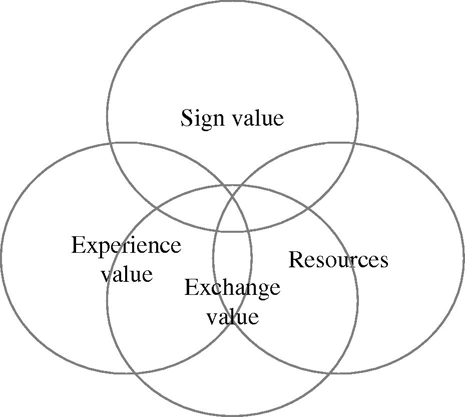
Value propositions as experienced by customers.
Practices contextualize customers’ value creation, resource integration and value propositions; the customers experience and evaluate value propositions and related offerings as their potential resources relative to practices. In practices, cultural discourses (such as ideologies and cultural ideals) as well as the opportunities and constraints of practices inform resource integration. They inform the customers which meanings of the value propositions are desirable and acceptable, and thereby guide the acceptance of value propositions and how the offerings are used and integrated with other customers’ resources. The opportunities and constraints of practices refer to context-bound and situational factors which influence how well customers can enact desired cultural discourses in practices, examples being consumer resources, material constraints, other practice participants, and other practices.
Sign value means the ability of the value proposition to address desirable cultural discourses (such as ideologies and cultural ideals) which customers either consciously or unconsciously (try to) enact in a specific practice. The value propositions can include meanings that customers perceive as undesirable. If the customers evaluate that the value propositions cannot provide improved sign value for them compared to their current state, they do not accept the value propositions. In the worst case, the value propositions are unable to raise their attention in the first place. Because each customer has unique resources and experiences and because each resource-integration context of a specific practice is different from others, each customer interprets sign value idiosyncratically. Thus the customers co-create the meanings of the value propositions. The customers often find new sources of the sign value compared to firms’ intentions in two ways: by inventing different meanings and uses for the value propositions in the practice or by integrating the offerings in practices which did not belong to the firms’ initial idea of the scope of the value propositions. The co-creation of meanings starts before the purchase of the value proposition, for example, through advertising (e.g. Mick and Buhl, 1992) or learning from others’ experiences.
Experience value
According to S-D logic, customers (and other beneficiaries) experience the value of offerings idiosyncratically in use (Vargo and Lusch, 2008). Venkatesh et al. (2006) perceive use value and exchange value as derivations of sign value. Drawing on S-D logic and Venkatesh et al. (2006), I argue that experience value is subordinate to sign value. The experience value means that customers can materialize sign value into experience; with the help of the value proposition in a practice the customers can enact desired cultural discourses. The customers can anticipate whether or not sign value is likely to materialize into experience before purchase via cues, such as via advertising and recommendations. If the customers have prior knowledge or experience of the skills and knowledge of the suppliers, they use this knowledge as an indication for the experience value. The customers can actively search for information in order to become convinced that the proposed sign value will materialize into experience. This is well evidenced by countless online forums where peers share their use experiences. When the customers, based on their subjective interpretation, experience value in their practices as the value propositions promised, value becomes co-created. However, this is not what happens in real life where consumers tend to accept value propositions which disappoint them in use (e.g. Bougie et al., 2003).
Resources
According to Vargo and Lusch (2008) applied operant resources, that is, specialized knowledge and skills, are the fundamental bases for exchange where offerings are the distributors of firms’ operant resources for customers’ use. As the primary source of value of the value propositions is their sign value and ability to materialize it into customer experience, it is logical to argue as follows: it is the meanings of the value propositions which inform the customers whether or not to benefit from the firms’ skills and knowledge, and how they want to benefit from them. At the same time, the customers are dependent on the firms’ operant resources which make the value propositions available for them. In most cases, the customers are not skilled enough or lack other relevant resources such as time so that they could materialize their desired sign value into experience by themselves. Therefore, the customers are willing to accept the value propositions proposed by firms (Arnould, 2005).
Exchange value
Exchange value refers to the financial and non-financial sacrifices of a value proposition that are required to integrate an offering with other customers’ resources, in order to materialize desired sign value. The purchase of an offering indicates that the customers accept the value proposition. The exchange value is always subordinate to the sign value and experience value; it is not worth the customers accepting the value proposition when the exchange value is not likely to exceed them. Notice that customers can represent more than one stakeholder groups. In this case, the financial sacrifice can be shared by all stakeholder groups or covered by one customer only. For example, an employer can sponsor its employees’ fitness practices which benefit them both. Furthermore, the accepted exchange value manifests how much the sign value and its anticipated materialization into experience are worth for the customers. Finally, the exchange value manifests and signifies the value of applied skills and knowledge used for materializing the sign value into the customers’ experience. For example, a high price signifies and manifests the prestigious image and excellent cooking skills of a luxury restaurant.
Like experiencing value (Holbrook, 1999) experiencing a value proposition is a relativistic experience. Customers compare value propositions against one another. If the sign and experience value of different value propositions are evaluated as equal, the customers can bargain. As a result, the exchange value can be significantly lower than the sign and experience value. In this specific case, the exchange value does not manifest to the importance of the value proposition in the customers’ value creation. Finally, as earlier discussed, the value propositions are evaluated idiosyncratically. As a result, the desired sign value of the same value proposition varies from context to context. Therefore, the accepted exchange value for the customers also varies by context.
Implication from the value co-creation design perspective: Value propositions as design architecture for reciprocal sign value, experience value, exchange value, and resource integration
Certain S-D logic informed researchers (e.g. Ballantyne et al., 2011; Cova and Salle, 2008; Payne et al., 2005) emphasize that value propositions need to contribute to reciprocal value creation. Therefore, the value propositions have been conceptualized as an interactive process and dialog of crafting reciprocal value promises (Ballantyne et al., 2011; Payne et al., 2005). In this way the value propositions facilitate value co-creation among different stakeholders in the value network (Payne et al., 2005). Co-crafting reciprocal value propositions contributes to the achieving of mutual benefits from the resource integration. I argue that customer value is still a prerequisite for value co-creation in most cases in modern markets where monopolies are seldom and cartels forbidden. Unless the anticipated sign value and its expected materialization into customer experience exceed the exchange value for the customers, they will not accept the value proposition and thus there will be no value co-creation in the first place.
However, at the same time, value propositions need to address and materialize the desirable cultural discourses and the goals of the other stakeholders, such as marketers and their suppliers. Otherwise these stakeholders are not willing or able to invest their knowledge and skills in co-designing the value propositions with/for their customers in the long run. Consequently, from the value co-creation design perspective, this study introduces the value propositions as design architecture for reciprocal sign value, experience value, exchange value, and resource integration.
The findings of this study suggest that designing reciprocal value propositions can take at least three paths. The first path focuses on understanding how existing value propositions could better materialize desirable cultural discourses, such as cultural ideals, into customer experience in those practices where the value propositions are currently used. For example, a food marketer could aim at creating a ready-made food value proposition which addresses and materializes all dimensions of the food ideal. The second path takes a cultural ideal and a relating identity project as a starting point for designing value propositions. For example, a food marketer could aim at helping parents to enact their good parent project better than with the help of current value propositions. This would mean investigating how the parents enact their good parent projects across practices which influence their children's wellbeing. As an outcome, the food marketer could propose to parents non-food related value propositions in non-food related practices. The third path starts by taking current offering as a starting point for enhancing value co-creation and envisioning in which new customer practices it could be integrated. A marketer perceives markets as customer practices. For example, a contract catering firm could perceive a workplace restaurant as firms’ spatial resource for carrying work-related practices, such as a meeting.
Irrespective of the chosen design path, the marketer needs to understand how it can help its customers to better materialize sign value into experience in customer practices. This means understanding what type of sign value customers want to experience in their practices and what obstacles they then face. Thus the design of experience value translates to planning which kind of resources need to be integrated and how so that the customers can materialize the sign value into customer experience. The planning acknowledges that the exchange value cannot exceed the other two value elements. McCracken (2005, p. 175) suggests perceiving marketing as ‘meaning management’. Effective marketing and branding is about addressing valuable cultural meanings or cultural contradictions. This study adds a practical resource management dimension to the abstract meaning management; the marketers need to facilitate resource integration so that desired cultural discourses, such as cultural ideals, can be materialized into customers’ lived experience in different practices.
Resource integration planning includes the practices of the marketer and a larger value network. It is about identifying stakeholders who are needed to design and materialize the value proposition so that the customers can experience the desired sign value. At this stage at the latest, value proposition design includes other participants beyond customers. At the very least they usually look for financial benefits, which has implications for the design of the exchange value. The exchange value needs to be high enough so that it makes sense for a firm and other stakeholders to participate in value co-creation. At the same time, the exchange value must not exceed the sign and experience value because is not worth making non-financial sacrifices and paying more or than what the sign and experience value are worth for the customers. It is worth noticing that stakeholders can and do enter value co-creation for other benefits than financial benefits only. In the ideal case, the involved stakeholders experience improved value through co-creation according to their subjective standards informed by cultural discourses and practices.
Conclusions
By contextualizing the concept of a value proposition in consumer practices, this study aims to contribute to marketing theory, especially to the discussion within S-D logic, in four ways. Firstly, this study extends understanding on the socio-cultural and situational character of value propositions, value creation and value co-creation. It links the generic benefits and sacrifices of the value propositions to the consumers’ practices where the consumers try to enact desirable cultural discourses, such as cultural ideals, by integrating their available resources with offerings. Consequently, this study pinpoints what the essence of the value propositions is in the customers’ real-life contexts: the ability of offerings to help the customers to enact desirable cultural discourses into experience in practices. Hence, from the customers’ perspective, the study constructs the value propositions as firms’ proposals which integrate sign value, experience value, exchange value and resources.
Secondly, informed by Venkatesh et al. (2006) and S-D logic (Vargo and Lusch, 2008), this study integrates three different value concepts: sign value, experience value and exchange value as customers’ decision-making criteria for accepting value propositions. By introducing the experience value and the exchange value as the derivatives of the sign value, this study conceptually captures the customers’ value emphasis. As a result, this study directs the theoretical debate from the exchange value (of goods-dominant logic) versus the value-in-context or use value (of the service-dominant logic) to the primacy of sign value. Thereby this study extends current theorizing (Kowalkowski, 2011) on how circumstances both on the seller and buyer side influence the value emphasis of exchange: exchange value versus use value.
Thirdly, this conceptual investigation highlights the primacy of cultural discourses and practices in resource integration and exchange. The cultural discourses and practices inform customers which meanings of value propositions, and thus which value propositions, are desirable and thereby guide the customers’ purchasing and resource integration decisions. In addition, they guide resource integration in the firms’ sphere. They inform firms which skills and knowledge are needed for designing and materializing value propositions which their customers will value and accept and which will eventually benefit firms themselves. Hence, the study suggests that cultural discourses and practices inform firms where to specialize in terms of skills and knowledge. Furthermore, they guide how different actors as potential beneficiaries are willing to co-operate with each other.
Consequently, from the value co-creation design perspective, the study constructs the value propositions as design architecture for reciprocal sign value, experience value, exchange value, and resource integration. Thereby it offers firms a conceptual tool for designing more effective value propositions where the effectiveness refers to the ability of the value propositions to address and materialize desirable cultural discourses in customers’ (and other beneficiaries’) in practices. In addition, by perceiving markets as customer practices, this study helps firms to extend their market view from the current use situations of their value propositions into other customer practices where value can be co-created. Aligned with Karababa and Kjeldgaard (2013), this study perceives the value of an offering as a dynamic, context-dependent, intersubjective and subjective notion that is constantly co-created and re-created by customers and other involved stakeholders.
Finally, this study emphasizes the primacy of customers in value co-creation. It is the customers who accept and use value propositions in their own ways irrespective of firms’ plans. Value is created by customers for customers (Heinonen et al., 2010). Vargo and Lusch (2008) suggest that value becomes co-created when customers use offerings. Compared to Vargo and Lusch's (2008) view on value co-creation, this study takes a narrower perspective. It suggests that value becomes co-created only when the customers can enact desirable cultural discourses in practices by integrating firms’ offerings with their other resources – and as a result experience value.
The study has various limitations which offer scope for future research. First, even though this study uses the empirical evidence of prior research, it is a conceptual examination. Therefore, a logical continuation would be to examine empirically how consumers experience and evaluate value propositions in their practices. This could include operationalizing the value proposition concept to a construct. Second, it would be valuable to extend the empirical examination from consumers as customers to all the beneficiaries in a specific value network, in order to learn more from the contextualized value proposition. This study recognizes that customers cannot always materialize the desired value by integrating value propositions with their other resources. An empirical examination of value proposition failures would be a valuable approach to learn more from the contextualized value proposition and from customer learning. This study does not investigate post-consumption experiences. Nor does this study focus on examining value propositions as service interactions in practices even though S-D logic emphasizes the relational nature of value co-creation (Vargo and Lusch, 2008). These themes represent relevant future research areas. Finally, this study acknowledges the existence of brands and value propositions as concepts but does not investigate their relationship. Studying theoretically and empirically how these concepts are related to one another would contribute to marketing theory.