







Abstract
It is a common phenomenon that at any gathering, people cluster into small and multiple groups to: chat, exchange ideas, establish relations, and explore collaborative opportunities either within their field of work or even in newer frontiers. Certain relationships remain strong and may eventually lead to fruitful collaborations while others may be short lived. Depiction and/or modelling of such an emergent social networking behaviours are inherently complex. With this motivation, in the context of an academic conference, this research focuses on the development of ‘Networking of Scholars at an Academic Conference (NASC) Model’ using Agent Based Modelling and Simulation (ABMS) technique. The paper describes the model and its implementation in NetLogo. NetLogo is powerful programming environment that facilitates the generation of scenarios and thus helps visualisation of emergent network of relationships among scholars.
Introduction
Academic conferences assure lively forum for scholars for presenting their professional work as papers and posters, intellectual exchanges and debates of their researches, gain knowledge by attending workshops and field trips. In addition to that conferences provide opportunities to join with other scholars to develop cultural, social and scholarly market places for professional developments and collaborative work (Friedkin, 1984; Liberman and Wolf, 1997). In the broader sense, conferences encourage networking among participants could they be new connections, meeting old contacts and/or avenues build long-term relationships. Since a conference is a middle ground, acts as an intermediary among academic faculty, research students, industry practitioners, researchers, industry/product promotional marketers and sales people. Due to the fact of the respective professional boundaries and opportunities present, the knowledge, interests and experience level of the participants may vary, for example from a professor to sales person. Therefore, when these differing groups of people come in contact with each other during the conference, their interactions will not only be driven by their personal behaviours but also their professional attitudes and interests. Thus a study of networking behaviour of scholars is interesting, but challenging due to the complicated and dynamic nature of participants.
Research context
The online dictionaries define an academic conference as a conference for researchers (not necessarily academics) to present and discuss their work. Together with academic or scientific journals, conferences provide an important channel for exchange of information between researchers. The mutual relationships that form among the conference participants at can actually facilitate a network of connections among them. Several authors have studied on how such networks evolve and the behaviours of these networks. Mergel et al. (2005) employed the homophily arguments (tendency for people to connect with others who have similar attributes and behaviour) as well as theories of status and career/life cycle to determine the factors led to the establishment of ties from interactions at the International Network for Social Network Analysis. Berardo (2010) concluded that advice networks are approximately three times as dense as the networks of written collaboration. Wang and Li (2010) suggested that complete and systematic approach is necessary to realize and analyse academic network and used social network analysis (SNA) methodology. McCarthy et al. (2004) indentified the opportunities for interaction are unevenly distributed among attendees at academic conferences and extend the opportunities by designing AutoSpeakerID (augmented formal conference paper sessions) and Ticket2Talk (augmented informal coffee breaks).
Despite the progress in analysing and studying the academic networking, little advance is made to model the phenomenon due to the complex nature of the interactions among scholars. Recent advances in Agent Based Modelling and Simulation (ABMS) techniques with roots in complex adaptive systems are emerging to help the researcher to model interactions among intelligent beings. With this motivation, this paper focuses on modelling networking of scholars in an academic conference setting using this relatively new technique, ABM that has a powerful mechanism to visualise the emergence of patterns.
Research questions and hypotheses
The principal motivation for this research is to find an answer for the question: “What encourages the development of strong links between conference participants?”
The research question implies two hypotheses, as follows:
We aim to address these hypotheses by building a simulation model. NetLogo provides an easy environment where participants are represented as agents, and their interactions over time can be analysed through a set of assumptions. The assumptions are portrayed as explicitly as possible to that output of simulation runs can be visualised. NetLogo facilitates to experiment with varying values to assumption variables through the NetLogo interface. The next section briefly describes the model construction, followed by discussion of results obtained through analysis. We also share the network of relations through a small sample obtained during our ABM training program. The last section also looks at the limitations of the study and what opportunities exist for future research.
Model construction
In formal or informal gatherings it is noticeable that some people may attract the other participants more than their peers. These popular participants may be the centre of attraction either due to their eloquence, lively debate on some hot topics and in case of academic gatherings these could be prominent researchers who had worked or working on interesting or emerging areas of knowledge. While several attributes together might explain this prominence, it is worthwhile to a build a model with simple concepts and progressively increase the complexity as the model's formative or predictive nature gets validated. We assume that ‘Sociability Index (SI)’ and the willingness to mix with other professionals (P) are the key factors in the formation of relationships; as such the NSAC Model builds on these assumptions. They are expressed as a fractional value ranging from 0 to 1, 0 meaning very low sociability or lack of willingness to mix and 1 meaning high sociability or extremely open to mix.
As noted earlier, the general professions of participants at an academic conference are academic staff, research student, or people working in research and development establishments. It is natural that in an informal gathering people tend to initiate dialogue with similarly positioned peers more easily and form networking links with them as some mutually interesting and beneficial common factor emerges out of their dialogue. The other interesting aspect at these gatherings is that people who know before or people from the same institute likely to cluster initially and sustain than a cluster fully heterogeneous participants belonging to several different institutes.
NetLogo representation
In NetLogo participants are referred to as agents. Agents have built-in attributes like shape, size, colour etc. The modeller can assign additional attributes, like SI as noted above. NSAC model utilises colour to designate university, shape to convey profession and size to express SI of each participant. Fig. 1 provides the NetLogo interface of the model. User defined settings allow the user to choose a value for each of the exogenous variables. Setup and Go buttons allow the initialisation of the simulation environment and running of the simulation, respectively. The right hand side of Fig. 1 depicts a conference environment with agents distributed randomly across a meeting room. The five rectangular boxes to the left are the gathering locations for the agents during session breaks.
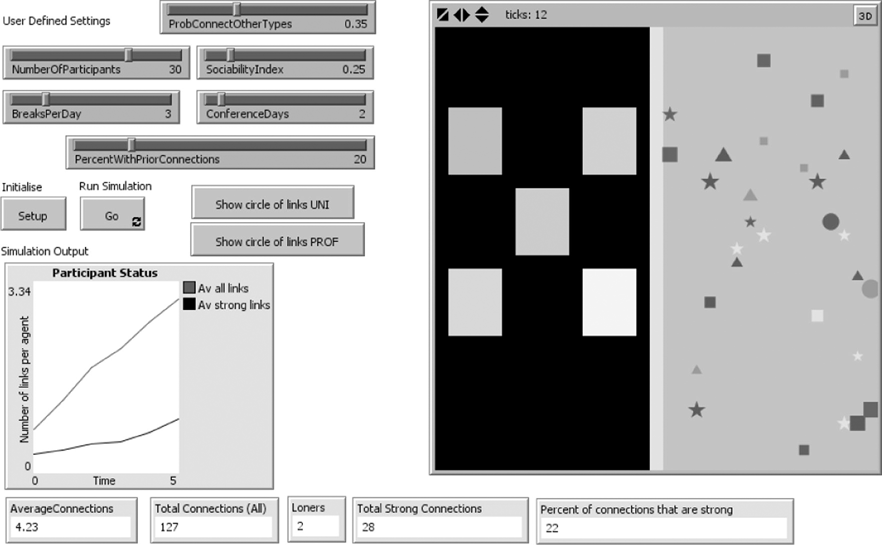
NSAC model interface (NetLogo programming environment).
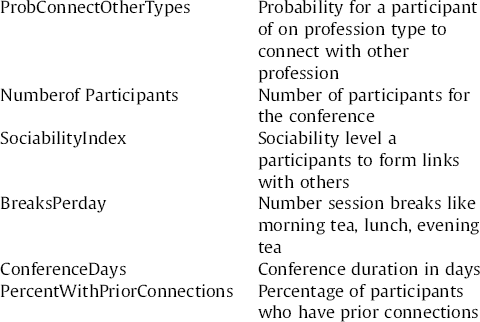
The NetLogo allows the user to simply slide the switches and assign values to the variables. Then the user can run a simulation changing either each or all of the switches at each instant. This provides a flexible mechanism to generate various scenarios, for example, a conference of 3days, 4days or 5days etc. At the end of the simulation run the user can visualise the links formed by clicking on the show circle of links buttons. The Buttons labelled ‘Show circle of links UNI’ and ‘Show circle of links PROF’ allows the user to see the link formations after each completed simulation run. The link formations can be viewed in two different modes, categorised either by university or profession of the participants.
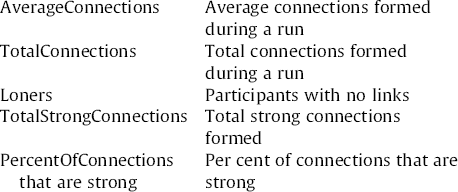
The NSAC Model is coded in NetLogo with a set of assumptions and procedural logic. The underlying algorithm that facilitates the links generation can thus be summarised as:
At each break participants are randomly assembled at five clustering locations. Participant status is randomly set as ‘Active’ or ‘Passive’. Only active participants will join a cluster. Participants establish new links or strengthen existing links between them. Combined sociability index, and belongingness to the same university or profession play a role in the link formation. Links established for during iterations (tick) and total links established by each participant are computed and tracked. The interaction process is simulated based on number of conference days and breaks per day user-settings. Each break consists of two iterations.
Fig. 2 shows the portrayal of emergent relationships between participants for a typical run. Each apex in the figure is a participant; lines joining them are the established links and thickness represents the strength of the relationship.
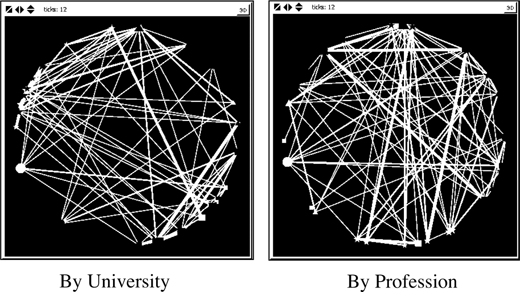
Emergent networking links between participants.
Test runs
The model was tested with four levels of participants and two sociability-index levels, implying 119 simulations. The model performed well within the levels of input changes. However, the exploratory statistics given in Table 1 clearly showed the higher standard error suggests insufficient data and therefore more simulations are needed for firm conclusions. Nevertheless our conclusions were strictly based on our initial assumptions when building the agents.
Exploratory statistics of NSAC model outputs (total connections, total strong connections and number of loners).
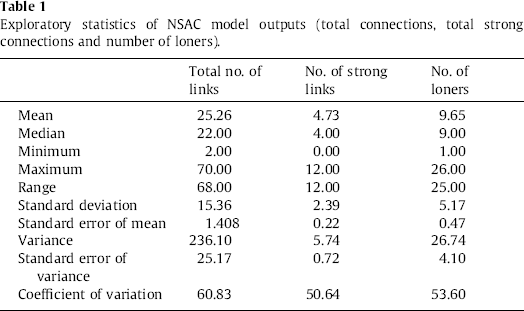
Exploratory statistics of NSAC model outputs (total connections, total strong connections and number of loners).
The data represented in Fig. 3 clearly showed the positive linear relationship between numbers of Academics and SI levels in a one conference; however need further simulations with changes of other inputs. Similarly a positive relationship was also observed between number of links and the total strong links (Fig. 4). The data presented here is only about one-day conferences, therefore participants’ retired state is not evident.
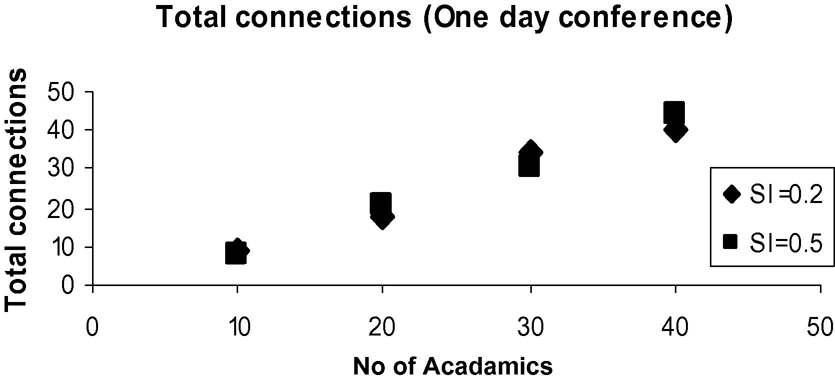
Number of participants vs links generated.
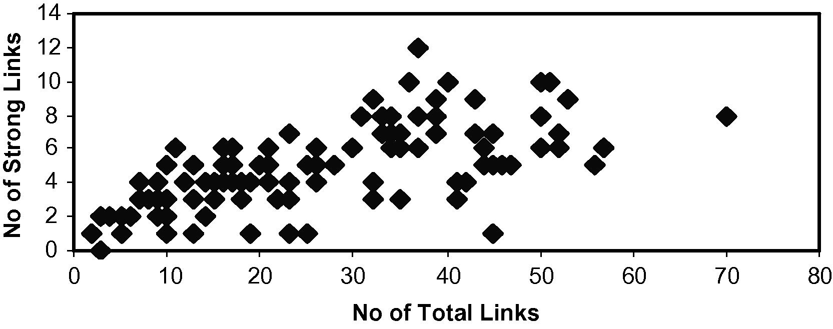
Totals links vs strong links.
The model was further tested for the deferent level of willingness to mix with other groups (i.e. 0.25, 0.35, 0.45 and 0.55) when number of breaks/day changed as 2, 3, 4 and 5 assuming that breaks were available prior to conference in the morning, at morning tea, at lunch, at afternoon tea, at drinks/dinner in the evening. In the test runs number of participants was limited to 30 and sociability index were set as 0.2. Constraining the number of conference time as three days, ten iterations were performed per each combinations and results were presented as graphically for average connections, total connections, number of loners and total strong connections and the resulting outputs were presented as Figs. 5–8. Although the number of iterations was very limited the emerging patterns were clearly observed from the data as lower values of willingness to mix with others index (P) set to 0.25. The number of loners was increased when P was decreased.
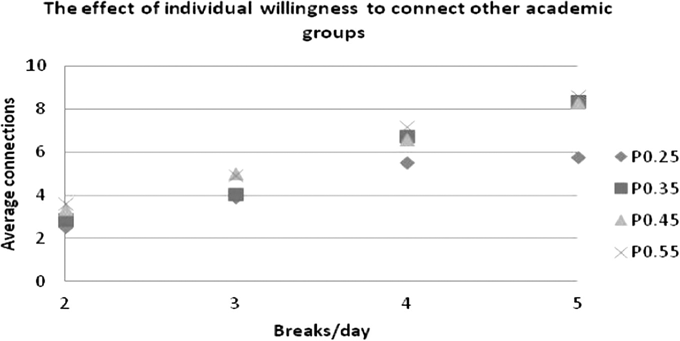
Effect of individual willingness to mix with others and number of breaks/day on average connections.
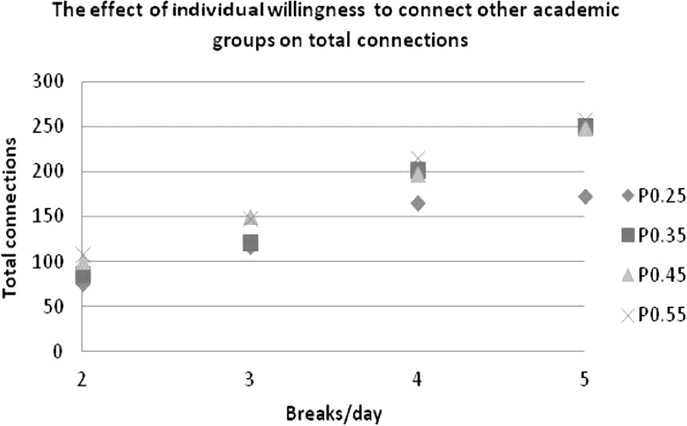
Effect of individual willingness to mix with others and number of breaks/day on total connections.
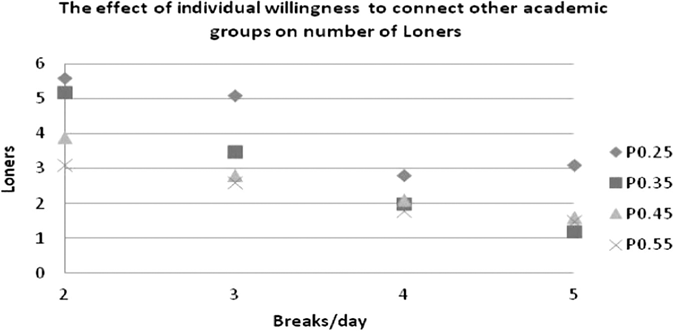
Effect of individual willingness to mix with others and number of breaks/day on number of loners.
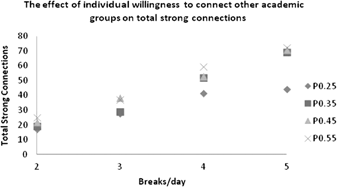
Effect of individual willingness to mix with others and number of breaks/day on total strong connections.
The authors sought to understand the links formation among participants during an intensive program on ABM. The following Fig. 9 presents the actual status of links formed among the participants. Six responses were obtained from a group of 54 participants. The questionnaire identified each participant with a unique number, and the respondents are asked to check mark whether they happened to make a link with each of the participant. The responses are tabulated and fed as input to a NetLogo program specially written to process and depict the links.
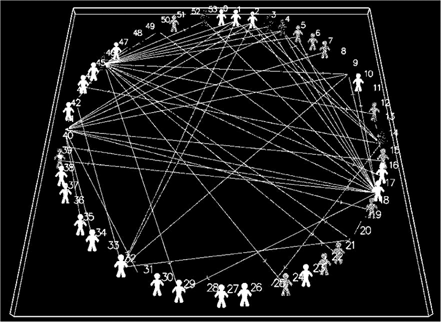
Network of relations based on participant survey.
The research into NSAC Modelling provided a view an opportunity to understand that complex models where intelligent agents involved can easily be constructed using NetLogo. The simulations and simple statistical tests provided a positive indication of the validity for the hypothesis. The model allowed us to work with many combinations which were impossible to experiment in real world situations in a short time. In essence, this research effort itself bears testimony for the emergence of collaboration between the authors.
Limitations and future opportunities
Validation of NSAC Model requires considerable work as any other model. A survey has been contemplated to collect relationships formed and other assumptions underlying the relationship formations between participants. We intend to collate this data, arrive at the real world phenomenon, fine tune and validate the model. In this model we consider only the sociability and wiliness to mix with others as indices. In the real world links can be formed on the basis of gender, country and specific subject areas or interests. Similarly there is a possibility to not get linked with some people and avoid linking with their immediate circle. In future, all of these concepts can be added to the model.
Footnotes
Acknowledgements
Authors gratefully acknowledged Associate Professor David Earnest of Old Dominion University, USA, the course instructor of the Complex Adaptive Systems and Agent Based Modelling workshop, University of Sydney for introducing us to ABM world and his lecture series where we found the initial idea for this paper. The help given by Prof. Louise Young, University of Western Sydney during the conceptual stage of the project is also acknowledged. The authors also thank Prof. Ian Wilkinson, University of Sydney the ABM course coordinator for giving us the opportunity to participation. We also would like to thank Dr. Steven D'Alessandro for his continuous encourgement. We also like to extend our appreciation to Ms. Anna Evanelista, Mr. Luke Greenacre, Ms. Sharon Purchase, Mr. Rukman Wimalasuriya, Mr. Benjamin Cheng and Ms. Deborah De Freitas for providing the evaluation feedback. We also would like to acknowledge Ms. Sana Marroun for her support during initial meeting and her amazing team spirit.