







Abstract
Competition is intensifying amongst shopping malls. In response scholars have advanced various perspectives regarding how to differentiate shopping malls to gain competitive advantage, such as adding or expanding the level of entertainment available (Sit et al., 2003). Others suggest malls satisfy non-functional wants, which stem from associations one has with the mall (Rintamaki et al., 2006). Herein, a reflective measurement model is tested that explores the relationships between the latent constructs shopping mall image and congruity on customer behaviour. A high-end shopping mall in Indonesia is the context. As hypothesized, shopping mall image had a strong effect on customer behaviour, namely, the likelihood of purchasing, returning to the mall, and spreading positive WOM. However, congruity – captured by the indicator variables ‘self-image congruity’ and ‘congruity with other shoppers’ – had no effect on customer behaviour. We attribute this unanticipated finding to Indonesians scoring low on Hofstede's dimensions of Individualism and Indulgence. Survey participants indicated that there was high self-image congruity as well as congruity with other shoppers, but were unwilling to admit it affects their shopping behaviour – arguably, that would be self-indulgent and indicate a lack of restraint with respect to controlling their desires.
Introduction
Intense competition amongst shopping malls has forced mall managers to create differentiation between their mall and that of nearby competitors. They start to do this by carefully understanding what their target consumers’ market values are, hence, what drives their shopping behaviour. Over 40 years ago it was recognized that customers at retail establishments seek more than just utilitarian benefits, such as price and convenience (Tauber, 1972). Solomon (2002, p. 299) comments: “Shopping malls have tried to gain loyalty of shoppers by appealing to their social motives as well as providing access to desired goods… Malls are becoming giant entertainment centers…” Numerous conceptualizations of what drives customer value have been advanced that vary in their hierarchy (abstract versus concrete drivers) as well as complexity (Rintamaki et al., 2006, and Sit et al., 2003, offer reviews). A failure by management to identify factors that ultimately affect shopping behaviours could very well lead to creating a mall image that is not congruent with the customers’ self-concept. One strategy to create a favourable shopping mall image is by managing attributes inherent to the mall. Sit et al. (2003) suggest these attributes include merchandising, accessibility, service, atmospherics, entertainment, food, and security. These attributes are controllable and can serve to satisfy functional needs; but Rintamaki et al. (2006) suggest customers seek to satisfy non-functional wants too, which stem from associations one has with the mall.
Each customer has his/her own perception of a shopping mall's image and thus can derive different levels of value from their shopping experience. Given a choice between two or more easily accessible malls, a customer will visit and shop at the mall that has an image congruent with their self-concept. Self-image congruency is defined by Kressmann et al. (2006) as the match between a consumer's self-concept and their image of a given product, store, or in our case, a shopping mall. Their study involved surveying car owners, and they found that the greater the self-image congruency, the greater was the loyalty towards the brand. The same reasoning can be applied to why a customer decides to visit and shop at a particular mall. Herein, we explore the relationship between the latent constructs shopping mall image and congruity on customer behaviour. The context is a high-end mall in Indonesia.
Surabaya is the second largest city in Indonesia and has, according to the Association of Shopping Mall Management in Indonesia, more than 33 shopping malls, ranging from low price-quality tier shopping malls to premium, luxurious shopping malls. Naturally, this creates intense competition, and managers are responding by pursuing differentiation strategies. One of the new shopping malls in Surabaya, Indonesia, is Ciputra World Surabaya which was established in 2011. A management goal was to develop a luxurious mall image by carefully considering the mall's design, the selection of retailers as well as offering excellent hospitality all under one roof where customers can express their modern lifestyle. But there are unanswered questions about the effectiveness of the chosen strategy on shoppers’ behaviours. Thus, the focus herein is to provide insight into how perceptions of the mall (its image and how congruent it is with one's self-concept) affects consumer's shopping behaviours, specifically the likelihood of purchasing, returning to the mall, and spreading positive WOM.
Literature review and hypotheses
The starting position taken herein is that there is a link between the latent constructs shopping mall image and customer behaviours. But what are the observable and positively correlated indicator variables that would serve to reflect the latent construct shopping mall image? Levy and Weitz (2007) suggest that there are attributes of a shopping mall that play a significant role in shaping the image of the mall; however, there is no one set of attributes scholars have agreed upon (Rintamaki et al., 2006; Sit et al., 2003). We take the perspective advanced by Sit et al. (2003) that there are seven shopping mall attributes. Consistent with reflective measurement models, these items intuitively meet the criteria of being inter-correlated; they share a common theme, and thus adding or dropping one of the indicator variables would not change the meaning or conceptual domain of the latent construct shopping mall image (Coltman et al., 2008). An advantage of embracing Sit et al. (2003) is that it provides granularity without being overwhelming from an empirical sense, and all the attributes are intrinsic to the mall and controllable by management. We acknowledge that factors affecting the customer experience, such as crowds or the perceptions of crowds which affect shopper satisfaction (Jones et al., 2010), are excluded.
The seven indicator variables considered herein are taken from Sit et al. (2003). These are:
Merchandising, which refers to the products that are sold at the mall. Finn and Louviere (1996) state that merchandising includes product assortment, quality, pricing, and fashion or style. Solomon (2002, p. 299) commented that some malls are so focused on becoming places of entertainment “almost to the point that their traditional retail occupants seem like an afterthought.” Accessibility refers to the ease of getting to, entering and moving about within the shopping mall. According to Levy and Weitz (2007), there are two main accessibility components, macro accessibility and micro accessibility. Macro accessibility includes road conditions, road patterns, natural and artificial barriers, and distance from home or office. Micro accessiblity includes parking capacity, congestion, visibility and the ease of browsing and locating stores within a mall. Services, of which there are three types (Sit et al., 2003): personal service, communal service and amenities service. Atmospherics includes design, scent, music, lighting, etc., factors that create affective quality. Collectively, these create the ambience inside the mall. Entertainment facilities inside the mall. There are two types of entertainment facilities: permanent entertainment, for example movie cinemas, karaoke stations, and beauty and spa rooms; but there is also occasional entertainment, for example exhibitions, fashion shows, and seasonal displays. Food or food courts inside malls encourage customers to stay longer and appear to stimulate impulse buying (Haynes and Talpade, 1996). Security, which refers to how safe the customers feel within the mall as well as when entering and leaving.
Sirgy and Samli (1985) argued that when customers have favourable perceptions of a store's attributes, it increases customers’ repurchase intentions as well as their shopping frequency at the store. Moreover, Bloemer and de Ruyter (1998) stated that positive evaluations of store attributes increases customer satisfaction and customer loyalty. Customer loyalty refers to customers voluntarily choosing to keep connecting with or purchasing certain products over the long term. There is a difference between short term and long term customer loyalty. In short term loyalty customers may exhibit loyalty but switch easily when they find other interesting or better offerings; in the case of long term loyalty the customer will stay loyal even though there may be potentially better offerings available (Liu et al., 2011). Loyal customers exhibit regular buying behaviour over a given period of time (Griffin and Lowenstein, 2001). Herein loyalty refers to the customers’ intentions to regularly visit and shop at Ciputra World Surabaya even though there are other high-end shopping malls in Surabaya. Given these insights, the following hypotheses are advanced:
Customers tend to visit and shop at malls that have an image congruent with their self-concept, which stems from the belief one holds about themselves as well as from the responses (opinions, judgements) by others when interacting with them. Reed (2002) proposes that self-concept is the individual's perspective about his/her life that develops automatically through interactions with others. Kressmann et al. (2006, p. 955) define self-image congruency as “the match between consumers’ self-concept (actual self, ideal self, etc.) and the user image (or ‘personality’) of the given product, brand, store, etc.” Thus, when a customer purchases a product or patronizes a store, particularly one of a hedonic nature which is likely to be well represented at an upscale mall, it is likely that one of the motivations satisfied “can be understood through a symbolic interactionism perspective which emphasizes the importance of products in setting the stage for the multitude of social roles that people play… Shopping represents a social act where symbolic meanings, social codes, relationships, and the consumer's identity and self may be produced and reproduced” (Rintamaki et al., 2006, p. 14). In short, customers buy hedonic products that express their self-image. When products are congruent with their self-concept then they become loyal to those products (Kressmann et al., 2006). Mall managers must therefore endeavour to understand their target market's self-concept and armed with that knowledge create a mall image that is congruent with it. Self-image congruency will increase customer loyalty. The following hypothesis is therefore advanced:
This research effort used a mall intercept survey; 200 respondents completed the survey at Ciputra World Surabaya, Indonesia. There were two sections to the survey. The first collected information regarding the respondent's gender, age, education, and monthly income; and the second section the reflective indicator variables described below.
Twelve measures were collected to reflect three latent constructs. The first of these constructs, shopping mall image (henceforth ‘shopping’), comprised perceptions by customers of seven indicator variables (Sit et al., 2003): merchandising which refers to the quality and product assortment sold by outlets within mall; accessibility which refers to the ease of access for the customer to enter and to leave the mall; service which refers to the service facilities offered within mall; atmospherics which refers to the overall ambience experienced by the customer inside the shopping mall; entertainment which refers to the variety of entertainment inside the shopping mall; food which refers to the food choices available inside the mall; and finally security, which refers to how safe the individual feels during their visit at the shopping mall.
The second latent construct is ‘congruity’ that includes two reflective indicator variables: self-image congruity which refers to the perceived congruity between the individual's self-concept and the shopping mall image, and social self-congruity which refers to the congruity between the customer's self-image and their image of other customers at the mall. Finally, the third construct is customer behaviour (labelled ‘loyalty’), and includes three indicators: repeat purchase which refers to the customer's intentions to repurchase products at the shopping mall; word-of-mouth which refers to customers recommending the shopping mall to others; and future shopping intentions which refers to the customer's intentions to continue coming to the shopping mall.
All the reflective indicator variables were measured on 5-point Likert scales.
Results and analysis
Descriptive analysis
Customers who visit Ciputra World Surabaya are predominately women (68%); regarding education, the majority range from senior high school to university graduate. Occupations included students, entrepreneurs, government officers and professionals/executives; average income ranged from Rp 1 up to Rp 10 million (∼$1000 AUD) per month.
Model estimation
Convergent validity was assessed by comparing the reflective indicator score to the latent variable score. From Fig. 1 it can be seen that all reflective indicator scores had a value that exceeded the cut-off value of 0.5, which means that the research model fulfils the minimum requirement for convergent validity. The lowest reflective indicator score amongst the seven shopping mall attributes variable was merchandising (0.583), suggesting that this attribute contributes less to the overall latent shopping mall image construct, but this must be interpreted with caution as merchandising was correlated with four of the other six remaining indicator variables (p<.05). With respect to the two congruity measures, both reflective indicator scores exceeded 0.83; these two indictors were also correlated with each other (p<.01). Finally, the lowest reflective indicator score for customer loyalty was word-of-mouth (0.584), which means that the latent loyalty construct is driven more by customer's intentions to repurchase products at the shopping mall and to continue coming to Ciputra World Surabaya. WOM was correlated with intentions to continue coming to the mall (p<.01), but not with repurchase intentions (p > .05). The average variance extracted was greater than 0.5, thus the research model has good discriminant validity. The R-square for the inner model was 0.474.
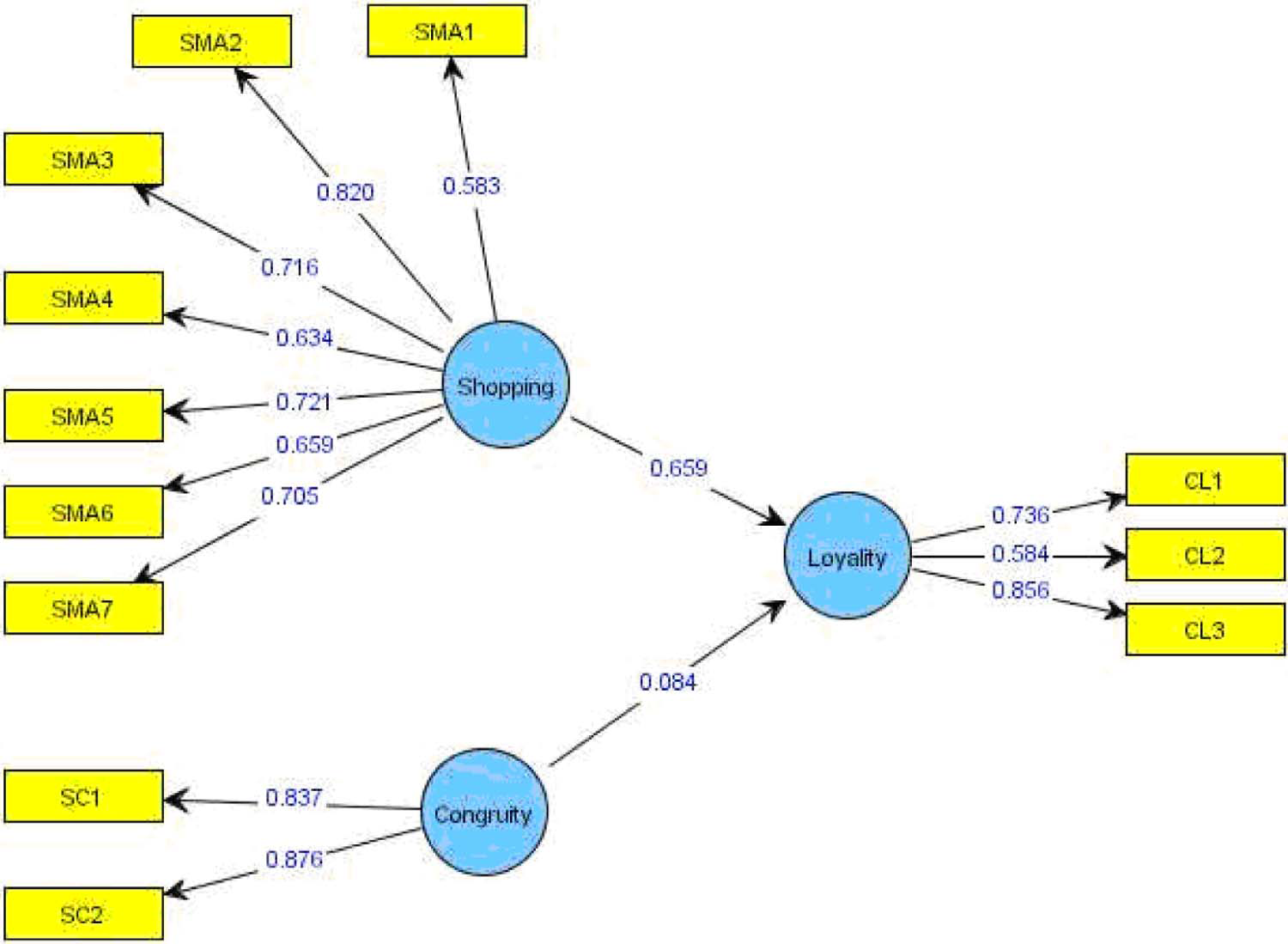
Partial least squares research model.
The mean values for all seven indicator variables reflecting ‘shopping’ exceeded 4.18/5, suggesting that the mall performs well on all these attributes. Similarly, the means for the three reflective measures for customer loyalty exceeded 4.13. As seen in Fig. 1, the gamma coefficient is 0.659 (t-statistic = 6.953, p<.01), thus, ‘shopping’ significantly influenced customer ‘loyalty’ as predicted by H1.
Regarding the congruity measures, self-image congruity had a mean of 3.65 whereas social image congruity was 4.09. A plausible explanation for these scores is provided by The Hofstede Centre (The Hofstede Centre, 2016). Indonesia scores low on Individualism (14 versus Australia's score of 90) and relatively low on Indulgence (38 versus Australia's 71). If one accepts Hofstede's analysis, Indonesians should place a high emphasis on conforming to the expectations of society and that of groups to which they belong (Indonesians rarely shop alone), hence the relatively higher social image congruity mean score (4.09). At the same time the indulgence score suggests they are restrained by social norms, and they should try to control their desires, which could explain the relatively lower mean for self-image congruity (3.65). The gamma coefficient is 0.084 (t-statistic = 0.856, p > .05), thus ‘congruity’ does not significantly influence customer loyalty; therefore H2 is rejected. It appears that individuals can indicate that there is reasonably high self-image congruity as well as congruity with others, but be unwilling to admit it affects their loyalty – arguably, that would be self-indulgent and indicate a lack of restraint with respect to controlling their desires.
There is no generally accepted model for what factors drive customer value although customers have functional needs to satisfy – elements inherent to the mall – as well as non-functional wants, which stem from associations one has with the shopping mall (Rintamaki et al., 2006). As such, the inner model of Fig. 1 has two latent constructs: the first, labelled ‘shopping’ endeavours, to capture functional needs, and the second, ‘congruity’, to capture non-functional wants. With respect to the former we measured the seven shopping mall attributes advanced by Sit et al. (2003) to reflect the latent construct ‘shopping’ – these attributes are inherent to a mall and controllable by management. The relationship between ‘shopping’ and ‘loyalty’ was significant, hence H1 was supported.
The means value for all seven reflective indicator variables were greater than 4.18/5, thus management has done an excellent job delivering on these attributes. It would be inappropriate to jump to any conclusions regarding the relative contribution of one reflector variable compared to the others as the variables are expected to have inter-item correlation and the inclusion or deletion of an item is not meant to alter the conceptual domain of the latent construct of interest, shopping mall image (Coltman et al., 2008). However, while a priori these items were expected to be correlated, there were exceptions: merchandise was not correlated with atmospherics or security; and food was not correlated with service and atmospherics (all p's > .05). Accessibility and entertainment were the two items correlated with all seven indicator variables. Sit et al. (2003; but see Haynes and Talpade, 1996, and Solomon, 2002) suggest that entertainment is a “neglected” attribute shaping a mall's image, along with food and security.
The gamma coefficient between ‘congruity’ and ‘loyalty’ was not significant, thus H2 was not supported. This was unexpected. Over 40 years ago Tauber (1972, p. 49) commented that “[M]any retailers would benefit from defining their business as being part of the social-recreational industry.” Rintamaki et al. (2006) provide empirical support regarding the social value of department store shopping, concluding that “[O]ur insights suggest expending effort that boosts one's status or self-esteem could be a viable differentiation strategy as it would create social value” (p. 20). Herein we found there was significant correlation between the two indicator variables that reflected the latent ‘congruity’ variable (one measured congruity between self-concept and store image, and the other congruity with other patrons), but there was no significant relationship between ‘congruity’ and ‘loyalty’. The mean values for these two indicators were 3.65/5 and 4.09/5, respectively. Despite these reasonably high means, this did not translate into loyalty. We suggest this is due to Indonesians ranking low in Individualism and Indulgence (The Hofstede Centre, 2016). Hofstede would suggest Indonesians have a strong desire – relative to Australians – to conform to social norms and control their desires. Admitting that they like to indulge in shopping and satiate desires through consumption would seem to run counter to these underlying cultural tendencies. Nevertheless, we strongly caution against concluding that congruity and shopping behaviours have no relationship. Research to date steeped in a Western perspective suggests there is a social dimension to department store shopping that should not be ignored (Rintamaki et al., 2006). But perhaps the lack of a significant relationship is more prosaic: there are other high-end malls in Surabaya, Indonesia, and these malls may very well also rate high on congruity, thus congruity does not drive loyalty, but rather characteristics of the mall that shape its image. We therefore encourage further research to explore this potential relationship and tease apart these different views. A cross-cultural comparison could shed light on the Hofstedian view, and an intra-city mall comparison could unearth the role, if any, of congruity and customer loyalty amongst Indonesian shoppers.
Footnotes
Acknowledgement
A previous draft of this paper was presented at the Tourism Hospitality International Conference.