







Abstract

From the time when human beings consumed only necessities defined as goods and services necessary for survival such as food and shelter, we have arrived in an era where we need loans to satisfy all the consumption needs we have. We have evolved from Homo sapiens into Homo debitus (Lazarato and Jordan, 2011). However, nature that we have always considered as self-renewing has shown its limits, in form of natural catastrophes that scientists consider human-made through the pollution that our consumption has created. Hence, recent trends in consumption have emerged ranging from ethical and sustainable consumption (Papaoikonomou et al., 2011) to extreme forms of anti-consumption (Chatzidakis and Lee, 2013) to solve the problem. From minimal to maximal consumption, the circle of consumption is now closing itself in the era of mega-trendy sustainability (Kotler, 2011; Prothero et al., 2011) as Fig. 1 shows.
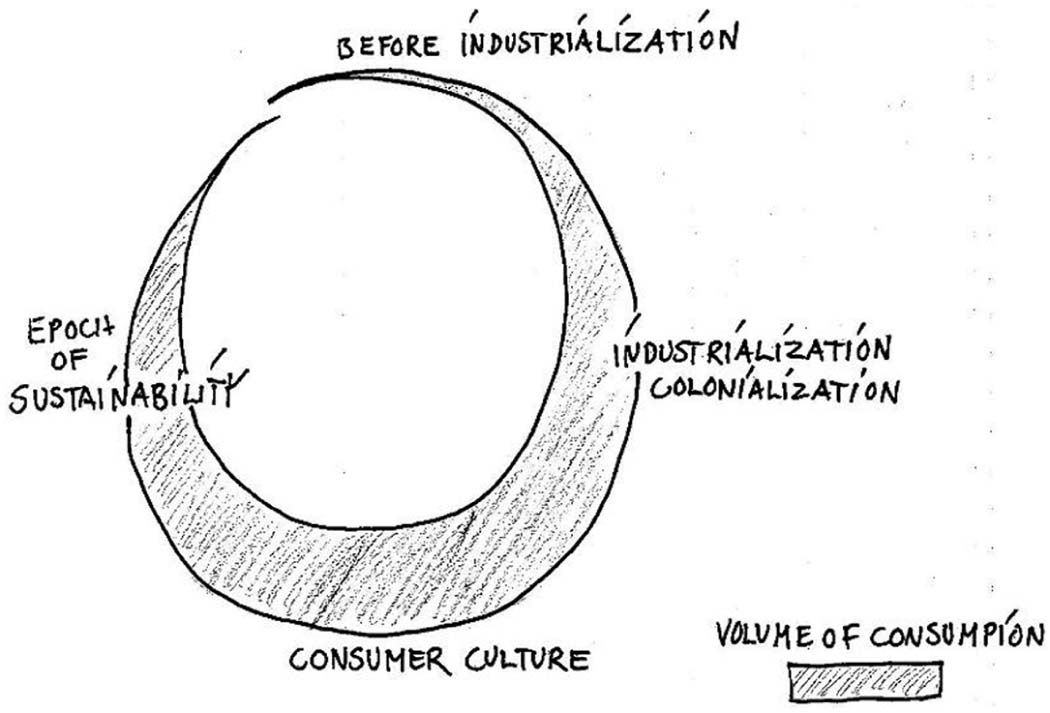
The circle of consumption.
Marketing as a managerial activity and field of study (Layton, 2009) has followed the circle. In the era of gathering and before industrialization, marketing was a less aggressive managerial activity as the cultivated and handmade products could not be made for surplus. Supply and demand found each other in perfect conditions, and since the production time was long producers could not make too many products. All this changed when industrialization and colonialization made it possible to produce too many products and services for very low prices. The era of surplus in supply began and created new needs and extended needs with up- and cross-sales, creating a global consumer culture. Marketing as a more aggressive managerial activity emerged from the era of consumer culture.
Marketing as a field of study (Layton, 2009) has also followed the above development, as the development of definition of marketing shows. While in the rise of consumer culture the definition embraced only business activities, in the twilight of consumer culture it already includes “society at large.” Table 1 provides the development of definition of marketing.
History of definition of marketing.
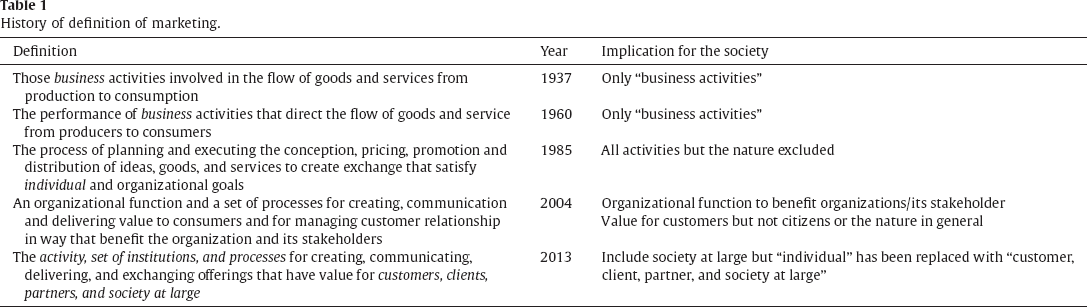
Until the 1960s the marketing definition has been that of “business activities” (Gundlach, 2007) excluding both society at large, nature, and human beings as citizens, thus illustrating the era of mass consumption and emergence of consumer culture. In 1985 the definition has been broader to include “all activities” but still excluding concern for nature or society. The broader conceptualization might have had its roots in the birth of social marketing where marketing ideas were implemented to solve social issues (Andreasen, 2002; Kotler and Zaltman, 1971). However, still the definition marginalizes individuals into only consumers and ignores nature. The last definition of marketing does take society at large into consideration, and speaks about institutions instead of organizations; but still human beings are consumers, clients or partners but not non-economic units such as citizens or individuals. However, social marketing reaches also to individuals other than consumers, clients or partners. Hence, the definition of marketing could be even broader, to address social and environmental concerns: “The activity, set of institutions, and processes for creating, communicating, delivering, and exchanging offerings that have value for human beings, society at large, and environment.”
What is the future of marketing today when many of us see the need for down-shifting consumption for the sake of nature and ourselves? I suggest two scenarios. First, the death of modern marketing as management activity in the epoch of new ecologically and socially conscious consumers and anti-consumption human beings, who have also received education in media criticality. Second, the use of marketing management tools to enhance goals of sustainability that are less covered in the social marketing domain.
Marketing as marketing systems that are “…complex social networks of individuals and groups linked through shared participation in the creation and delivery of economic value through exchange” (Layton, 2015, p. 303) still also embraces “economic value”; however, it also acknowledges quality of life as an outcome of marketing systems (Layton, 2009). The generation of human beings that are more concerned about well-being of our globe than individual economic value will define quality of life beyond economic growth. Individual quality of life for this generation may be alternative food channels, local communities and businesses or other novel movements that all improve the global quality of life beyond individual well-being. Therefore, the discussion about marketing systems could also include even wider systems than those of “social networks,” since marketing systems, too, are embedded in ecological systems of plants and animals, i.e., the environment. It is this very environment that cannot carry increased consumption without fatal consequences of collapse (Confino, 2015). Furthermore, if ecological and biological environment will collapse, then collapse of social and economic systems will follow. Therefore, marketing systems cannot ignore the physical and biological systems.
As Fig. 1 suggests, if consumption is diminishing due to the concerns of both our own well-being and our surrounding nature, then what is the role of marketing as a management tool and, consequently as a discipline? This paper proposed the following thesis:
Combination of social marketing and macromarketing to promote and research issues of new alternative lifestyles that go beyond growth, consumption, and individual well-being in order to save the planet. Use our power of macromarketers to promote social issues to profit-making firms that still consider shareholders as their only stakeholders. Extend our study of markets and marketing systems to involve the possibility of “de-growth.” To discuss and propose definitions of marketing and marketing systems that include ecological systems. To use social marketing to promote and develop efforts to support community activities that have been lost in individualistic societies.