







Abstract
This paper's purpose is to analyze how persuasion mechanisms are applied in current advergames. The study's rationale is that brand position and integration, the autonomy of the brand message in the game and the game-goal–message-goal overlap, entertainment as well as word-of-mouth and social integration are essential persuasive mechanisms of advergames. A sample of 195 advergames was taken from several popular advergames sites and was analyzed by two independent coders for the identified persuasive mechanisms using a developed coding manual. The content analysis revealed that advergames in general apply all six persuasive mechanisms. Logos are shown and used more often than products. Additionally, results suggest a high autonomy of the message (e.g. most applied placement tactics displayed the logo and product name as well as showing corporate colors). Furthermore, a high congruence of logos and products with the game content was observed. The results reveal that more than a third of games were well liked and included several mechanisms to increase competition. Word-of-mouth and social aspects were integrated to a small extent. The results are useful for researchers, game developers and companies, as well as for gamers. Implications for consumer researchers as well as industry professionals are provided.
Introduction
In recent years, advergames have gained a lot of attention from practitioners and researchers alike. Branded entertainment activities are seen as a valuable extension to engage with consumers within larger campaigns (Kretchmer, 2004). Advergames are custom-made for the advertiser, differentiating them from in-game advertising, which is more likely to resemble product placements in terms of the effects (Terlutter and Capella, 2013; Waiguny et al., 2012). According to Wallace and Robbins (2006), advergames can be defined as “A web or downloadable game where the primary objective of building is to deliver advertising messages, drive traffic to web sites and build brand awareness.” (p. 26). Călin (2010) defined advergames as “…online games that incorporate marketing content” (p. 726), which means that advergames can be a promising tool for conveying specific brand messages (Kretchmer, 2004) and usually reference one specific brand or product (Grossman, 2005).
In terms of the uses and gratification (U&G) approach of motives of media use (Katz et al., 1973), escapism, competition, fun and curiosity are central motives for playing advergames (Lee and Youn, 2008). Advergames are played for fun, they are played voluntarily and players typically access the website hosting the advergame deliberately. Hence, the contact of the individual with the advertising message in an advergame is based on greater levels of voluntariness than is the case in most other forms of advertising.
The custom-made nature of advergames also allows the exertion of influence and the use of persuasion within the game. Various researchers in the disciplines of advertising, marketing and game design studies have investigated the mechanisms, particularly with regard to how the games persuade (for an overview on the research see, e.g. Terlutter and Capella, 2013; Waiguny et al., 2012; Youn et al., 2012).
Previous content analyses of advergames
Only a few studies have analyzed the prevalence of advergames and they have done so from very different perspectives. Most of the recent analyses of advergames were embedded in the content analysis of food and toy manufacturers’ websites (Culp et al., 2010; Weber et al., 2006) as well as popular children's websites (Alvy and Calvert, 2008) and merely considered counting the available advergames. All studies indicated that advergames are already a common form of communication addressed to children in the U.S. (Culp et al., 2010; Moore and Rideout, 2007; Weber et al., 2006). Hofmeister-Tóth and Nagy (2011) pointed out that advergames are a successful tool to promote strategies and to reinforce and generate brandrecognition as well as positive associations toward the advertised products. Thus, a considerable body of research has elaborated on what makes advergames persuasive and discusses different processes and mechanisms (for more details see Appendix A).
The studies answered important questions about different forms of brand integration and viral behavior related to advergames. However, a systematic, empirical overview detailing which persuasion mechanisms are currently applied in a large number of advergames is missing. Hence, by means of content analysis, this paper investigates a large number of current advergames and analyzes which and how persuasion mechanisms derived from scientific evidence are applied in the advergames. Therefore, the purpose of our paper is to answer the following research question: How are persuasion mechanisms and principles applied in current advergames?
We contribute to existing literature and practice by, first, providing a comprehensive framework of persuasion mechanisms and principles which are derived from an evidence-based literature review. By doing so, we demonstrate how many suggestions from academia are applied in current advergames. Second, we investigated which of the principles and mechanisms are applied. Practitioners might find the paper interesting to identify possibilities to increase the persuasive power of the advergames.
Literature review: Persuasion principles and mechanisms
“Persuasion refers to the power of persons to alter attitudes and behavior through information” (Cacioppo et al., 1991, p. 799). Therefore, persuasion represents an essential aspect of human communication and can be defined as the attempt to use communication to influence, i.e. to either change or maintain attitudes, beliefs and, ultimately, behavior. Cialdini (2007) demonstrates six key principles of persuasion, which explain how to use marketing tools to influence the decisions of others. The first principle, “reciprocity”, states that a request, which is preceded by an unexpected gift (e.g. free samples, positive experience or information), has a higher capability to convince potential subjects. The second principle, “commitment and consistency”, is characterized by the fact that people want their beliefs to be consistent with their pre-existing values, actions and attitudes. Marketers use this persuasive principle to achieve, for instance, higher conversion rates (e.g. creating an account, filling out a form, clicking on something). The third principle, “social proof”, is about getting evidence or social proof, if people are uncertain when making decisions. People tend to observe others to obtain guidance in their decision or action making processes (e.g. through recommendations or rankings on websites or postings of other users). The fourth principle, “liking”, provides the explanation that people are influenced more by people they like or people who are physically attractive or similar to themselves. For example, the more attractive a website is, the higher the increase of the conversion rate that can be obtained. The fifth principle, “authority”, delineates that people tend to obey authority figures and want to follow experts’ or professionals’ opinions. The sixth and last principle, “scarcity”, relates to supply and demand, which means that things are more attractive if they are scarce or limited in their availability, e.g. if a product is sold and only a few items are left, people are even more interested in buying this product (Cialdini, 1993, 2007; Jaeggi, n.d.). Advergames address some of these principles, for instance; as they are usually actively sought and consumed, the players already show a commitment. Furthermore, the incorporation of elements in the game addressing the players’ peers relates to the principle of social proof. The choice of characters in the game fosters liking and studies have found that e.g. customizable avatars, which are more similar to the actual person, further increase liking (Trepte and Reinecke, 2010).
Besides the principles of persuasion, one has to take the level and depth of processing into account, which are commonly explained by dual processing theories of persuasion. One of the most cited models is the elaboration likelihood model (ELM), developed by Petty and Cacioppo (1986), which describes the impact of persuasive messages on the recipients in relation to his/her attitude toward the subject of the message. The ELM proposes two different ways of processing the message and their respective outcomes on the change of attitudes: (1) the central route and (2) the peripheral route. Following the central route, the recipient considers the information and compares the information with already existing knowledge actively, carefully and thoughtfully. The person is cognitively highly involved in the message elaboration. On this basis, arguments are either adopted or rejected. The attitude change will be relatively resistant and enduring over time. On the other hand, taking the peripheral route, arguments and their quality are secondary and less important for the recipient. The subject's persuasion arises from peripheral positive or negative cues (e.g. attractiveness, competence or prominence, credibility, the length or the communication). The attitude change is weak and unsettled. The model proposes that with an increase of the central information processing, the peripheral information processing decreases (Petty and Cacioppo, 1986). Attitudes, which are based on usefulness considerations, can be changed more easily through rational arguments, whereas attitudes, which are based on emotions, can be changed through emotional messages (Petty, 1999). Many models, such as the ELM, are used to describe the persuasive influence of messages, by engagement with the narrative or the identification with the character and by reducing counterarguments (Dahlstrom, 2013). Emotions play an important role in research on persuasion (Dillard and Nabi, 2006; Dillard and Seo, 2013). One way to generate emotions is by employing narratives. According to Hoeken and Sinkeldam (2014), the use of persuasion and narrative is called “narrative persuasion”, which is based on evoking images and is often used for entertainment purposes by pursuing real world topics. Identification with a character, which means that the subject takes the character's goals into account as their own, can be a mechanism of narrative persuasion. The extent to which subjects identify themselves with a character can influence the experience of emotions and further the attitude. If a character is limited or regulated in attaining the goals, negative feelings and thus, a negative attitude toward these factors will occur. Narration in advergames can help to reduce the player's awareness of the advergames’ persuasive intention (Hoeken and Sinkeldam, 2014). Advergames clearly are more peripherally processed, particularly the actual brand messages, as the player focuses on the gameplay, thus, the narrative story gains even more importance. Yet, to apply these basic persuasion principles and mechanisms, it is important to relate them to design principles, which can be integrated into games. Hence, the next chapter addresses the persuasive elements which can be integrated into advergames.
Characteristics of advergames and persuasion
Bogost (2007) calls persuasion occurring from games “procedural rhetoric”, which is the “art of persuasion through rule-based representations and interactions, rather than the spoken word, writing, images, or moving pictures” (p. ix) and “the art of using processes persuasively” (p. 3). Furthermore, Bogost (2007) claims that games can use narratives and simulation to convey messages and make people learn. “Instead of telling the player what the point is, the game lets him or her experience it.” (p. 35). The power of narratives in persuasion via games is a topic of growing interest, especially among communications scientists (e.g. Hoeken and Sinkeldam, 2014; Thomson, 2010) as well as computer scientists and game design researchers (e.g. Bogost, 2007; Fogg, 2003; Juul, 2005; Khaled et al., 2007; Nakamura and Csikszentmihalyi, 2002) that has applicability beyond educational games. Based on the “homo ludens”, or more precisely “the playing man”, Huizinga understands play also as form of learning (Huinziga, 1998) that is especially applied to children (Sutton-Smith, 2001), but can also be used for adolescents and adults. Yet, even if the game teaches several contents for advergames, it is important that the content or narrative of the game is linked with the actual company. This is achieved in the same way as for classic advertising through the incorporation of the brand. However, the processing of this brand information is different.
Current research indicates that persuasion via advergames is versatile and depends on several characteristics of the game and the player. It is necessary to understand that the players primarily play advergames to be entertained and not to inform themselves (Lee and Youn, 2008). As a result, we can assume that a detailed and systematic processing of embedded messages does not occur. Thus, information is likely to be elaborated rather heuristically and peripherally (Chaiken, 1987; Chen and Chaiken, 1999; Petty and Cacioppo, 1986). Another factor, which contributes to a more heuristic and/or even unconscious processing of brand and product information in advergames, is that they arouse the player strongly (Grodal, 2000) and limit cognitive capacity for all non-game-related tasks (Lang, 2006; Waiguny et al., 2012). As a result, when just assessing brand or message memory, advergames do not perform as well as some prominent classic ads, however, elements like interaction and a placement of the brand in the focal areas of the gameplay have positive effects on brand memory (e.g. Gross, 2010; Lee and Faber, 2007; Nelson, 2002; Waiguny et al., 2011a). Thus, it is recommended that the brand is an integral part of the game itself, not just a sponsoring message at the end or beginning of the game (Waiguny et al., 2011a).
Besides pure memory effects, entertainment and persuasion are interlinked and implicit and explicit attitude change can happen (Waiguny et al., 2013). This is achieved again by pairing the brand with the presented content of the game. Implicit learning effects are based on fluency and priming effects (Auty and Lewis, 2004; Hang and Auty, 2011) and on operant conditioning by rewarding the successful completion of brand-related tasks (Bang et al., 2006). Another implicit mechanism at work is the evaluative conditioning by combining the brand and the positive-valenced entertainment experience (Baeyens et al., 2005; Kroeber-Riel, 1984), which enables the classical affect transfer known from traditional advertising (e.g. Batra and Ray, 1986; Burke and Edell, 1989; Edell and Burke, 1987; MacKenzie and Lutz, 1989). The game should be entertaining and fun and a brand should be visible within the gameplay area, which means that the unconscious implicit effects are related to the activity of gaming itself.
Explicit attitude change is mostly related to changes in the beliefs someone holds about a brand and occurs when we learn new information about the brand. Based on educational games, advergames can use different learning techniques for persuasion. Ritterfeld and Weber (2006) distinguish between three paradigms of learning with entertainment formats. The first is motivation, where the game seduces the player to gain further information on the topic (e.g. visiting another website, reading articles within the game, etc.); directing the player's attention to this information is therefore essential. The second paradigm is reinforcement, where players gain rewards for learning (e.g. rewards for reading, or additional cheats and codes etc.). Both of these paradigms address more explicit communication goals and learning techniques. Third, the blending paradigm uses simulation in the game for implicit learning, whereby the gamer has to fulfill defined tasks that teach him/her the intended messages (Ritterfeld and Weber, 2006). This can be fostered by using operant conditioning techniques that offer rewards for successfully managing as well as dole out punishments for not successfully completing the tasks (Bang et al., 2006). Another important factor, which leads to a more explicit change, is the reduction of counter-arguing. Games in general are a voluntary activity without pressure, which reduces counter-arguing. They usually follow a rule system, have a defined goal for success in the game and, in particular, they make players learn about something through these defined rules (Caillois, 2001). Furthermore, games can use more than just verbal or visual information to convey messages (Bogost, 2007; Ritterfeld and Weber, 2006). In addition, because games usually reward the player by being entertained, there is also a strong motivation to repeat the game, which leads again to learning effects (Caillois, 2001). Finally, the player is able to gain new skills, learn new behaviors and gain new identities (Sutton-Smith, 2001). These explicit as well as implicit learning and persuasion mechanisms can also be applied by advergames to learn about brands and products (Thomson, 2010). Center of the persuasion of the game, however, is the brand, which serves as a connector between the game content and the company. Thus, in our analytical framework, we mostly focus on the question of how and where brands are placed as well as which other elements in the game might create positive or negative feelings or tell a certain story about the brand.
Analytical framework for analyzing the persuasive mechanisms of advergames
While the previous chapters addressed persuasion mechanisms in general and persuasion within advergames in particular, this chapter addresses the actual research question “How are persuasion strategies applied in current advergames?” Based on the previously discussed persuasion principles, processing and the relation of the brand and content, a framework was developed to investigate if mechanisms and design principles are applied, which are related to the persuasive character of advergames. Subsequently, we analyze the content of several advergames, irrespectively of whom they target as players. Based on the persuasive mechanisms discussed above, an integrated framework of the basic mechanisms of persuasion applied in advergames, which was grounded in prior research findings, was developed. Consequently, we propose that (1) brand position and integration, (2) the autonomy of the brand message in the game and (3) the game-goal – message-goal overlap are essential for the persuasiveness of advergames. Furthermore, research has demonstrated that (4) entertainment is strongly related to learning effects in games and the persuasion works best if the player is entertained. Moreover, some researchers propose an affect transfer of the game to the brand. Additionally, a stream of research shows that (5) the word-of-mouth and social integration as well as (6) commitment and consistency are essential design elements of persuasive advergames.
Brand positioning and integration
The brand positioning and integration is related to two major advertising measures, brand recall and attitude toward the brand. Brand positioning and integration are mainly driven by two factors: first, brand or product prominence and second, the level of integration depth.
Brand positioning
The body of research so far confirms that advergames can strengthen brand recall. The more prominently a brand is placed in the game, the more likely it is that a positive influence on brand recall and/or recognition will be observed (Cauberghe and De Pelsmacker, 2010; Lee and Faber, 2007; Van Reijmersdal et al., 2010; Yang and Wang, 2008). However, similar to product placement in movies, it is assumed that a prominent placement of the brand can positively influence attitude toward the brand even when it does not result in an explicit recall. Overt, prominent placements can also result in negative attitudes (Cauberghe and De Pelsmacker, 2010). Most important for the recognition of the brand is that it is placed in areas where the player allocates his/her attention (Khaled et al., 2007).
Brand integration strategies
There are several possibilities of integrating brands or branded products into games. Chen and Ringel (2001) and Theodorou and Sirmakessis (2009) proposed three different types of integration, which cover (1) the associative type (the brand is placed outside the gameplay, e.g. on billboards, surroundings, etc.), (2) the illustrative type (where the product is used within the game but without concrete interaction or benefits of usage, e.g. tires of a car in a racing game) and (3) the demonstrative type (the logo/product and its benefits or functions are in interaction with the player, e.g. the gamer can buy a golf club, and the performance in the game is related to the brand bought, as the attributes of the golf club are simulated). Based on classical and evaluative conditioning (Baeyens et al., 2005), it could be assumed that a brand appearing in an entertaining game is positively loaded when the neutral stimulus (brand) is combined with a positively valenced stimulus (entertainment) (Kroeber-Riel, 1984). In classical advertising research, this is known as affect transfer. Cialdini (2007) describes liking as a strong persuasion principle. This liking is related to the source of the persuasion, usually people, but in the case of advertising or advergames, the source is the ad or advergame. Thus, liking the ad (respectively, the advergame in this context) can foster liking the brand, if it is recognized (e.g. Batra and Ray, 1986; MacKenzie and Lutz, 1989; Stayman and Aaker, 1988). Especially along the peripheral route of persuasion, combining pleasurable feelings (conveyed by the ad) engages liking of the promoted brand (Burke and Edell, 1989; Edell and Burke, 1987). Considering advergames, this affect transfer is possible too and has already been observed (Van Reijmersdal et al., 2010), both for prominent and for subtle placements (Cauberghe and De Pelsmacker, 2010). Besides the pure pleasure of playing, the similarity of characters can also be seen as an antecedent of liking (Cialdini, 2007). Thus, if avatars can be chosen or customized, this enhances liking (Bailey et al., 2009). Blending a freely chosen or customized avatar with the brand or product should further highlight these effects.
Illustrative and demonstrative placement formats further engage the described learning processes regarding the product's attributes and features; they allow further associations to be made with the product or brand (Chen and Ringel, 2001; Van Reijmersdal et al., 2007; Waiguny et al., 2014). Thus, the key feature is whether the integration and the game provides actual information about the product or the logo, and tells a narrative story (Hoeken and Sinkeldam, 2014). The key distinction between associative, demonstrative, and illustrative is that in the latter two cases the brand is not simply present, it is an integral part of the game's narrative.
Autonomy of the brand message in the game
Autonomy is understood as a measure of how independently of further information or knowledge the message and the game content can be conveyed to and processed or constructed by the gamer. Games can be either fully autonomous, which means they are self-explanatory, or additional information or knowledge may be required in order to make sense of the presented brand-related information (Smith and Just, 2009). To give an example, if various models of a car brand are competing in a racing game, and the features of each car brand are incorporated into the performance in the game, that would constitute an autonomous message, as the player learns about the features of the brand. A tetris-style game with e.g. matching flavors of a food brand, could serve as another example. Meanwhile, the same tetris game where logo elements need to be matched shows a lower autonomy, as it is not clear what kind of message is conveyed other than the placing of the logo. Various mechanisms can be applied to create the message within the game. Thus, the repetitive imparting of the same messages of the games is essential just as the product or the brand must be clearly identified within the game. Furthermore, related to learning games, learning hints like conditioning a sound with the product or brand could also be used to ensure consistency and make the message clear to the player (Thompson et al., 2010).
Game-goal–message-goal overlap
An important persuasive tool is the game-goal–message-goal overlap. One inherent feature of a game for the purpose of learning is the possibility of using several ways to influence beliefs. Ritterfeld and Weber (2006) claim that games use narratives in the form of the storyline (e.g. including audiovisual stimuli), simulation, interaction and intelligence as learning techniques. A persuasive effect is obtained, if there is a high overlap between the goal and the story of the game and the goal of the message to be conveyed by the game (Bogost, 2007). Thus, it is essential to fit the message into the rules and aims of the game. In the case of advergames, this is the match between the intended brand message and the goal and story of the game (Smith and Just, 2009). The fit consists of two areas. Congruence is assumed to be important for the brand memory as well as for the brand attitude in product and brand placements in entertaining formats. Therefore, the featured brand and the advergame have to be congruent (Lee and Youn, 2008). Theoretical and empirical evidence has shown that incongruence increases brand recall but that, in the case of incongruence, the receiver becomes more suspicious about the placement (e.g. Balasubramanian et al., 2006; Bhatnagar et al., 2004); thus, incongruence might negatively influence brand attitudes. In terms of gaming, congruity is necessary for the genre-advertising match, for instance, integrating Coke into a fantasy game might cause suspicion. This was observed for a range of different game genres (e.g. fantasy, WoW, racing, ego-shooter games, etc.) (Chang et al., 2010). Gross (2010) found positive effects of congruity on the memory and on the attitude toward the game. This contradicts, to some extent, the theoretical assumptions about incongruence and brand recall in games (Nelson, 2002). However, the importance of the overlap of the theme and the advertising was also researched by Wise et al. (2008), who confirmed a positive relationship. Second, in terms of the game-advertising-brand fit, it is more important that the goal of the game fits the goal of the message. To illustrate how this overlap works, we can draw on a very simple example of an energy-saving game called “Power House.” The player is part of a daily soap-like story, but the winning conditions are set so that the player has to fulfill several energy-saving tasks in the house. The more energy he or she saves, the more points he/she earns (Bang et al., 2006). Another example is the game “Groovy Glider” by Pringles that conveys the different flavors of the brand by making the player collect the ingredients in order to gain points. From a theoretical point of view, instrumental conditioning (Bang et al., 2006), procedural rhetoric (Bogost, 2007) as well as reciprocity (Cialdini, 2007) are related to the game-goal overlap. From a conditioning point of view, the player receives a reward for performing the correct procedures to learn about the brand. Furthermore, this reward represents some form of reciprocity for consuming brand-laden content.
An important factor of the game goal–message goal overlap is the interactivity of the player with product and or brand elements. Research has shown that this increases both liking of the game as well as liking of the brand (Rifon et al., 2014) and furthermore leads to a more positive attitude.
Entertainment
While the persuasive elements discussed above are of a more technical nature and consider the game's design, the last and probably most important factor of persuasiveness of advergames is related to the perceived entertainment. Often, the flow construct is used to describe entertainment in games or, as Sherry points out, “…Csikszentmihalyi seemed to have video games in mind when he developed the concept of flow,…” (Sherry, 2004, p. 339). Flow can be described as an optimal experience, which occurs, if the skills meet the offered challenge (Csikszentmihalyi, 1988). This causes positive emotions, immersion in the activity, loss of time- and self-consciousness, the pleasure of controlling the activity, and focused attention on the activity (Nakamura and Csikszentmihalyi, 2002). As the flow construct describes, flow is the relation between challenge and skills. Thus, anything that motivates players to challenge themselves is essential to create persuasive advergames.
Besides the flow experience, sculpting the pleasure of the players of a game, the pleasure of exploration and the pleasure of control also contributes to the feeling of being entertained for both children (Thomson, 2010) and adults. This results in an immersion playing computer games that lasts for hours (Grodal, 2000; Lazzaro, 2008). Yet, repetition could improve persuasiveness, as the conditioning and affect transfer effects described above happen more fluently (Nelson and Waiguny, 2012). As we propose the implicit learning effects via conceptual and perceptual fluency (Waiguny et al., 2013), the time spent playing games is essential, as the longer the exposure time, the more likely are fluency (e.g. Grimes and Kitchen, 2007) and related exposure (e.g. Zajonc, 1968, 2001) effects (Waiguny and Terlutter, 2011).
Besides, the effects of immersion, suspicion and counter-arguing are reduced, especially if all cognitive resources are allocated to the gameplay and players are in a good mood (Nairn and Fine, 2008; Waiguny et al., 2011a). Furthermore, competition, which increases the challenge to master the tasks and obstacles of the competitive elements in the games, influences the enjoyment of the players. Competition can also arise from a social situation where the player competes against another player, which is also called social competition (Vorderer et al., 2003).
To sum up, persuasive gaming theorists see the perceived fun or entertainment as a major variable in the achievement of persuasive effects (Blumberg et al., 2013; Khaled et al., 2007; Ritterfeld and Weber, 2006). To nurture the overall liking of the game, incorporating mechanisms to increase the challenge of the game, like different difficulty levels and/or competitive elements, is essential.
Word-of-mouth and social integration
Santos et al. (2007) outlined that word-of-mouth is an essential tool of advergames, particularly to disseminate them. But, social proof is set as one of the major persuasion principles of Cialdini (2007). Basically, by engaging in a comparison or interaction with peer groups of the players, the content of the game and also the likelihood to recommend it to others are increased. Yet, only very little research has investigated the relationship to date. Waiguny et al. (2011b) show that liking of the advergame increases the likelihood that children intend to recommend the game to others. Besides the simple recommendation of the game, the social media integration of games is important to reconnect with the consumer and also to amplify the results of the advergames’ effectiveness by repetition of the gameplay as well as discussions with peers. Järvinen (2009) described several design ideas for making social games. They addressed four major areas: sociability (e.g. inviting others, showing gaming on profiles), narrativity (e.g. challenging others, tales of the game, need of others to progress in the game), spontaneity (e.g. showing the progress or success of the game) and symbolic physicality (e.g. pokes, friends as commodities in the game, rewards to share) (Järvinen, 2009).
Commitment and consistency
Cialdini (2007) describes being consistent with someone's own beliefs as one of the major principles of influence. Also, if we are already committed to an easy task, this creates a belief which the individual does not want to contradict with further actions. While it is hard to design games to perfectly match individual beliefs, tokens of commitment could be easily integrated, for instance, signing in to access the game or providing codes from already bought products might enhance the likelihood that people want to try the game (Cialdini, 2007).
Method
Coding scheme development and framework
Based on existing literature, categories of persuasion mechanisms are derived, which can be answered in a checklist-like yes/no manner. As can be seen in Table 1, the framework for analyzing the persuasive mechanisms of advergames included different categories. The questions contained on the coding sheet referred inter alia to the game itself, the game genre and industries, the product and/or logo (e.g. interaction and integration), the rewards, the communication goal as well as the game goal, the social media integration and learning effects.
Framework for analyzing the persuasive mechanisms of advergames.
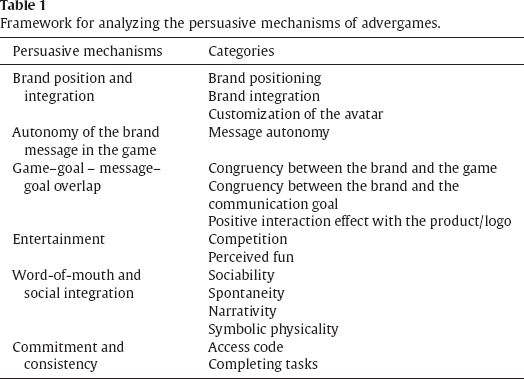
Framework for analyzing the persuasive mechanisms of advergames.
Advergames were selected from four major websites (advergames.com, de.gamespost.com, de.ogigames.com, adventuregamesite.de), which were best known for offering a large range of free advergames at the time of the survey. These four websites were not sponsored by companies, but rather collected the advergames of many websites of various different companies.
At the time of selection, the four websites offered 1,038 advergames. Out of those 1,038 advergame, 200 games were selected randomly. Two research assistants played the same 60 advergames out of the 200 games separately from each other. Both research assistants were told to play each game and try to finish the games as they would in real life. After every played game, each research assistant completed the coding scheme independently, playing the advergame again, if necessary. Results of the 60 independently coded advergames were compared and the overallinter-coder reliability was measured (Holsti, 1969). An average overall inter-coder reliability of 80.19% was observed, exceeding the acceptable level of 80% (Kassarjian, 1977; Lombard et al., 2002; Riffe et al., 1998). The specific inter-coder reliabilities of the selected persuasive mechanism categories can be found in Appendix A.
The two researchers revisited the advergames in cases of disagreement and both discussed and reconciled the codes with the coders and provided more detailed instructions. On account of the high percentage rate of inter-coder reliability (Neuendorf, 2002), each research assistant coded half of the remaining 140 advergames independently without adjusting it with the other researcher. Five games were no longer available online when the examination of the advergames started, thus a total of 195 advergames was included in the analysis.
Results
Investigated persuasion mechanisms in advergames
We first analyzed the different genres of the advergames. The type of genre was coded into 14 categories, partially following the suggestions by Hofmeister-Tóth and Nagy (2011): action, adventure, puzzle, quiz, sport, shooter, racing, arcade, strategy, simulation, fighting, role, card and other. Multiple answers were possible. As Table 2 shows, among several genres, action (19.5%) and adventure (16.9%) were the most prevalent genres, followed by puzzle (14.4%), quiz (13.8%), sport (12.3%), shooting (11.3%) and racing (10.3%) games.
Genres of the advergames.
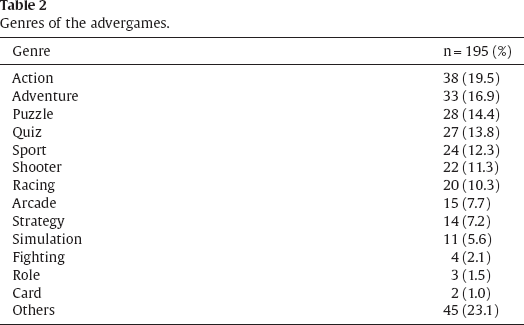
Genres of the advergames.
Based on the literature review, a comprehensive and detailed categorization of different product industries could be observed, which were partly classified according to Lee and Youn (2008) and Stout and Moon (1990), whereby the most advertised products (Table 3) were from the electronics sector (36.4%) (e.g. travelling, toys, movies), followed by products from the food (26.2%) and computer industries (6.2%). This matches the results of Lee and Youn (2008) to a large extent, who also detected that most of the games were from the electronics and food industries. Here, we can already see an interesting shift compared to prior studies. While earlier studies found a lot of games in the food section (Lee and Youn, 2008), our study suggests that more and more industries are utilizing advergames these days. However, the differences might be a result of a different sampling approach, as Youn and Lee used the leading advertisers list, which traditionally features a lot of fast-moving consumer goods (FMCG) manufactures.
Industries.
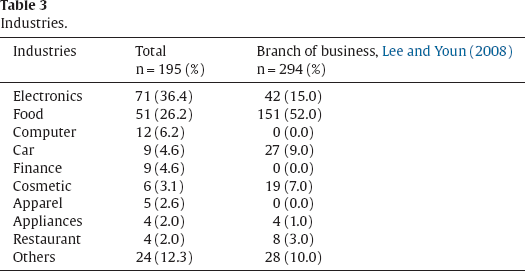
In our study, to allow for a better understanding of the brand positioning and integration, we made the distinction between products and logos. Logos are clearly labeled and defined, whereas products can be touched, have similar functions with few differences and can fulfill the needs of customers (e.g. functions, ingredients) (Arche, 2000; Joseph, 2015). The majority of the games (94.9%) showed a depiction of the product or the logo, with 47 (73.3%) games, in which only products were shown and 61 (80.5%) games, in which logos were displayed. Furthermore, results from our content analysis (Table 4) show that the logo continues to be used more often than products. Only a few advergames displayed both. Seven different placement positions were identified: the corner, the center of the gameplay, the top of the gaming area, below the gaming area, somewhere in the surrounding, as avatar itself or displayed on the avatar. In some games, the products and logos appeared in several places. The categories for measurement were partly derived and adapted from Hofmeister-Tóth and Nagy (2011). Most advergames showed the logo (34.9%) or the product (50.3%) in the center of the gameplay. However, the placements remain rather static, as the occurrence of logo or product placements on the avatar or the logo or product as avatar are quite low, except for the product as avatar, which was the case in 57 advergames (29.2%).
Brand positioning.

Brand positioning.
To investigate how many placement positions were applied simultaneously, we added up the occurring product and logo placement positions. Out of 14 different placement positions (7 possible placement positions for the product and 7 for the logos) we detected that, on average, the majority of the games kept with one to three (58.9%) different placement positions of logos or products simultaneously. In 35 advergames (17.9%) the avatar could be chosen by the player himself/herself, in only 5 games (2.6%) the avatar could be put together individually by the player.
To analyze the different integration strategies, we conceptualized categories according to Chen and Ringel (2001) and Theodorou and Sirmakessis (2009). In order to ascertain the associative integration, we examined if the product and/or logo was shown in the game. For the purpose of analyzing the illustrative integration, we observed if the product and/or logo was collected (e.g. gathering) and/or used (e.g. gathering and using). To detect the demonstrative integration, we checked whether the game imparted information about the product and/or logo. As can be seen in Table 5, the majority of the games integrated associative (92.8%) placements rather than those of an illustrative (32.8%) or demonstrative (26.7%) nature.
Brand integration.
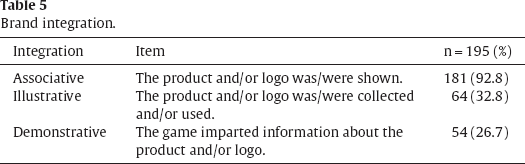
When examining the autonomy of the brand message in the game, we first quantified if the brand name was shown in the game. Second, we detected how the brand was integrated in the game (e.g. naming a game level or avatar after the brand) and which company-related features (e.g. advertising jingle, corporate colors, product packaging) were demonstrated. Third, we measured the autonomy of the message by the following three categories: the product/logo was always shown in the same context, the message of the company was clearly recognizable and music sounded when showing the product/logo appeared. Although autonomy is not directly observable from the content, the coded principles should allow the players to process the information autonomously.
The most frequently applied placement tactics (Table 6) were to display the logo (83.1%) and product name (68.7%). Incorporating corporate colors (68.2%), naming levels like the products (19.0%) and naming a playable avatar like the product (8.2%) were other observed persuasive tactics. 18.5% of the games featured different variants of the product and 13.3% of the cases showed the product's packaging. More brand-related messages like the mascot (9.7%), the brand slogan (7.2%), naming levels like the logo (6.7%) (e.g. Milka Knowledge from Milka), recording jingles (2.6%) or naming the avatar like the brand (1.0%) (e.g. the avatar Pom-Bear from Pom-Bear) were not frequently recorded. While repetition of the same context (e.g. background and/or content of the game) was more frequent in our sample (74.9%), only smaller proportions of games followed the suggestions to connect the products/logos with the message (38.5%) or to play music when showing the product/logo (32.8%).
Message autonomy.
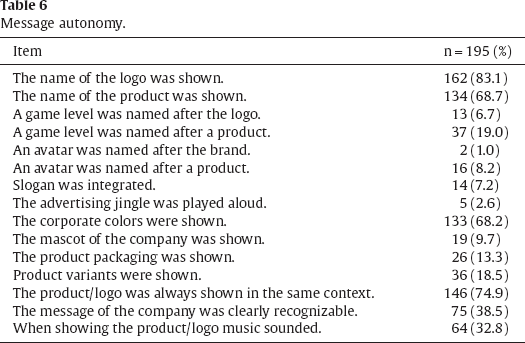
Message autonomy.
A high congruency between the game goal and the communication goal would indicate a high level of persuasiveness. Therefore, we tried to investigate the overlap of the product/logo and the game content. Our data show that the observed advergames largely considered the importance of congruency. First, we ascertained whether the product or logo is essential for the meaning of the game, thus we asked if the game and the whole game plot could also work without the brand or product. 91.3% of the investigated games would work with any brand integration, thus most of the games are not unique. The next step in the overlap and congruence was whether the games feature a match between the game content and the product/logo category (e.g. a racing game for a car). As can be seen in Table 7, more than half of the games (66.7%) had a good game and product category match. The match between the logo and the game content, however, seems to be easier to achieve (72.3%). 63.6% of the games matched the company explicitly.
Congruency between the brand and the game.
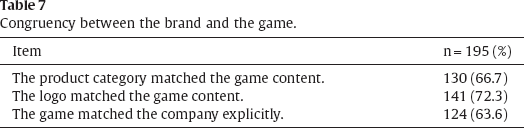
Congruency between the brand and the game.
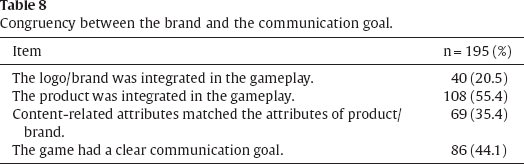
Furthermore, we examined if the product/logo was integrated in the gameplay itself and if the content-related attributes matched the logo/product. Moreover, it was essential to examine if the game had a clear communication goal or not. As Table 8 shows, logos tended to be placed in the background and were not usually integrated in the game itself (20.5%) in comparison to products, which were more likely to be integrated (55.4%). Additionally to the integration of the product/logo in the gameplay, the integration of the product/logo in the narrative is also essential. We observed that in 44.1% of the games, a narrative communication goal was integrated, but the goal was related to the product or logo in only 35.4% of the cases.
Congruency between the brand and the communication goal.
As can be seen in Table 9, almost a third of the games (31.3%) integrated the product in the game goal, whereas only 9.2% of the games integrated the logo. The most prominent tactics were collecting the product (10.3%) (the player had to collect the product, e.g. collecting drink cans or sweets), or using the product (15.9%) (the player had to use the product, e.g. drive a certain car in a car race), whereas in a small number of games, collecting (2.1%) and using (2.6%) the logo had a positive influence on the game.
Positive interaction effect with the brand.
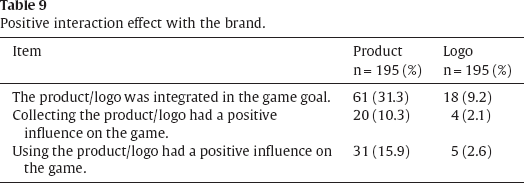
An essential factor for the persuasive mechanism of advergames is the entertainment delivered by a game. As mentioned in thetheoretical part, competition is a major factor to enhance entertainment. Therefore, several categories were specified to measure the competition and furthermore the entertainment of the conducted games. As can be seen in Table 10, a major tool to make advergames more entertaining involves integrating high scores, rankings and comparisons against the players themselves or in comparison to others. More than 40% of the games (41.5%) contained competitive elements. 38.5% of the cases involved the inclusion of the gamers in a high score list allowing them to compare themselves with others. A quarter of the games (25.1%) provided a personal high score list for the gamer, and 27.7% of the games provided a message describing how well the player performed in a single trial. This shows that the competitive factor is not that well adapted in advergames yet.
Competition.
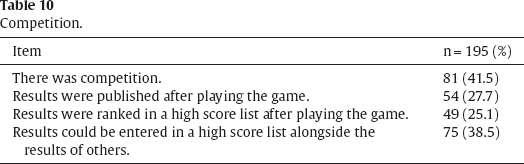
Competition.
Finally, to measure the perceived entertainment of each game, we recorded available rating scores on the platforms the advergames were sampled from. The ratings are similar to product ratings and are either a percentage value or stars (0 to 5 stars, so a mean score between 1 and 5). To make them comparable (as some were points, some were percentages), we scaled all scores as percentages. The average percentage rating was 41.0%, Table 11 shows the distribution. 68 (34.9%) games were not rated, 23 (11.8%) games got a rating between 1% and 30%, 19 (9.7%) of the cases had a rating of 31% to 41%, another 18 (9.3%) advergames were rated between 51% and 70%, and 67 (34.4%) games were rated above 71%. This shows that there are two large groups – one group of games was rated quite well, while the remaining ones were rated quite poorly.
Perceived entertainment.
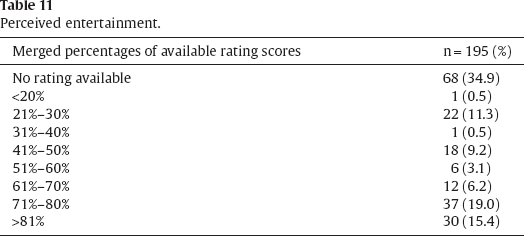
With reference to the word-of-mouth and the social integration, we tried to analyze the social aspect of the advergames. Only 8 games (4.1%) were integrated in a social media platform. Our investigation showed (Table 12), furthermore, that design ideas in sociability are prevalent in the games; inviting friends directly from the game (20.5%) or via social media (41.0%) were the most common forms. Spontaneity with regular updates on social media platforms was also observed in 13.1% of the games. The integration of social elements in narratives included challenging others by publishing results (5.6%) and providing rewards for recommendations (1.5%). Finally, the use of friends as game commodities (necessary in order to proceed in the gameplay), was only observed for one advergame (0.5%).
Social aspects.
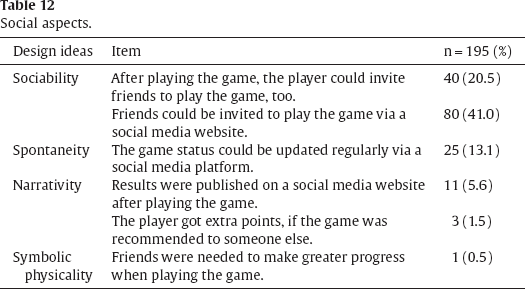
Social aspects.
To detect commitment and consistency, we tried to examine first if a registration is needed as this is a form of commitment toward the game and ultimately the advertiser. In 0.5% of the advergames, the player needed to register. Another design principle to achieve commitment is using codes attached to the actual product, which are needed in the course of the gameplay. Although some evidence exists for this practice, this was not observable in any of our analyzed games.
Conclusion
Principal findings
Previous studies have shown that advergames can influence the attitude toward the brand positively (e.g. Cauberghe and De Pelsmacker, 2010; Van Reijmersdal et al., 2010; Waiguny et al., 2012), but little research has been done on how persuasive mechanisms are applied in advergames and, furthermore, how those mechanisms function (Smith and Just, 2009). Based on a ludological (Juul, 2005) understanding of how games can persuade, the categories for the exhaustive coding scheme were predominantly based on the previously described analytical framework for advergames (Chen and Ringel, 2001; Hofmeister-Tóth and Nagy, 2011; Lee et al., 2009; Moore and Rideout, 2007; Smith and Just, 2009; Theodorou and Sirmakessis, 2009). Thus, a checklist of proven persuasion mechanisms was applied to the advergames sampled for the content analysis.
One of the most important findings is how the logos and products are placed and integrated within the games and which persuasive principles are applied. Therefore, we first analyzed how persuasive mechanisms of the logos and product positioning as well as the integration were integrated in the games. It could be observed that logos are shown and used more often than products. Furthermore, the results show that placement tactics are still quite static, which also match our results, which revealed that most of the observed games applied associative placement integrations. Nevertheless, the majority of the games displayed the logos or products continuously. Interestingly, products were shown in the center of the gameplay compared to logos, which were more frequently shown in a corner of the game. This leads to some implications. First, advergame designers might make placements more diverse, not only to ensure that games are not kept too similar, but also by featuring actual products, which can prove more beneficial as the message with products can be more interesting. Second, in terms of research, no studies so far have addressed differences between logo and product placements in games, thus experimental studies might investigate which ones are more effective.
In a next step, we examined how persuasive mechanisms of the message autonomy were applied. Our analysis confirmed that brand names as well as corporate colors were shown in the majority of the games. In more than 70% of the games, the products and logos were shown in the same context (e.g. the product/logo was shown against the same background or within the content of the game). This reveals that the design of the games generally supports the autonomy of the message. Yet, experience of features or influencing the brand or product information was not prevalent. Future research might address differences between designed autonomy and self-supported autonomy of the player.
Third, when analyzing the game-goal–message-goal overlap, a high congruence of logos as well as of products with the game content could be observed. This is also in accordance with a good match of the game and the company and/or product itself.
Furthermore, our findings show that products were more likely to be integrated in the gameplay than logos and less than half of the observed games integrated a narrative communication goal, which was related to the logos or product in slightly more than one third of the games.
The inclusion of competitive elements, which was the case in more than 40% of the games, could be observed as one persuasive mechanism of entertainment. Publishing the results after playing the game was not a very common form. Furthermore, it could be ascertained that more than a third of all games was rated very highly (rated higher than 70%), while another group was rated very poorly (rated lower than 30%) on rating platforms. This indicates that the games were either very entertaining or not entertaining at all.
Additionally, it could be observed that word-of-mouth and social aspects were integrated in the advergames to quite a modest extent, although inviting friends directly from the game or via social media were rather more common forms. Finally, we found out that access codes were generally not necessary to play the game, as in only one of the games required a registration to play the game.
Limitations
This content analysis demonstrates the thematic relevance of persuasive mechanisms in advergames, but there are still some limitations within the study. First of all, the examination of the persuasive mechanisms of advergames is still in its early stages, which means that not all persuasive mechanisms are taken into consideration. Due to the fact that the nature of a content analysis is mainly the investigation of how things are carried out and this content analysis gives an overview of persuasion mechanisms that are applied in current advergames, future studies should also focus on the impact of these persuasion mechanisms in more detail. Future research could try to explore further persuasive tactics, applied in advergames, as for example Cialdini's persuasive principles “scarcity” and “authority”. Follow-up studies should take those principles into consideration, too.
Overall, the content analysis showed a good inter-coder reliability, but due to the fact that the games were played by only two research assistants, the generalizability, the validity and reliability of the results in the context of qualitative research is limited (Malliet, 2007). Thus, future content analysis should be done by more coders to generate more objective results and to capture a greater number of persuasive mechanisms that can be used to benchmark future research. Furthermore, as the coding plan was developed before coding, future content analyses might use a more qualitative thematic coding approach (Hsieh and Shannon, 2005).
Additionally, the construct of flow could not be analyzed when measuring the persuasive mechanism “enjoyment” in this content analysis, because of the small number of coders. The construct of flow is based on feelings and emotions when playing a game. Analyzing the flow construct would have been too subjective and therefore not reliable at all. However, the merged percentages of the liking ratings of the games provides an indication of how flow-generating the advergames are, as flow usually results in a high liking of a certain game. Moreover, this is an exploratory study. To investigate if the conducted persuasive mechanisms are successful or not, additional research is mandatory to measure, for instance, changes in the player's attitude or memory (e.g. by measuring recall and recognition). Clearly, the emotional, attitudinal and behavioral reaction to the analyzed games by players can only be assumed in the application of a content analysis. Thus, further research might address and compare different mechanisms applying experimental methods. Another limitation of this research is that there is no reference to social media or emerging mobile activities and applications and the question of persuasiveness within these contexts. Future studies should take these issues into account due to the fact that the development and use of advergames within social media and mobile application contexts is evolving rapidly.
Implications
Based on the relatively scant knowledge and data about persuasive mechanisms in advergames, the results of the study can contribute to the existing literature in various ways, providing researchers and marketers with a multitude of findings and measurement tools. The results of this content analysis are essential for advertisers to understand how to successfully implement and evaluate persuasive mechanisms to promote their brands more effectively. Marketers, designers, game developers as well as companies could try to tailor their (adver-)games more closely to the players’ needs by employing more persuasive strategies and tools in their offered games (e.g. the players can interact more with the products and logos and may learn more about the positive features of the product/logo). The greatest number of brands seen in the advergames was for electronics or food products. Therefore, those products should be integrated more intensively with a high congruency between the brand, the game and the communication goal and should therefore be more effective than brands appeared only in the background.
The first persuasive mechanism of this paper addressed the brand positioning and integration. Due to the fact that placements are quite static, the findings suggest a promotional environment that demands active brand stewardship. Results show that almost a third of the games (32.8%) applied illustrative brand integration and only slightly more than a quarter of the games (26.7%) used demonstrative brand integration. Due the fact that previously conducted research (e.g. Chen and Ringel, 2001; Van Reijmersdal et al., 2007; Waiguny et al., 2014) has revealed that the illustrative and demonstrative brand integration are a key feature of advergames and can create positive attitudes toward the product's attributes, game developers and companies should focus more on these integration types instead of the associative brand integration.
The second persuasive mechanism referred to the autonomy of the brand message in the game, which means that highly autonomous games are self-explanatory and additional information or knowledge is not mandatory (Smith and Just, 2009). Results revealed that naming a game level or an avatar after the brand was not very common. The mascot of the company (9.7%), product packaging (13.3%) and product variants (18.5%) were also hardly shown. Therefore, marketers should integrate more brand-related elements (e.g. companies’ mascots, product packaging, product variants, naming a level after an avatar or a brand) and conditioning hints (e.g. showing the brand together with music) to create self-explanatory and thus more persuasive messages.
To increase the game-goal–message-goal overlap and to obtain a higher congruency between the brand and the communication goal, companies and game developers should integrate the brands more in the gameplay, convey a clear communication goal and content-related attributes should further match the brand, e.g. using or collecting the brand can positively influence the player. Consequently, those products should be integrated more intensively with a high congruency between the brand, the game and the communication goal and should consequently be more effective than brands appearing only in the background.
Since competition can influence the enjoyment of the players (Vorderer et al., 2003), more competition while playing the game would be demanded (this was only the case in 41.5% of the games) by e.g. publishing the results or ranking the results in a high score list after playing the game or entering the results in a high score list alongside the results of others. Those competition tactics were rather rare in the observed advergames. Furthermore, when developing new advergames, advertisers and practitioners should consider which story to tell and how to tell it within the games (Waiguny et al., 2013). Additionally, it would be interesting to examine how different persuasive mechanisms are associated with enjoyment.
Moreover, word-of-mouth is an essential persuasive tool of advergames (Santos et al., 2007). Marketers should focus more intensely on this persuasive mechanism by e.g. offering the possibility to invite friends to play the game after finishing the game (even through social media websites), or offering the possibility to regularly update the game status on social media platforms regularly or to publish the results there after playing the game. Furthermore, another suggestion for the development of future advergames is to reward the player with extra points, if the game was recommended to someone else after playing the game to increase the word-of-mouth and social aspects. Finally, to generate a higher commitment and consistency, it would be helpful to provide codes from already bought products and develop the game in such a way that the player needs these access codes to be able to play the game. Also, a mandatory registration would enhance the player's commitment.
In conclusion, this content analysis provides an initial attempt to discover how persuasive mechanisms are applied in advergames and reveals that advergames are an innovative tool to promote logos and products persuasively.
Footnotes
Appendix A
Previously conducted content analysis on advergames
Appendix B
Inter-coder reliabilities of the selected persuasive mechanism categories