







Abstract
Sustainability requires that consumers and organisations consider how their activities impact on the natural environment. The initial marketing discussion of ‘sustainability’ as we now define it was into green consumer behaviour and within the literature in this area has continued to grow. This paper analyses 677 journal articles with a green consumer focus that have appeared in 34 leading marketing, psychology and environmental journals between 1975 and 2014. The most influential articles, authors, and institutions are identified using citation analysis. An examination of the trends in topics focused on in the research, over eight five-year periods, identified behavioural intentions, demographics and marketing strategy as the top three subjects in the domain. Overall, the results show that green consumer research is a multidisciplinary research domain that has been explored across a diverse range of issues and contexts, with researchers dispersed globally, ensuring that sustainability continues to be an area of interest within the consumer domain.
Introduction
It has been suggested that sustainability is critical for the survival of mankind and thus is a pressing issue of business and marketing research (Chabowski et al., 2011; Lim, 2016). Reviews of sustainability in marketing have identified that the issue has been examined from a range of perspectives and that sustainable or green consumer behaviour was one of the first areas examined within the literature in the 1970s (McDonagh and Prothero, 2014), with sustainable or green consumer issues still being extensively studied. This research focuses on the idea that addressing environmental issues is largely dependent on consumers integrating environmental issues and concerns into decision making as consumer behaviour generates significant negative environmental impacts (Ivanova et al., 2015). As such, understanding consumer behaviour in regard to sustainability and pro-environmental behaviour is important for marketers and policy makers and the environment (Peattie, 2001). Additionally a multi-disciplinary perspective is required, to ensure all salient issues and research are considered (Peters et al., 2013), especially given that green consumer behaviour is by its very nature implicitly multi-disciplinary, covering marketing, psychology and environmental issue.
A wide number of definitions of sustainable or green consumer behaviour exist. For example, the Green Consumer Guide (Elkington and Hailes, 1988) defined green consumerism in terms of consumers’ propensity to consume products that are healthy for them and others, minimise environmental harm over the product life-cycle (design, production, transportation, usage and post-usage), are not tested on animals, and do not adversely affect other countries.
As with any area, it is valuable to systematically overview the green consumer research to identify the state of play and evolution of research domains (Wilkie and Moore, 2003). Given the increasing importance of addressing environmental and sustainability issues in marketing (Chabowski et al., 2011), it seems appropriate to trace the multi-disciplinary development of the sustainable or green consumer behaviour research domain. The scope of green marketing issues is also expanding, including within general business contexts and supply chain areas which are also growing (Chabowski et al., 2011; McDonagh and Prothero, 2014), but the role of consumers in driving sustainability is still focal to addressing environmental issues. As such, it is important to trace developments in the discipline and to understand trends in the research field. This can be done by seeking answers to questions such as who are the leading members (authors and institutions) of scholarly community in this research domain, how has research evolved over time, and what are the central issues in the research domain (Porter et al., 2002). This paper addressed these issues by assessing the contributions (quality and impact) of journals, articles and authors to the knowledge system of the research domain using citation analysis, as well as the topics focused on within the area.
Sustainability and green consumer behaviour literature
Green consumer research as an academic domain of enquiry is not new. It started in the 1970s when researchers (e.g., Murphy et al., 1978) began to develop segmentation strategies and models of consumer behaviour that leveraged consumers’ environmental concern. A variety of terms have been used to define consumers integrating environmental issues into their thinking (Kilbourne and Beckman, 1998), ranging from green, ecological, ethical, responsible, pro-environmental and sustainable consumers (within this work the term green consumers is used, given early research focused this terminology). According to a search of Google Scholar, since 1975, there have been over 600 articles dealing with various aspects of green consumer behaviour, which have been published in a wide variety of marketing, psychology, and environmental journals, and this excludes the numerous works that have a broader green marketing strategy or green business marketing focus.
There have been five reviews of the green marketing literature (Chabowski et al., 2011; Chamorro et al., 2009; Kilbourne and Beckman, 1998; Leonidou and Leonidou, 2011; McDonagh and Prothero, 2014) and within these reviews authors have identified green consumer behaviour as one area of study. While these studies review the literature on environmental issues in marketing, the fact that they have covered all types of issues means there has not been a focus on green consumer research (as shown in Appendix A) and this paper seeks to explore this domain within the marketing literature in more detail. Most of the previous literature reviews are descriptive in nature and present an overview of conceptual development on green consumer research field. This paper seeks to use bibliometric methods to capture updated trends in the research field that will provide perspectives on the volume of research activity, augmenting and extending these previous reviews. This is not to suggest that other literature has not undertaken reviews of the aspects of work in the green consumer domain, as researchers have reviewed the characteristics of green consumers (Diamantopoulos et al., 2003; Hughner et al., 2007; Kilbourne and Beckman, 1998), behavioural facets of green consumers (Brennan et al., 2003; Leire and Thidell, 2005; Leonidou and Leonidou, 2011; Steg and Vlek, 2009; Verain et al., 2012), and alternative methodologies used within green consumers studies (Chamorro et al., 2009). Many of the previous reviews have documented the volume of research activity on green marketing, and they have been broader than just focusing on green consumer research. As such, there remains a scope of identifying research impacts of the journals, authors and articles using their bibliometric information within this domain. Additionally given the rapid increase in work within the environmental area, it is important to update past studies to identify the trends today, given the previous time frames of earlier studies.
Therefore, identifying patterns within the extant literature on green consumer research, and assessing research impacts of journals, authors, articles and institutions, will augment traditional/descriptive literature reviews (Porter et al., 2002). This study does this by: (1) identifying the journal articles related to green consumer behaviour in leading marketing, psychology and environmental journals; (2) identifying the journal articles, authors and institutions that have made the most significant contribution to the literature, based on article numbers and citation analysis; and (3) investigating how research sub-topics in the research domain have evolved over time.
Citation analysis
Citation analysis is a library science technique introduced in the 1920s (Levy, 1977), which is a valuable way to assess the research impact of a work within a discipline (Bornmann and Daniel, 2008; Cronin, 2001; Garfield, 1972). There are a number of alternative ways to assess the impact of works and authors in a discipline (Zupic and Čater, 2015). One approach that has been used relates to assessing the citations of works, where it is argued that papers with higher citations are more impactful and thus influence the development of the domain (Arnold et al., 2003; Schaffer et al., 2006). Citation analysis is the most common objective approach to ranking authors, articles and journals, used in several business disciplines such as marketing (Baumgartner and Pieters, 2003; Chan et al., 2012, 2017; Jaffe, 1997; Jobber and Simpson, 1988; Leone et al., 2012; Leong, 1989; Schlegelmilch and Oberseder, 2010; Wang et al., 2015), economics and finance (Chan et al., 2013; Chen and Huang, 2007; Frey and Rost, 2010; Mabry and Sharplin, 1985; Pinkowitz, 2002), information technology (Deng and Lin, 2012; Willcocks et al., 2008), and operations research (Davarzani et al., 2016; Petersen et al., 2011; Vokurka, 1996). It is claimed that citations are free from biases associated with perceptual evaluations of impactful works (Jobber and Simpson, 1988; Zupic and Čater, 2015), and thus citations are an effective measure of the scientific impact among authors and journals. Nonetheless, it has sometimes been suggested that even this method can be manipulated through behaviours such as self-citation (Fowler and Aksnes, 2007).
Journals and articles
Citation analysis can be used in three different ways. The first is to identify impact and productivity of journals in a research domain using citation counts of articles published in the journals (Chan et al., 2012; Coombes and Nicholson, 2013; Leone et al., 2012; Schlegelmilch and Oberseder, 2010). Citation analysis has also been used to assess journal quality and to create rankings of marketing journals (Guidry et al., 2004; Jobber and Simpson, 1988) and to assess the influence of a journal within a discipline at various points in time. For example, Leong (1989) and Cote et al. (1991) described the influence and contribution of the Journal of Consumer Research over two time periods 1974–1988 and 1974–1989, whereas Sprott and Miyazaki (2002) examined the citation of articles published in the Journal of Public Policy and Marketing, yearly between 1982 and 2001.
Second, citation analysis has also been used to identify most cited articles in a given journal, so as to understand whether that journal has diverse influence across the literature. For example, Cote et al. (1991) and Hubbard et al. (2005) assessed the most cited works in the Journal of Marketing, Polonsky et al. (2013) assessed the most cited works in the Australasian Marketing Journal, and Sprott and Miyazaki (2002) assessed the most cited works in the Journal of Public Policy and Marketing.
Third, citation analysis is also used to identify seminal articles within a research domain. For example, Coombes and Nicholson (2013) examined the characteristics of key references for business models and marketing published between 1970 and 2011; Chan et al. (2017) examined the most-impactful articles within the advertising domain published between 2000 and 2014; and Schlegelmilch and Oberseder (2010) examined the most impactful articles within marketing ethics published between 1960 and 2008. This study employs citation analysis to identify impactful journals and journal articles within the green consumer behaviour research domain.
Authors and institutions
Citation analysis can also be used to identify the most influential authors and institutions contributing to a research domain. For example, Backhaus et al. (2011) identified the most influential authors in business marketing in leading marketing journals; Chan et al. (2012) identified most influential authors in marketing research literature between 2000 and 2009; Chan et al. (2017) identified most influential authors in advertising literature between 2000 and 2014; and Leone et al. (2012) identified the most influential authors in pricing within leading marketing and business journals between 1980 and 2010.
The most productive institutions can also be examined based on the impact of research works produced by their faculty. For example, Chan et al. (2012) identified the leading publishing institutions in marketing research between 2000 and 2009; Fetscherin and Heinrich (2015) identified the leading publishing institutions in consumer brand relationships across marketing journals between 1998 and 2010; and Leone et al. (2012) identified the leading publishing institutions on pricing between 1980 and 2010. These studies also have generally compared the geographic contribution of the authors and institutions (e.g., Polonsky et al., 2013; Wang et al., 2015) to assess the geographic diversity of expertise and research interest.
Topic coverage
The sub-themes of importance within a discipline change over time, which might reflect the growing sophistication of a domain (Polonsky et al., 2013; Wang et al., 2015; Wilkie and Moore, 2003) or a change in the issues of research interest (Leone et al., 2012; Polonsky and Ringer, 2009; Sprott and Miyazaki, 2002). Thus, topic coverage is important for understanding the evolution of a research domain, especially in one such as green consumer behaviour which is continually evolving. The popularity of sub-themes in a research domain can be identified using an analysis of keywords (Fahimnia et al., 2015; Huber et al., 2014; Kim et al., 2016; Leone et al., 2012; Nel et al., 2011; Wu et al., 2012). For example, Kevork and Vrechopoulos (2009) examined the evolution of customer relationship management from 2000 to 2006 across a set of journals, and Lamberton and Stephen (2016) examined the evolution of research in digital and social media from 2000 to 2015 in marketing journals. Such analyses identify the diversity of themes addressed in a research domain, allowing for a tracking of the evolution of themes as well as changes in themes’ popularity. For example, a citation analysis of pricing literature (Leone et al., 2012) identified in a range of leading marketing and business journals, between 1980 and 2010, examined the changes in 20 subject areas. An evaluation of topic coverage might also consider the evolution of topic within a specific journal. For example, Huber et al. (2014) traced subject development within the Journal of Marketing Research over 49 years between 1964 and 2012, and found 25 subject categories existed and their importance (or interest in these) changed over time. Polonsky et al. (2013) traced the development of the Australasian Journal of Marketing over its first 20 years and found that the 25 subject categories received identifiable changes in attention over time. The present study aims to identify topic coverage in green consumer behaviour literature within journals, and how it has evolved over eight five-year periods, to help identify what issues are increasing in importance, or interest.
Methodology
To identify the impact of the journals, articles, authors and institutions in green consumer behaviour literature, this study uses authorship and citations adjusted for the number of authors and years since the work has been published. The weighting methods remove bias associated with the older works that have had more time to be cited and are, thus, incorrectly ranked higher (Holsapple et al., 1994; Mabry and Sharplin, 1985). Much of the marketing literature on impact has used these or similar measures to assess impact and contribution, such as absolute number of articles (e.g., Chan et al., 2017; Coombes and Nicholson, 2013; Leone et al., 2012), weighted number of articles (e.g., Leone et al., 2012; Polonsky et al., 2013), absolute citation counts (e.g., Cote et al., 1991; Leone et al., 2012), and weighted citation counts (e.g., Leone et al., 2012).
Data
The first step involved identifying the target set of journals to be searched. While it is recognised that citations can be attributed to books, book chapters and conference papers, it has been suggested that citations to such materials within the marketing domain have declined over time (Polonsky and Polonsky, 2007). In addition, citation tools, such as SSCI, focus on journal articles, making journals and citations to journals the important currency for assessing academic impact.
For the marketing discipline 28 journals were selected that have been identified as leading marketing journals with an emphasis on consumer behaviour research. The journals included were classified as the top-ranked journals in previous marketing journal ranking studies (Baumgartner and Pieters, 2003; Polonsky and Whitelaw, 2006; Theoharakis and Hirst, 2002). We acknowledge that there was the potential to include other journals in this study, but focused on journals that had a general marketing issues or consumer behaviour focus. Thus, the authors’ subjective judgements may have introduced bias in the journal selection which might be a limitation to the study, although it is impossible to include all journals. The list of 28 marketing journals was supplemented by four environmental journals – Energy Policy, Ecological Economics, Business Strategy and the Environment, and Journal of Cleaner Production – as each of these journals extensively examines green consumer research issues. We also included the Journal of Environmental Psychology and Journal of Personality and Social Psychology, given that they too extensively examine green consumer research issues. Moreover, the mission statements of these environmental and psychology journals indicate a focus on environmental consumption that justifies inclusion of these journals in this study. Nonetheless, it is acknowledged that other journals not included, such as the Journal of Environmental Management (JEM) or the Journal of Consumer Policy (JCP), might have a similar focus. This omission might have introduced some potential bias into the study. Although a subsequent review of JEM failed to identify any such appropriate articles, JCP did have several works that could have potentially been included.
The second step involved identifying all articles dealing with green consumer issues in the 34 targeted journals that were published between 1975 and 2014. This was done by undertaking a keyword search in each journal, using the terms “green consumer” (70% of the articles), “environmentally-conscious consumer” (63% of the articles), “sustainable consumption” (48% of the articles), and “green consumerism” (28% of the articles). The words had to appear in the title, abstract or as keywords, to ensure that the works focused on green consumer behaviour issues and multiple terms could be used in each article. This process identified 677 articles. The list of articles was then reviewed by one of the authors and two independent researchers to ensure that all articles were focused on green consumer behaviour. Editorials, commentaries, or book reviews were excluded from the study. For each article, the names of all authors, their institutional affiliation, article title, year and the publication's name were recorded. Table 1 lists the 34 journals and the number of articles that appeared in each, as well as the overall citations and average citations per year.
List of journals, article counts, overall citations and average citations per year.
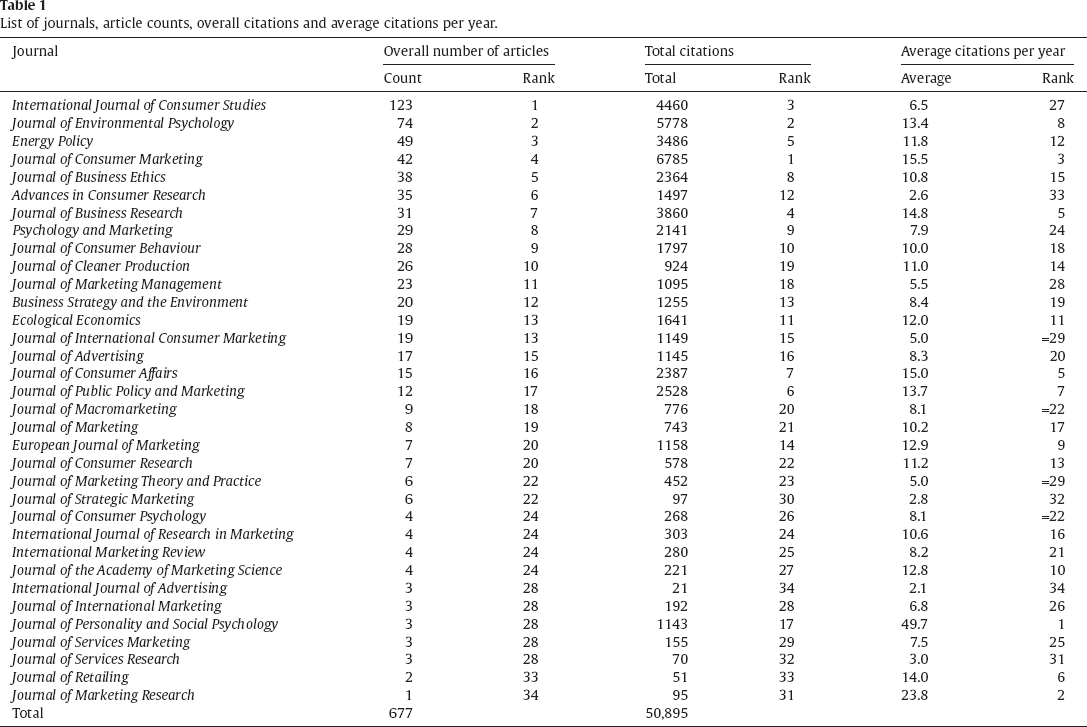
List of journals, article counts, overall citations and average citations per year.
The third stage involved determining the citation number for each article as of August–September 2015, based on Social Sciences Citation Index citations. Overall, the 677 works had received 50,895 citations and were authored by a total of 1335 authors.
The first stage of the analysis involved a simple tabulation of the number of articles and their associated citations, which were then aggregated (see Table 1). Given that citation rates of works are affected by the age of an article (Canabal and White, 2008), we also calculated the average citation rates per year, that is, the overall number of citations divided by the years since the work was published (Yan and Ding, 2010; Zhang et al., 2010), thereby removing any disadvantage more recent works might have incurred.
To allow for an assessment of journals, authors and institutions, it was also necessary to undertake a weighting process to allocate authorship and citations to individual authors and institutions (Leone et al., 2012). If an article was co-authored by three authors, the authorship and citation for each author is one-third of the total. If one of the three authors has another single-author paper, the total authorship contribution is 1.33. Similarly, if an article was co-authored by five authors, the citations for each author would be one-fifth of the article's total citations. If an individual was involved in multiple works, the relevant authorship or citations would be aggregated for that author. Additionally adjusting citations per year also allows us to take into consideration time effects (Holsapple et al., 1994). When assessing the institutional and journal performance, we used the weighting processes, which have been applied in previous citation analysis within marketing (e.g., Kumar, 2016; Chan et al., 2012; Leone et al., 2012; Polonsky et al., 2013).
Subject categorisation
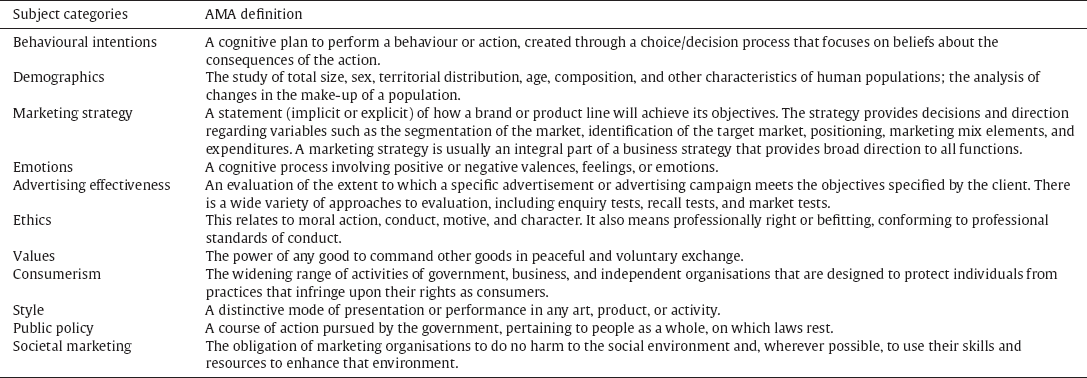
Subject categories of works can be created using content analysis of the abstracts (Kevork and Vrechopoulos, 2009; Nel et al., 2011; Polonsky and Ringer, 2012), categories existing within the literature (Polonsky et al., 2013) or other sources (Leone et al., 2012). In this study, keywords in the titles and the abstracts of the 677 articles were extracted, reviewed and categorised, based on subject categories from within the dictionary of the American Marketing Association (see: https://www.ama.org/resources/Pages/Dictionary.aspx). This categorisation was validated by eight academics and five marketers working in the consumer behaviour domain. This resulted in 11 subject categories being defined (see Appendix B for a definition of subject categories). Following earlier studies on the subject/topic coverage (Huber et al., 2014; Leone et al., 2012; Wang et al., 2015), we also assessed changes in the categories over eight five-year periods.
Results
Journals
The first stage of the analysis assessed the overall impact of the 34 journals examined (see Table 1), based on the number of papers, overall citations and average citations per year. This identifies that the International Journal of Consumer Studies had the largest number of green consumer articles, followed by the Journal of Environmental Psychology, Energy Policy and Journal of Consumer Marketing. These four journals have published over 42.5% (i.e. 288 out of 677) of works between 1975 and 2014, with 41.4% (i.e., 280 out of 677) of the articles appearing in the last 15 years. Chamorro et al. (2009) also identified that Journal of Consumer Marketing published most number of articles (i.e. 7 out of total 30 articles) in green consumer research in their study of 22 journals between 1993 and 2003. The rankings of journals, however, change when assessed by overall citations: Journal of Consumer Marketing (1), Journal of Environmental Psychology (2) and International Journal of Consumer Studies (3). Based on average citations per year, the rankings again change: Journal of Personality and Social Psychology (1), the Journal of Marketing Research (2) and the Journal of Consumer Marketing (3). A comparison of rankings across the three evaluations, using the Wilcoxon signed rank test, identifies that there are significant differences (authorship–citations, z = −5.09, p < .000; authorship–average citations, z = −1.8, p = .073; citations–average citations, z = −5.09, p < .000) and thus the most ‘impactful journal’ in the green consumer behaviour area varies depending on the criteria used.
Table 2 assesses the number of articles in each journal within eight five-year periods. As might be expected, generally the number of works increases over time. Only two journals published articles on green consumer behaviour in the first period and there was an increase from 1990 to 1994 (37 journals), which continued in each subsequent period. The numbers of articles across journals increased considerably in the periods 2005–2009 (150 articles) and 2010–2014 (373 articles).
Journal's rank ordered by number of articles.
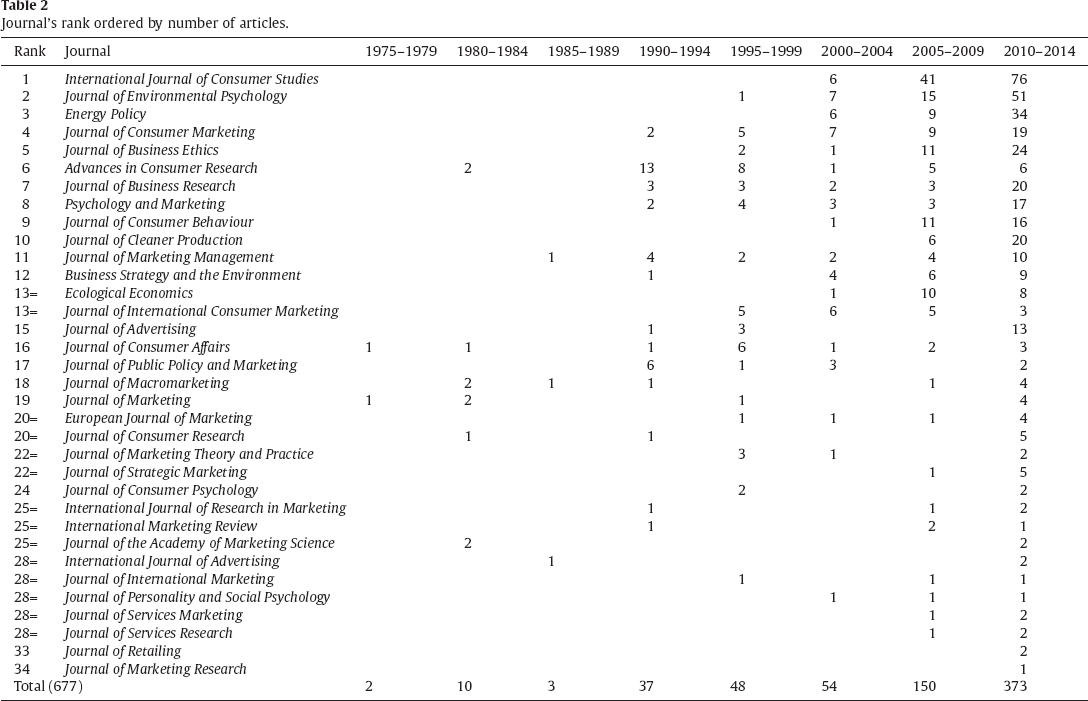
Journal's rank ordered by number of articles.
The average number of citations per article was 74.5 (124.4 std) and the average yearly citation per article was 9.9 (12.2 std). There were 24 articles (or 3.5% of the sample) with no citations, and approximately 50% of the articles had 35 citations or fewer. When assessing average citations per year, more than 43% had 5 citations or fewer. This is similar to the finding of Leone et al. (2012) and Cote et al. (1991), who found there was a significant drop-off in the number of papers with a large number of citations/citations per year.
Table 3 lists the 25 most highly-cited articles, based on their citations per year. Over one third (i.e., 9 out of 25) were published between 2010 and 2014, indicating that some of the more recently published articles have been highly impactful. The top three most-cited articles appeared in psychology journals, with the next five in marketing journals. These eight articles account for 11.7% of all green consumer works’ citation. Interestingly, the most cited green consumer behaviour research papers did not appear in what might normally be considered the top marketing journals (i.e., JM, JCR, JMR), which differs from the results of earlier multi-disciplinary studies on leading works (e.g., Leone et al., 2012; Schlegelmilch and Oberseder, 2010; Jaffe, 1997).
The 25 most highly-cited articles based on citations per year.
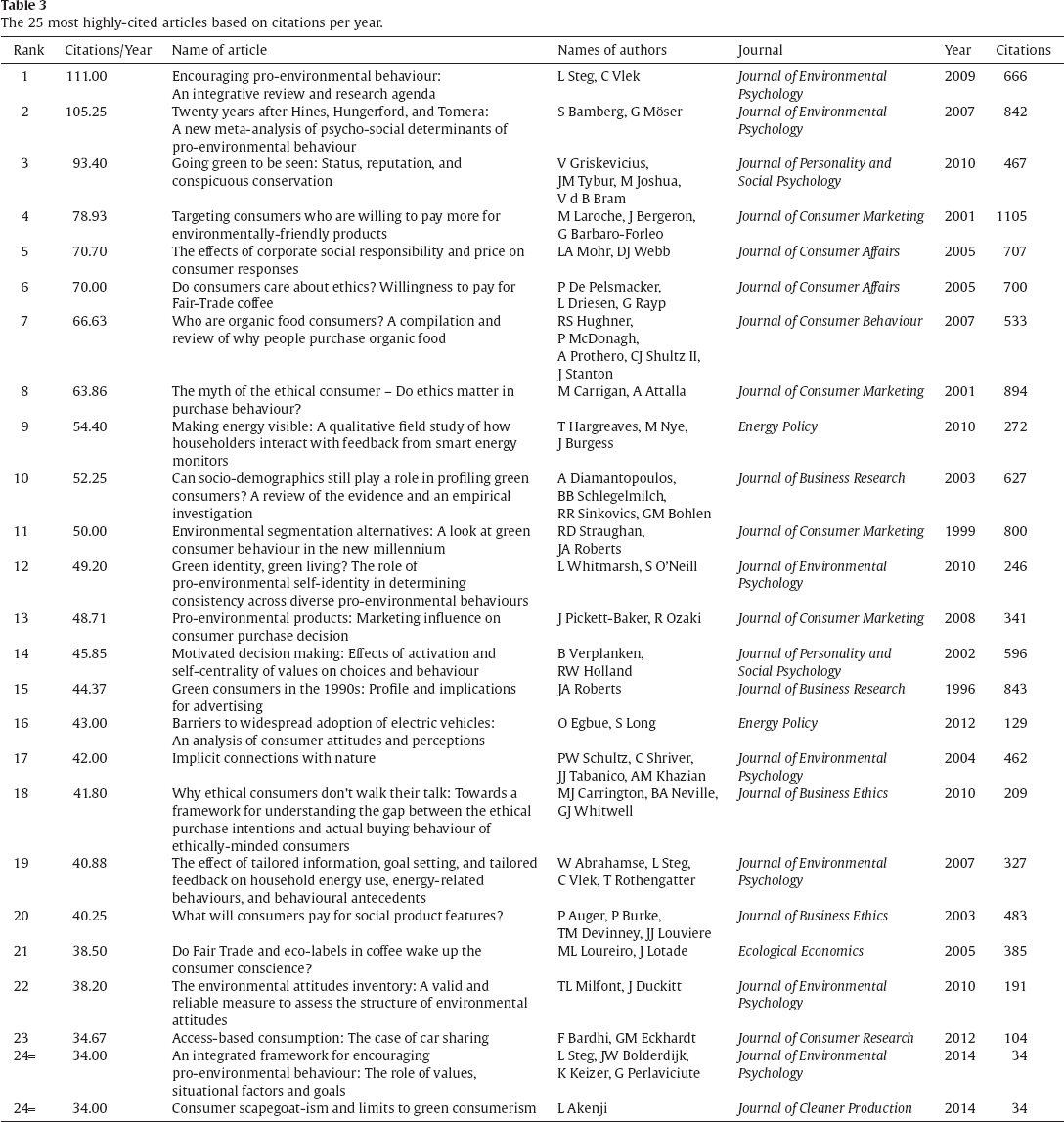
The 25 most highly-cited articles based on citations per year.
There were 1335 different authors across the 677 green consumer articles. Only 51 authors or 3.8% of all authors were practitioners, which is lower than the results in other research fields, where there were 15% practitioner authors in product innovation work (Biemans et al., 2007) and 14% practitioner authors in industrial marketing work (Ford et al., 2001). Sprott and Miyazaki (2002) suggest that increased participation from the practitioners benefits a research field for its actual and perceived relevance, and application of published research. Thus, more practitioners within the green consumer behaviour areas should be encouraged, even though studies have found their contribution in academic literature to be declining (Cortina et al., 2017; Polonsky and Ringer, 2012; Sprott and Miyazaki, 2002). It was also identified that 25 (3.7%) out of 677 articles were published through industry–academic authorship collaborations.
It is valuable to identify the most significant contributors to a research domain to identify the geographic diversity. The top 25 authors are listed in Table 4, based on: the weighted number of articles, the weighted citations, and the weighted citations per year. There is a large degree of congruency across measures in regard to who are the leading authors, with three of the top four ranked authors being the same, although in differing order – Thøgersen, Roberts and Steg. These three authors have also authored the most papers, 9.3, 5 and 3.6, respectively, which might explain their higher citations. Twenty-four of the 49 most influential authors (in total across the three indices) also have featured among the authors of 25 most highly-cited articles. A correlation analysis across the full set of authors identified that papers, total citation and weighed citations are highly correlated – papers/total citations (r = 0.615, p < .01); papers/weighted citations (r = 0.665, p < .01); total citations/weighted citations (r = 0.815, p < .01).
The 25 most influential authors.
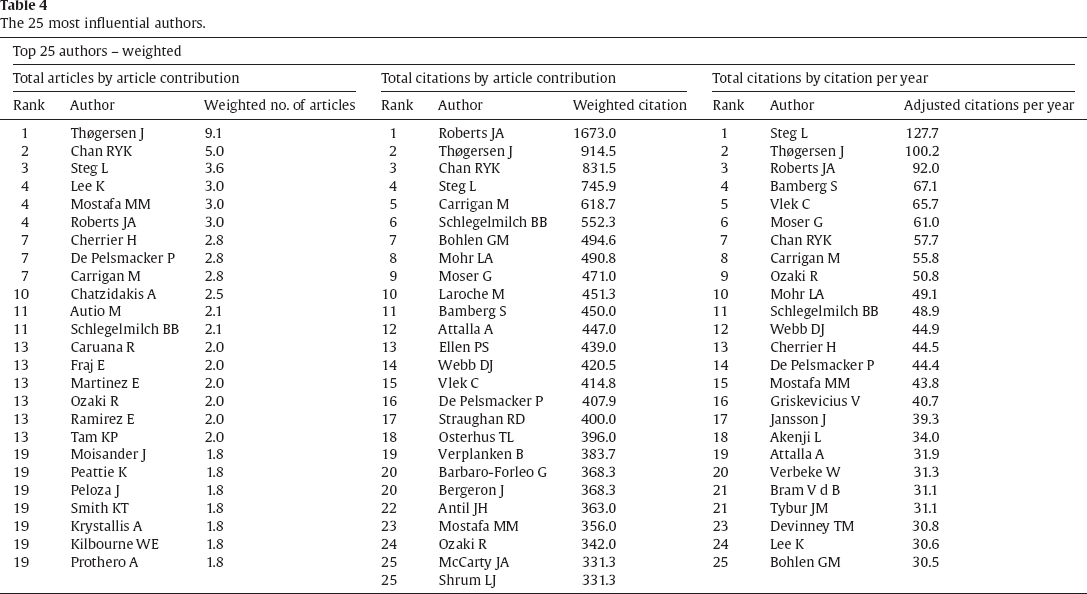
The 25 most influential authors.
In regard to authorship, 129 (19.1%) of the 677 articles were single-authored works, 261 (38.6%) of the articles had two co-authors, 186 (27.5%) of the articles had three co-authors and 101 (14.9%) of the articles had 4 or more co-authors. An analysis of authorship suggested that single authors worked declined pre-2000 (in the first 25 years) from 28% to 16.9% between 2005 and 2014. Interestingly, only 114 (8.5%) out of 1335 authors produced single authors works, with 17 (34.7%) of the 49 leading authors (mentioned in Table 4) publishing at least one single author article, although only two of the most highly-cited 25 articles were single author works. This suggests there has been an increase in collaborative research within the domain, which is important in terms of sharing ideas, understanding varying perspectives originating from different specialisations, identifying interesting and relevant research problems, conducting and validating field surveys, and deriving substantial conclusions (DeBerry-Spence et al., 2013; Katz and Martin, 1997; Pitt, 2008).
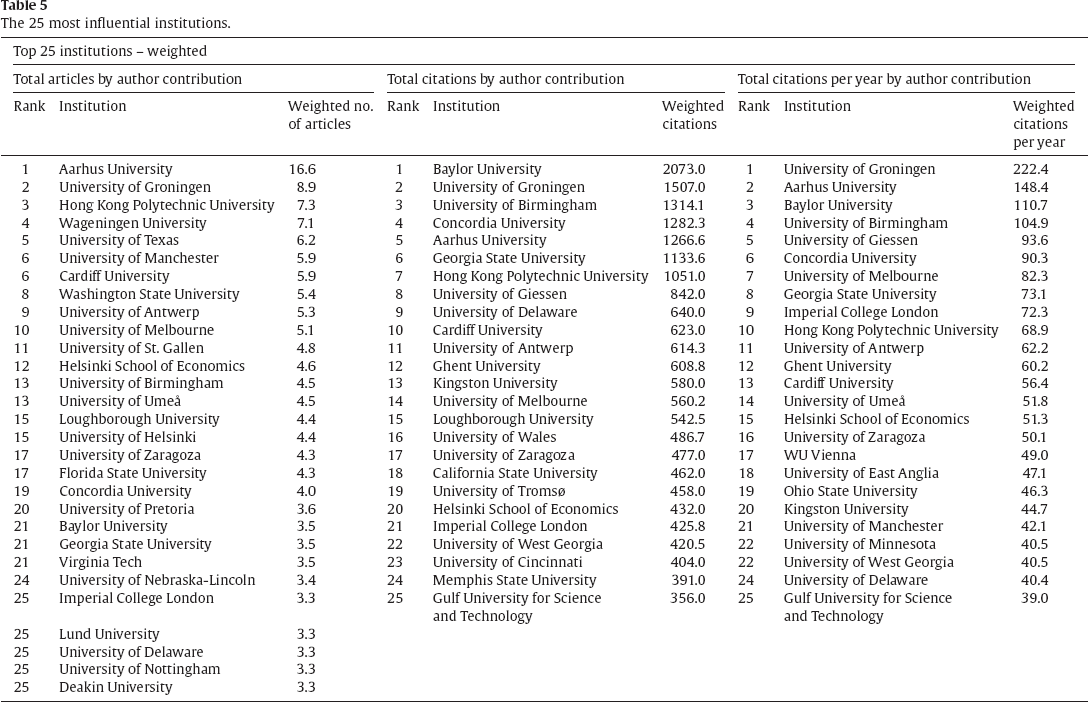
While examining individual authors is important, it is also important to identify whether there is institutional strength (Polonsky and Ringer, 2012) within the green consumer area. Overall, there were the authors based at 538 academic institutions, 9 non-academic institutions, 45 government/not-for-profit institutions and 25 different for-profit organisations. Table 5 lists the top 25 institutional affiliations of authors. As with authorship and citations, institutional affiliation was also adjusted based on the number of authors.
The 25 most influential institutions.
The 25 most influential institutions.
The results indicate that the University of Groningen and Aarhus University contributed the highest weighted number of articles, with Baylor University and University of Groningen having the highest number of citations, and the University of Groningen and Aarhus University having the highest number of citations per year. Articles published by authors affiliated with the University of Groningen and Baylor University also appeared in most highly-cited 25 articles. Authors from other institutions in Table 5 such as University of Giessen, University of Birmingham and Concordia University have featured in the 25 most highly-cited articles.
Table 6 reports on the regional contribution of works and identifies that, in fact, the largest proportion of works are from European-based authors and about two-thirds (i.e., 16) of the top 25 institutions by authorship originate from outside North America. In other domains it has been found that there is a greater concentration of North American academics, such as in marketing research (Chan et al., 2012), brand relationships (Fetscherin and Heinrich, 2015) and pricing (Leone et al., 2012), although the socially-oriented marketing research field was found to have a more geographically-diverse authorship distribution (Polonsky and Mittelstaedt, 2006). Interestingly, in our study 15% of the 592 institutes were in Australasia, one of the smallest regions demographically. Overall, the results seem to suggest there is a broad global interest in green consumer issues. The results also show that collaboration among institutes across different countries has occurred within 131 articles or 19.4% of all articles. The inter-institutional and inter-region collaborations potentially increase research impact of articles and improve research breadth (Katz and Martin, 1997; Pitt, 2008), although 14 of the 25 most highly-cited articles were authored by individuals within one institution and 10 others involve collaborations within the same region.
Global dispersion of authorship.
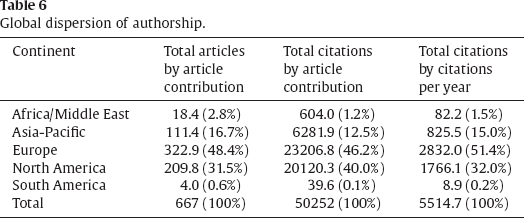
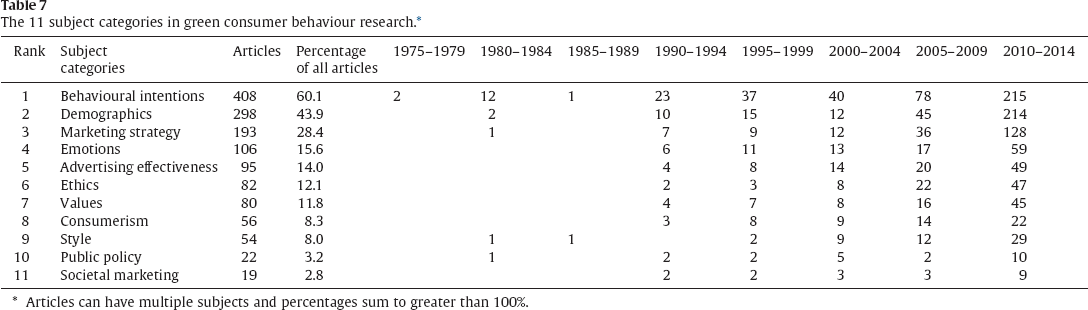
Table 7 lists the eleven subject categories covered in each of the eight five-year periods. Article keywords extracted from the articles were categorised into eleven subject categories (see Appendix B) chosen from the dictionary of the American Marketing Association (AMA) (see: https://www.ama.org/resources/Pages/Dictionary.aspx), based on authors’ and seven experts’ evaluations.
The 11 subject categories in green consumer behaviour research.
*
The 11 subject categories in green consumer behaviour research. *
Articles can have multiple subjects and percentages sum to greater than 100%.
Most articles were classified into more than one subject category and thus the total number of subjects across areas is greater than the number of articles. As can be seen in Table 7, the behavioural intentions category is the largest subject domain, representing 60.09% of all articles, followed by demographics at 43.89% and marketing strategy at 28.4%. Comparing subject categories across five-year time periods suggests that behavioural intentions have been studied since the initiation of the green consumer domain, while other subject categories, such as ethics, advertising effectiveness and societal marketing, appeared from 1990 onwards. The five-year trends suggest that from the 1990s onwards researchers have focused more on behavioural intentions, demographics and marketing strategies compared to other subject categories. Advertising effectiveness, emotions, ethics and values have also gained substantial attention from the researchers in the green consumer research domain, though relatively less than the three aforementioned. The trends also show there is a small and consistent focus on subject categories such as public policy and societal marketing.
When comparing these results with previous studies, it appears there were similar trends in earlier green marketing reviews. For example, behavioural intentions was identified as a major area by Chabowski et al. (2011), Leire and Thidell (2005), Kilbourne and Beckman (1998), Leonidou and Leonidou (2011), McDonagh and Prothero (2014), Steg and Vlek (2009) and Verain et al. (2012). Demographics was identified as a substantive subject category by Diamantopoulos et al. (2003), Kilbourne and Beckman (1998) and Verain et al. (2012). Whereas advertising effectiveness identified as a subject category (i.e. similar to ‘Consumers’ responses to green ads’) by Chamorro et al. (2009), policy-related discussions were suggested as being important in reviews by Leire and Thidell (2005), McDonagh and Prothero (2014), Steg and Vlek (2009) and Hughner et al. (2007). As such, Table 7 supports previous research as well as suggests there has been a changing emphasis of specific subject categories over time.
Overall, this study aimed to trace the development of literature on green consumer behaviour within the broader sustainability domain in regard to journals, articles, authors, institutions, and issues examined. A systematic trend analysis and citation-based assessment of all 677 articles published between 1975 and 2014 on 11 subject categories in 34 journals from varied disciplines identified the breadth of authors (1,335) and affiliations (592 institutions), located in diverse parts of the world. This suggests that there is a broad interest in green consumer domain with a high degree of collaborative research and increased participation of non-American and non-European academics. Interestingly, many of the highly-cited articles have been published recently, with an increasing number of works on green consumer behaviour appearing in the literature, as well as a shifting emphasis in some of these works. As such, it does appear that the domain is still evolving and significant innovations are still occurring.
There are three explicit conclusions of this study that contribute to our understanding of the green consumer research domain. First, the results related to highly-cited articles and subject areas suggest the diverse interests within the domain, and that it continues to evolve over time, expanding beyond early research focusing on defining green segments of consumers and now seeks to better understand how sustainability issues are being enacted on by consumers, as well as how marketers and policy makers can assist consumers in behaving more responsibly. While the findings may identify opportunities for research in the future, it is unclear as to whether this research fully embeds sustainability within consumer behaviour, for example, issues related to the ownership of goods as compared to the acquisition of want satisfaction (i.e. sharing or renting). Thus, it will be important that future researchers identify gaps in conceptual frameworks and theories, as well as geographical dimensions, that could be explored in the future; researchers may need to also broaden how sustainability integrated into consumer behaviour research as well.
Second, the institution rankings may be beneficial for academics and research students seeking to identify institutions that would be supportive of work in green marketing areas, thus allowing institutions to increase their competency within that domain. In terms of authorship and institutional location, the research suggests that there is indeed global interest in green consumer behaviour. Interestingly, even though there are large numbers of authors and institutions in North America, the largest area of interest is apparent in Europe. Moreover, a close examination of the tables related to articles, authors and institutions also reveals the considerable impact of even smaller regions such as Australasia. Thus, the results clearly suggest that the green consumer behaviour research domain is geographically diverse in regard to institutional affiliations and authorships. This geographic broadening is especially important, as different regions may have different philosophical perspectives to sustainability and therefore to green consumer research as well.
Third, the subject categories identified in the study reveal general interest of the research community in the domain, and diversity of the subject categories shows the substantial development and considerable level of maturity of the domain. One possibly concerning issue is then when one looks at the papers there still seems to be an emphasis on how consumers respond to different sustainability programmes within aspects of marketing or whether specific personality factors influence narrowly defined behaviours. There has been less emphasis on reshaping consumer behaviour and the role of sustainability within consumption, thus echoing the challenges of integrating sustainability within marketing more widely (Lim, 2016). While these results are useful for researchers to find out about the prevailing subject categories in the green consumer research domain and to trace their development over various time-periods, there may still be a need to reframe the research to look at deeper sustainability issues rather than target marketing activities on individual consumer characteristics.
Limitations and future research
The study has several limitations. First, categorisations of journals, articles, authors, affiliations and subjects are always open to debate, but we have sought to follow systematic processes that are grounded in prior literature. Other journals, however, might have been included. For example, Journal of Consumer Policy (JCP) that has published at least 20 articles on green consumer behaviour (as suggested by Google Scholar) was not included. Unfortunately, given the sheer volume of research in the domain and the growing number of publications, including all possibly journals and works was not possible.
The second limitation is the possibility that some green consumer papers in the journals examined were inadvertently overlooked. We believe that using multiple key terms ensures that all relevant works were identified, although with the expansion of the discipline some may use different terminology to frame their sustainable consumer research. Third, while we believe the citation data are robust, self-citations cannot be ruled out, which could inflate the impact of some papers (Svensson, 2010). However, given our focus on reporting the leading authors, works and institutions, we suggest that self-citation would be less likely to affect overall numbers for authors, works and institutions as compared to those which had fewer citations.
Future research could go beyond simple counts and examining relationships between authors and ideas, using methods such as co-citation analysis. Additional analysis of trends might also enable the identification of future research gaps to be explored. Research might also seek to go deeper to see whether the works are applying theory from other contexts, or developing new theory that has been applied outside the green consumer behaviour domain. Thus, as was identified earlier reframing consumption itself may be an issue of critical importance for sustainability that needs to be considered. We did not review the methodologies used within the green consumer research and this could be explored in the future especially as new tools such as neural marketing and methods (e.g., netnography) could be used to better understand consumer decision making and process when it comes to environmental issues, or big-data might allow for a better assessment of behavioural outcomes, rather than consumer intentions. Tools such as meta-analysis might also be used to seek to draw conclusions on the empirical impact of specific relationships across the domain, rather than focusing on individual studies. Finally, of course other aspects of green marketing could be explored. For example, research examining organisational greening activities would also be worth exploring, although it might require a wider set of journals to be included (i.e., more management focused).
Footnotes
Overview of literature reviews on sustainability in marketing
Consumer, consumption, purchase, environment, declaration, labelling, product, knowledge and understanding. Green marketing, ecological marketing, environmental marketing, sustainable marketing, green product, green communication, green consumer, ecological consumer. Climate change, Carbon, People, planet, and profit, Conservation, Social, environmental, and economic, EPA, Base of the pyramid, Triple bottom line, Bottom of the pyramid, Fair trade, Corporate social responsibility, Organic, CSR, Cradle, Corporate social performance, Citizen, CSP, Protectionism, Stakeholder theory, Ethics, Green, Human rights, NGO, Pollution, Emissions. Environmentalism, environmental marketing, management, green marketing/management, sustainable marketing/management, natural environment, sustainability, environmental responsibility. Food, consumer, green, sustainable, ethical behaviour, fair trade, environment, organic, animal welfare, animal friendly, ethic, ecological, social responsibility, corporate social, consumer segment, segmentation, cluster analysis.
Authors
Specific domains
Search strategy keywords
Years covered
Journals covered (number)
Number of articles
Methodology used in the review
Substantive findings
Kilbourne and Beckman (1998)
Review and categorisation of the environmentally related research
Not specified
1971–1997
12
102
Subjective evaluation of content
Research themes: characterisation of green consumer, conceptualisation of environmental consciousness, environmental behaviours, energy conservation, legislation and public policy issues, environmental values and institutions
Brennan et al. (2003)
Issues affecting consumer interest in the UK in organic food
Not specified
Not duration-specific
Not journal-specific
Not article-specific
Subjective evaluation of content
Consumers’ choice for organic food determined by five principles – information accuracy, access/availability to products, product safety, choice from a range of products, representation for consumer voice
Diamantopoulos et al. (2003)
Socio-demographics to profile green consumers
Not specified
1969–2000
Not journal-specific
53
Subjective evaluation of content
Assessed role of age, gender, marital status, number of children, education, social class in green decision making
Leire and Thidell (2005)
Factors related to product-related environmental information affecting Nordic consumers’ purchases
Multiple search terms
*
1995–2003
Not journal-specific
54
Subjective evaluation of content
Influencing factors: consumer awareness of specific programmes, consumer awareness about underlying environmental issues, association between environmentally-relevant issues and product choices, consumer acceptance of product-related information formats and sources, consumer behaviour
Hughner et al. (2007)
Factors affecting purchasing of organic food
Not specified
1985–2005
Not journal-specific
33
Subjective evaluation of content
Purchase motives: health and nutritional concern, superior taste, concern for the environment, food safety, lack of confidence in the conventional food industry, concerned with animal welfare, support local economy, more wholesome, nostalgia, fashionable curiosity; Deterrents: price premiums, lack of organic availability, poor merchandising scepticism of certifications, insufficient marketing, current food source satisfaction, sensory defects
Chamorro et al. (2009)
Characteristics of articles on green marketing
Multiple search terms
†
1993–2003
22
112
Frequency analysis
Identification of top journals publishing green marketing works: ACR; JCR; JCM, JMM. Dominant topics are: green consumer, recycling behaviour, green communication, macromarketing, concepts and strategies; Leading authors are: Thogersen, Kangun, Grove, Polonsky, Banerjee
Steg and Vlek (2009)
Factors promoting pro-environmental consumer behaviour
Not specified
Not duration-specific
Not journal-specific
Not article-specific
Subjective evaluation of content
Four-stage framework for promoting pro-environmental consumer behaviour – identify behaviour to be changed, identifying factors for behaviour change, design and apply interventions, evaluate effects of intervention
Chabowski et al. (2011)
Changing intellectual structure of sustainability research 1950s–1980s, 1990s and 2000s
Multiple search terms
‡
1958–2008
36
1320
Co-citation analysis using multi-dimensional scaling
Sustainability research areas across the three time periods have topics related to: citizenship behaviour, stakeholder theory, corporate performance, triple bottom line
Leonidou and Leonidou (2011)
Characteristics of authors, articles, methodologies and thematic areas in environmental marketing
Multiple search terms
§
1969–2008
119
530
Content analysis
Multi-authored, cross-cultural, and inter-disciplinary collaborative efforts. Increasing manuscript length and references over time. More sophisticated designs and larger samples, focusing on causal structures. Expanding scope of research, broader geographic coverage, industries, and products. Great diversity and in-depth coverage of the topics.
Verain et al. (2012)
Classification of variables used in sustainability literature to segment food consumers
Multiple search terms
¶
1995–2010
Not journal-specific
16
Frequency analysis
Three types of variables: personality characteristics, food-related lifestyle and behaviour
McDonagh and Prothero (2014)
Review and categorisation of sustainability marketing research
Not specified
1998–2013
12
181
Subjective evaluation of content
Five streams of sustainability marketing were identified: 1. Individual consumer concerns, behaviour and practices, 2. Environmental laws, regulations and policies, 3. Organisational sustainability strategies and sustainability markets, 4. Institutional, societal and systems perspectives, and 5. What is sustainability marketing and how can we achieve it?
Subject categories and their definitions from the AMA Dictionary
| Subject categories | AMA definition |
|---|---|
| Behavioural intentions | A cognitive plan to perform a behaviour or action, created through a choice/decision process that focuses on beliefs about the consequences of the action. |
| Demographics | The study of total size, sex, territorial distribution, age, composition, and other characteristics of human populations; the analysis of changes in the make-up of a population. |
| Marketing strategy | A statement (implicit or explicit) of how a brand or product line will achieve its objectives. The strategy provides decisions and direction regarding variables such as the segmentation of the market, identification of the target market, positioning, marketing mix elements, and expenditures. A marketing strategy is usually an integral part of a business strategy that provides broad direction to all functions. |
| Emotions | A cognitive process involving positive or negative valences, feelings, or emotions. |
| Advertising effectiveness | An evaluation of the extent to which a specific advertisement or advertising campaign meets the objectives specified by the client. There is a wide variety of approaches to evaluation, including enquiry tests, recall tests, and market tests. |
| Ethics | This relates to moral action, conduct, motive, and character. It also means professionally right or befitting, conforming to professional standards of conduct. |
| Values | The power of any good to command other goods in peaceful and voluntary exchange. |
| Consumerism | The widening range of activities of government, business, and independent organisations that are designed to protect individuals from practices that infringe upon their rights as consumers. |
| Style | A distinctive mode of presentation or performance in any art, product, or activity. |
| Public policy | A course of action pursued by the government, pertaining to people as a whole, on which laws rest. |
| Societal marketing | The obligation of marketing organisations to do no harm to the social environment and, wherever possible, to use their skills and resources to enhance that environment. |
Prashant Kumar is an Assistant Professor (Marketing) in T. A. Pai Management Institute (TAPMI), Manipal, India. He teaches courses like Business-to-Business Marketing, Environmental Management, Marketing Research and Customer Relationship Management in business schools in India. He has been awarded Fellow of (equivalent to a doctoral degree) National Institute of Industrial Engineering, Mumbai, India, in 2015. He holds a Master in Business Administration (Thapar University Patiala, India) and Bachelor in Electrical Engineering (Maharana Pratap Engineering College, Kanpur India). His work has been published in a number of international journals, including International Journal of Retail and Distribution Management, and Marketing Intelligence and Planning. He has also presented papers in a number of international conferences in Asia and Europe. His research interests are in the areas of green marketing.
Michael Jay Polonsky is an Alfred Deakin Professor in the Department of Marketing within the School of Business at Deakin University in Australia. He has taught at a number of universities in Australia, New Zealand, South Africa and the US, as well as in programmes in China, Singapore and Malaysia. He has published over 150 journal works in marketing and other business-related domains. Much of his research has a focus on the interface of business and environmental/social issues.