







Abstract
This research study aims to investigate the role of creativity and project management as important aspects of service quality. The context is the advertising industry which is highly competitive and its clients have very specific needs and expectations. Data was collected using indepth interviews with marketing managers and project leaders who were responsible for the advertising needs of their organisations. The findings provide detailed insights into the nature of creative competence, project management process and project outcomes from the clients’ perspective. Creative competence includes an assessment of the creative work produced by the advertising agencies and their staff. The project management processes reflect the need for detailed plans and budgets to be developed and communicated, as well as having a clear process for change management once the project scope and plan have been signed off. This study is the first of its kind using a qualitative approach to investigate the role of creativity and project management in enhancing the service quality of advertising agencies.
Introduction
This study evaluates the role of creativity and project management in enhancing the service quality of advertising agencies. With an exponential increase in technology-enabled services, the attention of the services literature has shifted to measurement and operationalisation issues in service quality (Kurt and Atrek, 2012). SERVQUAL was introduced by Parasuraman et al. (1988), followed by the development of E-S-QUAL (Parasuraman et al., 2005), a measurement scale for online service quality. Previous literature on service quality reveals that perceived service quality dimensions are not limited to those identified in SERVQUAL and E-S-QUAL (Ganguli and Roy, 2010; He and Li, 2010). These scales are inadequate in addressing specific issues which are relevant to the advertising industry as a service provider in the business-to-business (B2B) environment. For instance, service quality in the client-advertising agency context involves the quality of an agency's performance, project outcome, project management processes, creative competence and other aspects, which are not addressed by either SERVQUAL or E-S-QUAL. Moreover, several basic differences exist in the relationships between client and their advertising agencies as compared with other B2B services and there is a paucity of such studies in B2B contexts such as advertising agencies (Caceres and Paparoidamis, 2007).
Previous research undertaken to investigate the client-advertising agency relationship can be categorised into two groups. The first group consists of studies focused on the key drivers of relationship performance (Wackman et al., 1986) whilst the second group focuses on dissatisfaction, factors that precipitate switching behaviour and reasons for termination of relationships (Henke, 1995; Lace, 1998). There has been limited research on the evaluative criteria and processes used by clients in developing service-quality perceptions (Caceres and Paparoidamis, 2007). SERVQUAL appears to be insufficient to conceptualize service quality in Business-to-Business context due to the complex nature of inter-firm service offering and relationships (Woo and Ennew, 2005). Moreover, several authors have argued that the concept of service quality and quality dimensions are industry-specific (Babakus and Boller, 1992; Baker, 2013). As such, the current study seeks to explore service quality perceptions in the professional services, in particular, advertising agencies which are project based organisations (Bartsch et al., 2013) involving “the creation of temporary systems for the performance of project tasks” (Sydow et al., 2004, p. 1475). Therefore, the dimensions of project management can be used to enrich the understanding of service quality as perceived by the clients of advertising agencies. However, Carden and Egan (2008) found that there is no published research relating project management to marketing. Hence, the research purpose is to develop and enhance understanding of the range of immediate experiences related to service quality in the advertising context which are embedded in the relationship and interaction between an advertising agency and its client (Goulding, 2005, p. 302). The main research question is “How is service quality of advertising agencies, being project-based organisations, perceived by their clients?” More specifically, this study aims to investigate clients’ perspective of the role of creativity and project management as core areas associated with service quality of advertising agencies. This study adds to the understanding of how project management is applied in the marketing discipline, specifically in the advertising context.
This paper is structured as follows: A review of the literature is performed with a discussion of service quality since advertising agencies provide professional services to their clients. This evolves into a discussion of specific services provided by advertising agencies, which are considered to be relatively important by their clients. The issues or problems are elicited as gaps in the literature. The research methodology follows using a qualitative approach. The in-depth findings are reported and discussed. The paper concludes with a discussion of theoretical and managerial implications, the limitations of the study and suggested future research.
Service quality provided by advertising agencies
Several researchers attest to the importance of service quality as a factor underlying business performance and an organisation's long-term feasibility (Carrillat et al., 2007). According to Cronin and Taylor (1992) there is interest in the measurement of service quality, as services have become increasingly important in the global economy, and organisations need to focus on offering and delivering higher quality services in order to maintain their competitive stance. However, ‘service quality is an elusive and abstract construct that is difficult to define and measure’ (Cronin and Taylor, 1992, p. 55). Oliver (2010) claims that the notion of quality was developed with regards to technical excellence in a manufacturing environment, whereas the quality construct in the services literature is an attitudinal construct which centres around customers’ perceptions of overall excellence or superiority (Kang, 2006). Hence quality in manufacturing can be objectively assessed whilst in service contexts quality is evaluated subjectively. Parasuraman (1998), Caceres and Paparoidamis (2007) and Stan et al. (2007) note that most of the literature in the area of service quality relates to consumer research rather than research conducted in B2B environments.
Various authors have suggested that service quality is comprised of several attributes (Thaichon et al., 2014). The ‘Nordic’ perspective originating with Grönroos (1982) offered two global categories, technical and functional quality (Brady and Cronin, 2001), which is suitable for application in business service relationships (Szmigin, 1993). The technical component relates to the outcome of the service provided and may be measured objectively, whilst the functional aspect refers to how the service was delivered or the process and is more likely to be assessed in a subjective manner (Szmigin, 1993). Whilst in general, customers assume that a service provider's technical quality is of a satisfactory standard, in the advertising industry the objective measurement of technical quality, which would equate to the quality of the creative and strategic outputs, is not always readily assessable.
Szmigin (1993) has modified and expanded Grönroos’ model and offers three components of service quality: ‘hard quality’, relating to technical quality; ‘soft quality’ which equates to functional quality; and ‘outcome quality’ which refers to the achievement of the desired goal or outcome. This author points out that although a service may be well performed, the desired outcome may not have been achieved, and outcome quality may be outside the control of the parties in the relationship as it is vulnerable to external forces and environmental conditions. This fits well with the classification of project success adopted in this study; the hard and soft quality, which are collectively referred to as ‘process satisfaction’ by Szmigin (1993) is comparable to the dimensions of creative competence and project management, whilst the outcome quality equates with project outcome. Szmigin (1993) claims that the hard and soft aspects of quality impact on the day to day aspects of the relationship, however, the service providers would be judged in the long run on their outcome quality. Szmigin's (1993) conceptualisation of service quality being composed of hard, soft and outcome quality is aligned with Michell's (1986) findings in relation to reasons for client dissatisfaction with advertising agency performance. These authors along with others such as Stan et al. (2007) agree on the relative importance of the three areas of service quality, i.e. creativity, client service and campaign results.
The current study aims to adopt Szmigin's (1993) classification of service quality consisting of the three dominant dimensions of hard or technical quality, soft or functional quality and outcome quality. Patterson and Spreng (1997) and Caceres and Paparoidamis (2007) have previously used Grönroos’ classification of service quality in the context of client-agency relationships. However, Szmigin's model extends Grönroos’ two dimension model and is easily adaptable and readily applicable in the advertising B2B environment. It would be inappropriate to use SERVQUAL as not all its dimensions are relevant in measuring and evaluating the relationships between clients and their advertising agencies (Davies and Palihawadana, 2006). Fig. 1 depicts the conceptualisation of service quality in the current study.
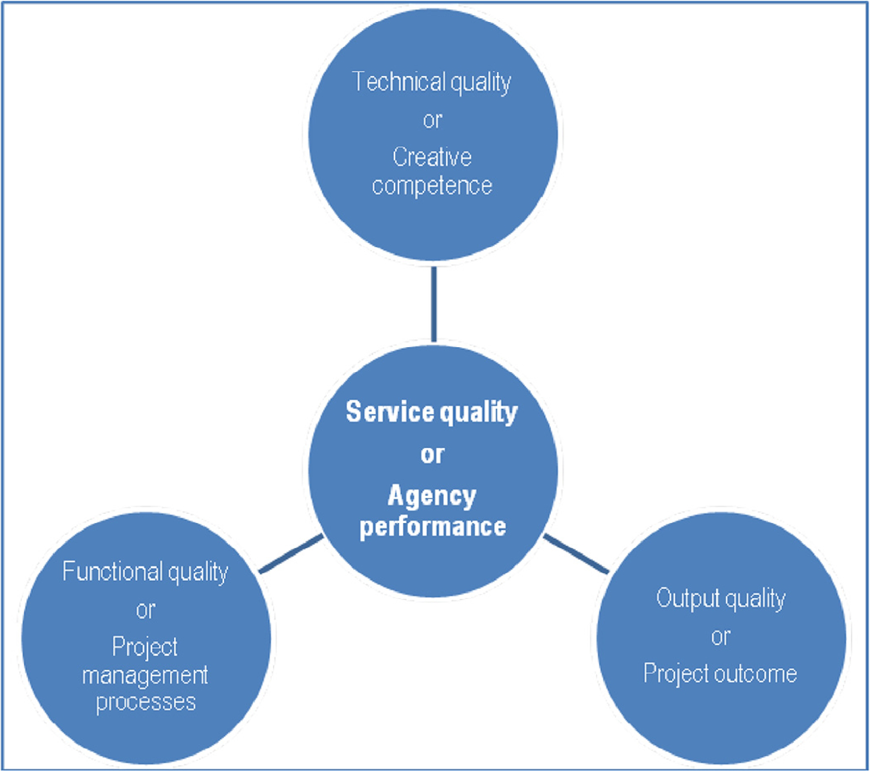
Conceptualisation of service quality developed for the current study.
Although the service quality literature has informed the development and design of the current study, owing to the customisation required for the advertising context, context specific nomenclature has been employed to describe the various components of service quality in this study.
Ulaga and Eggert (2006) suggest that items in performance based constructs should include affective and conative dimensions in relationship management studies. LaBahn and Kohli (1997) define agency performance as encompassing ‘the quality of the agency's creative work and the agency's attention to the implementation of advertising campaigns’ (p. 500). However, the current study broadens agency performance to incorporate three dimensions: hard or technical, soft or functional and output quality in the forms of creative competence, project management, and project outcomes respectively. The following section considers the specific services provided by advertising agencies commencing with creative services followed by a discussion of the project management literature.
Creative competence
Competence is one of the key variables incorporated in relationship management studies as customers value their relationships with competent providers. There are several sources of competence including intellectual, technical, commercial and social (Ndubisi et al., 2009). In the current context, intellectual and technical abilities are core competencies for successful agencies. When organisations select advertising agencies the key selection criteria are related to performance factors, such as creativity, the development of fresh ideas and knowledge and experience within the firm's industry (Fam and Waller, 2008; Henke, 1995). Verbeke (1988) studied the advertising client-agency relationships in the Netherlands and demonstrated that the main predictor of overall satisfaction with an advertising agency was the quality of their creative work. This finding is not surprising, as firms predominantly seek creativity from their agencies, however, the construct ‘quality of creative work’ in Verbeke's (1988) study is not clearly defined, nor its components identified.
Agencies provide a variety of services to their clients, even within the confines of a single campaign. In the studies that identified agency performance as being critical (Verbeke, 1988; Wackman et al., 1986), the construct relating to agency performance reflects the quality of the creative work rather than an assessment of the services that were delivered. LaBahn and Kohli (1997) define creative quality as ‘the client's perspective of its agency's level of creative performance’ (p. 500). In the current study creative competence is defined as the client's assessment of the quality of the agency's creative work and its capacity to execute the agreed upon the campaign.
Many advertising agencies see themselves as providers of marketing solutions (Beverland et al., 2007) rather than simply the creators of various advertising campaigns. However, their clients see the agencies as predominantly supplying creativity (Halinen, 1997) with the other offerings as secondary. This perception appears to be evolving, as Koslow et al. (2006) note that ‘marketers often come to agencies with difficult problems seeking creative solutions’ (p. 99). Hence one can detect a shift in client expectations over the last decade. Beverland, Farrelly and Woodhatch (2007) reaffirm that the ability of agencies to generate solutions provides clients competitive advantage and differentiation.
Creativity is a concept that has been difficult to define although generally it is associated with originality, appropriateness or relevance (Kilgour, 2005; Li et al., 2008). Koslow et al. (2006) claim that research relating to creativity has shifted from a focus on the creative people themselves to situational factors that impact on creativity. In the advertising context, marketers from the client organisation ‘set an overall tone for the creative environment, which impacts creativity dramatically’ (Koslow et al., 2006, p. 81). This may be true even in situations where the creative staff from the agency do not directly interact with the client.
Beverland et al. (2007) suggest that agencies need to adopt an entrepreneurial approach, especially for their key accounts. ‘In the context of agency-client relationships, proactivity would involve actively shaping the relationship to develop new opportunities, and is defined as being predisposed to anticipating and acting on the future needs of the client, including suggesting new directions to advance the relationship’ (Beverland et al., 2007, p. 50). Clients’ expectation of proactivity from their creative agencies was identified by Lace (1998). Agencies report that clients are unable to articulate their marketing problems clearly but rather request a marketing campaign to address their specific needs. It is then the responsibility of the proactive agency or account manager to assist the client to fully define the problem, identify objectives and thereby develop relevant strategies rather than simply address the client's initial request.
It is believed that proactive advertising agencies have distinct comparative advantages as the initiatives they take tend to yield desirable outcomes. According to Beverland et al. (2007) proactivity results in satisfied clients who have stronger bonds with their agencies, and a greater level of trust which in turn stimulates commitment and partnership between the client and the advertising agency. This results in improved outcomes which in turn strengthens relationships and hence impacts on future business intentions.
Cagley (1986) however suggests that creativity does not rate quite as highly on the list of agency selection attributes. Henke (1995) undertook a longitudinal study to identify the areas that agencies should focus on in order to retain their existing clients. She determined that satisfaction with creative skills becomes less important than other performance dimensions, such as campaign execution and achievement of the desired outcome, once the client agency relationship has been established. As such, it is important to note that agency performance is a broad construct and includes considerations relating to implementation as well as to creativity (LaBahn and Kohli, 1997). Implementation ‘is defined as the client's perception of the extent to which its agency executes the client's advertising campaign according to the plan’ (p. 500) and is aligned with the implementation phase in project management, which can be considered as the functional and output quality. Hence successful agencies would need to exhibit strong creative quality as well as the ability to efficiently implement advertising campaigns.
Project management
The bulk of work handled by advertising agencies for their clients can be classified as project work. As mentioned earlier, in the marketing literature Grönroos (1982) contends that customers assess service quality using two key dimensions: how a service is delivered (functional quality) and what was delivered (technical quality), whilst Szmigin (1993) identifies three key dimensions being hard, soft and outcome quality. These conceptualisations align with the success dimensions associated with traditional projects and project management. Thus it can be seen that quality evaluations are made during the service encounter (process quality) as well as after the service has been performed (outcome or output quality) (Kang, 2006). The discipline of project management has evolved over many years however the formal tools and techniques that have been developed are rarely adopted in non-traditional contexts. The following section provides background on project management and the assessment of project success. The nexus between traditional project management and its application in the advertising context will also be addressed.
Criteria for success of project and project management
De Wit (1988) differentiates between project success (output quality) and project management success (process quality). Thus two stages need to be considered when assessing projects, the delivery process as well as the outcome or product (Baccarini, 1999; De Wit, 1988; Ika et al., 2005; Szmigin, 1993). Cooke-Davies (2002) distinguishes between ‘doing the project right’ and ‘doing the right project’. The former relates to operational issues and refers to effective project management whilst the latter adopts a strategic perspective and refers to undertaking projects that are beneficial to the organisation and which improve their competitive position. Although this distinction is a very important one, it is often not acknowledged in the project management literature (De Wit, 1988).
Although efficient project management, that is, adherence to time, cost and quality specifications are important (Baccarini, 1999; De Wit, 1988) this does not measure the success of the project outcome, or the effectiveness of the project or whether the project has met its stated objectives (Atkinson, 1999). During a project and on its completion, time and cost appear to be the important concerns. However, over time this dominance fades and is replaced by a focus on whether the project provided the intended solution (Baker et al., 1988). Therefore perceptions of project success vary over time (Baccarini, 1999). Kupakuwana and van der Berg (2005) make the distinction that traditionally, project managers tend to focus on criteria which can be assessed in the short term, whilst clients tend to be long-term oriented focusing on project outcomes. These authors assert that ‘a project is not only about providing an end product, but is also a service product in and of itself. The processes of service delivery should be taken note of and service delivery best practices should be integrated into project management’ (p. 30). It is rare to see such acknowledgment of the importance of service delivery and the impact of project management on the client in the project management literature. Therefore both project efficiency and project effectiveness (or success) need to be considered when success is being assessed in the context of a successful project (Shenhar et al., 1997). However, within the project management literature the issues of efficiency and effectiveness are quite often confused (Belout, 1998) or used interchangeably.
As well as determining the relative importance of project management success and project success, success during and post implementation are considered important. Given the ambiguous nature of project success Baker et al. (1988) contend that it is unlikely that a project will be absolutely successful. Assessments will vary as a project may be viewed as more or less successful by the various stakeholders. Whilst some criteria may have been attained, achievement of other objectives may have failed (De Wit, 1988). Project management success may be measured during and at the end of the implementation stage, however project effectiveness or success needs a longer time frame (Atkinson, 1999; Baccarini, 1999). It is for this reason that generally project efficiency is equated to project success, thereby eliminating the important consideration of project effectiveness. De Wit (1988) points out that it is unrealistic to expect to be able to objectively measure project success. This would be especially true in cases where the project success criteria are not clearly defined and agreed upon by all stakeholders during the initial project phase (Altmann, 2005). The setting of clear subjective project goals and objectives is equally important in advertising and marketing projects as it is in traditional applications of project management (Rust et al., 2004).
There are various considerations when attempting to define project success, some of which include: the stage within the project life cycle (Altmann, 2005), the timing of the assessment (Baccarini, 1999), the project type, the stakeholder's expectations (Baccarini, 1999; Dvir and Lechler, 2004; Ika et al., 2005), the industry (Meredith and Mantel, 2003), and the organisation's view of success (Meredith and Mantel, 2003). The assessment of project success is therefore a complex and subjective area and may vary across stakeholders, industries as well as project stage.
Project management processes and outcomes
According to Kupakuwana and van der Berg (2005), project success is related to customer satisfaction with the project outcome, although this does not always account for overall customer satisfaction. Additional project related factors that ensure customer satisfaction include good relationships and effective communication between project team and customer which are attributed to project management success (Kupakuwana and van der Berg, 2005). On the other hand, SERVQUAL developed by Parasuraman et al. (1988) to assess service quality perceptions focuses on elements of service delivery whilst ignoring the outputs or outcomes. Hence the assessment of technical quality in service industries has been debated (Kang, 2006) since customers tend to assess how the service was delivered, rather than its outcome. Such a contention may be pertinent in high credence service situations such as medical and legal services, but is not universally applicable.
Grönroos (1982) and Szmigin (1993) have respectively identified elements of service quality which directly relate to the current context. This is technical quality which relates to the outcome of the service encounter, and is incorporated in the current study through the creative competence dimension; functional or process quality which relates to the way a service is delivered and is being incorporated through the project management processes dimension; and outcome quality which is assessed through the project outcome dimension.
In marketing and advertising campaigns it is generally difficult to define and measure the outcomes particularly for above-the-line campaigns. The marketing budget does not always extend to measuring the project results. Some marketers justify their expenditure on the campaign itself and prefer to avoid focusing on the outcomes, which may mean that results are achieved some time after a campaign has ended. However, this trend needs to change and agencies together with their clients need to be able to clearly identify measures of success at the outset of campaigns, as is common with most traditional projects. Agencies need to ensure that clients understand the value of their advertising campaigns and also that results may take the time to materialise. Furthermore, project outcomes are vulnerable to the influences and forces of external factors which are beyond the control of the client and their advertising agency.
Baccarini (1999) and Ika et al. (2005) claim that project success is more important than project management success, that is, an effective outcome is paramount to efficient delivery, although the assessment of success will vary depending on the stakeholder. Many studies in the services literature disregard reference and assessment of outcome quality (Kang, 2006), whilst others provide conflicting findings. In studies relating to the client-agency relationship, Halinen (1997) determined that satisfaction with the process was more important than with the outcome. Patterson and Spreng (1997) suggest the converse to be true with clients being more concerned with the overall outcome rather than the service provision itself, that is, effectiveness was emphasised over efficiency, and is exemplified by performance based compensation (Li et al., 2008).
Qualitative research
Methodology
It is proposed that the client-advertising agency relationship is embedded in social structures (Fligstein and Dauter, 2007). As such, this study is grounded in social constructivism demonstrating the worldview that social reality is a construct of social interaction between various entities in the society (Camargo-Borges and Rasera, 2013). Methodologically, the objective is not to verify or persuade others about the precise explanation of the phenomenon, but to enhance the scope of knowledge (Camargo-Borges and Rasera, 2013). Informed by social constructivist view, the current research adopted a phenomenological approach (Creswell, 2007). The central aim of phenomenology is to develop and enlarge “understanding of the range of immediate experiences” (Goulding, 2005, p. 302). Service quality is a customer-based concept (Parasuraman et al., 1991; Song et al., 2016) and can only be examined from the client's perspectives (Venetis and Ghauri, 2004). The clients in advertising industry are companies that purchase advertising services and that are engaged in relationships with advertising agencies. The interview protocol was developed to identify how the key informants or clients had experienced their working relationships with their respective service providers. More specifically, (a) client's perceptions of service quality from their advertising agencies; (b) clients’ definitions and expectations in regards to creativity and creative work from their agencies; (c) the processes involved in working with agencies on projects of strategic importance; and (d) relative importance of creativity, project processes and project outcomes. As this study was predominantly exploratory, the interviewer allowed participants to guide the discussion in order to facilitate a full understanding of the issues involved.
The unit of analysis (Sekaran and Bougie, 2010) was identified as the individual marketers within corporations who commission advertising agencies to undertake strategic and promotional campaigns, as well as the marketers who work alongside account managers and other agency staff to turn the project into a reality. Purposive sampling was utilised for the study (Creswell, 2009). The ideal participants were marketers in corporations, including government, public and private, with extensive experience commissioning advertising projects and working with advertising agencies. In order to locate appropriate participants, the names and contact details for marketers with responsibility for advertising were compiled from the www.bandt.com.au (BandT). BandT is the leading publication for Australia's advertising, marketing, media and PR industries. With an online website and a bi-monthly magazine, BandT provides latest information on the issues, trends and people in these industries (BandT, 2017). As the researcher was based in Melbourne, marketers based in Victoria were contacted via phone and asked to participate in a semi-structured interview. Status of potential respondents as key informants was determined by asking if they had had extensive experience working with strategic and/or creative advertising agencies.
The final sample consisted of 15 participants. This number was not pre-determined; instead, this was when saturation was achieved. The interviewees came from different industries and sectors such as fast moving consumer goods, automotive, leisure and tourism, fast foods, higher education, and retail. All of the participants had at least five years experience in marketing roles. Six had between 10 and 19 years experience and one-third had over 20 years marketing experience. While most of them were either marketing, advertising or brand managers/directors, they were in different hierarchical levels in their organisations. This helps to enrich the insights of this research as the opinions of marketers at various ranks are likely to impact on long-term relationships between clients and service providers as well as project outcomes (Karantinou and Hogg, 2009). For example, senior marketing managers are likely to be the decision makers when it comes to which agency to employ and whether or not to continue relationships with the existing advertising agency. On the other hand, such decisions could be influenced by those who have the day to day dealings with the agency such as less senior members of the marketing team. Four of the participants used to work for advertising agencies prior to their current roles. Table 1 provides further details for each participant.
Demographic profile of the interviewees.
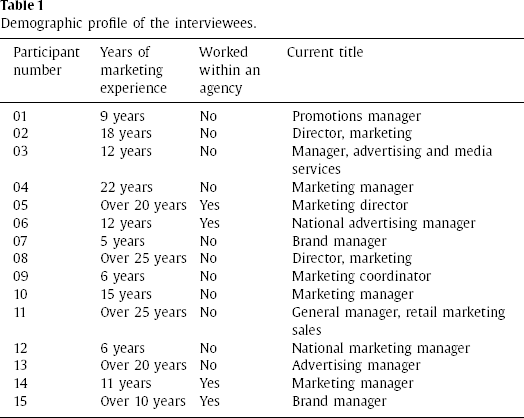
Demographic profile of the interviewees.
Data were systematically analysed in order to ‘understand and interpret the meanings and experiences of the informants’ (Spiggle, 1994, p. 492) using the process recommended by Creswell (2007). All transcripts were read to identify significant phrases, before developing general themes and finally describing the phenomenon or lived experiences of the clients’ interactions with their agencies. Both a priori and emergent categories were identified. NVIVO version 10 for Windows was used for analysis and to enable retrieval (Spiggle, 1994). Sections 3.1 and 3.2 present respondents’ significant statements using broad themes and the Discussion section draws these together in order to describe the interplay between creativity, project management and service quality highlighting the linkages with previous studies.
Service quality
The components of service quality were explored with interviewees, and several themes emerged when marketers were asked its meaning in the current context.
Five participants made mention of creative excellence and/or quality of the output provided, whilst nearly all said that processes, timeliness and/or the quality of the account services were evidence of service quality. In particular, Participant 5 highlighted the ease of dealings whereas time management and deadlines fulfilment were emphasised by Participant 12. These can be summarised by a quote by Participant 10:
‘The process of the weekly meetings, work in progress reports and the key people, the creatives and the account managers’ (Participant 10).
Other themes that emerged relating to service quality included consistency and continuity of account staff which appears to be more of a concern when organisations are working with larger agencies. High turnover rates could be a hindrance in a relationship between the client and an advertising agency due to potential costs associated with working with new people as indicated by Participants 8 and 4:
‘I like continuity … you go to so much trouble to brief a team, and I don't like the creative team turning over on a three monthly basis’ (Participant 8).
‘And occasionally we work with new staff at the agency. How quickly they get through the learning curve, the fact that I'm too busy to get served up garbage’ (Participant 4).
Responsiveness and communication were further themes. Timely communications, constant updates of progress and directions, and following-ups are examples of good quality which could have a positive impact on the overall attitude towards the service. Finally, interviewees revealed that when agencies add value and show ‘deep’ understanding of the client and their industry, service quality was judged to be high. This was stated by Participant 7:
‘And just basically having an exceptional understanding of our brands and our market place’ (Participant 07)
The following quote encapsulates most of the elements of service quality, including the importance of proactivity (as discussed in Section 2.2).
‘Always being very prompt, being able to get hold of people, then responding to briefs on time, and possibly commenting a bit above what they were asked to do in terms of potential insights or presenting some research that we may not be aware of, the follow-through, consistency. All those things are important’ (Participant 13).
Creativity (what creativity means to clients)
It was found that clients have different expectations of the advertising or creative agency. This finding is supported by West et al. (2008) and Stadler (2011).
A participant suggested that creativity was expressed as an aggregate of touch points guided by one unique idea. Likewise, one claimed that creativity should be original and different, stimulated by ‘various inspirational sources….to develop the best story about your brand’ (Participant 03).
Most participants indicated that the agency needed to have a clear understanding of the target market and that the creative needed to connect with these markets, which can be challenging when the agency staff needs to place themselves in the shoes of the target audience. A particular example was provided by a marketer for a women's gym who worked with an all male team of creatives at the advertising agency.
The majority of participants highlighted the significance of the creativity aligning with their brand image and personality. They agreed that it was not the message that creativity came from. One indicated that creativity came not from the message, but from how and where it was portrayed, consistent with Stadler (2011) As such, the creative and the media agencies needed to cooperate to deliver the highest level of creativity.
‘take these new and creative ideas, and try to harness that freshness into the meaning of your brand, so it fits within the totality and what your brand stands for’ (Participant 10).
Although participants could not reach a consensus on the meaning of creativity, most of them insisted that creativity was imperative and a part of their evaluation on the quality of the advertising agencies, especially in terms of communications to the target audience as emphasised by Participant 1, ‘creative people bring creative ways of communicating’. In particular, creativity helps to effectively convey the intended message to the customers and develop associated positive feelings such as love. This is indicated by the following excerpt:
‘It lies in the heart of our communication … our effort in being very creative is just to serve one purpose: developing awareness and love in our target market’ (Participant 2).
The importance of encouraging and supporting the agency's creativity was highlight by all participants, which is demonstrated by the following excerpt from Participant 8.
‘What you're constantly doing when you're trying to make good marketing is that you are trying to let the creative people have as much creative licence as you can” (Participant 8).
On the other hand, the role of creativity in advertisements can be less emphasised if the client has rigorous restrictions and internal constraints about the corporate look and feel. In this case, they are not looking for originality but consistency.
Creativity (creative planning process)
Planning large-scale advertising projects appears to be done in one of two ways. Some companies prepare a brief which is then presented to their agencies who respond with various pitches relating to strategic and/or creative solutions. Such organisations see their agencies as service providers. Koslow et al. (2006) and Kilgour (2006) found that the briefs that had been prepared by marketers were of limited value to the agency's planning process.
Other companies, who consider their advertising agencies as strategic partners, tend to involve their agencies from project inception, presenting them with a problem or an idea for a campaign which is then developed into a brief together with the agency. Such an approach is preferred by agencies (Kilgour, 2006). Smaller-scale projects may commence with a formal brief but are more likely to be commissioned in an informal manner, especially when the time is at a premium and the client-agency relationship is established.
Agencies pitch the campaign to their clients or potential clients. Such a pitch would incorporate the creative ideas that the agency had developed to address the client's marketing problem or objective. Through a series of interactions between the client and the agency team, the details of a campaign are finalised and approved. This process is aligned with the commissioning of complex projects in traditional project management applications such as construction, engineering and telecommunications. The Project Management Book of Knowledge (PMBoK), which for many is the bible of project management, sets out five phases of project management: initiation, planning, executing, monitoring and controlling, and closing. The commissioning and approval of an advertising campaign would be classified as project initiation. In traditional project management applications, during the initiation phase a project charter would be developed that sets out the project sponsor, funding arrangements, governance and presents the business case. This charter is then approved by the sponsor or client and signed off, just as is the case for advertising projects where an analogous process is followed with differing nomenclature.
Agency project processes and project implementation
Participants were asked to describe the processes followed by their agencies. Their responses can be categorised into three groups. The first group was aware of good internal processes of their advertising agents, especially when dealing with large projects. The second included those who did not actually pay attention to their agencies’ processes, and instead employing their own internal processes for handling marketing campaigns and projects. The third group was those who had experience with poor or very poor process management of their agencies. The interviewees in this group admitted that they actively involved in developing the internal processes with the agencies because they could not use the services of an agency who had ineffective business practices in the long term.
It is imperative for both parties – the client and the creative people – to have knowledge of each other's internal processes and to agree on a common set of processes which can increase effectiveness as well as to avoid anxiety and frustration for both organisations. This is illustrated by the following excerpt from Participant 7:
‘We work hand in hand with the agency and it definitely involves the internal processes here as well. Not just their processes though. It should be about getting the right process that works for both parties’ (Participant 7).
One participant explained that the cooperation between a client and an agency in the internal process takes priority when considering service quality as compared to creativity. This highlights the significance of project management processes which tend to involve a considerable amount of time during the planning and implementation of a project.
“Service quality is more is associated with the processes because that's what's sort of, if you think about the time you spend with your agencies, it's the planning processes and all the day-to-day year-in-year-out processes that you tend to associate with service quality. The actual creative act, the actual thinking up creative ideas, bringing them to life, actually takes up a small proportion of the 365 days, so you tend to think the service quality relates more to the process and the management of your account” (Participant 2).
Once clients sign off on a project they are kept informed through regular work in progress meetings which may occur weekly or monthly, although marketing staff may liaise with their account managers or key contacts several times each day, either by phone or email. A few companies have electronic project tracking systems or portals through which they can check how their projects are progressing. Most participants agreed that time and budget concerned them most in the project management process. They underlined that it was important for them to have access to and keep track on the progress as well as updates on a budget. Moreover, they expected the agency to be able to implement and complete the project within the specified budget and agreed timeline.
“The simple measure is that you actually hit your numbers. In other words you have a campaign that is executed within your budget” (Participant 4).
“I think that there is a minimum standard that you have got to have because once you have come up with the creative idea, you have still got to be able to implement that on time and correctly and that is where a lot of the process comes” (Participant 8).
Some interviewees felt that their advertising agencies did not appreciate the urgency of some projects, using the available time for development and subsequently placing pressure on the clients at the approvals stage. This appeared to be more of a problem where clients were not large accounts, or were large accounts at a smaller agency.
Project outcomes
Some marketers indicated that project performance measures were objectively defined at the outset of the campaign and assessment of the effectiveness of the campaign was built into projects. This was especially evident in campaigns undertaken by parent companies on behalf of franchisees, as well as digital campaigns which are relatively easy to measure. Most clients said that campaign results were very important as marketers needed to be accountable with the finite resources of the company and justify advertising expenditure. Not all interviewees had processes in place to directly measure and assess the effectiveness of their promotional expenditure. Others were able to directly and efficiently measure campaign impact, for example, through the point of sale systems where sales can be regularly monitored and compared to historical sales trends in a timely manner.
Creative, processes or outcomes?
In essence, advertising agencies offer three things to their clients: their creative expertise, the processes to plan and implement a project, and the output or results of the project. When participants were asked to rank these three, almost all ranked the project outcome as having the highest priority, and this aligns with a previous study by Patterson and Spreng (1997) which finds that outcomes have a considerably stronger effect on both value and satisfaction than other performance dimensions. This can be explained by the fact that outcomes reflect the core of service expectations which is the successful delivery of the results for which the service provider was used. This is demonstrated by the following excerpts:
‘Look, the outcome is what we want’ (Participant 4).
‘Outcome … on the assumption that outcome is going to have to be what impacts our side of the business the most, in terms of account sales and all those things’ (Participant 5).
One participant who worked for a parent company on behalf of franchisees felt that the ranking was dependent on whose perspective was taken. As a marketer she was more interested in the creative aspects, whilst as the representative of the franchisees whose money she was spending she ranked the project outcome as most important.
Discussion
‘The core competency of advertising agencies and other creative firms is more than simply producing creative work – it's the efficient management of that production’ (Travelstead, n.d.). The client has an interest in both the ‘what’ and the ‘how’ of the service being provided by the agency (Caceres and Paparoidamis, 2007). Assessment of the functional quality dimension tends to be more subjective than the technical or outcome dimension. Not only is the evaluation of service quality complex (Brady and Cronin, 2001) it may also vary between industries and varies by account size (Stan et al., 2007).
In the current study clients were asked to focus on and discuss specific ideas about functional, technical and outcome quality. Creative competence includes an assessment of the creative work produced by the agency and its staff and is representative of soft attributes of service quality. Project management processes were constructed as an operational concept with a focus on the hard or technical aspects of project planning, incorporating the development and communication of the project plan. Outcome quality was associated with the project outcome construct.
Creative competence
The provision of creative competence is the main reason that organisations employ advertising agencies. They look for specialist knowledge, creative prowess, new and fresh ideas, and ways of marketing and promoting their goods and services that are innovative and yield the results they are seeking. These skills cannot be found within businesses and thus corporations turn to advertising agencies. Furthermore, employing the services of agencies reduces the need to employ additional staff as well as headcount within the organisation yet it provides the sought expertise through outsourcing.
The creative competence dimension in this study reflects the client's assessment of the standard and level of innovation of the creative work provided by the agency, its alignment with the client's needs as well as the agency's ability to competently deliver the agreed upon creative strategy, consistent with the findings of LaBahn and Kohli (1997).
Creative competence is a focal dimension as it has been found to be the key component of service quality. Whilst it is the main reason that organisations turn to agencies, creativity does not have the same connotation to all clients. All clients expected the agency staff to have a clear appreciation of the advertisers’ target audience as well as the corporate or brand image. Whilst some were clearly seeking original and innovative ideas and solutions both with regard to content and context, others were content with campaigns that were deemed ‘appropriate’. Thus creativity should be assessed on the basis of originality and appropriateness, particularly that the creative is right for the product, the target market (Koslow et al., 2006; Stadler, 2011) and fits the needs of the client organisation.
It became evident that marketers were expecting their agencies to fully understand their current situation and business problem, as well as have an affinity with their products and an understanding of the final customer. This understanding equips agency staff to offer creative solutions that display innovation and proactivity. Beverland et al. (2007) concur that clients are seeking agencies which are proactive and are able to provide comprehensive solutions to achieve the desired outcomes for their clients.
Clients hold their agencies accountable for the quality of the advertising campaigns yet Koslow et al. (2006) note that over the half the variability in creative work is attributable to the marketers within the client organisations themselves rather than the agency. This aligns with social interdependence theory that asserts that the behaviours of each party will influence outcomes (McCallum and Harrison, 1985). Advertisers need to be aware of how their behaviours and attitudes impact the creative work and solutions provided by agencies. This was noted by one of the interviewees, ‘if the relationship is suboptimal what is going wrong on your side?’ (Participant 11).
Greater levels of creativity can be achieved when senior management are open to new ideas and are prepared to work with the agency through the creative process, rather than simply being involved in the final approval process (Koslow et al., 2006). Senior management can have quite a profound impact on creativity, as they generally have the power to terminate relationships with suppliers such as advertising agencies. The threat of dismissal can impact on the agency's solutions and creativity (Koslow et al., 2006).
Project management processes
The project management processes dimension reflects the need for detailed plans and budgets to be developed and communicated, as well as having a clear process for change management once the project scope and plan had been signed off. These could be classified as basic requirements that clients of service providers would expect as minimum professional standards, rather than processes that would lead clients to rate their service providers highly. These are basic tools of the trade for any organisation that is project based, irrespective of the industry.
Minor scope changes may have minimal impact on the project implementation plan however larger ones that require substantial changes to the original project plan may have a significant impact. For example, a simple request for a scope change will distract the project team or at least the account manager from the planned schedule, whilst the feasibility and implications of the change request are assessed and evaluated. This can delay or add costs to the project, as well as the impact on the final outcome. Agencies should have systems in place to manage project scope request changes after initial project plans have been finalised and approved. Such a system needs to include a process to assess the impact of the change, a process to communicate with the client and seek client approval, and finally a process to facilitate communication of the approved changes to the project team.
It appears that advertisers are generally satisfied with the project management processes that their agencies have in place. Some of the marketers interviewed explained that previously their agencies had very poor internal project management processes, but the client had worked with the agency on process improvement and the agencies now had professional and effective processes. It is interesting that clients are prepared to assist suppliers in this manner, when there are alternate suppliers readily available and accessible. This level of cooperation and collegiality is evidence of a strong alliance between the client and agency.
Several measures can be used to assess whether the project management process was efficient and effective, with the most popular three being based on the Iron Triangle, that is, whether the project was completed on time, within budget and met the specified quality. Although these three measures are accepted as the Iron Triangle of project management, no empirical studies were located that assessed project management performance using these criteria. Whilst clients set the constraints of the campaign, that is, the marketing objectives and resources such as budget and project duration, it is the agency that needs to ensure it can achieve the desired and planned results within these limits.
Project completion time
Assessing whether projects were completed within the originally specified time frame has been previously explored and reported in the current context. If advertising projects fail to meet project deadlines this may lead to significant negative consequences for the clients, as well as the impact on future relationships and ultimately the desire to continue business relationships.
Participants rarely mentioned completion time, yet when probed indicated that once plans were signed off they expected that projects would be completed on time. However several marketers expressed frustration with timelines saying that agencies took their time completing in-house tasks but placed pressure on clients for review and approval to proceed to the next stage, without due recognition of the internal processes and time frames required in the client's organisation.
A further concern with regard to time came from marketers who were working with large advertising agencies, but did not have a dedicated team or were smaller accounts. These respondents indicated that response times could be slow as requests would be placed in a queue and handled in order of priority, often passing through several departments at the agency before being actioned and signed off.
Although it has been shown that time pressures constrain creativity (Koslow et al., 2006) consideration also needs to be given to whether the time is in fact a project constraint that needs to be adhered to. It is possible that the project outcome is not time related and hence time is not made a priority by either the client or their agency, in which case if the project is not completed on time there will be few if any negative consequences.
Project completion within budget
The two predictors of whether an advertising project was completed within the original budget were project management processes and whether the project was completed on time. Costing any unique project is complex as it is fraught with uncertainty, particularly relating to the amount of time tasks will take and the human resources required for completion. Agencies need to ensure that project budgets are realistic, adequately covering costs whilst avoiding overcharging clients. Contrary to expectation, Koslow et al. (2006) demonstrated that advertising project budgets do not have a great impact on either creativity or originality. This does not imply however that budget constraints do not impact campaign outcomes, as budgets will influence media and production expenditure.
Clients need to have a clear understanding of their agencies’ fee structures and expected costs of their projects. Thus it is the responsibility of the agency to carefully cost campaigns and projects and communicate these to the client to minimise surprises and conflicts relating to prices charged. Agencies who have poor planning processes will find it difficult to prepare realistic project budgets which will have a direct impact on the client's value perceptions.
It is not uncommon for senior managers across client organisations to be involved in approving marketing budgets and marketing expenditure, especially for large and strategically important projects. Agencies and some clients are reporting that increasingly procurement officers are also becoming involved in marketing and advertising expenditure decisions. Such senior managers and procurement officers may have limited direct experience with marketing (Koslow et al., 2006), possess a little appreciation of the complexities involved with marketing and lack the expertise to appreciate the value that marketing expenditure provides to an organisation. Nonetheless, these managers are responsible for the governance of the assets of the corporation. However, once project plans and budgets have been approved by the client's organisation it is important that the agency is allowed to complete the project within the original budget, assuming that the scope remains unchanged.
Boards and senior managers are responsible and accountable to the company's stakeholders as stewards of their organisation's resources. Whilst reduction of costs and accountability are often the focus of management, the issue of the prices charged by agencies did not appear to be a major concern for the marketers who were interviewed, although several indicated that there was constant pressure to achieve more with a smaller budget. This may be due to the fact that the previous commission-based fee structures used in advertising agencies have been replaced by a more transparent structure based on the predicted and actual efforts required to complete the project, occasionally combined with a results-based payment (Li et al., 2008; Wilson, 2010). This has required greater agency accountability. Nonetheless clients need to appreciate that relationships with advertising agencies cannot be treated in the same manner as relationships with other vendors and suppliers. Some marketers have unrealistic and conflicting expectations that their agencies will produce exceptional creative work at the lowest possible price. Organisations need to take into account the constraints that they are placing on their agencies, especially when assessing their performance.
Project outcomes
When considering measures of project success one must first determine which stakeholder's perspective is being assessed, and then attempt to specify the criteria upon which project success will be based. It is not universal practice to clearly and quantifiably define how and when the outcome of an advertising project will be assessed, or to allocate adequate funding to assess the effectiveness of a campaign. Additionally, there are temporal considerations as some advertising projects are undertaken to elicit immediate responses, whilst others are more strategic in nature and have longer time frames. Therefore, there may be a significant time lag between the undertaking of a project and recognition of its outcome. Thus assessment of project success may need to be made some time after the project is deemed to have been completed.
With the increasing popularity of digital campaigns, assessment of campaign impact and outcome is readily accessible, as data are automatically captured and impact can be electronically tracked without additional cost or effort. Marketers have faced mounting pressure to avoid ineffective spending and display evidence of the results of their marketing expenditure, that is, to be transparent and accountable (Wilson, 2010). Collecting, monitoring and tracking of results and marketing metrics is gaining popularity, especially for digital and direct marketing campaigns, thus project outcomes can be easily and readily evaluated. Accurately assessing campaign results are also in the agency's interests since poor financial results may lead to agency dismissal even if they were not the underlying cause (Koslow et al., 2006). Li et al. (2008) point out that some advertisers are beginning to compensate their agencies based on campaign outcomes.
Theoretical and managerial implications
Theoretical contribution
This study was the first to investigate the service quality in the client-advertising agency, drawing from literature in three key areas: project outcome, project management processes and creative competence. More specifically, the study extends the literature regarding the role of project management in the marketing context. Shenhar and Dvir (2004) observe that project management research is in its infancy and is yet to establish itself within academia. Carden and Egan (2008) undertook a search of scholarly publications and found that there is no research relating to project management published in any marketing journals. Hence this study adds to the understanding of how project management is applied in the marketing discipline, specifically in the advertising context.
Managerial implications
This study has several implications for advertising agencies. Agencies need to focus their attention on aspects that matter to the clients to maintain business associations and custom as well as to reduce churn and alternate seeking behaviour. The findings from the current study are equally applicable across various forms of advertising agencies, as long as their services involve an element of creativity.
As project outcome, project management processes and creative competence were all found to be important, advertising agencies should focus on these aspects of their service in order to increase agency performance or service quality. They need to involve clients in the creative process so that they understand campaign creation, and the time and effort required. Whilst project management and planning can be tedious and time consuming, this process should be seen by both parties as an investment. The return on investment is that the project runs on time, to budget and achieves the desired outcomes, ultimately delivering value to both organisations. Agencies should endeavour to develop appropriate project planning and management processes so that they are able to competently and efficiently undertake projects.
Limitations and future research
The findings of this study are bound by the context of the client-advertising agency relationship in Australia, which might be different from other countries. Further research could be done in other settings to enhance the findings. Secondly, as the current research primarily focuses on the clients’ perspectives, future research could investigate the role of creativity and project management from the agencies’ point of view, which would further enrich the understanding of these aspects in the advertising context. Moreover, this study was unable to capture the temporal effect on the client and their relationships with advertising agencies. Some previous studies have reported changes in relationships over time such as those of Wackman et al. (1986). The current study did not differentiate between account size which according to Stan et al. (2007) may impact the evaluation and relative importance of the three core dimensions of service quality, namely hard, soft and outcome quality in a B2B service provision context. Therefore, a longitudinal study of agency clients of varying sizes would be useful to encompass the changing patterns of client expectations, attitudes and behaviours over time.