






Abstract
Although service recovery tactics have been extensively investigated, little is known about what firms should do when service recovery fails (i.e., double deviation). It is primordial to understand whether and how customer trust may be recovered after a double deviation. The results of an experimental study show that it is possible to recover customer trust through improvements in organizational processes (i.e., regulation) and discounts (i.e., financial compensation). Remarkably, regulation and financial compensation lead to similar trust levels, which means that these trust recovery tactics are equally successful. Moreover, attributions of benevolence explain why regulation and financial compensation can recover customer trust after a double deviation.
Keywords
Introduction
The gross domestic product of economies worldwide is largely based on the services sector. Incomputable service transactions occur daily, and in each one of them, certain characteristics of the service can improve or decrease the performance of the service delivery to the customer. For example, variability (Zeithaml et al., 1988) can improve the quality of the customer experience in consuming a service; however, this characteristic can also decrease the service performance and cause a failure to meet the customer's expectations.
A service failure occurs when customers perceive the service performance to be poorer than they had previous expected (Smith et al., 1999). In situations of service failure, a company can use a service recovery process to try to restore the service and consequently the relationship with the customer (Tax et al., 1998). Service recovery can be initiated by a customer complaint or by the company's proactive identification of the failure.
Although service recovery can be effective to restore the service, it is influenced by all the characteristics that also influence the original service delivery. Consequently, the service recovery can be perceived as adequate or inadequate by the client. When the service recovery process is adequate to the client, a service recovery paradox can occur, leading to high customer satisfaction (de Matos et al., 2007). Moreover, through a restoration of the levels of perceived justice (Smith et al., 1999; Tax et al., 1998), an adequate service recovery can positively influence customer trust (Tax et al., 1998). In this way, the literature on service and relationship marketing considers the service recovery efforts of companies as mechanisms by which trust after violations caused by initial service failures can be rebuilt.
On the other hand, when the service recovery is inadequate or the customer's expectations are not fulfilled, it may result in a double deviation. Double deviation occurs when a company fails twice to meet the customer's expectations: first, with a service failure and, second, with an unsuccessful or failed service recovery (Bitner et al., 1990). Both the initial service failure and the double deviation violate customer trust, but double deviations lead to greater trust violation than the initial service failures (Basso and Pizzutti, 2016).
After a trust violation is caused by a double deviation, or else, after all efforts have been made to recover the service and compensate for the negative customer experience, the company can direct the efforts to trust recovery, avoiding online public complaints and negative word of mouth (Tripp and Grégoire, 2011). In this case, when all service recovery efforts are done, attempts to recover customer trust are important tools for company competitiveness because trust violation can lead customers to seek information about competitors (dos Santos and Basso, 2012).
Different tactics may be used to recover customer trust, solve problems, and change customers’ negative attitudes, such as regulation (Dirks et al., 2011), financial compensation (Cremer, 2010), apologies (Kim et al., 2004), promises (Basso and Pizzutti, 2016), and reticence (Ferrin et al., 2007). Among these tactics, we choose to understand whether and how regulation and financial compensation can recover trust after a double deviation occurs. Regulation refers to a message about the establishment of a system to ensure future trustworthy behavior and to limit future transgressions (Dirks et al., 2011), while financial compensation refers to an offer to issue financial compensation for renewed trustworthiness (Cremer, 2010).
Additionally, we verify the underlying mechanism that explains the relationship between trust recovery tactics (regulations and financial compensation) and trust. Specifically, we test how attributions of benevolence mediate the effect of these trust recovery tactics on trust after a double deviation occurs. We find that both regulation and financial compensation send cues of benevolence to customers, signaling that the company is putting the customer's goals before its own goals. In other words, customers may perceive that the company is benevolent because it is investing time and money in them rather than trying to preserve the transaction profit.
Literature review
Double deviation and trust violation
After the occurrence of service failures or negative episodes that can violate customer trust in a company, certain actions can be performed to recover the service. Specifically, service recovery refers to the service provider's actions in response to a failure in the service delivery process (Tax et al., 1998). Service recovery constitutes an opportunity for service providers to invest in their relationship with their customers and demonstrate interest in providing good service (Berry, 1999). Moreover, service recovery is an opportunity for service providers to evaluate and improve their service processes.
Customer complaints may be the starting point for service recovery processes (Hsieh, 2011; Jabraeeli and Daryani, 2015). However, the company can also start the service recovery process (Smith et al., 1999). In the airline industry, for example, the service recovery process is usually initiated by the company because it can identify certain failures (e.g., flight delay) before customers complain. Since failures can always occur in service delivery, successful service recoveries are a key step in the customer–company relationship, as they can prevent customers from switching to another service provider (Fornell and Wernerfelt, 1987).
A successful service recovery may lead customers to feel more satisfied after the recovery than they would have felt had there been no service failure at all. That is, sometimes, service recovery may lead to greater post-failure satisfaction levels in comparison to pre-failure satisfaction levels (de Matos et al., 2007). Nevertheless, sometimes, firms may fail in recovering the service, and the results may be negative for the customer. This failure in service recovery is conceived as a double deviation in the marketing literature (Bitner et al., 1990).
According to Bitner et al. (1990), if a service recovery is poor or worse than what the customer expected, it can represent an additional failure, thus intensifying the effects of the initial service failure. Some studies identify that a double deviation has negative consequences for the relationship with customers (e.g., Holloway et al. (2009), Kau and Loh (2006) and Tax et al. (1998)). Kau and Loh (2006) found a significant difference in trust between satisfied and dissatisfied complainers. Specifically, the authors found that the satisfied complainers presented higher levels of trust than dissatisfied ones.
Customer trust is defined as the customer expectation that a service provider is responsible and reliable in fulfilling its promises (Sirdeshmukh et al., 2002). Therefore, a service provider's unfulfilled promises may represent trust violations. Trust violations occur when individuals who trust another party realize that this other party is acting contrary to what was expected (Elangovan et al., 2007; Kim et al., 2004). Both the service failure and the failed service recovery represent acts that were not expected by customers. Thus, both the service failure and the failed service recovery (i.e., the double deviation) should lead to customers’ trust violation.
According to Darke et al. (2008), trust violation may occur due to failures in communication between the company and the customer. Moreover, according to Leonidou et al. (2012), trust violation may be caused by unethical behavior by the company, such as defective products and unfulfilled promises. Trust violation may be a consequence of one party's indifference and lack of concern (Kim et al., 2004).
In the services marketing area, Basso and Pizzutti (2016) found that a double deviation can imply a greater customer trust violation than a single deviation (e.g., initial service failure). In other words, service failures have a negative impact on customer trust, and double deviations maximize this negative impact (Basso and Pizzutti, 2016).
Trust recovery
After a trust violation, a company may use strategies to recover trust. Kim et al. (2004, p. 105) define trust recovery as the “activities directed at making the trust beliefs and trust intentions of an individual more positive after a perceived violation”. Webber et al. (2012) mention that trust recovery should restore trust behavior and increase perceived responsibility and commitment levels.
According to Basso and dos Santos (2014), events similar to double deviations have been investigated in the context of social interactions. For instance, Haselhuhn et al. (2010) examine how individuals’ implicit beliefs in their relationship partner can affect trust recovery when trust has been violated more than once (i.e., similar to a double deviation context). Also in the context of social interactions, Dirks et al. (2011) investigated trust recovery after several experimental rounds that could impose subsequent trust violations. These authors investigated two trust recovery mechanisms: regulation, through which a partner can demonstrate a system to ensure that future violations will not occur, and penance, in which the transgressor offers monetary compensation to send a signal of credibility to recover trust.
The literature on trust recovery after double deviation is scarce. So far, studies have shown that trust recovery tactics involving apologies and promises that the failure will not recur are more effective in the context of double deviation than in the context of single deviation (Basso and Pizzutti, 2016). The authors also found that a promise is more effective in recovering trust when the failure is based on the lack of competence, while an apology is more effective to recover trust when the failure is based on a lack of integrity.
Companies may adopt several tactics beyond the trust recovery tactics used by Basso and Pizzutti (2016) when trying to recover customer trust (e.g., financial compensation, endorsement of third parties, reinforcement of commitment, recognition or information, regulation, reticence, silence, reputation system). Two of these tactics are investigated in the current manuscript: regulation and financial compensation. Financial compensation is one of the most cited tactics in the literature (Davidow, 2003), which shows how relevant this tactic is. Regulation, to the best of our knowledge, has been unexplored in the context of service failures.
Regulation
The purpose of regulation is to create a system to ensure reliable future behavior and to avoid failures (Dirks et al., 2011). Dirks et al. (2011) investigated regulation as a trust recovery tactic in a work relationship context. In their study, a CEO who had violated employees’ trust adopted a system that would restrict his ability to perform the same violation again. This regulation tactic increased employees’ trust in the CEO. Sitkin and Roth (1993) also investigated regulation in a work relationship context. The authors argued that formal rules and procedures could be created to increase the protection of employee rights and recover trust after a violation. Since managers may control a company's policies and procedures to increase perceived reliability among employees after trust violations (Dirks et al., 2011; Sitkin and Roth, 1993), this could also be an effective tactic to recover customer trust. Every important company activity is part of a process. There is no product or service offered by a company without an organizational process.
Zeithaml et al. (1988) explained that it is difficult to deliver constant service quality because service performance often varies. The authors argued that communication and control processes affect employees’ performance and service quality delivery. For example, a supervisory control system that measures employees’ performance only by their output (e.g., amount of sales) may reduce employees’ friendliness, which often is a key factor for service quality and customer satisfaction. Thus, appropriate communication and control processes should increase employees’ performance and service quality delivery (Zeithaml et al., 1988). According to Antony (2006), process management is a way of reducing process defect rates and service performance variation, leading to greater job satisfaction for employees as well as customer satisfaction and retention. Process management is so important that the task of redesigning processes has been considered one of the major instruments for improving companies’ performance (Reijers, 2003). “Everywhere around the world, in almost every industry, business processes are being fine-tuned, downsized, reengineered, value-added and re-aligned” (Reijers, 2003, p. 2).
The topics discussed so far show how process management is important to deliver good services and achieve customer satisfaction. Moreover, they show that redesigning process and creating systems that prevent future failures are essential to improve company performance and recover individuals’ trust in the company. Therefore, informing customers about regulation efforts may be beneficial for service providers. Customers who perceive that a service provider is trying to adjust its process to avoid future failures should exhibit higher levels of trust than customers who do not perceive such attempt. Regulation may trigger thoughts that the service provider is doing something to offer better and reliable services in the future, which may recover customer trust. In accordance with the literature discussed so far, the following hypothesis is formulated:
Financial compensation
After facing service failures, customers usually expect some sort of financial compensation (e.g., money or discount) to maintain the equity of their relationship with the service provider (Vázquez-Casielles et al., 2012). Davidow (2003) mentioned that a financial compensation is a tangible benefit offered by a company (transgressor) to try to compensate for a service failure. According to Gelbrich et al. (2015), compensation helps maintain the customer's positive intentions toward the company after negative episodes occur. For Bottom et al. (2002), financial compensation has a stronger effect on positive emotions than apologies. Cremer (2010, p. 846) found that “under circumstances where outcomes are negative – due to the losses incurred – financial remedies were shown to be most effective”.
Financial compensation is a way of trying to recover customer trust after service failures occur by making up for the customer's loss (Darley and Pittman, 2003). In other words, customer trust may be recovered because the compensation seeks to restore the customer's condition before the service failure and consequent trust violation occurred. Desmet et al. (2011) found that financial compensation can recover trust because the compensation represents a monetary self-sacrifice performed by the company.
Customers who receive financial compensation report more satisfaction, higher repurchase intentions, lower negative word of mouth intentions, and lower third party complaint intentions than customers who do not receive financial compensation (Vázquez-Casielles et al., 2012). Just as financial compensation affects customer satisfaction and behavioral intentions after service failures, it can also affect customer trust. That is, customers who receive financial compensation after a double deviation may report higher trust levels than customers who do not receive financial compensation. Therefore, the following hypothesis is formulated:
The role of benevolence
According to Chen and Quester (2015), benevolence is the extent to which a partner is interested in the welfare of the exchange partner's welfare and motivated to seek mutual benefits. Benevolence implies a willingness to do good for another party, placing this party's interests ahead of self-interests and egocentric motives (Schoorman et al., 2007; Sirdeshmukh et al., 2002).
In addition to competence and problem-solving orientation, benevolence is one dimension of company and employee trustworthiness, and it positively influences trust formation (Sirdeshmukh et al., 2002). That is, customers tend to trust service providers who are benevolent, competent, and oriented toward solving problems. Benevolence is so important that customers prefer to take the advice of a benevolent rather than an expert provider when making highly emotional difficult decisions (White, 2005). Therefore, benevolence may sometimes be the most important trustworthiness dimension. In the case of a double deviation – when anger and frustration are present (Grégoire et al., 2009) – trust recovery tactics that send signals of benevolence to the customers may be effective to recover trust.
According to Sirdeshmukh et al. (2002), company practices that indicate respect for the customers and their best interests can provide evidence of benevolence. In their paper, the authors state that benevolence must be operationalized through frontline employees’ behaviors or policies and practices of the company. Additionally, they also mention that this action of signal benevolence can reflect in costs for organization. In the present study, both trust recovery tactics can reflect costs for the organization, since regulation includes a review and reorganization of the processes and a financial compensation, which may include a transfer of money to the customer. Specifically, Lin and Leung (2014) found that procedural justice (or else, the procedures used in a relationship) positively influence the perception of benevolence, while, Okimoto (2008) found that financial compensation can be perceived as a benevolent gesture from the transgressor.
Trust recovery tactics such as regulation and financial compensation may increase customers’ perceptions of a service provider's benevolence. The fact that a service provider is improving its process to avoid future failures (i.e., regulation) and is offering a discount for future services (i.e., financial compensation) may signal that this service provider wants to do good for customers and cares about their interests instead of focusing only on profit.
This perception of the service provider's benevolence, in turn, may increase customer trust. Therefore, benevolence may mediate the effect of regulation and financial compensation on customer trust. This reasoning leads to the following hypothesis:
Method
Research design
A single-factor between-subjects experiment was conducted with random assignment. The trust recovery tactic was manipulated (regulation, financial compensation, and no tactic) after a double deviation.
Participants
Participants were 117 students from a business school (Mage = 24.3, SD = 6.7, 58% men). The number of participants per experimental condition ranged from 38 to 40.
Procedures
Participants read a double deviation situation that happened to another person. This type of projection technique has been used in other experimental studies (e.g., Grégoire et al. (2009) and Van Laer and de Ruyter (2010)) with the purpose of making participants imagine rather than remember a situation because memories may affect the results. The double deviation situation was similar to the one used by Grégoire et al. (2009), in which a customer was exposed to a service failure and complained to the company, but the company failed in the service recovery. The double deviation situation presented to the participants was as follows:
On a business trip, Paul was victim of a robbery and had his cell phone stolen. After the incident, Paul called his cell phone operator, Communicate Telecommunications, to block his cell phone number. During the call, Paul was transferred to several attendants who failed to block his number.
One day later, Paul called again to ask the phone operator to block the number of his stolen phone. Paul noticed that the attendant was not being very helpful and explained again that he wanted to cancel the stolen cell phone number and not the new one.
The attendant was angry with Paul, started to communicate aggressively and did not block his number.
After this, Paul decided to terminate the contract with his mobile operator.
After being exposed to the double deviation situation, participants were exposed to the trust recovery manipulation. An introductory text mentioned that Paul received an email from the phone company after one week. Then, participants in the regulation tactic condition read the following email message:
We want to thank you for choosing our company. We are aware that there were failures in our service at an important time for you. For this reason, we announce that we are reviewing the rules and regulations from our service delivery system in order to ensure reliability to our customers and avoid future failures.
In the financial compensation condition, the following message was presented to participants:
We want to thank you for choosing our company. We are aware that there were failures in our service at an important time for you. For this reason, we announce that we are giving you 50% discount for the first six months to purchase any of our company phone plans.
Participants in the condition with no trust recovery tactic were exposed to an email containing a neutral message that informed them about the change in the company's telephone number.
Measurements
Trust (α = .83) was measured with 4 items used by Sirdeshmukh et al. (2002). Attribution of benevolence (α = .81) was measured with 3 items adapted from Sirdeshmukh et al. (2002).
As control variables, it was assessed whether participants had filed a complaint with their telephone service (73.5% yes; F(1, 113) = .526, p = .47), the length of their previous relationship with the telephone company (M = 5.46 years; F(1, 113) = .871, p = .35), and how often they had switched their mobile service in the past 3 years (M = .49 times; F(1, 113) = .385; p = .54). These variables did not have a significant effect on customer trust variations (findings presented in parentheses). Likewise, customer disposition to trust (α = .71), measured through a scale adapted from McKnight et al. (2002), had no effect on trust (M = 4.78; F(1, 113) = 1.244, p = .27).
In addition to these variables, both satisfaction with the mobile telephone service (α = .87, (Sirdeshmukh et al., 2002)) and failure severity (α = .89, (Mattila, 2001)) were controlled. Respondents’ overall satisfaction with mobile services had a significant effect on trust (M = 3.70; F(1, 113) = 4.384, p < .05) as well as failure severity (M = 6.60, F(1, 113) = 4.877, p < .05). Therefore, these control variables were included in the analysis of the hypotheses of the study as covariates in the ANCOVA.
Finally, the perceived realism of each scenario was assessed (M = 5.76). Specifically, the perceived realism means for the regulation tactic (M = 5.95), financial compensation tactic (M = 5.53), and no-tactic conditions (M = 5.80) were above the scale midpoint (i.e., above 4) and similar to each other (F(2, 114) = .68, p = .50). All variables were measured using 7-point scales.
Results
Manipulation check
The trust recovery tactic manipulation was checked by asking participants about the content of the e-mail message they received from the mobile operator. When asked about whether the mobile phone company reported a change in its telephone number (i.e., no tactic), the group from the no-tactic condition reported the highest agreement level (M = 5.63), while participants exposed to financial compensation (M = 1.97) and regulation tactics (M = 2.38) reported significantly lower agreement levels (F(2, 114) = 51.41, p < .01).
When asked about whether the company was providing a discount (i.e., financial compensation condition), participants in the financial compensation tactic condition reported the highest agreement level (M = 5.82), while participants in the regulation tactic (M = 1.90) and no-tactic conditions (M = 1.40) reported significantly lower agreement levels (F(2, 114) = 125.48, p < .01). Finally, when asked about whether the recovery was performed through a review of the process, participants exposed to the regulation tactic (M = 4.77) presented a higher agreement level than participants in the financial compensation tactic (M = 1.95) and no-tactic conditions (M = 2.03; F(2, 114) = 32.07, p < .01).
Trust
The trust recovery tactics had significant effects on trust after the double deviation (F(2, 112) = 6.307, p < .01). Specifically, financial compensation led to higher trust levels (M = 3.13) than the no-tactic condition (M = 2.24; p < .001). This result supports hypothesis 1, which states that financial compensation will have a positive effect on customer trust after a double deviation.
Similarly, regulation (M = 3.00) led to higher trust levels than the no-recovery-tactic condition (M = 2.24; p < .01). This finding supports hypothesis 2, which states that regulation will have a positive effect on customer trust after a double deviation. It is important to note that there was no significant difference in trust levels between participants from the financial compensation and regulation conditions (p = .63).
Mediation
The attribution of benevolence was tested as a mediator of the effect of the trust recovery tactics on customer trust after a double deviation, following the procedures indicated by Zhao et al. (2010). The independent variable was transformed into a dummy variable, with ‘0’ representing the absence of trust recovery tactics and ‘1’ representing financial compensation. The effect of financial compensation on benevolence was positive and significant (a = .46, t = 3.23, p < .01), as was the effect of benevolence on trust (b = .46, t = 5.18, p < .001). The indirect effect of financial compensation on trust through benevolence was also positive (a × b = .21). Moreover, the confidence interval for the indirect effect, using 5000 bootstrap resamples, did not include zero (ranging from.07 to.43), which indicated that the indirect effect was significant. The total effect of financial compensation on trust was also significant (c = .40, t = 3.08, p < .01). On the other hand, the direct effect of this tactic on trust was not significant (c’ = .18, t = 1.54, p = .13), showing that benevolence totally mediated the effect of financial compensation on trust. These results are presented in Fig. 1.
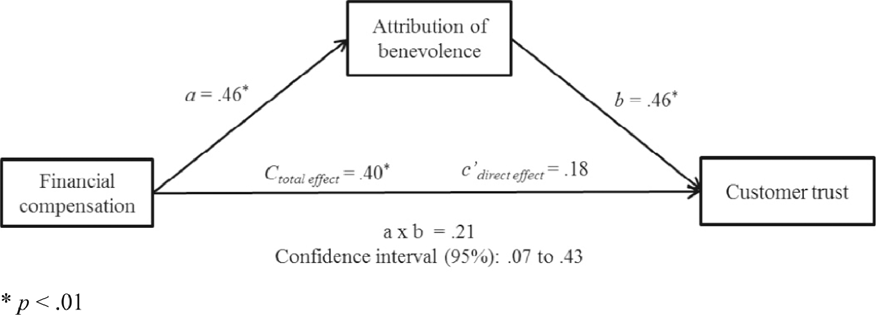
Mediation of the financial compensation effect.
A similar procedure was conducted to test whether benevolence mediated the effect of regulation on trust. The path between regulation and benevolence was positive and significant (a = 1.11, t = 4.20, p < .001), as was the relationship between benevolence and trust (b = .42, t = 4.29, p < .001). Regulation showed a significant and positive indirect effect on trust (a × b = .47) because the confidence interval for this effect did not contain zero (ranging from.13 to 1.11). The total effect of regulation on trust was significant (c = .71, t = 2.77, p < .01), while the direct effect of regulation on trust was not significant (c’ = .23, t = .91, p = .36). These results (presented in Fig. 2) show that benevolence totally mediated the effect of regulation on trust.
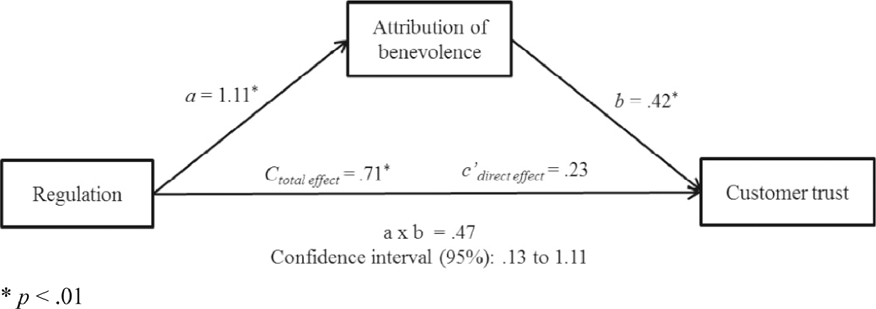
Mediation of the regulation effect.
Both of the mediation tests support the assumption that the attribution of benevolence is the underlying mechanism explaining how financial compensation and regulation can recover trust after a double deviation. These findings support hypothesis 3.
Although the literature on trust recovery is still developing (Tomlinson, 2012), a few marketing studies have explored the possibility of restoring customer trust (Van Laer and de Ruyter, 2010; Xie and Peng, 2009), and fewer studies (Basso and Pizzutti, 2016) exploring the recovery after double deviation. In this study, trust recovery tactics (i.e., regulation and financial compensation) positively influence customer trust after a double deviation occurs. Specifically, these findings increase knowledge to the literature by showing, differently from Dirks et al. (2011) and Vázquez-Casielles et al. (2012), that both regulation and financial compensation can be useful to recover trust after the end of the conflict. Or else, when the conflict between customer and company has finished, with a negative result to the customer (double deviation), the managers may control the company's policies and processes (regulation) to restore customer trust. Moreover, managers can offer financial benefits to clients after a double deviation to recover their trust and avoid possible negative word of mouth.
It is important to note that these findings reveal that tactic generally used and tested in the service recovery (before the double deviation) can be used to recover trust after the failed attempt to recover the service and trust in the service recovery process. This finding is important, especially when the social media and the online platforms make it easy for a customer to spread a negative word of mouth (Tripp and Grégoire, 2011).
The results show that regardless of the recovery tactic (regulation or financial compensation) adopted by the company, customer trust may be recovered after a double deviation. Interestingly, customers are not seeking financial compensation over regulation because both tactics lead to similar trust levels.
The results also show that benevolence mediates the effect of trust recovery tactics on customer trust. Specifically, both financial compensation and regulation send signals of benevolence to customers, who understand that the company is considering the customer's goals before the company's goals. This attribution of benevolence positively influences customer trust after a double deviation.
The attribution of benevolence is the underlying mechanism that explains how the trust is positively influenced by regulation and financial compensation after the double deviation. Specifically, based on the attribution theory (Kelley and Michela, 1980), after the insertion of the tactics, the customer perceives that the company is putting the customer's goals in first place, giving up greater profits and generating expense to compensate (financial tactic) or provide better services in the future (regulation) for the customer. These tactics signal to the customer that the company has benevolence, that is a positive antecedent of the trust (Sirdeshmukh et al., 2002).
Final remarks
Service failures may occur at any moment, violating customer trust. A failed service recovery attempt (double deviation) may represent an even worse trust violation (Basso and Pizzutti, 2016). Trust violations may harm the relationship between companies and customers. Therefore, it is necessary to identify efficient trust recovery tactics. This study shows that regulation and financial compensation have a positive effect on customer trust after a double deviation. Both of them lead to higher perceptions of the company's benevolence, increasing customer trust in the company. Most importantly, the tactics are equally successful in recovering customer trust. Thus, companies may decide which tactic to use based only on the company's goals and resources. For instance, providing financial compensation may be a better option when a company does not have enough time or appropriate personnel to review its policies and processes, while regulation may be a better option when the costs of financial compensation are much higher (e.g., when there are too many customers to be compensated) than the costs of reviewing policies and processes.
Limitations and suggestions for future studies
This study is limited to the analysis of two recovery tactics (regulation and financial compensation). Future studies could adopt other recovery tactics (apology, denial, promise, endorsement, reaffirming the commitment, recognition, information, reticence, silence, or reputation systems) with the purpose of identifying whether they have a positive effect on customer trust after a double deviation. Moreover, future studies can explore situations that can influence the performance of the trust recovery tactics (e.g., characteristics of the failure). This recommendation is especially important to identify when regulation and financial compensation could be more effective to recover trust. In this way, it is important to note that in this study both tactics have similar effects on trust, however more studies are necessary, with larger samples, to support that regulation and financial compensation have similar effects on trust after the double deviation.
Future studies can also be conducted to identify whether financial compensation and regulation tactics can affect variables other than trust. For example, in a relational perspective, future studies can analyze the effects of these trust recovery tactics on loyalty or commitment.
Some double deviations may be more severe than others. For instance, a double deviation that leads to higher levels of customer anger and stress could be considered more severe than double deviations that do not lead to customer anger and stress. Trust violation in the former case may be higher than trust violation in the latter case. Higher dissatisfaction levels after service recovery may lead to more negative results such as higher avoidance and desire for revenge levels (Grégoire et al., 2009). Therefore, trust recovery tactics may be ineffective in such severe cases. This study investigated only one type of double deviation, without manipulating its severity (e.g., high versus low). Future studies may investigate trust recovery tactics in different severity levels of double deviation.
Footnotes
Acknowledgments
This research was supported by the Brazilian Conselho Nacional de Desenvolvimento Científico e Tecnológico (CNPq – Grant No. 448553/2014-7).