







Abstract
This research investigates the role of emotion and message framing in stemming plastic consumption. Across three experimental studies examining consumer intentions, participation, and product choice, this research demonstrates that an image depicting plastic waste (vs. victims of plastic waste) elicits disgust (vs. sadness). Building on construal level theory, we show that an image of plastic waste is more effective in encouraging consumers to reduce their plastic consumption when combined with a “why” message (e.g., reasons to reduce plastic consumption). In contrast, an image portraying victims of plastic waste is more effective when presented with a “how” message (e.g., steps to reduce plastic consumption). The findings of this research highlight the importance of understanding discrete emotional responses to advertising images, especially in the context of reducing plastic consumption, and thus will benefit social marketers and policy makers.
Introduction
The issue of environmental plastic pollution is a global concern (Haward, 2018), with plastic pollution of the marine environment a prominent example of the negative impact of humans on nature (Gall and Thompson, 2015; Law, 2017). In addition to plastic marine pollution, there are also many other negative issues related to plastic consumption, such as land pollution dependence on and depletion of non-renewable fossil fuels potential impacts on human and wildlife endocrine systems, and air pollution from inappropriate disposal (North and Halden, 2013; Thompson et al., 2009).
Given the significance of the problem, the body of literature examining how consumers can be encouraged to reduce plastic consumption is growing (Sharp et al., 2010; Thomas et al., 2016; Wagner, 2017). However, most studies have investigated the role of taxes and levies in nudging consumers not to use plastic bags (see Xanthos and Walker, 2017 for a review). While this approach can be effective under some conditions, prior research also shows that regulations may evoke psychological reactance rather than behavioral compliance and long-term behavioral change (Laurin et al., 2012; Laurin et al., 2013).
Instead, as Xanthos and Walker (2017, p. 24) correctly point out, “one of the best strategies to mitigate plastic pollution would be to reduce its consumption at source” (i.e., increasing consumer participation and awareness of the issue). Our research aims to address this gap in the literature and assist social marketers and policy makers in developing effective advertising strategies to encourage consumers to reduce their plastic consumption, as opposed to simply ‘forcing’ them – which can lead to negative backlash (Birau and Faure, 2018; Laurin et al., 2012, 2013).
The present research takes a novel perspective, capitalizing on distinct negative emotional responses evoked by different types of plastic waste images. These negative emotional responses can be matched with specific message framing to more effectively promote consumer intentions to reduce plastic consumption. In particular, it is hoped that inducing negative emotions will motivate people to make positive behavioral changes (Marteau et al., 2012). From a theoretical perspective, this examination of negative emotions is consistent with past research on social marketing (Cotte et al., 2005; Duhachek et al., 2012; Gallopel-Morvan et al., 2011) and a recent call for studies investigating how different, discrete positive emotions can lead to distinct influences on consumer decision making (So et al., 2015).
Drawing upon construal level theory (Trope and Liberman, 2010), we propose that disgust elicited by an image depicting plastic waste can increase the persuasiveness of a “why” message (e.g., reasons to reduce plastic consumption). In contrast, sadness evoked by an image portraying a victim of plastic waste can increase the persuasiveness of a “how” message (e.g., steps required to reduce plastic consumption). We test these predictions across three studies examining consumer intentions (Study 1), participation (Study 2), and product choice (Study 3; see Fig. 1). In the following sections, we begin with a review of the relevant literature to develop our key hypotheses. We then present three experimental studies to test these hypotheses. Finally, we end with a general discussion of theoretical contributions, managerial implications, and future research avenues.
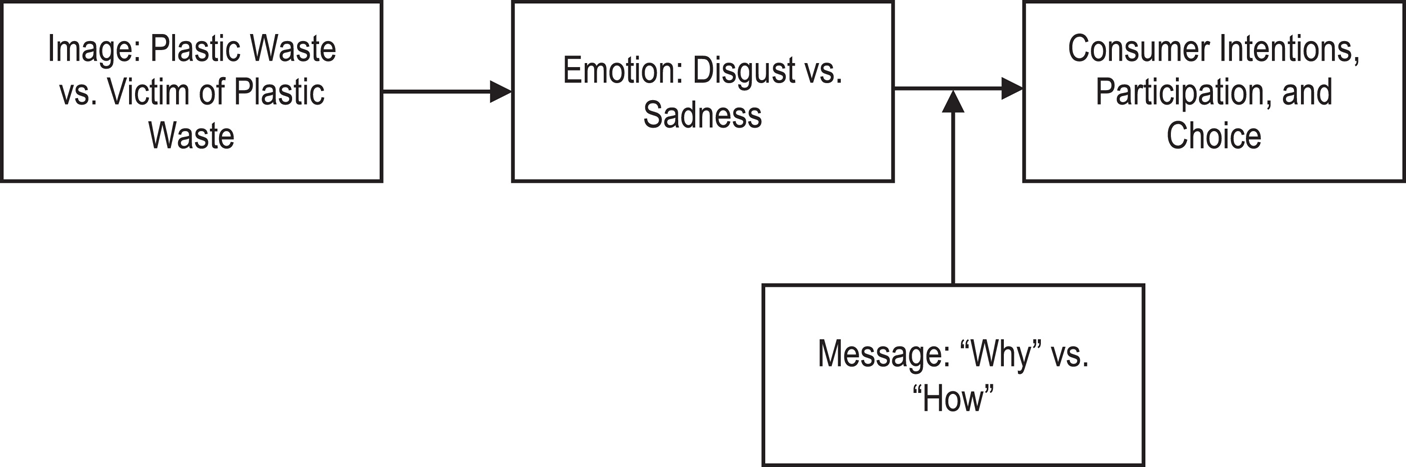
Conceptual model.
Emotional responses to image
Research in the communication literature has established that different images in news frames can elicit distinct emotional responses (Iyer et al., 2014; Powell et al., 2015) that influence subsequent judgments and decisions. For instance, Iyer et al. (2014) found that individuals who viewed images of victims of a terrorist attack felt sad. In contrast, exposure to images of terrorists increased appraisal of terrorists as dangerous, making individuals feel fearful. In a similar vein, Powell et al. (2015) found that images of victims of a conflict in Central African Republic evoked sadness, leading to increased intentions to donate.
In the context of plastic waste, social marketers can communicate the issue using different images. First, they typically show an image illustrating the plastic waste itself. We argue that this tactic elicits the emotion of disgust. This is because consumers tend to associate plastic waste with disgusting sensorial experiences (Fisher, 2004; Hawkins, 2010). This emotion arises naturally after exposure to factors such as human and animal waste, contaminated food, and poor hygiene (Rozin and Fallon, 1987; Rozin et al., 2000). Notably, once activated, disgust triggers an immediate, aversive state that drives consumers to withdraw from offensive substances (Rozin and Fallon, 1987).
Prior research in advertising and marketing highlights the potential effects of disgust on consumer decision making. For instance, in the context of controversial advertising, disgusting appeals lead to less favorable attitudes from consumers compared to non-disgusting appeals, and also affect brand recall (Dens et al., 2008). When a product that participants rate as ‘disgusting’ (e.g., feminine napkins) touches a ‘neutral’ target product (e.g., cookies), consumers show more negative evaluations of that target product (Morales and Fitzsimons, 2007). However, disgust does not always lead to negative influences. For example, when disgust appeals are combined with fear appeals in a social marketing advertisement (for instance, images of rotting gums or toes on cigarette packaging), disgust can increase message persuasion beyond that of appeals that evoke only fear. This is because disgust elicits strong, immediate avoidance reactions (Morales et al., 2012).
Alternatively, social marketers may also show an image illustrating the victims of plastic waste (e.g., animals that are negatively impacted by plastic waste). We predict that such images are more likely to elicit the emotion of sadness. This is in line with prior research suggesting that focusing on the victims of a negative event (e.g., war, terrorism) can evoke sadness from the viewers (Iyer et al., 2014; Powell et al., 2015). This is because sadness is associated with a sense of loss (Lazarus, 1991; Salerno et al., 2014). In turn, sadness motivates individuals to assess and potentially revise subsequent behaviors (Bonanno et al., 2008; Welling, 2003). Individuals may then seek to regulate their sadness and avoid further loss (Salerno et al., 2014) by changing their circumstances (Lerner et al., 2004). Consequently, many charitable advertisements seek to elicit sadness to motivate consumers to donate (Small and Verrochi, 2009). Other studies of the emotion sadness report that activities such as consuming indulgent food (Garg et al., 2007; Salerno et al., 2014) and listening to music (Lee et al., 2013) may help individuals to feel better when they are sad.
Building on prior research, we argue that consumers will feel disgusted or sad, depending on the type of image used to highlight the issue of plastic waste. Importantly, while acknowledging that other negative emotions such as anger, guilt, shame, and fear may also arise from such images, we contend that without any additional information (e.g., the agent responsible for negative events, or the role of self in those events), the emotions of disgust and sadness will be the primary emotional responses. Formally, we propose that:
Construal level Theory: Disgust and sadness
We develop our arguments using construal level theory as their basis (Trope and Liberman, 2010). This theory posits that a psychologically distant object will be construed in an abstract manner (high construal level), whereas a psychologically closer object will be construed in a concrete manner (low construal level) (Trope and Liberman, 2010). When there is a match between abstract mindset and psychologically distant focus, and between concrete mindset and psychologically near focus, individuals will likely process information more fluently, leading to more favorable evaluations (Trope and Liberman, 2010; White et al., 2011). Such CLT-based congruence has been established across different advertising and consumer behavior contexts, including green products (Chang et al., 2015), recycling behavior (White et al., 2011), emotional appeals (Septianto and Pratiwi, 2016), and anti-counterfeit behaviors (Kim and KP Johnson, 2014).
Previous studies have also identified that specific emotions can be activated in association with different construal levels, depending on the appraisal themes associated with that emotion (Chowdhry et al., 2015; Han et al., 2014; Labroo and Patrick, 2008). Of particular relevance to the current research, disgust is a negative emotion associated with exposure to offensive, indigestible objects (Lazarus, 1991). This appraisal motivates individuals to withdraw from or expel those focal objects (Rozin et al., 2000), which in turn leads them to perceive an object or issue from a more distant perspective (i.e., high construal level). In contrast, sadness revolves around the appraisal themes of loss and helplessness (Lazarus, 1991). The emotion causes consumers to empathize with a focal victim, or focus on the current situation with the intention of changing it (Lerner et al., 2004). Consequently, sadness motivates individuals to develop a closer perspective on an issue (i.e., low construal level).
Congruent image and message effects
We further contend that the disgust or sadness arising as a result of evaluating different images (plastic waste vs. victims of plastic waste, respectively) can differentially influence the persuasiveness of different messages encouraging consumers to reduce their plastic consumption. This is because image and message framing are more effective when there is a congruent underpinning mechanism (Brosius et al., 1996; Feldman and Hart, 2018; Geise and Baden, 2014). Thus, because disgust and sadness activate different construal levels, matching them with a compatible message can have a profound influence on the persuasiveness of the message.
Past research has established that two types of message framing can be differentiated based on construal level, specifically “why” versus “how” messages (Septianto and Pratiwi, 2016; White et al., 2011). In particular, actions can be described hierarchically because actions and the goals relating to those actions can be interpreted as more abstract or more concrete (Trope and Liberman, 2010; Vallacher and Wegner, 1989). In such a hierarchy, an action (e.g., study for an exam) has an abstract aspect, answering the issue of why the action is performed (e.g., to receive a good grade). Conversely, the same action also has a concrete aspect, providing the details of how the action is performed (e.g., read a textbook) (Trope and Liberman, 2010). As applied in the context of our research, we can think of messages relating to reasons to reduce plastic consumption (“why” message; high construal level), or messages relating to the tactics for reducing plastic consumption (“how” message; low construal level).
We propose that image and message framing can be combined effectively when they have congruent construal levels. Specifically, we expect that an image depicting plastic waste (which will evoke disgust) and a “why” message, both of which involve high construal levels, should lead to a congruent processing style. On the other hand, combining an image depicting a victim of plastic waste (which will evoke sadness) with a “how” message, both of which involve low construal levels, should also lead to a congruent processing style. Formally:
Overview of studies
We designed three studies with three distinct dependent variables to provide firm support to our findings. Study 1 examines how emotional responses to advertising images can differentially influence consumer intentions to reduce their plastic consumption. Study 2 replicates the findings of Study 1 using a different dependent variable. Specifically, we request consumers to participate in a follow-up survey relating to the issue of plastic waste. Following prior research (Winterich et al., 2013), higher levels of consumer participation indicate a more effective message. This dependent variable has practical implications because NGOs not only approach people to educate them about plastic consumption, but also to look for volunteers. Hence, Study 2 suggests a way for NGOs to gain more participation from the public for helping and volunteering in plastic reduction research or sharing information. Study 3 extends Studies 1 and 2 by examining a context in which consumers need to make a product choice decision (bottled water in a glass vs. plastic container). This set-up is significant because it offers a real-world context in which consumers can influence plastic waste reduction efforts via their purchase decisions. We test and replicate our findings across three different dependent variables (consumer intentions, participation, and product choice) to address the potential issue of social desirability bias due to self-reported intentions (Study 1). We also use more indirect behavioral measures such as helping behavior and product choice to account for this possibility (Studies 1 and 2; Fisher, 1993).
Study 1
Design and procedure
One hundred and ninety participants were recruited from Amazon Mechanical Turk (42% female, Mage = 30.33, SD = 8.25). The study employed a 2 (image: plastic waste, victim of plastic waste) × 2 (message: “how,” “why”) between-subjects design.
In the first task, participants were either shown an image of plastic waste (a beach full of plastic waste) or a victim of plastic waste (a turtle deformed due to plastic waste). 1 Both images had the identical tagline: “Let's live with less plastic” (see Appendix 1 for stimuli used in this and the two subsequent studies).
We conducted a separate pretest to validate the stimuli. Seventy-seven participants were randomly shown either the image showing plastic waste or the image showing a victim of plastic waste. They indicated on a 7-point scale (1 = not at all, 7 = extremely) whether the image illustrated victim(s) of plastic waste. An independent sample t-test revealed that participants considered the image showing a turtle (M = 6.49) to illustrate a victim of plastic waste, as compared to the image showing the beach (M = 4.28, t = 6.49, p <.001).
Afterwards, participants were asked to indicate their emotional responses to the image according to 12 items rated on a 7-point scale (1 = not at all, 7 = extremely). The items were: “disgusted” and “repulsed” to measure disgust (α = 0.91); “sad” and “gloomy” to measure sadness (α = 0.87); “angry” and “mad” to measure anger (α = 0.88); “fearful” and “anxious” to measure fear (α = 0.85); “embarrassed” and “ashamed” to measure shame (α = 0.84); and “remorseful” and “guilty” to measure guilt (α = 0.85). These items have been validated in prior research (Agrawal and Duhachek, 2010; Lerner and Keltner, 2001).
Next, participants were shown either a “how” message (Less Plastic, 2018b) or a “why” message (Less Plastic, 2018a). As can be seen in Appendix 1, the “how” message was composed of nine steps for consumers to reduce their plastic waste (“how” messages), while the “why” message consisted of nine reasons for consumers to reduce their plastic waste (“why” messages). For example, one low construal suggestion in the “how” message is to clean homes with natural ingredients (thereby avoiding need to purchase cleaning products that are most often sold in single use plastic packaging). In contrast, a higher construal reason listed in the “why” message is that plastics pollute the oceans. As the dependent variable, we asked participants to rate on a 7-point scale (1 = not at all, 7 = very) the likelihood they would reduce their plastic consumption after reading the message. As a manipulation check, we also asked them to rate the extent to which the respective messages focused on “why people should” or “how people can” reduce their plastic consumption (1 = not at all, 7 = extremely).
Message manipulation check
As predicted, participants reading the “how” message rated the message as informing people how to reduce their plastic consumption (M = 5.89), as compared to those who saw the “why” message (M = 4.18, t(186) = 7.12, p <.001). In contrast, participants who saw the “why” message indicated that the message informed people why they should reduce their plastic consumption (M = 5.93), as compared to those who saw the “how” message (M = 4.40, t(186) = 7.12, p <.001).
Emotional responses
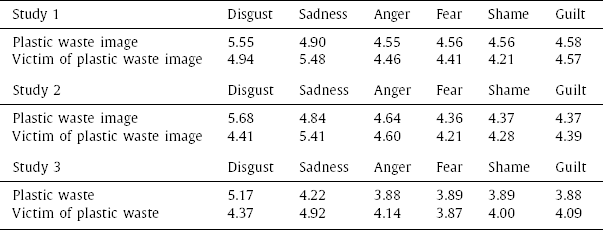
Participants who saw an image showing plastic waste reported higher levels of disgust (M = 5.55) than those who saw an image depicting a victim of plastic waste (M = 4.94, t(186) = 2.87, p = .005). In contrast, participants who saw an image showing a victim of plastic waste reported higher levels of sadness (M = 5.48) as compared to those viewing an image of plastic waste (M = 4.90, t(186) = 2.46, p = .015). Importantly, the levels of other emotions (anger, fear, shame, and guilt) were similar across the two conditions. This finding implies that any differences in terms of behavioral consequences cannot be attributed to these other negative emotions (see Appendix 2 for reports on all emotions measured). These findings support Hypothesis 1.
Consumer intentions
We conducted a two-way ANOVA with image, message, and their interaction as independent variables, and consumer intentions to reduce their plastic consumption as the dependent variable. The results revealed a significant interaction effect (F(1, 186) = 11.68, p <.001 ηβ = 0.054). Specifically, participants viewing an image of plastic waste reported higher intentions to reduce their plastic consumption after reading the “why” message (M = 5.82), as compared to those reading the “how” message (M = 4.95, t(186) = 3.09, p = .003). In contrast, participants viewing an image depicting a victim of plastic waste exhibited higher intentions to reduce their plastic consumption after reading the “how” message (M = 5.56), as compared to those reading the “why” message (M = 5.08, t(186) = 1.74, p = .084; see Fig. 2). These findings support Hypothesis 2.
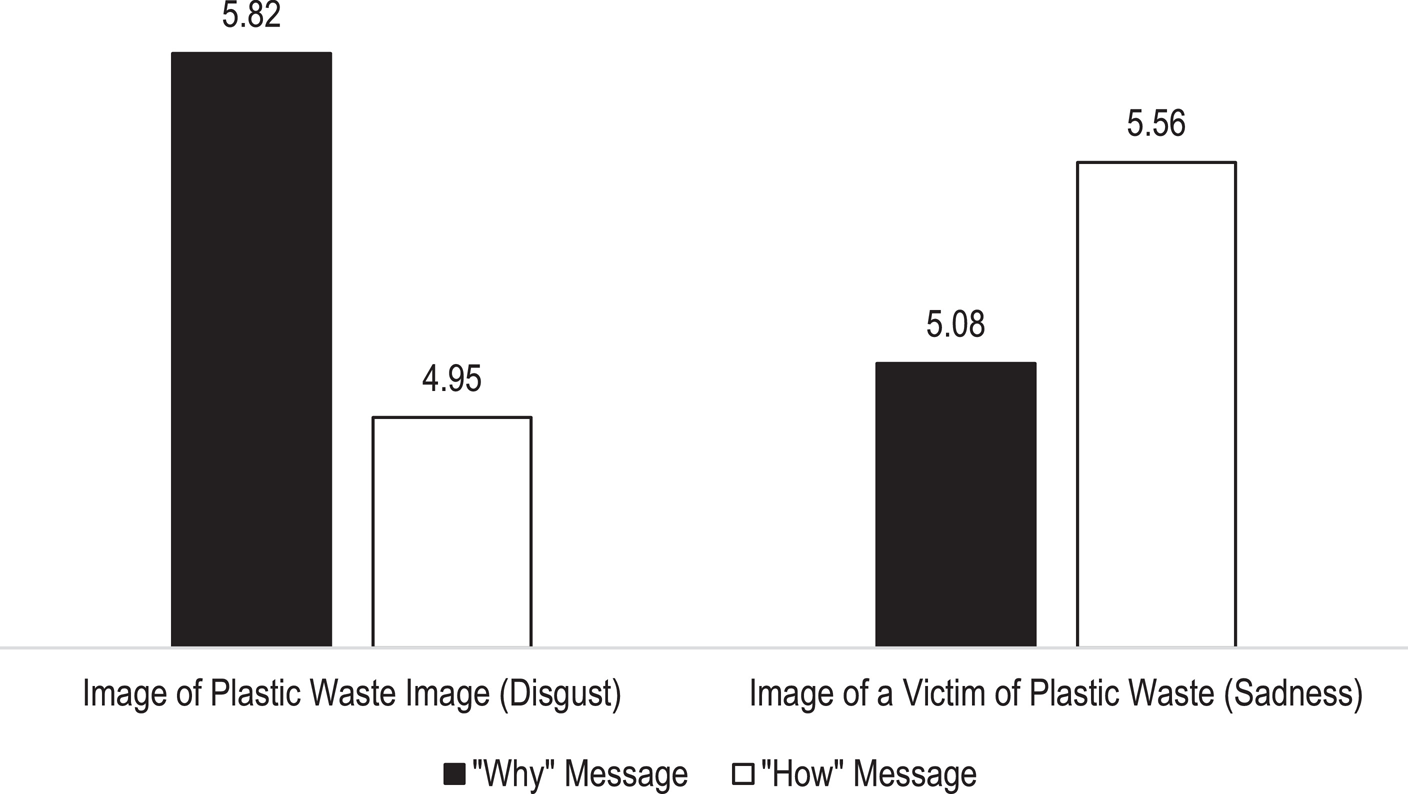
Intentions to reduce plastic consumption by image and message conditions (Study 1).
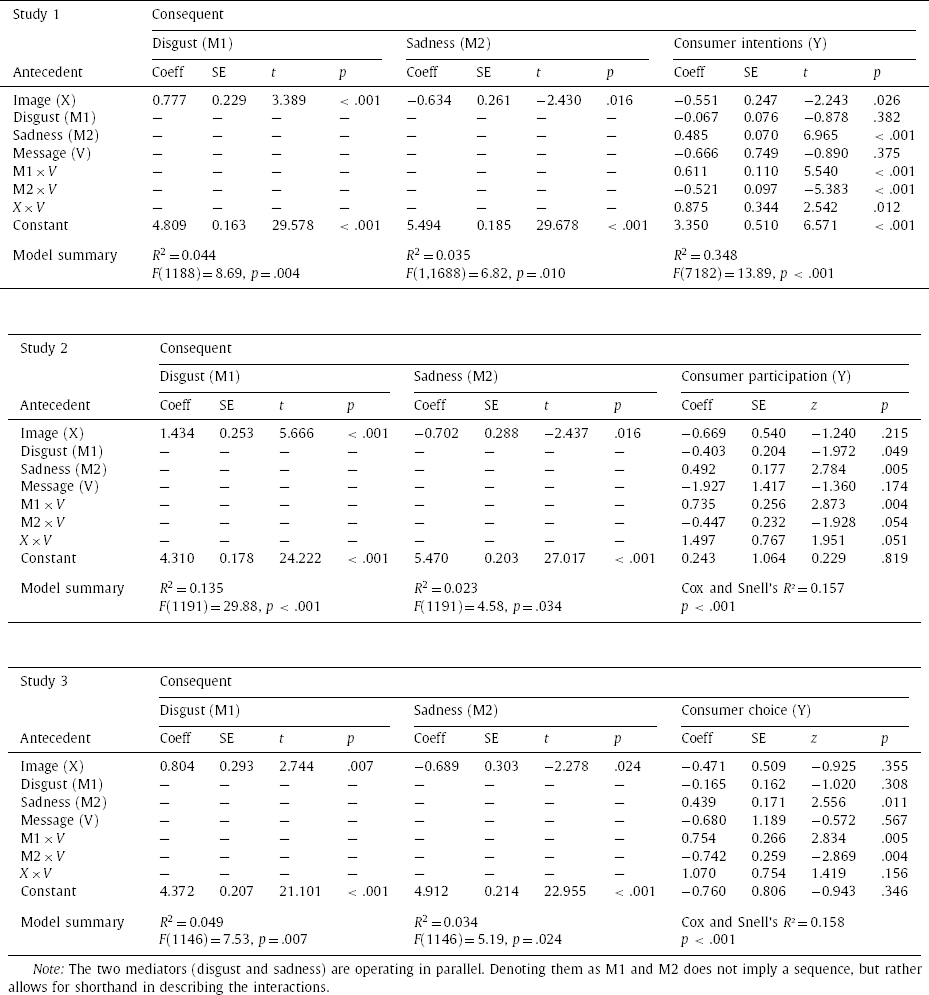
As proposed in Hypothesis 3, disgust and sadness will mediate the effect of the different images on the dependent variable. We conducted a moderated mediation analysis using PROCESS Model 15 with 10,000 resamples (Hayes, 2017). Specifically, we examined the indirect effect of the images (IV) on consumer intentions (DV) via disgust and sadness (Mediators), moderated by the message (Moderator). The results revealed a significant indirect effect of the images via disgust for the “why” message (B = 0.3121, SE = 0.1383, 95% CI [.0828, 0.6177]). Additionally, there were also a significant indirect effect of the images via sadness for the “how” message (B = −0.3055, SE = 0.1374, 95% CI [−0.6083, −0.0631]). These findings provide support for Hypothesis 3 (see Appendix 3 for full mediation results).
Design and procedure
One hundred and ninety-three participants were recruited from Amazon Mechanical Turk (41% female, Mage = 35.02, SD = 11.58). This study employed a 2 (image: plastic waste, victim of plastic waste) × 2 (message: “how,” “why”) between-subjects design.
Study 2 employed similar materials and procedure to Study 1 with the exception we used a behavioral measure as the dependent variable. Specifically, after reading either the “why” or “how” message, participants were asked to read one-page of information in the form of a request from the NGO “Plastic Ocean Project”. They were then asked whether they were willing, without additional compensation, to participate in a 5-min follow-up survey related to their understanding of the issue of plastic waste (Winterich et al., 2013). The focal dependent variable was whether participants indicated yes (1) or no (0). If participants indicated yes, they were given a link to complete the additional survey 2 after first answering demographic questions.
We also used the Behavioral Identification Form to test whether disgust and sadness lead to differential levels of abstractness/concreteness. In particular, higher (vs. lower) BIF scores reflect a more abstract (vs. concrete) mindset (Septianto and Pratiwi, 2016). Findings demonstrate that disgust led to a more abstract mindset (M = 7.40) as compared to sadness (M = 5.77, t(162) = 3.39, p <.001).
Message manipulation check
As predicted, participants who saw the “how” message rated the message as informing people how to reduce their plastic consumption (M = 6.15), as compared to those who saw the “why” message (M = 4.22, t(189) = 7.75, p <.001). In contrast, participants who saw the “why” message indicated that the message informed people why they should reduce their plastic consumption (M = 5.98), as compared to those who saw the “how” message (M = 4.38, t(189) = 7.17, p <.001).
Emotional responses
As in Study 1 and consistent with Hypothesis 1, we found that participants who saw an image of plastic waste reported higher levels of disgust (M = 5.68) than those who saw an image showing a victim of plastic waste (M = 4.41, t(189) = 5.42, p <.001). In contrast, participants who saw a victim of plastic waste reported higher levels of sadness (M = 5.41) as compared to those seeing an image of plastic waste (M = 4.84, t(189) = 2.18, p = .031).
Consumer participation
We conducted a logistic regression analysis with image (1 = plastic waste image, 0 = victim of plastic waste image), message (1 = “why”, 0 = “how”), and their interaction as independent variables, and consumer participation (1 = yes, 0 = no) as the dependent variable. The results revealed a significant interaction between image and message (R2 = 0.060; B = 0.54, SE = 0.16, Wald = 11.31, p <.001). With regard to willingness to participate in the follow-up survey, participant participation was higher among those viewing a plastic waste image when they also read the “why” message (78%) compared to those who read the “how” message (53%; χ2(1) = 6.65, p = .010, OR = 3.19). Conversely, the percentage of participants participating after seeing an image of a victim of plastic waste was higher after they read the “how” message (76%) than after they read the “why” message (55%; χ2(1) = 5.08, p = .024, OR = 2.69; see Fig. 3). These findings support Hypothesis 2.
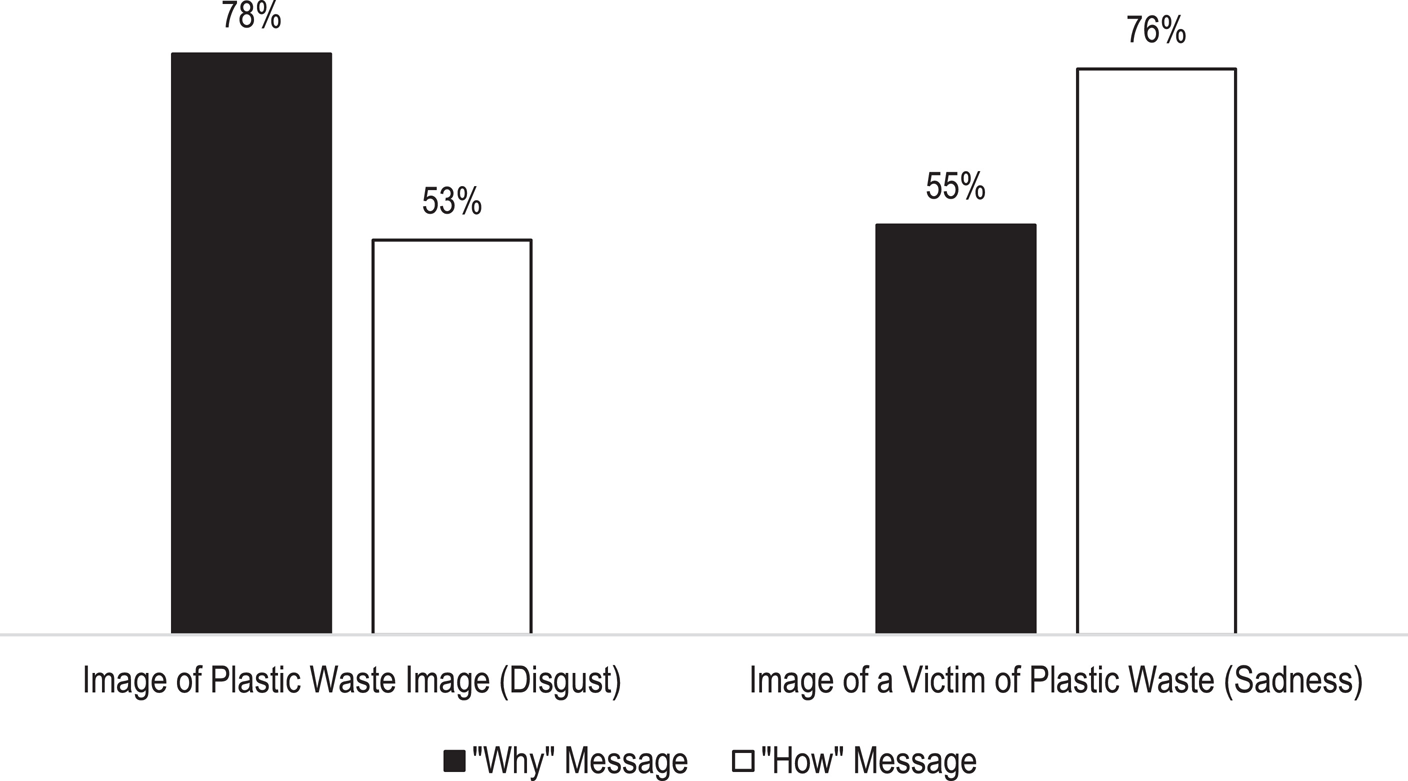
Percentage of participants participating in a follow-up survey by image and message conditions (Study 2).
Using PROCESS Model 15 with 10,000 resamples, we examined the indirect effects of the images (IV) on consumer participation (DV) via disgust and sadness (Mediators), moderated by message (Moderator). The results revealed a significant indirect effect of the images via disgust for the “why” message (B = 0.4967, SE = 0.2693, 95% CI [.1124, 1.1567]), whereas there was also a significant indirect effect of the images via sadness for the “how” message (B = −0.2648, SE = 0.1815, 95% CI [−0.7207, −0.0211]). These findings provide support for Hypothesis 3.
Study 3 extends Studies 1 and 2 in several ways. First, we use product choice as a dependent variable to offer a relevant managerial implication. Second, because there may be concerns that both images used in Studies 1 and 2 represent ‘victims’ of plastic waste (i.e., the beach [environment] and the turtle [animal]), Study 3 uses an identical (neutral) image of plastic waste, but we manipulate the focus of the issue in the body copy. In addition, because there is ‘overlapping’ information between the “why” message (i.e., one of the reasons listed includes the consequence that plastic waste kills marine animals), consumers could potentially form a defensive processing mechanism (Agrawal and Duhachek, 2010). Hence, in Study 3, we do not provide specific information regarding the “why” or “how” message, instead priming participants with the body copy.
Design and procedure
One hundred and forty-eight participants were recruited from Amazon Mechanical Turk (44% female, Mage = 34.78, SD = 11.35). Study 3 employed a 2 (focus: plastic waste, victim of plastic waste) × 2 (message: “how,” “why”) between-subjects design.
We developed four advertisements using an identical image but differentiated by the body copy. We used the question, “How Do You Feel about (Victims of) Plastic Waste?” to prime participants to think about plastic waste (or the victims of plastic waste). We also used the sentence variations “Consider HOW You Can (WHY You Should) Make a Difference” to prime participants to think about “how” versus “why” they should reduce their plastic consumption. Similarly to Studies 1 and 2, participants then indicated their emotional responses to the advertisement. For the focal dependent variable, we utilized a trade-off product choice. Specifically, participants were asked to choose between two types of bottled water. One product used a glass bottle with a $1.00 price point, whereas the other used a plastic bottle with a $0.50 price point. 3
Given the ‘anti-plastic’ messages participants were exposed to, it would have been obvious to ask participants to choose between the two comparable products, which differ only in the amount of plastic. Hence, following prior research (Winterich and Barone, 2011), we utilized a trade-off task by making the glass bottle more expensive than the plastic bottle.
Message manipulation check
We found that participants who saw the “how” message rated the advertisement as making them think about how to reduce their plastic consumption (M = 4.71), as compared to those who saw the “why” message (M = 3.93, t(144) = 2.23, p = .027). In contrast, participants who saw the “why” message indicated that the advertisement made them think about why they should reduce their plastic consumption (M = 5.48), as compared to those who saw the “how” message (M = 4.38, t(144) = 3.58, p <.001).
Emotional responses
Consistent with Hypothesis 1, participants who were asked to think about their feelings about plastic waste reported higher levels of disgust (M = 5.18) than those who thought about victims of plastic waste (M = 4.37, t(144) = 2.72, p = .007). In contrast, participants who thought about victims of plastic waste reported higher levels of sadness (M = 4.92) compared to those thinking about plastic waste (M = 4.22, t(144) = 2.28, p = .024).
Product choice
We conducted a logistic regression analysis with focus (1 = plastic waste, 0 = victim of plastic waste), message (1 = “why”, 0 = “how”), and their interaction as independent variables, and product choice (1 = glass bottled water, 0 = plastic bottled water) as the dependent variable. The results revealed a significant interaction between focus and message (B = −0.46, SE = 0.17, Wald = 7.27, p = .006). The follow-up tests showed that in the “plastic waste” condition, more participants chose glass-bottled water after reading the “why” message (70%) than after reading the “how” message (46%; χ2(1) = 4.50, p = p = .034, OR = 2.70). However and as expected, in the “victims of” plastic waste condition, more participants chose glass-bottled water after reading the “how” message (64%) versus the “why” message (43%; χ2(1) = 3.35, p = .067, OR = 2.33; see Fig. 4). These findings provide evidence for Hypothesis 2.
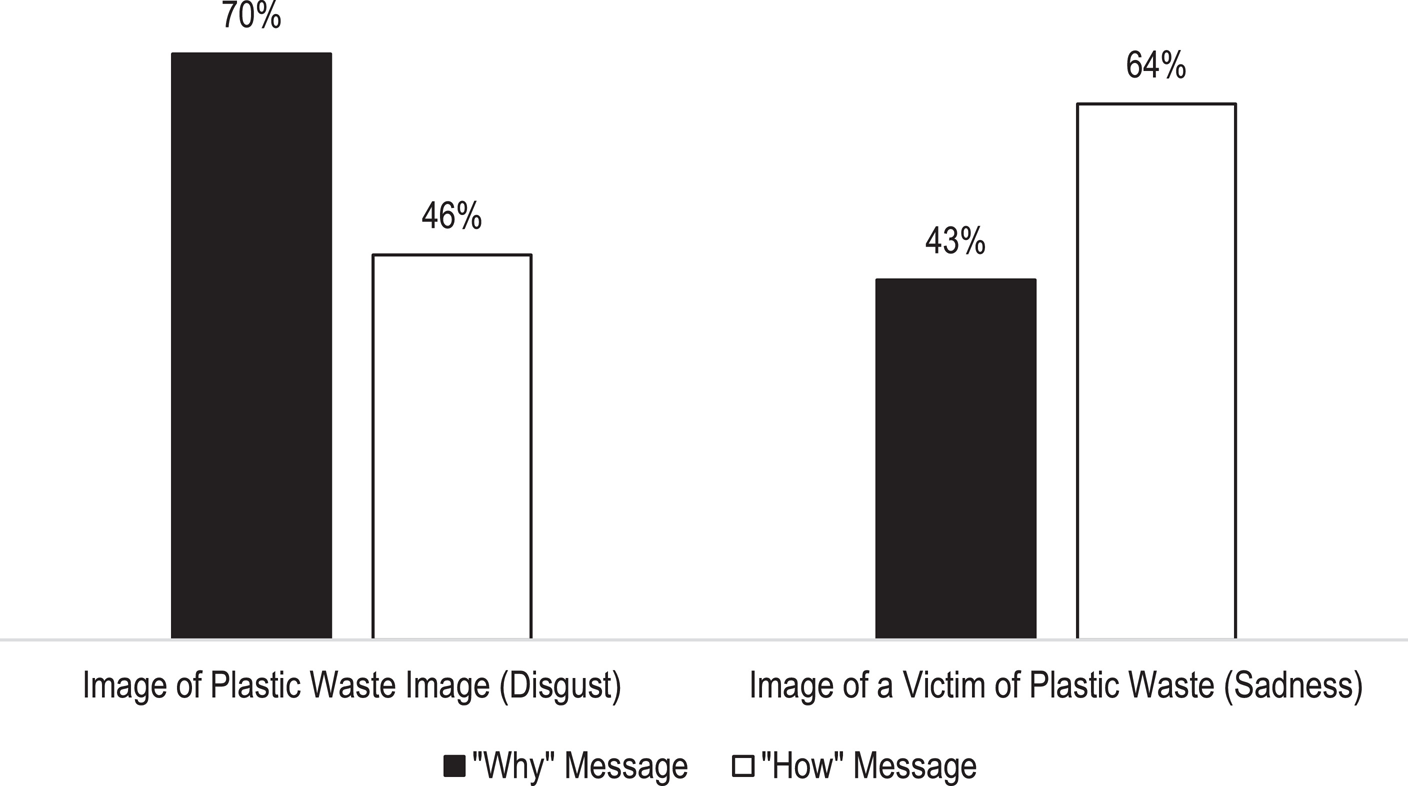
Percentage of participants choosing glass (vs. plastic) bottled water by focus and message conditions (Study 3).
Using PROCESS Model 15 with 10,000 resamples, we examined the indirect effects of different issue focus (IV) on consumer choice (DV) via disgust and sadness (Mediators), as moderated by different messages (Moderator). The results revealed a significant indirect effect of image via disgust for the “why” message (B = 0.4738, SE = 0.2941, 95% CI [.0989, 1.2419]). In contrast, there was a significant indirect effect of image via sadness for the “how” message (B = −0.3025, SE = 0.2020, 95% CI [−0.8063, −0.0188]), thus supporting Hypothesis 3.
Our research examines how distinct emotional responses to advertising images can lead to differential influence on consumer decision making. In particular, building on the emotion and construal level literatures, we tested how to match specific negative emotions with advertising messages to encourage consumers to reduce their plastic consumption. Study 1 tested our predictions to confirm that viewing an image of plastic waste can evoke disgust, whereas viewing in image depicting a victim of plastic waste can evoke sadness. Following this, we demonstrated that matching a disgust-inducing image with a “why” message (and matching a sadness-inducing image with a “how” message) is effective in influencing consumer intentions to reduce plastic consumption. Study 2 replicated the findings of Study 1 by examining a behavioral outcome; that is, whether participants were willing to help in a task related to reducing plastic waste without compensation. Study 3 extended the findings of Studies 1 and 2 using a different dependent variable (product choice) and different stimuli to increase internal validity and confidence in our findings.
Theoretical and managerial implications
This research makes several important theoretical and managerial contributions. First, we contribute to understanding of how to encourage consumers to reduce their plastic consumption. This is significant because the focus of most studies in this area has been the impact of taxes and levies on plastic bags on consumer attitudes and behaviors (Sharp et al., 2010; Thomas et al., 2016; Wagner, 2017). However, this could be problematic in the long-run because such policies can evoke psychological reactance instead of positive behavioral change (Laurin et al., 2012, 2013). Thus, social marketers have an important role to play in increasing consumer awareness and participation to address the plastic waste issue (Xanthos and Walker, 2017). The key purpose of our study is therefore to provide guidance for social marketers in developing effective strategies by purposively matching certain images with specific messages to increase consumer intentions, participation, and product choice with regard to reducing plastic consumption.
Specifically, Study 1 used a format not dissimilar to many other online campaigns, which environmental groups and other NGOs employ to raise awareness and change behavioral intention of a desired audience to reduce plastic consumption. Therefore, a direct implication of our research is that social marketers should match the type of message they are communicating with the type of emotion they are eliciting, whether it be from an image (as in the case of our research) or messaging. For instance, a message such as “think of the victims of single use plastics” (accompanied by an image or not) should, according to our research, be best paired with concrete advice on ‘how’ the audience should change their lifestyle in order to reduce plastic consumption. In contrast, if the social marketer wants to draw attention to grand scale environmental degradation, for example, by using expansive drone imagery of the great Pacific garbage patch, then our research suggests that the higher level construal thinking triggered by such imagery would best be accompanied by more abstract ‘why’ messages, such as “Think of what we are leaving behind.”
In Study 2, the dependent variable was a measure of willingness to participate in another online survey (without further compensation for their time). In the ‘real world’ many social marketing campaigns are implemented with the objective of encouraging further online activity/engagement related to the focal cause or topic. Therefore, the dependent variable which we utilized in Study 2, can easily be generalized to real-world implications for social marketers, such as, signing an online petition, answering another online survey (as in our Study 2), and forwarding the original message onto friend and family within the audience members’ social network. Study 2 demonstrated that participants in the correctly aligned scenarios were at least 20% more likely agree to participate in an additional survey. Without making too bold a claim in the absence of further research, we are confident that, in practice (based on our findings), audience members exposed to the correct pairing of waste imagery and why messaging (or victim imagery and how messaging) may be more likely to engage with further requests of the social marketer, such as forwarding the message, signing an online petition, or providing additional information.
Finally, in Study 3, we demonstrated that social marketers can even change purchase intentions if the messaging is aligned in accordance to construal level theory. For instance, by asking the audience to think more concretely about ‘how’ they can make difference when thinking of the victims of plastic, or in contrast, asking them more abstractly about ‘why’ they should make a difference when thinking about the environment more broadly.
From a theoretical perspective, we also contribute to the literature of emotion in general, and the negative emotions of sadness and disgust in particular. This is significant because it responds to a recent call for research examining the differential influence of emotions on consumer decision making (So et al., 2015). Specifically, previous research on disgust has largely explored the negative effects of disgust on consumer behavior (e.g., Dens et al., 2008; Morales and Fitzsimons, 2007), with some exceptions (e.g., Morales et al., 2012). The present research adds to this literature by showing how social marketers can use disgust appeals to leverage the effectiveness of a “why” message in promoting plastic waste reduction, thus highlighting the potential benefits of evoking disgust. Additionally, past research on sadness has primarily examined the effects of sadness on consumer behavior from the emotion regulation perspective (Garg et al., 2007; Salerno et al., 2014). Our research adds to understanding of how social marketers can effectively combine sadness appeals with a “how” message, thus demonstrating the practical implications of using sadness from the perspective of construal level theory (Chowdhry et al., 2015; Trope and Liberman, 2010).
Moreover, we further contribute to the emotion literature by investigating the effects of integral, as opposed to incidental emotions. This is significant because previous studies investigating the link between emotion and construal levels typically examine incidental (or ambient) emotions (Chowdhry et al., 2015; Han et al., 2014; Labroo and Patrick, 2008). Incidental emotions arise from unrelated tasks (e.g., how the sadness of losing a friend can influence product evaluations), while integral emotions emerge from a focal task (e.g., how the emotional appeals of a product influence product evaluations) (Lerner et al., 2015). Notably, while incidental emotions allow us to draw conclusions with high internal validity (Han et al., 2007), such findings might not extend to actionable implications due to the nature of incidental emotions. Thus, by examining how different images can lead to distinct emotional responses, this research offers social marketers more control in developing effective advertising strategies rather than trying to guess what incidental emotions the subject of a communication may be feeling at a specific moment in time.
Limitations and extensions
Despite these promising results, this study has some limitations that can be addressed in future research. First, the context of the study (reducing plastic consumption) differs from other social marketing contexts, such as practicing safe sex and tobacco reduction in that these behaviors have immediate health related impacts on the target of the message. In contrast, as with many environmentally focused causes, reducing plastic consumption is creating change that may take several decades to realize the benefits. A second limitation of this study is its use of negative emotions only. While the use of negative emotions is common across most social marketing (Agrawal and Duhachek, 2010; Andrews et al., 2014), the potential of positive emotions in social marketing campaigns has been discussed (Previte et al., 2015). Thus, future research could investigate the use of images that differentially evoke positive emotional responses in the context of environmental preservation, as well as in other social marketing targeting issues such as drunk driving, safe sex and tobacco reduction. Finally, the present research examines three types of dependent measures: consumer intentions, participation, and product choice. Future research could explore additional (behavioral) measures to investigate the effectiveness of social marketing messages, such as whether or not participants are willing to share a social marketing message via social media.
In summary, this study contributes to the social marketing literature by demonstrating the efficacy of emotion evoking images when paired with appropriate marketing messages. Specifically, images evoking sadness, an emotion that leads to concrete thinking, are best paired with concrete “how” messages. In contrast, images evoking disgust, which leads to more abstract thought processes, are best paired with “why” messages. When exposed to such pairings in our research, not only did participants’ intentions shift in a positive direction, but they also behaved in a manner indicating support for the social marketing cause.
Footnotes
Stimuli
Summary of emotion responses by image conditions
| Study 1 | Disgust | Sadness | Anger | Fear | Shame | Guilt |
|---|---|---|---|---|---|---|
| Plastic waste image | 5.55 | 4.90 | 4.55 | 4.56 | 4.56 | 4.58 |
| Victim of plastic waste image | 4.94 | 5.48 | 4.46 | 4.41 | 4.21 | 4.57 |
| Study 2 | Disgust | Sadness | Anger | Fear | Shame | Guilt |
| Plastic waste image | 5.68 | 4.84 | 4.64 | 4.36 | 4.37 | 4.37 |
| Victim of plastic waste image | 4.41 | 5.41 | 4.60 | 4.21 | 4.28 | 4.39 |
| Study 3 | Disgust | Sadness | Anger | Fear | Shame | Guilt |
| Plastic waste | 5.17 | 4.22 | 3.88 | 3.89 | 3.89 | 3.88 |
| Victim of plastic waste | 4.37 | 4.92 | 4.14 | 3.87 | 4.00 | 4.09 |
Full regression and mediation results
| Study 1 | Consequent |
|||||||||||
|---|---|---|---|---|---|---|---|---|---|---|---|---|
| Disgust (M1) |
Sadness (M2) |
Consumer intentions (Y) |
||||||||||
| Antecedent | Coeff | SE | t | p | Coeff | SE | t | p | Coeff | SE | t | p |
| Image (X) | 0.777 | 0.229 | 3.389 | <.001 | −0.634 | 0.261 | −2.430 | .016 | −0.551 | 0.247 | −2.243 | .026 |
| Disgust (M1) | — | — | — | — | — | — | — | — | −0.067 | 0.076 | −0.878 | .382 |
| Sadness (M2) | — | — | — | — | — | — | — | — | 0.485 | 0.070 | 6.965 | <.001 |
| Message (V) | — | — | — | — | — | — | — | — | −0.666 | 0.749 | −0.890 | .375 |
| M1 × V | — | — | — | — | — | — | — | — | 0.611 | 0.110 | 5.540 | <.001 |
| M2 × V | — | — | — | — | — | — | — | — | −0.521 | 0.097 | −5.383 | <.001 |
| X × V | — | — | — | — | — | — | — | — | 0.875 | 0.344 | 2.542 | .012 |
| Constant | 4.809 | 0.163 | 29.578 | <.001 | 5.494 | 0.185 | 29.678 | <.001 | 3.350 | 0.510 | 6.571 | <.001 |
| Model summary | R2 = 0.044 | R2 = 0.035 | R2 = 0.348 | |||||||||
| F(1188) = 8.69, p = .004 | F(1,1688) = 6.82, p = .010 | F(7182) = 13.89, p <.001 | ||||||||||
| Study 2 | Consequent |
|||||||||||
|---|---|---|---|---|---|---|---|---|---|---|---|---|
| Disgust (M1) |
Sadness (M2) |
Consumer participation (Y) |
||||||||||
| Antecedent | Coeff | SE | t | p | Coeff | SE | t | p | Coeff | SE | z | p |
| Image (X) | 1.434 | 0.253 | 5.666 | <.001 | −0.702 | 0.288 | −2.437 | .016 | −0.669 | 0.540 | −1.240 | .215 |
| Disgust (M1) | — | — | — | — | — | — | — | — | −0.403 | 0.204 | −1.972 | .049 |
| Sadness (M2) | — | — | — | — | — | — | — | — | 0.492 | 0.177 | 2.784 | .005 |
| Message (V) | — | — | — | — | — | — | — | — | −1.927 | 1.417 | −1.360 | .174 |
| M1 × V | — | — | — | — | — | — | — | — | 0.735 | 0.256 | 2.873 | .004 |
| M2 × V | — | — | — | — | — | — | — | — | −0.447 | 0.232 | −1.928 | .054 |
| X × V | — | — | — | — | — | — | — | — | 1.497 | 0.767 | 1.951 | .051 |
| Constant | 4.310 | 0.178 | 24.222 | <.001 | 5.470 | 0.203 | 27.017 | <.001 | 0.243 | 1.064 | 0.229 | .819 |
| Model summary | R2 = 0.135 | R2 = 0.023 | Cox and Snell's Rβ = 0.157 | |||||||||
| F(1191) = 29.88, p <.001 | F(1191) = 4.58, p = .034 | p <.001 | ||||||||||
| Study 3 | Consequent |
|||||||||||
|---|---|---|---|---|---|---|---|---|---|---|---|---|
| Disgust (M1) |
Sadness (M2) |
Consumer choice (Y) |
||||||||||
| Antecedent | Coeff | SE | t | p | Coeff | SE | t | p | Coeff | SE | z | p |
| Image (X) | 0.804 | 0.293 | 2.744 | .007 | −0.689 | 0.303 | −2.278 | .024 | −0.471 | 0.509 | −0.925 | .355 |
| Disgust (M1) | — | — | — | — | — | — | — | — | −0.165 | 0.162 | −1.020 | .308 |
| Sadness (M2) | — | — | — | — | — | — | — | — | 0.439 | 0.171 | 2.556 | .011 |
| Message (V) | — | — | — | — | — | — | — | — | −0.680 | 1.189 | −0.572 | .567 |
| M1 × V | — | — | — | — | — | — | — | — | 0.754 | 0.266 | 2.834 | .005 |
| M2 × V | — | — | — | — | — | — | — | — | −0.742 | 0.259 | −2.869 | .004 |
| X × V | — | — | — | — | — | — | — | — | 1.070 | 0.754 | 1.419 | .156 |
| Constant | 4.372 | 0.207 | 21.101 | <.001 | 4.912 | 0.214 | 22.955 | <.001 | −0.760 | 0.806 | −0.943 | .346 |
| Model summary | R2 = 0.049 | R2 = 0.034 | Cox and Snell's Rβ = 0.158 | |||||||||
| F(1146) = 7.53, p = .007 | F(1146) = 5.19, p = .024 | p <.001 | ||||||||||
Note: The two mediators (disgust and sadness) are operating in parallel. Denoting them as M1 and M2 does not imply a sequence, but rather allows for shorthand in describing the interactions.