







Abstract
This paper proposes a multichannel, multimedia communications framework based on the concept of Customer Lifetime Value. The framework begins with customer information from the company's database, segments the customers based on the value they provide to the company, and advocates sending targeted messages using differentiated modes of communication. The framework also closes the communication loop by identifying the appropriate modes of inbound communication for the four customer segments (“Icons,” “Go-Getters,” “Opulents,” and “Misers”), and proposes customized firm responses based on the nature/purpose of the inbound communication call. The article presents this framework in both B2C and B2B settings, offers managerial implications for implementing this framework and outlines future research directions.
Introduction
Marketing communications can create buyers when they are conscious and desirous of what the company has to offer. However, the choice of channel and media for communicating such messages holds the key to sustaining the interest of customers. Companies have strived hard to develop the right products and services, price them appropriately and market them to their target audience, in an effort to satisfy their customers. Along the way, companies realized that communication with customers and prospects plays an important role in their continued existence. By the turn of the century, companies had almost perfected the art of mass marketing — a “one-size-fits-all” strategy of selling standardized products to a lot of customers. This strategy was ably supported by mass-media communication techniques that helped companies reach millions of customers with a single message.
The practice of mass marketing was pioneered by Ford and Coca-Cola in the early 20th century. This concept was characterized by (a) standard products that were produced, distributed, advertised, and promoted at a mass level, (b) customers who were anonymous to the companies, (c) one-way marketing communication — from companies to customers, (d) production techniques focusing on economies of scale, and (e) market share-driven management decisions (Peppers and Rogers 1993). Ford's Model T was mass produced and mass marketed to middle class consumers. It was designed to meet the needs of all users and was positioned as a “universal” car. Coca-Cola too, adopted a similar concept with a unified national marketing campaign. Other manufacturers such as Quaker Oats, Proctor and Gamble, Eastman Kodak, and many others belonging to the automobile, furniture, household appliances and apparel industries employed this marketing approach.
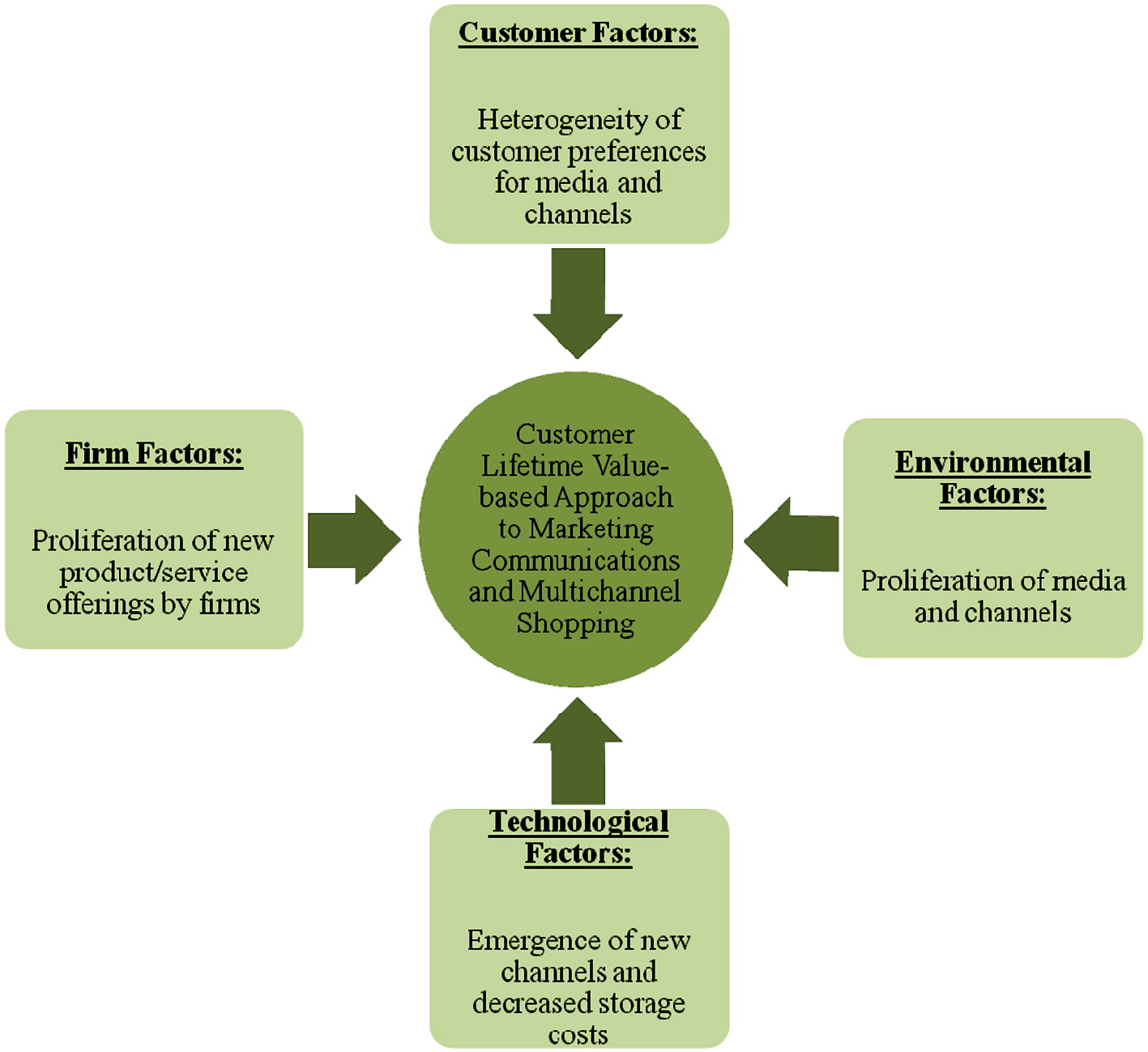
This strategy has gradually given way to segmented marketing, niche marketing, and customized marketing of tailored offerings that suit the tastes and needs of individuals. Furthermore, products and services are increasingly combined to provide solutions to customer needs (Shankar, Berry, and Dotzel 2009). This paper proposes that the reasons for this transformation in marketing communications are four-fold: (a) proliferation of new product/service offerings by firms, (b) heterogeneity of customer preferences for media and channels, (c) proliferation of media and channels, and (d) advances in technology. Fig. 1 illustrates the changing scenario of marketing communications.
The changing face of marketing communications.
As illustrated in Fig. 1, new product and service launches by firms, changes in customer preference for media and channels, changing media and channel options, and technological advances have created a need for a new marketing communications approach — one that integrates multichannel and multimedia options. The following paragraphs elaborate on the firm, customer, and environmental factors.
Proliferation of new product/service offerings by firms
Firms have always developed products as answers to the rapid changes in consumer tastes and preferences, level of technology, and competitive environment. According to a Nielsen report, 122,743 new UPCs (Universal Product Codes) were sold in 2008 through U.S. grocery, drug and mass merchandiser channels, excluding Wal-Mart. While the number of new product introductions in 2008 was similar to that in 2007, the sales increase through new products was 6.6%. Further, of the top 100 new introductions in the existing categories, 98 were extensions of existing brands and only two were entirely new offerings. 1
Nielsen Wire (January 30, 2009), “New Products Generate $21 Billion In Sales In 2008,” http://blog.nielsen.com/nielsenwire/consumer/new-products-generate-21-billion-in-sales-in-2008/.
Management consultants Booz and Hamilton (1982) classify all new product introductions into six different categories: (a) radically new products, also known as discontinuous innovations (examples include microwaves and 3M's Post-it Notes), (b) new product lines (examples: Apple's iPhone, Lexus from Toyota), (c) existing product line extensions (example: hybrid cars by Toyota, Honda among others), (d) improvements or revisions to existing products (example: 3G iPhone), (e) repositioned products (example: General Mills’ Yoplait modified an existing yogurt item and repositioned the resulting product — Whips, as a dessert), and (f) lower-priced products (example: Kimberly-Clark's Kleenex Premium toilet tissue is priced well below the premium lines of other tissue makers).
However, not all new product introductions are successful. Linton, Matysiak, and Wilkes (1997) placed the failure rate of new grocery products at above 70%. They also estimated that the top 20 U.S. food companies enjoy a 76% success rate for new product introductions and the bottom 20,000 U.S. food companies have an 11.6% success rate for new product introductions. Further, they estimated the average new product introduction cost for retail grocery stores per product, per store to be $270 and that approximately 5000 new products are introduced into a supermarket annually. While there may be multiple factors contributing to the success or failure of a product, one key factor that ensures continued existence of the product is appropriate marketing communications. Marketing communications could be related to product promotion, value proposition, customer satisfaction, or product performance among others.
Heterogeneity of customer preferences for media and channels
Owing to the explosion of media channels, the variations in customer preferences towards media channels have also increased. When this is viewed along with the growing fragmentation of customer segments, the declining effectiveness of traditional media and emergence of newer communications channels, and the number of contact avenues that customers now demand, the field of marketing communications portrays a changed outlook.
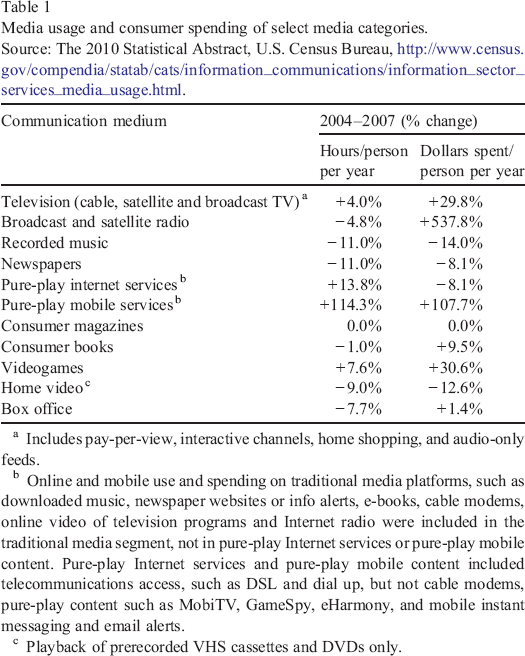
Traditionally, brand managers, service providers, and product manufacturers used mass communication vehicles (print, TV, radio) as their primary mode of communication. The message often focused on product and price with little regard to heterogeneity in the customer's needs and wants. This situation has changed since then. Communication based only on mass advertising has become a thing of the past. Customers’ needs and wants have become too diverse for marketers to satisfy them with a single all-purpose approach. With the availability of new data collection and communication tools such as loyalty programs, there is less need to employ techniques that indiscriminately focus only on price. Technological advancements have altered the pattern of commercial communication. For example, with respect to communication channels, the number of players in any media category has greatly increased in the past decade. Table 1 provides the changes in the usage of select media categories within this decade.
Media usage and consumer spending of select media categories.
Source: The 2010 Statistical Abstract, U.S. Census Bureau, http://www.census.gov/compendia/statab/cats/information_communications/information_sector_services_media_usage.html.
Includes pay-per-view, interactive channels, home shopping, and audio-only feeds.
Online and mobile use and spending on traditional media platforms, such as downloaded music, newspaper websites or info alerts, e-books, cable modems, online video of television programs and Internet radio were included in the traditional media segment, not in pure-play Internet services or pure-play mobile content. Pure-play Internet services and pure-play mobile content included telecommunications access, such as DSL and dial up, but not cable modems, pure-play content such as MobiTV, GameSpy, eHarmony, and mobile instant messaging and email alerts.
Playback of prerecorded VHS cassettes and DVDs only.
From Table 1, it is interesting to note that people have been spending more time on interactive media (i.e., interactive television, pure-play internet and mobile services, and videogames) than on the traditional media (i.e., radio and print media) between 2004 and 2007. 2 This trend is expected to grow even more over time. Clearly, firms should start to take advantage of this modified media landscape because of the increasing importance given to the interactive media and how it fits perfectly with the objective of building two-way conversations with customers. These changing dimensions can present companies with a challenge because integrating knowledge about customer needs across the growing number of segments, channels, and product category combinations is vital to the sustained existence of companies. This changing scenario also has potential implications for ensuring organizational stability and resource allocation across the channels, as they can affect the revenue and cost functions of a business.
The 2010 Statistical Abstract, U.S. Census Bureau, http://www.census.gov/compendia/statab/cats/information_communications/information_sector_services_media_usage.html.
Proliferation of media and channels
Over the years, there has been a fragmentation of customer segments into groups such as the baby boomers, the GenXers, the GenYers, and the recently emerging Hispanic segment, among others. Conceivably, industries such as the consumer packaged goods and retailing are the most impacted by this trend. With varying needs and preferences arising out of the polarization of customer segments as captured by the consumer panel data, these industries are striving to deliver products and services that cater to the customer's needs. At a macro level, organizations now must market across several channels, including television, print, radio, direct mail, and public relations. This 21st century trend is quite a change from the turn of the 20th century, when print advertisements in magazines, newspapers, and on posters were the only means of communicating messages.
With the evolution of new media options, marketing managers also have to rethink the roles of traditional media avenues. The channels of distribution exploded when cable television (1980s) and the Internet (1990s) gained popularity. For instance, while network television (networks such as ABC, NBC and CBS) was the most preferred broadcast media option in the early 1980's, viewership now has migrated from network television to cable television. Similarly, the magazine business has undergone a substantial change. For instance, the number of magazines in the U.S. increased from around 13,000 in 1988 to over 19,000 in 2007. 3 Among the fastest growing magazine categories are magazines focusing on ethnic groups and regional interests. While the ethnic-based magazines grew from 443 in 1998 to 855 in 2008, the regional interest-based magazines grew from 752 to 1138 over the same period. 4 This trend shows that consumer segments are increasingly splintered into smaller sub-segments.
National Directory of Magazines, 2007. http://www.magazine.org/ASME/EDITORIAL_TRENDS/1093.aspx.
National Directory of Magazines, 2009; Oxbridge Communications.
In this day and age, digital advertising, including the use of Internet search engines such as Google to promote products and services, has revolutionized marketing. In addition to opening up a wealth of opportunities, however, the changing media landscape also poses great challenges for marketers. With new media options opening up, media agencies are forced to rethink their marketing resource allocation strategies.
Zhang et al. (2010) provide integrated multichannel strategies in the retailing context. They define multichannel retailing as the ability to sell to consumers through multiple types of retail channels. In other words, the interaction must entail a sales transaction, rather than just communication across different channels. However, this study goes beyond the transaction aspect and also includes multiple mediums that are used for the purpose of communication. For this study, we define “multichannel” as the variety of channels that customers use to interact and transact with the firm (Rangaswamy and van Bruggen 2005); and “multimedia” as both offline and online media that firms and customers use to communicate with each other.
The retail environment has grown from a state where customers typically interacted with the firm through one channel (e.g., bricks-and-mortar store) using offline media (e.g., TV) to a state where customers interact through multiple channels such as the telephone and catalog while communication modes still remain largely offline. With the invasion of the electronic medium, the retail setup has reached a stage where customer transactions occur through multiple channels and the communication flows through both offline and online media such as websites, email, and more recently, social media. This has resulted in a business environment that integrates multiple channels and multiple media. Recent studies have addressed the multichannel aspect of this purchasing environment (Balasubramanian, Raghunathan, and Mahajan 2005; Verhoef and Donkers 2005; Kumar and Venkatesan 2005; Dholakia, Zhao, and Dholakia 2005; van Baal and Dach 2005). This study also includes the multimedia component, apart from multiple channels, in suggesting a customer value-based framework for the retail setting. Therefore, by developing a thorough understanding of market trends, looking at competitors’ allocation strategies and the effectiveness of various media, marketers can take a micro-level approach as to which media is appropriate for each channel.
Advances in technology
With the advent of Internet technology, it is now possible for almost all the manufacturers and service providers to publish their information and perform transactions with customers online. The online product/service search process for customers has become easy and cost-effective with the emergence of powerful online search engines such as Google, Yahoo!, MSN/Live and Ask.com. Technology has grown tremendously over the years and has given rise to new options such as Internet, email, websites, satellite television, and cell phones, apart from a wide variety of print media. The marketing implication for this increase in options is the ability to reach targeted segments and optimize the media spending by studying the responses to marketing campaigns. Further, technological advances have enabled delivery of “richer” media as well as accommodated customization with relative ease. However, the proliferation of technology has also given rise to more fragmented audiences.
An outgrowth of technological advances has been the changes with respect to data storage technologies. Both the supply and demand of data storage technology has changed significantly over time. On the supply side, technology is getting better with storage getting cheaper on a cost-per-bit basis and the units of storage getting larger. Looking back to the late 1990's, 1 GB of hard drive space would be unheard of. In 2008, most computers come with at least 150 GB of hard drive space. Storage prices have dropped consistently and are expected to continue to do so in the future.
On the demand side, the amount of data available to be stored has grown geometrically. With roughly 1.6 billion people on the Web worldwide in 2008, every business needs to keep track of the people who shop on its website. 5 Other factors that drive the demand for storage include packaged applications (CRM, sales-force automation, and data-marts), growth in data-warehousing applications, storage service providers, and storage-intensive consumer applications. As a result, many companies are now faced with the need to double their storage capacity every 6 to 12 months. According to IDC, average data-center energy costs are growing at 20% a year and are expected to double by 2012. The IT consulting company also predicts that the average data growth rate for companies will increase more than 600% between now and 2010.
Internet World Stats, http://www.internetworldstats.com/stats.htm.
Given all the above changes in the business environment, we are looking at a marketing scenario that places a greater demand on learning about customer preferences, value proposition, and product and service customization. Product-centric strategies are no longer capable of dealing with these advanced requirements. As a result, customer-centric strategies are emerging as a response. Therefore, the current scenario requires a formidable communication framework that can integrate these changing business dimensions to develop multichannel, multimedia communication messages. The communication plan suggested here is a holistic approach towards customer communication — one that begins with the information about customers, involves delivering the message, covers the customer feedback and delivers the firm's response for the feedback — all in an effort to provide a seamless implementation of customized messages to the customers.
This paper proposes a multichannel, multimedia framework to manage customers based on the value they provide to the company. In other words, by classifying customers into four segments, companies can use that information to design and implement a communication plan for their customers. Neslin et al. (2006) define multichannel customer management as the design, deployment, coordination, and evaluation of channels for enhancing customer value through effective customer acquisition, retention, and development. It is also important to note that multichannel customer management is a customer-centric marketing function and not a channel-centric marketing function (Rangaswamy and van Bruggen 2005).
This paper is organized in the following manner. The section “Understanding customer behavior across multiple channels” describes the changes in customer behavior with respect to channel adoption. The section “A customer lifetime value-based approach” introduces the multichannel, multimedia customer management framework for B2C and B2B settings. The section “Looking ahead” concludes the paper by providing managerial issues and future research directions.
Understanding customer behavior across multiple channels
The result of these changing scenarios is the need for a multichannel, multimedia communication framework. Prior research has highlighted some important insights on multichannel customer management based on changes in customer behavior. These behavioral changes have impacted channel choice (Montoya-Weiss, Voss, and Grewal 2003), channel migration (Thomas and Sullivan 2005; Venkatesan, Kumar, and Ravishanker 2007), allocation of marketing resources (Venkatesan and Kumar 2004), managing multichannel shoppers (Kumar and Venkatesan 2005), and have added much knowledge and interest in the area of multichannel customer management framework. Ansari, Mela, and Neslin (2008) have found differences in the value of multichannel and single channel customers. Further, the key issues and managerial questions about multichannel customer management have been raised by Neslin and Shankar (2009) and Rangaswamy and van Bruggen (2005). Keller (2010) adopts a brand equity approach in a multichannel, multimedia retail environment and suggests that marketers must design and implement an integrated channel strategy that maximizes short-run sales and long-run brand equity.
A recent study by DoubleClick (2006) revealed that across 15 industry verticals, websites are the single greatest source of influence on online consumers when they are making shopping decisions. Nearly 18% of respondents preferred websites for their purchases, followed by in-store information (15%), and word-of-mouth (14%). It was interesting to note that traditional media such as catalog, mail, television were among the least preferred for online consumers. With specific reference to industry verticals, the study found that websites dominated purchase decisions for airline tickets and that web-based advertisements were more influential than other advertisements. In the movie industry, movie goers were most influenced by advertisements in television and in theaters, word-of-mouth, and movie reviews.
Therefore, it is clear that customer reactions to marketing efforts are rapidly evolving. This calls for a strategic framework that integrates multiple channels and multiple media in order to deliver targeted messages to customers. It is imperative to have a customer-centric focus to incorporate and integrate individual customer preferences and interactions. The following section proposes a multichannel, multimedia customer management framework that will help companies to implement their marketing communications in an effective manner.
A customer lifetime value-based approach
Customer Lifetime Value (CLV) looks at a customer's value to the firm based on predicted future costs and transactions. It is defined as the sum of cumulated future cash flows — discounted using the Weighted Average Cost of Capital (WACC) — of a customer over his or her lifetime with the company. However, for most applications CLV is computed over the next 3 years of the customer's relationship with the firm and not his entire lifetime — the reason being nearly 80% of profit from a customer can be realized in the next 3 years (Gupta and Lehmann 2005). The communication framework proposed here incorporates this customer management approach. The CLV approach described above is a model-based framework that accounts for firm-customer exchange characteristics and customer heterogeneity, of which marketing communications are a part. After computing CLV, we also calculate the marginal effect of marketing communications on profitability for each customer. This will give us an indication of the marginal increase in profit from a customer for a unit increase in marketing communications. Doing this aids marketers in designing the right communication strategies for the various customer segments.
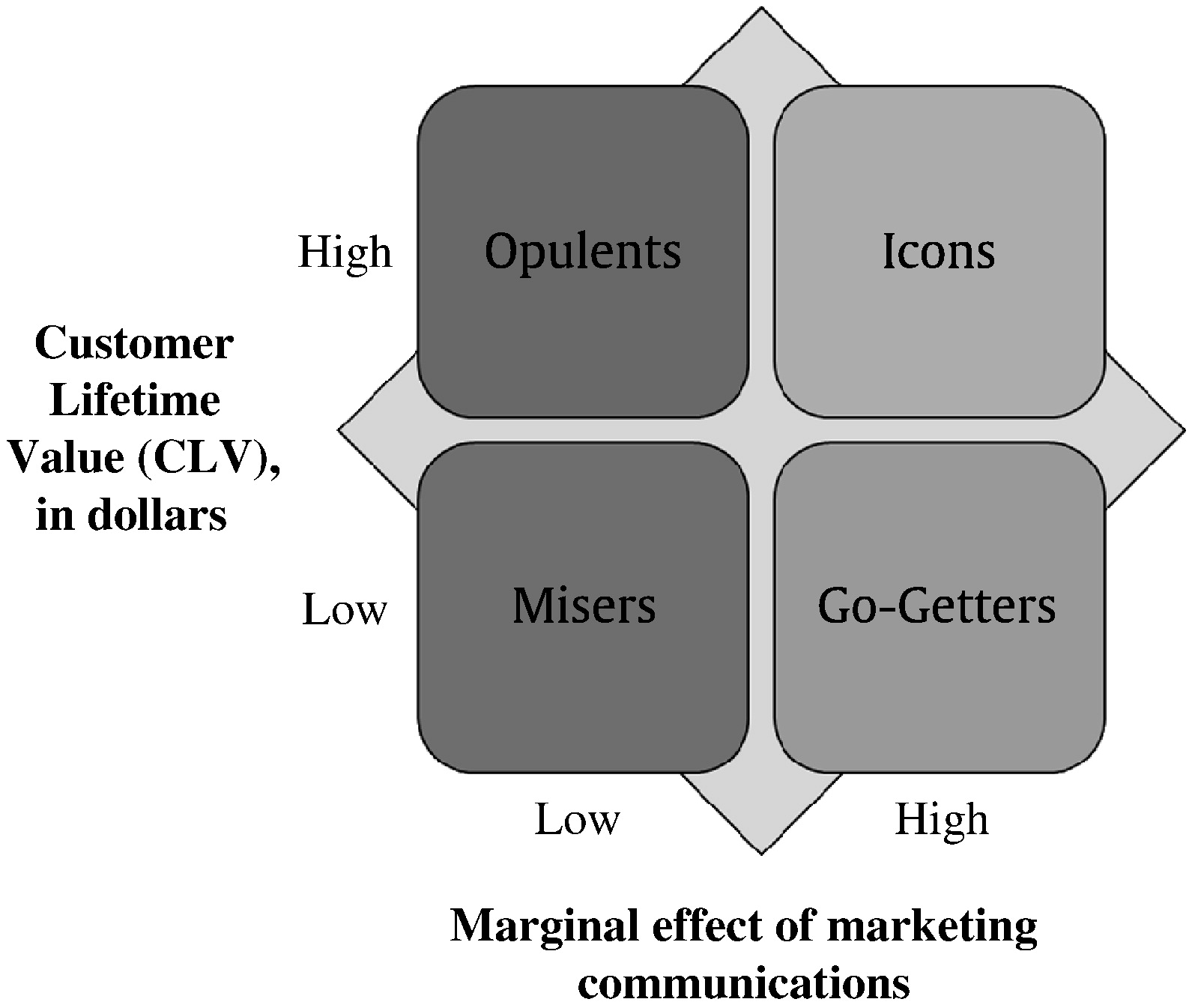
The marginal effect of marketing communications on the future profitability of customers can be determined using the CLV model-based approach. This is the first order differential of the CLV model that gives the marginal increase/decrease in profits from a customer because of a marginal increase/decrease in marketing communications. The reason for determining that marginal profitability is that it provides a dynamic view of the customer's future profitability because of marketing communications. However, a variation within high and low CLV customers with respect to their marginal effects of marketing communications is expected. Fig. 2 describes the variation in the marginal effects of marketing communications and CLV of individual customers.
Segmenting customers on CLV and the marginal effect of marketing communications.
As shown in Fig. 2, the customers can be segmented by two parameters, namely, their CLV and the marginal profitability (first order differential of CLV model). There are two types of high CLV customers — the ones whose marginal increase in profit because of marketing communications is high (Icons) and those who are low (Opulents). Along the same lines, we make the same distinction for the low CLV customers based on their marginal profitability (Misers and Go-getters). Communication strategies directed toward each of these segments is based on the cost of communication and the customer's receptiveness to a particular mode of communication. Kushwaha and Shankar (2007) provide a conceptual framework for multichannel resource allocation decisions by segmenting customers based on the channels used while shopping. They consider as single channel customers, those who shop exclusively through the catalog, the store, or the Web; and as multichannel shoppers, those who use multiple channels to shop. They build an optimization model to show that firm profits can be substantially improved by optimally reallocating marketing efforts across the different customer-channel segments. This study however, segments customers based on their future value to the firm and their marginal profitability.
Based on these four segments, we identify four levels of message types (Level 1 through Level 4) that firms can use for outbound communication. Level 1 communication provides room for the most personalized/customized messages and level 4 provides the least personalized/customized messages. The four levels are chosen in a decreasing order of personalization/customization. For instance, the Level 1 message may consist of personalized emails and direct mailing efforts while the Level 4 message may consist of broadcasting, print advertising etc. For the most valuable segment — the “Icons,” we suggest that firms use the Level 1 message that offers the most personalized message type. Similarly, firms can use a Level 2 message for “Go-getters,” Level 3 message type for “Opulents” and, the Level 4 message for the “Misers.” These types of messages and the relevant modes of communications are explained in detail in a B2B and B2C setting in this section.
This framework is strategic in that the content and delivery of messages are the result of a customer value-based measurement. That is, by identifying the “Icons,” “Go-getters,” “Opulents” and “Misers” using CLV and marginal profitability analysis, and in conjunction with customer-level information, it is possible to drive targeted messages to customers. This framework is bi-directional in that the flow of communication is two-way with customers and the company interacting with each other. This framework is result-oriented in that the needs of a customers’ inbound call is identified and specific targeted marketing messages are provided. Dholakia et al. (2010) propose a multichannel, multimedia framework to study consumer behavior. Using the framework, they view consumer behavioral issues (on the vertical axis) and the multichannel environment (on the horizontal axis) along a grid. While they identify the underlying dimensions of the multichannel consumer experience in a buying process using a matrix, this study proposes a framework for interaction and communication using the multichannel, multimedia approach.
The importance of the communications function in marketing has spawned a whole new body of knowledge called the Integrated Marketing Communications (IMC). Several influential studies have contributed immensely to this body that focuses on communication (Duncan 1994; Duncan and Moriarty 1997; McKenna 1991; Peppers and Rogers 1993; Schultz et al. 1993; Stewart 1995). Each of these studies has emphasized two-way communication through paying more attention to customers and interactivity and that the communications function is integral to building and nurturing brand relationships. Duncan and Moriarty (1998) propose a two-way communication-based model of relationship marketing and discuss how communication, as against persuasion, is central to developing customer-focused marketing actions. They demonstrate how interactive communication at corporate, marketing and marketing communication levels leads to the brand relationships.
This article argues that a more effective communication-based framework can be developed using customer value analysis. The framework provided here has its foundation in determining the value that a customer provides to the firm and his/her marginal profitability with respect to marketing communication efforts. Using the information from customer value analysis, an effective transaction and communication-based framework that can offer customized messages to the different customer value segments can be developed. This article also recognizes the distinction between B2B and B2C business formats and offers a framework that will help each manage and nurture profitable customer relationships.
Successful marketing communications have three essential qualities: (a) they should be strategic in nature, (b) they should be bi-directional in flow, and (c) they should be result-oriented in catering to customers’ needs. The multichannel framework suggested here integrates these three qualities and suggests a differentiated communication strategy based on the future value that customers offer to the firm and their receptiveness to marketing communication efforts by the firm. This differentiated strategy is also determined by the communication mode that customers would use to contact the firm, the nature or purpose of the contact initiative, and the appropriate response from the firm. This paper proposes the marketing communication approach for a B2C and B2B firm.
The case of a B2C firm
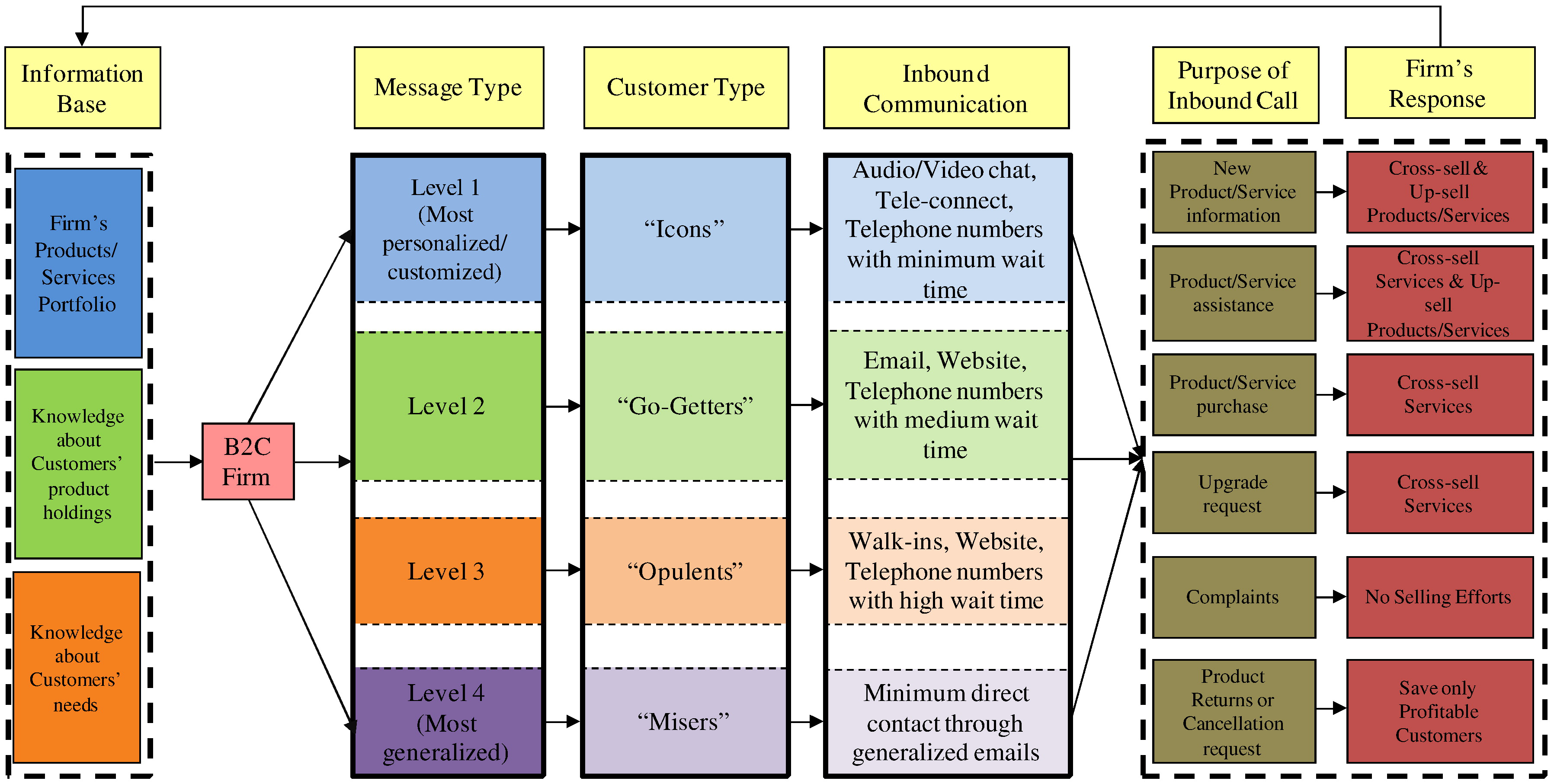
Fig. 3 provides the communication framework for a B2C firm. The information base forms the basis for the differentiated communication framework. Typically, a B2C firm would offer a wide variety of products/services to its customers. Therefore, knowledge about (a) its offerings, (b) how many of its offerings the customers already possess, and (c) what type of needs do customers have, would help the firm to decide what message it would send to its customers.
Multichannel, multimedia framework for a B2C firm.
Best Buy, an electronics retailer would offer entertainment gadgets, automobile navigation systems, computers and hardware, telecommunication devices, and home appliances as products. Best Buy's service offerings would refer to the installation, maintenance, repair and warranty plans for computers and hardware through their Geek Squad®, installation of audiovisual equipment in automobiles, auto detailing services, and financing options for purchases.
There has been a rise in retailer spending towards one area — technologies that help companies track customers’ behavior and purchase patterns. According to a recent report from AMR Research and the National Retail Federation (Business Week 2009), U.S. retailers increased their overall IT budgets by 8% in 2008, after a 2% increase a year earlier. Of more than 125 retailers surveyed in 2008, 59% invested in new systems or upgrades in customer relationship management, a category that includes analytics. This trend shows that companies are keen to know the customers’ buying pattern and their current product holdings. Best Buy has information about its customers’ product holdings and uses them to segment customers and target them with specific offers.
In understanding customer needs, Best Buy has segmented its customers into four groups — Buzz, the young technology enthusiast; Barry, the wealthy professional; Ray, the family man; and Jill, the soccer-mom (Washington Post 2005). Best Buy has studied the shopping behaviors of these segments and has found them to be different, when examined over different periods of time. For instance, they have found that their “Barrys” can afford to purchase an entire home theater system, including all accessories and add-ons, in one transaction or several transactions over a short period in time. In comparison, the “Buzzes” purchases were distributed over a longer period of time, owing to financial constraints. In case of a “Ray,” his typical purchases over a 60 day period after the purchase of a television included branded television stands, digital cable, home theater surge, digital television PSP (a handheld game console), among others. “Jills” on the other hand were the main shoppers for the family but usually avoided electronics stores. She was well-educated and usually very confident, but unsettled by the products at Best Buy and terminologies like gigabytes and megapixels. When companies analyze their customers’ purchase behavior, the insights obtained will help them in designing customized messages.
As noted earlier, the messages will be customized or generalized based on the future value the customers provide to the firm and his/her responsiveness to marketing communications. Personalization and customization are types of one-to-one marketing, which companies can employ to build relationships with the customers (Arora et al. 2008). Personalization is when the firm decides, usually based on previously collected customer data, what marketing mix is suitable for the individual. Examples of personalization include Amazon.com's and Barnes & Nobles’ personalized book and music recommendations, Netflix's movie recommendations, iTunes music recommendations, TiVo's recommendations for television shows, and StumbleUpon's website recommendations (Montgomery and Smith 2009). Customization is when the customer proactively specifies one or more elements of his or her marketing mix. Examples of customization include Dell.com, which allows customers to custom-build their computers, Dominos.com, which allows customers to design their own pizzas, and the MyYahoo feature at Yahoo.com, which allows users to specify elements of their home page such as the weather forecast, reports on their favorite stocks, or local sports news. Of course, the generalization will have varying degrees for the “Opulents” and the “Go-getters,” with the “Opulents” getting the more generalized messages and the “Go-getters” receiving messages that have some amount of customization. The level of customization of the message will drive the choice of outbound communication.
For the “Icons,” the most appropriate methods of outbound communication are email, direct mail and mobile marketing. Marketing studies have shown that mobile marketing is an emerging medium of communication and has important managerial implications (Barnes and Scornavacca 2004; Shankar and Balasubramanian 2009). Shankar et al. (2010) address key questions in order to better understand mobile marketing in a retail environment. They identify key challenges in mobile marketing such as understanding customer behavior in the retail environment, applying mobile marketing to acquire new customers and maintain current customers, managing the disconnect between managers and users, and choosing between push and pull strategies. Addressing these challenges will vastly improve the usefulness of this medium.
The above-mentioned three forms provide ample room for customization and personalization, which would be very useful in contacting the most valuable customers. Apart from these two methods of communications, telephone calls to the “Icons” are also possible. For instance, American Express makes courtesy calls to their high-value customers to ensure they are satisfied with the offerings. A combination of website, direct mail, trade publications, and word-of-mouth marketing can be used to communicate with the “Go-getters.” Word-of-mouth marketing is an important channel because it has been shown that the medium-value customers are the best people to refer the company and its offerings (Kumar, Petersen, and Leone 2007). These modes, while offering some scope for customization, also help provide customer segment-level messages. And for the low value customers (“Misers”), where messages are general in nature, companies can resort to broadcast, news prints and podcasting to deliver messages. Podcasting is a small but growing medium which marketers can use to deliver audio advertisements for a targeted market (Winer 2009). It is important to note that the choice of communication medium also depends on the communication objectives. For instance, if the objective is to create brand awareness, then, non-customized communication messages are most likely sent through mass media. As a novel and innovative mode of communication, interactive technologies are gaining momentum. Varadarajan et al. (2010) investigate the impact of interactive technology on retailing strategy and provide a framework for retailers to incorporate integrative technologies. They define interactive technology as devices and information infrastructure that mediate multi‐way communication that is both timely and contingent. Examples of current and emerging interactive technologies include cellular phones with web-browsing functions, GPS technologies, social networking on the Internet, search technologies, and bookmarking or information organization technologies. These technologies are highly interactive wherein the receiver's response follows the sender's directly and logically actions. Berry et al. (2010) examine current challenges and opportunities for innovation in interactive services and discuss several emerging success factors for retailers.
Once the message has been communicated to the customers, companies will also have to provide avenues for customer feedback. This framework proposes that the customer value-based approach be applied even for designing inbound communication modes. For instance, with regard to high-value customers (“Icons”), companies would want to obtain immediate feedback. Therefore, modes such as voice and text-based chats with customer service representatives and dedicated telephone lines with minimum wait time would be the most appropriate. In contrast, low value customers (“Misers”) can be migrated to modes, which involve minimal direct contact, so as to reduce costs of service. An example of this mode of communication would be providing an email address the purpose of feedback and communication.
Next, we need to analyze the nature and purpose of an inbound communication call by the customer. (For the purpose of discussion, an inbound communication call refers to the communication initiative by the customer, and not just a telephone call). This framework classifies customer calls into six types. This framework proposes a response message from the firm for all the six types of communication. They are:
New product/service information — Customers may call to enquire about any new products or services that they can consider for future purchase. In the example of Best Buy, a Barry might call in to find out information about subwoofers for his new Plasma television. During such a call, after satisfying his request, Best Buy should up-sell and cross-sell related products/services to him. An example of the up-sell can be an advanced version of a subwoofer. An example of the cross-sell can be subwoofer stands. The practice of up-selling is common in automobile purchases. For instance, a BMW dealer would highlight the advantages of owning the more expensive BMW X5 to a customer looking to purchase the less expensive BMW X3 model, by offering him the opportunity to test drive the X5.
Product/service assistance — Customers may call to request usage assistance for the products that they have already bought. For the “Jills” of Best Buy, this could be technical assistance with a new camcorder that she bought recently. Here again, after satisfying her request for assistance Best Buy can up-sell or cross-sell products/service to her. An example of up-sell can be a premier service plan for Geek Squad® and an example of cross-sell can be to get her to sign up for Geek Squad® services. An example of up-selling during product/service assistance would be Nordstrom. Nordstrom's Personal Touch Shoppers Program has “wardrobe consultants” who assist shoppers with their purchases. Aided by the customer profile, their purchase history and their personal touch with the customer, the consultants help in fashion selections and recommendations.
Product/service purchase — Customers may often call to buy a product or service. The nature of such purchases may be accessories or add-ons to their existing products, or entirely new products. For instance, a “Buzz” of Best Buy could buy a warranty for the laptop that he bought recently. Here, a cross-sell initiative from Best Buy would be most appropriate. An example of this can be an extended coverage for his laptop or coverage for his computer accessories. A simple example of cross-selling during a purchase request would be McDonald's cross-selling fries with the purchase of a hamburger. This is also a proven method for Amazon. For example, after each product purchase, the customer immediately sees a list of products under the heading, “Amazon Customers Who Bought This Product Also Bought.” The list might include other products by competitors or related products from different product categories.
Upgrade request — Upgrades, as the name suggest, refer to newer and advanced versions of products. For the “Rays” of Best Buy, this could be an upgrade of coverage in his existing Geek Squad® coverage. Here, opportunities for cross-selling products/services may arise. For instance, Best Buy can consider cross-selling other technology products that can be covered under the Geek Squad® coverage. Similarly, in the case of Brinks home security system, a customer would want to upgrade from his/her basic security plan to include a motion detector and a detector that goes off if there is a break-in involving smashed glass doors and windows. In such a scenario, after satisfying their request, Brinks would cross-sell their $5 unlimited monthly service plan, which does not require the customer to pay $90 for every upgrade he/she would make.
Complaints/feedback — A very common usage of inbound communication mode, complaints continue to flow into customer service departments of companies. Fornell and Wernerfelt (1987) identified that it is optimal for the firm to allow customer complaints up to a threshold. Therefore, all complaints are not bad and this presents a challenge to managers for managing complaints. The complaints vary based on products or services bought. For a mobile phone service provider, this could be a call to dispute a long distance call charge to an account. Since complaints can potentially harm the relationship between the firm and the customer if handled inefficiently, all the firm's initiatives (in this case) should be directed at resolving the dispute charge. The firm should not indulge in any up-selling or cross-selling efforts.
Product returns or cancellation requests — These requests are a common feature in a B2C setting. Using customer data from a catalog retail firm, Petersen and Kumar (2009) find that (a) a customer's product return positively affects future buying behavior with the firm, up to a threshold, (b) considering product returns in customer analysis increases the predictive accuracy of a customer's buying behavior, his product return behavior and the firm's marketing resource allocation decision, and (c) for the catalog retail firm, the optimal percentage of product returns that maximized the firm's profits was 13%, or a decrease in product returns by 3% from the current level.
Unsatisfied customers typically want to return their product or cancel their service. Best Buy is well known for its list of “demon” customers. They have identified those customers who have taken advantage of the product returns policy and have told them not to shop at Best Buy in the future (Boyle 2006). It should be noted that requests for cancellation occur only in a contractual setting such as magazine subscription, credit card services, and mobile phone services, among others. Here again, the firm's focus should not be on up-selling or cross-selling, but rather on saving customers. This framework suggests that only profitable customers should be saved. The level of profitability can be computed by a Customer Lifetime Value (CLV) analysis.
It is important to note that the decision to up-sell and/or cross-sell should be made only after considering the customers’ profitability and loyalty. Reinartz and Kumar (2002) provide up-selling and/or cross-selling recommendations based on customers’ loyalty and profitability to the firm. For instance, they advocate a short-term, hard-sell cross-sell strategy through promotions and mailing campaigns targeted towards the high-profitable, short-term customers. When these communications yield no result, the firm should stop communicating with these customers. Similarly, for the low-profitable, long-term customers they recommend an investigation into the customers’ size-of-wallet and share-of-wallet on a decision to up-sell and cross-sell. If the customers have a small size-of-wallet, then, they are not valuable enough to continue pursuing. However, if they have a small share-of-wallet, then, specific up-selling and cross-selling efforts should be pursued to induce them to purchase more.
Thus far, we have seen the differentiated communication and marketing initiatives for the value-based customer segments of a B2C firm. This framework starts with the information that companies collect about their customers, use that knowledge to drive differentiated and targeted messages to its “Icons,” “Go-getters,” “Opulents,” and “Misers,” provide avenues of communication to their customers based on the value they provide to the company, and offer targeted marketing initiatives in response to the inbound communication from the customers. The learning and insights from this exchange of communication between the firm and its customers will feed in to the firm's information repository and will help drive the firm's future communication and marketing efforts to its customers. Now, we will see how this framework works in a B2B setting.
The case of a B2B firm
The multichannel framework suggested for a B2B company that is similar to the B2C framework in terms of conceptual layout but different in terms of actionable communication and marketing initiatives. Fig. 4 provides the framework for a B2B firm.
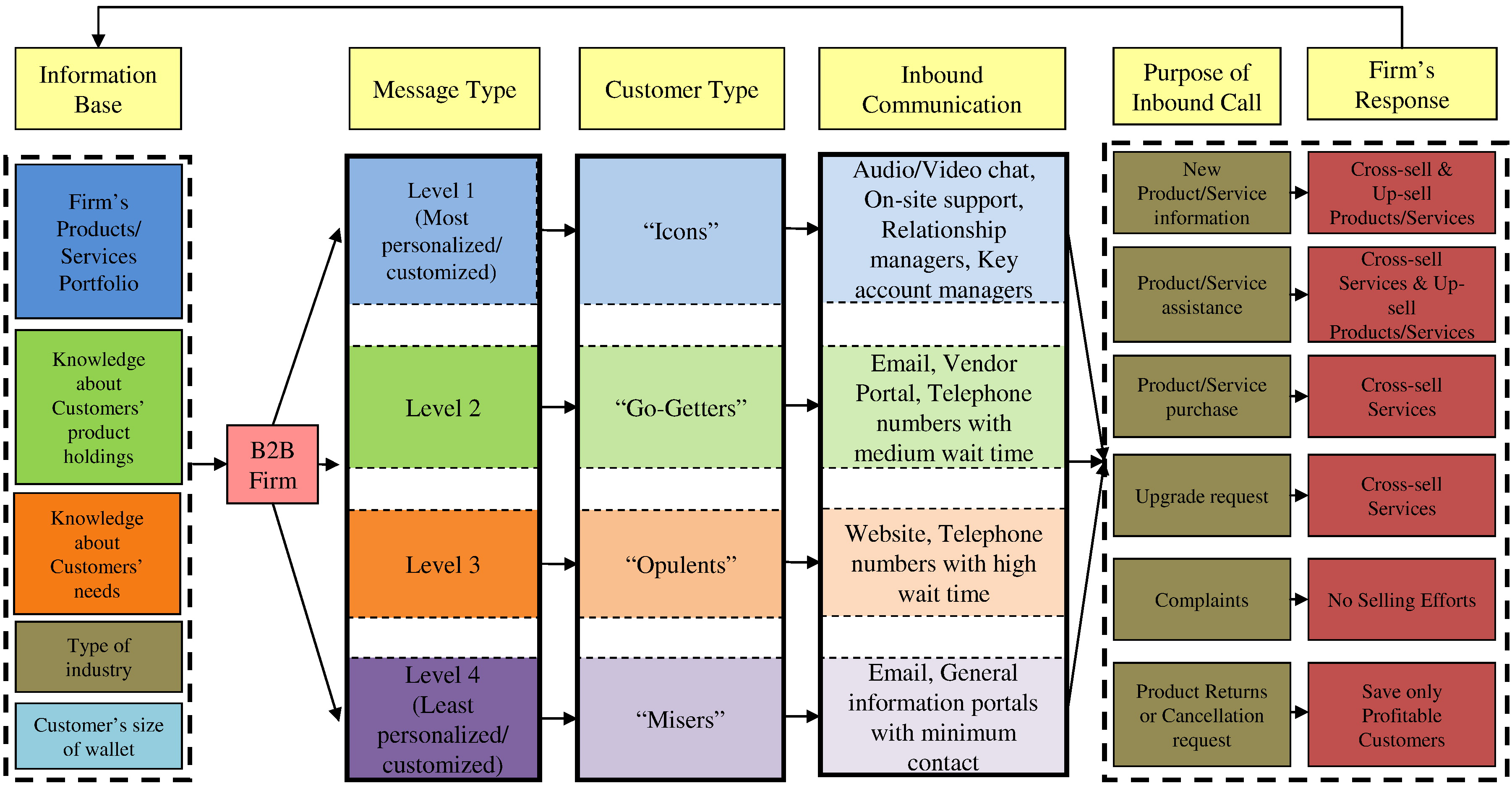
Multichannel, multimedia framework for a B2B firm.
The communication process begins with the information database that the company has about its customers. Therefore, the knowledge about (a) its product/service portfolio, (b) the customer holdings, (c) what type of needs do customers have, (d) the type of the industry the customer belongs to, and (e) the size of the customer, would help the firm in deciding on a message that it would send to its customers.
IBM manufactures and sells computer hardware and software, offers infrastructure services, hosting services, and consulting services across business and technology verticals. It has a rich customer database, which it uses to sort customers based on a customer-level metric and develop marketing initiatives based on the scores on this metric. This score, Customer Spending Score (CSS), is calculated on an annual basis and is defined as the total revenue that can be expected from a customer in the next year. This metric was later replaced by CLV, owing to its ability of addressing both the top line of a company and the variable cost of serving a customer or the bottom line (Kumar et al. 2008). Further, the sales team at IBM adds qualitative inputs such as customer buying behavior and needs, which further nourishes their information database.
The next stage in our framework is to send appropriate messages to the customer segments. In our example of IBM, with customer information as the launch pad and customer segmentation (into “Icons,” “Go-getters,” “Opulents,” and “Misers”) as an aid, they can send targeted messages to the value-based customer segments. For instance, they can send customized messages to the “Icons” through highly personal modes such as sales force and telephone. For the “Go-getters,” IBM can use semi-customized messages through telephone, direct mail, and reference marketing. Reference marketing implies that the company can use their high-value clients to act as references for their medium-value customers. This is different from referral marketing where companies encourage and reward customers who talk positively about the company's offerings and thereby bring in new customers. These modes can be adjusted to provide just the right amount of customization without getting too general. For the “Opulents,” IBM can use semi-generalized messages through modes such as email and trade publications. And for the “Misers,” IBM can use avenues such as catalog and email to send general, untargeted messages.
Once the company reaches out to its customers with a specific message, they also have to develop communication channels through which its customers can contact the company. In the case of IBM's “Icons,” it would be appropriate to have an audio/video chat with customer service representatives, relationship managers and key account managers who take care of the most important (here most valuable) clients. For its “Go-getters,” IBM can use emails, dedicated vendor portals which customers can visit and provide feedback, and telephones lines with medium wait time. For the “Opulents” IBM can use information websites, and telephone numbers with a high wait time. And their “Misers” segment can be offered modes such as email and general information portals that allow minimal contact.
As discussed in the B2C framework, the reasons why a customer would call the company can be classified into six categories. These calls have a specific firm response:
New product/service information — Customers may call to enquire about any new product or service that they can consider for future purchase. In the case of IBM, a customer may call to enquire about software products or about a range of servers. For a service, this might be a request about training or business outsourcing needs. For such a call, after satisfying the request, IBM should up-sell and cross-sell related products/services to the customer. An example of the up-sell can be an advanced range of servers. An example of the cross-sell can be technology application services for their security needs. The instance of cross-selling and up-selling is very important in specialty care product purchases. When hospitals call to enquire about a Magnetic Resonance Imaging (MRI) system, GE Healthcare can undertake up-selling efforts by promoting an advanced system with additional capabilities, depending on their needs and usage pattern. Subsequently, they can also cross-sell their financial services plan to aid the hospitals in their purchases. GE Healthcare may initiate these efforts by sending sales force to the hospital, directing the hospital to a dedicated online portal containing the product information or by offering virtual product demonstrations.
Product/service assistance — Customers may call to request usage assistance for the products that they have already bought. For IBM customers, this could be a request for assistance for Internet security systems. Here again, after satisfying the assistance request IBM can up-sell or cross-sell products/services. An example of up-sell can be advanced Internet hardware management tools and an example of cross-sell can be to get them server security services. Consider the case of Jones Lang LaSalle, the real estate and investment management company. For a customer who seeks assistance in managing his property, Jones Lang LaSalle can cross-sell their facilities management/outsourcing services to manage the property. They can also up-sell their strategic consulting services to help the customer's property acquisition and/or disposition efforts. By providing successful case studies of their clients in the past, offering to provide their key clients as referrals, and by demonstrating significant cost savings through their consulting and/or outsourcing services, Jones Lang LaSalle can communicate their product offering to their customers.
Product/service purchase — In a B2B setting, sometimes customers may contact the firm to buy a product or service. These purchases could include accessories or add-ons to existing products or entirely new products. An example could be a purchase request for a UPS for the server bought recently from IBM. A related cross-sell initiative from IBM can be a warranty for the UPS. Another example of up-selling and cross-selling during purchase requests in a B2B setting would be DuPont. Among other products and services, DuPont also sells animal health solutions as part of its Food and Pharmaceutical Quality Assurance Products. An animal research center or a livestock production facility may call to request cleaners and disinfectants to maintain its facility. In such a scenario, DuPont can cross-sell their heavy-duty cleaners and niche application products that have been developed for particular animal species. Using successful case studies highlighting the best practices in various industries and information brochures regarding proactive care about cleanliness and hygiene, DuPont can also up-sell their disease preparedness products such as hand sprays, hand wipes and multi-purpose disinfectant sprays. It is important to note here that the up-selling and cross-selling efforts should be directed to customers who have a high CLV and a large size-of-wallet.
Upgrade request — Upgrades are very common in technology products. Bolton, Lemon, and Verhoef (2008) propose that the firm's upgrade decision is influenced by (1) decision-maker perceptions of the relationship with the supplier, (2) contract-level experiences, and (3) interactions between firm and contract-level variables. IBM could request an upgrade for its storage systems. An IBM initiated cross-sell strategy here can be to promote the latest range data storage management software based on the customer's relationship with IBM, and their current product/service holdings.
Complaints/feedback — Managing relationships is very important in a B2B setting. This is why many companies have relationship managers to manage their key clients. For IBM, complaints can arise either from ineffective products or insufficient technology support. IBM should focus on resolving the complaint and not in engaging in any up-selling or cross-selling efforts.
Product returns/cancellation requests — These requests are not very common in a B2B setting. Customers may choose to manage their data storage in-house and call in to request cancellation of their storage services from IBM. Here, IBM should focus on retaining those customers from churning (if they are profitable). They can consider setting up a firm credit, which the customer can avail for their future purchases. Once the customer has been saved, IBM can focus on cross-selling products/services that are more suitable to the customers’ needs.
The two frameworks suggested here propose a comprehensive communication process and have made an attempt at completing the communication loop with a customer-centric focus. The multichannel framework suggested here is novel on two counts: (a) apart from completing the communication loop (outbound and inbound communication), the framework suggests customer-centric firm responses that are appropriate, relevant, and timely, and (b) by linking the firm's responses to the information database, they can use this information to further tailor their products/services and marketing efforts to suit the needs of all their customers.
Since the frameworks described here depend heavily on customer-level data, it is critical that companies adhere to ethical data usage and regulatory aspects regarding customer privacy. In fact, not many companies display data privacy policies on their web sites. Johnson-Page and Thatcher (2001) concluded (based on a survey) that data privacy policies are more commonly found on company web sites in countries where: (a) consumers have greater access to and experience of using the Web; and (b) there is an established market economy with clear business laws. The foundation for personal data protection legislation rests in the set of principles developed by the Organization for Economic Cooperation and Development (OECD) in 1980. 6 They present a set of eight principles that best balances effective privacy protection with the free flow of personal data. The principles are: (a) collection limitation, (b) data quality, (c) purpose specification, (d) use limitation, (e) security safeguards, (f) openness, (g) individual participation, and (h) accountability. Using these principles, companies can develop privacy policy measures that can be applied in all business environments. Therefore, data privacy issues have to be contended with to ensure effective working of these frameworks.
OECD Guidelines on the Protection of Privacy and Transborder Flows of Personal Data, http://www.oecd.org/document/18/0,3343,en_2649_34255_1815186__1_1_1,00.html.
The frameworks described in this study can be applied in situations where the firm is in direct contact with the end consumers and in situations where it sells through channel intermediaries. For instance, consider the B2C framework. For a telecommunications firm, this framework is directly applicable as the firm stays in contact with the consumers. In the case of a CPG company, they are in immediate contact with only the channel intermediaries or retailers. In such a situation, the CPG company would have to apply the B2B framework as opposed to the B2C framework. Having said this, the CPG companies are increasingly using social media to be in touch with the direct consumers and establish strong connection with opinion leaders and influencers among the users. In the case of the B2B framework, this framework is applicable when a company sells directly to other businesses and when they sell through agents or channel partners. IBM, for instance, sells directly to businesses and through business partners. Therefore, they can use this framework in interacting and communicating with their customers and their channel partners.
It is important to note that the frameworks suggested here adopt a customer value approach. Another way to think of this approach would be the brand value approach. While Keller (2010) shows that brand equity can be managed by adopting an integrated channel management strategy, Kumar (2008) demonstrates that by managing brand value at the individual customer-level firms can maximize customer value. In other words, by understanding the link between individual brand value (IBV) and CLV, firms can efficiently allocate their resources to generate maximum value. By linking factors such as brand knowledge, brand attitude, and brand behavior intentions to the final customer behavior outcomes, firms can thus link the IBV of their customers and their CLV. A clear understanding of the various factors that affect IBV and its link to CLV also enables firms to design and develop appropriate communication messages and channels that can maximize value to the firm. The next section proposes some concluding thoughts and provides future directions for this framework.
Looking ahead
In this final section, we review some key managerial issues faced by companies in implementing such a framework and propose future research directions.
Managerial issues
The managerial issues in implementing the proposed framework can be categorized into two groups: (a) strategic outlook and (b) operational details.
Strategic outlook
The strategic outlook for companies should be geared towards a customer-centric approach, rather than a product-centric approach (Shah et al. 2006). This is a significant change in how a company should look at its business activities. The underlying philosophy of focusing on the products, or the product-centric approach, is to sell products to whoever is willing to buy. In a product-centric approach, catering to the needs of customers by developing appropriate products becomes the driving force for a business. This principle is further accentuated by developing a comprehensive portfolio of products, using product-level profitability and market share as the key metrics of performance measurement, and by adopting a transaction-based approach is the business paradigm. However, the disadvantage of this approach is that companies tend to ignore customer-specific needs that are crucial in determining their relationship with the firm.
Adopting a customer-centric approach is vital for implementing the framework suggested here. The underlying philosophy in a customer-centric approach is to focus on customers, or to explore how many products can be sold to a particular customer. It also includes serving a portfolio of customers with relationship building activities. By following this approach, firms can structure around customer segments and relationships and use CLV and customer equity as key performance metrics.
The road to customer-centricity lies in interaction orientation (Ramani and Kumar 2008). In this philosophy, customers are viewed both as a source of business and as a potential business resource for the firm. It should be noted that the framework discussed uses customer information to drive communication messages and then utilizes the ensuing results as potential resources for future use. This approach helps customer empowerment and to harness the network effects of customer-to-customer linkages. This philosophy involves (a) understanding that every marketing action needs to be at a customer level, (b) utilizing prior customer interaction responses to drive successive products and services, (c) empowering customers to connect and collaborate with the firm, and (d) calculating customer profitability and using that information to drive customized marketing messages. These actions will successfully steer a company from focusing on products to focusing on customers.
Operational details
Establishing a strategic outlook toward multichannel customer management is only part of the solution. For a complete adoption of this approach, the operational details have to be fine-tuned to produce desired results. Some key initiatives on the operational elements of business have to be undertaken to enable a complete transformation. These initiatives include: (a) data sufficiency, (b) human resource support, and (c) metrics for measurement.
Data requirements for implementing the proposed framework can be challenging for many companies. In many cases, especially in the retailing environment, the strategic focus of the business and the level of communication (at the brand level, segment level, or at the individual level) determine the development and implementation of CRM in an organization. Verhoef et al. (2010) propose a framework to identify the most salient components in this process. This framework examines issues such as supply chain and customer data, customer insights, marketing actions, and customer outcomes.
To implement the proposed framework, data have to be collected from a sufficiently large customer base, customer value computed through CLV analysis, marginal profitability determined from the CLV, and customers segmented into the four cells as described in Fig. 2. These actions call for three essential data characteristics:
Customer-level data is necessary to develop this framework.
Data should include transaction information (including past customer value, recency and frequency of purchases, contribution margin, channel preferences, channel adoption rates, multichannel behavior, marketing touch methods, media of touch, and number and frequency of touches).
Breadth of data should be for at least two or three years. The longer the time span, the more satisfactory the result.
Human resource interaction and support is a vital aspect in implementing such a framework. Some of the key initiatives on the human side of business that need to be undertaken are: (a) cultivating and communicating the importance of customer-centricity through employee-targeted communication messages, (b) stressing the initiative's effectiveness and potential benefits, (c) instituting transparency in information dissemination about the change process, (d) involving stakeholders to be part of the change, and (e) developing a monitoring and evaluation process.
Metrics help organizations identify and implement key performance indicators and implement corrective actions, if any. To enable this framework, management should track and monitor customer-level metrics. Traditionally, companies have used product-centric metrics to track and measure market share, mind share, and product and portfolio management activities. However, shifting to a customer-centric approach requires the management to emphasize forward-looking metrics, such as CLV and CSS.
Implementing the strategic outlook and refining the operational details to suit customer-centricity is not difficult. For instance, IBM has incorporated a customer-centric approach in managing their customers with excellent results. However, to ensure continued success, firms should continue to work toward collecting information at the individual customer level.
Guidelines for future research
There is considerable scope for further research in this area. Payne and Frow (2004) present a comprehensive overview of future research initiatives that includes (a) nature of channel usage over time, (b) selection of new channels when communicating with customers, and (c) measurement of customer experience in a multichannel context. We discuss a few additional areas for further research.
The relative effectiveness of various modes of communication in a B2B versus B2C context needs to be quantified.
Approaches to maximize ROI for the use of new media can be investigated.
A method of optimal allocation of resources across traditional and new media can be determined.
With regard to social networks, it would be interesting to quantify the value of word-of-mouth and better utilize this mode of communication to drive value.
The influence of social media as a channel of communication needs to be determined. Social media is growing in popularity and more companies are establishing their presence in social networking channels. It would also be interesting to test the impact of social media as one of the potential channels for outbound communication.
Empirical work on new purchasing channel adoption is needed to further the implementation of customer-centricity.
This paper also opens up opportunities for research on pricing in online and offline retail formats. Grewal et al. (2010) propose a strategic pricing framework, which describes the antecedents and moderators of online and offline pricing decisions as well discusses a number of relevant metrics. Past research (Ancarani and Shankar 2004; Pan et al. 2002; Pan et al. 2004; Ratchford 2009) have investigated pricing issues in a multichannel setting. Our proposed framework can be used to extend these studies to include the communication component.
Investigation into communication channel response is another research area. What makes a particular customer segment accept a particular channel? Further, new media technologies like mobile marketing can be considered (Shankar and Balasubramanian 2009; Shankar et al. 2010).
Our framework considers only the cost of contact, the message type and the modes of contact. This framework can also be extended to include the intent behind the communication. Incorporating the brand building aspect would lead to further insights and increased applicability of this framework.
While we have examined the multichannel framework in B2C and B2B contexts, a detailed analysis into sector-specific differences and similarities will shed greater light on this framework.
In conclusion, this paper proposes a multichannel multimedia communication framework by integrating a firms’ knowledge about customers and the value customers provide to firms. By combining relationship marketing and channel management principles, this framework provides an approach that companies can use to send customized messages to its value-based customer segments.
Footnotes
Acknowledgments
The author thanks the assistance of Bharath Rajan in the preparation of this manuscript. The author owes additional thanks to Renu for copyediting this manuscript.