







Abstract
Virtual worlds (VWs) have become increasingly prominent during the past decade, populated by individual users and more recently, even “real world” firms. To effectively use a VW for business purposes, a relevant question for those firms pertains to why people use VWs and which motivational drivers might influence their participation behavior. This study offers an early analysis of the topic by extending a social influence model to explain participation behavior in a new, marketing-relevant context and identify specific motivational drivers of VW participation. Socializing, creativity, and escape emerge as individual drivers. Accounting for user heterogeneity also reveals four latent segments, each characterized by a distinct motivational driver, and one segment that reflects mixed motives. The segments differ substantially in their descriptive characteristics (e.g., usage intensity, overall spending behavior). These results have significant implications for research, VW operators, and companies doing business in VWs.
Keywords
Introduction
Virtual worlds (VWs) have become very popular in the past decade, populated by both individual users and organizations. Although the intense hype around these three-dimensional virtual hyperrealities has come to an end (Haenlein and Kaplan 2009), operators still keep reporting increasing usage levels; for example, Habbo Hotel claims to have surpassed 200 million registrations as of January 2011 (Sulake Corporation Oy 2011). In general, the U.S. virtual goods market should reach US$2.1 billion overall in 2011, and VWs constitute an increasingly meaningful share of the related opportunities (Smith and Hudson 2010).
By offering a social and economic supplement or alternative to the real world, VWs allow people and organizations alike to “step” into another world. People can assume a virtual identity through an avatar and thereby engage in different real-world-like activities, such as meeting friends, earning money, shopping, or building a home. Business opportunities include purchase-related engagements such as the sale of virtual products (e.g., virtual Nike shoes) or physical products (e.g., real Nike shoes sent to a user), as well as information/communication-related tasks such as promoting the company (e.g., advertising Nike in the VW), and conducting market research (e.g., testing the design of new Nike shoes on avatars).
The high popularity of VWs has attracted several major real-world firms to engage in these new environments, including Adidas, American Apparel, Dell, Disney, IBM, Nike, MTV, Reuters, and Toyota (Bélisle and Bodur 2010). In 2009, the world economy of Second Life as one of the most prominent VWs reached US$567 million—corresponding to a growth rate of 65% from 2008 (Linden 2010). On the other hand, some firms have already closed their virtual stores because users were not attracted by their offerings (Edery and Mollick 2009). Hence, the overall trend remains puzzling and requires a clearer understanding of what might have gone wrong for these firms.
From an academic perspective, we still know relatively little about VWs. Most prior contributions involve editorial content in practitioner outlets; few articles have been published in academic journals, and those that appear are mainly conceptual descriptions of business models for VW operators (e.g., MacInnes 2006) or potential opportunities (e.g., Papagiannidis, Bourlakis, and Li 2008). The few empirical studies to date can be categorized into three research directions: (i) Studies that investigate the link between individuals and their avatars in VWs as well as the impact of VWs on virtual identity building (Bélisle and Bodur 2010; Parmentier and Rolland 2009); (ii) studies that analyze the impact of brand experiences in the VW on brand attitudes and consumer purchase behavior in the real world (Gabisch 2010; Haenlein and Kaplan 2009); and (iii) studies that examine the determinants of VW user adoption (Chung 2005; Fetscherin and Lattemann 2008; Shin and Kim 2008). The objective of our study is to investigate what actually motivates people to join and participate in a VW. Hence, our research mostly corresponds to the third group of studies. The common framework underlying all existing studies in that group is the technology acceptance model (TAM; Davis 1989). However, a TAM framework is only of limited use for studying the determinants of VW acceptance for two reasons: First, the rather abstract determinants within the TAM (i.e., perceived usefulness and perceived ease of use) do not appropriately reflect the specific user motivations for VW participation, which can be considerable in number given the varied usage opportunities in VWs. Second, the TAM ignores important group-level influences arising from social interactions between VW members (Bagozzi 2007). Hence, there remains a strong need to identify the specific user motivations of VW participation as well as to analyze – in a more holistic framework – how these motivations translate into participation behavior.
To accomplish this, we adopted a two-step research approach building around two consecutive studies: First, we undertook a formal uses and gratification (U&G) development process to identify the key motivations of VW use (Blumler and Katz 1974). Second, we applied the motivations we identified to build a modified social influence model (SIM; Dholakia, Bagozzi, and Klein Pearo 2004) that provides a holistic framework for analyzing the influence of individual-level user motivations on intended VW participation behavior, even as it controls for potential group-level (social) influences. For model estimation, we adopted a response-based segmentation perspective (Jedidi, Jagpal, and DeSarbo 1997) and accounted for possible heterogeneous motive structures. With this approach, we were able to identify latent segments of VW users with distinct motivational drivers. Finally, we profiled the user segments according to key demographic (age, gender, education, income, occupation, and residence) and behavioral (proportion of VW-only friends, spending amount per month in the VW, and actual usage intensity) variables.
By considering our segment-specific findings, both VW operators and participating firms can benefit from a better understanding of VW usage motivations, as well as align their activities with the demands and characteristics of selected target groups. To the best of our knowledge, this article offers the first comprehensive approach to understanding and explaining intended user behavior in VWs through an analysis of social influence. It thus not only provides important managerial guidance but also advances research on consumers’ motivational drivers and social influence.
Conceptual Framework
Virtual Worlds
Loosely speaking, a VW is a virtual place that enables users to communicate, cooperate, and collaborate, as in the real world (Hindmarsh, Heath, and Fraser 2006). Users, or more accurately their avatars, can establish a business, marry a partner, or travel to exotic locations (Fetscherin and Latteman 2007). For a more holistic definition, however, VWs have to be regarded from different perspectives. By integrating sociological (Muniz and O'Guinn 2001; Rheingold 1993), technological (Lechner and Schmid 2001), and economic perspectives (Balasubramanian and Mahajan 2001; Hagel and Armstrong 1997), we define a VW as an unstructured social and technological environment that possesses three central characteristics: (1) It is embedded in a three-dimensional, visually sophisticated digital space; (2) it comprises an aggregation of people who are graphically represented by avatars, and movements of these avatars within the digital space are rendered simultaneously to all other constituents in the virtual vicinity in a three-dimensional visualization that enables real-time interaction; and (3) users of the VW engage in different exchange processes, whether social (mutual dissemination of thoughts and opinions), material (trading virtual material objects), or monetary (transfer of virtual currency). Every constituent engages in some but not necessarily all exchange processes.
This definition distinguishes VWs from related virtual venues, such as multiplayer online games or virtual communities. Specifically, whereas online games are structured (i.e., closed) environments that are designed around socialization, fantasy and role playing with clearly defined goals, VWs are unstructured (i.e., open) environments that lack mission-oriented narratives, defined character roles and goals (Reeves, Malone, and O'Driscoll 2008). Further, VWs offer an active economy that is designed around the ownership of virtual property (Mennecke et al. 2008; Parmentier and Rolland 2009; Salen and Zimmerman 2003). In contrast with virtual communities, VWs offer a more real-world-like environment, mainly through their three-dimensional representation (Fetscherin and Lattemann 2008), so interactions take place in realistic environments that mirror real-world locations, such as conference rooms, lounge areas, restaurants, or tropical beaches. Through their avatars, users also can make nonverbal (e.g., smiling, winking, nodding, shrugging) and verbal (e.g., breathing, yawning, laughing) utterances. Thus in VWs, they can express their feelings more easily, conveniently, and accurately to other users than in virtual communities (Chung 2005).
Research Setup
To investigate the individual motivations that draw participants to VWs, we must account for the mechanisms by which individual-level determinants translate into participation intentions in the specific context of a VW. Because participation in VWs always involves some form of social interaction, a person's decision to participate depends on not only personal motives but also a form of social influence that originates within the VW (Dholakia, Bagozzi, and Klein Pearo 2004; Postmes, Spears, and Lea 2000). For example, a user interested in finding new friends in a VW is more likely to participate continually if he or she learns that other members in the VW share similar interests. To capture participation behavior in VWs fully, we thus need to integrate individual-level motivations for VW usage with social influences originating in the VW itself.
Considering this integrative demand, we turn to the SIM (Bagozzi 2000; Bagozzi and Dholakia 2002, 2006; Bagozzi, Dholakia, and Mookerjee 2006; Bagozzi, Dholakia, and Klein Pearo 2007; Cheung and Lee 2010; Dholakia, Bagozzi, and Klein Pearo 2004; Shen et al. 2011) as a useful baseline model for framing our analysis. In brief, the SIM implies a causal relationship between motivational drivers and participation behavior in network-like environments, though the constructs are not linked directly but instead are mediated by social influence variables (i.e., group norms and social identity; Etzioni 1996) and decision making and intentional variables (i.e., desires, we-intentions). Dholakia, Bagozzi, and Klein Pearo (2004) developed the SIM in the context of virtual communities. They chose drivers of Internet usage taken from extant literature to account for individual-level user motivations in their model (e.g., self-discovery, social enhancement). However, those rather general motivational drivers may not account completely for the unique and complex features of VWs, such that they may produce an incomplete understanding of the motivations for VW participation.
Against this background, we adopt a two-step research design (see Fig. 1): In a first step, we employ the U&G approach suggested by Blumler and Katz (1974) to augment an initial list of individual-level motivations derived from U&G studies of related web-based facilities with motivations that drive VW usage specifically. Although initially developed for passive media consumption, the U&G approach is also well suited for examining network-like media usage (Ruggiero 2000). In a second step, we incorporate these drivers into the SIM so that we can analyze the specific influences of individual-level user motivations on intended VW participation behavior, even as we control for possible group-level (social) determinants of member participation. The U&G approach and the SIM are complementary concepts, in the sense that the U&G development process provides necessary input information for the SIM. That is, a SIM requires a set of individual-level user motivations, determined upfront. In contrast with group-level variables, which are rather general in nature, individual-level motives may depend on a specific context. The set of context-specific, individual-level motives in turn is the main output of a formal U&G development process.
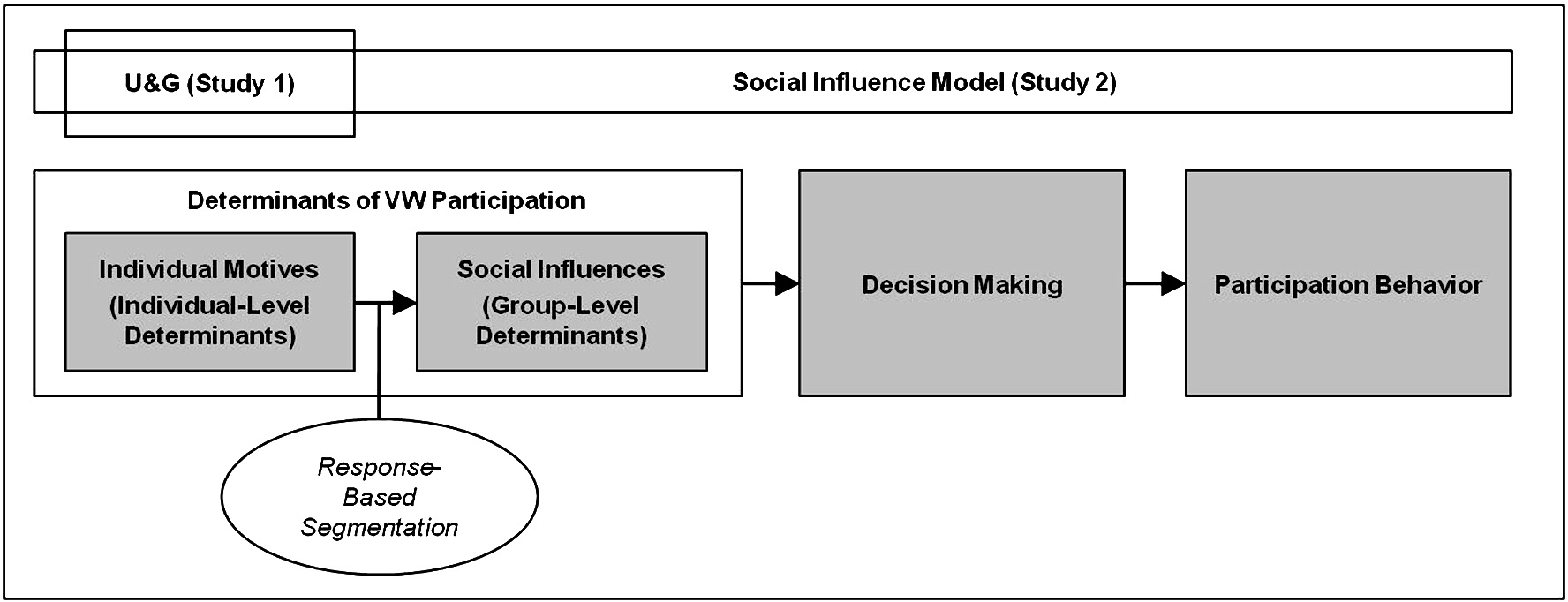
Conceptual framework.
Furthermore, as our formal definition indicates, a VW provides varied usage possibilities, and every member uses some but not necessarily all of them. For example, some users might be interested in visiting the VW only to establish and maintain relationships, but others might appreciate that its real-world-like characteristics allow them to build houses, buy clothes for their avatars, and so on. Hence, a VW might be populated with distinct user segments, each acting in response to different sets of motivations. To account for such heterogeneous motive structures, we adopt a response-based segmentation perspective in the second step of our analysis (Jedidi, Jagpal, and DeSarbo 1997) and identify latent segments of VW users with distinct individual-level usage motivations. This response-based segmentation is a key difference from previous applications of the SIM, which usually are constrained to homogeneous motive structures—a constraint that seems particularly unrealistic in Internet-based environments that offer widely varying usage opportunities such as VWs.
Finally, the setting of both of our studies is the VW of Second Life. Second Life provides a favorable study environment for several reasons: First, it is among the VWs with the fastest growing membership (Bélisle and Bodur 2010). Second, it is a general purpose VW without being targeted to any specific user segments of certain ages or demographics (Mennecke et al. 2008). And third, it offers a technologically advanced space to develop complex simulations resembling the real world and is already equipped with many real-world-like features (Parmentier and Rolland 2009). Since the fundamental objective underlying all VWs is to resemble the real world (Durlach et al. 2000; Turner and Turner 2006), they should – from a conceptual point of view – function in the same way; that is, as open environments where the user can act as freely as in the real world. This also means that, in reality, VWs predominantly differ with respect to the degree by which the underlying technological platform enables resemblance of the real world. Given Second Life's highly developed technological environment, it constitutes an adequate representation for all other VWs striving for the identical baseline objective (i.e., resembling the real world), particularly for those which are general purpose in nature and not focusing on any specific user segments.
Study 1: Individual Motivational Drivers of VW Participation
Uses and Gratification Approach
The U&G paradigm evolved in the communications theory literature to identify audience motivations for using different kinds of media (Katz, Blumler, and Gurevitch 1973). Instead of focusing on the effects of media content, the U&G perspective puts the audience at the center. With an “active audience” as its basic tenet, the U&G paradigm assumes that people are goal-oriented and actively seek and use media. Hence, the key objective of this approach is to explore the social and psychological needs that motivate people to use certain types of media and engage in particular media-usage behaviors for their need gratification.
Despite its general popularity within and outside communication research, the U&G approach has been criticized for several shortcomings. According to Littlejohn (1989), these shortcomings comprise three major groups: (1) Lack of a coherence and theory, (2) social and political objections, and (3) instrumental bias of uses and gratifications. For example, because it lacks a common theoretical basis, debate persists over whether the U&G approach is a full-fledged theory or merely a data collection strategy (e.g., Severin and Tankard 1997; Swanson 1979). Other criticisms relate to its general perspective, in that the U&G approach regards media solely as a means to serve audience needs, ignoring any negative effects of media on society or culture (Littlejohn 1989). However, perhaps the greatest concern is its active audience assumption; that is, the approach assumes that media consumption is selective and initiated by self-awareness of the individual's own needs and an expectation that those needs will be satisfied by particular types of media, rather than a situationally dictated incidental act (Lin 1996).
While the first two (groups of) shortcomings are rather general in nature, the restrictiveness of the active audience assumption is contingent on the study context. In particular, U&G portrays media consumption as primarily rational, excluding “mindless or ritualistic” (Littlejohn 1989, p 276) consumption patterns by definition. Hence, the active audience assumption has been regarded as fairly restrictive, particularly in the context of one-way passive (traditional) media settings (i.e., radio and early television media). In contrast, new media technologies, such as the Internet in general or VWs in particular, are considered to fit this active audience assumption better (Ruggiero 2000). It is because these technologies are designed for active use, with a reversed communication flow: The individual user controls the process by initiating media access (Stafford and Stafford 2001). For example, VW users log in and then make purposive choices about the applications to use inworld. Furthermore, the inherently interactive nature of online technologies, including e-mail or chat features, demands more activity by users than do traditional media (Chung and Kim 2008). Thus, in interactive media settings, users likely are particularly aware of the needs they are attempting to gratify through their media usage, which should motivate them to engage in specific behaviors more so than would traditional passive media contexts (Eighmey 1997). This makes the U&G approach particularly applicable in interactive (i.e., non-passive) media consumption settings. Notably, it has appeared recently in studies of Internet usage (Charney and Greenberg 2002; Ko, Cho, and Roberts 2005; Korgaonkar and Wolin 1999; LaRose, Mastro, and Eastin 2001; Leung 2001; Papacharissi and Rubin 2000; Perse and Ferguson 2000; Stafford, Stafford, and Schkade 2004), websites (Eighmey and McCord 1998; Stafford and Stafford 2001), online game adoption (Chang, Lee, and Kim 2006; Taylor 2003), online fantasy sports use (Farquhar and Meeds 2007), blog usage behavior (Chung and Kim 2008), and contributions to virtual communities (Ogan and Cagiltay 2006; Wang and Fesenmaier 2003). However, to the best of our knowledge, no empirical work specifically applies a U&G perspective to VW usage motivations. Relying exclusively on U&G studies that focus on general Internet usage or related web-based facilities is insufficient to account for the unique and complex features of VWs. To obtain a complete understanding of the motivations driving VW usage, we first derive an initial set of individual-level drivers from previous U&G studies dealing with related web-based facilities. We then undertake a formal U&G development process to validate this initial list as well as to augment it with drivers that specifically relate to the unique characteristics of VWs.
Previous U&G Findings
The identified drivers in this section are the result of a review of U&G literature dealing with consumer motivations for general Internet usage or usage of related web-based facilities such as virtual communities. We only identified motives as relevant that are in line with the general nature of a VW environment evaluated along the three central characteristics of our formal definition.
Previous studies have identified a “new” social dimension specific to the Internet that stems from opportunities for establishing and maintaining contact with other people in web-based communication venues, such as chat rooms or virtual communities. Thus several studies agree that many members join interactive communication venues to counteract boredom, meet like-minded others, and find companionship and social contacts (e.g., McKenna and Bargh 1999; Wellman and Gulia 1999). This form of user motivation is commonly referred to as social interaction. Since VWs clearly allow users to engage in several forms of social interaction, we expect social interaction to be a potential reason of VW usage.
Extant studies also recognize that Internet usage is related to entertainment motives. Entertainment is derived from the mere use of the medium itself (including all its features) such as by taking advantage of the pleasure of browsing the Web or playing games (e.g., LaRose, Mastro, and Eastin 2001; Leung 2001; Perse and Ferguson 2000; Stafford and Stafford 2001). Since VWs offer many opportunities to perform tasks that may generate some form of excitement and pleasure, entertainment may also constitute a reason for participants to join a VW.
Finally, previous U&G studies pertaining to virtual communities and general Internet usage also reveal an escape-like motive, such that people strive to live a life beyond their real life; this need can be attributed to different intentions, whether to completely replace an existing life, to live out fantasies, or merely to gain acceptance and approval and enhance social status within the community (e.g., Grace-Farfaglia et al. 2006; Leung 2001; Lin 2002). In this way, the escape motive also accounts for aspects of social enhancement which relates to the value that people derive from gaining recognition and approval of others while interacting with them, and the enhancement of their social status within their community on account of their performed activities (Baumeister 1998). For example, several studies show that many people engage in virtual communities to answer questions from other users, mainly for recognition by peers (e.g., Dholakia, Bagozzi, and Klein Pearo 2004; Hars and Ou 2002). In general, escape might be an important motivation for VW participation because VWs are designed to resemble the real world and thus they provide an excellent means to fulfill escape-related needs.
Thus, based on the findings from previous U&G studies, these three key motivations can be expected to be relevant in the context of VWs. However, to align these rather general drivers to the unique characteristics of VWs, and to identify possible further drivers, we additionally engaged in a U&G development process.
U&G Development Process
Following the standard U&G development process, we generated an initial list of descriptive terms to serve as a sample of possible motivations for VW usage. Specifically, we formulated four open-ended questions using word association probes to elicit such a list (Stafford, Stafford, and Schkade 2004; Szalay and Deese 1978):
What is the first thing that comes to your mind when you think about what you enjoy most when using this VW? What other words describe what you enjoy about interacting in this VW? Using single, easy-to-understand terms, what do you use this VW for? What activities in this VW are most important to you?
We hired seven users of Second Life to promote the questionnaire by visiting a variety of inworld locations, where they communicated with people at random and encouraged them to visit the survey website. Promoters were specifically instructed not to recruit friends or any other known users to avoid a structural sampling bias. To ensure a broad cross-section of VW users, promoters had to visit a list of thematically different VW hotspots to promote the survey. As an incentive, respondents received $10 in virtual currency (VW$) for their participation (equal to approximately US$0.04). Promoters received the same amount for each new recommendation. The survey appeared in English-, French-, German-, and Spanish-language VW forums. During the one-week period that the questionnaire was online, 229 respondents completed the survey. Plausibility checks (e.g., deletion of meaningless entries) reduced the sample to 213 respondents, who provided 1581 individual entries.
Subsequent to the data collection, we used an iterative data aggregation procedure to categorize the descriptive terms (Bitner, Booms, and Tetreault 1990; Stafford, Stafford, and Schkade 2004). This analytic induction process requires careful readings and sorting of the entries into groups and categories, according to similarities in the reported uses and gratifications. We set aside a holdout sample of 10% of the provided entries. With the remaining (calibration) sample, we grouped similar entries in terms of content under unifying labels (e.g., find interesting places, have fun, design my avatar, textures). Two trained judges, working independently, read, sorted, reread, and recombined the entries until they reached the consensus opinion that all entries within a group were more similar to each other than to those in any other group (Bitner, Booms, and Tetreault 1990). Together the judges articulated the exact nature of the similarity, which they used as the basis for labeling each group (subcategories). Next, subcategories related to similar aspects were combined into main categories, retaining their unique labels (Stafford, Stafford, and Schkade 2004). The two judges again were required to reach consensus. We ultimately selected all main categories that had been mentioned at least 25 times. Overall, the process identified 11 main categories and 40 subcategories with a total of 1198 descriptive terms (75.7% of the originally provided entries). The detailed coding results are available on request.
To assess the quality of this classification scheme and the resulting judgment-based data, a third judge who had not participated in the initial categorization task coded all entries in the calibration sample, according to the 11 categories and 40 subcategories. Using this judge's assignments, we calculated interjudge reliability scores (Kassarjian 1977), which revealed a coefficient of agreement equal to 96.8% (Bettman and Park 1980) and Perreault and Leigh's (1989) index of reliability equal to .982, both of which confirm the high interjudge reliability. Finally, the judges reviewed the holdout sample to ensure it did not contain information not already in the coding scheme. No new information emerged, so the derived (sub-)categories appear sufficient to cover all relevant dimensions of VW uses and gratifications.
Derivation of Underlying Motivational Factors
To identify motivational drivers of VW usage, we adopted the subcategories identified from the first stage of the U&G development process as items in a second-stage questionnaire designed to measure specific gratifications associated with a VW (e.g., “I use virtual worlds to create objects I cannot create in real life”). Respondents indicated their agreement with the 40 items on a seven-point rating scale ranging from 1 = “I strongly disagree” to 7 = “I strongly agree” (Stafford, Stafford, and Schkade 2004). This data collection again occurred online, over a one-week period, publicized by five promoters within Second Life. They received the same instructions as the promoters in the prestudy. This main questionnaire appeared again in English, French, German, and Spanish VW forums. As an incentive, we rewarded participation with VW$100 (US$0.38), and promoters received VW$25 (US$0.09) for each participant they had acquired. 1
In Second Life, users could buy a t-shirt for their avatar for around VW$100.
During the one-week study period, 615 VW users completed the survey. Because the survey featured compulsory questions, there were no missing data. The respondents, whose ages ranged from 18 to 87 years (average 32.8 years), included 50.6% women and 49.4% men. According to official user statistics provided by the operator of Second Life (Second Life Virtual Economy Key Metrics) 2 the average age of active users in the corresponding year of our survey was 33.0 years; as in line with our sample. Unfortunately, official gender information was not available in a standard raw format. Hence, to obtain a second-best benchmark we referred to the few empirical studies on VWs that also used Second Life for data collection and provided standard demographic information for their samples. The only study meeting these criteria was Bélisle and Bodur (2010) with a reported proportion of 56.3% female participants. Given their small sample size of 75 respondents, this number can still be considered comparable to the gender distribution in our sample. Hence, in terms of the available statistics we did not observe any major differences between the sample characteristics and “typical” members in Second Life.
Exploratory Factor Analysis
After data collection, we randomly split the sample into calibration and validation samples (ncalibration = 307, nvalidation = 308; MacCallum et al. 1994). Using the calibration sample, we performed a common factor analysis to identify the underlying motivational drivers of VW usage. With the common factor analysis, we could identify the latent, unobservable concepts that explain common variance in the indicator variables. To simplify the factor structure, create more meaningful factors, and ease factor interpretation, we also obliquely rotated the factor matrix and only retained variables with factor loadings greater than or equal to .5 (Bagozzi and Yi 1988). Further, variables with communalities less than .5 were deleted from the analysis (Hair et al. 2009). To determine the number of factors to extract, we applied the latent root criterion. Thus, we only retained factors with eigenvalues greater than 1. The latent root criterion for establishing a cutoff is particularly reliable when the number of variables is between 20 and 50 (Hair et al. 2009); which was the case in our study. The iterative procedure revealed a three-factor solution, in which the factors accounted for 78.1% of the variance. Table 1 depicts the rotated loading matrix for the three factors with items loading at .5 or greater highlighted in bold.
Three-factor solution of motives for virtual world usage.
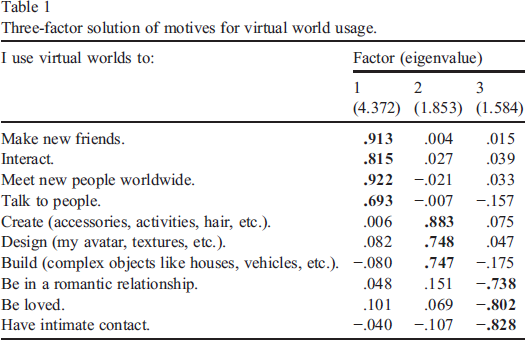
The derived solution reveals that the first factor comprises the four items “make new friends,” “interact,” “meet new people worldwide,” and “talk to people.” The items clearly relate to the social dimension of VWs and reveal that meeting (new) people and making friends is a key motivation for using VWs. We labeled this factor “socializing”. Actually, the presence of many people from all over the world provides ample opportunities to find new friends. Moreover, its unique technological features means a VW provides new socializing opportunities in the Internet-mediated environment. The second factor consists of three indicators: “create (accessories, activities, etc.),” “design (my avatar, textures, etc.),” and “build (objects like houses, vehicles, etc.).” This motivational driver, named “creativity,” reflects the capacity in VWs to create virtual objects. VW residents appear to acknowledge such opportunities of giving their creativity full scope. Finally, the third factor, which can be referred to as “love,” also entails the social dimension of VWs; however, it focuses more on intimate and romantic relationships between people, as described by the corresponding indicators: “be in a romantic relationship,” “be loved,” and “have intimate contact.” Indeed, the multitude of users in VWs, combined with the possibilities of real-time activities, provides people with far more opportunities than what traditional dating websites can offer (e.g., 3D virtual dates).
Confirmatory Factor Analysis
Using the remaining 308 data points in the validation sample, we subjected the three constructs and their indicators to validation by confirmatory factor analysis (CFA). The model attained good fit (χβ(32) = 55.51, p < .01; confirmatory fit index [CFI] = .98; root mean squared error of approximation [RMSEA] = .05; square root mean residual [SRMR] = .04). To assess the quality of the identified factors, we examined the individual item reliability, composite reliability, and average variance extracted (AVE, Gerbing and Anderson 1988). The individual item reliabilities were adequate, ranging between .55 and .85. At the construct level, the analysis of composite reliability (Fornell and Larcker 1981) revealed the constructs’ excellent internal consistency. The reliability values exceeded Bagozzi and Yi's (1988) suggested threshold of .6 (.91 for the first factor, .84 for the second, and .83 for the third factor). The AVE reached values of .71, .63, and .62 for the three identified factors, beyond the threshold of .5 recommended by Bagozzi and Yi (1988). To assess discriminant validity, we also investigated whether the AVE of the factors was greater than their shared variance (Fornell and Larcker 1981). This condition was satisfied for all three factors. Therefore, the three factors fulfilled the conditions of discriminant validity and internal consistency. Overall, the CFA supported the exploratory results.
Individual-level Motivations
With these three key motivations of VW usage, we finally evaluated the degree to which they match the motivational drivers deducted from previous U&G studies. This step allowed us to consolidate the findings and to derive a final list of individual-level motivations of VW usage.
Both socializing and love refer to the social benefits derived from establishing and maintaining contact with other VW users. This directly links them with the social interaction motive from previous U&G findings. However, while socializing-related motives focus on general social interactions, love emphasizes the social benefits of intimate relationships. In this way, they represent distinct dimensions of the rather general motive social interaction (Korgaonkar and Wolin 1999; Ogan and Cagiltay 2006)—a distinction which might be important in the prevailing context and would have been hidden had we not engaged in the U&G development process that specifically accounted for the particularities of VWs. The same argument applies to the creativity motive. Creativity can be regarded as a dimension of the entertainment motive. Whereas entertainment is a general, overarching category that comprises several aspects, creativity directly relates to the specifics of VWs. Apparently, the main source of entertainment in VWs, beyond interacting with others, is engagement in creative tasks.
Building on these findings, our initial list of motivations was adapted in the following way (see Table 2): First, social interaction was split up into socializing and love. Second, entertainment was replaced with the more specific creativity motive. Only escape was retained from the initial list, even though it did not surface in the U&G development process. This might have different reasons. Perhaps the participants applied impression management tactics (Bolino et al. 2008; Goffman 1959). Even if escape is a valid motive, admitting it is tantamount to admitting personal shortcomings and failures. Another reason might be the active audience assumption of the U&G approach requiring respondents to have enough self-awareness to know and articulate their reasons for using certain media; otherwise some motivations remain undetected. This may have happened with escape in the prevailing context, since escape is a rather abstract motive, and in contrast to socializing, creativity and love, it is not connected to specific tasks and thus harder to articulate. Considering these issues, escape was retained as a fourth motivational driver, indicated by the items “escape from the real world,” “live a better life than my real life,” and “live out my fantasies” (Grace-Farfaglia et al. 2006).
Individual-level motivations of VW usage.
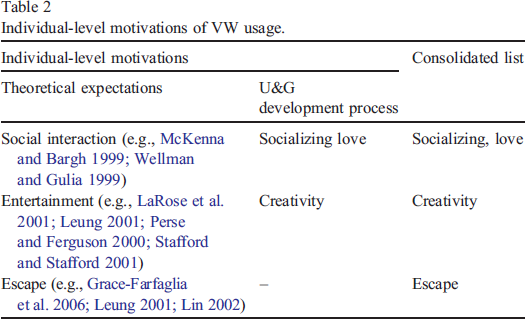
Overall, the consolidation procedure generated the following four individual-level motivations: Socializing, love, creativity, and escape. These drivers provide a useful and valid starting point for conducting a thorough analysis of VW participation behavior, as we do in Study 2.
Study 2: Participation Behavior in Virtual Worlds
As we have noted, participation behavior in virtual venues that enable some form of social interaction (like a VW), is driven by both individual- and group-level (social) determinants. The decision to participate usually occurs not in isolation but rather collaboratively or with an aim to fit in with other members (Bagozzi 2007). This notion is strongly tied to social identity theory (SIT) claiming that group identities can be fundamental to a person's self-concept (Tajfel and Turner 1979). Indeed, there is a great deal of evidence that people have a fundamental need to belong to social groups (Hornsey and Jetten 2004) and that a sense of belongingness with others impacts human behavior (Baumeister and Leary 1995). Moreover, communication research has shown that social influence of this kind is prevailing even in Internet-mediated environments, despite the lack of direct physical contact (Postmes, Spears, and Lea 1998). Since individual-level and group-level determinants are interrelated in their influence on participation behavior (Hogg and Abrams 1988), there is a need to integrate the individual reasons from Study 1 with social reasons for member participation in a VW.
This perspective, as we have noted previously, is consistent with the SIM. As proposed by Dholakia, Bagozzi, and Klein Pearo (2004) and in accordance with SIT (Hogg and Abrams 1988; Tajfel and Turner 1979) and the model of goal-directed behavior (Perugini and Bagozzi 2001), the SIM postulates that decision variables (i.e., desires, we-intentions) directly influence participation behavior and are a function of individual motivational drivers and social influences. We illustrate the interrelationships we anticipate among the various components of the SIM and their effects on participation behavior, as adapted to the setting of VWs, in Fig. 2.
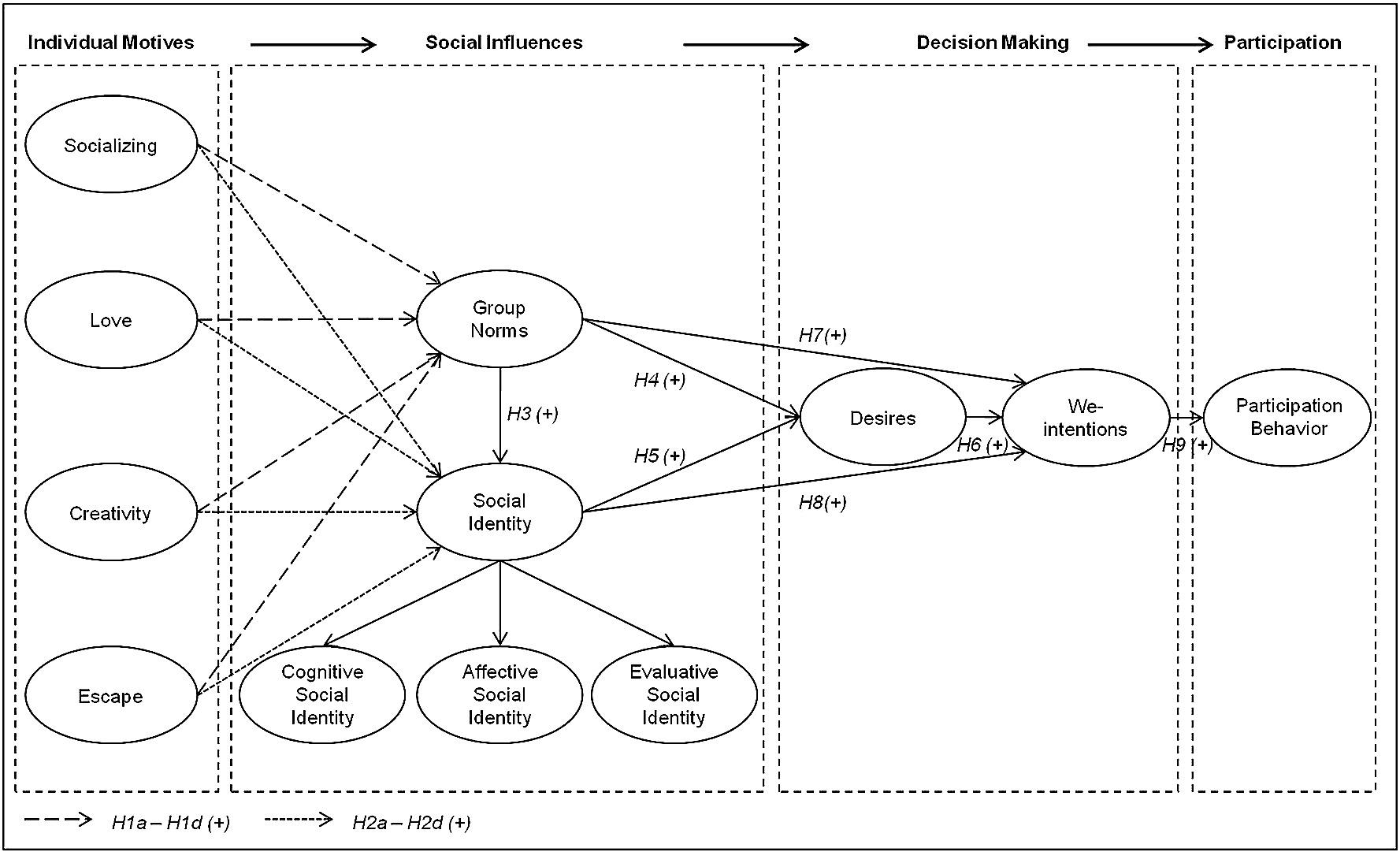
Social influence model of virtual world participation with hypothesized paths.
Hypotheses Development
Social Influence Variables
VWs assemble people who share common interests. According to the SIM, such group-forming processes generally are guided by two forms of social influence: Group norms and social identity. Group norms describe a member's understanding of and commitment to a set of values, goals, beliefs, and conventions shared by other members of the group (Dholakia, Bagozzi, and Klein Pearo 2004). These norms are formed and become known to members primarily through interaction, often inferred from text-based communication. However, as already explained above, interaction in VWs is not limited to exchanging textual messages; members can also express verbal and nonverbal utterances through their avatars, such as yawning and smiling (Bailenson and Yee 2005). Thus users should be able to both engage in the formation of group norms and learn respectively discover group norms prevalent in a VW more easily.
After a user finds that his or her values and goals match those of other members in the VW, internalization occurs, and the individual member begins to commit to the values of the group. In general, since members should volitionally accept group norms as aligned with their individual motivations (Postmes, Spears, and Lea 2000), group norms should form only if the individual user is able to find other members who join the VW for similar motivations. This point seems particularly pertinent for individual motivations that are group-referent, such as motivations that emphasize the benefits of social interactions among group members (Dholakia, Bagozzi, and Klein Pearo 2004). In our study context, the socializing and love motivations are clearly group-referent because their primary benefits arise from social interactions with other members (e.g., make new friends, interact, talk to people, be in a romantic relationship). Users with stronger socializing and love motives therefore should be interested in joining social groups in the VW and form stronger group norms. We therefore predict:
With regard to the escape motive, our conceptualization reveals a rather broad construct that refers to the very complex issue of living a (virtual) life. Living a life, whether in the real world or a VW, always includes social interactions, so we expect users with strong escape motivations to strive for social benefits arising from interactions with other VW members. Escape thus is another group-referent motive, and we similarly hypothesize:
Finally, the creativity motive seems, at first glance, less group-referent than the other motives because its underlying needs clearly entail non-social (but rather technical) issues, such as furnishing a virtual apartment or designing clothes. However, to the extent that members with a creativity motive are interested in discussing and presenting their created objects to other members in the VW, it may be group-referent as well, especially if these users strive for a form of social enhancement (Baumeister 1998), gained when created objects are complemented and approved by other members. Indeed, the entertainment motive, which closely corresponds to the creativity motive, has been found to have a group-referent basis (Dholakia, Bagozzi, and Klein Pearo 2004). Therefore, we also hypothesize that
The second social influence variable in the SIM, social identity, refers to a psychological state in which people acquire a social identity (as part of their self-concept) through a group when they perceive group membership (Reed 2002; Terry, Hogg, and White 1999). In a cognitive sense, it appears that people divide their social world(s) into groups, categorize these groups, and then try to establish self-esteem by making favorable comparisons of their ingroup(s) with outgroups—a process typical of all humans. Three psychological constructs frame an individual's social identity: (1) Self-awareness of membership (cognitive component), (2) appraisal of belonging to the group (evaluative component), and (3) an affective commitment in the form of emotional involvement (affective component).
In general, people identify with a group (i.e., build a social identity) when they anticipate significant benefits from their membership (Hogg and Abrams 1988). Those benefits link primarily to the perceived functionality of the group, such that people identify with groups to the extent that those groups fulfill each person's needs (Hogg and Abrams 1988). In our study context, such needs correspond to the individual-level motivations for people to use VWs, as we identified in Study 1. A user who is primarily interested in establishing and maintaining contact with other people (socializing motive) thus will identify with a VW only if that VW provides an adequate platform (social and technical) to fulfill that need. In turn, we argue that for a given level of need fulfillment by the VW, social identification with the VW relates positively to the strength of the user's socializing motive. This argument also can be transferred directly to the remaining individual-level motivations, and we hypothesize:
In addition, these social influence variables are not independent. Investing time to understand the behavioral code of a group affects self-awareness of group membership and its value. The acceptance of group norms therefore helps members to identify with the group(s) they feel part of. Hogg and Abrams (1988) note that a well-defined group structure is a result of the cooperative interdependence of group members, based on their shared goals and norms (i.e., group norms), which in turn leads to positive identification with the group (i.e., social identity). Hence, we expect:
If group norms thus mediate the effects of the individual-level motivations on social identity, the motivational drivers should determine social identity in two ways: Directly and through their impact on shared goals and norms among group members.
Decisional Variables
Neither the individual- nor the group-level variables directly determine participation behavior because both categories depict only reasons for acting, without providing the motivational content needed to stimulate an intention to act (Bagozzi and Dholakia 2002). Therefore the transformation of reasons into intentions requires felt desires to engage in the activities (Bagozzi 1992; Dholakia, Bagozzi, and Klein Pearo 2004). In other words, desires combine individual and social reasons for acting into an overall motivation to act. According to the SIM, desires to participate are directly preceded by the social influence variables, which themselves are functions of the individual-level motivations. Next, the underlying mechanisms by which group norms and social identity advance an individual's desires for participation in a VW will be explained (for more detail, see Dholakia, Bagozzi, and Klein Pearo 2004).
By capturing the prevailing values, goals, beliefs, and conventions of the VW, group norms implicitly create mutual agreements among members about ways to behave in the VW, particularly with regard to when and how to engage in social interactions. In this sense, highly developed group norms not only provide members with the potential to decide to engage in specific VW activities, but they also lead to a desire to do so (Dholakia, Bagozzi, and Klein Pearo 2004). We hypothesize:
Because people strive to maintain a positive self-defining relationship with other in-group members, they also should be motivated to engage in behaviors designed to accomplish this goal (Hogg and Abrams 1988). In VWs, maintaining the group relationship, and thus a distinct social identity, requires active participation in social interactions. Therefore, we hypothesize:
The attractiveness of VWs for an individual member derives from the shared usage of artificial environments and social interactions with other members; thus the referent of any activities is not the individual user but rather all members in the VW. Hence, a user should regard him- or herself as a member of a group and form participation intentions in relation to this plural target (Bagozzi and Dholakia 2002). To account for such group-related intentions, the SIM features a “we-intentions” construct that mediates between desires to participate and individual participation behavior. A we-intention refers specifically to the “commitment of an individual to participate in joint action and involve an implicit or explicit agreement between the participants to engage in that joint action” (Tuomela 1995, p 2). We-intentions to participate in a VW might form in two ways: Effortful and habitual (Dholakia, Bagozzi, and Klein Pearo 2004). On the one hand, we-intentions require individual commitment to performing and furthering the joint group action (Tuomela 1995), and such individual commitment is bundled in the desires construct, so we hypothesize:
On the other hand, group members develop participation routines over time in the VW. Thus for many participation episodes, behavior may be habitual rather than effortful. Then group norms and social identity should influence we-intentions directly, rather than indirectly through desires:
These hypotheses are based on the work of Dholakia, Bagozzi, and Klein Pearo (2004) and adapted to VWs.
Finally, we define user participation behavior as the intention to return to the VW in general. The level of we-intentions should have a direct effect on subsequent participation behavior because strong we-intentions facilitate the engagement in activities that serve to satisfy needs shared by the members of distinct groups. This argument is also in line with standard attitude-theoretic concepts (such as the theory of planned behavior; see, for instance, Ajzen 1991; Eagly and Chaiken 1993). Thus:
Study Design and Empirical Results
Sample Characteristics
Data collection took place through viral networking in Second Life. Residents received virtual currency equivalent to US$0.65 for participating and US$0.10 for promoting the questionnaire to other residents (VW$150 and VW$25, respectively). In total, 500 VW users completed the survey, and the compulsory questions allowed for no missing data for the relevant covariates. However, we acknowledge some missing data related to demographic measures (at most, two missing answers per variable). Of the total sample, 265 (53.1%) were women, and 234 (46.9%) were men. The youngest respondent was 14 years of age and the eldest was 65 years, with a mean age of 31.3 years and a standard deviation of 9.99 years. Again, drawing on the available benchmark statistics for age (mean age = 33.0; Second Life Virtual Economy Key Metrics) and gender (56.3% female participants; Bélisle and Bodur 2010), as documented for Study 1, we could not find any major differences between the sample characteristics and “typical” participants of Second Life.
Measures
To measure individual motivational drivers, we used the measurement scales from Study 1. For the social influence and decisional constructs (social identity, group norms, desires, we-intentions), we employed items proposed by Dholakia, Bagozzi, and Klein Pearo (2004). Social identity is treated as a second-order construct composed of an affective, cognitive, and evaluative component (see Fig. 2). To measure participation behavior, we used three items: “I plan to participate in this virtual world in the future (next three months),” “I intend to use this virtual world in the future (next three months),” and “In the future I will return to this virtual world (next three months)” (Davis 1989; Lin 2006). All measures are available on request.
We ran CFAs to assess the quality of the measurement model. We also evaluated the internal consistency of the constructs using composite reliability (ρ ε ; Bagozzi and Yi 1988; Fornell and Larcker 1981) and AVE. The values for ρ ε ranged between .77 and .99, and the AVE reached values between .51 and .88. Thus, all ρ ε and AVE values passed the stipulated thresholds (ρ ε > .6, AVE > .5; Bagozzi and Yi 1988; Boomsma 2000; Fornell and Larcker 1981).
To test for discriminant validity, we initially ran a CFA with 12 latent constructs and a total of 29 indicators. The model fit the data well (χ 2 (338) = 565.22, p ≈ .00, CFI = .97, Tucker–Lewis index [TLI] = .97, RMSEA = .04, SRMR = .03); in Table 3, we reveal the ϕ-matrix of latent constructs for the full sample. This test also determined whether the correlations among the latent constructs were significantly less than 1 (ϕ-value ± 2 standard errors; Bagozzi and Yi 1988). Because none of the confidence intervals included 1, this test provides evidence of discriminant validity. In addition, we tested whether the AVE for each construct was greater than its shared variance with other constructs (Fornell and Larcker 1981). The data fulfilled this second requirement for all constructs.
φ-matrix of latent constructs for full sample (N = 500).
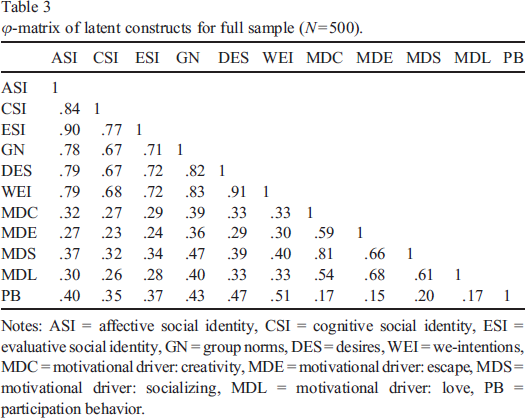
Notes: ASI = affective social identity, CSI = cognitive social identity, ESI = evaluative social identity, GN = group norms, DES = desires, WEI = we-intentions, MDC = motivational driver: creativity, MDE = motivational driver: escape, MDS = motivational driver: socializing, MDL = motivational driver: love, PB = participation behavior.
Because the data came from a single (survey) source, we finally assessed the potential effects of common method variance on our results. We followed the well-established procedure proposed by Widaman (1985) that has been used in a number of studies to partial out method effects (Podsakoff et al. 2003). In particular, we compared the measurement model used in this study (12 constructs and 29 indicators) with an extended version that additionally includes a first-order (method) factor with all of the 29 items as indicators. In general, the existence of a method factor can be determined by examining the improvement in model fit caused by the added method factor (Williams, Buckley, and Cote 1989). The CFA fit statistics for the extended model revealed a good model fit (χ 2 (309) = 472.91, p ≈ .00, CFI = .98, TLI = .98, RMSEA = .03, SRMR = .03). Although the comparison of the two models resulted in a significant chi-square difference (p < .01; with Satorra and Bentler (2001) correction), 3 the incremental fit index (i.e., improvement in normed fit index; Bentler and Bonett 1988) yielded a value of .0046 indicating a negligibly small model improvement (Elangovan and Xie 1999; Williams, Buckley, and Cote 1989). Furthermore, the factor loadings of the 29 indicators on the theoretical constructs remained unchanged after including the method factor. This finding, along with small model improvement, let us conclude that any relationships observed in the study represent substantive rather than artificial effects (Carlson and Kacmar 2000; Elangovan and Xie 1999).
Since we used Mplus's MLR estimator, the chi-square statistics needed to be adjusted by the recommended scaling correction (Satorra and Bentler 2001).
Hypotheses Tests
Structural equation modeling served to test the hypothesized paths in the underlying SIM (see Fig. 2). Because we have reason to assume that our data set is exposed to patterns of unobserved heterogeneity with respect to respondents’ motivations to use a VW, estimating a standard SEM for the complete data set would likely produce misleading results (Jedidi, Jagpal, and DeSarbo 1997). In particular, as our formal definition explicates, a VW provides varied usage possibilities and every member uses some but not necessarily all of those possibilities. Yet distinct user segments could act in response to different sets of motivations.
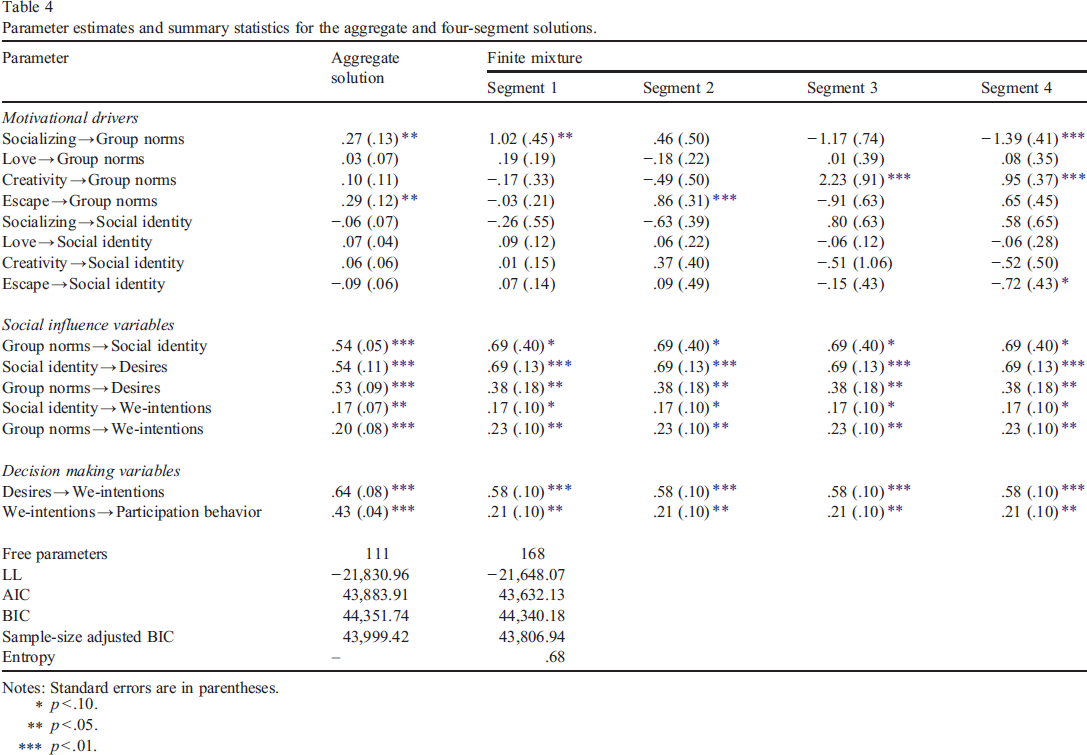
To account for potential unobserved heterogeneity in our data set we estimated several finite mixture structural equation models (Dolan and van der Maas 1998; Jedidi, Jagpal, and DeSarbo 1997), varying the number of segments and allowing for different structural parameters across segments. In particular, we allowed the means and path coefficients of all motivational drivers and the intercepts of group norms and of social identity to vary across segments. All other parameters were held constant across segments because they are not subject to any a priori heterogeneity expectations. We also tested for measurement invariance by comparing two competing finite mixture models for each considered segment solution: One in which the measurement model was restricted to equality and one that allowed the measurement model to vary across segments (see, for instance, Jedidi, Jagpal, and DeSarbo 1997). To reduce the common problem of local optima, we estimated each model 20 times using different random starting values. Finally, the standard model selection criteria for finite mixture models (Muthén and Muthén 2007) pointed to the four-segment solution in which the measurement model is invariant across groups. Increasing the number of segments from one to four decreased the model selection criteria from 43,883.91 to 43,632.13 (Akaike information criterion [AIC]), from 44,351.74 to 44,340.18 (Bayesian information criterion [BIC]), and from 43,999.42 to 43,806.94 (sample-size adjusted BIC). Increasing the number to five segments did not result in further model improvements in terms of BIC and sample-size adjusted BIC (AIC = 43,616.69, BIC = 44,404.82, sample-size adjusted BIC = 43,811.27). Finally, an entropy-based measure based on posterior probabilities for the four-segment model (Muthén and Muthén 2007) revealed a value of .68. This measure quantifies the degree to which the model can separate the various segments and ranges between 0 and 1, such that a value closer to 0 indicates greater difficulty classifying the observations into distinct groups. The entropy values of comparable finite mixture applications indicate that this determined value is within an acceptable range (e.g., Jedidi, Jagpal, and DeSarbo 1997). At this stage, we can already conclude that our data set is subject to unobserved heterogeneity and that the four-segment model adequately represents the underlying data structure.
The estimated structural parameters for the four latent classes are depicted in Panel 2 of Table 4. Note that only the parameter estimates for the effects of the motivational drivers on group norms and social identity are segment-specific. The remaining parameters were held equal across segments.
Parameter estimates and summary statistics for the aggregate and four-segment solutions.
Notes: Standard errors are in parentheses.
p < .10.
p < .05.
p < .01.
In contrast with the aggregate model (see Panel 1 of Table 4), which indicated a simultaneous, moderate impact of two motivational drivers, the finite mixture results reveal segment-specific effects of motivational drivers across the four latent classes. In particular, segment 1 indicates a significantly positive effect of only the socializing motivational driver on group norms (γ = 1.02, SE = .45). In contrast, in segment 2, the escape motive is the sole significant impact on group norms (γ = .86, SE = .31). Segments 3 and 4 both reveal significant (positive) effects of creativity on group norms (γ = 2.23, SE = .91; γ = .95, SE = .37, respectively). However, whereas this effect is exclusive in segment 3, segment 4 also exhibits a negative impact of socializing on group norms and of escape on social identity. The love motivational driver plays a minor role, such that the results indicate no significant effects for any segments. Thus we confirm H1a, H1c, and H1d, but not H1b.
With the exception of segment 4, each user segment is driven by a single, distinct, individual-level motive. Segment 1 includes respondents who use the VW only for socializing (e.g., making new friends, interacting, communicating). We call them “socializers.” In segment 2 though, users participate in the VW predominantly to escape from the real world and live another (virtual) life, beyond their real life; we call them “refugees.” The segment 3 users express an exclusive intention to use the VW for creativity reasons (e.g., designing their avatar, designing fashion, building houses and vehicles, creating skins) and constitute the group we refer to as “creativity seekers.” Finally, the mixed results for segment 4 suggest that it includes any respondents who do not fit into the previous three segments, a notion further supported by the small segment size (15% of the sample; see also Table 5). In a technical sense, it represents a catch-all for users with distinct, less common motive structures, whom we label “specialists.”
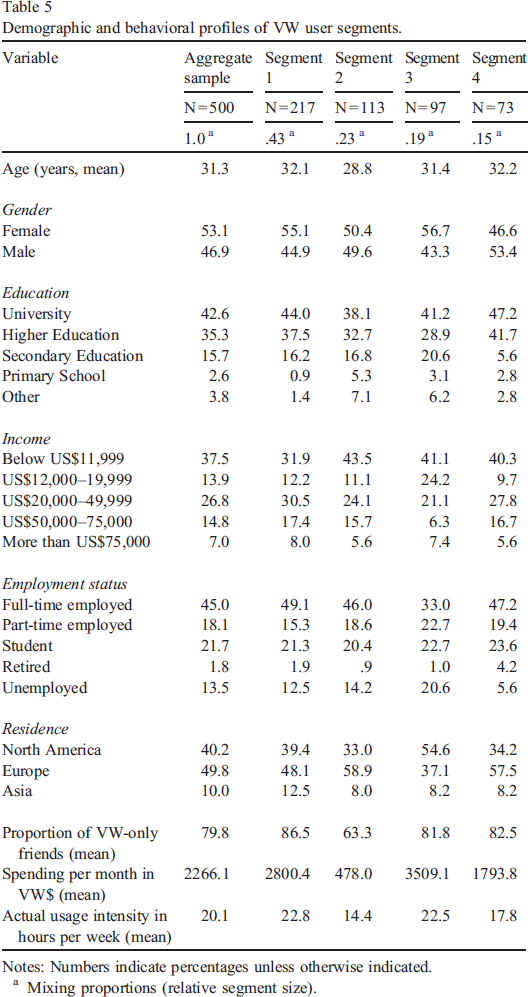
Demographic and behavioral profiles of VW user segments.
Notes: Numbers indicate percentages unless otherwise indicated.
Mixing proportions (relative segment size).
Regarding the postulated direct effects of the motivational drivers on social identity, we find no significant effects and must reject H2a–d. The positive association between group norms and social identity (β = .69, SE = .40) is in line with H3. Hence social identity is affected only indirectly by individual usage motivations.
In examining the associations between social influence variables (group norms and social identity) and their consequences, we find that group norms positively influence desires (β = .38, SE = .18) and we-intentions (β = .23, SE = .10), in support of H4 and H7. In line with H5 and H8, the model shows a significantly positive influence of social identity on both desires (β = .69, SE = .13) and we-intentions (β = .17, SE = .10). Finally, desires relate positively to we-intentions (β = .58, SE = .10), and we-intentions in turn positively influence participation behavior (β = .21, SE = .10), in support of H6 and H9.
Profiling User Segments
After having identified the key motivational drivers for the four segments, we used posterior probabilities from the finite mixture model to classify respondents into the segments and to describe the segments based on key demographic and behavioral characteristics (Bhatnagar and Ghose 2004; Dillon and Mukherjee 2006). The demographic variables we used include age, gender, education, income, occupation, and residence; the behavioral variables are proportion of VW-only friends, spending per month in the VW (in community currency), and actual usage intensity (in h/week). The resulting profiles are summarized in Table 5.
Segment 1 (socializers) is the largest class, corresponding to 43% of the sample. In line with their focus on seeking social interactions, they have a relatively high proportion of VW-only friends (86.5%, versus 79.8% at aggregate level). Users in this segment also exhibit above-average spending behavior (VW$2800.4 versus VW$2266.1 aggregate).
The segment 2 refugees group is the second largest, with 23% of the sample. Users of this segment earn less than socializers, perhaps partly because of their below-average education levels. Somehow counterintuitively, despite their desire to escape from the real world and live a new or different life in the VW, their spending behavior is very low—the lowest among all user segments (VW$478 versus VW$2266.1). Their usage intensity also is significantly lower than that for the other user segments (14.4 versus 20.1 h/week).
Segment 3 (creativity seekers) consists of 19% of the sample. Unlike the previous segments, creativity seekers are employed only part-time or are unemployed. Despite their low income levels, creativity seekers spend the most of all user segments (VW$3509.1), which is likely a direct consequence of their underlying motive, in that being creative in a VW (e.g., designing an avatar, building a house) requires the user to buy virtual material objects.
Finally, the specialists in segment 4 represent the smallest group (15% of the sample). In line with their moderate desire to engage in creative tasks, their spending behavior is lower than that of creativity seekers (VW$1793.8 versus VW$3509.1).
Discussion
The consecutive studies we have presented provide insights into (1) which motivational drivers play a role in VW usage and (2) how these drivers exert influence on participation behavior. Our results reveal that motivation to engage in a VW can be traced back to three individual-level user motivations: Socializing, creativity, and escape. Socializing motivations are primarily concerned with establishing and maintaining personal relationships with other members in the VW, whereas creativity motivations center on the technical benefits arising from the various possibilities to create virtual objects in a VW. Finally, escape motivations describe the motivational tendency to use the VW as a virtual supplement or alternative to real life. Overall, these identified user motivations imply that a VW attracts users not only for social reasons, as in the case of other virtual venues (e.g., virtual communities), but also for creativity reasons.
In addition, a user's motivation to engage in a VW is often one-dimensional; that is, the decision to participate can be attributed exclusively to one motivational driver. By building on a finite mixture approach to account for heterogeneous motive structures among respondents, we identified four latent user segments: Socializers, refugees, creativity seekers, and specialists. The first three segments are driven exclusively by the socializing, escape, and creativity motive, respectively. Only the specialists (the smallest segment) are influenced by multiple motives. Thus, user motivations for VWs can be regarded as mainly mutually exclusive, such that users usually join a VW for one reason only.
From an academic perspective, this finding provides strong evidence of the general need to account for unobserved heterogeneity when analyzing VW user behavior (Bauer and Curran 2004; Dolan and van der Maas 1998; Henson, Reise, and Kim 2007; Jedidi, Jagpal, and DeSarbo 1997; Tueller and Lube 2010). In Table 4 we provide the estimated path coefficients for the aggregate and segment-specific models; the aggregate solution clearly appears biased by indicating a simultaneous effect of only two motivational drivers. The creativity motive remained completely undetected in this model, and the other two motives’ influences were underestimated, according to their moderately sized coefficient estimates. To the extent researchers use a SIM in a context in which users have different kinds of usage opportunities, it seems necessary to adopt a response-based segmentation perspective for the model estimation. Otherwise, a SIM is likely to produce misleading results, in that it is constrained a priori by the assumption that participation behavior always is driven by the same motivational set. We not only add to existing SIM applications by adapting the model to the new context of VWs, but we also indicate the general need to account for unobserved heterogeneity when studying the effects of context-specific, individual-level antecedents within a SIM framework.
Managerial Implications
To discuss the managerial implications, it makes sense to delineate two perspectives: Operators of VWs and participating firms. Operators of VWs are usually interested in generating as much participation as possible, so they should design a world that attracts members of all user segments, taking into account all three individual motivations: Socializing, creativity, and escape. To address socializing usage motivations, the VW might offer innovative communication means, such as motion tracking that records the real movement of the user and translates it into movement by the avatar (Greenemeier 2009). To attract the creativity segment, operators should offer applications that allow for the construction of virtual objects or pose technical challenges that demand innovative solutions. Finally, the VW features should enable escape-oriented users to live an alternative form of real life, such that the design is not only realistic but also provides users with a broad range of possible activities to choose and follow their own personal goals. Escape-related motivations often imply general dissatisfaction with the real life, so users might be given the chance to create a completely new (virtual) identity and own virtual products that they could not afford in the real world (e.g., Hemp 2008).
Attracting users of all segments also requires a means by which users with similar interests can find one another in the VW. A key finding in our analysis reveals that individual usage motivations translate into participation intentions only through the formation of group norms. Group norms can form only if users find others who join the VW for similar motivations; otherwise, they gain no benefits from participation. In simple terms, a creativity seeker does not want to discuss created objects with socializers or with refugees but only with peers—that is, other creativity seekers. In this respect, operators might establish locations in the VW (e.g., clubs, restaurants, beaches) that clearly imply a certain motive, such as the “Creativity Garage” or “Dropout Beach.”
In contrast, firms engaging in a VW do not necessarily need or want to address all user segments. Rather, they likely prefer a selective market strategy, which depends primarily on their general objective. Basically, firms may use a VW in two regards: As an information/communication channel (i.e., to gather and disseminate market information) or as a distribution channel (i.e., to sell virtual or real products; see also Kaplan and Haenlein 2009).
For information/communication-related objectives, it seems important to consider the unique characteristics of the different user segments. 4 For example, socializers engage in intensive user-to-user communication, which may help firms stimulate electronic word of mouth (eWOM). In general, because of their trustworthiness, information and product recommendations sent by other consumers exert strong impacts on various aspects of consumer behavior (e.g., brand perceptions, buying intentions, customer acquisition), more so than traditional marketing vehicles (Bickart and Schindler 2001; Katz and Lazarsfeld 1955; Trusov, Bodapati, and Bucklin 2010). Recent studies have shown that even firm-initiated WOM communication (e.g., viral marketing) may have positive effects on sales (Godes and Mayzlin 2009; Mayzlin 2006). Our study reveals that socializers exhibit above-average usage rates, so they should be especially well suited for intensifying eWOM communication across their network of VW friends.
Because specialists lack any clearly defined motive structure, we exclude them from this discussion.
Creativity seekers instead offer promising characteristics as co-creators. That is, their interest in creative tasks implies that they would be particularly good co-creators in product innovation processes, which can help companies generate new product development ideas (Hoyer et al. 2010). Involving consumers more actively in product development processes also leads to new ideas that are more likely to reflect consumer needs. Considering the advanced technological possibilities for consumer–firm interactions in VWs, firms might leverage creativity seekers and co-create new ideas/products in a more comprehensive, cost-efficient manner. For example, they could organize focus groups in virtual offices or provide participating users with virtual design tools (e.g., toolkits; von Hippel and Katz 2002) to develop new products. Finally, a large proportion of VW users are interested in these creativity-related tasks, so the need to incentivize them to encourage their participation is minimal—a task usually considered a key challenge for consumer co-creation (Hoyer et al. 2010).
Despite these benefits, firms should be careful when interpreting such generated insights because the population in the VW does not necessarily generalize to the real world. A single person may assume a different identity in the virtual world than in the real world (De Nood and Attema 2006), so any information generated in VWs – whether from consumer co-creation or other market research activities – must be validated in the real world before using it for decision making.
When firms use the VW as a distribution channel, they might sell virtual or real products. The former are digital versions of real products or products designed specifically for VWs. Beyond confirming the general notion that users are willing to pay for virtual goods, our results highlight substantial segment-specific differences in overall spending behavior. Socializers and creativity seekers spend significantly more on virtual products than refugees and specialists (see Table 5); therefore, firms should concentrate on these high-spender segments when designing their virtual products.
For real products, the motivations of the user segments again can be used to derive recommendations for segment-specific offers. Creativity seekers might be targeted with mass customization approaches, giving them the opportunity to customize real products in the VW. For example, Nissan and Toyota provide versions of their real cars in Second Life, which users may configure according to their preferences and then test (i.e., drive) their customized variants in the VW. Furthermore, VW members can use their avatars as virtual models to create an online shopping experience that resembles a traditional offline buying experience (Kim and Forsythe 2008), which might offer an advantage over traditional two-dimensional shopping websites such as Amazon.
In summary, our analysis has important managerial implications for both operators that run VWs and firms that do business across virtual and real worlds. A segment-specific approach generates further insights, though these implications also should be evaluated in relation to the limitations of our study.
Limitations and Further Research
A potential limitation for both our studies pertains to the data collection method, which encompasses only one VW. In theory, VWs all function similarly (according to our definition, which excludes multi-user online games), so the results from the SIM should generalize to other VWs. However, there may be systematic differences between the users targeted by a specific VW. For instance, while Second Life is a rather general world and targeted to all potential users, Habbo Hotel is predominantly designed for teenagers, which can be assumed to differ in various ways from adult VW users. Such differences between distinct target segments potentially moderate the findings presented in this paper. Furthermore, using VW participants to promote participation in the survey could have introduced a bias in the respondent selection. Even though we tried to minimize that problem by establishing clearly defined interviewer instructions and we did not find any interviewer-specific differences with respect to the respondents’ answer patterns, we cannot completely rule out that no interviewer bias exists.
In terms of future research, a longitudinal study would offer a good way to detect changes in individual user motivations over time. Moreover, building on the various user segments identified in our study, further research might also conduct investigations into the possible ways of addressing segment-specific demands. This assessment should include the impact of communication, as well as innovative possibilities for user integration (e.g., virtual idea contests) that may even lead to the development of new products in the real world. Finally, conducting studies on other VWs should provide information on whether the basic psychological relationships can be generalized and thus elevated to an overarching construct level.
Footnotes
 .
.