







Abstract
Average effects of influence strategies on consumers’ attitudes and behaviors have been studied extensively. Less is known about the relative size of individual differences in these effects, despite recognition of their importance in social psychology. Two experiments use repeated exposures to influence strategies to identify the effects of each social influence strategy for individual participants. Study 1 provides evidence of large variation in the effects of influence strategies, such that for many participants the estimated effect of using an influence strategy is negative, even though the effect of that strategy is significantly positive on average. Study 2 replicates these findings over three sessions, each a week apart. The observed variation in responses to influence strategies cannot be attributed to transient intra-individual variation (e.g., strategy × mood interactions). Meta-judgmental measures of personality constructs (e.g., need for cognition) explain only a small portion of the observed variance, suggesting the importance of directly modeling heterogeneity in responses to influence attempts. These results are important for interactive marketeers since they indicate that different influence strategies substantially differ in their effects on individual consumers and should thus be adapted to individuals.
Introduction
Human persuaders frequently tailor their influence attempts to their audiences. For example, a successful car salesman may be able to “read” individual customers and skillfully determine his messages and behaviors so as to increase his effectiveness in selling. Investigators in psychology and consumer behavior, after studying successful salesmen, have identified several influence strategies that can be used to change individuals’ attitudes in a desired direction. The practice of using influence strategies is increasingly being transferred from face-to-face selling to interactive marketing. For example, products on e-commerce Web sites are frequently accompanied by ratings of previous consumers, expert evaluations, or are presented at a special discount. Each of these influence strategies—consensus, authority, and scarcity respectively—has been shown to be effective in both laboratory and field settings; this provides empirical evidence consistent with their widespread use.
Even though personalization is considered a key component of interactive marketing (Montgomery and Smith 2009), scalable adaptation to individuals has historically been difficult (Beniger 1987) or has not been adopted in practice (Murray and Häubl 2009). Persuasive messages that use influence strategies in mass media cannot be adapted to individuals per se, but only to the distribution of demographic characteristics in the audience for, e.g., a television program during which advertising time is sold. However, the behavior of interactive persuasive technologies (Fogg 2002) is determined in response to the input of specific individuals, who are increasingly tracked across their use of multiple devices and services. In online commerce, featured products and cross-selling attempts are thus sometimes personalized to individual account-holders based on their past purchases, behavior, and demographics (e.g., Amazon.com). Likewise, online advertising networks (e.g., Google AdWords and AdSense, Facebook Ads) allow advertisers to target their message to fine-grained, ad-hoc segments determined by the content created and consumed by individuals, including individuals’ peers (Baker 2009).
Existing forms of personalized and adaptive persuasive technologies have largely adaptively selected ends—particular behavior and attitude change goals—for individuals (Kaptein and Eckles 2010). For example, ads for different products or recommendations for different books are shown to different consumers. More recently, some work has instead aimed to adapt to the means that are most effective for particular individuals. Existing systems tailor advertisements and the terms of their offers to individuals by using the previous responses of their friends, as identified by data from online social network services (Baker 2009). Within the marketing research literature, Hauser et al. (2009) developed methods for adapting Web sites to the cognitive style of visitors by measuring and modeling their behavior; they show that this increases the effectiveness of the Web site in persuading visitors to purchase broadband services.
Over the past 30 years, our knowledge of individual differences in persuasion processes central to consumer behavior has increased substantially. Investigators (following Eagly 1981; Haugtvedt, Petty, and Cacioppo 1992) have identified and provided evidence about how psychological traits affect persuasion, social influence, and compliance by working out their consequences according to established theories of information processing and attitude change. Thus, there are several traits for which there are well-supported accounts of their causal roles in persuasion processes. These studies suggested that persuaders should attend to not only the average effects of influence strategies but also to individual responses to different strategies.
The present work compares the magnitude of heterogeneity in the effects of influence strategies to their average effect and establishes that much of the observed heterogeneity is due to stable individual differences. By contrasting the average effects of the use of influence strategies in an interactive marketing setting to the individual differences in their effects, we show that while the current “static” use of persuasion in interactive marketing is effective, the differences between consumers are substantial. The size of the heterogeneity in responses to influence strategies motivates adaptively selecting influence strategies for each consumer. We thus describe why, and how, influence strategies can be a level of analysis that is useful for scalable adaptation of interactive marketing attempts.
Before presenting this empirical work, we begin by briefly reviewing the literature on the average effects of influence strategies and psychological theories that aim to account for these effects. We then describe how investigators have already studied individual differences in persuasion processes using meta-judgmental measures (e.g., questionnaires) of psychological traits. Finally, we describe how our method, which relies on operative measures of the effects of influence strategies, can be useful for scalable adaptation of the use of influence strategies.
Influence Strategies
The array of means by which persuasion and social influence can be used to change attitudes and behaviors in consumers can be overwhelming. Both researchers and practitioners have made extensive use of the categorization of persuasive messages as implementing more general influence strategies. Theorists have proposed different taxonomies of influence strategies: Cialdini (2001, 2004) develops six principles at length, Fogg (2002) describes 40 strategies under a more general definition of persuasion, Kellermann and Cole (1994) gather 64 groups from several taxonomies, and others have listed over 100 (Rhoads 2007). These different counts result from differing levels of exhaustiveness, exclusivity, emphasis, and granularity (Kellermann and Cole 1994).
Even though some theorists have argued that taxonomies of influence strategies are inherently atheoretical (O'Keefe 1994 influence strategies are a useful level of analysis that helps to group and distinguish specific influence tactics or implementations of these strategies. For designers of persuasive messages, classifying “almost out of stock” as an implementation of the scarcity strategy (Cialdini 2001) provides research-based expectations about that message's effects—across products and individuals.
The present work uses three of the six influence strategies described by Cialdini (2001). We focus on effects of the scarcity, authority, and consensus influence strategies since these are common in interactive marketing.
Scarcity: Assumed scarcity increases perceived value of products and opportunities (Cialdini 2001), so advertisers and salespeople often use phrases like “limited release” and “while supplies last” (Lynn 1991). There is overwhelming evidence that identifying a product or service as scarce favorably affects consumer attitudes and increases the chance of purchase (Eisend 2008; Inman, Peter, and Raghubir 1997; Lynn 1989; West 1975). Authority: When an authority figure tells people something to do, they are more likely to do it (Blass 1991; Milgram 1974). Consumers are therefore frequently faced with authority endorsements of products such as “expert reviews.” Authority is considered a social influence strategy (Kelman and Hamilton 1989; Martin and Hewstone 2003) that is effective in part because some levels of responsibility and obedience to authority are essential for the existence of every social community (Cialdini 2001; Modigliani and Rochat 1995); thus, obedience has an evolutionary advantage. Authorities, including experts, often are reasonably expected to base their attitudes on information not directly available to consumers. Consensus: When individuals observe, or otherwise learn, that multiple others share a belief or engage in the same behavior, they are more likely to believe and behave similarly (Ajzen and Fishbein 1980; Cialdini 2004; Goldstein, Cialdini, and Griskevicius 2008; Zhu and Zhang 2010). This effect of consensus is used to influence consumer decision making by stating that products are bestsellers or by displaying other consumers’ positive evaluations of a product. Multiple motives and processes have been posited to explain the effectiveness of the consensus strategy: implementations of the consensus strategy constitute informational influence (i.e., appealing to a motive for accuracy and effectiveness), by serving as “social proof” (Cialdini 2001; Hardin and Higgins 1996); on the other hand, Asch's (1956) conformity experiments are an example of motivations to maintain positive relations with others contributing to consensus effects.
Scarcity, consensus, and authority have each been extensively studied and their expected average effects on consumers are well known: implementing any of these strategies is expected to have a positive average effect on attitudes toward the associated product and to increase the likelihood of product purchases. However, the effects of each of these influence strategies are moderated by both situational and individual differences—to the extent that each can often have adverse effects instead. These proposed processes have motivated psychology and consumer behavior researchers to study individual differences in responses to implementations of these strategies (Packer 2008).
Individual Differences in Responses to Influence Strategies
Much work on individual differences in persuasion has directly drawn on dual-process models—and the Elaboration Likelihood Model (ELM; Cacioppo et al. 1986) in particular—to work out how newly-posited or well-established traits could moderate persuasion. Many studies have examined trait differences in motivations, such as need for cognition NFC; Cacioppo et al. 1986), that affect differences in peripheral and central processing of persuasive messages. Thus, NFC predicts differences in the effects of argument strength on attitudes, the degree to which individuals rely on product characteristics versus source liking (e.g., Haugtvedt, Petty, and Cacioppo 1992), attitude strength resulting from processing a persuasive message (e.g., Haugtvedt and Petty 1992), and metacognition in persuasion (e.g., Tormala and DeSensi 2009). More generally, for many consumer choice settings in which personal relevance is neither very low nor very high, elaborative processing of stimuli varies with NFC, such that NFC measures an individual difference in propensity to scrutinize and elaborate on arguments via the central route (Cacioppo et al. 1996). For example, consumers high in NFC are more likely to scrutinize whether someone endorsing a product is actually a doctor (or an actor playing a doctor) and how this might be informative about the product.
NFC is the most widely used of several traits that operationalize stable motivational heterogeneity in dual-process models (Haugtvedt, Liu, and Min 2008). Measures of individuals’ need for closure, need to evaluate, and need for affect have all received attention in the persuasion literature. We expect that this approach of using the ELM to generate hypotheses about how new or established traits affect persuasion processes will continue to yield insights into the many relationships between personality and persuasion. On the other hand, the ELM does not immediately suggest traits that would be associated with differences in responses to individual influence strategies. The flexibility of the ELM—whereby any cue can serve in many different roles—can also make it difficult to extract specific predictions about how a trait might affect persuasion in interactive marketing practice (cf. Petty and Wegener 1999).
Investigators have also fruitfully drawn on the categorization of messages as implementing distinct influence strategies to identify and study personality constructs that are plausibly associated with the posited processes by which particular influence strategies function. For example, the commitment strategy, including a range of implementations such as in “foot-in-the-door,” functions through the application of motivations for consistency. A personality construct that measures these motivations—the preference for consistency scale—predicts responses to the commitment strategy, such that for participants low on this scale these strategies are ineffective (Cialdini, Trost, and Newsom 1995; Guadagno et al. 2001).
Both of these lines of prior research can be described as relying on meta-judgmental measures of personality traits. In the context of measuring attitude strength, Bassili (1996) distinguished between meta-judgmental measures and operative measures of attitude strength. A similar distinction applies in the context of individual differences in persuasion. Meta-judgmental measures of personality traits ask individuals to report judgments about the consistent, structural properties of their broadly applicable attitudes, preferences, beliefs, and behaviors; in these measures, individuals’ psychological processes serve as objects of their consideration. Many questionnaire-based measures of personality traits are meta-judgmental measures. On the other hand, operative measures are measures of individuals’ psychological processes in use; that is, they are measures of the processes in operation. Stable heterogeneity in a psychological process produces heterogeneity in associated operative measures of individual differences. For example, one operative measure of NFC is a summary of differences (e.g., mean difference) between an individual's responses to strong versus weak arguments about multiple topics. A summary of differences between an individual's responses to messages that do and do not implement a particular influence strategy is one possible operative measure of stable heterogeneity in that strategy's effects. As we discuss below, operative measures may also have the advantage of being easier to scalably obtain in interactive marketing contexts than meta-judgmental measure.
Overview
This paper examines the magnitude and structure of heterogeneity in effects of influence strategies. Two experiments varied the influence strategies included in the presentation of several products and measured participants’ attitudes toward those products. By fitting hierarchical models with crossed grouping factors (i.e., crossed random effects, Baayen, Davidson, and Bates 2008) to these responses, we estimate the effects of influence strategies on individuals; these estimates are operative measures of individual differences in persuasion processes.
In Study 1, participants rated several books accompanied by different implementations of multiple influence strategies in a single session. The aim of this study is to estimate the size of the heterogeneity of responses to influence strategies and compare this estimate to those strategies’ average effects. We regard these as consistent estimates of “upper bounds” on the size of heterogeneity because they are expected to include variation due to transient changes in responses (i.e., changes in “states” rather than differences in “traits”). However, if the heterogeneity that is estimated in this first study is large compared to the average effect, this warrants a further investigation of the individual level effects of influence strategies. The large estimates of heterogeneity from this first study, such that the estimated effects of particular influence strategies for many individuals are negative though the average effects are significantly positive, motivate investigation of the stability of this heterogeneity in Study 2.
Study 2 measures the effects of influence strategies over three distinct sessions, each approximately a week apart. Compared to Study 1 there is relatively little reduction in the heterogeneity that is estimated in Study 2, confirming that much of the variation observed in Study 1 is best attributed to stable individual differences, rather than transient changes in responses. For both studies, we investigate the structure of the heterogeneity in effects of influence strategies by examining associations between the strategies (i.e., how the effect of one strategy on a consumer is associated with the effect of another on that same consumer).
Study 1: Average Effects vs. Individual-level Effects
Study 1 was designed to identify the heterogeneity in the effects of influence strategies in a product-evaluation context. This includes estimating the effect of each influence strategy for each individual; this estimate is an operative measure of individual differences in persuasion. We also estimate the average effect of these influence strategies in order to evaluate the relative magnitude of the heterogeneity. This comparison quantifies the importance of attending to individual differences in responses to the use of social influence strategies in marketing. We regard this study as a first but essential step to motivate personalization in the use of influence strategies in interactive media.
Method
Participants
Participants were 179 university and community college students enrolled in social science courses, who participated for partial course credit. Of the recruited participants 111 were females. The mean age of participants was 24.3 (SD = 8). The study was conducted online and participants participated from their own computers.
Procedure
The study was advertised as “Evaluating books” and asked prospective participants, “What would you like to read?” After signing up for the study, participants received a link to the study Web site. Participants were then instructed that they would be presented with 14 science fiction novels, and that they would be asked to evaluate each of these books.
Participants were sequentially presented with 14 Web pages, each containing an image of a book, a short textual description, and four questionnaire items. The books were selected from Amazon.com and all fell in the same price range ($10–12), all had approximately an average rating of three out of five stars by previous Amazon.com customers, and none was a bestseller. This selection was made to minimize the effects of specific books. Descriptions of the books were adapted to be of similar length.
Each book was accompanied by a reason why it was ostensibly selected, which appeared just above the book's description and cover image. We analyze responses to the eight of these 14 messages, those which implemented the consensus, authority, and scarcity influence strategies, as well as two control messages. 1 Two implementations of each strategy were delivered in sequence. For example, a participant would first be presented with two books that were ostensibly selected because they represented “the majority view.” The first book would be accompanied by the first implementation of the strategy (“Over a million copies sold!”) and the second accompanied by the second implementation of the same strategy (“Voted best fictional book by college students”). Each participant rated all books and was exposed to both implementations of each of the strategies. Table 1 shows the implementations used in this study. We composed these implementations based on appeals found on successful online stores.
We limited the analysis to these three strategies to facilitate comparison with Study 2, in which it was only possible to include multiple realistic implementations of these three.
Messages accompanying books in Study 1.
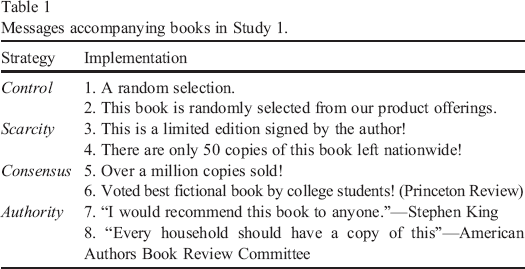
Participants were randomly assigned to different orders of presentation of the influence strategies. Book order was kept constant to control for differences in the appeal of the books.
Measures
Each of the books was evaluated by participants on four items. For each of the items, a ten-point rating scale with both of the end-points labeled was presented. The following items and answer end-points were used for each book:
How likely would you be to recommend this book to your friends? (Very unlikely–Very likely) How much would you enjoy reading this book? (Would not enjoy at all–Would enjoy very much) How would you judge the quality of this book? (Very poor quality–Very good quality) How likely would you be to buy this book if you were going to buy a novel? (Very unlikely–Very likely)
After evaluating the books, participants completed a questionnaire addressing demographics and some traits that are expected to affect book evaluations. We administered the 18-item measure of NFC (Cacioppo and Petty 1982; Cacioppo, Petty, and Kao 1984, α = .89). We also administered the Ten Item Personality Inventory (TIPI) to obtain meta-judgmental measures of the Big Five personality traits (Gosling, Rentfrow, and Swann, Jr. 2003) and participants were asked about their age, gender, and academic major.
Results
This study resulted in a dataset describing the evaluation of B = 14 books by N = 179 subjects. For each participant, the evaluated books are accompanied by one of K = 8 implementations of influence strategies (two implementations for each of S = 4 strategies). Finally, each book was evaluated using Q = 4 different items, each on a ten-point scale.
Data analysis involved a series of comparisons of mixed-effects models with crossed random effects (Baayen, Davidson, and Bates 2008) and subsequent examination of the estimated parameters of the selected model (see Appendix A for a brief review). This is a modern version of analysis of variance (ANOVA) for factors with many levels (Gelman 2005). These models are: (A) a model with no heterogeneity in the effects of influence strategies, (B) a model in which only the effect of using any strategy varies from person to person, and (C) a model in which the effects of each strategy vary from person to person. Comparison of Models A and B corresponds to testing the null hypothesis that there are no individual differences in overall “persuadability” by the consensus, authority, and scarcity influence strategies. Comparison of Models B and C tests the null hypothesis that individual differences in the effects of influence strategies are exhausted by individual differences in overall “persuadability”. Thus, selection of Model C over Models A and B would reject both of these null hypotheses in favor of the conclusion that there is statistically significant heterogeneity in influence strategy effects.
Each of these three models can be written

The design matrix X
jb
is a 1432 × 4 matrix consisting of a column of ones and indicators for each of the three strategies. Thus, β is a 179 × 4 matrix of intercepts and coefficients for each strategy for each individual. Finally,
In this formulation, the three models differ only in their constraints on Σ
β
. Model A only allows for between-person variation in an intercept, so it has
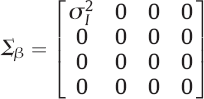
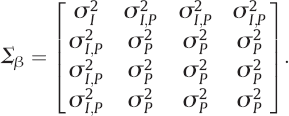
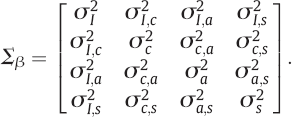
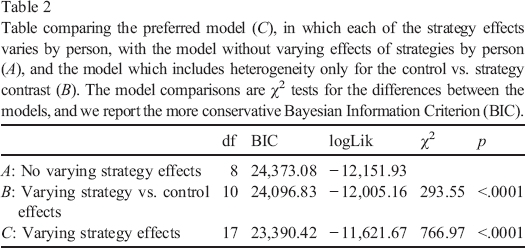
Table 2 presents the comparison of these three models. Model C is preferred. This directly supports our hypothesis that there are individual differences in the effects of these three influence strategies. Furthermore, this heterogeneity is not exhausted by heterogeneity only in an overall effect of any of the three strategies, as compared to no strategy. Thus, we reject the two null hypotheses corresponding to the restrictions on Σ β in Models A and B. The extent, not just this existence, of this observed heterogeneity is of theoretical and practical significance, so we now examine the estimated parameters of Model C.
Table comparing the preferred model (C), in which each of the strategy effects varies by person, with the model without varying effects of strategies by person (A), and the model which includes heterogeneity only for the control vs. strategy contrast (B). The model comparisons are χ2 tests for the differences between the models, and we report the more conservative Bayesian Information Criterion (BIC).
Magnitude of Heterogeneity
We characterize the magnitude of heterogeneity in effects of influence strategies by examining
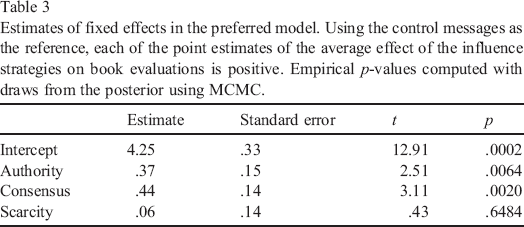
In order to compare the heterogeneity in the effects of influence strategies with the average effects of those strategies, we first consider these average effects. Consistent with the choice of established influence strategies and widely used implementations for this study, there is a significant effect of influence strategy, χ2(3) = 13.92, p = 0.003. Table 3 presents the estimates of the average effects in Model C. The average effects of the authority (p < 0.01) and consensus strategies (p < 0.001) are both significantly positive and similar in magnitude. 2
The reported p-values are computed from R = 5,000 drawn from the posterior density for these effects using Markov Chain Monte Carlo MCMC, see Baayen, Davidson and Bates (2008) simulations. We did not find a significantly positive average effect of scarcity. It may be that, despite the use of realistic implementation of this strategy, the situation of Study 1 may not have been conducive to these messages. Subsequent discussion thus focuses primarily on the authority and consensus strategies. No significant improvement of model fit was found when including varying effects for implementations in addition to varying effects of strategies.
Estimates of fixed effects in the preferred model. Using the control messages as the reference, each of the point estimates of the average effect of the influence strategies on book evaluations is positive. Empirical p-values computed with draws from the posterior using MCMC.
Summary of random effects in Model C. The square root of the diagonal elements of
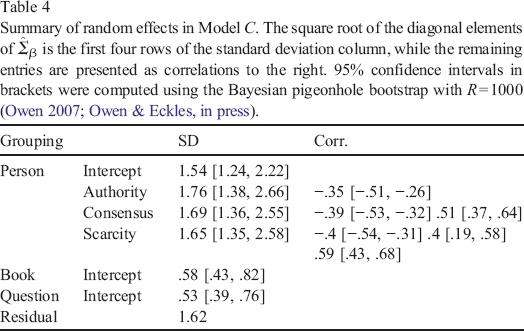
Fig. 1 is a graphical comparison of the estimated average effect of each strategy and the estimated distributions of strategy × person effects. The solid vertical lines indicate the average effect of each strategy compared to the control message, which effect is indicated by the vertical dotted line. The solid black density is the estimated Gaussian distribution of the strategy × person effects in the population.
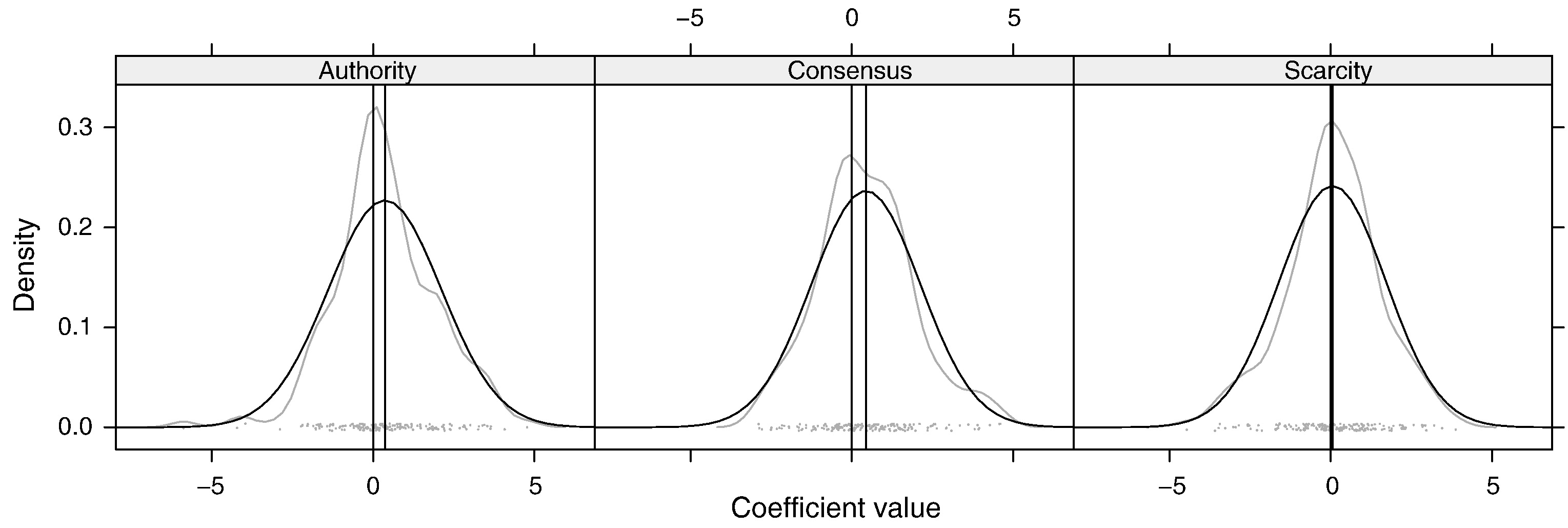
Comparison of heterogeneity in the effects of influence strategies with the average effects of those strategies. The solid black vertical lines are the estimated average effects of each strategy, as compared with the control message. The black curves are the estimated normal distribution of strategy effects for the population, while the gray curves are the density of the estimates of the strategy effects for this sample. Estimates are from Model C.
As an illustration of the magnitude of individual differences in influence strategy effects, we can consider how common it is for the estimated effect of the consensus strategy for an individual to be negative, despite its average effect being significantly positive. We find that for 41.3% (95% CI [35.8, 45.3]) of the participants the estimated effect of consensus is negative. There is substantial uncertainty about each of these estimates and the estimated variance used to shrink these estimates toward the average effect is an upper bound, so we expect that this overestimates the number of our participants for whom the true, stable effect is negative. As a more conservative estimate, we find that 23 (12.8%) of our participants have estimated effects of consensus that are statistically significantly below zero.
Qualitatively, one can compare the different standard deviations presented in Table 4: The estimated standard deviation of participants’ responses to books not accompanied by influence strategies (the intercept varying by person,
Structure of the Heterogeneity
In this section we further examine the structure of the heterogeneity as opposed to its magnitude. This structure is of practical importance since an examination of the magnitude does not itself warrant modeling each strategy for each individual: the heterogeneity could also have been caused by individual differences in responses to any type of persuasion, leading to a similar magnitude of heterogeneity. In this section we illustrate that substantial heterogeneity exists at the level of distinct influence strategies.
Comparison of Models A, B, and C supported the hypothesis that the structure of heterogeneity in influence strategy effects is more complex than single dimension of overall “persuadability”. In particular, the covariance matrix for the strategy effects Σ β in Model C allows for more complex relationships among the effects of each strategy. While the effects of the three strategies are moderately correlated, they also have substantial unique variation, as seen in Fig. 2. This figure makes clear that, for many individuals, one specific influence strategy is estimated to have a positive effect on product evaluations, while for other strategies the sign of the effect is reversed for the same individual.
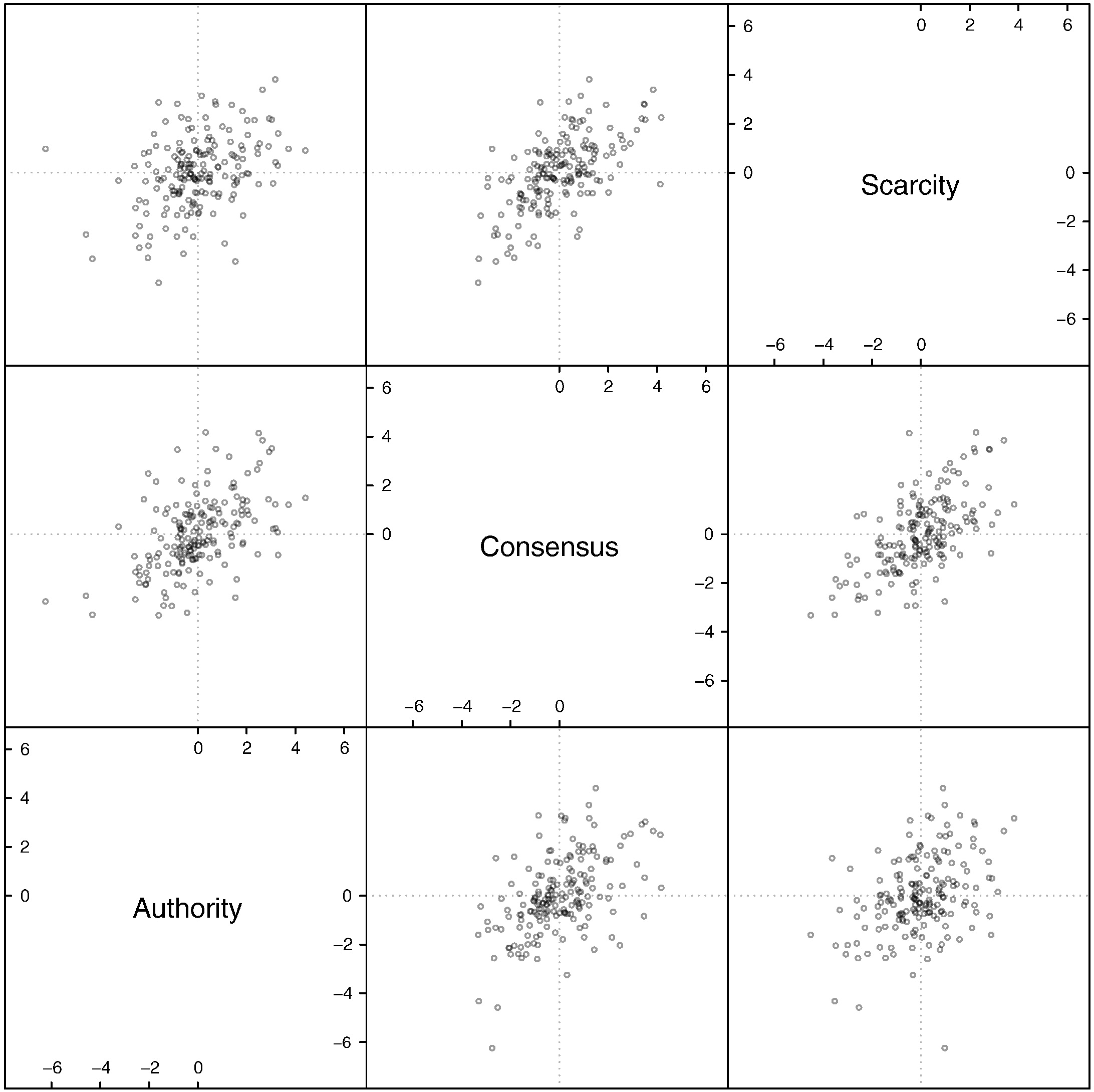
Estimated influence strategy effects for each participant in Model C, as compared to the control messages. Note that for some individuals, the estimated effect of one strategy is negative, while the estimated effect of another is positive.
Demographics and Meta-judgmental Measures
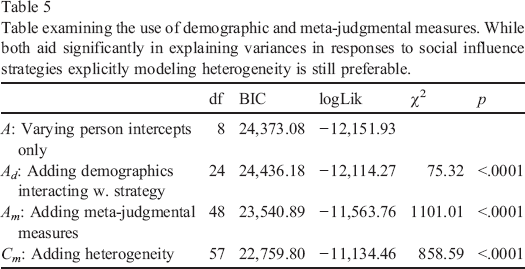
To examine whether current marketing practice would be able to sufficiently capture the individual differences identified in this study given its standard demographic and meta-judgmental measures we perform a series of model comparisons including these measures. Table 5 presents four model comparisons. First, we compare Model A—the baseline model without varying strategy effects—with a model that includes demographic variables interacting with influence strategy. 3 These additions significantly improve fit. Next, we add both the obtained measures of NFC as well as the Big Five to the model. Despite the large increase in degrees of freedom this model is preferable (even according to conservative BIC measure). This shows that meta-judgmental measures can indeed be beneficial to attend to individual differences in persuasion processes. However, the final comparison shows that allowing for heterogeneity in responses to influence strategies—as done in Model C—despite the demographics and meta-judgmental measures still significantly improves model fit. Thus, the demographics and meta-judgmental measures included in this analysis are insufficient to capture all individual variation.
Age is entered as a linear term with separate indicators for upper and lower quartiles.
Table examining the use of demographic and meta-judgmental measures. While both aid significantly in explaining variances in responses to social influence strategies explicitly modeling heterogeneity is still preferable.
Discussion
Study 1 enabled us to compare the heterogeneity in effects of influence strategies to their average effects. This heterogeneity is large compared to the average effects, which provides a measure of their comparative importance for theory and practice. This heterogeneity was not exhausted by differences in overall responses or in susceptibility to all of the influence strategies considered together; rather, the preferred model includes varying effects for each of the influence strategies. Furthermore, models including this heterogeneity were preferable even when including demographic or meta-judgmental measures as independent predictors for responses to each strategy.
It is striking how large the heterogeneity is relative to the average effects of each of the influence strategies. Even though the overall effects of both the authority and consensus strategies were significantly positive, the estimates of the effects of these strategies were negative for many participants. As an illustration that this heterogeneity is not simply differences in overall persuadability, some participants for whom the effect of the authority strategy was negative were positively influenced by consensus messages. Employing the “wrong” strategy for an individual can have negative effects compared with no strategy at all; and the present results suggest that there are many people for whom the included strategies have negative effects. On the other hand, employing the “best” strategy for an individual could offer substantial increases in persuasion over the best performing strategy on average.
Study 2: Temporal Stability of Heterogeneity
While the analysis of Study 1 produced unbiased estimates of the effect of each influence strategy for each participant, each of these estimates had relatively high uncertainty. The resulting estimates of heterogeneity were expected to be upwardly biased. Transient intra-individual variation, such as that caused by differences in mood, fatigue, and situation, is not separately identified, as participants only rated books during a single session. This problem is common but ignored (cf. Watson and Strayer 2010) in operative measures of traits. In particular, moods—emotional states lasting from several hours to several days—can affect elaboration (Bless et al. 1990), thereby moderating the effects of influence strategies on attitudes. To address this issue, in Study 2 participants encountered implementations of the same influence strategies over three sessions.
Method
Study 2 was also conducted in a product-evaluation context in which participants rated books. Rather than being a study ostensibly about book preferences, Study 2 was ostensibly a user experience evaluation of a new online bookstore; during each of three sessions approximately a week apart, participants were guided through a series of tasks in which they could freely browse and search this bookstore (see Fig. 3). In addition to rating a number of books, participants were asked to perform other tasks fitting with the cover story. Like the homepage of online retailers (e.g., Amazon.com), books were organized under titles that implemented an influence strategy; individual book description pages also featured implementations of these persuasive strategies.

Appearance of the bookstore in Study 2. The authority strategy is implemented in the orange box just below the title of the book. The evaluation questions and the tasks for participants appeared in the bottom bar.
Participants
Participants were 70 community college students enrolled in social science courses and were participating for partial course credit. Fifty-nine (83.4%) of the recruited participants were female. The mean age of participants was 25.1 (SD = 9.9). Again, the study was conducted online and participants participated from their own computers.
Procedure
Our study was announced as “Bookstore evaluation” and its ostensible aim was to evaluate a newly developed bookstore. Once signed up for the study, participants received an email explaining that they would receive a link to the study Web site once every week for three subsequent weeks. Participants received the emails on Mondays and were asked to participate in that weeks’ session by that Wednesday. Participants who had not participated by Wednesday morning received a reminder email.
Participants began each session by clicking on a link to the study Web site in the Monday or Wednesday emails. After an instruction page, participants were taken to an online bookstore augmented with an instruction and questionnaire “bar” at the bottom of the page.
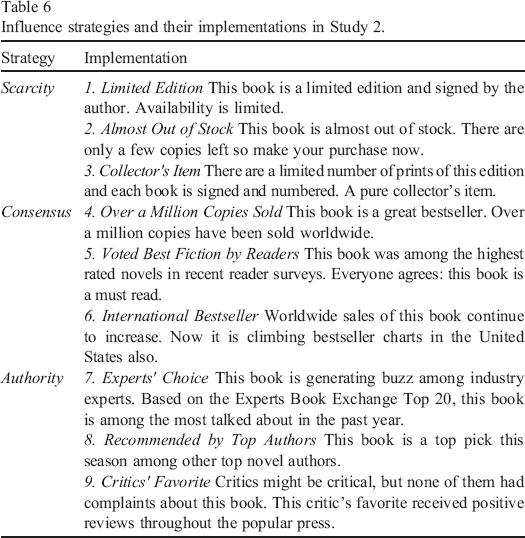
The home page of the bookstore displayed books under categories implementing influence strategies. We included three implementations of each of the strategies used in Study 1 (see Table 6). We omitted any control heading (e.g., “random selections”) in order to maintain the realism of this online retail context.
Influence strategies and their implementations in Study 2.
Each session consisted of approximately 20 tasks. Six of these tasks were product evaluation tasks, which asked participants to go to the home page of the bookstore, find a particular book, and rate that book. The remainder of the tasks, such as “Please find a book called [book name] and add it to your shopping cart,” were included to be consistent with the cover story of a user experience evaluation.
Participants rated two books for each strategy during each session. These two books were presented with the same implementation and were rated in sequence. The order of the three strategies over each session was randomized and the specific implementations used in that particular session were randomized. The order of books and the combination between books and strategy implementation were also randomized over participants.
At the end of Study 2, each participant had evaluated 18 books. After finishing the three sessions, participants were assigned course credit for their participation.
Measures
We obtained the same demographic and meta-judgmental measures as used in Study 1. Hence, we measured participants’ evaluation of the books, their NFC (α = .9), and their personality using the TIPI.
Results
The analysis of the product evaluations collected in Study 2 is similar to that in Study 1, in that we conduct model comparisons testing for heterogeneity in influence strategy effects. Since each participant evaluated books accompanied by each of the three strategies during each of three sessions, one can separately examine their responses by session. Thus, unlike Study 1, we can analyze participants’ responses to books accompanied by each strategy over the three sessions. On the other hand, all books evaluated by participants in Study 2 are accompanied by authority, consensus, or scarcity; there are no control messages for comparison. These are the primary changes from Study 2 that are important for the analysis.
Model Comparisons
As in Study 1, a test of the null hypothesis of no heterogeneity in responses to influence strategies corresponds to the comparison of two mixed-effects models. The first model, Model D, includes varying intercepts for sessions and participants. The second model, Model E, adds strategy × person effects.
Both models can be written as:

In this model X
jb
is a matrix of indicators for strategies and sessions such that β is a 70 × 6 matrix of coefficients of the coefficient for each strategy and each session for each participant. We have
The strategy and session coefficients varying by participant are modeled independently from each other; that is, Σ β has a block structure (see Equation 6) in which Σ β (s) is the covariance matrix for strategy coefficients and Σ β (t) is the covariance matrix for session coefficients. In Model D, each element of Σ β (s) is set to zero, while in Model E it is unconstrained.
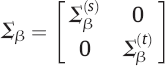
Table 7 shows the comparison of these two models. Allowing for heterogeneous influence strategy effects significantly improves model fit. This shows that also in this study there is variation in responses to the different implementations influence strategies. In Study 2 the variation is observed across the different sessions and is thus not caused by transient intra-individual differences.
Table comparing Model E with a model without varying effects of strategies by person (Model D). The comparison shows stable heterogeneity in responses to influence strategies over the three sessions.
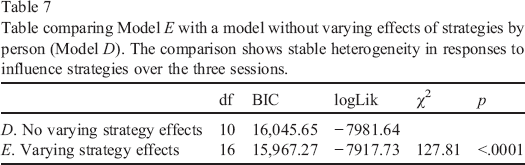
Table 8 summarizes the random effects of Model E. Qualitative comparison to Table 4 shows that the point estimates of the standard deviations of the strategy × person effects are slightly lower in Study 1 than in Study 2: This accords with the expectation that the estimates in Study 1 are upper bounds because of transient intra-individual variation. However, the confidence intervals for the standard deviations for Study1 include the point estimates from Study 2.
Summary of random effects of Model E. The square root of the diagonal elements of
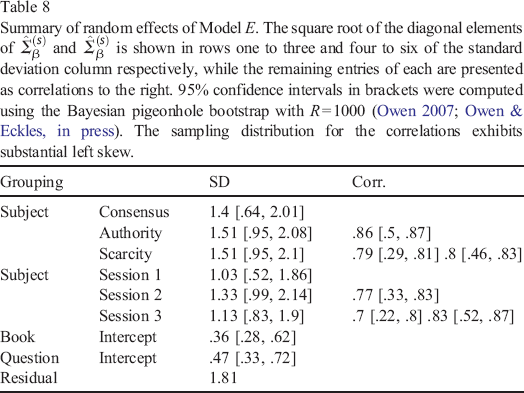
The correlations between the strategy × person effects are larger in Study 2. This is expected for two reasons: First, in Study 1, the overall intercept of each participant is separately identifiable from the strategy × person effects—which is illustrated by the negative correlations between the person intercepts and the strategy × person effects. In Study 2 this is not the case, and thus the correlations between strategies include an overall response tendency. Second, this observation is consistent with the idea that the estimates in Study 1 include noise from transient intra-individual variation and are thus attenuated.
Demographics and Meta-judgmental Measures
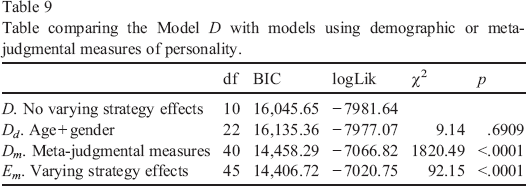
As in Study 1 we also fit models that use common marketing measures of consumers—such as gender, age, and personality—to explain the observed differences. The results are presented in Table 9. Contrary to Study 1 the demographic measures of age and gender did significantly improve fit. Measures of NFC and the Big Five do aid in explaining responses to social influence strategies. However, these are again insufficient to capture the variation that can be modeled using operative measures. Allowing for varying effects of social influence strategies at an individual level significantly increases model fit.
Table comparing the Model D with models using demographic or meta-judgmental measures of personality.
Discussion
The large heterogeneity in the effects of influence strategies found in Study 1 motivated estimating this heterogeneity over multiple sessions. The analysis above demonstrates that the heterogeneity in effects identified in Study 1 largely cannot be attributed to transient intra-individual variation. Rather, the observed variation is the result of stable individual differences in responses to distinct influence strategies. Even after using meta-judgmental measures of traits as predictors, including strategy × person effects significantly improved model fit. This finding highlights that while meta-judgmental measures can aid in understanding responses to social influence strategies, operative measures—the estimated strategy × person coefficients—reflect additional variation.
General Discussion
The two studies presented provide evidence of substantial heterogeneity in how influence strategies affect consumers’ attitudes. Model comparisons rejected the two null hypotheses—those of no heterogeneity and heterogeneity only in overall effects of influence strategies. We conducted two additional analyses to characterize this heterogeneity.
First, the inclusion of control messages in Study 1 enabled comparing the upper bound for heterogeneity from that study with the average effect of the strategies. This comparison suggested that this heterogeneity is large enough that influence strategies that are effective on average nonetheless have a negative effect for many individuals. While the estimates of heterogeneity used in these comparisons were upper bounds, the analysis of Study 2 illustrated that much of this estimate cannot be attributed to transient intra-individual variation. This further supports the conclusion that if we consider the average effect of, e.g., the authority strategy to be substantial, then by comparison heterogeneity in its effects is likewise substantial and worth further attention.
Second, we used existing and new meta-judgmental measures of personality constructs to examine if, or to what extent, the estimated heterogeneity is exhausted by these measures. In analysis of both studies, these measures improved model fit. Nonetheless, even when including these messages, directly modeling heterogeneity in influence strategy effects improved fit. We tentatively conclude that both meta-judgmental measures and the operative measures—constructed through modeling strategies such as those used here—can support better understanding and application of persuasion. However, in interactive marketing practice, operative measures—observations of responses to social influence strategies—are possibly easier to obtain for large numbers of consumers than meta-judgmental measures.
Contributions of the Current Work to Interactive Marketing
The current work contributes to the current state of the interactive marketing literature in three ways: First, the work signals the importance of attending to individual level effects in interactive marketing. While the effects of several standard interactive marketing practices, such as the use of influence strategies, are positive on average it is of importance to estimate whether individual-level differences are in play that are large enough to warrant personalization. Second, we have demonstrated the use of hierarchical multi-level models with crossed random effects to enable such investigation based on operative measures—consumers’ actual behavioral responses—as opposed to meta-judgmental measures. Finally, we have shown that for the specific case of influence strategies the heterogeneity in consumers’ responses is large and consistent which warrants personalization on the level of influence strategies in interactive marketing.
Theoretical Importance
Our findings demonstrate the importance of heterogeneity in responses to influence strategies. The observed heterogeneity provides reason to regard the existing evidence about average effects as insufficient for supporting theories about the underlying psychological processes. Even conditional on a meta-judgmental measure of a single trait, average effects on influence strategies thus do not accurately characterize their effects for individuals. The method and results presented here can aid theorists of consumer behavior in two ways.
First, the heterogeneity implies that theoretical explanations for influence strategy effectiveness should consider routes in which implementations of influence strategies have negative effects on attitudes or compliance. Theories that posit processes by which influence strategies are effective should also be able to account for the large number of consumers for whom their implementations have negative effects. This finding implies that for each influence strategy possibly multiple processes are at play, and each of these should be detailed in theoretical attempts to explain the success or backfiring of implementations of influence strategies.
Second, the associations between the effects of different influence strategies—as identified by the correlations between the different operative measures—can aid theorists in linking the psychological processes responsible for the effectiveness of different influence strategies. If the correlation between two strategies is high, this suggests that there may be substantial overlap in the psychological processes that produce the effects of these strategies. Even though, as detailed above, multiple psychological processes might be in play for a single strategy or implementation, identifying (partial) overlap between strategies aids us in understanding consumers’ cognitive processes. Operative measures can thus be used to distinguish both strategies and their implementations. While in the studies presented above the number of implementations was limited, the presented method should in future work be used to incorporate a larger number of implementations for each strategy.
Implications for Influencers
While applied successfully in multiple settings, the use of influence strategies could be even more effective once tailored for specific consumers. We have provided evidence that employing the “wrong” strategy for an individual can lead to compliance that is lower than attempts without the support of implementations of influence strategies. We have demonstrated that this negative effect of influence strategies on particular individuals cannot be characterized sufficiently by an overall “persuadability” dimension. Rather, the distinct influence strategies provide dimensions that proved useful in modeling individuals’ responses to influence attempts. One use to which a model of individual differences in persuasion can be put is selection of the “best” influence strategy for an individual. The present results provide evidence that selecting the strategy estimated to have the largest effect for an individual can offer substantial gains over selecting the strategy with the largest average effect.
The results above imply that influencers and marketeers should attend to the conditional effects of influence strategies instead of the average effects. In most interactive settings it is relatively easy to generate estimates of individual level susceptibility to a distinct influence strategy. As in the present work, interactive marketers can directly model responses to influences strategies once they have identified different types of product appeals as implementing distinct influence strategies.
To use the results presented above, influencers will have to create implementations of distinct influence strategies to support product representations or customer calls to action. As in the two studies presented above, multiple implementations of influence strategies can be created and presented separately. Thus, one can support a product presentation on an e-commerce website by an implementation of the scarcity strategy (“This product is almost out of stock”) or by an implementation of the consensus strategy (“Over a million copies sold”). If technically one is able to represent these different strategies together with the product presentations, identify distinct customers, and measure the effect of the influence strategy on the customer, then one can dynamically select an influence strategy for each customer. Kaptein (2011) describes an initial implementation of such a system.
In many applied settings the problem of learning the optimal strategy for an individual customer will be a sequential one. Here a combination of the multilevel models that are proposed in this article with additional simple techniques such as applications of randomized probability matching to select different strategies can be used to optimize the selection of influence strategies for individuals in real-time (e.g., randomized probability matching, Scott 2010). As long as the success (e.g., click-through, revenue, etc.) of an influence strategy on an individual customer can be measured, then marketeers can estimate the expected success of subsequent influence strategies. Adopting a Bayesian approach in which individual level priors are informed by the behavior of other (similar) customers for similar product categories (etc.) will enable interactive marketeers to “borrow strength” from previously observed responses to influence strategies in a similar context. The obtained estimates of the expected success of distinct strategies for individual customers constitute persuasion profiles. These profiles can be used to select influence strategies accompanying future product presentations (Fogg 2006; Kaptein and Eckles 2010).
Conclusions
The effects of influence strategies on product evaluations are heterogeneous. This heterogeneity is anticipated by previous research on causal roles for personality constructs in processing persuasive messages. However, the present results allow direct characterization of the magnitude of this heterogeneity. In particular, this heterogeneity in responses to influence strategies is large relative to the average effects of these strategies. This implies that using the “wrong” strategy for an individual consumer can be detrimental as opposed to not using an implementation of an influence strategy, even though the implementation of this strategy is effective in increasing compliance at an average level. The large magnitude of the observed heterogeneity emphasizes that evidence about average effects can be a misleading guide to development and selection of theories about how influence attempts affect consumers’ attitudes and behaviors. The results presented in this paper show that interactive marketers should adapt their usage of distinct influence strategies to the responses of individual consumers.
Footnotes
Acknowledgements
This work benefited from comments by Clifford Nass, Abhay Sukumaran, Michael Nowak, Panos Markopoulos, Boris de Ruyter, Emile Aarts, members of the Stanford CHIMe Lab, and anonymous reviewers. Dean Eckles was supported by a grant from Nokia.
Analysis Using Multilevel Models with Crossed Random Effects
Both Study 1 and Study 2 presented in this work use multilevel (hierarchical) models with crossed-random effects to obtain the operative measures of the individual level effects of different influence strategies. This section briefly describes these models and why they are appropriate for estimating and studying individual differences. The models extend common linear regression in the sense that some parameters (or batches of parameters)—called the “random effects”—are informed by a prior distribution over their values. To understand hierarchical models it is convenient to start with an explanation of the so-called “null” model (Snijders and Bosker 1999). In this “null” model, the responses of a consumer—in the subsequent studies their evaluations of different products—are modeled using a average level intercept and an individual level intercept. The latter represents the difference in score of a specific individual from the average score of others. The model can be written as follows:
Let us examine how this “null” model represents individual differences: Suppose y1j is participant 1's evaluation of a product j. The model described in Equation 7 predicts this customer's evaluations based on a weighted average of the evaluations of other participants, as well as the (prior) evaluations of the same consumer. If a consumer—consumer 1—evaluates products more positively than the average consumer her individual μ1 will be positive. If multiple consumers score consistently much higher or lower than the grand average,