







Abstract
This study investigates how the effect of the failure of co-created products or services influences: (a) internal attribution (i.e. the self) and external attribution (i.e. the firm), (b) customers’ expectancies of success, and (c) customers’ future motivation to co-create and contribute to recovery from failure. We use attribution theory and the attribution–expectancy framework to explain the theoretical relationships we advance and test our hypotheses in two independent experiments that stimulate co-creation through role-play and vignettes. The results show that customer co-creation shifts the attribution for failure to the self, resulting in atypical shifts in expectancy (increasing customers’ expectancy of future success and motivation to continue co-creating in the future). Our results suggest that utilizing customers’ efforts and skills in the co-creation of products and services can help firms to manage failure effectively. The implications of our findings on co-creation research and product and service failures are discussed, specific applications within the digital context are considered, and suggestions are offered for future research.
Introduction
Co-creation involves customer participation in various stages of production and use processes through the application of operant resources such as knowledge, skills, and effort (Vargo and Lusch 2004, 2008). Co-creation and computer technology have supplemented each other's advancement over the last decade, particularly after Prahalad and Ramaswamy's (2004) seminal paper was published in the Journal of Interactive Marketing. The interactive technology platforms that have been created as an outcome of the internet revolution have supported co-creation between firms and customers by facilitating collaboration, interactivity, outreach, speed, and flexibility (Bacile, Ye, and Swilley 2014; Bolton and Saxena-Iyer 2009; Rossmann, Ranjan, and Sugathan 2016; Sawhney, Verona, and Prandelli 2005). Consequently, several scholars in the domain of interactive marketing have devoted a significant effort to understanding customization, firm–customer interactions, and co-creation (Bacile, Ye, and Swilley 2014; Hsieh and Chang 2016; Miceli, Ricotta, and Costabile 2007; Wind and Rangaswamy 2001).
Firms are increasingly adopting co-creation for three reasons. First, the internet has facilitated the emergence of new channels of consumer–firm engagement. Second, new technologies such as 3D printing and Web 2.0 technology have enabled firms and consumers to co-create with ease. Third, as customers are becoming more informed and interconnected, they are demanding participation and co-creation as opposed to remaining passive receivers of value (Deighton and Kornfeld 2009; Sawhney, Verona, and Prandelli 2005; Schaefer and VanTine 2010; Shankar and Malthouse 2009). An IBM survey found that 78% of consumers worldwide are willing to co-create products and services with their retailers (Schaefer and VanTine 2010). Technology has made it possible for leaders in innovation such as P&G, BMW, Siemens, and Beiersdorf to engage in co-creation (Bilgram, Bartl, and Biel 2011). In the digital world, firms are using customer designs to co-create everything from apparels to automobiles (e.g., Local Motors, Threadless). Therefore, research on co-creation has gained importance across diverse areas, including public policy, innovation, operations, and marketing (Galvagno and Dalli 2014; Voorberg, Bekkers, and Tummers 2015). As such, it is emerging as a new and strategically beneficial frontier in the competitive effectiveness of modern organizations (Bendapudi and Leone 2003; Vargo and Lusch 2016). However, the positive effects of co-creation are accompanied by the challenges of managing firm–consumer interactivity and dealing with the implications of failed co-created products and services.
Extant research has predominantly focused on successful co-creation, which has somewhat overshadowed research that aims to understand the ‘failure of co-created products or services’ (henceforth, simply failure) 1 (Dong, Evans, and Zou 2008; Heidenreich et al. 2015). The interactive processes of co-creation bring diverse groups of customers into contact with firms and an increased number of customer–firm touchpoints increases the propensity of failure (Hart, Heskett, and Sasser 1989; Zeithaml, Parasuraman, and Berry 1985). Failure indicates that the co-created product or service does not meet the customer's desired usage objectives. As it is unintentional and outside of customers’ control, it is distinct from other adverse situations such as the co-destruction of value (Smith 2013), dysfunctional customer behavior during co-creation (Greer 2015), or the boomerang effect (Kull and Heath, 2016). On the one hand, the possibility of failure might negatively influence customers’ satisfaction and intentions to repurchase (Keaveney 1995; McCollough, Berry, and Yadav 2000). On the other hand, the interaction and other positive effects of co-creation may generate value (Srivastava and Shainesh 2015). Therefore, the overall effect and nature of failure are theoretically intriguing and important to understand in terms of practice.
For the simplicity of presentation, ‘failure’ implies the ‘failure of co-created products or services’, unless specified otherwise.
This study contributes to the literature by offering a clear understanding of consumers’ evaluation of failure, their subsequent attributions, their expectancy of success, and their willingness to co-create in the future (henceforth, CCF). We attempt to answer the following open questions: (1) Once failure has occurred, how are attributions influenced by degrees of co-creation? (2) How do these attributions influence customer expectancies? (3) How does attribution, and in turn, expectancy, affect CCF? These questions are investigated by using the attribution–expectancy framework (Teas and McElroy 1986) to support our central argument that co-creation will affect failure attribution, which will in turn positively affect customer expectancies and CCF (Fig. 1).
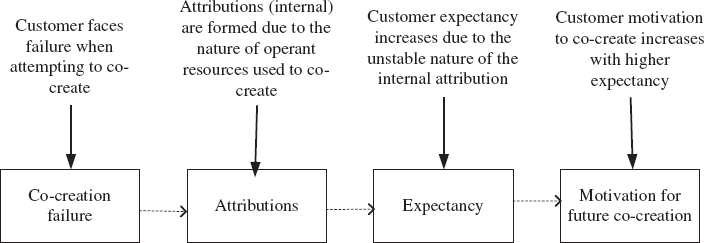
Reduced model.
This study makes three contributions to the research on failure and co-creation. First, we explain customer co-creation as an inexpensive mechanism to shift failure attribution from the firm to the customer. Second, using expectancy as a mediator, we link attribution processes and motivation to co-creation when customers face failure, thereby offering an important mechanism for managing the adverse consequences of failure. Third, we demonstrate the advantage of co-creation's capacity to cause an atypical improvement in customers’ willingness to initiate recovery efforts and remain involved in them, despite having previously experienced failure. The explanation of atypical expectancy shifts within the context of co-creation offers insights into the attribution–expectancy theory put forth in psychology.
The remainder of this article is organized as follows. A formal introduction to co-creation within the context of our research is followed by a synthesis of attribution and expectancy theories in order to derive our central hypotheses. Next, we delineate our empirical research, which comprised two experiments (including data collection methods, analyses, and findings). Lastly, the Discussion section addresses the implications and limitations of the research.
Conceptual Development
Co-creation
Co-creation has been conceptualized in various ways. It entails the creation of value for each other by two or more entities across several loci of production and consumption and through the processes of interaction, engagement, personalization, equity, relationship, and usage experiences (Ranjan and Read 2016; Vargo and Lusch 2016). Co-creation has also been defined as the mutual and compensatory expenditure of resources and effort by co-creators (Arnould, Price, and Malshe 2006; Heidenreich et al. 2015; McColl-Kennedy et al. 2012). In a literature review of co-creation behavior, Handrich and Heidenreich (2013) found that 65% of the studies used customer effort as the major descriptor of customer co-creation, while the remainder used personalization. We incorporate this diversity in the understanding of co-creation in our empirical processes of measuring the construct of co-creation as interaction, personalization, and the exchange of effort and skills.
In light of Kunz and Hogreve's (2011) suggestion to examine the processes that motivate customers to become co-creators, our theorizing has three further foci:
Since we are concerned about the consequences of failure, we create bridges between co-creation and failure by theorizing about how the involvement and use of customer resources during co-creation shapes customer attributions when they experience failure; and how such resource integration influences customer attribution. Nature of the customer resources expended and its effect are theorized according to expectancy theory. Customer willingness to co-create (as the dependent variable): as incidents of failure are occasional and our studies incorporate a single failure incident, transactional outcome variables are best-suited to understanding the impact of failure (Gelbrich and Roschk 2011; Oliver 2014; Tax, Brown, and Chandrashekaran 1998). We conceptualize CCF as customers’ willingness to co-create in the future in order to understand customers’ intention to co-create products and services subsequent to failure (Dong, Evans, and Zou 2008). Therefore, CCF, which is a more temporal measure, was more suitable than outcomes such as satisfaction or loyalty, which are based on accumulated experience (Gelbrich and Roschk 2011; Johnson, Anderson, and Fornell 1995).
Attribution Theory
Attribution theory explains the causal mechanisms that people ascribe to events. According to Weiner (1985), there are two key reasons for attribution: (1) to understand the environment, and (2) to manage engagement with the outcomes of attribution. Therefore, when customers face failure, they will devise attributions that support an understanding of the future and appear to give them control over that future. We now describe how customers’ attributions differ in a co-creation failure versus a normal failure.
In normal situations, people attribute success internally, to the self, but attribute failure externally (i.e. to firms) (Clark and Isen 1982). Such attributions are a self-serving attempt for customers to protect their self-esteem (Harvey et al. 2014; Miller and Ross 1975). However, it has been found that customers attribute failure to themselves in situations where they have utilized self-service technology (SST) or technology-enabled services (Harris, Mohr, and Bernhardt 2006; Heidenreich et al. 2015; Zhu et al. 2013). In these studies, failure was studied in the form of technical glitches, which are routine or expected (e.g. ATM failure). Therefore, these might just be cases of multiple failures that led complainants to re-evaluate their attributions. According to Weiner (1986), attribution behaviors are absent or irregular when such routine events occur. Heidenreich et al. (2015) use a technology-based service for rail/flight ticket booking which considers booking interruption (again, a technical glitch) as failure. Harris, Mohr, and Bernhardt (2006) use a situation in which respondents face failure when they perform an online bank transfer. Although such technology-enabled services are “highly interactive,” they cover only limited elements of co-creation (Bolton and Saxena-Iyer 2009). Moreover, how customers’ attribution of failure to the firm is influenced in the case of co-creation is not known. Internal and external attributions therefore need more theoretical investigation and empirical confirmation in order to generate a better understanding of the nature of customer attribution for failures of co-creation.
Within the context of co-creation, the explanation for failure is more observable to the customer, who was involved in the creation of the product or service. Boshoff and Leong (1998) and Mattila and Patterson (2004) explain that when people receive an explanation for a failure or can clearly see the evidence of why a failure occurred, they are more willing to put the blame on themselves. Therefore, co-creators are more likely to attribute failure to themselves. Moreover, the operant resources such as effort, skills, and knowledge that customers have spent during co-creation impact their attributions in different ways. This is because they become cognizant of the role they played in co-creation and are willing to attribute some of the blame to their involvement and their application of resources. Consequently, when individuals aim to guard their self-esteem in situations of failure (Kelley and Michela 1980), co-creation shifts the focus away from the firm to the critical norms of the co-created system (i.e. the process of the applied operant resources). This provides alternative anchors of attribution that reduce external attribution (Kelley 1973; Hansen and Scott 1976). In a similar vein, Atakan, Bagozzi, and Yoon (2014) explain that when customers are involved in designing a product, they may become committed to the product and identify with it. Norton, Mochon, and Ariely (2011) and Peck and Shu (2009) further specify that close physical proximity and a sense of touch and feel during co-creation can increase customers’ perceived ownership of the product. Thus, co-creation raises individuals’ self-awareness of their consciousness or their bodies, and individuals may relate co-creation to their personal history. This intensifies the focus on the individual, as opposed to the firm. We therefore hypothesize:
Expectancy Theory
Expectancy theory explains why people choose one behavior over another (Oliver 1974). Expectancy refers to people's belief that certain behaviors will result in improved performance or superior outcomes (Walker, Churchill, and Ford 1977), which leads people to prefer those behaviors. The association that individuals form between expectancy and behavioral intentions is partly dependent on prior outcomes pertinent to that association (DeCarlo, Teas, and McElroy 1997; Johnston and Kim 1994; Teas and McElroy 1986). Successful outcomes increase the expectancy that a behavior will produce the same outcome again, while an outcome of failure reduces the expectancy that a behavior will be successful. These are considered typical shifts in expectancy. Conversely, shifts would be considered atypical if expectancy increases after a customer faces failure, and decreases after a customer meets with success (Weiner 1986).
When failure occurs, expectancy shifts in relation to the interaction between the locus and the stability dimension of the attribution (Weiner 1986). 2 Locus attribution refers to whether the perceived cause of an outcome is internal (to a consumer) or external (to a firm), while the stability dimension of attribution refers to the perceived variability or permanence of the causal factor. As stability attribution increases, a consumer perceives the cause of a failure to be a consistent occurrence.
According to Weiner (1985) and subsequent empirical examinations of attribution dimensions (e.g. DeCarlo, Teas, and McElroy 1997), the controllability dimension of attribution is not clearly distinct from the stability and locus dimensions. Therefore, we focus only on the locus and stability attributions.
Prior studies indicate that when causal attributions are stable, individuals do not expect a better effort–performance link, which results in typical shifts. In contrast, unstable causal attributions can result in atypical shifts (Harvey et al. 2014; Weiner 1986). Stable internal failure attributions or stable external failure attributions can lower the expectancy of success. However, unstable internal attributions of failure increase expectancy, whereas unstable external attributions have no influence on expectancy (Harvey et al. 2014; Teas and McElroy 1986). Therefore, when failure is attributed to personality, or to task difficulty – which are stable characteristics – the individual does not anticipate success (low expectancy) even if more resources are to be used in the future. However, if failure is attributed to internal unstable factors (e.g. a lack of effort), individuals’ expectancy of future success increases because they believe that investing more effort will lead to this success (Harvey et al. 2014; Johnston and Kim 1994; Weiner 1986).
Empirical studies have characterized co-creation in terms of the time and effort that customers expend (Handrich and Heidenreich 2013). As a result, when customers contribute resources such as knowledge, skills, time, and effort to co-creating (Bendapudi and Leone 2003; Vargo and Lusch 2008), these resources become additional anchors for their attributions of failure. While knowledge and skill can be improved through practice (Kantak and Winstein 2012), time and effort are dependent on individual motivation (Dysvik and Kuvaas 2013). Therefore, the resources of time, effort, and skill that the customer uses in co-creation are perceived to be unstable, or perceived as resources that the customer can improve upon in the short-term. Therefore, failure attribution to such anchors would be unstable, raising customer expectancy and resulting in atypical expectancy shifts (Harvey et al. 2014).
We further hypothesize:
Decision and achievement theorists have regarded expectancy as an important predictor of individual behavior. For example, expectancy influences academic performance, task persistence, task choice, and salesperson behavior (DeCarlo, Teas, and McElroy 1997; Eccles and Wigfield 2002). According to Weiner (1986), “Every major cognitive motivational theorist, including Tolman, Lewin, Rotter, and Atkinson include the expectancy of goal attainment among the determinants of action” (p. 80). The expectancy of future success is a strong determinant of behavioral intentions (Fishbein and Ajzen 1975), and if a person's anticipation of a reward (or success) for a particular activity is low, he or she will probably not perform that activity. It follows that attribution (which influences expectancy) will have a strong bearing on future behavioral intentions (Weiner 1986, p. 98). This claim has been examined and supported by several studies. For example, Day (1982) found that students who reported unstable reasons for dropping out of school (e.g. needed a break from academic work) were more likely to return to college than students with other reasons for dropping out because they expected future success (e.g. taking a break would help them succeed).
Drawing from prior evidence, we further relate the customer expectancy that follows a co-created failure to CCF. When customers have positive expectancy due to an internal failure attribution that is directly related to the effort and time they have expended, they also perceive a positive link between effort and future performance. They will consequently be motivated to improve their performance on future tasks by increasing their effort (DeCarlo, Teas, and McElroy 1997; Dixon, Spiro, and Jamil 2001). Therefore, we expect that internal failure attribution will lead to an increase in individuals’ CCF and that this effect will be mediated by an increase in expectancy. We hypothesize:
Both stable and unstable external attributions are expected to cause typical shifts in expectancy (DeCarlo, Teas, and McElroy 1997; Johnston and Kim 1994; Teas and McElroy 1986). A person's expectancy for success decreases following failure when the attribution for the failure is external. External attribution causes individuals to feel that they lacked control over the failure, which will in turn reduce their confidence in the control they have over future co-creation outcomes. Therefore, customers do not expect an effort–performance link in the future. Consequently, we expect that attributing failure to the firm will reduce expectancy and subsequently reduce CCF (Badovick 1990; Weiner 1986). We hypothesize:
Co-creation of Recovery
Firms usually face customer attrition or customer apathy to initiate or participate in the firm recovery process (McCollough, Berry, and Yadav 2000; Tax, Brown, and Chandrashekaran 1998). Traditional firm recovery practices are often less effective without customers’ involvement. To mitigate this limitation, we examine how failure attribution influences customers’ willingness to co-create recovery (henceforth, CCR), and how such influences are modified.
Different antecedents drive customer commitments to CCF and CCR. As a result, there may not be any correlations between them. CCF is an attitudinal state that is driven by commitment, trust, and the value placed on the firm–customer relationship (Buttle and Burton 2002; Oliver 1999). In contrast, CCR is generally driven by dimensions of perceived justice and customers’ external attributions of failure (Gelbrich and Roschk 2011). Therefore, there is a theoretical distinction between the co-creation of recovery and a usual co-creation of products and services. In addition, the hierarchy of operant resources required in CCF vs. CCR is different (Madhavaram and Hunt 2008). When customers face failure after co-creation, they attribute the failure internally and such attributions can increase the expectancy of future success. When customer expectancy is high, customers might be more willing to get involved in the recovery process because of their perceived role in the failure and the increased probability of a successful recovery. Using the attribution–expectancy relationship explained in the Conceptual Development section, we therefore argue that customers will have higher CCR when they attribute the failure internally because their expectancy of success is higher. We hypothesize:
Study 1
Study 1 examines how the failure of a co-creation influences customer attributions. We try to understand how customers’ self and firm attributions are influenced by co-creation. These attributions are non-compensatory and can even co-exist, depending on the dimensions of information that customers have access to — particularly consistency, consensus, and distinctiveness (Kelley 1973). We further examine how these attributions will in turn influence CCF (indicated by black arrows in Fig. 2).
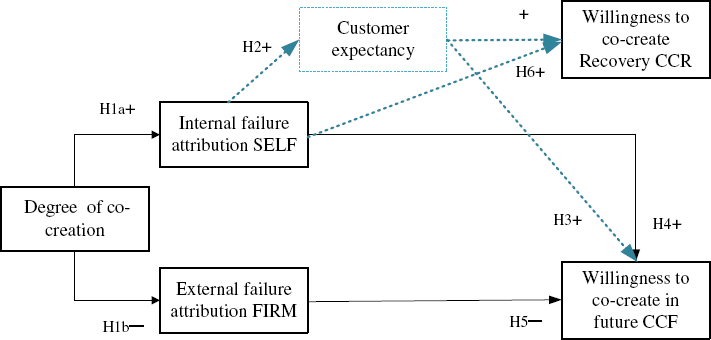
Hypothesized relations.
Method
We conducted an experiment in alignment with Keppel (1991) by manipulating co-creation using written scenarios (Appendix A). Our decision to use a scenario-based study was motivated by the flexibility it gave us to manipulate our conditions and manage the cognitive variables without distractions (Bitner, Booms, and Tetreault 1990). Further, using a scenario-based study allowed us to circumvent the ethical considerations and costs that are commonly involved when failure is enacted in a real experiment (McCollough, Berry, and Yadav 2000; Strizhakova and Tsarenko 2010).
We randomly exposed participants to scenarios that differed in terms of the degree of customer involvement and the effort required for product co-creation (co-creation level: high vs. low). Co-creation was manipulated by adjusting the amount of customization, customer skill and effort required for product creation. In the high co-creation condition, the customer had many parts of the bicycle to choose from and had to try to fit those parts individually to the bicycle frame using the required tools. This demanded considerable skill and effort. In the low co-creation condition, customization options were fewer and the customer did not have to try to fit the parts to the bicycle frame. Instead, he/she only had to show the parts to the employee. Hence, less customer skill and effort were required to create a product in the low co-creation scenario. Failure was manipulated by informing respondents that the final product – the bicycle – had presented balancing issues during test rides and did not appear to be sound.
Measures
For manipulation checks, we measured the degree of co-creation using one item from Dong, Evans, and Zou (2008) and two items from Heidenreich et al. (2015). Since these items measure various facets of co-creation such as customization options, contribution to design, and effort and time expended, the co-creation construct has been conceptualized as formative according to the guidelines provided by Diamantopoulos and Winklhofer (2001).
We checked whether the failure condition was properly enacted by using an item from Heidenreich et al. (2015) and asking whether the bicycle was designed well. In the failure condition, firm failure attribution was measured using items from Dong, Evans, and Zou (2008), while internal failure attribution was measured using four items from Heidenreich et al. (2015) and one item from Zhu et al. (2013). CCR and CCF were measured by adapting three items from Maxham and Netemeyer (2002) to the bicycle design context. All of the above items were measured on a 7-point Likert scale anchored by totally disagree (1) and totally agree (7) (see Appendix B). We conducted an exploratory factor analysis using varimax rotation and ensured that the items for each measure loaded only to a single factor (Appendix B).
Pretest
The manipulation check was conducted (N = 60) in a between-subjects design, with participants hailing from an engineering alumni group (average age of 31 years). Participants were randomly assigned to one of the two manipulated conditions (low vs. high co-creation). We used ANOVA to test whether the experimental factors varied as intended. The results indicated that the manipulation for degree of co-creation was strong. Subjects in the high co-creation condition reported significantly higher scores on the degree of co-creation scale (Mhigh cc = 4.77) than subjects in the low co-creation condition (Mlow cc = 3.81, F (1, 58) = 12.33, p < .01).
Data Analysis and Results
Subjects for the main study (N = 180) were members of a MBA alumni group from a leading business school in India (average age of 28 years) and were randomly assigned to one of the manipulated conditions (low co-creation or high co-creation). Items were averaged to obtain a single measure for each construct. The manipulation of the degree of co-creation was again found to be successful (Mlow cc = 3.98, Mhigh cc = 5.093, F (1, 178) = 63.21, p < .01).
Following Bagozzi (1977) and Mackenzie (2001), we preferred structural equation modelling (SEM) to test the hypotheses on the experimental data. 3 We were able to account for the measurement error by using SEM with multi-item measures for our constructs. The use of multi-item measures instead of dichotomous variables also helped to produce a larger variance in the data, in addition to controlling for measurement error. According to Bagozzi, Yi, and Singh (1991), the Partial Least Squares (PLS) approach is suitable for performing such an analysis.
We performed a univariate analysis with the manipulated conditions and found that the results held, as we see in the analysis using SEM. We also employed Mackenzie's (2001) more rigorous method of experimental data analysis to control for the unintended influence of experimental manipulation on the dependent variable and again, found that the results held.
Therefore, a two-step SEM using PLS was employed to test the hypotheses (Hair et al. 2013). We estimated the measurement and structural model using the PLS-SEM. The PLS approach has more power than the covariance-based SEM (CB-SEM) and is more robust to the violation of normality assumption. Moreover, it is the recommended approach for research with a smaller sample size and emphases prediction (Hair et al. 2012; Reinartz, Haenlein, and Henseler 2009). The PLS is also the recommended approach for dealing with formative constructs (Chin 1998). We used the PLS SEM for estimating our conceptual model because the data were not normally distributed (Mardia's test for multivariate normality: χ2skewness = 1,647, p < .001; Henze–Zirkler's Multivariate Normality Test: HZ = 1.04, p < .001) and because of the presence of the formative construct.
Measurement Model
First, we estimated the measurement model by checking for the adequacy of the reflective constructs used in the study. We estimated the reliability and discriminant validity of the constructs using confirmatory factor analysis (see Appendix B). These tests are not suitable for formative constructs and hence not reported. Both Cronbach's alpha and composite reliability for all the constructs exceeded the acceptable level of .7 (Bagozzi and Yi 1988; Hair, Ringle, and Sarstedt 2011). In addition, the average variance extracted (AVE) was greater than .5 for all the constructs, confirming convergent validity. The maximum squared correlation for each construct was less than its AVE, confirming the discriminant validity. The reliability and validity of the measurement model were therefore confirmed (Table 1) (Bagozzi and Yi 1988; Fornell and Larcker 1981).
Descriptive statistics and correlation matrix for Study 1.
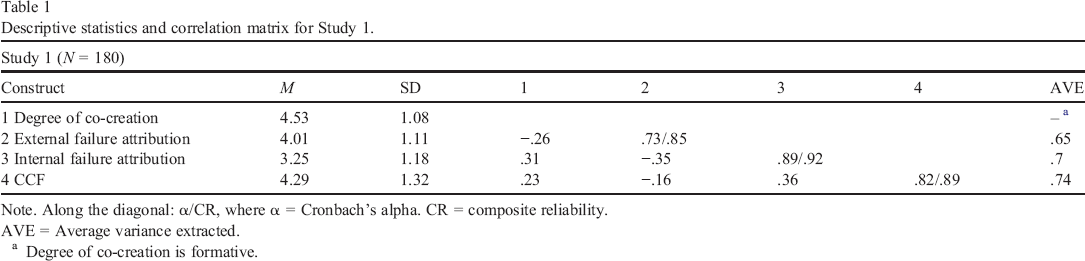
Note. Along the diagonal: α/CR, where α = Cronbach's alpha. CR = composite reliability.
AVE = Average variance extracted.
Degree of co-creation is formative.
The quality of the measure for degree of co-creation, which was conceptualized as a formative measure, was evaluated in the ways suggested by Hair, Ringle, and Sarstedt (2011). All the weights or loadings of the items for the construct were statistically significant (p < .001), which supported retaining the items. The variance inflation factor (VIF) for each item was less than 2 and the condition index was less than 30, suggesting that multi-collinearity was not a problem.
Structural Model and Test of Hypotheses
After establishing the measurement model, the path model was analyzed using the PLS-SEM with smart-PLS 3. The results (Table 2) confirmed that in the failure condition, degree of co-creation positively impacts internal failure attribution (b = .32, p < .001) and negatively impacts firm failure attribution (b = −.23, p < .01) (H1a and H1b). Internal failure attribution has a positive effect on CCF (b = .34, p < .001), thereby supporting H4. Our prediction that attributing failure to the firm will have a negative impact on CCF (H5) was not supported (b = −.05, n.s.).
Results of path analysis for Study 1.
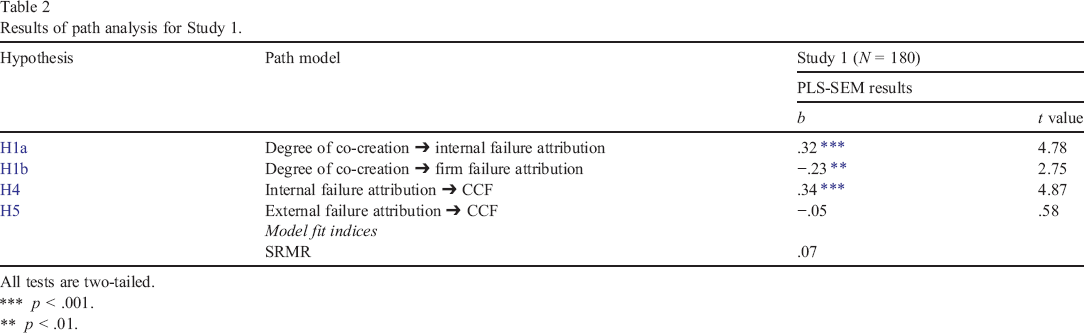
All tests are two-tailed.
p < .001.
p < .01.
It has been argued that the covariance-based CB-SEM and PLS-SEM have complementary strengths and should be used in a way that best suits the research objective (Hair et al. 2012; Reinartz, Haenlein, and Henseler 2009). In light of criticism regarding the absence of a measure of overall model fit that questions the PLS-SEM's usefulness (Hair et al. 2012), we chose to confirm the results through a CB-SEM estimation after excluding the formative construct.
We also conducted three tests for common method bias using CB-SEM. Firstly, Harman's One Factor Method (Podsakoff et al. 2003) revealed that the first factor of all the items in the measurement model did not account for the majority of the variance, which indicated that common method bias was not a problem. Secondly, we loaded all the items on to a common factor and conducted a confirmatory factor analysis (CFA). The results were then compared to the results of the CFA with the measurement model (e.g. Grace and Weaven 2011) through a Chi-squared difference test. A non-significant Chi-squared difference test suggested that the common method factor does not significantly improve the fit of the model, again showing that there was no common method bias. Finally, we conducted a common latent factor method (Podsakoff et al. 2003) by testing the same measurement model with a common latent factor linked to all the items. None of the factor loadings of the items to their respective constructs dropped significantly, which is yet another indication that common method bias was not a problem.
We examined configural invariance by running the model with two manipulation groups and without any restrictions. The model fitted well, which indicated that the model structure is invariant across the two groups (i.e., the participants across the two groups conceptualized the constructs in the same way) (χ2 (168) = 237; SRMR = .06; CFI = 0.94; TLI = .92; RMSEA = .048). To examine metric invariance, we constrained the regression weights so that they were equal between the groups. The Chi-square difference test with an unconstrained model indicated that there was no significant difference between them (Chi sq. diff = 15, dof = 15, p = .45). Therefore, the test for metric invariance was also satisfied, implying that the different groups responded to the items in the same way. As a result, we now have more confidence in the use of our measures across both high and low co-creation situations.
We also analyzed the proposed relationships (excluding the formative measure) using covariance-based structural equation modeling with AMOS software. The results supported the PLS-SEM results. The structural model demonstrated strong overall fit indices based on Hu and Bentler's (1999) criteria (χ2 (84) = 129, p < .01; SRMR = .05; CFI = 0.96; TLI = .95; RMSEA = .06). Thus, the proposed model provides a good fit for the data.
Study 1 answers the research questions of, (1) How is attribution influenced by degrees of co-creation in case of failure? (2) How do these attributions in turn affect CCF? We found that an increase in the degree of co-creation increases internal failure attribution and reduces firm failure attribution. While internal failure attribution increases CCF, firm failure attribution reduces it. In the next study, we test our theoretical explanation for these effects on CCF using expectancy shifts. Additionally, it examines the predicted relationship regarding the influence on CCR.
Study 2
We have claimed that internal failure attribution causes an atypical shift in expectancy by increasing it due to the time and effort customers put into co-creation. We argue that the increase in expectancy increases CCF and CCR. In Study 2, we measure customer expectancy and examine its mediating role in influencing CCF and CCR in order to test our argument about atypical expectancy shifts in cases of failure (indicated by dotted arrows in Fig. 2).
Method
The bicycle design scenario used in Study 1 was again used, in this case by drawing an American sample from Amazon Mechanical Turk (N = 112). As was the case in Study 1, respondents were randomly exposed to the co-creation and failure scenarios, then asked to answer questions measuring attribution, expectancy, CCF, and CCR. Amazon Mechanical Turk samples are widely considered to be representative of the U.S. population and used to generate data that has a level of reliability and validity comparable to other well-regarded sample recruitment methods (Buhrmester, Kwang, and Gosling 2011; Goodman, Cryder, and Cheema 2013; Mason and Suri 2011; Paolacci, Chandler, and Ipeirotis 2010). Respondents from Mechanical Turk are experienced at completing experiments online and are comfortable with the research process. Hence, we uploaded our survey on Mechanical Turk with the requirement that participants should be from the U.S. and have task acceptance rates above 97%. We received 130 responses, and from those, obtained 112 complete and valid surveys to use in the final analysis. This sample size is adequate for the PLS-SEM estimation (Hair et al. 2012) used for our model. The average age of our respondents was 34 years and the sample has a 3:2 male-to-female ratio. Realism checks (Dabholkar and Bagozzi 2002) indicated that the scenarios were considered realistic (a rating of 3.52 on a scale of 1 to 5) and easy to understand (a rating of 5.34 on a scale of 1 to 7). The manipulation check for co-creation was successful.
In addition to using the scales from Study 1, expectancy measures were adapted from Teas’ (1981) performance probability scale (e.g. Johnston and Kim 1994). The scale items (alpha = .89) measured respondents’ perceived probability of success (see Table 3 for the correlation matrix). This scale has been widely adopted as a measure of expectancy in major marketing studies. Attributing failure to the firm was avoided in this study in order to reduce the complexity of the model and to focus on using expectancy to validate our theoretical argument.
Descriptive statistics and correlation matrix for Study 2.
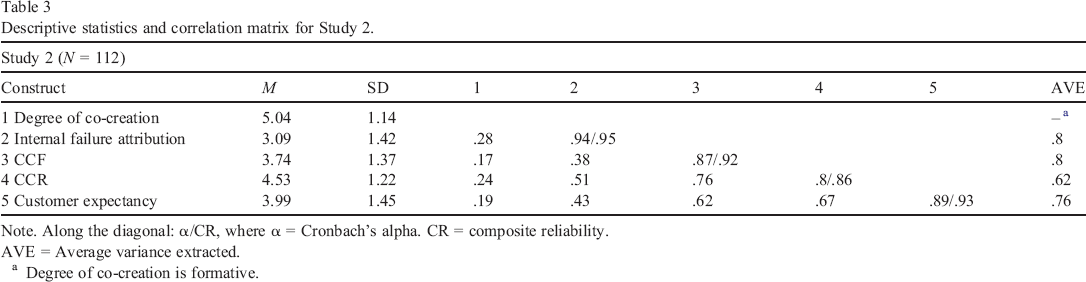
Note. Along the diagonal: α/CR, where α = Cronbach's alpha. CR = composite reliability.
AVE = Average variance extracted.
Degree of co-creation is formative.
Results
As was the case for Study 1, the responses were analyzed using the PLS-SEM. The results supported the role that customer expectancy plays in influencing CCF and CCR (Table 4). The effect of degree of co-creation on increasing internal failure attribution (H1a) was also supported (b = .32, t = 3.84, p < .001).
Results of path analysis for Study 2.
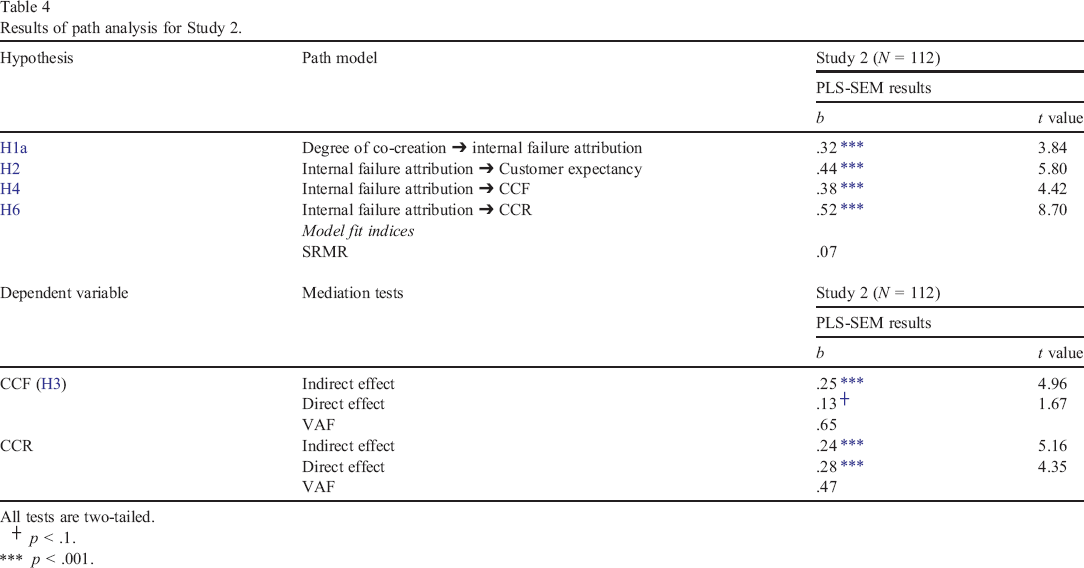
All tests are two-tailed.
p < .1.
p < .001.
We followed Hair et al. (2013) by performing bootstrap procedures for mediation checks using the PLS-SEM. This method is ideal for our study because of its non-reliance on any distributional assumption and the high power it maintains even when samples are small. Our first step was to test the total effect of internal failure attribution on CCF and CCR. Both these direct effects were found to be significant (b = .38, t = 4.42, p < .001 and b = .52, t = 8.70, p < .001, respectively), confirming H4 and H6. Next, we introduced expectancy as a mediator variable in the model. Internal failure attribution was found to have a significantly positive influence on expectancy of success (b = .44, t = 5.76, p < .001), supporting H2. Thus, the increase in customer expectancies following failure is an atypical expectancy shift. Moreover, customer expectancy was found to significantly influence CCF (b = .56, t = 7.86, p < .001) and CCR (b = .55, t = 8.15, p < .001). The paths to and from the mediator were therefore significant.
Then, we found that the indirect effect of internal failure attribution through expectancy on CCF was significant (b = .25, t = 4.96, p < .001). The direct effect excluding this path turned out to be marginally significant (b = .13, t = 1.67, p < .1). The variance accounted for (VAF) by the path through expectancy was .65, which indicates mediation (Zhao, Lynch, and Chen 2010). Similarly, the indirect and direct effects on CCR were also found to be significant (b = .24, t = 5.16, p < .001; b = .28, t = 4.35, p < .001, respectively) (VAF = .47). According to recent guidelines in testing mediation (e.g. Zhao, Lynch, and Chen 2010), establishing the significance of an indirect effect is considered sufficient to establish the mediation. Therefore, our hypothesis (H3) that expectancy mediates the influence of internal failure attribution on CCF is supported. The direct and indirect effects together account for 40% and 52% of the variance explained in CCF and CCR, indicating model fit. The mediation effect was again confirmed using the bootstrapping procedures recommended by Imai, Keele, and Yamamoto (2010). The scales were averaged and tested for the indirect effect using a mediation package (Tingley et al. 2014) in R 3.1.3. The VAFs for CCF (VAF = .64) and CCR (VAF = .46) confirmed the PLS-SEM estimates, supporting the results we obtained from using the PLS-SEM.
Discussion
Co-creation researchers focus substantially on the practice of firm–consumer interactivity, which is an issue of central importance to the Journal of Interactive Marketing (Ratchford 2015). The increasing importance of firm–consumer engagement within the digital context motivates us to link our findings to the research and practice of co-creation in such contexts. We do so by integrating the psychological theories of attribution and expectancy into co-creation research.
Across two independent empirical studies, we find that an increase in the degree of co-creation increases internal failure attribution and reduces firm failure attribution. Internal failure attribution increases CCF and CCR, while firm failure attribution reduces CCF. We identify atypical expectancy shifts in failure such that the expectancy of future success increases rather than decreases. When customers contribute their skills and effort to co-create a product or service, the unstable nature of internal failure attribution results in the increased expectancy of better performance and enhanced customers’ motivation to co-create. Knowledge about the conditions that enhance CCF and CCR complements recent conceptual claims regarding co-creation as a source of competitive and strategic benefits (Vargo and Lusch 2016).
This research makes the following contributions. We identify atypical expectancy shifts during failure of co-creation, such that, expectancy of future success increases rather than decreases. By co-creating with customers, firms will avoid the need to be solely responsible for recovery efforts and be able to draw from customer resources as well as safeguard against external attribution, negative customer emotions, and retaliatory behavior. Also, as co-creation increases customers’ willingness to be involved in recovery, it can improve upon the effectiveness of traditional recovery efforts. We also argue that co-creation improves customers’ perceptions of fairness as well as employee morale, and it can reduce leakages to firm as well as consumer stock of value after failure. A detailed discussion of the theoretical and managerial significance of the study follows.
Theoretical Implications
Understanding the Link between Co-creation and Attribution
Understanding the effect of co-creation on attribution in post-failure scenarios was an objective of this study. Self-serving biases and fundamental attribution errors often result in the external attribution of failure to the firm (Miller and Ross 1975). However, the utilization of operant resources such as customers’ effort and skills increases the salience of those resources and increases customers’ propensity to attribute failure to their own lack of skills or effort.
We draw from expectancy theory in order to explain customers’ future intentions to co-create after failure. Utilizing a learning theory perspective can allow us to put forth a similar explanation. As customers attribute failure internally to their effort and skills, it can be argued that the positive influence of a failed co-creation on expectancy occurs because of customers’ confidence in learning new skills that will enable them to improve their efforts in the future. Therefore, a failed co-creation can also facilitate customer learning via the co-creation process.
Influence on Expectancy and Motivation
We establish a relationship between expectancy of success and customer motivation to co-create subsequent to a failure. Existing marketing problems that involve achievement or performance related outcomes can be similarly analyzed by using the concept of atypical expectancy shifts. Atypical expectancy shifts have been observed in games of chance and discussed in literature on salesforce motivation (Johnston and Kim 1994; Weiner 1986). Gamblers fallacy and the negative recency effect are related phenomena in which atypical expectancy shifts are also observed. We contribute to the marketing literature by identifying the existence of such shifts in consumer–firm co-creation processes. We also advance knowledge on how consumers form expectancies about products and services and how those expectancies are related to their beliefs about the use of operant resources. There has been a limited examination of such relationships in marketing literature and finding atypical relationships within various contexts can be a rewarding theoretical exercise. For example, there is an increased use of gamification in firm–consumer online interfaces; gamification triggers perceptions of luck, which is an unstable attribution and can cause atypical expectancy shifts.
Contribution to Co-creation Literature
The conceptual foundation of co-creation is continuing to evolve and is subject to considerable criticism and debate. However, the primary stream of co-creation research continues to be its macro foundations (Grönroos and Voima 2013; Vargo and Lusch 2016). Drawing from theories on individual psychology, we contribute to the co-creation debate by examining the effect of the individual customer in the value co-creation process — a subject that has received scant attention in the research (Hoyer et al. 2010; Kunz and Hogreve 2011). Therein, we suggest that the application of customers’ operant resources contributes to value creation, even after failure. Increases in CCF and CCR can lead to lower switching costs, increased relational value, and increased learning and expertise, which can all be sources of value to customers. A firm also creates value for itself through an increase in repeat co-creation, a reduction in blame for failure, and a reduction in employee stress (Ranjan, Sugathan, and Rossmann 2015). This understanding enables our findings to be applied to other practical contexts in which customers contribute operant resources such as effort, time, and skills. For example, our results might be applicable to public management or social innovation scenarios in which citizens or end-users are involved in online co-creation through web-forums and social media.
Implications for Co-creation Facilitated by Technology
As detailed in the introductory section, co-creation is often facilitated by advances in internet and other modern technologies. In order to explicate how our results inform the current research on technology-enabled co-creation, we took a sample of that research to discuss how our results connect to it and can drive future research (see Appendix C). The first column of the summary table in Appendix C describes a cluster of firm co-creation practices. The next two columns describe key scholarly investigations into co-creation at the interface between marketing and digital or interactive technologies. The third column presents insights into these issues based on the findings of this research. Lastly, we present managerial implications and directions for future research. This summary table and the analytical exposition bridging extant research with our study highlight how our results can complement and inform future research on technology-enabled co-creation.
Managerial Implications
Our findings suggest that co-creation can motivate CCF and CCR, even when a failure has occurred. Firms cannot completely avoid product and service failures (Lovelock and Gummesson 2004; Zeithaml, Parasuraman, and Berry 1985) and when failure occurs, customers might become reluctant to engage with the firm. Most of the current recovery strategies try to contain the damage of failure and minimize its loss, and are thus reactive strategies (Agustin and Singh 2005; Mikolon, Quaiser, and Wieseke 2014; Rust and Huang 2012). Moreover, unless customers explicitly complain, a failure might go completely unnoticed by the firms. As customer apathy to initiate or become involved in failure recovery impedes the firms’ recovery efforts, insights into CCF and CCR have practical significance for managers. As it is easier for firms to repair or redesign a product when the customer initiates recovery and is willing to be part of the process, the use of co-creation can improve upon the effectiveness of traditional recovery strategies.
Our research proposes co-creation as a possible proactive strategy. For instance, firms can harness customers’ operant resources by embedding simple co-creation tools and widgets on an online platform and enhance CCF and CCR in the case of failure. For example, phone and tablet cases are a source of worry for most case-manufacturers due to the high likelihood that these products will be perceived to have failed in terms of design, durability, or performance. DODOcase was allowing customers to co-create with custom cases through a very prominent tab on DODOcase's home page, http://www.dodocase.com/. The practice helped solve the problem of misplaced attribution of failure by shifting the attribution of failure away from DODOcase, and in fact, triggering future intentions to co-design the cases.
By integrating co-creation in product development strategies, firms can somewhat reduce the negative fallout of new product failure. We found that as consumers invest their effort and skill, they become willing to take the blame for failure, and furthermore, are also willing to contribute to firm's future co-creation tasks. Such benefits are tangible business expectations when brands such as IKEA encourage its consumers to co-create furniture with interventions such as IKEA online installation video.
External attribution of failure to the firm or its employees can result in several negative emotional consequences (Vaerenbergh et al. 2014). We suggest that shifting the attribution of failure to the customer can reduce such effects. Such shifts can be achieved by the use of digital media platforms that offer easy, non-obtrusive, and cost-effective opportunities to co-create and thereby shift consumer attribution away from the firm to the self. For example, if customers contribute their efforts to the co-creation of a 3D-printed toy at Shapeways and the product fails, the chance that they will respond to the failure with anger and dissent may be reduced.
Firms can use co-creation to improve perceptions of fairness, customer–employee rapport, and employee morale. Prior research indicates that attribution of failure, as well as the recovery efforts made by the firm, influences consumers’ perceptions of fairness subsequent to failure. When consumers initiate co-creation and recovery subsequent to failure, firm failure attribution is reduced and discomfort among service providers and firms is reduced, which in turn strengthens the customer–employee rapport and increases customers’ satisfaction and repurchase intentions (DeWitt and Brady 2003). Future research can delineate the specific processes that underlie such effects and the outcomes of perceived fairness.
Limitations and Future Research
Our examination of the failure of co-creation was limited to the customer viewpoint. We have not examined firms’ perspective on such failures. Further, it would be interesting to examine firm-related stimuli, such as co-creation facilitated by technology, and how it influences firm and customer responses to failure. For example, the way attributions are made in the case of new technologies such as 3D printing may not be the same as how they are made when online forums are used to share the specifications of a product. The way one perceives the technological interface one uses for co-creation is also important; for example, the influence could reflect whether one sees an interface as realistic or as facilitating parasocial interaction, which occurs when consumers have the illusionary experience of interacting with personas though the interface (Labrecque 2014).
Attributions are complex cognitive mechanisms and we provide a theory-driven explication as to how co-creation can influence attribution. However, the boundary conditions of such an effect can be further improved. To that end, the question of which operant resources contribute – independently and together – to that effect needs further investigation. It should also be noted that other factors such as cognitive loads (e.g. time pressure), duration, and the complexity of co-creation can also influence the use of consumer operant resources (Cheung and To 2011), which might influence the relationships tested in this study. These factors are avenues of future research that can illuminate potential moderators of our results. We also expect to see research examining emotions after failure of co-creation. Since attributions influence customer emotions, our results offer future research opportunities to investigate the mechanisms to manage negative customer emotions such as anger, negative word-of-mouth, and the subtle customer retaliation that can follow a product or service failure.
Although there is an abundance of scenario-based experiments in marketing literature, research using actual stimuli of co-creation could be more engaging and precise (Dallimore, Sparks, and Butcher 2007; Karande, Magnini, and Tam 2007). However, conducting research on actual failures is a complex process that is influenced by respondent biases, ethical issues, and the difficulty of manipulating scenarios of failure. Our choice to conduct scenario-based experiments offered several benefits; including flexibility of manipulations, better control of confounds, and cost efficiencies. Nevertheless, it would be useful to confirm our results in actual co-creation settings. In addition, the use of the three-item formative co-creation scale can be further improved in order to capture other facets of co-creation (see Ranjan and Read 2016).
Another limitation of our study is that our explanation for the influence of expectancies on CCF and CCR does not capture task-specific factors such as individuals’ beliefs about competence to accomplish a task, individual goals, volition, self-schema, and cultural milieu (Eccles and Wigfield 2002). Future research therefore needs to analyze the boundaries of our study's validity. We also acknowledge the possibility that alternative theories can explain our results, for example, the learning theory perspective. Further, the significance of the direct effect while testing for mediation suggests that the effects on CCF and CCR can be explained by other mechanisms, in addition to expectancy, for example, customer emotions, which was not included in our treatment of attribution and expectancy theories.
Although our study explains how co-creation can be useful in situations where failure has to be managed, it is more pertinent to situations that are unexpected and personally relevant to customers. As a result, the study might not apply to routine or unimportant outcomes, which are less likely to result in a detailed causal search process. Finally, attempts to generalize our results to other contexts, such as product versus services, must be performed cautiously.
Footnotes
Vignette
Instruction
You are planning to buy a new bicycle. Please put yourself in the situation described below and answer the questions that follow. Imagine yourself as
You see an online advertisement from a reputed bicycle brand inviting you to a nearby store to design your own bicycle. Necessary assistance is available from the store-employee. The bicycle is delivered to you the next day.
You visit the bicycle shop the next day. You were led to an employee X, who would be assisting you in designing the bicycle.
Manipulation: High co-creation
X takes you to a facility which displays various parts. The facility also stocked a range of models for each part. You initially choose a frame you like. Subsequently, you chose other parts, one-by-one assessing the configurations, after carefully reading through descriptions of each part and being reassured by the employee on the overall fit. Then you try to fit the parts in the frame after getting the required tools from the employee. You had to put a lot of effort because of the large number of parts available and lack of prior experience. You select all the parts for the bicycle after trying them out. The employee asks you to collect the bicycle the next day.
Manipulation: Low co-creation
X shows you a catalog with bicycle pictures in it. He then prompts you to select the one closest to your imagination. You indicate to him a bicycle model (that you would prefer). The employee says that they have this model in stock. The employee shows you various alternative parts that can be fitted to the model. You select some of those parts for your bicycle. The employee asks you to collect the bicycle the next day.
Failure manipulation:
Next day, when you visit the store, the bicycle is ready. But, on test ride, you find that the bicycle has balancing issues. The bicycle looks very bad. Some of the fittings won't fit properly and may be dangerous while riding.
Scale Items with Factor Loadings
All factor loadings are significant at .001 level.
Scale item
Loadings EFA
Loadings CFA
a
Formative measures
Manipulation check — degree of co-creation (from Dong, Evans, and Zou 2008 and Heidenreich 2015)
The service provider and your contribution to the design add up to 10. How much do you think you contributed to the design of bicycle?
The service provider offered me several options to customize the bicycle to my taste.
I had to spend a lot of time and energy in designing the bicycle.
Reflective measures
External attribution of failure (from Maxham and Netemeyer 2002)
The firm is responsible for the bad design of the bicycle.
.767
.809
The design problem that I encountered was entirely the firm's fault
.824
.780
I will blame the firm for the bad design of the bicycle.
.741
.834
Internal attribution of failure (from Heidenreich et al. 2015 and Zhu et al. 2013)
I am fully responsible for the bad design of the bicycle.
.886
.862
The problem that led to final bad design was clearly caused by me.
.782
.843
The design failure I faced was entirely my fault.
.847
.846
I am solely responsible for the service failure.
.777
.803
I am responsible for the design failure of the bicycle.
.753
.821
Willingness to co-create recovery (CCR) (from Dong, Evans, and Zou 2008)
I intend to rectify the mistakes I made in designing the bicycle earlier.
.762
.769
I would use this design facility again to rectify the mistakes made in first attempt.
.813
.818
I am willing to choose this design facility to improve the bicycle I designed earlier.
.537
.772
It is very likely that I would improve the design of the bicycle in another attempt.
.702
.704
Willingness to co-create in future (CCF) (from Dong, Evans, and Zou 2008)
I would use similar opportunities to co-produce in other service situation in near future.
.790
.901
It is very likely that I would choose such co-design features next time in another service situation.
.829
.841
It is very likely that I would participate in designing of similar services, in future.
.743
.833
Customer expectancy (Performance probability scale Teas 1981) (from Johnston and Kim 1994)
Based on your original expectations, current outcome of the service, please indicate probability for the next statement
I am (please check the appropriate percentages below) certain that I will be successful in constructing the bicycle the next time.
.675
.773
Using the scale provided, answer the following questions (1 = no chance, 7 = certain)
What is the likelihood that increasing your effort by 20% would increase the probability of making a good bicycle by 20%?
.822
.930
What is the likelihood that increasing the time spent on bicycle design by 20% would increase the probability of making a good bicycle by 20%?
.829
.912
What is the likelihood that developing my skill for selection of bicycle parts and assembly by 20% would increase the probability of successful bicycle design by 20%?
.825
.867
Application and Future Research Direction of this Study at the Interface of Co-creation and Interactive Technology
Note: VCC stands for value co-creation.
Co-creation examples
Exemplar co-creation investigation
Co-creation connection with the digital/online/technology aspect
Insights derived from current study
Future research
Customers of
Cova and White (2010): Examine new trends in online community behavior
Technology-enabled and empowered co-creator consumers can gather into communities and rebel against brands and companies.
Rebel communities generate their own concepts, bonding, and ‘mindset’ during co-creation. Nevertheless, an attribution shift in case of failure can safeguard the firm against such online rebellion
While individual attribution of failure has been examined, a deeper understanding of ‘community’ attribution needs to be researched.
Bell and Loane (2010): Web and internet use by firms to leverage capabilities
Superior networking capabilities generated from community resources create collective intelligence (e.g., open music recording).
Attribution can guide the behavior of the musician co-creator — for instance, s/he may expect future success after initial failure, if the failure is attributed to lack of personal effort
How the attribution to stable trait-like characteristics such as intelligence/ability influences expectancy and future behavior after failure of co-creation?
Albuquerque et al. (2012): Examine value created by user-generated content on online platform
There are segments of co-creators: more experienced users are more likely to co-produce.
Offers attribution-based possibilities of psychographic segmentation. Such segments will differ along expectancy and future intention to co-create
Online co-creators are a heterogeneous segment. Such segments of co-creators might differ along attribution, and linkages of attribution type with other psychographic traits of consumer segments are worthy of more research attention.
Mallapragada, Grewal, and Lilien (2012): Role of the locus of the project's founders in the social n/w of developer users
(Co-creation of OSS depends on) project's visibility, uniqueness, and popularity.
Future desire to co-create (in OSS) under managed attribution and expectation can be an intangible resource driving VCC
How do the different characteristics of co-creation project such as visibility and popularity influence the co-creator's attributions?
Scaraboto and Kozinets (2011): How consumers negotiate economic and non-economic benefits across three different modes of VCC.
Volunteer + community projects, company + community projects, and volunteer + company projects are the three ways in which consumer negotiate benefits of VCC. Consumers draw from community-specific values (e.g. work/play, market logics, web 2.0 culture).
Customer intention to co-create even after facing failure signals benefits of learning, reduced future effort, and self-assurance for co-creators.
Volunteer intention to attribute the failure to self while co-creating, has implication for non-profits.How is collective appraisal of co-creators’ expectations achieved and how do volunteers respond to failure of co-creation? This is an important question because volunteers do not co-create for their own consumption.
At Füller (2010): Develops concept of virtual co-creation
Describe four types of consumers’ expectations: reward-oriented, need-driven, curiosity-driven, and intrinsically interested.
Co-creation triggers intrinsically interest that shapes expectations of co-creators differently.
What is the personality–expectation link across the four types of expectancy (Füller 2010)? How will the results vary across customer pursuit of tangible rewards and intangible benefits during co-creation?
Nambisan and Baron (2009): Drivers of voluntary VCC.
Customers participate in online forums for “altruistic” or “citizenship” motives as well as to attain significant benefits.
Our results suggest cognitive antecedents of customer's voluntary co-creation, showcasing that expectancy of success and attribution of past attempts are an important determinant of co-creation.
Examining the effect of motive (personal vs. citizenship) on the model discussed in this research can offer novel contribution to extant knowledge about co-creation processes.
Grover and Kohli (2012): Co-creating IT value through four layers of relational arrangement between firms.
Online platforms are fertile ground for development of digital capabilities and sharing of assets, knowledge, and facilitating governance.
Co-creation can modify expectancy of future success. Such modification can act as an alternative social and informal control, which is inexpensive in facilitating future online co-creation.
Co-creating for complex products, such as an automobile, will need expertise and effort. How do the layers of relational arrangement influence customer willingness to expend their effort and skills?
Lanier, Schau, and Muñiz (2007): Ownership issues in media-based products through the consumer writing of fan-fiction.
What is left unwritten (incomplete) in the focal text inspires fans to engage in VCC in fan communities. Whether the firm or the consumer owns the “meaning” of such content is contested.
Who owns the failure of co-created content is equally important. Our results suggest that individual in the fan community may attribute the failure to himself and will more willingly contribute to the community, due to increased expectancy of success.
Does ownership of co-created value in fan-communities differ from individual co-creation? Do atypical expectancy shifts happen in community co-creation as well? These are some of the interesting open questions.
Sneaker freaks at
Muzellec, Ronteau, and Lambkin (2015): Offer a model of evolution of marketing strategies and business models of two-sided internet businesses.
Business models of internet ventures evolve from B2C towards B2B, and ultimately to a combined form due to a shift in the relative influence of different business stakeholders.
Intermediaries can be envisaged as resource integrators, whose VCC can be mapped over time over incidences of success and failure. If each party sees itself as a co-creator, then the VCC can be much higher due to the shared ownership of failures and higher expectancy of success.
Using qualitative or mixed research method, future research can examine the formation of attributions and its implication on behavioral intentions when different stakeholders co-create in two-sided markets using their skill and effort.
Dash and Saji (2007): Antecedents of online shopping.
Consumer trust building measures result in risk reduction in online shopping.
Our model illustrates insights on pertinence of managing consumer behavior in VCC. Due to influence of expectancy, the positive future intentions might trigger trust.
The influence of co-creation on trust building and as a signal for assurance and trust, much similar to that of ‘brands,’ in faceless online transactions is a less understood domain
Barrutia, and Gilsanz (2013): Resource integration and the perceived value of websites.
In e-commerce, value-for-money and effort, control, and convenience have been considered as the customers’ higher order evaluations contribute to the perceived value of websites.
Customers attribute the failure to the resources they integrated. Such attribution increases the co-created value in addition to the higher perceived value in website use.
What kind of resource integration e-commerce allows and what might be the effect of these types of resource integrations on our results can be studied in subsequent research.
Rajah, Marshall, and Nam (2008): Assesses the effect of VCC on consumer satisfaction and loyalty.
Value-in-use (dialogue, interactions, personalized treatment, and level of customization) in the experience network creates unique value.
Customer satisfaction and trust are direct consequences of consumer expectation and attribution, because future intention to co-create is a form of behavioral loyalty.
What would be the effect of internal attribution of online co-creation failure on consumer satisfaction? How do the different forms of value-in-use moderate customer response after failure?
Through
Johnson, Bardhi, and Dunn (2008): Role of consumer technology paradoxes in self-service technology.
Three technology paradoxes operate in SST context: control/chaos, fulfill needs/create needs, and freedom/enslavement.
Knowledge of customer attribution behavior after failure of co-creation, can contribute directly to such paradoxes in the SST context.
An investigation into attribution and expectations of co-creators can illuminate paradoxes and skepticism of some firms and the openness of others towards possibilities and challenges of co-creation.
Pongsakornrungsilp and Schroeder (2011): Consumer's distinct role in VCC via interaction in brand community.
‘Providers’ disseminate knowledge and using their experience create value for and with the less experienced ones. ‘Moderators’ voluntarily commit themselves to a number of duties.
‘Beneficiaries’, interact, converse, argue, and exchange knowledge.Both providers and moderators may commit to internal attribution and thereby continue to co-create due to the effort they use in the brand community.
How can VCC through provider and beneficiaries balance any risk that may arise due to novices? Can external attribution happen in such cases?
Brodie et al. (2013): Examines consumer engagement in online communities.
Consumers vent out negative feelings online; express concern for others; self-enhancement; seek advice; social benefits; economic benefits; platform assistance; and helping the company.
Because attribution of failure to the firm (and possible negative feelings) is less in case of failure of co-creation, customer contribution in online communities is less adversely affected.
How will our results change when the co-creation is for individual economic benefit versus when it is more egalitarian?
Buchanan-Oliver and Seo (2012): Preconditions of co-creation of meaningful story plots derived from consumer knowledge of myth and fiction.
(Warcraft) computer game gives players the power to influence how the characters and story can develop. Even underdeveloped story elements encourage consumers to actively partake in creating unintended and appealing story.
Attribution mechanisms and future expectancy of success in game environment may be similar to our results because of the use of customer operant resources.
Firm–consumer direct interactions may create as well as destroy value. Understanding especially of destruction of value can invoke insight from desire to co-create recovery theory in this study.
Harwood and Gary (2010): Examine the nature and characteristics of a virtual VCC.
Active and demanding consumers whose sophisticated tastes and consumption patterns are increasingly disjointed, heterogeneous and difficult to control by the firm.
Our results should not be generalized to all contexts. For e.g., we have not accounted for the variability in the heterogeneous consumer segments across all co-creation platforms.
How are heterogeneous tastes catered to in an online co-creation community?