







Abstract
Today's consumers are immersed in a vast and complex array of networks. Each network features an interconnected mesh of people and firms, and now, with the rise of the Internet of Things (IoT), also objects. Technology (particularly mobile devices) enables such connections, and facilitates many kinds of interactions in these networks—from transactions, to social information sharing, to people interfacing with connected devices (e.g., wearable technology).
We introduce the POP-framework, discuss how People, Objects and the Physical world inter-connect with each other and how it results in an increasing amount of connected data, and briefly summarize existing knowledge on these inter-connections. We also provide an agenda for future research focused on examining potential impact of IoT and smart products on consumer behavior and firm strategies.
Introduction
Today's consumers are immersed in a vast and complex array of networks. Each network features an interconnected mesh of people and firms, and now, with the rise of the Internet of Things (IoT), also objects. Technology (particularly mobile devices) enables such connections, and facilitates many kinds of interactions in these networks—from transactions, to social information sharing, to people interfacing with connected devices (e.g., wearable technology). Because of the penetration of mobile and wearable devices, inexpensive provision of connectivity by firms such as Google and Facebook worldwide and exponential decrease in the costs and size of sensors, consumers now can have connectivity anywhere, almost with everyone and, in theory, with almost any object. Accordingly, these connections exist in both virtual and physical worlds. As technologies connecting people, firms, and objects continue to evolve, both virtual and physical networks connecting all of these entities will grow larger, more complex, more diverse, and even more mobile in nature. For this reason, the notion of the “connected consumer”, which marketers have discussed now for decades, must evolve as well. Consumers are now connected in many ways, not only through social or communication networks with other people. Connectivity, therefore, is omnipresent, multifaceted, and multidimensional.
This paper presents a framework for representing and understanding consumer connectivity in a world that is increasingly global, technology-enabled, and mobile-oriented. Specifically, we examine the notion of omnipresent, multifaceted, and multidimensional connectivity, discuss how it is related to marketing value, and advance a number of associated research opportunities. We examine connectivity both from the conventional perspective where a consumer is actively engaged in a network through devices (particularly mobile or wearable), interacting with other consumers, firms, or objects; and also from an emerging perspective where a consumer is passively engaged in a network through objects such as IoT sensors and appliances that form networks and communicate with each other to “sense” consumers’ locations, characteristics, needs, behaviors, and even moods and, then trigger actions or information transmissions that can create some form of value for consumers. This dual perspective of active and passive consumer engagements allows us to consider new avenues for interesting and important research.
A Framework for Consumer Connectivity
We propose a framework for consumer connectivity with three components: People, Objects, and Physical environments (POP) (see Fig. 1). Advances in mobile-oriented technologies enable consumers to connect with (1) People (other consumers and firms’ representatives), (2) Objects, and (3) their Physical environments. These connections allow for information exchange, including passive sensing of data, multi-way communication exchange and data retrieval, and transactions. Generally, POP connectivity means that consumers are embedded in vast digital networked information systems that can be used in myriad ways.
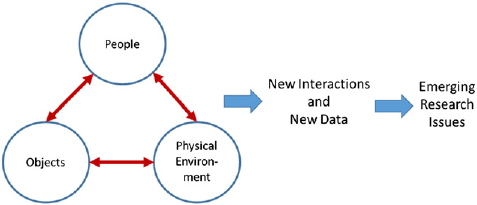
Framework and flow.
On the dimension of “People” in POP, consumers can instantly communicate with others through a variety of means. Vocally, consumers can talk with other people without them needing to be present in the same location. Visually, multiple smartphone apps (e.g., Facetime, Skype) enable people to see each other via live video. Virtually, consumers can connect with others through various text-based or social media platforms (e.g., Telegraph, Twitter, Facebook and Snapchat). Beyond connecting with others, consumers can also monitor others, such as employers their employees and parents their children. Consumers can also connect with themselves via wearable technology. Specifically, in what is known as the “connected self,” wearable technology equipped with multiple sensors and LEDs, such as Fitbit provide wearers with instantaneous access to various personal health metrics such as heart rate, sleep patterns, and calories burned. Wearable technology is thus revolutionizing how people approach activities, such as how athletes train or how frequently office workers take a break from their stationary positions.
On the dimension of “Object”, consumers can connect with the objects they possess and other “connected” objects and sensors present in both public and private spaces. For example, people can now start their automobiles remotely, monitor their “smart” homes and give commands to objects within the home (such as the thermostat), as well as sync information across devices. The IoT extends beyond current possessions to future ones as well, such as the ability to track packages while in transit, from the time of departure at the warehouse to delivery at houses or businesses. Generally, with respect to consumer IoT applications, we are observing many-to-many interactions between smart products—passively, without active human interventions—and interactions between smart products and consumers that are more active. This mixture of interactions, among objects and between consumers and objects, represents somewhat of a “frontier” for consumer connectivity as we currently understand it. The inclusion of connectivity with and among objects—a key part of this framework—adds a layer of additional complexity that, to date, has not been well understood in the consumer behavior and marketing literature.
On the dimension of “Physical”, consumers can connect with their environment such as locating where they are in real-time in order to optimally navigate to a desired destination (e.g., using mobile apps such as Google Maps or Waze). As more cities become “connected cities” and “smart cities”, consumers can instantly learn about the weather, traffic conditions, and current events, as well as the location of public transport (e.g., ride-shares, buses, trains, planes). Constant connectivity also enables citizens to report on various aspects of physical surroundings that may need extra attention from authorities, both actively (such as filing a report of some infrastructure malfunction on a mobile device) and passively (through enabling automatic location-based transmission of traffic and pavement malfunction). Wearable technology also enables consumers to monitor themselves in their physical environment, such as their distance traveled and the speed at which they traveled. The ability to connect to rich and vast amounts of data in their environment transforms consumers into more informed and empowered shoppers. For instance, consumers can learn about the prices of products at different physical and online stores and can access customer reviews while shopping. On the flip side, the connectivity offers the opportunity for firms and governments to respond to consumer actions and shape their demands to increase the profitability or system efficiency from a public policy perspective. More generally, the migration toward smart retail and smart cities is enabled by understanding and predicting consumer needs using not only mobile devices but a host of sensors collecting fine grained data about consumers, infrastructures and integrated systems. These rich sets of interactions that have never been witnessed before offer a tremendous opportunity to answer several research questions related to socio-cyber-physical systems. Connectivity also transforms some traditionally physical formats (e.g., newspapers) into digital formats (e.g., information, entertainment) for consumers.
Our proposed framework forms the starting point to understand the new interactions that are enabled and the new data that is generated through these interactions (see Fig. 1). Based on this understanding, the paper highlights the emerging research issues which are relevant for firms and consumers who are likely to benefit from such interactions as well as regulators who need to ensure consumer welfare and privacy in the midst of large volumes of data the interactions will generate.
In the following sections, we expand on the POP framework for consumer connectivity and discuss how connectivity is changing the way in which consumers connect with People, Objects, and their Physical worlds. We then outline the emerging research issues in the context of discussing the extant research on these dimensions (see again Fig. 1).
Connecting with People
There has been much research in marketing on drivers and consequences of consumer-to-consumer connectivity over the last 15 years (Lamberton and Stephen 2016), particularly given the exploding rise of social media and its mainstream ubiquity for current marketing practice. Many studies have examined how consumers influence each other and marketing-related outcomes in these settings (e.g., Chae et al. 2017; Godes and Mayzlin 2004, 2009; Minnema et al. 2016; Srinivasan, Rutz, and Pauwels 2016; Stephen and Galak 2012). From a social networks perspective, the role of social influence in the context of information diffusion has been investigated in multiple studies (e.g., Goldenberg et al. 2009; van den Bulte and Wuyts 2007). This literature has focused on how consumers directly influence each other's choices due to network effects, which may arise from different underlying mechanisms, such as imitation. Researchers have considered the size of these social influence effects, as well as specific social network structure variables (e.g., degree centrality, tie strength, clustering) as predictors of these effects, primarily related to diffusion.
With the widespread adoption of mobile phones, a tremendous amount of mobile data, presents wireless carriers and researchers with a great opportunity to study consumer behavior, social networks, and, ultimately, the interplay between the two. Importantly, mobile network data often contain extensive, detailed and longitudinal information at the individual level about contacts which can be used to infer social networks (Eagle, Pentland, and Lazer 2009). The network based on mobile data is typically constructed with the call detail record (CDR), which is produced by telecommunications equipment automatically. The record includes the details of a phone call or other communications transaction (e.g., text message) that passes through that facility or device. The record also contains various attributes of the call, including time, duration, completion status, source number and destination number. Several researchers have used CDR data to study social influence on consumer decisions in such domains as new product adoption and churn (e.g., Godinho de Matos, Ferreira, and Krackhardt 2014; Nitzan and Libai 2011; Risselada, Verhoef, and Bijmolt 2014).
As the mobile device has evolved from a simple appliance for calling and texting to a tool with many social apps connecting customers, new opportunities are emerging. For example, sport apps, such as Strava, allow users to follow the sport (i.e. cycling) performance of other customers. New interactive apps (i.e. Musically) allow teenagers to share self-made video clips. This provides new opportunities for studying social connectivity, as connectivity can vary in strength and span multiple dimensions. For example, in a sport app context, researchers can examine how sharing performance affects sport behavior and performance. Will it help runners or cyclers to persist with their activities? Does it stimulate a stronger performance? Does it improve the experience? In the context of Musically, one can investigate if connectivity improves creativity of the videos, or whether more videos get posted as more videos are shared. Similarly, for other social apps, direct reactions to received input from others in the network can be studied.
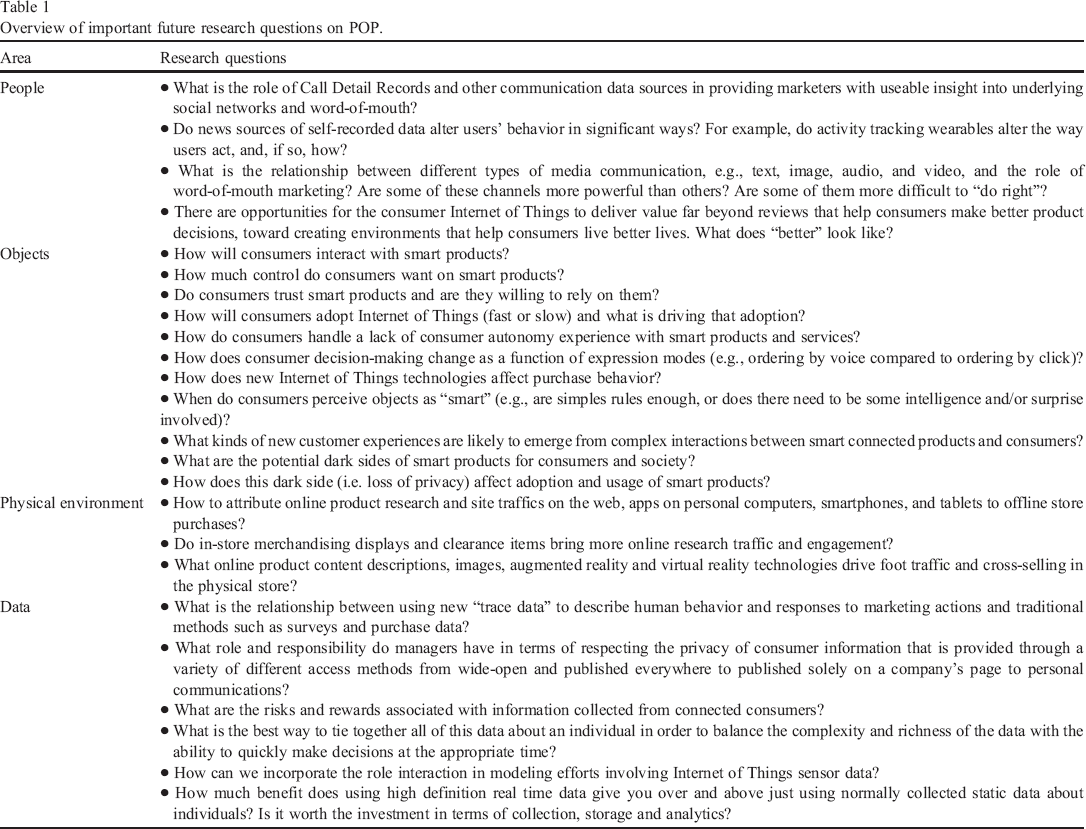
As consumers connect with each other across multiple dimensions—text, image, audio and video—the created content can be analyzed to uncover content-based network structures. For example, there could be strong networks of brands within the content shared by people. A mapping between social networks of people and networks of brands identified in the content could be very helpful for identifying competitive brand maps and associated segments of consumers. Such content networks can extend beyond brands to interests, experiences and needs, representing a treasure trove of information relevant for marketers. Table 1 summarizes the important emerging research issues under this dimension (People).
Overview of important future research questions on POP.
Connecting with Objects
Today we are rapidly moving toward an environment where people may communicate directly with smart everyday objects and these objects can communicate with each other—the Internet of Things (IoT) phase. The consumer Internet of Things involves a wide range of “smart products,” some formerly dumb (e.g. lights, locks and switches), but also some natively smart (e.g. the Amazon Echo, SmartThings hub and Apple watch), that consumers encounter on a regular basis across space and time and that are now capable of interacting with each other and with consumers. By putting sensors and activators on objects commonly found in and around the home and adding network connectivity, numerous objects can become “smart” ones. These include, but are not limited to, connected audio and media streaming devices, connected smart TVs, wearables, thermostats and smoke detectors, lights, switches and receptacles, locks and door openers, air conditioners, hubs, large and small home appliances, all manner of monitoring (pets, food, babies, water, humidity), gaming, cameras, mattresses, clothing, storage spaces, and cars. These few examples show that smart products run the gamut of mostly ordinary objects and devices that consumers regularly encounter as they live their lives. They include objects that can be controlled remotely the user—long finger (e.g., controlling thermostat at home while at work) as well as truly autonomous objects infused with artificial intelligence that takes action based on environmental conditions (e.g., self-adjusting thermostat).
On the related note, Belk (2013) has argued that the meaning of everyday objects changes, depending on who is connecting them, what they are being connected to, and where they are being connected. The ability of smart objects to connect not only with the consumer and each other, but also with other virtual and physical devices on the Internet, will accelerate the pace of change in the meaning of these everyday objects.
We recognize three unique aspects of smart products that impact consumers’ interactions with them—agency, autonomy and authority (Hoffman and Novak 2016). First, by definition, smart products have agency because they have the ability to act (Latour 2005). Just as consumers can express agency by acting on or asserting themselves (Bandura 2001), smart products can express agency to the extent that they “possess the ability for (inter)action, having the ability to affect and be affected” (Hoffman and Novak 2016, p. 30). Second, smart products can play an autonomous role, so that when a consumer interacts with a smart product, it is an active partner in the interaction and has the capacity to autonomously express its agency to the consumer through its actions—whether the consumer directs commands to it remotely or closely or the object acts autonomously. For example, a smart thermostat can adjust the temperature with or without any direct interaction with the home's occupants, communicating that it knows what temperature is optimal for the house better than the consumer does (Nest 2016). Third, smart products have the authority to interact with each other, without direct interaction from the consumers. Lights can go on if unexpected motion is detected, with the lights triggering a camera that will record and send a notification if a person is detected who cannot be recognized. These three unique properties of the components in the consumer IoT, agency, autonomy and authority, impact the kinds of interactions that are possible in networked consumer environments and suggest a host of exciting new research questions.
Smart products exhibit agency in interactions with large-scale systems (i.e., the refrigerator can identify that it is out of milk and eggs and negotiate with grocery stores through APIs to get the “best bargain” in real-time). Different IoT devices can be represented as nodes in an interconnected system where each node has access to certain pieces of information and exhibits certain level of autonomy enabled by consumers. The strategic interactions of these consumer-facing nodes (products) with external systems open up entirely new fields of inquiry and may lead to new business models (Bucherer and Uckelmann 2011). Recently, Leminen et al. (2012) proposed a framework to classify different types of new business models enabled by information shared through IoT devices. We modify the framework to focus on consumer-related business models (see Fig. 2).
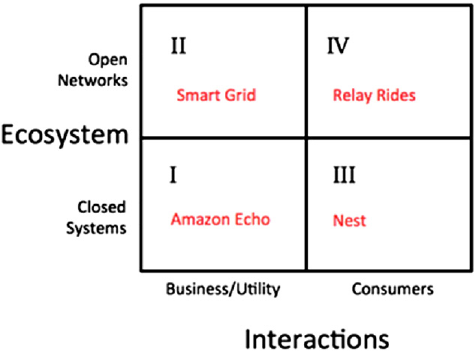
Consumer-centric IoT business models.
We classify the IoT-enabled customer-centric business models on two dimensions. The first dimension captures the extent of the eco-system, where one extreme represents a completely closed system whereas the other extreme represents a completely open network. The other dimension captures whether the interactions are with firms/utilities or with other consumers. Most examples of IoT enabled products have been in a closed system where consumers interact directly with the devices without any external engagement (Model III), for example, products like Nest Thermostat or Dropcam. As more technology companies enter this space, we are witnessing IoT devices acting as a channel between consumers and firms. Amazon Echo is an excellent example of this business model, where consumers can purchase products from Amazon through Echo. As IoT matures, we expect the rise of business models where consumers can interact with firms through open networks that work on pre-established protocols (Model II). Already almost half of U.S. households have smart-meters that can engage in two-way communications (Monnier 2013). As we move toward smart electrical grids, these have the potential to intelligently schedule tasks like running the dishwasher and washing machines during periods when relatively cheaper electricity is available. Finally, Model IV refers to business models where consumers can transact with each other through IoT devices, e.g. Relay Rides that enables strangers to rent someone's car. All these new business models either make existing systems efficient or add a novel interaction that was earlier cost-prohibitive. What remains uncertain is how much value these agents create and what level of autonomy would consumers want to give to these agents to transact on their behalf.
Currently research within marketing and consumer behavior on the IoT is in its early stages. There are numerous interesting research avenues. For example, how will consumers interact with smart products? How much control over smart products do consumers want? Do they trust smart products and are they willing to rely on them? How do they handle a lack of consumer autonomy? How will consumers adopt smart objects—quickly or slowly? How does price of such products play a role in adoption? With every manufacturer comes up with their own standards, how does incompatibility of the smart products impact their adoption? (Kannan and Li 2017).
More interesting are the unintended consequences of smart products which could be viewed as the “dark side” of smart products. For example, use of smart products by consumers may impinge on the privacy of other users (e.g. drones flying over neighbors’ homes; monitoring devices snooping neighborhood). This could result in consumer backlash impeding adoption of such smart objects. Another issue involves runaway smart objects make autonomous decisions that overrides consumer preferences and commands. What impact would such cases have on smart object adoption? Table 1 expands on these issues under the heading of Objects.
Connecting Digital with Physical
Mobile is the hub of omnichannel marketing and retailing with connected customer experience. Mobile is currently playing an integral role in the physical world, both with respect to consumer's shopping behaviors and firms’ targeting strategies. For consumers, the implementation of mobile allows them to connect to the digital world from wherever they are in the physical world, and, hence, introduces the potential for an enhanced purchase experience across both channels. For firms, mobile enables the online and offline channels to be integrated in one seamless fashion with a focus on the overall seamless customer experience (Lemon and Verhoef 2016).
Consumers have the ability to search online, choose brands and products based on reviews posted by other consumers, and then make the final purchase in store. This is typically called web-rooming and has been the dominant form of research shopping behavior for years (e.g., Verhoef, Neslin, and Vroomen 2007). For example, Nordstrom's mobile app allows consumers to search online for clothing or other products, read detailed product information, and receive real-time inventory availability from the nearest store. Thus, for retailers, this extra information can add value if properly integrated to guide consumers to the in-store purchase. Mobile savvy consumers also have the ability to use the retail store as a showroom, making their final purchase online (e.g. Gensler, Neslin, and Verhoef 2017; Rapp et al. 2015). For example, Amazon's mobile app contains a scan feature that can scan an in-store product barcode and offer the same item for purchase from Amazon. Thus, this added competition dimension is extremely important for physical retailers to carefully consider as they enter the mobile domain.
Another important aspect in the mobile domain relates to new opportunities for mobile advertising and promotions. While earlier research focused on product-based drivers of mobile effectiveness (e.g. Bart, Stephen, and Sarvary 2014), today firms and researchers recognize that, similar to online channel, customers’ use of mobile technology generates information that can be captured by firms for targeting purposes. Customers are individually addressable, with devices generally used by a single person; they tend to always have their device with them; and often share their real-time location when using various apps and services, based on cell tower and GPS information. The device also provides flexible communication channels, and customers can be reached through email, SMS (short message service, or text messages), MMS (multimedia messaging service), mobile web, and various other apps. As firms today increasingly take advantage of this opportunity, researchers can study the effectiveness of various advertising and promotion tactics (see Andrews et al. 2016a; Grewal et al. 2016 for overview and research agenda).
The effectiveness of mobile promotions is guided by the principle that context—taking the right action at the right place and time—determines consumer response (Kenny and Marshall 2000). Recent research has confirmed that mobile users seek and respond to information relevant to their location, and are more likely to click through on search results for places near their current location (Ghose, Goldfarb, and Han 2013). Proximity, both in terms of location and timing, also affects response to promotional efforts (Luo et al. 2014). Proximity effects are important even on a localized scale, where different technologies are used to determine location (such as Wi-Fi and low energy Bluetooth beacons); within the confines of a shopping mall, distance has been shown to influence response (Danaher et al. 2015); taken a step further, customers’ real-time trajectories can influence their response (Ghose, Li, and Liu 2014).
Marketers can combine location with other data layers about the user's physical environment. For example, a very basic aspect of physical environment, the weather, can have a dramatic impact on customers’ relative receptivity to different marketing messages (Li, Cheng, and Luo 2015). Place information can allow a marketer to geo-fence competitive locations (Fong, Fang, and Luo 2015). Distinct from social context, the density of people in an environment can affect mobile device usage and promotional response (Andrews et al. 2015).
Less is known about the long-run effects of mobile marketing tactics, which is critically important to study in order to understand the strategic marketing implications of mobile technology. Equilibrium analysis provides one way forward, as we wait to observe what happens as technologies are more broadly adopted. For example, if firms do not consider competitive responses to targeted price promotions, their unilateral evaluations of targeting effectiveness can potentially misestimate the profitability of targeting tactics, even with high quality experimental data; an equilibrium model can be used to predict competitive outcomes (Dubé et al. 2017). Not only will firms adjust their long-run behavior, but consumers will change their behavior as well, and could even choose their location based on firms’ targeting strategies. An equilibrium analysis suggests that consumer cherry-picking of promotions can soften competition (Chen, Li, and Sun 2015). Without better knowledge of long-run and competitive outcomes, it is difficult to address the more basic strategic questions of what markets get served and by whom. In Table 1, these research issues are summarized under the heading of Physical environment.
POP Framework and Data Opportunities
The connectivity of people, objects and physical environment means that virtually everything and everyone around us is collecting data all the time. The growth of these large-scale data streams means that individuals are constantly leaving a “digital exhaust” trail of where they have been (Dhar, Jarke, and Laartz 2014). To understand the new type of data related to POP framework, one has to understand the technology that enables objects to transmit and receive data from other objects.
The data exchange interface most prominently used to date is referred to as Application Protocol Interface (API). These programming interfaces allow for connectivity in a standardized and platform-independent way. For example, making so-called API requests via standardized URLs, one can retrieve data about objects in the Internet of Things (e.g., to integrate data from a temperature sensor in a user's smart home). Compared to proprietary transmission systems, APIs enable software developers to costlessly experiment with integrating new data retrieved from objects in one's own product or service. It is not surprising that new platforms/devices heavily invest into having a well-documented API to facilitate as many other devices to integrate with their platforms/devices.
One pioneer of API technology in the social media domain is music recommendation service Last.fm, collecting users’ music consumption history from multiple devices and platforms. Instead of programming interfaces to hundreds of different music players themselves, Last.fm released a public API which allowed developers and/or users of these clients/players to program these interfaces instead. Importantly, due to the open nature of APIs, they enable researchers to tap into the information stream between customers and their devices, and devices between each other. For example, to monitor consumer behavior on Twitter, Toubia and Stephen (2013) used the streaming API of Twitter. Certainly, the potential of tapping into the communication stream between consumers and objects, and objects among themselves, leaves ample data opportunities for future research.
Another key concept relates to emerging data structures when working with connected consumers. Traditional data sets analyzed in marketing are “flat” and have a fixed structure. Consider, for example the structure of typical panel data, which consists of customers’ visits (potentially multiple) to store outlets per week. However, current communication structures between objects are more complex than this. While meta-data (e.g., timestamp, transmitting and receiving device) are relatively easy to record, the exchanged data is highly diverse; while a fitness tracker may transmit data on a user's running speed to their favorite running app, a social network may transmit recently taken photos or video content to a user's watch. The data structure, hence, needs to be sufficiently flexible to accommodate these different types of data (e.g., numeric/text, photo, and video).
A popular format used for that purpose is called JSON—Javascript Object Notation. This semi-structured data format stores information in nested trees (e.g., a shopping history nested within a customer). However, the format is free with regard to what additional data is stored (e.g., within a customer's shopping trip, a company may store tracking data from in-store Wi-Fi/iBeacon devices). While highly flexible and often used in practice, researchers still need to leverage the wealth of information that can be extracted from these semi-structured data sources. Indeed, better attribution cross-channel, cross-device, cross-media models need to be developed to understand which marketing channels have the strongest power for customer acquisition and retention, extending on prior work (De Haan et al. 2016; Li and Kannan 2014). Advanced modeling is used to account for the fact that different channels are being used in different phases of the search-purchase funnel. However, the challenge continues to be that more data does not necessarily mean better models and better consumer insights.
The last decade has witnessed an enormous amount of data collected by firms to target consumers with ads and products. Most of these data were limited to the online domain, capturing just a snapshot of consumers’ activities and preferences. With the emergence of mobile devices, firms have been able to target consumers based not only on their location (Andrews et al. 2016b), but also their trajectories (Ghose, Li, and Liu 2014). Data from IoT enabled devices will push this boundary further and allow firms to peek even deeper into the consumers’ journey and extract their preferences.
While firms can use these data to maximize consumer experience, they can also be exploited to extract a larger amount of consumer surplus. Companies like Amazon, Apple and Google are competing aggressively to get a foothold in households using IoT devices (Bariso 2016). This data-rich environment raises several privacy and security related issues. One of the most pressing questions is who owns and controls the data? This question has been gaining significant regulatory oversight especially in Europe, which recently disallowed third party cookies from collecting data without explicit user content. We believe this issue is going to get even thornier once devices inside people's homes start collecting and sharing data on a larger scale.
It is not clear yet if market driven incentives will be sufficient for firms to adopt policies that favor consumers or whether regulatory oversight is required to ensure a fair outcome for consumers. While some research suggests that businesses may be better off collecting less data from consumers to preserve credibility of tailored marketing communication (Gardete and Bart 2016), further empirical investigation and systematic analysis of risks and rewards associated with the information collected from connected consumers is much needed (Wedel and Kannan 2016). Moreover, models accounting for limited data availability can be developed (e.g., Holtrop et al. 2017). At the same time, the prevalence of IoT devices also poses a big security risk in addition to the privacy risk. Connected devices may serve as an entry point for intruders to hack into these interconnected systems and steal sensitive consumer information from homes and cars. Addressing both the privacy and security risk becomes even more important as adoption of IoT devices by connected consumers increases.
Specifically, it is important for future research to focus on helping regulators and policymakers understand how POP and consumer data privacy can coexist harmoniously. Real-time location information is potentially quite sensitive, and consumers may not always understand the lengthy terms and conditions they agreed to. However, other relevant factors may not be immediately apparent, and further research is needed: for example, location information has enabled ride-sharing services that provide alternative means of transportation. Adoption of these services has been associated with lowered rates of vehicular homicide, which should be a high priority public policy consideration. Similarly, there may be law enforcement applications which present tradeoffs between civil liberties and public safety. Table 1 highlights the important data related research issues that are fast emerging.
Conclusion
We are living in an increasing connected world, which is being facilitated by mobile technologies. In this paper we have aimed to discuss this connectivity by focusing on three types of connectivity: people-wise, object-wise and physical-wise. In most recent years we have seen the strong development of mobile technologies. However, in this paper, we also discussed new emerging developments surrounding the IoT. While research on the consumer IoT is in its infancy, we can speculate about where the future is likely to take us. We identified multiple avenues for future research on the four important areas of research: people, physical, products and data. As already noted within this paper we provide these avenues in Table 1 per area. In the people domain, we still observe opportunities for future research. Specifically, we are interested in how new technologies (i.e. smart devices) will affect behavior. In the physical domain, research is required to understand how mobile technologies affect offline purchase behavior, as well as how mobile technologies used offline affects online purchase behavior. Our table clearly shows that IOT and smart products will create many opportunities for future research. The list of research questions is large and strongly focuses on how consumers will use and consider smart products. Finally, the new technologies will also provide opportunities for research on data. Specifically, we want to mention the use of data by firms and consumers, and how privacy concerns will come into play. We hope that our list of research questions in Table 1 will stimulate future research on connecting People, Objects and the Physical environment with considered increasing amounts of different data.