







Abstract
Sharing experiences with peers through online reviews has amplified the impacts of individual articulations on the reputations of firms across many industries. With employee review sites, current and former employees share their positive and negative experiences with their company, which has become an increasingly important aspect for reputation management and for job seekers’ decision-making on where to apply. In the present study, the effects of discrepant reviews (i.e., reviews with a high variance in company evaluations) are examined in the context of employer review sites. In particular, we investigate how review discrepancy, persuasion knowledge activation, and constructive company responses affect job seekers’ trust in the company and the resulting application intentions. In our preliminary study, we analyzed a sample of 25,827 published company reviews on the German employee rating site Kununu.de. The results revealed that high levels of discrepant reviews for the same company exist, thus underlining the need for additional studies. In our main study, a 2 (review discrepancy) × 2 (persuasion knowledge activation) × 2 (company response) between-subject-design experiment was conducted with 311 respondents. We find that high levels of discrepancies lead to increased intentions to avoid submitting applications to the focal company and reduced intentions to pursue employment. This study complements the research concerning online reputation by highlighting the relevance of discrepant reviews for job seekers’ application intentions.
Introduction
In an era in which firm- and marketing-controlled channels (e.g., corporate web sites, online advertising) as main drivers of a company's reputation seem bygone and their effectiveness on consumer attitudes and behaviors is lacking, stakeholders (such as customers or employees) influence peer consumers’ perceptions and behaviors, as well as the firms’ brands via various online articulations (Huebner-Barcelos, Dantas, and Sénécal 2018; Pitt et al. 2018). Multiple online platforms, such as travel and hospitality review sites like TripAdvisor, provide highly accessible and influential venues to express opinions, share experiences, and encourage or discourage peers from choosing a specific brand or service provider (Melián-González and Bulchand-Gidumal 2017). Those platforms distribute and aggregate feedback about firms, products, and services of all kinds (Dabirian, Kietzmann, and Diba 2017; Diekmann et al. 2014). In this new area in which traditional marketing-controlled media are complemented (and sometimes replaced) by consumer-initiated communications, Hennig-Thurau et al. (2010, p. 324) label the consequences for marketing management as playing pinball, in which extensive information is “available on brands and products which can multiply, but also interfere with the companies’ marketing messages (such as bumpers do when playing pinball),” thus making it more complex to control the firm's reputation online.
In this context, the role of consumers’ online articulations in shaping the attitudes and behaviors of peers, thus influencing the firm's and its offerings’ reputations, has received a significant amount of empirical research (e.g., King, Racherla, and Bush 2014; Lamberton and Stephen 2016). This line of research has been complemented by investigations of online articulations’ characteristics, such as their valence (e.g., Plotkina and Munzel 2016; Purnawirawan et al. 2015) and their volume (Chevalier and Mayzlin 2006; Liu 2006). In addition to the valence and volume, another line of research integrated the notion of a consensus among individual reviews that amounts to an aggregated picture of the products or services that reflects the underlying consensus among raters (Benedicktus 2011; Purnawirawan, De Pelsmacker, and Dens 2012). However, while the consensus of online articulations of consumers has received some empirical research, the effects of the discrepancy between those articulations have remained widely under-researched.
More recently, with the rise of online employee review sites such as Glassdoor, online articulations by other-than-customer-stakeholders of the firm (e.g., employees) and their impacts on the reputation of the company's brands and offerings became the focus of empirical research (King and Grace 2010; Pitt et al. 2018). With online employee review sites, current and former employees can anonymously and publicly write visible reviews regarding their current or former employer. Similar to customer review sites, employee review sites are more credible than corporate websites (Kaur and Dubey 2014) because they are independent and are not controlled by the company, as is the case for owned social media (Sivertzen, Nilsen, and Olafsen 2013). Consequently, recent research highlights the importance of online feedback from employees on the firm's attractiveness as an employer and the firm's overall reputation. For example, Opitz, Chaudhri, and Wang (2017) show that, compared to customers’ articulations, the negative voices of employees cause disproportionally more harm to a firm's reputation.
Despite the growing popularity of employee review sites (for instance, Glassdoor has approximately 35 million reviews of 700,000 companies (Glassdoor 2017) against 11 million reviews in early 2016 (Forbes 2016)) and their importance for employer branding, they have received surprisingly little attention in marketing research (Ollington, Gibb, and Harcourt 2013). For example, Schmiedel et al. (2016) examined company reviews from Glassdoor to identify cultural factors that matter to the IT workforce. Other researchers have pointed to the potential of social media for online recruiting in general (e.g., Holland and Jeske 2017; McFarland and Ployhart 2015; Sivertzen, Nilsen, and Olafsen 2013). However, there remains a need for research to investigate the consequences of different company review characteristics (e.g., positive, negative, and mixed) on job seekers’ intentions to apply for a job or to deny submitting an application. These are important outcomes since attracting and retaining key talents may determine the company's future competitiveness in times in which employee loyalty has decreased (Bondarouk, Ruel, and Weekhout 2012; Roth et al. 2016).
The present research contributes therefore to the marketing literature in four ways. First, by investigating the effects of discrepant online reviews on trust perceptions and behavioral consequences, this research further complements research on the effects of specific review characteristics (here, the discrepancies between reviews). For the present research, discrepant reviews refer to the extent of disagreement among different company reviews of the same organization (Jiménez and Mendoza 2013), and it might be considered the opposite of consensus information, which signals forms of social proof (Cialdini 2006). The current study therefore seeks to gain an understanding of the impacts of discrepant reviews on readers’ behavioral consequences.
Second, the present research adds to the literature on the effects of online reviews on attitudinal and behavioral outcomes by focusing on online articulations in an under-researched setting: employee reviews on employee review sites. As customers increasingly take into account the treatment and working conditions of employees in their purchasing decisions, the consideration of employees’ reviews seems important as a highly impactful driver of a firm's overall reputation. In addition, employee reviews form a signal to potential job applicants and may influence their intentions to submit an application or not.
Third, this research also studies the role of persuasion knowledge activation in evaluating online reviews. Potential customers or job seekers may be generally aware of company's persuasion attempts in various forms, such as marketing campaigns or news reports, on marketing tactics (Bambauer-Sachse and Mangold 2013; Munzel 2016). Having this knowledge activated may be an important determinant of the context of employee review sites. The third contribution therefore pertains to the analysis of the effects of persuasion knowledge activation in job application scenarios.
Finally, as a potential coping strategy, the role of firm responses is examined, such as constructive statements regarding negative evaluations. Marketing scholars already investigated how firms could and should respond to criticism voiced online to prevent unfavorable effects on their reputation (Dens, De Pelsmacker, and Punawirawan 2015; Schamari and Schaefers 2015; Ullrich and Brunner 2015; Van Laer and de Ruyter 2010). However, while existing research includes the roles of consensuses and constructive firm responses, their scrutiny so far is separate. This final contribution pertains therefore to the investigation of managerial constructive responses to negative company reviews. Additionally, together with the discrepancy of reviews, it fills an important gap in the literature on the combination of firm responses and a consensus among reviews.
The research aims to address outlined gaps in the literature and to test the motivated hypotheses in a two-step approach. In a preliminary study, we first assess the extent of review discrepancies for 25,827 employer reviews of 400 companies drawn from a large German employee review site called Kununu.de. The results of this preliminary study confirm high levels of discrepant reviews for the same company. Based on the findings of our preliminary study, our main study employs a 2 × 2 × 2 between subject design experiment with 311 participants to unravel the effects of review discrepancies, persuasion knowledge activation, and companies’ intervening actions on job seekers’ perceived trust and related application intentions. In particular, in the main study, we manipulated the company's review discrepancy (factor 1: low vs. high), persuasion knowledge activation (factor 2: active vs. not active), and constructive company responses to negative comments (factor 3: available vs. not available).
Theoretical Background and Hypothesis Development
Online Reputation and Review Sites
Corporate reputation is defined as “a perceptual representation of a company's past actions and future prospects that describes the firm's overall appeal to all of its key constituents when compared with other leading rivals” (Fombrun 1996, p. 72), and it reflects the impressions of various stakeholders of a firm (Musteen, Datta, and Kemmerer 2010; Schaarschmidt, Walsh, and Ivens 2015). A track record of delivering on promises and gaining trust is essential for a good reputation. With the changing digital landscape, a wide variety of stakeholders, such as employees and customers, are shaping companies’ reputations by providing online content (Shmargad and Watts 2016). Hence, companies face the challenge that all stakeholders have the ability to publish content online through social media channels, which are usually not under managerial control. Corporate guidelines with regard to employees’ Internet and social media usage (i.e., social media guidelines) are a useful intervening mechanism, but they cannot guarantee that former employees do not express their (negative) opinions publicly (Walsh, Schaarschmidt, and Von Kortzfleisch 2016). Thus, we observe a transfer of the locus of control (Rotter 1954) in marketing communication away from business towards the consumers/employees (Berthon et al. 2012).
Signaling theory underscores the importance of online reputation and rating sites since it outlines that individuals search for signals when they face degrees of information asymmetry (Spence 1974). In the present case, internal stakeholders (i.e., employees) usually hold more information about a company than job seekers. Due to this lack of information on the job seekers’ side, job seekers try to reduce the information asymmetry and search for information about the company (Boulding and Kirmani 1993), which they do on employee review sites such as Glasdoor.com and Kununu.de in the times of social media. Thus, peer reviews of companies form a signal for job seekers, which, in return, affect how job seekers rate the company. Thus, employee review sites have offered new opportunities and challenges for online reputations and employer branding.
Due to multiple global turmoil and financial scandals, such as Volkswagen's exhaust gas scandal in 2015 (Davenport and Ewing 2015) or the United Airlines incident in April 2017 (Victor and Stevens 2017), the public scrutiny of companies is rampant, and trust in companies is possibly more important than ever. In the context of online reviews, multiple definitions of trust exist (McCorkindale, DiStaso, and Sisco 2013), but, for this study, we equate trust to “one party's level of confidence in and willingness to open oneself to the other party” (Hon and Grunig 1999, p. 19). Previous research has shown that trust is a decisive driver of intentions and transactions and becomes increasingly important due to the recent discussions of deceptive reviews (Mayzlin, Dover, and Chevalier 2014; Munzel 2016; Pan and Chiou 2011). Hence, trustworthiness is one of the most often investigated constructs in the context of online reviews and has played an important role for the resulting intentions, such as the intention to pursue employment (e.g., Cheung et al. 2009; McKnight and Kacmar 2006; Park and Lee 2009). The following sections discuss how discrepant reviews, persuasion knowledge activation, and constructive company responses affect perceived trustworthiness and the subsequent job seekers’ behavioral intensions, such as denying or submitting applications. Our underlying conceptual model is depicted in Fig. 1.
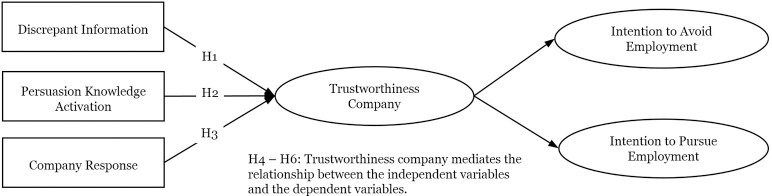
Study design.
Discrepant Company Reviews
Online reviews provide insights into companies, products and services and influence consumers’ decisions and behavioral intentions (Zhu, Yin, and He 2014). In general, the majority of reviews in the context of employee ratings are written anonymously. Features that disclose personal information, such as the author's real name, are typically not available. Hence, readers can only estimate the review source's trustworthiness based on own experiences with the company, with review platforms in general, and the consensus of information provided in reviews (Boerman, Willemsen, and Van Der Aa 2017). In virtual environments such as review sites in which information about the author of a review is scarce, the average opinion and discrepancy between reviews are immediately accessible and assist the reader in making causal inferences about the company and the review, and thus it influences the trustworthiness of the firm (Ba and Pavlou 2002; Pavlou and Dimoka 2006). Consensus information acts as a broad persuasive cue and choice heuristic (Chaiken, Liberman, and Eagly 1989), which reduces the complexity of individuals’ attributions and decisions and potentially enhances the perceived trustworthiness of the company (Benedicktus 2011).
Due to the power of consensus information and drawing on attribution theory in particular, we form our first hypothesis. Attribution theory describes how people interpret behavior and how this affects their own thinking and behavior (Heider 1958). Based on the framework of Weiner (1974, 1986), a three-stage process underlies an attribution. In the first stage, the individual must observe or perceive a certain behavior. Second, the individual must believe that this behavior was intentionally performed by others. Lastly, the individual must decide whether to believe that the other person was forced to perform the behavior due to their situation. Transferring the last step of the framework to our context, if all reviews are in line with each other (and in line with the numeric assessment) and there is a unanimous opinion about the reviewed company, the full set of reviews will, as a whole in an ex-post reasoning, be attributed to the depicted company's performance (as reflected in an average numeric assessment).
In the case of high discrepancy in which company profiles have a large number of deviating reviews, the reader might not be able to attribute the impression derived from the reviews to an overall company picture. Therefore, discrepant information does not lead to a coherent picture and review readers cannot correctly attribute the causes for the reviews to potential reasons. Thus, instead of trust derived through a feeling of harmony (Kelley and Michela 1980; Orvis, Cunningham, and Kelley 1975), discrepant reviews leave the review reader with a cognitive dissonance, especially when the overall review ratings are neither extremely positive nor extremely negative (Purnawirawan et al. 2015). In turn, we expect that a high level of discrepancy with regard to numeric assessments and the text sentiments (for reviews in expected non-extreme ranges) influence job seekers’ inferences about the review's source and finally reduce their perceptions of companies’ trustworthiness. Therefore, we posit the following hypothesis:
Persuasion Knowledge Model
Our second hypothesis is related to an extension that is based upon job seekers’ presumptions that reviews are generally manipulated. According to Gartner (2012), approximately 10–15% of all social media reviews have been faked. In a recent study of the large, multi-category review site Yelp, Luca and Zervas (2016) report that approximately 16% of reviews in their sample were considered as being suspicious and filtered by the site's teams. Overall, Yelp's algorithm for the same period as the study conducted by Luca and Zervas (2016) identified approximately 25% of their reviews as fake. These high numbers endanger the trustworthiness of online reviews in general. Therefore, having these deception attempts in mind when evaluating company reviews might change the attitudes towards the company and the behavioral consequences. To study these potential effects in detail, we draw on the Persuasion Knowledge Model (PKM). The PKM describes how people's persuasion knowledge influences their responses to persuasion attempts (Friestad and Wright 1994). In particular, the PKM postulates that customers develop knowledge about persuasion through experiences in social interactions and from observing marketers and other persuasion agents (e.g., advertiser and recruitment agencies). Over time, customers’ persuasion knowledge develops and customers “cope” with persuasion episodes. Previous research has shown that persuasion attempts in terms of different pricing tactics (e.g., Kotler and Keller 2006; Noble and Gruca 1999) and in-game-advertising (Lorenzon and Russell 2012) lead to higher persuasion knowledge on the customers’ side.
Consistent with the underlying premises of the PKM, our study focuses on job seekers’ activated persuasion knowledge, which is likely to affect companies’ perceived trustworthiness. Due to the anonymity of company reviews, job seekers are generally uncertain whether the company review was written by an unbiased source (e.g., an honest employee) or a biased commercial source (Boerman, Willemsen, and Van Der Aa 2017; Mayzlin, Dover, and Chevalier 2014). However, in line with previous research (e.g., Munzel 2016), we argue that persuasion knowledge is not permanently present in the review readers’ minds, which is why an activation of persuasion knowledge is often needed. Based on this argumentation, and in line with previous research on the use of persuasion knowledge (Boerman, Willemsen, and Van Der Aa 2017), we expect that an activation of job seekers’ persuasion knowledge increases their sensitivity towards review sources and review balance (Purnawirawan et al. 2015), which leads to lower evaluations of information credibility. In turn, this general sensitivity has (through a spillover effect (Chae et al. 2016)) a negative effect on the trustworthiness of the company that was rated.
Intervening Company Actions
When negative reviews appear, companies must address these reviews by either ignoring them or by actively intervening, although companies are considered to respond to company reviews comparatively slowly (Goldsmith and Horowitz 2006). While existing research highlights the importance of negative reviews as a threat to trust and company integrity (Van Laer and de Ruyter 2010; Ward and Ostrom 2006), more research is needed to further the discussion of how to actively address those negative articulations in order to mitigate their effects on potential customers or employees and the company's reputation. Increasingly, companies engage in showing that they are able to handle critiques and creating a dialog with their employees or customers (De Vries, Gensler, and Leeflang 2012; Dens, De Pelsmacker, and Punawirawan 2015). From an image restoration perspective, company responses are assumed to be a goal-directed activity and, in the case of a crisis or threat to one's image, focus on restoring or protecting one's reputation (Benoit 1995). For example, Lee and Song (2010) revealed that 23% of complainants in an online forum expressed their desire to receive a response from the company. Furthermore, individuals tend to expect a response by the company to understand the firm's explanation of the problem, and the literature on service failure management suggests that responding to a negative statement should be a better strategy than not taking any step at all (e.g., McColl-Kennedy and Sparks 2003). Response strategies, such as constructive feedback, are shown to reduce the perceived harm of a failure or conflict (Liao 2007; Mattila 2006). Thus, company responses on company evaluation platforms give companies the opportunity to prove that they take their employees seriously and are able to respond in a constructive manner. For example, if an employee writes a review that states that he/she does not receive enough appreciation, the company has the ability to refute this negative signal by writing an official response that offers personal discussion. Previous literature has shown that feedback in a constructive manner creates mutual trust (Six, Nooteboom, and Hoogendoorn 2010). Hence, a constructive company response sends a positive signal to the public that may outperform the preceding negative review. Thus, we expect that job seekers perceive the trustworthiness of a company to be higher if the company makes use of the constructive responses to negative reviews.
Job Seekers’ Behavioral Consequences and Mediation of Trustworthiness
Drawing on the commitment–trust theory (Morgan and Hunt 1994), we develop our next hypotheses H4 to H6, which address the effect of discrepant online reviews, persuasion knowledge activation, and company responses on two relevant outcomes: job seekers’ intentions to avoid employment and their intensions to pursue employment (Van Dam and Menting 2012). Here, trustworthiness has a mediating role (Fig. 1).
According to the commitment–trust theory, trust is the key mediator in the exchange between participants and reduces decision-making uncertainty (Morgan and Hunt 1994). Trust enables partners to take a long-term view of a relationship (Holdford and White 1997) in which job seekers are usually interested. Hence, job seekers who trust the company are more inclined to pursue employment because they believe that a positive outcome (e.g., regular payment and high esteem) will result from their decision to join this company. In addition, the intention to pursue employment may be seen as one of the most important decisions during an application because this is the prerequisite for all the following steps in the recruitment process. In turn, the intention to avoid employment describes a situation in which job seekers do no longer take the company into consideration when applying for future jobs. From a managerial perspective, avoidance is difficult to address since the company is usually unaware of the factors that result in missing applications.
In line with the previous reasoning detailed in the establishment of H1–H3, we propose that discrepant online reviews (discrepant information) and persuasion knowledge activation increase job seekers’ intentions to avoid employment and limit their intentions to pursue employment. In addition, we propose that company responses should have a positive effect on the intention to pursue employment but a negative effect on employment avoidance. In line with our reasoning on trust, we further propose that all paths are mediated by perceived trustworthiness. That is, all three aspects influence job seekers’ behavioral consequences since they affect trustworthiness, because trustworthiness affects the intentions to pursue or avoid employment, and there is no discrepancy as such.
Preliminary Study
Purpose and Data Description
The purpose of the preliminary study is to analyze the level of discrepancies in company reviews with respect to their numeric assessment and sentiments within the texts. To that end, we analyzed 25,827 reviews for 400 companies from Kununu.de between April and June of 2016 to assess how reviews deviate in reality. The companies were derived from four different sectors, which were equally distributed among information technology, logistics, health care and tourism. The company reviews usually consist of a title, a review text and a numeric assessment. To compare the tones of the reviews, we also calculated sentiments, which are the attitudes or feelings towards something (Hovy 2015), for each review. For sentiment analyses, we used AlchemyAPI, which is part of the IBM cloud platform Bluemix. AlchemyAPI is an easy to use web service that is able to analyze unstructured contents (news, articles, blogs, posts, etc.). It provides mechanisms to identify positive or negative sentiments within texts on a range from − 1 (negative) to + 1 (positive). Since not all reviews consist of a text and not all reviews consist of enough text to calculate sentiments, the sentiments of our analyzed company review titles and review texts were assessed using subsamples of 15,717 review titles and 12,249 review texts. 1
Please note that some reviews consisted of numeric assessments only, which is why the numbers of analyzed titles and texts are not equal to the overall number of reviews.
Numeric assessments of company reputation by current and former employees range between 1.0 (bad) and 5.0 (good) in a “star”-format. The standard deviation is 1.20 within all reviews’ numeric assessments according to the 25,827 reviews. The results show that all measured variables in Table 1 (i.e., the numeric assessment, review length, title length, review sentiment, and title sentiment) are significantly correlated at the level of p < 0.001, except for the correlation between title sentiment and title length. Consensus information is created if the information in different company reviews concerning the same company is similar, which means that the reviews do not deviate in a significant way. We analyzed the deviation of the numeric assessment within the same company and came to the result that 4,094 out of 25,827 reviews (15.8%) have a standard deviation of over 1.5 from their respective average company assessment. Based on this result, we can assume that a considerable number of discrepant review sets exist for the same company.
Correlations, means and standard deviations from company reviews (n = 25,827).
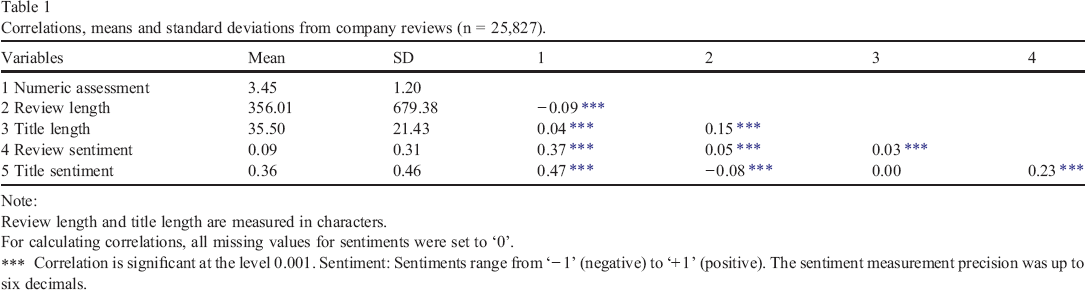
Note:
Review length and title length are measured in characters.
For calculating correlations, all missing values for sentiments were set to ‘0’.
Correlation is significant at the level 0.001. Sentiment: Sentiments range from ‘− 1’ (negative) to ‘+ 1’ (positive). The sentiment measurement precision was up to six decimals.
We further assessed the equality of the consensus for the differences for each company. Levene's test was used to assess the equality of the consensus for the differences between the ten most evaluated IT companies on Kununu.de. The results revealed significant differences between company reviews. Levene's test indicated unequal variances for the numeric assessment (F9,3,422 = 39.12, p < 0.001), title sentiment (F9,2,005 = 6.71, p < 0.001) and review sentiment (F9,1,562 = 2,79, p < 0.01). Together, the results indicate that job seekers are confronted with different levels of review discrepancy per company with regard to the numeric assessment and title sentiments. Table 1 depicts the descriptive results of the preliminary study, including the results of the sentiment analysis. We used the results (e.g., average numeric assessment) to build our experimental design, as we detail in the next section.
Main Study
Experimental Design
We tested our hypotheses by means of an experimental online survey design. In particular, we used a 2 × 2 × 2 between subject design and treated discrepant company reviews (factor 1: low vs. high), persuasion knowledge activation (factor 2: not active vs. active) and constructive company response (factor 3: not available vs. available). In particular, we created four new virtual company profiles in the design of an employee review site that deviate in their respective dimensions (including review title, review text and numeric assessment from a job seeker's perspective) to capture factors 1 and 3. We decided to create new virtual companies so that the reader would be unbiased. For factor 1, we needed two profiles that deviated in their degrees of discrepancy. Our research design requires companies with two different levels of discrepancy, but the average rating should be equal in terms of the overall assessment, sentiments and lengths. The preliminary study revealed that companies’ mean numeric overall assessment was 3.45 on a five-point scale, the mean title sentiment was 0.36 and the mean review sentiment was 0.09. Therefore, we decided to use these average values to build our fictitious profiles. In particular, each experimental condition compromises four company reviews by employees. The average numeric assessment, title sentiment, and review sentiment for these four reviews were equal to the results of the preliminary study. All used review titles and reviews originate from the Kununu data and were chosen to resonate with the desired tone of the experimental condition. Table 2 depicts one experimental condition with a company profile that reflects high discrepancy in all dimensions. As one can see, the average mean and sentiment are comparable to the average identified in the preliminary study, but the average results from high variations (i.e., discrepancy) in reviews. Table 3 shows an excerpt of a company profile with the factor discrepancy ‘low’ for comparison. In other words, the profile in Table 2 is characterized by high deviation in terms of the numeric assessment and review title, while the profile in Table 3 shows comparably lower discrepancy. Please note that the means of the numeric assessment, title sentiment and review sentiment are equal for both companies to ensure the comparability of results.
Factor: discrepant company reviews = “high”.

Note: The titles were translated from a bilingual English-German speaker into German language. Please contact the authors for the review texts.
Factor: discrepant company reviews = “low”.

With regard to the persuasion knowledge activation (factor 2 = not active vs. active), we created a fictions newspaper article that informs one experimental group of respondents about the high number of faked company reviews by means of recent statistics before they entered the survey. With regard to the constructive company responses (factor 3), one experimental group received employee review profiles that included constructive responses by the focal company (both for the discrepant and non-discrepant reviews sets) while the other group did not.
Data Collection and Sample
To recruit respondents, a crowdsourcing Internet marketplace for business and scientific purposes called Clickworker was used. Requesters are able to post different tasks such as an online survey for so called Clickworkers. Clickworkers can self-select different tasks on which they want to work for in exchange for a monetary payment set by the requester. In addition to that, requesters can require specific characteristics or skills from Clickworkers. As a requester, we published our online survey and asked for German employees, since Kununu, our example employee review site for this study, is a German service. In the literature, it is recommended to use attention check questions to increase the chance of collecting high-quality data when crowdsourcing based platforms are used (Peer, Vosgerau, and Acquisti 2014). Hence, we included an attention check question in the middle of the questionnaire that read, “Please answer the following question with ‘sometimes’.” We asked for 320 responses to the survey and provided a compensation equaling € 11.50 per hour for the completion of the questionnaire. The survey was accessible for only 14 hours since we achieved our intended sample of 320 complete answers within that time period.
To ensure external validity, our subjects had to represent the target group of individuals as closely as possible. As eligibility criteria for our survey, participants must already have experience with a review site, which makes them eligible to be a potential user of this platform. Our invitation referred to an academic study regarding “comparison of branches,” thus obscuring the real intention so that no potential self-selection bias would arise. Next, we randomly assigned each participant to one of our eight experimental groups. The average time spend on the survey was 8 minutes and 34 seconds. We eliminated all participants from the sample who finished our survey in less than 3.5 minutes since, according to various pretests, this was the minimum amount of time necessary to read all the text. The attention check question eliminated further participants. As a result, the final sample consisted of 311 completed surveys. A detailed sample description appears in the appendix. Of the respondents, 153 were male and 158 were female. On average, the employees were 36.3 years old. The majority had a high school diploma.
A Priori Manipulation Check
We conducted an a priori manipulation check for our three factors (factor 1: company review discrepancy, factor 2: persuasion knowledge activation, factor 3: company response). We follow Ellsworth and Gonzalez (2009) that stated that a manipulation check can interfere with psychological processes. Delayed manipulation checks may be stalled so much that the initial effect could disappear or be changed. In our case, a manipulation check after the treatment would have drawn the readers’ attention to the treatment and change their opinion on the treatment. Therefore, our independent variables (e.g., review discrepancy) are a combination of the independent variable and the probe but are not the ones we intended. On the other hand, manipulation checks at the end of the survey can cause problems because respondents’ impressions have changed and events have taken place, which makes the participants unable to unravel their current feelings from earlier answers. Recent research has also applied this procedure of a priori checking the experimental conditions (e.g., Purnawirawan, De Pelsmacker, and Dens 2013). Thus, the sample we used for our a priori manipulation check is not equal to the sample of our experiment. The sample of the a priori manipulation check consisted of 120 participants that were recruited via a convenience technique via Facebook and who were randomly assigned to one of our eight experimental groups. With regard to the company review discrepancy (factor 1: low vs. high), respondents were asked using a seven-point Likert scale ranging from 1 = “strongly disagree” to 7 = “strongly agree” how much they agreed with the following statement: “The reviews within the company evaluation are discrepant.” An ANOVA shows that respondents with the factor discrepant company review ‘low’ (Mlow = 3.87) perceived less discrepancy than those with the factor discrepant company review ‘high’ (Mhigh = 6.03) (F (1,119) = 77.26, p < 0.001). With regard to the persuasion knowledge activation (factor 2: not active vs. active) and company response (factor 3: available vs. not available), we asked whether respondents had seen the newspaper article about the faked company reviews and the company's constructive responses. All respondents answered the questions in the desired way. Hence, the manipulation was successful and appropriate to be used in the main study.
Measures and Model Evaluation
Our questionnaire for the main study contained multi-item measures for our constructs. All constructs relied on existing, validated scales to foster the validity and reliability of the measurement. A seven-point Likert scale ranging from 1 = “strongly disagree” to 7 = “strongly agree” was applied. The items were translated from a bilingual speaker into German for the final survey. To measure the perceived company trustworthiness, we adapted three items from Andrews, Netemeyer, and Burton (1998) and included two additional items: “The overall picture of this company appears consistent and no intention to defraud is apparent.” and “Honest employees work in this company.” A reliability analysis resulted in a Cronbach's α of 0.94 and an adequate composite reliability (CR) of 0.94 (Bagozzi and Yi 2012). We included two additional items because, in short pre-study interviews with HR managers, we received suggestions to include platform-specific items. 2
We also ran our analysis without the additional items, and the results remained stable. We thank one anonymous reviewer for the suggestion to clarify this issue.
To measure the intentions to avoid employment, we adapted five items from Allen, Van Scotter, and Otondo (2004) that we formulated from an avoidance intention perspective. Reliability analysis revealed an adequate Cronbach's α of 0.93 and a CR of 0.92 (Bagozzi and Yi 2012). For the latent variable intentions to pursue employment, we adopted five items from Highhouse, Lievens, and Sinar (2003). Reliability analysis revealed an adequate Cronbach's alpha of 0.9 and a CR of 0.9 (Bagozzi and Yi 2012). Next, we confirmed the reliability and validity by conducting a confirmatory factor analysis (CFA) using AMOS 23 and a maximum-likelihood estimator. In our CFA, we analyzed the company's trustworthiness, the intentions to pursue employment and the intentions to avoid employment. The model revealed a good fit with the data. All items have factor loadings above 0.5. The good model fit is also indicated by χ2 = 225.5, df = 79 and χ2/df = 2.9. The comparative fit index (CFI) of 0.97 is above the recommended threshold of ≥ 0.95 (Hu and Bentler 1999; Kline 2015). An adequate Tucker–Lewis coefficient (TLI) of 0.96 exceeded the threshold of 0.9, and a root mean square error of approximation (RMSEA) of 0.077 is a reasonable approximate since the value is > 0.05 and < 0.08 (Steiger 2007). The overall model revealed a good fit with the data. To assess the discriminant validity, we calculated the average variance extracted (AVE) for each construct. All constructs revealed AVE values above the recommended threshold of 0.5 (Hair et al. 2013). In addition to that, we compared all correlations between the constructs with the square root of each AVE value (Fornell and Larcker 1981). The results in Table 4 provide evidence of discriminant validity since all square roots of the AVEs are greater than their respective correlations.
Convergent validity, discriminant validity and correlations (n = 311).
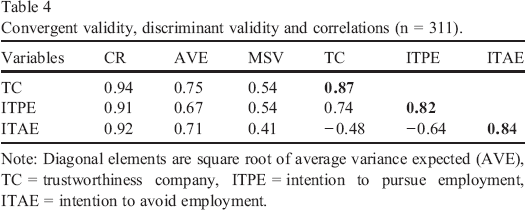
Note: Diagonal elements are square root of average variance expected (AVE), TC = trustworthiness company, ITPE = intention to pursue employment, ITAE = intention to avoid employment.
Next, structural equation modeling (SEM) using IBM SPSS Amos 23 was conducted for testing our hypotheses. For the model, we used the three independent variables as dummies (factor 1: discrepancy = 1, no discrepancy = 0; factor 2: persuasion knowledge activation = 1, no activation = 0; factor 3: constructive company response = 1, no response = 0), the mediating variable trustworthiness, the two outcomes of intentions to pursue employment and intentions to avoid employment, and four controls (i.e., age, gender, education, and Internet usage). The maximum likelihood was used as estimation procedure for estimating the model. The model fit values for the SEM that compromise our latent and manifest variables indicated a good fit with χ2 = 416.3, df = 128, χ2/df = 2.32, CFI = 0.95, TLI = 0.95, and RMSEA = 0.065. It turned out that discrepant company reviews (H1: β = − 0.53, SE = 0.11, p < 0.001), persuasion knowledge activation (H2: β = − 0.26, SE = 0.09, p < 0.001) and company response (H3: β = 0.10, SE = 0.08, p < 0.05) significantly affected company trustworthiness. Therefore, H1, H2 and H3 are supported by our data since review discrepancy and persuasion knowledge lower trustworthiness while company responses increase it. To further quantify the mediation effect proposed in H4–H6, we used bootstrapping with 5,000 bootstrap samples. We calculated the direct and indirect effects for the paths from our three independent variables to our two dependent variables (i.e., intentions to avoid employment and intentions to pursue employment). The data revealed that the indirect effects are significant (since the bootstrap intervals do not comprise zero) for the intentions to pursue employment (discrepancy: β = − 0.36 [− 0.44; − 0.29], persuasion knowledge: β = − 0.18 [− 0.43; − 0.11], and company response: β = 0.08 [0.013; 0.014]) and the intentions to avoid employment (discrepancy: β = 0.22 [0.12; 0.32], persuasion knowledge: β = 0.12 [0.05; 0.17], and company response: β = − 0.05 [− 0.10; − 0.01]), while the direct effects are insignificant in the presence of the mediator. Therefore, our hypotheses H4, H5 and H6 are supported (Table 5).
Results of structural equation modeling.
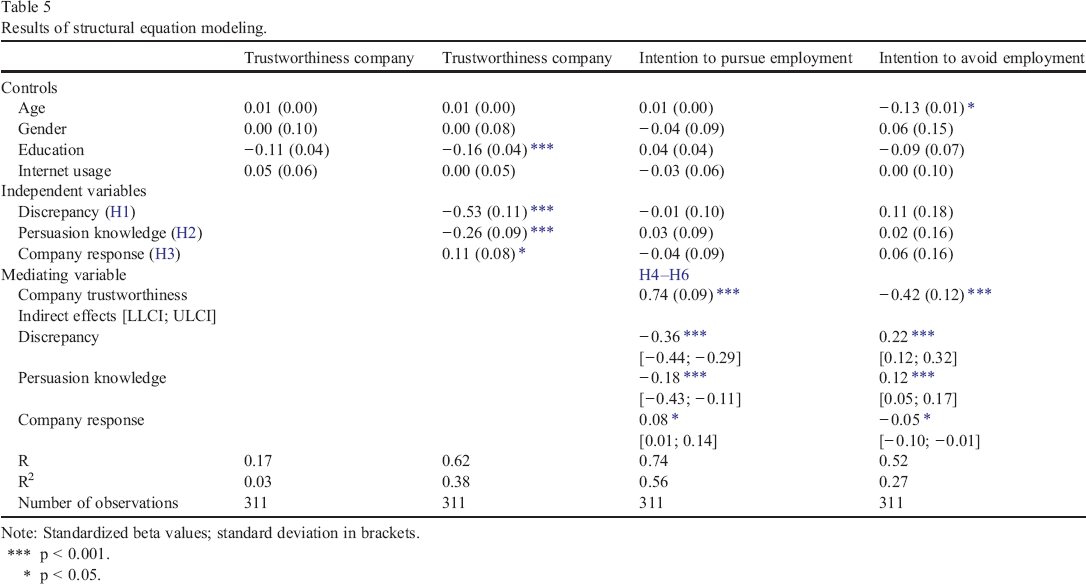
Note: Standardized beta values; standard deviation in brackets.
p < 0.001.
p < 0.05.
Discussion
We conclude this research by highlighting the main findings and discussing them in relation to theory and practice. The current study sought to gain an understanding of the role of discrepant company reviews on job seekers’ perceived trustworthiness and related application intentions. In addition, the roles of persuasion knowledge activation and constructive company responses were shown to influence companies’ trustworthiness negatively and positively, respectively.
As already noted, research has not yet documented the impacts of company reviews on employees’ application intentions. Research on online reviews is inclined to focus on the consequences of customer reviews, such as product or hotel reviews, rather than on employee reviews. This fact depicts an important oversight. This research is an attempt to contribute to the understanding of how potential employees are affected by online reviews (of other employees). While the marketing research underlines the importance of online reviews in general (e.g., Jiménez and Mendoza 2013), we still know little about the effects of employee reviews on employee review sites. Therefore, our research is, to the best of our knowledge, the first attempt that analyzed the effects of discrepant company reviews on job seekers’ application intentions.
Contributions and Implications for Theory
This study contributes to the theory in various ways. First, this research shows that review discrepancy for non-extreme overall ratings has a negative effect on trustworthiness and affects the resulting intensions, which is an aspect that has not yet been covered by marketing research. Second, this research investigated the review discrepancies in employee reviews. Compared to services and the majority of consumer products, choosing an employer involves a high fear of post-decision dissonance and high switching costs in case that one realized that she chose the wrong employer. Thus, studying this very sensitive context of employee reviews depicts an important contribution to the marketing literature. As a corollary, the results also suggest that persuasion knowledge activation has influences on job seekers’ intentions, most likely through a decrease of the intentions to apply and an increase in the intentions to avoid employment. Thus, this research complements recent attempts to investigate the roles of persuasion knowledge in social media and online marketing (Boerman, Willemsen, and Van Der Aa 2017). Finally, this research showed that managers are not at the mercy of anonymous employee reviews since constructive company responses increase companies’ trustworthiness.
Out of these main contributions, we derive the following implications for theory. First, concerning review discrepancy, our results show that for the average overall ratings, a balanced set of reviews is superior to a set of reviews with extreme (positive and negative) values in terms of perceptions of trustworthiness. This finding complements existing research on review balance and sequence that showed that positive or negative balanced reviews are considered more useful than neutral balance (Purnawirawan, De Pelsmacker, and Dens 2012). In this stream of research, positive balance is defined as a review set, in which the number of positive reviews is higher than the number of negative reviews (Purnawirawan, De Pelsmacker, and Dens 2012). In this sense, our experimental design had neutral balance (i.e., neither positive nor negative reviews dominated in the review sets), but it had high discrepancy within a review set. We further extended existing research by studying behavioral (in contrast to attitudinal) outcomes. Future research therefore could combine research on review balance and review discrepancy to study behavioral outcomes.
Second, this study replicates and complements research that showed that persuasion knowledge activation affects potential downstream variables (e.g., Munzel 2016). In particular, we based our reasoning on the fact that persuasion knowledge is not permanently present when evaluating company profiles. An activation of this knowledge therefore increases skepticism towards the review set that is currently evaluated, which, in turn, decreases trust in the respective company. While this contribution to theory provides support for the effect of persuasion knowledge activation (the previous findings from Bambauer-Sachse and Mangold 2013 were mixed), future studies nevertheless should investigate persuasion knowledge in all facets. In particular, our priming of persuasion knowledge activation was done with a newspaper article, but we could not control for how long this activation held. In this research, we also did not focus on previous levels of persuasion knowledge among respondents. Therefore, there is room for future studies on the nature of persuasion knowledge and its activation.
Third, we could show that the effect of constructive company responses, as a potential coping strategy, on negative reviews increase the company's trustworthiness, even if the effect is comparably small. From a theoretical point of view, this finding supports the notion that signals of trustworthiness come in a myriad of ways. While existing research on online reviews (in conjunction with signaling theory) tends to focus on numerical ratings and review content, our results indicate that company responses are an alternative form of signals that companies have control over.
Implications for Marketing Management
This work also has implications for management practice. Based on the findings of this study, we make several suggestions for marketing and human resource managers in the digital age. First, we have shown that company reviews influence job seekers’ decisions to start or avoid an application process with the focal company. Companies must abandon their skepticism about employee review sites and realize the strong influence that these reviews have on their online reputation both in the eyes of job seekers and customers. According to the research efforts summarized by Glassdoor (2018), 62% of job seekers say that their perceptions of a company improve after seeing an employer respond to a review. However, based on a recent analysis, only 12% of the companies listed on Glassdoor interact with the site in setting up a free account which, among other features, allows them to respond to reviews (Forbes 2016). Our results suggest that constructive company responses bring potentially lost trustworthiness back. Therefore, we encourage companies to train employees to be able to respond to negative reviews in an appropriate manner (and give them the mandate to do so). Apart from this research's direct findings, we also suggest that managers should consider preventing negative company reviews proactively. Once a company gets into the situation that negative company reviews exist, the subsequent positive reviews would lead to a discrepancy between the reviews, and therefore not produce the desired positive corporate reputation. Due to this fact, managers should try to proactively prevent negative company reviews. This certainly involves not only treating employees in a fair way but also building a communication culture of internal feedback. When employees have options to voice their complaints internally, they have fewer reasons to express them online. A proactive modus to prevent negative company reviews may also involve ensuring that all current employees possess a reasonable level of reputation-related social media competence (Walsh, Schaarschmidt, and Von Kortzfleisch 2016). If the workforce scores generally low in this respect, social media guidelines and training may be good approaches to prevent negative reviews. In addition, when negative reviews are unjustified (e.g., the review writer never worked at the company), contacting the employee review site operator with the aim to delete the post could also be a suitable strategy.
Second, we suggest a stricter registration process for users on employee review sites in order to increase the trustworthiness of company reviews. One way to ensure the author's credibility is to verify their identity via a passport during the registration process. Internet affine users are already familiar with this procedure, as other companies such as Airbnb, Twitter or Facebook have already applied it. Concerning persuasion knowledge activation, human resource managers that use online application management systems could use information from page referrers to identify when and why job seekers abandoned or continued their online application process. When potential applicants activated their persuasion knowledge by visiting a previous site that contained deceptive or deviant content about the focal company, managers could try to increase their online reputation at that particular page.
Limitation and Further Research
This research has several limitations that suggest some research opportunities. First, we considered the influence of employee ratings on job seekers only and ignored the effects on co-workers. Recent research has already shown that negative customer reviews negatively affect employees’ emotions (Bradley, Sparks, and Weber 2016). Additional studies could examine the effects of negative company reviews that are written by employees on co-workers of the same company. In a similar vein, investigating how customers use knowledge about company insights to build evaluative judgements of the company as a good employer would be a fruitful avenue. Second, recent literature addresses a distinction between conceptual and attitudinal persuasion knowledge (Boerman, Willemsen, and Van Der Aa 2017), which potentially could be included in future studies in discrepant online reviews. Furthermore, our study compares the effect of a company response in the form of a constructive comment versus no company response at all. While the literature stream on webcare (i.e., the responses of companies to negative (customer) reviews) has received increasing intention (Dens, De Pelsmacker, and Punawirawan 2015), future research should empirically assess the effects of different types of responses (e.g., explanations, Sitkin and Bies 1993) as a potential tool to manage a company's reputation in clear and ambiguous (i.e., information discrepancy) situations. Finally, our experiment was based on average numeric and sentiment assessments that represent average online reputations. However, review sets that consist of extremely and exclusively positive reviews could also lead to suspicion and endanger trust (Purnawirawan et al. 2015). Future research therefore could start to show if the effects present in this study hold for low-rated or high-rated profiles.
Footnotes
Items and Factor Loadings
Factor loadings
CR
AVE
α
Trustworthiness company (based on from Andrews, Netemeyer, and Burton 1998)
0.94
0.75
0.95
This company seems trustworthy to me.
0.96
This company seems credible to me.
0.94
This company seems believable to me.
0.86
The overall picture of this company appears consistent and no intention to defraud is apparent.
0.89
Honest employees work in this company.
0.64
Intention to avoid employment (based on Allen, Van Scotter, and Otondo 2004)
0.92
0.71
0.93
I would avoid asking this organization about job opportunities.
0.94
I will avoid to request information about jobs
0.94
I will avoid to search the internet to obtain information about jobs with this organization
0.72
I will avoid using my computer to request information about jobs with this organization.
0.78
I will avoid joining this organization.
0.83
Intention to pursue employment (based on Highhouse, Lievens, and Sinar 2003)
0.91
0.67
0.90
I would accept a job offer from this company.
0.83
I would make this company one of my first choices as an employer.
0.87
If this company invited me for a job interview, I would go.
0.74
I would exert a great deal of effort to work for this company.
0.85
I would recommend this company to a friend looking for a job.
0.81
Sample Descriptions
Number
Percentage
Gender
Male
153
49.2
Female
158
50.8
Age
0–29
112
36
30–39
87
28
40–49
53
17
50–59
44
14.1
≥ 60
15
4.8
Education
General school
12
3.9
Secondary school
84
27
High school diploma
105
33.8
Bachelor or equivalent
47
15.1
Master or equivalent
58
18.6
Doctoral or equivalent
5
1.6