







Abstract
New technologies such as Internet of Things (IoT), Augmented Reality (AR), Virtual Reality (VR), Mixed Reality (MR), virtual assistants, chatbots, and robots, which are typically powered by Artificial Intelligence (AI), are dramatically transforming the customer experience. In this paper, we offer a fresh typology of new technologies powered by AI and propose a new framework for understanding the role of new technologies on the customer/shopper journey. Specifically, we discuss the impact and implications of these technologies on each broad stage of the shopping journey (pre-transaction, transaction, and post-transaction) and advance a new conceptualization for managing these new AI technologies along customer experience dimensions to create experiential value. We discuss future research ideas emanating from our framework and outline interdisciplinary research avenues.
Keywords
Introduction
In the future, customers will likely undergo radically new experiences owing to new technologies. 1 For example, imagine you would like to buy some new clothing items for yourself. When you walk into a store and look at different clothing items, RFID chips (Internet of Things (IoT) technology) will enable you to find any relevant product information, including where and how it was made, where the material was sourced, how to wash the product, and how it can be delivered to your home. When you try on the item in a changing room, “smart mirrors” (which have a screen behind it that is connected to the digital world) can provide you with customized information such as how well the item you are trying fits, on what future occasions you could wear it, and how it blends or supplements your wardrobe. Moreover, Augmented Reality/Virtual Reality/Mixed Reality (AR/VR/MR) will allow you to see how the garments might look on you in different lighting conditions and different contexts (in the office or on the street) and situations (party or business meeting). If you are interested in how popular the item is, a virtual assistant will provide you with aggregate information (demographics and lifestyle) about other people that have bought the item and even predict whether you might like or buy the item. If you need service, you may encounter a robot that may be human-like and help with physical tasks or a chatbot that can have a personal conversation with you as if you are talking to a human salesperson. Finally, there will not be any need for a checkout counter; once you leave the store with certain items in your bag, the corresponding amount will be automatically deducted from your account. All of these technologies are typically powered by Artificial Intelligence (AI).
For expositional ease, we use the terms “customer,” “consumer,” and “shopper” interchangeably throughout the paper.
The above futuristic shopping example illustrates how radically new technologies and associated software and hardware can transform the customer experience. And not just in retail. The customer experience in almost any business will likely change. Along the customer shopping journey (i.e., the complete stages a customer goes through from pre-transaction to transaction to post-transaction), new touchpoints will be created and existing ones reconfigured. New technologies will influence how consumers search for products and brands, evaluate alternatives, make choices, and consume products and brands as well as improve the process of customer relationship management (Libai et al., 2020). Moreover, emerging technologies will create new value to customers (Rangaswamy et al., 2020), and successful companies will enhance this value by constantly and carefully shaping the technology-based interactions in a customer-centric way. However, despite the accelerating pace at which these technologies are being developed and used in many industries, academic research on how these technologies affect and transform the customer experience is rather sparse.
In this paper, we make several important contributions. First, we offer a fresh typology of AI-powered new technologies. Second, we propose a new framework for understanding the role of new technologies on the customer/shopper journey. Third, we advance a new framework for managing new technologies along customer experience dimensions to create experiential value. Finally, we discuss future research ideas emanating from our framework and outline interdisciplinary research avenues.
Focusing on business-to-consumer (B2C) businesses, we explore two important issues: (1) the role that new technologies will play in interactions along the customer shopping journey (i.e., what the technology might do and offer to consumers), and (2) how new technologies can create experiential value to consumers (i.e., what that value might be and how companies can further enhance it). The two issues are interrelated and closely tied to the two key approaches in the customer experience literature: mapping the customer journey along touchpoints and distinguishing different types of experiences (Lee et al., 2018; Shankar, 2014). Based on these issues, we advance a new framework for understanding the role of new technologies on the customer journey.
We will consider three interrelated technologies (or rather technology clusters) that we expect to have the biggest impact on the customer experience. These technologies include IoT, AR/VR/MR, and virtual assistants/chatbots/robots (AI). We will show how these technologies lead to a number of benefits for consumers throughout their shopping journey (e.g., collecting better information, facilitating imagination, and enabling better customer service). More generally, we discuss how these technologies create new experiential value by acting as a catalyst for action, increasing attachment, and integrating technology more seamlessly into people's lives.
We organize the reminder of the paper as follows. In the next section, we discuss the new technologies and develop a typology of AI-powered new technologies by building on the literature. We then discuss two key components of the customer experience: customer/shopper journey and experience type. In the subsequent section, we propose a new conceptual framework to understand the role of new technologies on the customer journey and advance a conceptualization to manage the new technologies along customer experience dimensions. We discuss and illustrate directions for future research emanating from our conceptual framework. We highlight some interdisciplinary research avenues and offer additional managerial implications. We close by raising additional future issues.
Key Technologies Affecting the Customer Experience of the Future
Over the last 20 years, the “digital revolution” has radically transformed the customer experience. To characterize digital technologies and their advantages, Nicholas Negroponte (1995), in his book Being Digital, described this transformation as a shift from “atoms” to “bits.” As Schmitt (2019) noted, in the context of marketing “atoms” are fast moving consumer goods and their brands, made in factories, advertised through mass media and sold in stores; “bits” are information, entertainment and interactive products, often produced instantaneously, promoted through social media and sold online In a “bit” economy, consumers and organizations can easily share massive amounts of information, and seamlessly interact, and communicate with each other.
To illustrate the impact of digital technologies on the customer experience, it is worthwhile considering its major technological inventions. The worldwide web has enabled new communications, interactions, and transactions via an entirely new medium and platform. E-commerce has provided a new sales channel and marketplace that allows consumers to receive products outside stores. Mobile platforms have integrated information on one device that can be used for multiple commercial applications. Social media and its tools for sharing text, images, and video have created social networks among consumers and user-generated content.
Yet, over the next 20 years, the digital revolution is entering a new phase: from “bits” back to “atoms,” by incorporating digital information into physical, solid products (Schmitt, 2019). At the center of this transformation are three technology clusters: the IoT, AR/VR/MR, and virtual assistants/chatbots/robots. We argue here that these technologies will result in an entirely new concept of customer experience—how shoppers experience the world, how they relate to others, and how they perceive objects in this world.
The Internet of Things (IoT)
Ng and Wakenshaw (2017, p. 6) consider IoT as “as a system of uniquely identifiable and connected constituents (termed as Internet-connected constituents) capable of virtual representation and virtual accessibility, leading to an Internet-like structure for remote locating, sensing, and/or operating the constituents with real-time data/information flows between them.” In short, IoT embeds smart computing systems into devices and connect them to the Internet. It has been described as “the evolution of the Internet covering the real world” (Ziegeldorf, Morchon, & Wehrle, 2014). IoT generates massive data on consumer usage. The embedded devices may be used in both B2C and B2B businesses. B2C applications include smart consumer appliances and home equipment, medical devices and implants, and smart devices in apparel. In all the domains, connected devices allow increasingly smart services such as the smart car providing condition monitoring, corresponding analytics, and much more (Beverungen, Müller, Matzner, Mendling, & Brocke, 2017).
However, IoT is likely to raise numerous privacy issues for users of IoT devices. Ziegeldorf et al. (2014) have identified these privacy threats: identification of features unknown to the user, localization and tracking, profiling, making private information public (including photos and videos), inventory attack (collecting information about properties of owned things), and linking separate information that the user does not like to be linked. Thus, it will be a balancing act for firms utilizing IoT to enrich the customer journey and create customer experience without jeopardizing peoples’ privacy.
Augmented Reality/Virtual Reality/Mixed Reality (AR/VR/MR)
AR/VR/MR adds additional informational capabilities and experiences to existing real-life experiences. AR does so by creating an add-on and interactive experience of a real-world environment through computer-generated displays, thereby creating more interactive, vivid, and richer experiences for consumers (Hilken, de Ruyter, Chylinski, Mahr, & Keeling, 2017; Yim, Chu, & Sauer, 2017). This is frequently done on a hand-held or smart-phone device where additional information (in textual, visual, or otherwise sensory form) may be displayed (e.g., Instagram filter, Pokemon Go app).
Whereas AR blends the virtual and real worlds (Huang & Liao, 2015), VR simulates the environment entirely, shutting out the real world. VR utilizes a wearable device (typically a headset), which blocks out “real world” sensory experiences to provide a more engaging and innovative environment by immersing users in virtual, often entertaining 3-D worlds (e.g., virtual videogames). Users of a VR device can interact in real time and move physically within the virtual world, typically through movements of the head, but possibly also through motion tracking of limbs. However, at this point, VR headwear is not yet comfortable and its effects not fully credible (LaMotte, 2017). For example, users often experience headaches and nausea after brief usage. Furthermore, the health dangers of falling and eye strain are high.
MR combines real and virtual worlds to produce new visual environments where physical and digital elements co-exist and interact in real time (Milgram & Kishino, 1994). It is an extension of AR in which users directly interact with virtual objects. Unlike AR that overlays virtual objects over the real world, MR integrates virtual objects with the physical world (e.g., the use of Hololens to teach anatomy). Moreover, while AR is mainly available through smartphone apps, MR requires a headset or an equivalent wearable device.
AR is likely to be commercialized quickly (e.g., as part of Google Maps and other apps), whereas VR seems to be held back by the lack of devices that project well and are not impacting consumer well-being while using the device. MR is not widely used as yet, but it will likely have the greatest impact in the future. About 82% of organizations plan to use MR glasses in the next three years, according to a study by Toshiba.
In sum, AR/VR/MR technology is likely to provide relevant new information and imagination quickly and conveniently for consumers before, at, and after purchase. It also is likely to revolutionize product trial, imaginations of product usage as well as the entire consumption experience. In particular, these technologies enable improved omnichannel experiences across different online and offline touchpoints for consumers (Hilken et al., 2018).
Virtual Assistants, Chatbots, and Robots
Virtual assistants are computer programs that understands user queries and complete a limited set of tasks for the user (e.g., Siri, Cortana, Alexa). The queries may include fact-based questions such as “what is the weather?” and the tasks may comprise simple instructions like “send a text to Jill.” Virtual assistants, chatbots, and robots are powered by AI. AI refers to actions that includes analysis and interpretation of data, learning from data, and using the learning to achieve specific goals and tasks. More broadly, AI enhances the intelligence of a product, service, or solution (Shankar, 2018). AI can perform many of the cognitive functions that humans typically perform such as learning, problem-solving, and decision-making. AI as an ecosystem comprises three elements (data collection and storage devices, statistical and computational techniques, and output systems) that enable products and services to perform tasks that are typically understood as requiring intelligence and autonomous decision-making on behalf of consumers. AI uses algorithms that allow machines to understand and produce natural language, learn from experience, and portray emotions. Today, algorithms can outperform expert humans at an increasingly comprehensive list of very specific tasks, from diagnosing some complex diseases to driving cars to providing legal advice (Simonite, 2014). Algorithms can also perform seemingly subjective tasks such as detecting emotion in facial expressions and tone of voice (Kodra, Senechal, McDuff, & El Kaliouby, 2013). AI is already reshaping marketing in many spaces, including retailing (Shankar, 2018).
Chatbots are a type of virtual assistant software programs that conduct conversations with users through audio or text. They are designed to simulate human conversations Chatbots are commonly used in customer service contexts. The AI behind chatbots uses natural language processing (NLP) algorithms.
Robots are intelligent, physically embodied AI machines that can sense and manipulate their environment and perform tasks autonomously and are becoming increasingly prevalent and important in many domains of business and consumer behavior (Dass, 2017; Nguyen, 2016; Simon, 2015). The market for social robots, which are intended to interact directly with consumers at home and in retail, hotels, and service contexts, has grown much faster than the market for manufacturing robots (Business Wire, 2017). Consumers can purchase robots that can engage with people in conversations and be companions and assistants (Gibbs, 2016).
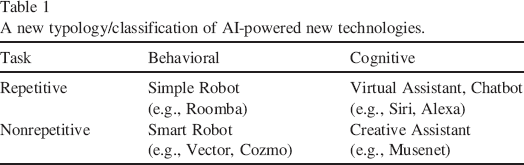
Virtual assistants, chatbots, and robots are outcomes in a framework based on different combinations of task type (repetitive vs. nonrepetitive) and activity type (behavioral vs. cognitive). In this framework, AI-powered technologies can be classified into four types as shown in Table 1. The most common form of technology is behavioral activity for repetitive task as exemplified by Roomba, the simple robot vacuum cleaner. AI representing cognitive activity for repetitive task is also fairly popular, algorithms or programs include chatbots such as Siri and Alexa. AI reflected by behavioral activity for nonrepetitive task through smart robots such as Vector and Cozmo are on the rise. Finally, AI representing cognitive activity for nonrepetitive task such as intelligent music creator Musenet is in its infancy. The holy grail of this form of AI, known as artificial general intelligence (AGI), which may match or surpass human beings, might take decades or longer to fructify. In sum, AI, in its conversational and physical/embodied form, offers great potential for improving outcomes for consumers.
A new typology/classification of AI-powered new technologies.
Next, we briefly review the customer experience literature to develop a conceptual framework that connects the technologies with customer experience.
Customer Experience: Customer Journey and Experience Dimensions
Experiences take place as a result of “encountering, undergoing, or living through things” (Schmitt, 1999). Accordingly, customer experience has been referred to as “internal and subjective consumer responses when in contact with a company” (Meyer & Schwager, 2007). Research on the customer experience and its management has pursued two approaches: delineating the contact with a company as a customer journey along experience touchpoints, and distinguishing different types of internal and subjective responses.
Customer Journey
Lemon and Verhoef (2016) conceptualize customer experience as a customer journey with the firm over time: from pre-transaction (including search) to transaction to post-transaction. In each stage and sub-stage, customers interact with firms through various touchpoints (Lee et al., 2018; Shankar, 2014). Traditionally, these touchpoints have included the product and its design, identity elements (including the name and nomenclature, logos, and other visual stimuli), packaging, communications, and service encounters. Various commercial channels and environments, in which products are placed, are also critical for evoking customer experiences (including, e.g., retail spaces, events, and trade shows). Through the digital revolution, additional touchpoints and channels/environments have been added, such as social media as a new form of communication as well as web sites, e-commerce, and mobile platforms as new environments (Foroudi, Gupta, Sivarajah, & Broderick, 2018; Lee et al., 2018; Lemon & Verhoef, 2016; Shankar et al., 2016).
The customer journey is iterative and dynamic, and includes multiple touchpoints and multiple channels or environments (Lee et al., 2018; McColl-Kennedy et al., 2015). Key dimensions of an effective customer journey design are the thematic cohesion, consistency, and context sensitivity of touchpoints (Kuehnl, Jozic, & Homburg, 2019). Moreover, consumers are increasingly connected, informed, empowered and active in seeking and creating their own experiences or co-creating them with companies (Prahalad & Ramaswamy, 2004).
Experience Dimensions
Another avenue of customer–experience research has explored the dimensions of internal and subjective experiences that these touchpoints evoke for a so-called “brand experience.” Brand experience has been defined as “subjective, internal consumer responses (sensations, feelings, and cognitions) as well as behavioral responses evoked by brand-related stimuli that are part of a brand's design and identity, packaging, communications, and environments” (Brakus, Schmitt, & Zarantonello, 2009, p. 53). We will argue that, as brand-related stimuli, technologies can evoke different experience dimensions and thereby create experiential value.
Various experience dimensions have been distinguished in the literature. There has been diversity in the number and content of experiential dimensions. For example, Schmitt (1999) distinguished five “strategic experiential modules,” labeled as “sense,” “feel,” “think,” “act,” and “relate.” Dubé and Le Bel (2003) proposed four “pleasure dimensions”—emotional, intellectual, physical, and social pleasures. Gentile, Spiller, and Noci (2007) distinguished six experiential components: sensorial, emotional, cognitive, pragmatic, lifestyle, and relational. Finally, Brakus et al. (2009) distinguish four types of brand experiences (sensory, affective intellectual, and behavioral). It should be noted that these experience types are not mutually exclusive. For example, of the four experience dimensions of Brakus et al. (2009), the sensory and emotional dimensions are empirically highly intercorrelated. Several experience dimensions may also get evoked at the same time, creating a holistic experience. Finally, and most importantly, not all types of experience might be as equally important and relevant to technological impact. Thus, in our framework, we focus on experiential dimensions that will be most heavily be impacted by IoT, AR/VR/MR, and virtual assistants/chatbots/robots. We propose that the new AI technologies that we discuss will impact the cognitive, sensory/emotional, and social dimensions of experience where they can create new experiential value, if properly implemented and managed.
A New Conceptualization of the Role of New Technologies Impacting the Customer Journey and Experiential Value
Following the customer experience literature, we conceptualize the role of new technologies as influencing the customer/shopper journey and experiential value. The first aspect of our conceptualization concerns what the technology will enable customers to do along the customer journey; the second dimension addresses what new experiential value might be created and how companies can enhance this value creation.
Customer/Shopper Journey
In accordance with the Lemon and Verhoef (2016) model of the customer journey and the Shankar et al., (2016) model of shopper journey, we conceptualize the customer journey as a transaction cycle that covers three phases: pre-transaction/purchase, transaction/purchase, and post-transaction/purchase. Breaking up the customer/shopper journey into the proposed different phases is critical to identify the distinct role that each technology might play. The notion that customers/shoppers move from information gathering and search to purchase and ultimately to evaluation of the purchase is well established not only in customer experience management but also in customer management and multichannel customer management (Howard & Sheth, 1969; Neslin et al., 2006; Neslin & Shankar, 2009; Pucinelli et al., 2009). Applying the customer/shopper journey model, we next discuss how the three emerging technologies (IoT, AR/VR/MR, and AI) are likely to influence each of the three transaction phases (see Table 2).
A new framework for understanding the impact of new technologies on the customer/shopper journey.

IoT
In the pre-transaction phase, IoT can provide consumers with rich, detailed, and relevant information which can be used to aid their decision process. For example, as illustrated in the introductory example, if RFID tags or barcode scanners are attached to garments, consumers can use their smartphone cameras, smart glasses, or other smart devices to scan those garments while shopping in the stores to check prices, colors, sizes, or availability of the products they are looking at. In addition, IoT will make it possible to use sensors or Bluetooth devices such as beacons in or outside of stores that locate customers’ smartphones and send customers personalized messages with relevant product information or special discounts when they stand near specific product (Shankar et al., 2016). Moreover, IoT can track the information that customers access online, and send them relevant information on products when they are in a store of the same brand.
IoT can also automate transactions. For example, in some retailing contexts (e.g., Amazon's or Alibaba's physical stores), IoT enables the reading of tags on items when customers leave a store, and automatically charges the customers’ accounts the prices of the items through the customers’ mobile payment app. For customers, such automated transactions improve convenience and lead to time savings. Furthermore, in the insurance industry, IoT will fundamentally change how consumers transact for their car, home, or health insurances. Connected car solutions based on IoT technologies (in this case telematics that track driving behavior) will enable new forms of payment such as pay-as-you drive. Based on the driver's behavior (such as the number of miles driven), insurance premiums can be individually and automatically calculated and deducted from the customers’ accounts.
During the post-transaction phase, IoT enables maintenance and service. For example, smart home devices (e.g., heating and conditioning systems) monitor the home's environment and enhance consumers’ energy use. Or home entertainment systems such as smart TVs connected with lights in the home can improve the living atmosphere by automatically adapting the lights to the colors of the TV screen. Further, with RFID technology, smart refrigerators can determine when consumers need to replenish certain items and automatically order these items from a favored retail store.
AR/VR/MR
AR/VR/MR is particularly important in the pre-transaction phase as such devices facilitate imagination, allowing consumers to experience and test products or services in 3D in real-time (Azuma, 1997). This technology can improve their knowledge of products (Yim et al., 2017) and increase their curiosity, enjoyment, and fun when trying out new products (Beck & Crié, 2018; Hilken et al., 2017; Scholz & Duffy, 2018). Applications of AR/VR/MR in the pre-transaction phase can be found in many industries. In retailing, for example, based on AR/VR/MR, consumers can virtually furnish rooms with selected items and see how furniture fits into their apartments (e.g., IKEA's place app) or test how beauty products look on their face (e.g., L'Oréal Make Up Genius). Moreover, in the hospitality industry, AR/VR/MR will substantially change the consumer experience in the pre-transaction phase. Restaurants offering a VR menu to consumers reduce their uncertainty in selecting a dish. Augmented GeoTravel allows consumers to visit places virtually before booking flights and accommodations and thereby supporting consumers in imagining their trip.
In the actual transaction phase, AR/VR/MR augments beyond the physical and facilitates payment. For example, a virtual cash register enables the shopper to virtually authorize a transaction. With this technology, the customer journey proceeds seamlessly from pre-transaction through the stages of the customer journey. Relating back to the above-mentioned furniture example, the necessity for physical interaction is limited to the post-transaction fulfillment while the other stages can involve a virtual experience. In case of the hospitality example, however, full virtualization is neither possible nor desired as physical interaction is part of the experience. Therefore, augmentation is more realistic and there are cases where tables are equipped with hardware and respective applications, allowing ordering and initialization of payment.
In the post-transaction phase, AR/VR/MR upgrades and enriches consumption for consumers. For example, head-up displays in cars that projects vehicle information such as speed, warning signals and navigational information on the windshield allow consumers to maintain focus on the road while receiving all relevant information without looking away from the familiar field of view. As another example, an MR headset can help experience Spotify music in the living room by decorating walls virtually with different playlists and mixing and matching music by clicking or touching the virtual wall.
Virtual Assistants/Chatbots/Robots
The roles of AI-enabled services in the pre-transaction phase is to select relevant information, customize choice sets, and advise customers on choices. For example, online retailers may use so-called “recommendation agents” when searching and selecting products or services online (Xiao & Benbasat, 2007). Such personalized product recommendations are based on prior browsing and purchase history and/or collaborative filtering methods that infer recommendations based on what other users who bought the specific product has also bought (e.g., Yoon, Eric Hostler, Guo, & Guimaraes, 2013). Even more, retailers or entertainment providers can create fully personalized and unique landing pages for their users that display user's favorite products, currently relevant information (e.g., promotions or new) and purchase/usage recommendations. Moreover, virtual assistants and chatbots can play an important role in answering questions about products and their usages and advise customers to reduce uncertainty.
In the transaction phase, AI-based services can partner and negotiate as part of the transaction and enable dynamic pricing to align supply and demand. In particular, in the travel and hospitality industry's dynamic pricing environments, these technologies can change how consumers transact. For example, emerging mobility apps (e.g., Lyft) base their pricing on real-time information and provide dynamic and transparent pricing based on time, traffic, and location. Furthermore, such AI-powered apps offer individualized real-time price reductions based on different options (e.g., pooling services). This provides consumers with a real-time, supply- and demand-based, and thus transparent pricing for their transaction.
In the post-transaction phase, virtual assistants can provide feedback and recommend additional consumption. For example, with regard to the healthcare industry, based on data collected by smart watches or fitness trackers, these assistants may provide health alerts and give consumers personalized fitness and nutrition recommendations. Moreover, other AI-based services can simplify consumers’ consumption and experience by facilitating problem detection or providing recommendation for optimized use.
While we have discussed virtual assistants and chatbots, which are in a nonphysical form, it is important to note that embodied form (humanoids, robots) may also accomplish some of these and physical tasks. In particular, the transaction and post-transaction stages of partnering and giving recommendations may be strongly affected if AI is embodied. Mende, Scott, van Doorn, Grewal, and Shanks (2019) have shown that interacting with robots (vs. humans) increases consumers’ discomfort with a service provider and elicits compensatory consumption in various consumption contexts (e.g., food intake). It is likely that the impact of robots on customers’ experience will become even greater and more radical in the future. We next discuss the experiential value that new technologies can provide.
Experiential Value
As discussed earlier, research on customer experience has distinguished different experience and dimensions. For the purpose of examining the role of new technology in value creation, it is useful to distinguish three dimensions of experiential value; cognitive, sensory/emotional, and social. Cognitive value is the experiential value that consumers receive as a result of processing the information and decision-making, and is closely tied to the analytical features of AI technologies. Sensory/emotional value comprises the value consumers get from sensory stimulation and emotional attachment, which results from the sensory and affective features of the AI technologies that we discussed. Finally, social value includes the value consumers receive by connecting to the social world around them because of the behaviors and relations that AI enables. We will discuss next what specific cognitive, sensory/emotional, and social value each technology can create and how a firm and management can further enhance that value (see Table 3).
A new framework for managing new technologies along the customer experience dimensions to create experiential value.
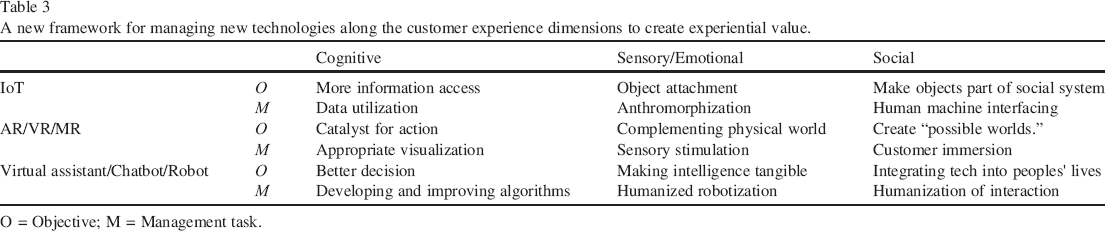
O = Objective; M = Management task.
IoT
As we have seen, IoT will make many ordinary consumer behavior tasks much easier by collecting information, enabling automation of transactions, and helping in maintenance and servicing. As a result, IoT will create immense cognitive value. From the perspective of the technology, Ng and Wakenshaw (2017) discuss two key features that can create cognitive value. The liquidization of IoT turns information in the here-and-now into general information that can be shared ubiquitously. Thus, each object has a rich set of historical and current data associated with it about its properties, origin, and sensory context. Relatedly, the digital materiality of IoT refers to a behavioral stamp on how a product is used (e.g., how wearers may use their clothes). From a customer perspective, IoT's cognitive value may thus be described as more information access. Firms, in turn, can further enhance this value through data utilization. Think in terms of a spiraling funnel. As consumers use more and more products and devices with IoT components, the firms involved will collect ever more data and can utilize the data to provide further information access.
Yet, IoT also is likely to have sensory/emotional value: consumers are more likely to get attached to the interconnected product and devices. Just as computer platforms (stationary and mobile) are creating object attachment (think of the iPhone) because of familiarity with various components (the apps, icons, and the like), so will IoT objects. Yet there will be an additional and much more powerful form of object attachment resulting from the interconnectivity itself. It will be hard for a consumer to give up a product or device without altering other devices because of the assemblage system. A key question is how firms can enhance this value. We believe that anthropomorphization can play a key role (Epley & Waytz, 2010; Epley, Waytz, & Cacioppo, 2007). Making the component human-like may increase object attachment, a sentiment similar to brand attachment (Park, MacInnis, Priester, Eisingerich, & Iacobucci, 2010). Imagine a toaster, a refrigerator, and a washing machine as three components of a smart home. We expect that if consumers imagine and treat these interacting devices as if they were people communicating with each other, this might increase consumers’ sensory/emotional value.
Finally, IoT can also have social value for the consumer by making the object part of a broader social system. The IoT home (as an apartment) may be part of a house, the IoT house may be part of an IoT housing complex, the IoT housing complex may be part of an IoT neighborhood (interlinked to local businesses), and that neighborhood may be part of a smart city. Businesses can enhance such social value through enhanced human–machine interfacing, that is, by showing how additional devices might be digitized and connected to IoT. After all, IoT systems can be described as assemblages (Ng & Wakenshaw, 2017) and analyzed in terms of their properties, capacities, and tendencies (Hoffman & Novak, 2018). At the same time, they are architectural modules, with inherent boundaries as well as transactions that may limit the flexibility with which one system may be assembled with another system (Ng & Wakenshaw, 2017).
AR/VR/MR
We have seen that AR/VR/MR can facilitate consumer's imagination, augment beyond the physical and upgrade and enrich consumption. The cognitive value that AR/VR/MR provides is a catalyst for action. When people can mentally imagine things, and AR/VR/MR is a powerful tool for that, they engage in pre-factual thinking that may make it more likely for the consumer to engage in the action (Epstude, Scholl, & Roese, 2016). From a firm perspective, this situation calls for appropriate visualization. As noted, AR/VR/MR devices have still technological shortcomings; they need to be addressed to deliver fully on this cognitive value.
The sensory/emotional value is the ability with AR/VR/MR devices to create an emotional connection that complements the physical world. With this technology, consumers will have the experience of a sensorial richer world. A prerequisite is that firms provide the necessary sensory stimulation. This stimulation should be multi-sensory, and not only mostly visual and auditory. For example, marketers are increasingly experimenting with ways to raise the sensory experience through touch, taste, and smell. The simulation also needs to be appropriate for Homo sapiens, meaning it needs to consider our physicality built by evolution.
Finally, AR/VR/MR can deliver social value. It can get people to imagine “possible new worlds” that free them from the here and now. Gaming and entertainment are good examples; they already immerse users into these worlds that are often taken and confused with reality. The challenge for firms will be not only to create customer immersion but to do so responsibly. Getting customers to distinguish between reality and augmented or virtual reality should no longer be the goal, but rather to keep the borders, yet increase the value of each reality type through a responsible creation of devices and software.
Virtual Assistants, Chatbots, and Robots
As discussed earlier, virtual assistants can help customers select among options, advise them, and customize information. Other AI-based services can be a partner and negotiator for consumers and companies; and it can give feedback and recommend additional consumption. The cognitive value of these technologies powered by AI is thus rather clear: better decisions that match customers’ preferences. As firms further develop and improve algorithms to enhance that value, humans may rely increasingly on these technologies, even on subjective tasks that they currently feel humans can do better. Thus, algorithm or machine aversion may diminish (Dietvorst, Simmons, & Massey, 2014).
AI-based technologies can even help customers better understand and predict their own preferences. Indeed, Amazon is leveraging customer data to mail products to customers without customers ordering them, through an experimental initiative called “anticipatory shipping” (Nichols, 2018). A customer can ask her own virtual assistant to predict her next purchase. Amazon uses this technology to anticipate what the customer is likely to need and ships them in advance. If the customer decides not to keep any item, she can return that item free of cost.
The sensory/emotional value of virtual assistants, chatbots, and robots consists of making intelligence tangible, in other words, making them a true human companion. Just as IoT may be anthropomorphized to increase this type of value, so could be these technologies in human-like form (Kim, Schmitt, & Thalmann, 2019). While hard to imagine at this point, in the future we may see humanoid robots that are employed on a wide scale in service businesses of hotels and retail stores, as counselors or consultants, as teachers, or social companions, as doctors, or even sex workers. There is a concern, following “uncanny valley” theory (Mori, 1970; Wang, Lilienfeld, & Rochat, 2015), that the sheer eeriness or uncanniness of such scenarios might scare away consumers (Mende et al., 2019).
Thus, ultimately, AI and especially robots would need to be fully integrated positively into people's lives and that such integration needs to be seen as delivering social value. This integration may be done by humanizing the interaction. In other words, in addition to improving algorithms and humanizing robots, it will be critical for firms to deliver virtual assistants, chatbots, and robots that can break down the barrier between humans and machines.
As AI will develop further, get ever smarter and more sophisticated, and mimic human processing and decision-making more through humanoid robots, human appearance, and physical behavior, the technology has the potential to further increase the cognitive, sensory/emotional, and social values discussed. But we note that there is also a danger. When virtual assistants, chatbots, and robots pass the Turing test—in other words, when we approach “technological singularity” (Eden, Moor, Søraker, & Steinhart, 2015)—they may far outpace humans, replace human jobs, and act as truly autonomous agents that learn and improve through self-programing (based on machine learning). Such a progression may result in the type of threats often portrayed in doomsday sci-fi movies.
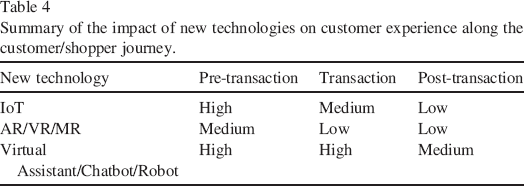
A summary of the likely impact of the three technology clusters on customer experience along the three big stages of customer journey appears in Table 4. IoT is likely to have maximum influence during the pre-transaction phase, while AR/VR/MR are likely to have the highest impact during transaction and MR may have the greatest influence in post-transaction phase. Finally, virtual assistants and chatbots will likely have high effects during pre-transaction and transaction phases, while robots will have a strong impact during the post-transaction phase.
Summary of the impact of new technologies on customer experience along the customer/shopper journey.
Research Issues Emanating from the Framework
Our conceptual framework highlights the important point that new technologies (i.e., IoT, AR/VR/MR, and virtual assistants/chatbots/robots) will have a wide-ranging influence on both the customer/shopper journey and on creating experiential value for customers. A major benefit of this framework is that it suggests various potential future research ideas along the different phases of a customer journey and according to the different types of experiential value. Each cell in the framework represents a rich source of ideas for future research. In the following paragraphs, we will first discuss some general research issues emerging from our framework.
Specifically, our new framework that allows us to examine future research issues for: (1) perceptual dimensions of technologies, (2) factors that determine customer experience in technology environments, (3) creation of experiential value, and (4) moderators of the relationship of new technologies with the stages in customer journey. In addition, we also advance interdisciplinary avenues for future research that have not been articulated by prior research on customer experience and technology.
Examining the Effects of the Perceptual Dimensions of Technologies
The technologies discussed are unlikely to affect the customer experience (i.e., the customer journey and experiential value) directly. Rather, we expect that underlying perceptual dimensions of these technologies may play a key role. We discus three critical dimensions in a bipolar fashion, which have been considered and investigated in recent work on technologies (Schmitt, 2019).
First, the general technologies that we discussed may be perceived as either autonomous or controlled. Along a bipolar dimension ranging from full autonomy (of the technology) to full control (by the user), there are various intermediate levels, and various factors (i.e., the design, the task, the environment in which the technology is used) are likely to affect this perceptual dimension. Autonomy (vs. control) refers to the technology carrying out operations and processes without external control such as sensing, planning, and acting to reach task-specific goals (Beer, Fisk, & Rogers, 2014). This raises the question how much autonomy vs. control customers find desirable and how this perceptual dimension affects the customer experience. Research should examine this question for the different stages of the customer journey and for experiential value creation. For example, is autonomy (vs. control) more desirable for certain technologies at the pre-transaction phase where information is collected than at the post-transaction phase where the technology interacts with the user? Also, is autonomy (vs. control) more desirable when certain types of customer value are being created. Finally, there is the more general empirical questions of what kind of features for each technology drive perceptions of autonomy vs. control
A second relevant dimension relates to comfort with a technology. This dimension may be thought of as perceived usefulness vs. uncanniness. As we described earlier, while radical new technologies are supposed to be useful to consumers and improve their experience, they may at times be viewed as eerie or uncanny due to fears and concerns. Thus, it is critical to study empirically to what degree the technologies featured in this article are seen as useful vs. uncanny and how such perceptions may affect the customer experience. And again, it will be important to see which features of the technologies affect such perceptions.
Finally, as the technologies that we discussed often perform tasks that have previously been performed or are still also performed by humans, the question arises to what degree the technologies are anthropomorphized. This issue may be covered by a perceptual dimension of anthropomorphism versus “technologism.” In general, technology and humanness seem to be at odds. When humans use cognitive enhancement products they are “mechanistically dehumanized” (likened to a robot), especially when the enhancement technology expands mental capacities beyond normal levels (Castelo, Schmitt, & Sarvary, 2019). And more human-likeness is not necessarily better. For example, digital helpers were liked less when anthropomorphized (Kim, Chen, & Zhang, 2016). Also, Grewal, Kroschke, Mende, Scott, and Roggeveen (2020) deal with how enhancement technologies affect customer perceptions. The authors propose that enhancing humans’ performance with enhancement products improves customer perceptions of the warmth and competence of the enhanced human, thus leading to positive customer reactions. However, they also propose that the use of enhancement products leads to customer perceptions of the dehumanization of the enhanced human and, ultimately, negative customer reactions. Thus, a key issue for future research is how the perceived dimension of anthropomorphism of the technology versus keeping it very technical affects the customer experience.
Factors that Determine the Experience in Technology Environments
An important empirical research task is to identify the key outcomes that are closely tied to customer experiences in new technological environment. That is, what creates a positive experience, and therefore, what are the key measures to assess the customer experience for the technology-driven customer journey? We propose that researchers focus, in particular, on the following outcomes and assess their relation to customer experience: satisfaction with the decision-making process, satisfaction with the outcome of the transaction, and customer engagement.
Satisfaction with the decision-making process would be particularly critical for the pre-transaction stage of the consumer journey. The new technologies facilitate this process in terms of collecting information, facilitating the imagination, and assisting in making the decision. Thus, it is important to examine consumer reactions to these processes, especially the positive experience in their decision process that stem from these technologies. As discussed by Rangaswamy et al. (2020), digital business platforms
The influence of IoT on the pre-transaction stage should be particularly significant. IoT provides consumers with very rich and detailed information which can be used to aid their decision process and provide a richer consumer experience. However, previous research on consumer information search has taught us that consumers do not always want all available information. Too much information could lead to information overload (Jacoby, 1984; Malhotra, 1984) and have a negative impact on the decision process and consumer experience. In fact, Lee and Lee (2004) have shown that information overload in an online environment decreases customer satisfaction and confidence and leads to confusion. Therefore, key questions for future research would involve what information is most useful to consumers and in what format it should be provided. It is also possible to develop indices to summarize and simplify the vast amount of information available. Further, the answers to these questions would most likely vary in terms of the key moderators that we discuss subsequently.
Technologies based on AI will also play a significant role in the pre-transaction stage. Data scientists and marketers are continually developing and evolving algorithms which offer increasingly sophisticated advice or recommendations on which product to select (e.g., Xiao & Benbasat, 2007). These recommendations could enhance customer satisfaction with the decision process because they significantly reduce the effort needed to make the decision, while helping customers make better choices that fit with customer needs. This situation is likely to occur if the recommendations match individual preferences and appropriately weight to the “right” attributes. However, some recommendations could also adversely impact satisfaction with the decision process. In particular, consumers may experience a loss of control over the decision or may feel uneasy if they cannot understand the algorithm or fully reconcile the algorithm's recommendations with their own choices. Given that the use of AI in the pre-transaction stage will greatly increase, these issues represent important avenues for future research.
In terms of the transaction stage, satisfaction with the outcome is particularly critical. It is important to assess whether these technologies help consumers make more optimal decisions (i.e., those that will maximize satisfaction of their needs) and increase their satisfaction with their choices as well as the experience. We are now in the age of customization and consumers have a wide array of choices, making it difficult to determine the best alternative. New technologies can move consumers toward making the best choice and enhance satisfaction.
Finally, during the post-transaction stage, customer engagement would be particularly important to assess. Customer engagement stresses consumers’ active and interactive role with a brand and has been examined in technology contexts (Hollebeek, Glynn, & Brodie, 2014; Hughes, Swaminathan, & Brooks, 2019; Pansari & Kumar, 2017; van Doorn et al., 2010). This is a key metric for firms given that it has been found to be the strongest predictor of purchase brand loyalty (Park et al., 2010) and due to the strong effect it has on firm performance (Kumar & Pansari, 2016).
A key question is whether these technologies strengthen the relationship or bond with the company or brand and lead to stronger commitment. In particular, a key topic for future research is the role of brands in the new technology environment and how consumers perceive and interact with brands. Traditionally, brands play a key role in the consumer decision process because they become familiar and trusted and a key goal for marketers is to develop a strong bond with consumer (Chaudhuri & Holbrook, 2001). When this happens, consumers develop strong commitment and loyalty to brands (Lam & Shankar, 2014). Thus, brands can serve as a decision heuristic which simplifies the decision process. However, in a world where new technologies provide consumers with unlimited information (IoT) and decision aids which provide useful recommendations (AI), consumers can more easily make optimal choices and may rely less on brand names in making their decisions. This situation would be the case for utilitarian products, in particular, for which decisions are typically based on functional attributes (Dhar & Wertenbroch, 2000). For hedonic products, the effect is not so clear. In this case, brand relationships and commitment are based on intangibles and emotions and it is not clear how these aspects would be captured and facilitated with new technologies. The key point, however, is that new technologies will likely dramatically alter the role of brands in the future. This phenomenon clearly has dramatic implication for the practice of marketing and is therefore a very important topic for future research.
Creating Experiential Value
In the case of experiential value, the key goal would be to assess customer experience with the new technologies along cognitive, sensory/emotional, and social dimensions. Existing scales do not capture the different consumer processing dimensions but rather focus on benefits derived from different attributes of the new media such as playfulness and aesthetics in the Internet shopping environment (e.g., Mathwick, Malhotra, & Rigdon, 2001). A multidimensional scale which captures each of these important aspects would be most useful. This is important because the totality of these three dimensions determine the nature of the impact of new technologies on creating experiential value. That being said, each technology may have a greater impact on one or more dimensions than the other.
For example, a particularly interesting avenue for future research is the impact of AR/VR/MR on sensory/emotional aspects. This technology is particularly useful in complementing the physical world and providing sensory stimulation, providing a richer consumer experience. It would be important to explore the types of sensory stimulation most valued or perceived most useful by consumers. Clearly, visual and auditory stimulation would be critical; however, it would be important to explore what types of visual and auditory stimulation lead to the greatest enhancement of customer experience. Another area for investigation might involve how to integrate other types of stimulation such as touch, taste, and smell to create an even richer consumer experience.
IoT is likely to have a greater influence on the cognitive dimension of experiential value than the other dimensions because this technology will offer a large amount of information for consumers to use in making their decisions. Thus, the cognitive aspect in the decision process will be greatly augmented, enhancing the experiential value. A key question for future research, therefore, would be to examine what types of information will be most useful in this regard and how does this vary across decision contexts. AI can further boost experiential value by greatly simplifying this process.
IoT also has the potential to improve social value by providing background information in a social interaction. For example, a salesperson could be quickly provided with personal information about customers as they are speaking with them. Future research could focus on the types of personal information that could make this type of social interaction most effective. However, it would also be critical to understand when this type of knowledge goes too far. In other words, there is likely to be a threshold beyond which consumer perceive an invasion of privacy which could negatively impact these social interactions. Research is needed, however, to determine this threshold and how it might vary across contexts. In addition, as mentioned previously, AI has the potential to deliver social value by humanizing the interaction with virtual assistants, chatbots, and robots. Research is clearly needed, however, to identify the key factors which aid this process.
Potential Moderators of the Relationship of New Technologies on the Customer Journey
The influence of the new technologies on the key dependent variables will vary across situations and consumer types. Thus, a rich future research direction is to identify the key moderators of this process. As a starting point for the customer journey, we can identify five potentially interesting moderators.
First, there will likely be strong generational differences in how consumers react to these technologies. It has been shown that age impacts consumer acceptance and use of information technology (Venkatesh, Thong, & Xu, 2012). Young consumers who have grown up with new technologies such as AI-based mobile apps can easily adapt to the influence of technologies on their decision processes, enhancing their experience. In contrast, mature consumers need to adapt to new ways of making decisions. This adaptation process, however, could create a greater appreciation of what these technologies can offer.
Second, there are likely to be significant cultural differences in consumer responses to the new technologies. In the context of personalized ads, Kramer, Spolter-Weisfeld, and Thakkar (2007) have shown that individuals with stronger interdependent and collectivistic tendencies are more receptive to nonpersonalized recommendations than others. We expect that the acceptance and usefulness of IoT, AR/VR/MR, virtual assistant, chatbot, and robot be greater in societies that are more individualistic and technologically advanced. The key question, however, is how these new technologies could be customized to fit the particular needs of the culture in question in order to create a satisfactory experience.
Third, the type of product could also play key role. For example, the impact of new technologies should vary depending on whether the product is more hedonic or utilitarian in nature. Due to its role in collecting and providing useful information for the decision process, IoT should be particularly helpful in the context of utilitarian products. On the other hand, given its ability to facilitate the imagination and provide a richer experience, AR/VR/MR should be particularly advantageous for more hedonic products. AI could play key role in both the cases and research is needed to determine how this role varies across types of products.
Two other key moderators involve psychological characteristics. Some consumers are more likely to embrace and use new technologies. This construct has been labeled technological readiness (Parasuraman, 2000). When consumers are more technologically ready, they are likely to use and have a positive experience with new technologies. Others who are low in this characteristic might be more resistant to the influence of new technologies. Finally, personal innovativeness could play an important role (e.g., Xu, Luo, Carroll, & Rosson, 2011). Some consumers are more open to trying new ideas and these consumers will more likely have a positive experience using these new technologies than other consumers.
Potential Moderators of the Relationship of New Technologies on the Experiential Value
Since customer experience involves cognitive, sensory/emotional, and social aspects, three related variables can be particularly relevant in explaining the relationship between the new technologies and experiential value. First, need for cognition has been identified as important moderator of decision-making process (Cacioppo & Petty, 1982). High need for cognition consumers are more likely to engage in extensive information processing, while those low in need for cognition, prefer more simplistic, heuristic processing. This situation suggests that new technologies may provide a stronger benefit for those with a lower need for cognition. However, an interesting question is what types of assistance would be most useful for those with a higher need for cognition. Note that this effect could vary across types of products or contexts.
Consumers could also vary in terms of their need for emotion (Raman, Chattopadhyay, & Hoyer, 1995). High need for emotion individuals are more sensitive to the emotional aspects of a situation and have a higher emotional intelligence. Therefore, AR/VR/MR could be particularly beneficial for those high in need for emotion since these technologies provide greater sensory stimulation and a richer experience. An interesting avenue for future research would be examine the nature and types of emotional/sensory stimulation can be provided by these technologies and, again, how this varies across contexts.
Finally, some consumers have a greater desire to socialize with others. The new technologies support the urge of people to socialize with others from which people derive pleasure (Junglas, Goel, Abraham, & Ives, 2013). Those people with higher needs for sociability may react more favorably to technologies enabling them to more easily connect with other people, realizing a more satisfying social experience than others.
These are just some general considerations and a few examples of areas for future research. Each cell in our framework can serve as a rich source of ideas for future investigations. What is clear from our framework is that there are many areas which need to be explored.
Some Interdisciplinary Research Avenues
Investigating the role of new technologies in transforming the customer experience requires an interdisciplinary view per se. Thus, throughout this paper we have referred to and evaluated literature from other disciplines such as computer science and data science that are complementary with (interactive) marketing. Yet, we want to emphasize that further interdisciplinary research is needed given the importance of the technological component in this research stream. Three domains are of particular importance: service science, information systems, as well as management and organizational science.
Service science includes smart systems including human (intelligence) and robots (physically embodied AI machines). Both will independently contribute to the future of customer experience, but their contribution will be magnified when the complement each other. Concepts around smart service systems can be very beneficial as they allow operationalizing (marketing) use cases at a technical level, including detail processes, data interfaces and operating instructions. For this purpose, Beverungen et al. (2017) propose a framework that emphasizes the consumer (front stage) and the services provider (back stage) as well as sensors and analytics which link to IoT and AI with focus on cases in energy, automobile and industry (B2B). B2C-related cases such has healthcare thinking of wearable activity trackers such as Polar Loop, Fitbit, Jawbone require more research from the service science perspective. Besides technological aspects it is important to factor in cognitive, emotional, and social elements of experiential value in the shopping journey.
Information systems science includes business process management. Despite an ever increasing amount of technologies, both hardware and software processes play a vital role in striving for a seamlessly integrated customer experience. We expect that the pace of innovation with regard to processes will further increase. Therefore, academics and practitioners in marketing need to come up with agile, yet structured reference processes that help navigate digital transformation of the customer experience (Frank, 2019; Kraume, Voormanns, & Zhong, 2019). As the discussed technologies are still young and further innovation takes place specific reference processes are still missing. Therefore, we call for further joint projects that close this gap and ensure that both marketing and technology experts can build on best practices and avoid reinventing the wheel. As discussed by Rangaswamy et al. (2020), the interactions that are enabled by digital business platforms are the key enablers of value creation and value appropriation on these platforms.
Management and organizational science among others focus on operational structures, including agile forms of organization, especially when it comes to technology roles. Different skilled technicians (e.g., architects, data scientists, and mathematicians) need to work hand in hand with business owners and functional experts in charge of customer experience along the entire process from pre-transaction, to transaction, to potential repurchase of products, services, or smart hybrid solutions post-transaction. This condition sometimes requires structural organizational transformation, incentive realignment, constant embrace of new technologies.
The joining forces of different disciplines will come at the price of opening up to and understanding outside research perspectives. Yet we are convinced that for understanding the impact of new technologies on customer experience, an interdisciplinary approach is necessary.
Additional Managerial Implications
In Table 3, we summarized some of the key managerial tasks in creating experiential value with new technologies. There are also a number of pitfalls and dangers which marketing managers need to be aware of in implementing these technologies (for a detailed discussion, see De Bruyn, Viswanathan, Beh, Brock, & Von Wangenheim, 2020). Nevertheless, transforming the customer experience through new technologies clearly has additional important managerial implications. The first has to do with the prioritization of most relevant technologies. Practitioners are confronted with a multitude of technologies. While AI/AR/IoT have been the main focus due to their importance and disruptive potential, most organization will have further technologies on the innovation radar. At the same time, resources, both financial and human, are scarce. Therefore, it is very important for companies to prioritize and focus on those technologies which have the greatest potential to transform their business and not get lost in too many parallel transformation projects. Our research frameworks can provide insights into this issue by determining which stages of the customer experience or type of experiential value are most critical.
Second, companies need to link technologies with use cases. Once practitioners have determined the relevant technologies on which to focus, it is important to quantify the impact of the related use cases. In other words, interdisciplinary teams need to translate the impact of technologies may have on the customer experience into additional revenues and related costs (assuming that in some cases new business models are enabled) or cost savings (assuming the case that given business models can be optimized).
To do so, companies need to link use cases to the relevant departments. Specifically, practitioners need to get experts from different functions aligned. This is important in order to realize growth or cost synergies that have been quantified in an earlier phase. Mapping out all involved stakeholders (e.g., Marketing, Human Resources, Operations, Finance, Information Technology), and identifying interdependencies between these groups can be of tremendous help in providing an improved customer experience and better company financial performance.
Companies also need to link use cases across the different channels. These include both physical (e.g., in store, home delivery, etc.) and nonphysical (e.g., mobile, chat, etc.). This is important because the various channels can play different roles in the customer journey. As only one example, mobile is likely to be critical at the pre-transaction stage, while in-store is clearly important at the transaction stage.
Further, it is important link new technology with old technology. While it is important to question the relevance of existing practices and potentially phase out legacy technology that is now outdated, we suggest that companies carefully review how the new technologies we have discussed might be integrated with existing technologies. It is essential for firms to understand how to integrate the new-age technologies into their existing practices seamlessly to aid in the generation of actionable insights. Toward this end, Gupta, Leszkiewicz, Kumar, Bijmolt, and Potapov (2020) propose an organizing framework to understand how firms can use digital analytics to accomplish this goal. A key point is that these different types of technologies might supplement each other. For example, there could be a situation where a chatbot might reach its limit or usefulness in communicating with customers and the conversation needs to be handed over to a human agent. In this case, it is very important to anticipate the technical hand-over from bot to human using a phone which is connected to an automatic call distribution (ACD) solution. This point also has strong implications for the process of Customer Relationship Management (for a detailed discussion see Libai et al., 2020).
In doing all of this, it is important for companies to be contextual. Throughout this paper we have provided tangible examples such as the smart mirror which is relevant in fashion industry but less so in the automotive industry. Therefore, it is important for managers to truly consider the relevant context. The good news is that many organizations do not need to start from scratch as they often already have their own proprietary frameworks. We suggest starting with these frameworks as points of reference and make the connection as this makes it easier to foster change and motivate teams on the transformation path, especially those from nontechnological departments.
Conclusion
From our discussion, it is clear that the new technologies, IoT, AR/VR/MR, virtual assistants, chatbots, and robots, will have a tremendous impact on customer experience, offering a great number of avenues for future research. Of course, beyond these technologies, there exist blockchain and 3D-printing. Blockchain will substantially improve the transparency in the entire value chain of a firm and 3D-print has the power to dramatically reduce time between purchase and delivery. Future research initiatives could incorporate technological advancements and expand our framework to include other emerging key technologies.
In addition, it is important to acknowledge that there could be potential downsides of these emergent technologies for consumers. These downsides include loss of control, privacy concerns, and the danger of overreliance and dependence on and addiction to these technologies (Inman & Nikolova, 2017; Ng & Wakenshaw, 2017). Thus, it is important for future research to address these dark sides of new technologies as well to provide a complete assessment of how new technologies will transform the customer experience.
Declaration of Competing Interest
None declared.