







Abstract
This textual analysis is a collective case study of K-12 United States History content standards in light of how they represent the historical experiences of African Americans during the Civil Rights Movement. The study uses a multi-perspective critical conceptual framework to evaluate the standards for nine state-level polities on both the quality of treatment and the orientation of how African Americans are depicted in the standards. Analysis revealed that the reviewed standards tend to discourage rigorous historical thinking in favor of non-conflictual narrative perspectives that accentuate the historical contributions of African Americans within a framework of linear social progress. This curricular approach is ultimately problematic because it encourages teachers and students to rely on convenient historical archetypes to construct a usable past, rather than problematizing the past and present experiences of African Americans.
Introduction
In May 2010 the Texas State Board of Education approved a series of social studies standards revisions along strict party-line votes after months of partisan debate over hundreds of amendments. The New York Times noted at the time that the amendments would potentially “put a conservative stamp on history and economics textbooks, stressing the superiority of American capitalism, questioning the Founding Fathers’ commitment to a purely secular government and presenting Republican political philosophies in a more positive light” (McKinley, 2010). Many of the most contentious debates over the Texas standards had to do with the representation of people of color and the legacy of racial discrimination in United States history, particularly as it involved teaching about the U.S. Civil Rights Movement (hereafter CRM) of the mid-twentieth century. The actions of the State Board were particularly significant in this case because of Texas's status as a statewide textbook adoption state and as the second largest textbook market in the nation after California, which meant that the Texas standards could determine the social studies content that students would be expected to learn not only statewide but nationally (Robelen, 2010). Indeed, the Texas debate was a stark reminder not only that curriculum policymaking is inherently political, but that the conserving function of social studies education is alive and well in the twenty-first century.
As seen in the Texas example, questions about not only what history matters but who matters in history have tended to ignite political firestorms about the place of multiculturalism in the nation's schools (Evans, 2004; Symcox, 2002; Zimmerman, 2002). The CRM provides a fascinating example of how social identities, particularly around race, are typically mobilized in U.S. History curricula. The CRM created an avenue for people of color to claim a much greater share of U.S. History textbook and curriculum space, but some have argued that the nature of this inclusion is superficial and acontextual, as people of color have increasingly been added to existing narrative frameworks that do not alter dominant representations of U.S. history (Fitzgerald, 1979; Kincheloe, 1993; Zimmerman, 2002). Within dominant narrative frameworks each politically influential racial and ethnic group is typically allotted a certain number of cultural signifiers (names, dates, and events), but according to Rains (2006), this contributory approach also “name-drops and lightly colorizes without managing to provide substance, context, or the ways in which racial issues have arisen in this country” (p. 138). This study investigates the extent to which nine state-level polities’ U.S. History content standards purport to engage K-12 students in nuanced analysis of the role of African Americans in the CRM.
Related literature
The most insidious manifestations of contributory approaches to social studies can be seen in the persistent ideological battles over the place of multiculturalism in school curricula. Hursh (1997) argues that the notion of “multicultural social studies” actually lacks any substantive meaning when it is deployed within an uncritical and celebratory framework, while Wills (2001) maintains that much of the blame for the superficial treatment of race in social studies education rests with curricular and pedagogical decisions to focus on “cultural differences” between European Americans and people of color, rather than focusing on the social and institutional conditions that often frame social interactions between races. Wills and Mehan (1996) advance the notion of “cultural tourism” to account for the prevalence of intellectually shallow approaches to multicultural inclusion in U.S. History curricula. The authors contend that cultural tourism “results when underrepresented groups are treated as ‘cultural representatives’ and not as ‘social’ or ‘historical’ actors” (p. 6). Especially for African Americans, argues Kincheloe (1993),“The nature of the coverage is so superficial, so acontextual, so devoid of conflict that the essence of the American black experience is concealed even as uncritical curricularists boast of ‘progress’ in the area” (p. 250). Furthermore, according to Kincheloe: Black history has often been represented in the curriculum as a set of isolated events-slaves as bit players in the larger portrayal of the Civil War, brief “personality profiles” of Sojourner Truth, Booker T. Washington as “a credit to his race”, George Washington Carver and the peanut, Martin Luther King, Jr., as the one-dimensional leader of a decontextualized civil rights movement now relegated to the past, ca. 1955–ca. 1970 (pp. 250–251).
Several other researchers have identified the prevalence of additive approaches to multicultural inclusion in U.S. History curricula. Fitzgerald (1979) maintains that U.S. History textbooks “made many discoveries about Americans during the nineteen-sixties. The country they had conceived as male and Anglo-Saxon turned out to be filled with blacks, ‘ethnics,’ Indians, Asians, and women” (p. 93). However, according to Fitzgerald, “In the main, this rewriting of history involved no profound alteration: it was merely a matter of adding, of putting in what was not there before” (p. 85). Zimmerman (2002) notes that “each racial and ethnic group could enter the story, provided that none of them questioned the story's larger themes of freedom, equality, and opportunity” (p. 4). Furthermore, argues Zimmerman Despite shrill warnings by a wide range of polemicists, the inclusion of racial and ethnic minorities in textbooks did not dilute America's majestic national narrative. Instead, these fresh voices were folded into the old story, echoing a century-long pattern of challenge, resistance, and co-option (p. 6).
Researchers have also documented contributory approaches to curriculum content dealing with archetypal people of color, such as Martin Luther King, Jr. and Rosa Parks. Alridge (2006) maintains that high school history textbooks frame King's life through “three master narratives: King as a messiah, King as the embodiment of the civil rights movement, and King as a moderate” (p. 664). According to Alridge these master narratives collectively serve to “offer a sanitized, noncontroversial, oversimplified view of perhaps one of America's most radical and controversial leaders” (p. 680). Furthermore, Alridge contends that “when students are exposed to only the typical master narratives of King and other individuals, they are deprived of a conceptual lens that would help them better comprehend the world around them” (p. 680). Carlson (2003) investigated the mythologization of Rosa Parks within multicultural education curricula and in popular culture, concluding that school and popular texts commonly pair Parks with King as “monumentalist heroes” who must “carry the burden of cultural progress and development on their backs” (p. 47). At the same time, maintains Carlson, monumentalist narratives ultimately serve a conserving function and “play into the presumption that change, and thus social progress, occur in America when people make legalistic or juridicial claims” (p. 49). The above examples indicate that contributory orientations toward social studies exert a powerful and often taken for granted influence on curriculum policymaking.
Conceptual framework
The notion of narrative is central to any discussion of how people make sense of the past. This study uses the term “narrative” in a sociocultural sense to denote a particular kind of shorthand or “cultural tool” that a society deploys to make connections between its past and its present (Barton, 2001; Wertsch, 1998), focusing particularly on how academic content standards deploy the historical experiences of African Americans to construct metanarratives of U.S history. The study's multi-perspective critical conceptual framework interrogates dominant hegemonic narratives about national history. One such dominant narrative is that the U.S. is a nation characterized by perpetually expanding freedom and opportunity (Kammen, 1993; Schlesinger, 1992), and this study explores the extent to which U.S. History standards frame the experiences of African Americans during the CRM as congruent with or anomalous from this archetypal narrative.
At the same time, this framework rejects a narrowly Marxian structuralist approach to historical and social criticism that seeks to correct ostensibly distorted Eurocentric “truths” by eliminating bias/false consciousness and restoring a heretofore obscured “objective truth.” While history is a socially constructed enterprise, the persuasiveness of any historical interpretation still lies very much in how effectively the researcher marshals verifiable supporting evidence to buttress an argument (Evans, 1999; Wineburg, 2001). The multi-perspective critical conceptual framework supports a balanced model of historical rigor that recognizes the importance of factual accuracy while simultaneously rejecting mono-causal narratives that discount the importance of nuance and contingency to the interpretive act, and the study's analytical focus is thus largely based on the degree to which the standards ask students to use evidence and consider multiple perspectives and causation in developing an interpretation or argument about the experiences of African Americans during the CRM.
The framework's critical component also seeks to better understand the interplay of social representations and social justice in U.S. History curricula. Many critically oriented scholars argue that normative Eurocentric epistemologies in the social studies tend to marginalize and delegitimize the experiences of people of color (Alridge, 2006; Carlson, 2003; Journell, 2008; Kincheloe, 1993; Ladson-Billings, 2003; Lintner, 2004). The study's critical lens builds especially on the work of scholars who have identified de-legitimization projects through textual analyses, especially Anyon (1979) and Apple (1992). Anyon maintains that “the school curriculum has contributed to the formation of attitudes that make it easier for powerful groups, those whose knowledge is legitimized by school studies, to manage and control society” (p. 382), while Apple's notion of “legitimate knowledge” speaks to the inherently ideological nature of social studies texts. This study's framework aims to disrupt the notion of school texts as omniscient purveyors of truth (Bain, 2006; Crismore, 1984; Paxton, 1999).
Data sources
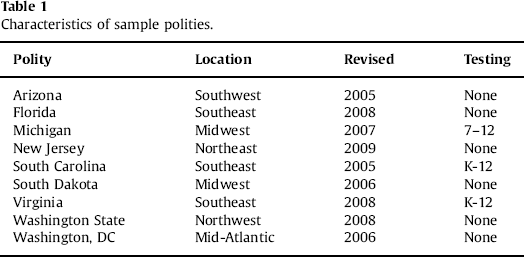
The data for this study come solely from the U.S. History portion of the social studies standards documents made publicly available through each state-level polity's Department of Education website (full citations are under References) (Arizona Department of Education, 2005; District of Columbia Public Schools, 2006; Florida Department of Education, 2008; Michigan Department of Education, 2007a, 2007b; South Dakota Department of Education, 2006; South Carolina Department of Education, 2005; State of New Jersey Department of Education, 2009; State of Washington Office of Superintendent of Public Instruction, 2008; Virginia Department of Education, 2008). The polities were selected based on several criteria: First, only polities that have comprehensive K-12 social studies standards documents with benchmarks and/or grade level expectations and content standards were included; second, only polities that have completed a revision of their social studies standards since 2005 were included, since more recent iterations of standards documents are more likely to manifest a greater concern for identifying comprehensive core content in light of the testing dictates of No Child Left Behind (NCLB). Third, it was important to maintain geographic balance between polities, especially given the recent Southern Poverty Law Center report that found significant geographic variability in the quality of content standards treating the CRM (Teaching the movement, 2011). Finally, although “understanding the growth of state-level history tests is problematic as the number of exams has proven to be a moving target” (Grant & Horn, 2006, p. 16), it was important to include in the dataset at least a few polities that test students annually on the U.S. History standards content (Standards, assessments, and accountability, 2010). Based on the above criteria Table 1 indicates the state-level polities included in the analysis. In this study Washington, DC is considered a state-level polity because it's educational bureaucracy acts like a state department of education in overseeing public instruction and publishing curricular benchmarks and content standards.
Characteristics of sample polities.
Analysis
Peräkylä (2005) stresses that “much of social life in modern society is mediated by written texts of different kinds” (p. 870). Bazerman (2006) argues that textual analysis is especially applicable to research on educational politics and policy, as “written texts pervade the educational process, the educational system, and the policy and political processes that shape education” (p. 77). Furthermore, Bazerman holds that “within the situation and moment, each text also has a rhetorical purpose—an underlying aim that it is attempting to carry out” (p.89). This study draws upon Bazerman's conceptualization to define textual analysis as an inductive process whereby the researcher engages in a dialogical process with a text in order to better understand its rhetorical functions. This research is also what Stake (2005) calls a “collective case study” because one of the guiding assumption of the study is that analysis of nine different standards documents will provide richer data than would analysis of only one or two. As Stake contends, “When there is even less interest in one particular case, a number of cases may be studied jointly in order to investigate a phenomenon, population, or general condition” (p. 445). Furthermore, Stake claims that the cases are “chosen because it is believed that understanding them will lead to better understanding, and perhaps better theorizing, about a still larger collection of cases” (p. 446).
This study employs both quantitative and qualitative analytical strategies to investigate the standards as sociopolitical signifiers of educational policy and politics. Of particular interest were the degree to which the standards purported to engage students in historical thinking about the experiences of African Americans during the CRM, assessed quantitatively, and the ideology of the standards conveyed by linguistic choices, assessed qualitatively. Each relevant standard (N=83) was analyzed as a whole text as constructed by each polity. The historical thinking dimension includes four criteria adapted from Wineburg's (1991, 2001) work on developing historical thinking: “evidence-based,” “multiple perspectives,” “evaluative/interpretive,” and “higher-order thinking.” A simple dichotomous rating was assigned for each dimension (“yes”=1, “no”=0) and then the score was totaled out of four possible points. A standard was evidence-based if it asked students to read and interpret specific documents, either historical or contemporary, and then develop a conclusion or defend a position using the document(s) for support. A standard included multiple perspectives if it asked students to consider competing sides of a historical or contemporary issue or the viewpoints of different social identity groups in U.S. history. A standard was evaluative/interpretive if it asked students to form and defend a conclusion, understanding, or constructed meaning about a historical or contemporary issue. A standard was higher-order if the verbs used in the statement transcended the “knowledge” and “comprehension” levels of Bloom's Taxonomy (Bloom, 1956), and instead required “application,” “analysis,” “synthesis,” “evaluation,” or other advanced intellectual processes.
The orientation dimension relates to the ideology of the standard, or to how the subject matter was deployed for a specific purpose. This dimension includes three categories: “contributory,” “progressive/exceptional,” and “discordant/conflict.” A standard was contributory if it focused primarily on praising or reinforcing the cultural contributions of African Americans during the CRM. A standard was progressive/exceptional if it primarily focused on gradual but inevitable democratic progress on U.S. race relations or generally implied a non-conflictual historical narrative. A standard was discordant/conflict if it substantively challenged or questioned the master narrative of the U.S. as a land of inevitably expanding freedom/equality over time for African Americans.
An example from New Jersey reveals how each relevant standard was coded (see Appendix for full coding results) (Fig. 1).
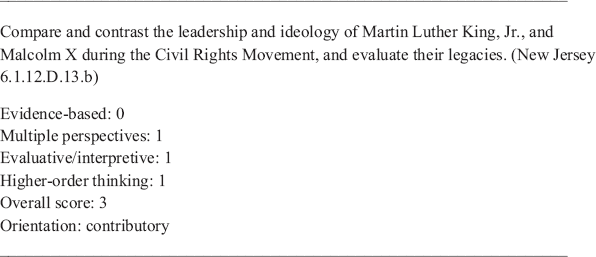
Example of coding scheme.
The standard is not evidence-based because it does not ask students to engage in any form of document analysis, but it meets the other three criteria because it includes two perspectives, it asks students to engage in comparative analysis of these perspectives, and it asks students to make an evaluative judgment of the overall legacies of king and Malcolm X. Thus, an overall rating of “3” was assigned to the standard. The standard was assigned a “contributory” rating because it focuses on the historical contributions of specific African Americans during the CRM.
Findings
Taken overall, the reviewed standards tend neither to engage students in historical thinking nor introduce discordant/conflict perspectives about the experiences of African Americans during the CRM. The findings are discussed further below along two dimensions: historical thinking and orientation.
Historical thinking
Overall, only 20 of 83 (24%) reviewed standards scored at least “2” in historical thinking. The only polities where at least half of the reviewed standards scored “2” or more were Michigan, New Jersey, and Washington State. Only five standards (6%) scored “3” overall, while only one (1%) scored “4.” Perhaps most striking, 51 of 83 (61%) failed to score at all, including all of the standards for Arizona, South Carolina, and South Dakota. Many of these non-scoring standards are vague both about what they expect students to know about the CRM and about what they want students to be able to do with the information beyond recall and description. The authors of the standards typically shoehorn prominent individuals, organizations, and events of the CRM into tidy chronological and thematic categories that trivialize the movement's significance and deemphasize the persistent racial tensions that emerged from the social changes the movement produced:
The reviewed standards typically represent the CRM as a convenient archetype of social change that represents the postwar renaissance of U.S. society's latent progressive spirit. Arizona situates the CRM within a master narrative of post-World War II social change: Describe aspects of post-World War II American society: postwar prosperity (e.g., growth of suburbs, baby boom, GI Bill), popular culture (e.g., conformity vs. counter-culture, mass-media), protest movements (e.g., anti-war, women's rights, civil rights, farm workers, César Chavez), assassinations (e.g., John F. Kennedy, Martin Luther King, Jr., Robert F. Kennedy, Malcolm X), shift to increased immigration from Latin America and Asia (Arizona Concept 9: PO 3)
This standard “covers” some historical content but it does not ask students to draw any connections between the listed examples or to evaluate the implications of multiple causes (both institutional and cultural) on how the postwar era radically changed U.S. society. Instead, the standard's descriptive structure conveys the notion that this chain of events was inevitable rather than subject to multiple contingencies.
Similarly, South Carolina and Virginia respectively expect students to engage with CRM content at a vague descriptive level: Explain the movements for racial and gender equity and civil liberties, including their initial strategies, landmark court cases and legislation, the roles of key civil rights advocates, and the influence of the civil rights movement on other groups seeking ethnic and gender equity. (South Carolina USHC-9.5) Demonstrate knowledge of the economic, social, and political transformation of the United States and the world between the end of World War II and the present by describing the changing patterns of society, including expanded educational and economic opportunities for military veterans, women, and minorities (Virginia USII.8)
Both standards encourage teachers to “cover” the CRM with broad strokes rather than to engage students in sustained analysis of the significance of particular people, events, legislation, or court cases surrounding the movement. Both standards also imply an inherent forward momentum to the CRM wherein social progress occurred naturally via a gradual and rational process, rather than through a discontinuous and dialectical process of social action, reaction, and compromise.
Several other standards tend to overload teachers and students with factual details, discouraging any type of higher-level analysis or evaluation of relative significance. Washington, DC and Florida respectively ask students studying the CRM to do the following: Explain the role of institutions (e.g., the National Association for the Advancement of Colored People, or NAACP; the Warren Court; the Nation of Islam; the Congress of Racial Equality; the Southern Christian Leadership Conference; League of United Latin American Citizens, or LULAC; the National Council of La Raza, or NCLR; the Mexican American Legal Defense and Education Fund, or MALDEF; the National Puerto Rican Coalition; and the Student Non-violent Coordinating Committee) (Washington, DC 11.11.4) Assess key figures and organizations in shaping the Civil Rights Movement and Black Power Movement: Examples are the NAACP, National Urban League, SNCC, CORE, Charles Houston, Thurgood Marshall, Rosa Parks, Constance Baker Motley, the Little Rock Nine, Roy Wilkins, Whitney M. Young, A. Philip Randolph, Dr. Martin Luther King, Jr., Robert F. Williams, Fannie Lou Hamer, Malcolm X [El-Hajj Malik El-Shabazz], Stokely Carmichael [Kwame Ture], H. Rap Brown [Jamil Abdullah Al-Amin], the Black Panther Party [e.g., Huey P. Newton, Bobby Seale] (Florida SS.912.A.7.6)
The Florida standard did score “2” because it specifically asks students to “assess” key Civil Rights figures and organizations, which suggests the possibility of higher-level evaluation, but the structure of this standard makes it just as plausible that teachers will focus on having students summarize a few goals and/or accomplishments of these leaders or organizations rather than engage in more sustained analysis of a few of these cases. The Washington, DC standard encourages the same type of superficial coverage, although absent the pretext of higher-level assessment. What these standards have in common with the more vague examples cited earlier is a lack of concern for evaluating significance in history. The standards suggest that all of the above people, organizations, and institutions are more or less equally important, so teachers and students have little incentive to engage in deeper analysis of any one of these phenomena.
Orientation
Of the 83 reviewed standards, 38 (46%) were contributory, 39 (47%) were progressive/exceptional, and 6 (7%) were discordant/conflict. The polities with majority contributory standards were Florida (72%), South Carolina (57%), and South Dakota (75%). Washington, DC (57%), Michigan (60%), and Washington State (60%) had majority progressive/exceptional standards. Arizona, New Jersey, and Virginia had a 50%–50% split between contributory and progressive/exceptional standards. As for discordant/conflict standards, Washington, DC had four (13%), while Michigan and Washington State each had one (13% and 20% respectively). The other six polities had no discordant/conflict standards at all. The relative absence of discordant/conflict curricular perspectives in the reviewed standards exemplifies what Wertsch (1998) has termed the “quest-for-freedom” historical narrative template, wherein the political, social, and cultural accomplishments of a minority population (in this case African Americans) testify to the notion of gradual but linear progress on U.S. race relations.
The authors of the reviewed contributory standards tend to adopt a “celebratory heroification” (Loewen, 1995) stance toward the CRM, in which “monumentalist heroes” (Carlson, 2003) serve as archetypal crusaders for equal rights and social justice in the face of often intense societal opposition. The reviewed early elementary grade standards almost universally include Martin Luther King, Jr. among the pantheon of great American heroes. South Carolina expects kindergarten students to be able to “illustrate the significant actions of important American figures, including George Washington, Abraham Lincoln, and Martin Luther King Jr.” (South Carolina USHC-9.5 K-3.2), as well as to “identify the reasons for celebrating the national holidays, including Independence Day, Thanksgiving, President's Day, and Martin Luther King Jr. Day” (South Carolina USHC-9.5 K-3.3). Michigan expects first grade students to be able to “identify the events or people celebrated during United States national holidays and why we celebrate them (e.g., Independence Day, Constitution Day, Martin Luther King, Jr. Day; Presidents’ Day)” (Michigan 1-H2.0.7), while South Dakota asks students to “listen to literature about Native American Day, Veterans’ Day, Thanksgiving, Independence Day, Martin Luther King Day, and Presidents’ Day” (South Dakota K.US.2.1). Florida includes King in a list of examples that also includes Pocahontas, George Washington, Abraham Lincoln, Harriet Tubman, and astronauts, asking kindergarten students to “listen to and retell stories about people in the past who have shown character ideals and principles including honesty, courage, and responsibility” (Florida SS.K.A.2.4). Florida also includes Martin Luther King, Jr. Day among a list of examples that asks first grade students to “identify celebrations and national holidays as a way of remembering and honoring the heroism and achievements of the people, events, and our nation's ethnic heritage” (Florida SS.1.A.2.3).
The list of significant CRM contributors typically grows longer in subsequent grade levels, but the standards authors typically portray the CRM as mono-causal and uni-polar. South Carolina expects fifth grade students to be able to “explain the advancement of the civil rights movement in the United States, including key events and people: desegregation of the armed forces, Brown vs. Board of Education, Martin Luther King Jr., Rosa Parks, and Malcolm X” (South Carolina USHC 5–5.3). Arizona expects students to be able to “recognize that individuals (e.g., Susan B. Anthony, Jackie Robinson, Rosa Parks, Martin Luther King Jr., César Chavez) worked for and supported the rights and freedoms of others” (Arizona Concept 9: PO 1), while Washington, DC expects fifth grade students to Identify key leaders in the struggle to extend equal rights to all Americans through the decades (e.g., Mary McLeod Bethune, Ella Jo Baker, César Chávez, Frederick Douglass, Rodolfo “Corky” Gonzales, Charles Houston, Martin Luther King Jr., Thurgood Marshall, Carlos Montes, Baker Motley, Rosa Parks, Malcolm X, Eleanor Roosevelt, and Reies López Tijerina) (Washington, DC 5.14.3).
The above standards offer no indication that these individuals worked toward very different goals and advocated very different strategies for securing civil rights, thus encouraging teachers and students to conclude that the CRM was a monolithic entity that enjoyed widespread unanimity of purpose. Celebratory heroes like King and Rosa Parks physically embody the quest-for-freedom narrative template because they reflect Americans’ collective preference for unifying historical frameworks that canonize individual exemplars of non-violence and deemphasize social conflict.
The reviewed progressive/exceptional standards typically adopt more or less linear narratives of U.S. race relations. Michigan expects eighth grade students to be able to: Analyze the key events, ideals, documents, and organizations in the struggle for civil rights by African Americans including: the impact of WWII and the Cold War (e.g., racial and gender integration of the military), Supreme Court decisions and governmental actions (e.g., Brown vs. Board (1954), Civil Rights Act (1957), Little Rock schools desegregation, Civil Rights Act (1964), Voting Rights Act (1965)), protest movements, organizations, and civil actions (e.g., integration of baseball, Montgomery Bus Boycott (1955–1956), March on Washington (1963), freedom rides, National Association for the Advancement of Colored People (NAACP), Southern Christian Leadership Conference (SCLC), Student Non-violent Coordinating Committee (SNCC), Nation of Islam, Black Panthers), resistance to Civil Rights (Michigan 8.3.1).
This standard suggests inherent forward momentum to the CRM, although “resistance” is mentioned at the end of the standard ostensibly to remind teachers and students that the movement could only go so far in solving the race problem.
Virginia frames the CRM as a linear series of legal and legislative triumphs in securing equal rights for African Americans: The student will demonstrate knowledge of the Civil Rights movement of the 1950s and 1960s by: identifying the importance of the Brown vs. Board of Education decision, the roles of Thurgood Marshall and Oliver Hill, and how Virginia responded; describing the importance of the National Association for the Advancement of Colored People (NAACP), the 1963 March on Washington, the Civil Rights Act of 1964, and the Voting Rights Act of 1965 (Virginia VUS.14).
This standard bookends the 1954 Brown decision with the 1964 Civil Rights Act and the 1965 Voting Rights Act as the symbolic alpha and omega of liberal remedies for racial inequality. Unlike the Michigan standard above, this standard implies that all of the necessary progress in race relations was duly achieved within this decade long period.
Other progressive/exceptional standards also focus on the federal government as the fundamental change agent in securing civil rights for disenfranchised groups. New Jersey expects sixth grade students to be able to “determine the impetus for the Civil Rights Movement, and explain why national governmental actions were needed to ensure civil rights for African Americans” (New Jersey 6.1.12.D.13.a), while Washington, DC expects twelfth grade students to be able to “analyze the development and evolution of civil rights for women and minorities and how these advances were made possible by expanding rights under the U.S. Constitution” (Washington, DC 12.10). These standards convey the stance that the federal government ultimately drove social change through a spontaneous awakening of moral conscience, rather than being forced to act by powerful grassroots social movements. The quest-for-freedom narrative template presupposes that the legislative and judicial achievements of the CRM established formal equality between the races, and that henceforth any residual inequalities could be blamed on cultural factors rather than on institutional discrimination.
Discussion
In general the reviewed standards tend to deemphasize rigorous historical thinking about the antecedents and consequences of the CRM and to promote non-conflictual narrative perspectives, such as the quest-for-freedom template, that accentuate the historical contributions of African American individuals and groups toward an ostensibly unitary and progressive crusade for equal rights and justice. The standards typically ask students to describe or explain events related to the CRM in a vacuum without providing sufficient political, social, economic, and cultural context for understanding these phenomena, and they tend to discuss the Civil Rights era as a period marked by consensus building toward a unitary vision of racial harmony, rather than as a period of social strife and widely divergent points of view on goals and tactics. Hall (2005) argues that the dominant narrative of the CRM, perpetuated in the reviewed standards, is that after the CRM culminated in the Great Society legislation of the mid-1960s, most European Americans finally acknowledged their past racial sins and accepted the constitutional rights of people of color, thus allowing U.S. society to fulfill the “American Creed” (Myrdal, 1944) by reconciling its egalitarian ideals with its previous discriminatory practices. According to Hall, however, this dominant narrative trivializes and de-contextualizes the historical impact of the CRM, precluding the possibility of discussing the movement with any amount of depth and nuance, or to “make civil rights harder. Harder to celebrate as a natural progression of American values. Harder to cast as a satisfying morality tale. Most of all, harder to simplify, appropriate, and contain” (p. 1235).
The ascendant narrative of the CRM is also problematic because it discourages analysis of persistent racial inequalities even decades after the nominal conclusion of the movement. Today there is widespread rhetorical support for civil rights; it is socially unacceptable to debate or even consider the merits of a racially segregated society. Mississippi Senator Trent Lott, for instance, virtually assured his political demise in 2002 by paying homage to Senator Strom Thurmond's postwar segregationist political platform (Feagin & O'Brien, 2003). Racial economic equality, however, has been much more elusive. As Conley (1999) argues, “In contemporary America, race and property are intimately linked and form the nexus for the persistence of black-white inequality” (p. 5). The master narrative of U.S. race relations, however, presumes that the legislative and judicial achievements of the CRM forever established an even playing field between European Americans and people of color.
Furthermore, the dominant quest-for-freedom narrative oversimplifies the various contingencies of the CRM by suggesting an inchoate unanimity of purpose among the various African American protest movements of the twentieth century. One especially prominent example here is the lack of historical context provided on the militant Black separatist movements of the 1960s, such as the Nation of Islam and the Black Panthers. Martin Luther King, Jr., Malcolm X, and Stokely Carmichael had radically different visions of how to achieve racial justice in the U.S., and in the case of King and Malcolm X especially, their visions changed dramatically during the course of their public leadership. According to Marable (2011), King and Malcolm X represented different poles (and different constituencies) of African American political thought: Since by the 1960s the overwhelming majority of African Americans lived in large cities, the conditions that defined their existence were more closely linked to what Malcolm spoke about than what King represented. Consequently, [Malcolm X] was able to establish a strong audience among urban blacks, who perceived passive resistance as an insufficient tool for dismantling institutional racism (p. 7).
The dominant narrative of the CRM, however, promotes an all-encompassing integrationist model of African American resistance that glosses over the inconvenient specter of militant action.
Ultimately, the authors of the reviewed standards perpetuate an uncritical stance toward the history of the CRM. Wills (2005) argues that this notion of simplistic thinking promoted through school curricula is actually a symptom of U.S. society's collective preference for convenient and unifying historical narratives: It is also evident in the privileged images and public discourse we see and hear every year as we commemorate King's life: King's ‘I Have a Dream’ speech, Rosa Parks's refusal to give up her seat on the bus, and the celebration of King's method of achieving social change through non-violent protest. This collective memory is by no means monolithic, but in the hierarchy of culturally available representations of the past this is the favored commemorative narrative in mainstream US society (p. 126).
The trope of linear progress on race relations in U.S. history remains a seductive framework in part because it allows Americans both to avoid acknowledging persistent social inequalities and to sit in self-congratulatory judgment of previous generations for failing to recognize the evils of racism. If we desire to engage more deeply with issues of race in contemporary U.S. society, then it is incumbent upon educators to critically interrogate the stories that we tell ourselves about our own past.
Footnotes
Characteristics of reviewed standards
Evidence-based Multiple perspectives Evaluative/interpretive Higher-order thinking Overall score