







Abstract
This study explored the use of a scaffolded version of lesson study to develop professional teaching knowledge for problem-based historical inquiry among three 4th-grade social studies teachers who taught Alabama History at the same high-poverty elementary school. Lesson study is a collaborative professional development approach that involves teachers designing, implementing, and reflecting on instruction in recursive cycles. Drawing upon observations of lesson study planning and debriefing sessions as well as classroom instruction, researchers examined the three teachers’ adoption of professional teaching knowledge for problem-based historical inquiry following three yearlong lesson study cycles. Findings suggest lesson study can be used to cultivate professional teaching knowledge for problem-based historical inquiry among elementary social studies teachers, though the transfer of that knowledge to more typical classroom instruction is fraught with challenges. Three factors appeared to explain variations in teachers’ adoption of professional teaching knowledge for problem-based historical inquiry: the degree to which each teacher deferred to professional authorities, whether and how each teacher prioritized developing prior knowledge before higher order thinking, and the extent to which each teacher held idiosyncratic views on teaching and learning.
Introduction
Social studies curriculum reformers have long advocated for issues-centered inquiry so that students practice the thinking, reasoning, and problem-solving necessary for citizenship (Evans, Newmann, & Saxe, 1996; Oliver, Newmann, & Singleton, 1992; Parker, Mueller, & Wendling, 1989; Saye & Brush, 2004). Yet, social studies teachers rarely use issues-centered instructional frameworks (Saye & Social Studies Inquiry Research Collaborative, 2013). One reason theory often fails to impact practice may be that teachers’ conceptions of knowledge applicable to teaching differ from those of researchers (Hiebert, Gallimore, & Stigler, 2002; Stigler & Hiebert, 2009). We wanted to understand whether lesson study, a professional development approach whereby teachers, researchers, and content experts plan, implement, and revise instruction together, might create an environment in which greater integration of theory and practice became possible. Lesson study has shown promise in helping teachers overcome obstacles to the adoption of more ambitious teaching (Howell & Saye, 2015;; Kohlmeier & Saye, 2017; Bocala, 2015; Fernandez, 2005).
This paper presents findings from a three-year lesson study professional development project called the Plowing Freedom's Ground (PFG) Project. The PFG Project was a partnership between social studies faculty at a large land-grant university in the southeastern United States and five nearby school districts. In previous work, we examined the nature of the professional teaching knowledge culture that emerged among the six 4th-grade teacher participants who were part of the larger project (Howell & Saye, 2015). In this paper, we examine the effects of lesson study on three teachers who taught at the same high-poverty urban elementary school. We sought to understand how these three teachers interpreted and enacted problem-based historical inquiry (PBHI), the issues-centered instructional framework at the center of our lesson study professional development project. For this paper, we focus on the following research questions:
How do 4th-grade teachers interpret a holistic, research-based framework for problem-based historical inquiry designed to increase professional teaching knowledge? Do 4th-grade teachers who exhibit greater understanding of PBHI demonstrate greater growth in professional teaching knowledge and higher levels of authentic pedagogy over time?
Perspective
One means to encourage teachers to adopt ambitious instructional frameworks like PBHI is to convince them that theoretical knowledge can be used to guide instructional decision-making. Teachers place their trust in craft knowledge which is developed through experience and organized around specific problems of practice. While researchers tend to parse out the various knowledge bases needed for good teaching (i.e., Shulman's (1986) contrasting of pedagogical and pedagogical content knowledge), teachers’ craft knowledge is more pragmatic and intertwined. Teachers reliant on this craft knowledge are unlikely to examine theoretical knowledge from researchers that could inform their instructional practice (Hiebert et al., 2002). To accept theory-based knowledge, teachers need to see it effectively applied within real-world classrooms (Hiebert et al., 2002). We, therefore, conceive of professional teaching knowledge as the merging of craft knowledge, which is personal, private, and often pragmatic, with researcher knowledge, which is public, propositional, and replicable (Saye, Kohlmeier, Brush, Mitchell, and Farmer, 2009). When familiar craft knowledge is merged with unfamiliar researcher knowledge to form professional teaching knowledge, practitioners become more willing to adopt theory-based generalizations (Hiebert et al., 2002; Saye et al., 2009).
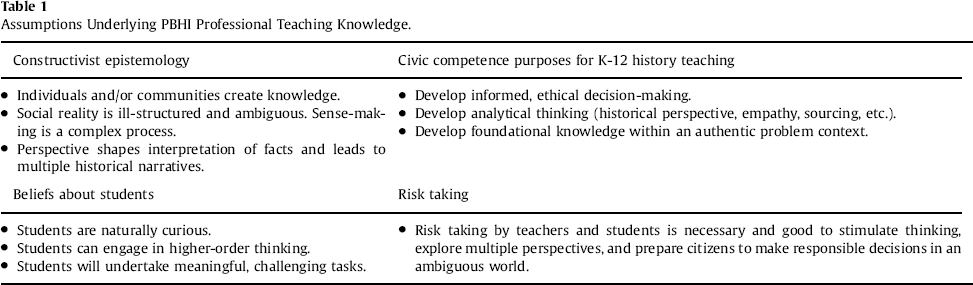
Table 1, drawn from our previous work mentoring individual teachers to adopt PBHI (Saye et al., 2009), summarizes our conception of professional teaching knowledge. Our assumptions about professional teaching knowledge are informed by our understanding of research on teaching and learning (Newmann, King, & Carmichael, 2007; Bransford, Brown, & Cocking, 2000) but also by our decades-long efforts to help teachers adopt ambitious, inquiry-oriented social studies teaching. Teachers who hold the cultural assumptions for PBHI professional teaching knowledge demonstrate a constructivist epistemology, a willingness to take risks and accept ambiguity, optimistic beliefs about student motivation and curiosity, and, perhaps most importantly, a commitment to civic competence as the principal mission of K-12 history teaching (Saye et al., 2009). Achieving civic competence in students demands that teachers require students to “use knowledge about their community, nation, and world; apply inquiry processes; and employ skills of data collection and analysis, collaboration, decision-making, and problem-solving” (National Council for the Social Studies, 2010, p. 9).
Assumptions Underlying PBHI Professional Teaching Knowledge.
PBHI and its obstacles
PBHI is an instructional framework that asks students to investigate historical events within the context of social issues to develop civically competent, democratic citizens capable of informed, ethical decision-making (Saye & Brush, 2004). However, PBHI has proven quite challenging for social studies teachers to implement (Rossi, 1995; Saye and Social Studies Inquiry Research Collaborative, 2013). Below we examine several factors that may influence teachers’ receptivity to and adoption of professional teaching knowledge for PBHI. Additionally, we consider how the marginalization of social studies at the elementary level and the lack of in-depth preparation to teach social studies also influence elementary teachers’ receptivity to instructional frameworks like PBHI.
Teacher dispositions
Dispositions are characteristics of teachers that summarize the frequency of teacher actions within contexts. Dispositions are descriptive in nature but also predict the frequency of future actions (Katz & Raths, 1985). For example, teachers open to inquiry teaching would likely hold dispositions favorable towards experimentation and risk-taking. Shaver (1996) suggests that social studies teachers should be open to exploring new ideas and hold tentative views of knowledge. He argues that teachers who hold these dispositions will make curricular decisions that honor the needs of their students, even when those decisions are countercultural within their school or school district. Regarding PBHI, a social studies teacher who is dispositionally intolerant of risk-taking is unlikely to push students to engage in cognitively complex tasks even when they have the content knowledge and teaching skill to do so.
Content knowledge and defensive teaching
If we assume teachers hold dispositions necessary for implementing PBHI, they still must confront dilemmas associated with the adoption of constructivist teaching, including the need for deep content knowledge (Bransford et al., 2000). Teachers must know the principles, issues, and points of view underlying the topic of study to lead students through an inquiry of it. When such content knowledge is unavailable, however, teachers tend to privilege facts rather than the exploration of challenging concepts. This privileging often results in the teacher tightly controlling discourse in the classroom to maintain control (Barton & Levstik, 2003; Windschitl, 2002), an approach that McNeil (1986) calls “defensive teaching.” Teachers do not make decisions to control classroom knowledge in a vacuum, however; indeed, cultural pressures from outside the classroom, including school or district emphasis on test taking, often influence teachers’ openness to new instructional frameworks like PBHI.
Teacher as gatekeeper
If social studies teachers are to adopt professional teaching knowledge for PBHI, they must also acknowledge that such study has merit for their students. As gatekeepers (Thornton, 1991), teachers are the key to what curriculum students experience. Teachers not only decide what content to teach but also how to teach it, thereby controlling the experiences students have in the classroom. Many social studies teachers, however, rely on textbooks for curricular decision-making. They separate curriculum from instruction, focusing their energies on instruction while leaving the curriculum to textbook authors. If teachers are to effectively navigate their role as gatekeepers and adopt new instructional strategies and curriculum planning paradigms, professional development that presents alternatives to textbook-based curriculum decision-making will be critical.
Teacher beliefs
Teacher beliefs influence how teachers run their classrooms. Nespor (1987) suggests that beliefs impact teaching in four ways: 1) teachers hold existential assumptions about their abilities as well as those of students, 2) teachers hold views about ideal teaching environments that can encourage them to see less than ideal conditions as constraining, 3) teachers’ feelings towards course content influence the way they teach it, and 4) teachers’ experiences in classrooms and with the culture of schooling influence their classroom behavior. Barton and Levstik (2003) point to beliefs about the purposes for teaching social studies as an important determinant for whether teachers will implement new instructional frameworks. If teachers view education for citizenship as the goal for social studies instruction, they are more likely to implement frameworks that pursue democratic citizenship. If, however, teachers believe their primary tasks are to control behavior and cover the content (McNeil, 1986), they are far less likely to adopt them. Professional development must, therefore, be sensitive to the realities of teaching environments while simultaneously helping teachers develop new beliefs about the purposes of social studies.
Cognitive complexity
Constructivist teaching of any kind, including PBHI, requires complex mental processes. Teachers must co-construct knowledge with students, mentor students as they develop intellectually, and provide support for students as they think through difficult problems (Bransford et al., 2000; Greeno, Collins, & Resnick, 1996; Scheurman, 1998). Many dilemmas confront constructivist teaching in practice. If, for instance, a school emphasizes the memorization of a core body of facts, the teachers in that school are not likely to encourage the epistemic cognition necessary for constructivist teaching (Hofer & Pintrich, 2002). Additionally, constructivist teaching requires teachers to use student misunderstandings to facilitate student learning using a wider range of teaching strategies (Bransford et al., 2000). Teachers must claim the autonomy necessary to make curricular decisions that allow for the facilitation of learning within a constructivist learning environment (Windschitl, 2002).
Teaching social studies in elementary schools
The present culture of elementary schooling presents significant obstacles to the adoption of instructional frameworks like PBHI in part because it has reduced the autonomy of classroom teachers. While No Child Left Behind encouraged high-stakes tests in reading, science, and mathematics, such tests have mostly not emerged in social studies. The result has been a marked reduction in the number of hours devoted to social studies by elementary teachers (Fitchett, Heafner, & VanFossen, 2014). Students receive as few as two to three hours per week of instruction in social studies (Howard, 2003; Leming, Ellington, & Schug, 2006). When social studies is integrated with other subjects rather than taught separately, such integration sometimes masks the uncertainty elementary teachers feel when teaching social studies (see, for example, Levstik, 2008). Elementary teachers are usually prepared as subject-matter generalists (Thornton, 2001) and only take two to three social science courses during their undergraduate preparation (Conklin, 2007). Though the number and quality of methods courses differ dramatically across the United States, many elementary teaching candidates take general methods courses not tied to specific disciplines while others take a single social studies-specific methods course that might include themes of inquiry, curriculum integration, and literacy (Conklin, 2007).
Using lesson study to develop professional teaching knowledge
The challenges associated with implementing PBHI are numerous and can seem insurmountable. We suggest that one promising means to overcome obstacles to the adoption of instructional frameworks like PBHI may be lesson study, a recursive and collaborative process of designing, implementing, reflecting on, and modifying a single research lesson during one academic school year (Lewis, 2009). Stigler and Hiebert (2009) note that lesson study is based on a long-term continuous improvement model that respects the fact that teaching is a cultural activity. Lesson study focuses on direct improvement of teaching in context, which acknowledges the complexity of teaching as a cultural activity. Teachers work in collaborative teams to plan, implement, and observe a single research lesson. Team members reflect on and discuss evidence of student learning gathered during lesson observations and from student work and then improve the lesson before observing it taught in a second classroom (Lewis, 2009). The collaborative nature of lesson study encourages teachers to make their assumptions about teaching and learning public (Halvorsen & Kesler Lund, 2013; Howell & Saye, 2015), an act that makes teachers’ views open to critique and change (Stigler & Hiebert, 1999). In our previous work (Howell & Saye, 2015), we examined the extent to which lesson study helped participating teachers navigate the marginalization of social studies at the elementary level so that taking part in a professional teaching knowledge culture became possible. In this paper, we examine how three teachers interpreted PBHI and the degree to which professional teaching knowledge for PBHI emerged.
While lesson study has grown in popularity across the United States, few studies examine the use of lesson study to encourage the adoption of theoretically-grounded instructional frameworks like PBHI. Halvorsen and Kesler Lund (2013) described how a group of 5th-grade history teachers used lesson study to rethink their instructional practices, but they acknowledge the lack of systematic classroom observations as a limitation of their study. Hubbard (2015) examined how teacher participation in lesson study impacted early childhood students’ perceptions of social studies instruction. She found, among other things, that teachers’ participation in lesson study minimally affected students’ attitudes towards social studies, findings which suggest a need for longer time horizons with lesson study as well as more sustained attempts at helping teachers transfer learning from lesson study to more typical classroom practice. Our study at least partially examines the degree of transfer from lesson study professional development activities to normal classroom instruction through classroom observations of research lessons and best-case comparison lessons chosen by participating teachers. We also examined teachers’ practice over three years, which allowed us to more fully document the potential for lesson study to encourage teachers’ adoption of professional teaching knowledge for an ambitious instructional framework like problem-based historical inquiry.
Study design
We conceptualized lesson study as a design intervention (Brown, 1992) because we used collaboratively planned and evaluated lessons to encourage professional teaching knowledge for PBHI. Design interventions take place in real classrooms with all their complexity, as opposed to laboratory settings where researchers can systematically control variables. Lesson study as a design intervention is grounded in socio-constructivist assumptions about teaching and learning (Bransford et al., 2000). Cognition is social within lesson study teams (Fernandez, 2005) and learning is mediated through the group of teachers as they engage in rich conversations about teaching and learning (Greeno & Collins, 1996). To holistically describe changes in teaching and learning brought about by lesson study, we collected data over three lesson study cycles so that we could view the data from multiple perspectives and triangulate findings (Design-Based Research Collective, 2004). We attended to how the teachers socially constructed knowledge as part of a lesson study design team, but we also considered the ways that the lesson study process enculturated teachers into an inquiry-oriented community of practice (Borko, 2004), a community in which we, as researchers, were equal members.
Our lesson study model differed from other lesson study models in two important ways. First, it was more broadly collaborative than typical lesson studies. Participating teachers, teacher educator staff, and project historians worked collaboratively to author the research lessons. In Year 1, for example, teacher educators acted as coaches and facilitated teacher decision making so it reflected the PBHI model. By Year 3, project staff relinquished the coaching role but remained equal participants, thereby allowing planning to unfold more organically. Second, our lesson study model was scaffolded. We considered Fernandez's (2005) warnings about guiding or scaffolding teacher learning during lesson study. Planning scaffolds required teachers to think about their goals for student learning as well as the pedagogical strategies that might maximize that learning. Moreover, staff persons provided additional scaffolding through subtle questions, suggestions, or examples, particularly during the first year of lesson study. We recognized the limitations imposed by our lesson study model as it related to teacher autonomy and therefore shifted greater control of the planning process to the lesson study team during Year 2 and Year 3. For instance, while we systematically completed planning scaffolds in Year 1, we used the planning scaffolds only informally in Year 3 when teachers referenced topics contained within them or when teachers specifically asked to look at them.
We employed a purposeful sampling strategy (Creswell, 2012). In the larger PFG Project, six elementary teachers from three different school districts volunteered to participate. The three teachers featured in this paper, Camille, Olivia, and Paige, taught 4th-grade at River Elementary, a K-5 elementary school in an urban district. The school had approximately 650 students, 86% of whom were Black and 86% of whom were eligible for free or reduced lunch. The teachers were responsible for teaching all subjects. 4th graders at the school scored in the 49th percentile on the Stanford Achievement Test the year the PFG Project began. While all three teachers were “highly qualified” under NCLB at the start of the study, they all spoke of their lack of in-depth preparation to teach history in meaningful ways. Moreover, the school districts participating in the PFG Project lacked sufficient funding to offer professional development in history before collaborating in the PFG Project. The teachers had no prior social studies professional development experience. Table 2 below overviews the teachers featured in the study. None of the teachers featured held degrees in history or social studies education, and all had fewer than twelve credit hours in history, most of which were completed in the freshman or sophomore year of undergraduate study.
Teacher Demographics.

Data collection
Each year, the 4th-grade lesson study team completed the same steps. In the summer, the team participated in a weeklong seminar during which historians provided content lectures and teacher educators modeled PBHI learning strategies for an identified historical era. Participants then engaged in the second week of lesson study. The 4th-grade teachers met as a team to identify research lesson teaching and learning goals and to design the research lesson and supporting materials. The team identified one teacher to implement the lesson for other team members to observe. Immediately following this observation, team members met at the school to discuss and critique lesson outcomes including student work. As part of this conversation, or in later meetings, teachers also reviewed video of lesson implementations. The teams then scheduled a time during or after school to make changes to the research lesson. A second teacher then implemented the updated lesson, and the team repeated the entire process. The yearlong lesson study cycle concluded with a final meeting to revise the lesson for the upcoming school year and to draw more holistic conclusions about teachers’ experiences throughout the year.
During all lesson study planning sessions, we used field notes to document teachers’ verbal and material contributions to the planning process. Whenever planned discussions occurred, such as when completing a lesson study scaffold or debriefing lesson study observations, a digital audio recorder was used in conjunction with field notes. We transcribed these audio recordings in full. We also collected lesson study planning scaffolds completed with 4th-grade team members and noted individual teacher contributions or concerns.
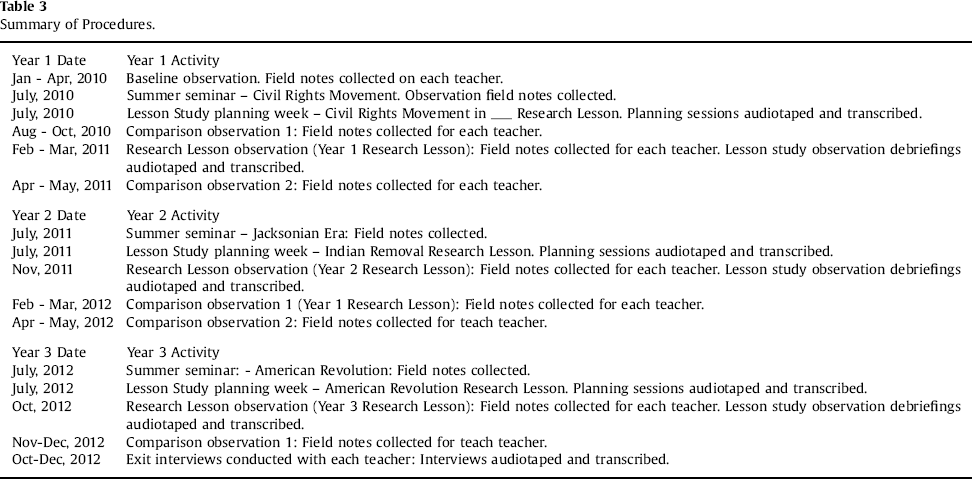
We conducted multiple classroom observations throughout the project: a baseline observation for each teacher before the start of the PFG Project, three observations during Year 1 and Year 2, and two observations during Year 3. Over the three years of this study, therefore, we observed each teacher nine times. During each observation, we compiled observation field notes of classroom instruction and collected the task handout or instructions given to students during the observed lessons. Observations included both lesson study research lessons as well as teacher-selected comparison lessons. In Year 1, we observed two comparison lessons and one research lesson. In Year 2, we observed one comparison lesson and two research lessons. In Year 3, we observed one comparison lesson and one research lesson. For the comparison lessons, teachers were directed to choose a lesson that demonstrated “powerful social studies learning” among their students. We hoped to compare lesson study research lessons to an ideal lesson, selected by the teacher, that represented their best efforts to design and implement engaging social studies instruction. While we gathered the bulk of our data during lesson study planning, observation, and debriefing sessions, we used data collected during classroom observations to corroborate our emerging interpretations of teacher thinking.
We employed Newmann and Associates’ (2007) Authentic Intellectual Work (AIW) rubrics during each observation to document levels of authentic pedagogy. The AIW instruction rubric contains four standards: Higher Order Thinking, Deep Knowledge, Substantive Communication, and Connectedness to the Real World. Each standard has a five-point scale. Therefore, a total ranging from 4 to 20 was possible on the instruction rubric, which we computed by summing the scores for each rubric standard (Newmann et al., 2007). While we also employed AIW task rubrics for each observation, there was little variability in scores for tasks associated with comparison or research lessons. Teacher-selected tasks consistently scored at the lowest levels on the AIW task rubric while lesson study tasks were co-created and scored similarly across all teachers. We have therefore omitted task scores from our analysis and focused instead on authentic instruction scores. A second rater scored twenty-five percent of these observations for purposes of inter-rater reliability (Patton, 1987). Prior AIW research has established an inter-rater agreement standard of greater than 65% exact agreement and agreement within one point to exceed 90% (Newmann & Associates, 1996). For all AIW standards, exact agreement was 66%, and agreement within one was 96%.
Finally, we conducted semi-structured interviews with each 4th-grade teacher at the conclusion of Year 3. We sought to understand the lived experiences of the 4th-grade teachers throughout the lesson study process (Patton, 1987). We probed for deeper meaning and asked unplanned questions when additional details were needed to understand the interviewee's perspective (Patton, 1987). We attempted to gain a nuanced understanding of the participant's experiences during lesson study by deliberately remaining naïve and open to new or unexpected explanations. Table 3 below summarizes our data collection procedures.
Summary of Procedures.
Data analysis
Simple descriptive statistics including means were used to make comparisons between the three teachers. For each teacher and each year, we averaged total instruction scores for the research lessons and the teacher-selected comparison lessons. Descriptive statistics were also used to determine the extent of changes among the 4th-grade teachers from Year 1 to Year 3. Analysis of qualitative data began by assembling all the transcribed data and field notes for each of the three 4th-grade teachers into individual case records in Microsoft Word. We then individually used typological and content analysis as well as analytic induction to interpret the case records (LeCompte & Schensul, 1999). Analysis began with the a priori criteria for PBHI professional teaching knowledge provided in Table 1 (Saye & Brush, 2004, Saye & Brush, 2007, Saye et al., 2009). After we analyzed and coded each case record using our a priori criteria, we made comparisons across the records and noted patterns that emerged. We then examined the experience of each teacher and reexamined all of the data more holistically for the use of professional teaching knowledge across participants. When discrepancies in the data emerged and our existing coding proved unhelpful, we modified the existing coding scheme and reexamined the data again. The new themes that emerged helped us consider aspects of our a priori coding scheme more deeply or to consider factors beyond it. Deference to authority, for example, reflects a teacher's epistemological stance but is also influenced by school culture.
Ethical dilemmas in design-based research
We confronted several ethical dilemmas as we conducted design-based curriculum research. The teachers we worked with did not always share our assumptions about teaching and learning. They made instructional choices grounded in their experiences working with the children of their community, experiences that led them to develop personal and practical theories of instructional practice (Cornett, 1990; Elbaz, 1981). We worry that comparing our problem-based model for teaching and learning to the teachers’ actual practice might be construed as teacher bashing. Criticizing the teachers who gave their time and energy to collaborative curriculum design is not our aim. We knew the teachers to be dedicated, compassionate, and enthusiastic professionals who loved their students. We looked forward to visiting their classrooms because of the hope they instilled in their students. As former classroom teachers ourselves, we appreciate the complexity of implementing instruction that might differ substantially from one's current practice and admire the teachers for volunteering to participate in a multiyear professional development project that might cause them to question their assumptions about teaching and learning.
Findings
In this section, we characterize variations in the emergence of professional teaching knowledge among the three teachers featured: Camille, Olivia, and Paige. To do so, we draw from data collected for Years 1 and 3 to capture the greatest degree of change. During baseline observations completed before the start of PFG Project activities, we consistently observed traditional pedagogy. Indeed, no teacher reached authentic instruction scores that other researchers have characterized as challenging social studies instruction. All three teachers focused their attention on conveying discreet facts from textbooks. Student thinking was lower order, knowledge was superficially treated, little conversation was observed, and lesson topics were rarely connected to anything beyond themselves.
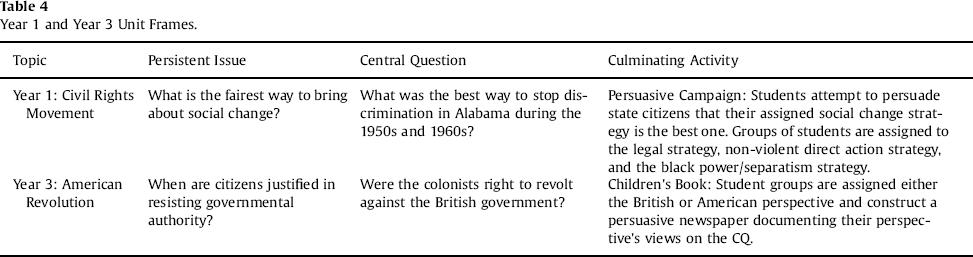
Table 4 summarizes the overarching structure of the Year 1 and Year 3 lesson study units. The table reflects the structure of a completed unit frame planning scaffold used by lesson study teams to develop a central focus for each year's unit. In the sections that follow, we organize our analysis around the a priori themes embedded in our assumptions about professional teaching knowledge but also speak to new themes within the data.
Year 1 and Year 3 Unit Frames.
Constructivist epistemological assumptions
Throughout the project, Camille retained absolutist assumptions about knowledge, which led her to consider policy makers or textbook authors as the best source for reliable historical knowledge. She voiced concerns that her students would not succeed unless the lesson study team focused on increasing students’ prior knowledge via vocabulary work. Camille argued during Year 1 planning, for instance, that her students would not be able to answer a Civil Rights Movement unit central question about discrimination unless the team focused on Civil Rights terms, people, and places early in the unit. During Year 3 planning, she encouraged her peers to consider textbook readings about the Declaration of Independence as the most appropriate way to scaffold students’ understanding because the “answers are in there with the explanations.” Camille consistently argued students need “background knowledge” before working through historical questions.
In contrast to Camille, Olivia wrestled with her epistemological assumptions throughout the PFG Project. Although Olivia's experience throughout lesson study was typified by her eagerness to participate, it was also characterized by her need to master the content well enough to conceptualize (and later facilitate) curriculum within a PBHI learning environment. In one instance during Year 1 planning, for example, Olivia confused Jim Crow segregation with black separatism, causing her lesson study team to consider resources that were not appropriate for a lesson examining separatism as Civil Rights change strategy. Despite the challenges posed by her content knowledge, Olivia often vocalized support for more student-centered approaches to teaching (at least in her rhetoric). In her exit interview at the end of Year 3, Olivia compared her prior instruction to her new desire to use multiple perspectives to provoke discussion:
In a normal lesson, we really don't discuss. It's just reading out of the book and then we give it to them. But our [project] lessons, there's room to discuss. There's more information from different sources that causes the conversation to get started… With our lessons, [students] are like, Ms. Olivia, …how we going to figure it out?
Olivia's desire to create instruction that gave students time and space to “figure it out” represented a significant shift in her aims from the start of the PFG Project. By the conclusion of the project, Olivia saw merit in allowing students space to construct knowledge together.
Like Olivia, Paige appeared to shift towards constructivist epistemological assumptions, including a belief that students could socially construct knowledge. However, Paige seemed to make that shift much earlier than Olivia. At the start of the project, Paige relied on the textbook for ideas about appropriate content and lesson sequencing. Much sooner than any other teacher, however, Paige expressed reservations about excessive use of the textbook even as she continued to rely on it for planning purposes. In this sense, it seemed that Paige had already developed some dissatisfaction with using the textbook as her primary source for planning social studies instruction. Interactions with staff throughout the PFG Project may have cemented her dissatisfaction while collaborative lesson study provided the space she needed to shift towards using other sources for planning. Paige was the first, for example, to encourage the lesson study team to adopt a thematic organization for the Year 1 Civil Rights Movement unit focused on the best way to end discrimination because she believed organizing lessons around individual Civil Rights change strategies would scaffold students’ thinking about the unit central question. Her suggestion came in immediate response to a proposal by Camille to organize the unit around the list of people, places, and events listed in the state course of study. During Year 3 planning, Paige encouraged the lesson study team to help students “take on the role of others’ thoughts, others’ perspectives.” She forcefully argued that her students could “learn from other people's opinions” and that doing so would “help them form their own.” Paige's comments during the completion of a Year 3 lesson planning scaffold suggested that she had begun to recognize the ill-structured and ambiguous nature of social reality. She seemed to understand the complexity of asking students to decide if colonists were right to revolt against the British.
There are a whole lot of underlying back issues as to why [the British] are doing these things [during the Revolutionary era]… It's still such a difficult thing to wrestle with, like right and wrong, submission to authority. I think those are all complex enough ideas that even when they're broken down, it's still pretty complex… It's not always a black and white issue. There's a lot of gray area and that will connect to real life too.
Paige seemed to accept that her students could construct knowledge, given the right materials, and that one's perspective can influence one's interpretation of the past and the present.
Civic competence purposes for K-12 history teaching
Camille supported transmission of historical facts to students and did not adopt civic competence as her purpose for history teaching. She encouraged the lesson study team to begin lessons with traditional expository instruction, and she understood the textbook to provide the content teachers should cover. Camille's thin history content knowledge and perhaps a focus on reading fluency may have reduced her openness to professional teaching knowledge for PBHI. During her Year 1 research lesson implementation, for instance, Camille appeared to lose sight of helping students evaluate nonviolent direct action as a change strategy. Instead, she focused her implementation on a single historical figure – Martin Luther King, Jr. She redirected an opening brainstorming session on nonviolent direct action to King's biography and then gave King credit for creating all nonviolent methods of resistance. Dong so reduced the complexity of the Civil Rights Movement to a single historical figure. Ultimately, Camille appreciated scaffolded lesson study, not because of its grounding in inquiry, but because research lessons helped students “retain [historical] information more.”
Olivia also began the PFG Project assuming the textbook provided the knowledge that teachers should transmit to students. Unlike Camille, Olivia never seemed to believe that students’ lack of background knowledge was insurmountable or that students were incapable of learning background knowledge as they worked to address a historical issue. By the end of Year 3, Olivia comfortably expressed her desire to move beyond transmitting the past to more civic competence purposes for teaching history. She remained unsure exactly how to accomplish that goal and often struggled to ground her thinking in PBHI principles. In one instance during Year 3 planning of learning goals, Olivia said, “I just want my kids to think” but was unsure about what her students should think. Again, while Olivia was among the first to offer a unit central question during Year 3 planning, she was satisfied with getting students “to care” as a goal for the teaching of the American Revolution. The fact that Olivia could articulate citizenship goals for her teaching marked a significant transition however. She provided one of the clearest examples of a teacher hopeful of developing students’ citizenship skills.
I see a purpose [for teaching social studies] now. Me teaching them this information is going to make them a better citizen of the United States. It's going to give them a desire to want to know more – to make this country a little better.
Paige readily adopted the notion that students could develop foundational knowledge within the context of an authentic problem. Like Olivia, Paige shifted rather dramatically in her rhetoric towards civic competence purposes for the teaching of history. She grew quickly in her ability to help the lesson study team use the unit central question as a planning tool. She often directly asked her teammates to explain how content or activities would help students answer the unit central question. By Year 3, Paige also began to realize that students needed exposure to multiple perspectives for them to think deeply about ill-structured social issues. When deciding whether the Year 3 unit central question was strong enough, for example, Paige drew upon her historical understanding to argue that her students could reasonably argue that American colonists were breaking the British king's rules and that they legitimately deserved punishment. Later, during her exit interview at the end of Year 3, Paige used this understanding to articulate a civic competence mission for her future social studies teaching.
Before [the project], I thought [the purpose of teaching social studies] was just to learn the facts and the dates and stuff. But now I think it's to create well-rounded thinkers who can deal with the issues that have been happening throughout history…
Paige appeared eager for something different in her social studies teaching. One important reason that Paige may have been open to PBHI was that she resisted integrating history instruction with literacy instruction, saying during her exit interview that history had become “not just about reading the facts, [but] it's about answering bigger questions.”
Beliefs about students
Camille often wondered whether her students could engage in higher order thinking or complete challenging social studies tasks. During Year 1 planning, for instance, she argued that having students investigate nonviolent methods of resistance on their own within the context of a question about ending discrimination would be insufficient. She said, “You got to tell them this is a nonviolent method and this is a march because we're on a lower level.” Camille, however, reaffirmed the relevance of focusing on discrimination by noting how the research lesson helped students see what it looked like when students excluded one another. Her comments suggested that her views about students were sometimes conflicted. On the one hand, she felt students would benefit from examining instances of discrimination. On the other hand, she seemed skeptical that students knew enough to address questions about discrimination. When Camille observed dramatically improved student engagement in her colleagues’ classrooms, she usually isolated those changes to the respective classrooms, thereby limiting the transferability of those outcomes to her classroom.
Olivia maintained optimistic beliefs about students. Very early, Olivia appeared to grasp the idea that research lessons were designed to help students make informed decisions on ethical questions and she seemed eager to empower her students to make them. She frequently diagnosed student challenges within the research lesson by drawing the lesson study team's attention back to the teacher's role within each lesson. During the final Year 1 observation debriefing, for instance, Olivia encouraged her team to consider the teacher's role in motivating students.
I think [the increased student motivation] has to do with us too because we were excited about our own lessons… I was like, “Hey, guess what we're going to do?” And so that made [students] want to do a little more. So I'm looking forward to the next lesson just to see their reaction… And then history won't be so boring to me…
In her exit interview, Olivia suggested that students’ increased retention of historical knowledge from research lessons forced her to reflect on her past expectations for students, saying, “I used to be satisfied with them completing a sheet out of the practice book and it was good, but now I expect more.” Olivia explained that she felt comfortable asking students to summarize different points of view and even to consider changes over time because her content knowledge had improved. As Olivia's content knowledge improved, her confidence using PBHI strategies grew.
Paige seemed most willing to shift towards more student-centered approaches to teaching social studies even as she acknowledged difficulties motivating her students to do challenging work. She was impressed by her students’ ability to discuss and engage in the research lessons throughout the PFG Project. She noted during a Year 1 observation debriefing, for example, her pleasure with “the conversation that [was] sparked between the kids, especially just watching and knowing my students in my classroom, you would never think that they would get as into it because they don't with a lot of things.” One reason Paige may have supported using PBHI with her students was her belief that students were “egocentric” and that using multiple perspectives helped students to think beyond their narrow-minded views. She hoped that using perspectives from sources beyond the textbook along with a meaningful unit question would encourage students to remain engaged. In doing so, she suggested that students could develop foundational knowledge while thinking critically, in stark contrast to Camille. During her exit interview at the conclusion of the project, Paige succinctly described the changes in her beliefs about students, saying, “I definitely give them a lot more credit and expect a lot more out of them because I know what they can do.”
Risk taking
Camille viewed risk taking as unwelcomed because it led to classroom disruptions and represented an unnecessary affront to a school culture focused on preparing students to pass standardized tests. Even though it seemed Camille understood that a more student-centered alternative for social studies instruction existed, she proved unwilling to consistently accept the risk associated with giving students “more control over the lesson,” as she described it. Camille preferred maintaining her traditional textbook-based pedagogy. After the Year 3 lesson study cycle, Camille, describing herself as a “leader-pleaser,” suggested that her job was to convey the knowledge others found valuable. She questioned whether PBHI was even possible in her classroom. In her exit interview, she affirmed a desire for approval from authorities.
…I wish we had something like [lesson study] for real in the school setting… I really learned a lot, but to be overall honest, I just don't see it right now coming. I think the idea you all had, if we could send that information to the government, I really think if they would look into it and really put it in place, it would be good.
Olivia, in contrast, embraced risk. She seemed to believe that risk taking could lead to better teaching and that better teaching would improve student learning. As the lesson study team considered learning strategies for a Year 1 Civil Rights lesson on the legal strategy of social change, Olivia encouraged her colleagues to consider having students protest something in their school or community. Her assertion made clear that she was willing to take risks to engage her students in learning about the past and that, unlike Camille, she had little fear of outside expectations. Olivia appeared to view herself as the gatekeeper for the curriculum her students experienced and therefore seemed to embrace lesson study as an opportunity to change the curriculum she used in her classroom.
Paige was at the center of most lesson study discussions including those centered on the risk associated with implementing PBHI and on dealing with controversial issues like race and power. During Year 1 planning, when several teachers grew concerned that their few White students might think that African Americans were still angry many years after the Civil Rights Movement, Paige, the only White teacher on the team, argued that students should learn about discrimination so that “it won't ever happen again.” Paige's ability to help her colleagues work through their feelings about the controversy contained within the Civil Rights unit may have resulted from her own metacognitive thinking, which she expressed in her exit interview.
I was worried, being a White person teaching it to Black children for them to be like, well why did you do that? I was fearful of like, would they feel angry towards me because I'm the one presenting them the information? And would it feel like almost the same thing? You know, I'm the one in charge here. I struggled with that before [the lesson].
These comments suggested that Paige was willing to set aside any discomfort she had with implementing research lessons. She seemed to believe that the risk of having students make sense of multiple perspectives was worth her time, energy and even discomfort.
Comparing research and teacher-selected lessons
In the section that follows, we discuss each teacher's implementation of teacher-selected comparison lessons. Table 5 provides authentic instruction scores for the three teachers by year and each type of lesson. However, in the discussion that follows, we focus on changes in comparison lessons, as they marked the most significant measure of transfer of learning from lesson study professional development to normal classroom instruction.
Authentic Instruction Scores.
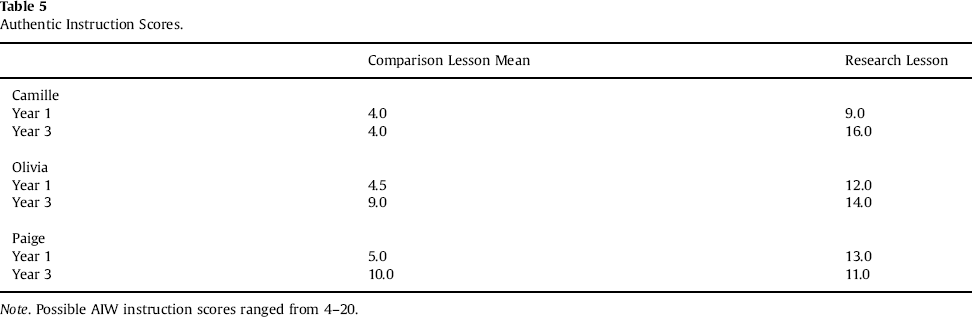
Note. Possible AIW instruction scores ranged from 4–20.
Camille
Observations of Camille's teacher-selected comparison lessons revealed many of the same tendencies previously discussed. Camille's two Year 1 comparison lessons focused on discreet facts from her textbook. In the first, Camille conducted a power point review of vocabulary. In the second, she led small reading groups through a review of a Newsweek article on the Civil Rights Movement that focused exclusively on comprehension. Neither lesson required students to demonstrate higher order thinking or to engage in challenging tasks. Camille's Year 3 teacher-selected comparison lesson evidenced little change from Year 1. In this lesson, Camille used a power point to convey chapter vocabulary about European exploration. She then had students watch a film clip on Christopher Columbus during which they were to “list three facts.” Following the movie clip, Camille placed students in groups of three and asked them to list the three best facts as a group. During the lesson, students focused on lower order recitation of factual knowledge, knowledge was treated thinly, there was no substantive conversation, and no justification for learning the content was provided. Comparison lesson observations suggested that Camille never transferred significant knowledge of PBHI to her normal classroom instruction. For Camille, there seemed to be too many barriers to her adoption of PBHI. Camille's reliance on the textbook as the source for the curriculum appeared virtually unchanged. Also, her belief that students needed substantial background knowledge before doing higher order thinking seemed unchanged. The explanation for Camille's consistency across the three years of the project may lie in her strong absolutist epistemology and her desire to meet the perceived expectations of the professional authorities in her life.
Olivia
During Olivia's Year 1 teacher-selected comparison lessons, students worked to comprehend textbook passages in a routine manner. In both lessons, students read textbook chapters as a class and then completed textbook questions or worksheets. Olivia's Year 3 teacher-selected lesson provided an intriguing insight into her thinking at the end of the project. Together with another 4th-grade teacher, Olivia had her students watch a live dramatization of the 2012 Republican and Democratic National Conventions during which student actors read excerpted transcripts from the most important political speeches. Olivia's purpose appeared to be to prepare her students for a school-wide mock presidential vote to be held the following week. In her exit interview, Olivia described her intentions:
…I've gotten to the point where I just don't want to use the book. I want to come up with lessons… We never would have thought…to collaborate together on history for an election lesson if it hadn't of been for you all… But we made a big deal out of it… Our kids are going to remember when they [are] 18 that they need to register to vote cause I voted at my school when I was in the 4th grade… It teaches them a lifelong lesson.
It seems clear from observing the lesson and from her comments above that Olivia hoped students would connect knowledge from the lesson to their future lives as citizens. The dramatization portion of the lesson, however, demonstrated little professional teaching knowledge for PBHI. In fact, the student actors simply read from the politicians’ actual speeches in words that most 4th graders would find difficult to understand. Also, the audience sat passively through the entire presentation. Olivia believed, however, that this lesson was a step forward because it demonstrated her willingness to collaborate on social studies lesson plans that she believed taught students valuable citizenship skills. Only when Olivia separated her class from her colleague's class did elements of PBHI professional teaching knowledge emerge. Olivia worked to link content on the election to her students’ lives as citizens by asking them to explain the “big deal about voting” and to convince her that she should go vote. Olivia's final teacher-selected comparison lesson was symbolic in many ways. While she consistently embraced professional teaching knowledge for PBHI in her rhetoric, she struggled to transfer that knowledge to normal classroom teaching.
Paige
During her Year 1 teacher-selected comparison lessons, Paige rushed through the lesson to such an extent that little discussion by students occurred. In one teacher-selected lesson, for example, she had students examine an image of the Dust Bowl and asked strong questions of the picture but rushed through it so quickly that it became teacher-centered recitation. Paige's Year 3 teacher-selected comparison lesson, however, was the highest scoring of all teachers. Paige's 50% improvement in authentic instruction compared to her Year 1 average was noteworthy. The lesson was also noteworthy for its abandonment of the textbook. Her final lesson featured the use of a primary document, which reported one woman's travel across the southeastern United States in the early 19th century. Paige worked to have students examine the primary account from multiple perspectives by repeatedly asking what students learned about Indians, white settlers, and their interactions after each passage of text. She then directed small groups to discuss the document before leading a whole class discussion. To conclude the lesson, Paige asked the class to describe what was happening in the primary account that resulted in problems between Indians and white settlers and how students would personally respond if people they did not know were consistently “coming through your yard without permission.” While her question failed to reflect the historical complexity of life on the frontier, it nonetheless asked students to think empathetically. Paige's final teacher-selected comparison lesson contained elements of PBHI design that suggested transfer of knowledge from lesson study. First, Paige provided interpretive questions that served as anchors for learning throughout the lesson, which she actively attempted to link to students’ own personal experiences. Second, by having small groups interpret the documents before sharing with the entire class, Paige used student collaboration to encourage conversation and the development of more complex understandings of White settlers’ interactions with Indians. Third, Paige scaffolded students’ reading in a manner that aided their interpretation of a complex, primary source document.
Discussion
Three primary factors seemed to influence the teachers’ interpretation and adoption of professional teaching knowledge for problem-based historical inquiry: deference to authority, a preference for developing basic content knowledge before deep thinking, and idiosyncratic views on teaching and learning. The factor that appeared most limiting was the degree to which each teacher deferred to authority and their tolerance for risk-taking. Camille consistently deferred to authority which limited her willingness to consider PBHI. Olivia and Paige did not overtly defer to authority and were more tolerant of risk-taking. Most importantly, Olivia and Paige defined improved student learning as that which led to civic competence. Both teachers accepted that risk taking was necessary to develop civically competent students.
When the teachers focused on developing students’ prior knowledge at the expense of higher order thinking, their support for professional teaching knowledge decreased. Camille and Olivia believed that students needed to hold a wide body of factual knowledge before they could do any higher order thinking. Olivia suggested that students could develop such knowledge while they wrestled with historical issue while Camille appeared skeptical of lessons in which students developed foundational knowledge within the context of addressing a problem. It seems, therefore, that the more teachers prioritized discreet facts or vocabulary development, the less credit or attention they gave to the role of scaffolding in helping students address challenging questions. Perhaps Olivia's optimism about her students’ abilities buffered her doubts and pushed her to consider professional teaching knowledge for PBHI more fully.
Idiosyncratic views of teaching and learning impacted the teachers’ adoption of professional teaching knowledge for PBHI. Although Camille grew impressed with student performance in her own and other teachers’ classrooms during research lessons, she did not believe those results could be duplicated in her classroom on a routine basis. For Camille, there was a mismatch between PBHI professional teaching knowledge and “her students” because she believed her students were different than other students. In contrast, Olivia drew confidence from collaboration even as she struggled to fully integrate PBHI professional teaching knowledge while Paige viewed collaboration as a messy process, but one that resulted in the creation of powerful social studies instruction focused on developing essential citizenship skills within all students. Importantly, both Olivia and Paige de-privatized their practice and engaged with colleagues in constructing and implementing PBHI lessons. Perhaps they had come to see value in the theory-based principles offered within the PFG Project.
Conclusion
This study investigated the impact of scaffolded lesson study on the development of professional teaching knowledge for PBHI among three 4th-grade social studies teachers. We focused on two research questions:
How do 4th-grade teachers interpret a holistic, research-based framework for problem-based historical inquiry designed to increase professional teaching knowledge? Do 4th-grade teachers who exhibit greater understanding of PBHI demonstrate greater growth in professional teaching knowledge and higher levels of authentic pedagogy over time?
Regarding Research Question 1, our findings suggest lesson study can be used to facilitate the development of professional teaching knowledge for PBHI among elementary teachers, though transfer of that knowledge to classroom teaching outside of lesson study remains difficult. We were encouraged, however, that all three teachers interpreted PBHI as a more rigorous alternative to traditional textbook-based pedagogy and all endorsed it as a means to develop content knowledge and valuable critical thinking skills in elementary students. Regarding Research Question 2, our findings suggest that those teachers who exhibited the greatest initial understanding of PBHI did demonstrate the greatest growth in authentic instruction over time. Olivia and Paige expressed initial enthusiasm for PBHI throughout the first year of the study, voiced consistent optimism about their students’ ability to function within a problem-based learning environment, and publicly acknowledged their frustration with their past use of the textbook to guide history instruction. More importantly, Olivia and Paige's lesson implementations suggested an emerging understanding of elements of PBHI practice including the use of ill-structured questions to frame instruction, the use of collaboration to facilitate student understanding, and the use of scaffolding to facilitate complex understandings.
As a group, the 4th-grade teachers featured in this paper struggled to ground their planning and teaching outside of lesson study in PBHI professional teaching knowledge, suggesting the teachers had not fully integrated PBHI theoretical knowledge into their practice. It appeared that the 4th-grade teachers remained skeptical they could ever fully replace textbook-based instruction. Indeed, most of the teachers continued to rely on the textbook outside of lesson study with Paige's final comparison lesson being the one exception. The result of this reliance may have been that the teachers missed opportunities in their normal classroom instruction to transfer knowledge of PBHI. Perhaps the teachers had little time to devote to independently developing history lessons given their school's focus on reading and math.
At the elementary level especially, lesson study appears to give teachers the time and space needed to plan and implement more ambitious social studies instruction. While two of the teachers adopted a problem-based rhetoric to express their hopes for classroom social studies teaching, only one was able to translate that rhetoric into classroom practice outside of lesson study. Our findings suggest that social studies researchers may need to be realistic about teacher change. We must anticipate long time horizons and be willing to walk alongside teachers, as equal partners, while they do the difficult work of facilitating student learning. We wonder too whether teacher change might be more likely among teachers who express a desire to implement inquiry before engaging in professional development. We have considered, for instance, whether lesson study might prove more profitable among a group of teachers prescreened for the dispositional tolerances necessary to implement inquiry.
Moving forward, it seems clear that a sustained commitment to professional development that encourages teachers to take what they learned back into their classrooms is critical to helping them adopt generalizable, research-based instructional frameworks. This need represents a significant commitment on the part of all stakeholders. While the role of administrators and policy makers in supporting problem-based historical inquiry was beyond the scope of the current study, we do recognize that the teachers in our study did not operate in a political or cultural vacuum. Given the marginalization of social studies reported in the literature, it seems clear to us that we must do more to understand the constraints under which teachers attempt to do lesson study. We wonder, for instance, whether inviting administrators or even policy makers to participate in lesson study alongside social studies teachers might create a space in which honest discussions about the place of social studies in the elementary curriculum become possible. Perhaps such discussions might lead administrators to offer more overt support for social studies teachers attempting to push back against the marginalization of social studies via lesson study professional development.
Footnotes
Acknowledgements
Support for this project was provided by U.S. Department of Education Grant U215X090346.