







Abstract
Thinking at the axes of homonationalism, civic education, and queer-inclusive social studies, this article complicates the uneven relationships between lesbian, gay, bisexual, transgender, and queer (LGBTQ+) exclusion and belonging. Arguing that more attention should be paid to how Genders and Sexualities Alliance (GSA) spaces may function to render particular imaginaries of the queer civic subject, and the U.S. queer civic subject in particular, more viable than others, I extend both the conceptual and methodological directions of out-of-school social studies research to underscore how equity – as a concept – becomes connotative of particular types of civic action and life. Highlighting how LGBTQ + youths’ talk can be discursively read and traced as a pedagogical text, I emphasize how a ‘good’ queer citizenry, and indeed a ‘good’ queer life, is one that follows the logics of cis-hetero-patriarchy and American exceptionalism. In so doing, I document the rhetorical reification and discursive production of queer complicity and community.
Introduction
Since his inauguration as the 46th President of the United States, Joseph R. Biden has been hailed as one of the most “pro-equality” presidents in modern history. Championed as an advocate for the lesbian, gay, bisexual, transgender, and queer (LGBTQ+) community when he announced his support for same-sex marriage in 2012, the Biden administration pledged ambitious LGBTQ + rights during their 2020 run for office. These promises, thus far, have resulted in direct action. On Monday, January 25th, 2021, for example, Biden signed an executive order repealing the Trump administration's ban on transgender troops serving openly in the U.S. military. The following White House press release joined this Obama-era reinstatement: “America is stronger, at home and around the world, when it is inclusive. The military is no exception” (White House, 2021).
In addition to championing these equity-oriented advances made by President Biden, and indeed they are noteworthy, it is essential to underscore how queer inclusion becomes linked with the nation-state and, albeit implicitly, works to construct an archetype of a “good” LGBTQ + citizen-subject (e.g., one who yearns for domesticity [e.g., marriage] and is willing to serve their country). In this article, I trace how this queer civic subject – an imagined ideal – was discursively produced among youths’ talk in one high school's Genders and Sexualities Alliance (GSA). Zeroing in on two episodes, I ask: (1) When reading GSA youths’ civics talk-as-text, what discourses (ways of representing) and accompanying styles (ways of being) produce the queer subject as human, as a citizen?; (2) How is the “Other” discursively (re)produced and disavowed?; and (3) What insights, if any, may these micro-moments of interaction offer queer-inclusive social studies research? Arguing that equity-oriented spaces such as the school GSA may play a role in creating civic-minded LGBTQ + citizens who respect democracy and diversity, I underscore their concurrent potential in forwarding imagined queer civic futures imbued with heternormative logics and homonationalist ideals.
Review of relevant literature
The impetus for advancing a queer-inclusive curriculum has largely been underscored by its ability to promote a more welcoming school climate for LGBTQ + youth. Statistics from the Gay, Lesbian and Straight Education Network (GLSEN), an education organization working to create safer schools, report that “67.6% of LGBTQ + students in schools with an inclusive curriculum said their peers were accepting of LGBTQ + people, compared to 36% of those without an inclusive curriculum” (Kosciw et al., 2018). These data suggest that behavior toward LGBTQ + individuals is more welcoming with the presence of an inclusive curriculum.
Curriculum, however, is not a cure-all. Who is classified as human remains an increasingly important social issue for LGBTQ + communities, especially in a political moment where the 45th President's rise to power was accompanied by an increase of 17% in reported LGBTQ + hate crimes (Southern Poverty Law Center, 2019). Although research underscores how the humanities, and the English language arts classroom more specifically, is a ripe site for infusing queer-inclusive topics and themes (see, for example, Blackburn & Buckley, 2005; Blackburn & Schey, 2018; Blackburn & Smith, 2010; Vetter, 2010, Wargo, 2017a), issues of diverse gender expression, sexuality, and LGBTQ + history remain relatively scant in the social studies (Wegwert, 2014). This section surveys literature across these areas, focusing mainly on queer-inclusive social studies in the secondary classroom and the extracurricular space of the genders and sexualities alliance.
Queer-inclusive social studies
Bringing LGBTQ + issues into the social studies classroom has not had the same traction it has received in other academic disciplines (Maguth & Taylor, 2014). Indeed, as Thornton (2003) noted, “few social studies materials appear to have a substantive treatment of gay history and issues … It is as if the millions of gay inhabitants of the United States, past and present, did not exist” (p. 87). Although work has, for example, taken up issues of homophobia in the high school civics class (Marchman, 2002), traced expressions of identity in an interdisciplinary LGBTQ + inclusive ethnic studies course (Moorhead & Jimenez, 2020), or analyzed the very structures that reinforce gender inequality (Crocco, 2001), the primary means through which queer-inclusive topics are discussed are either through legislative policies and seemingly controversial issues (see, for example, Beck, 2013; Hess, 2009; Journell, 2018) or the efficacy and affect of prospective and in-service educators navigating the teaching of LGBTQ + topics (Block, 2019; Brant & Tyson, 2016). And yet, the mandate of social education goes beyond the impetus to teach inclusion and embrace diversity. As Mayo (2007), so urgently writes: Social studies teachers – and those of us who educate them – have a responsibility to enlighten our students beyond the written pages of primary documents and textbooks or the latest method that touts to enhance student engagement. We must find and promote ways to broaden students’ understanding(s) of diversity; we must help students critically analyze ‘accepted’ ways of thinking so that new solutions to old problems may be discovered; we must find ways to negate the long-standing effects of racism, sexism, and homophobia. (p. 463)
Nonetheless, the “missing discourse” (Schmidt, 2010, p. 316) connecting gender and sexuality to broader questions of civic life remains, and the silence surrounding queer-inclusive social studies echoes Thornton's (2002) initial clarion call in asking, “does everybody count as human?” Notwithstanding, queer spaces outside of the formal social studies classroom (e.g., the genders and sexualities alliance) have proven more effective in connecting queer topics to themes of belonging, inclusion, and civic life more broadly.
GSAs as spaces that advance queer inclusion and queer-inclusive social studies
Gay-Straight Alliances (GSAs), now more commonly referred to as Genders and Sexualities Alliances, are extra-academic safe spaces for LGBTQ+ and allied youth. A multipurpose in-school organization, GSAs provide students with access to LGBTQ + related information and resources, the opportunity to organize and engage in self-advocacy, as well as the chance to take on school-specific issues of inequality and broader community change (Griffin et al., 2004). As others note, the foundational base in GSA research has little interest in its relationship to youths’ academic achievement. Rather, it has underscored its significance in promoting youth resilience (Poteat et al., 2013). Nevertheless, a critical connection between GSAs and equity, inclusion, and belonging – core issues in civics education – exists. Indeed GSAs, when measured against criteria put forth by the Campaign for the Civic Mission of Schools (2011), can be read as school-sanctioned civic spaces. Not only do they signal participation in an extracurricular activity, but they often provide youth with opportunities to debate and discuss current events as well as engage in service-learning opportunities. Research in social studies education has well documented these connections. For example, scholars argued that formalized relationships between GSAs and social studies educators might be one-way schools counter homophobia (Mayo, 2013a) and disrupt cis-heteronormative teaching (Lapointe, 2016). Regardless of their ability in forwarding discrete academic skills, their role in advancing a critical “third space” (Mayo, 2013b) in teacher development while simultaneously encouraging young people's activist development (Mayo, 2015) highlights their continued importance as sites of social studies learning.
This article, thinking at the intersection of these overlapping problem-spaces, complicates the uneven relationships between LGBTQ + exclusion and belonging. Arguing that more attention should be paid to how GSA spaces may function to render particular imaginaries of the queer civic subject, and the U.S. queer civic subject in particular, more viable than others, I extend both the conceptual and methodological directions of GSA research (Poteat et al., 2017) to underscore how equity – as a concept – becomes connotative of particular types of civic and social action. Highlighting how LGBTQ + youths’ talk can be discursively read and traced as a pedagogical text, I emphasize how a “good” queer citizenry, and indeed a “good” queer life, is one that follows the logics of cis-hetero-patriarchy and American exceptionalism. In so doing, I document the rhetorical reification and discursive production of queer complicity and community.
Conceptualizing a queer citizenry: On homonationalism and homonormativity
Although research at the nexus of K-12 civic education and LGBTQ + social studies has typically located itself in questions of equity, inclusion, and belonging (e.g., the Defense of Marriage Act, the repeal of Don't Ask Don't Tell), articulations of this type of sexual citizenship often comply to conservative neoliberal notions undergirding American exceptionalism. From this telos, Whiteness – albeit at times implicitly – becomes inscribed as the embodiment of legitimate citizenship and patriotism. Gays and lesbians are to serve as exemplars of how “it gets better,” and queer life's impetus and goals are to marry, serve openly in the military, and raise children. Sexuality, thus, serves as a lingua franca of modern citizenship that the West assumes amidst a global politics of rights and recognition. 1 In contrast to these aims, few have complicated reading the realities of gender, sex, sexuality, and citizenship that circulate in queer-affirming resource-based youth spaces. This paper conceptually takes up this charge to document how rhetoric surrounding these civic and social issues may advance a queer citizenry rife with homonationalism and homonormative tendencies.
For a detailed historical account of how the United States became “straight,” see Canaday's (2009) The Straight State: Sexuality and Citizenship in Twentieth-Century America. As she contends, “From the mid-1940s into the late 1960s … the state crafted tools to overtly target homosexuality. In contrast to the earlier period, policies were enacted that explicitly used homosexuality to define who could enter the country and be naturalized, who could serve in the military, and who could collect state benefits. A homosexual-heterosexual binary, in other words, was being inscribed in federal citizenship policy during these years” (p. 3).
In contrast to heteronormativity, homonormativity is a dominant form of queer sexual politics oriented toward consumption and domesticity. A concept referring to conservative queer politics, it unmoors queer – as a concept – from its connotative mode as a resistance movement and radical critique. As Eng (2010) suggests, queer “has come to demarcate more narrowly pragmatic gay and lesbian identity and identity politics, the economic interests of neoliberalism and Whiteness, and liberal political norms of inclusion” (p. xi). Made famous by Duggan (2002), homonormativity advances what Berlant (2011) later called “the good life.” It forwards a queer sexual politics predicated on heteronormative structures of kinship. Under the logics of homonormativity, LGBTQ + subjects become interpellated as actors and agents seeking incorporation into rights and recognition of the state.
Homonationalism was born out of and is an extension of homonormativity. Coined by Puar (2007), homonationalism is “an assemblage of geopolitical and historical forces, neoliberal interests in capitalist accumulation both culture and material, biopolitical state practices of population control, and affective investments in discourses of freedom, liberation, and rights” (p. 337). It adopts the lexicon of sexual rights and sees them as a gesture of civic recognition and inclusion. A process that is suggestive of imperialism, homonationalism produces a regulatory queer-citizen-subject – one who is secular, White and has access to cultural and legal citizenship – that disavows racialized others. Homonationalism advances what some refer to as “queer liberalism.” As Eng (2010) suggests, “queer liberalism is not necessarily about excluding bourgeois racial subjects from its aegis. To the contrary, it is about failing to recognize the racial genealogy of exploitation and domination that underwrites the very inclusion of queers and queers of color in this abstract liberal polity” (p. 45). 2 An analytic for apprehending the unintended and sometimes implicit consequences of the LGBTQ + movement's success in the Western world (e.g., Puar, 2013), homonationalism's currency as a concept gained traction for its ability to underscore the emergence of a new homosexual subject and queer citizen.
Although not naming it as such, Kimberlé Crenshaw, 2015 documented how queer liberalism functions when she suggested that LGBTQ + celebrations following the Obergefell judgement masked the racist violence in Charleston, South Carolina. Posted on June 26, 2015 she wrote: “Nine dead people – killed while worshipping – are now afterthoughts, to be squeezed into celebration of American Democracy. So now … Black people can marry whomever they please, but we can't vote, worship, represent our people, swim, shop, or walk the streets without fear of being discriminated against or even killed. So on this day of sorrow and celebration, this is what democracy looks like.”
Homonationalism, however, is not a static or isolated concept. Indeed, as Puar (2007) noted, homonationalisms are “partial, fragmentary, uneven formations, implicated in the pendular momentum of inclusion and exclusion, some dissipating as quickly as they appear” (p. 10). This plurality is important as it attends to the multiplicities of analytic geographies encapsulated in the broader assemblage of queer life. Although homonationalism has not been afforded the same theoretical grip it has in the humanities, scholars in education have used it to interrogate how teacher preparation, for instance, reproduces norms of nationalism and sexuality (see, for example, Reimers 2017). I, comparatively, use it here to interrogate the conservative logics underpinning a series of discussions LGBTQ + youth of Color had concerning issues of citizenship and intersectional justice (e.g., structural racism, immigration). In reading their GSA talk as pedagogical text, I argue that resource-based and queer-affirming spaces for LGBTQ + youth – spaces seemingly imbued with equity – may, in fact, transform into sites that reproduce xenophobic and racist reiterations of the LGBTQ + subject.
This paper re-enters data from a three-year (2012–2015) “connective” (Hine, 2015) ethnographic study examining how six LGBTQ + youths’ used a range of communicative technologies to navigate real and perceived inequality, orchestrate queer identity, and design more just social futures. Methodologically, this type of hybrid inquiry accounts for the co-extensive relationship between online/offline practices and social lives by “tracing the flows of objects, texts, and bodies” (Leander and McKim, 2003, p. 211). Whereas in previous pieces I localized my analyses on textual artifacts and writing completed online (see, for example, Wargo, 2017b, 2018), in this piece I zero in on data collected in school during the last year of the study. More specifically, I analyze youths conversations during “share circle,” a 20-min free-choice time of discussion that closed the school's weekly GSA meetings. Below, I describe the focal context, participants, and scope of activity in the school's GSA. After, I detail methods for data generation and analysis. I then talk across my own positionality as a queer “I-witnessing” researcher and co-facilitator whose talk and direction potentially shaped the encounter of who and what counted as a queer citizen.
Context
The Genders and Sexuality Alliance featured in this article was an extracurricular club housed at Center Ridge high school, an urban arts magnet in a small midwestern city. With a student population that matched the larger demographics of the city, 45% of the student body identified as Black, whereas 27% identified as White, 15% as Latino, 12% as Asian/Asian Pacific Islander, and 1% as Other. 72% of students were eligible for free or reduced lunch. My reason for including these descriptive statistics is not to advance a “damage-centered” (Tuck, 2009) narrative about a poor urban school in a priority district. Rather, I include this information to better texture the context and attend to the lived environs of the school and neighboring city.
About the Center Ridge GSA and ‘share circle’
The Center Ridge GSA, an organization established in 2009, was a collaborative space wherein LGBTQ+ and ally-identifying youth and adults came together, organized around local issues of injustice, and fostered community. From 2012 to 2015, my years of attending and co-facilitating the space, the average group size was 11 youths with 80% of those attending being youths of Color. In addition to Janice, a White cisgender teacher and lead adult facilitator of the group, the school social worker (Ms. Mollie) would also attend.
GSA meetings had an organized rhythm and structure. 60-70-min in length, attendees would sign in, the Secretary would detail the agenda, and then the President and Janice would work through old business. Typically, old business consisted of topics of conversation not finished at the last meeting. An area activist and community organizer, Janice – an English language arts and social studies educator at the school – would use this time to share opportunities for queer organizing and/or other social justice service-learning opportunities. After, new business was presented. A space for young people to share poetry, stream YouTube videos, and/or talk about personal issues and air grievances, the penultimate item on the agenda was share circle. After share circle, the President called the meeting to a close.
Although the GSA only occurred one day a week (Thursday), it is imperative to note here that Janice held in-class detention concurrently. This is important as it impacted how share circle functioned and/or what was shared during the discussion. I center this detail here as facets of the conversations presented in the findings are taken up by students who were serving detention.
Focal & peripheral participants
This paper features four of the six focal participants from the broader ethnographic study. Andi (she/her), a self-identified Latina lesbian, was 19-years-old and attended a local community college within walking distance of the high school. Still a quite visible member of the Center Ridge GSA, she was adamant about maintaining connections to her “queer family” (her words, not my own). This year was, as Andi put it, “her victory lap” to “see her seniors” through graduation. Zeke, Gabe, and Camille, during the 2015–2016 academic year, were seniors. Zeke (he/him) was a cisgender 17-year-old Black gay man. Camille (she/hers) was a cisgender 17-year-old Black lesbian-identifying woman and Gabe (they/them/he/his) was a gay, biracial, genderqueer identifying 18-year-old.
In addition to Zeke, Camille, Andi, and Gabe, several others are featured here as they came to shape the conversation during share circle. Janice, the GSA faculty liaison, was a 46-year-old veteran educator. Teaching four sections of English 10 and one of sociology, she was known by many throughout the school as a “free spirit” who focused too much on “social justice stuff” (her principal's words). Several peripheral youths, young people I came to know through my time and frequency in observing at Center Ridge, also spot the episodes featured here. For instance, Antonio (he/him) and Cindi (she/hers) were queer-identifying young people who regularly attended and assented to be recorded during GSA meetings. Although identifying as LGBTQ+, they were not focal participants in the broader project.
Similarly, Tarek (he/him) – a straight cisgender Black senior who had Janice's sociology class with Camille and Gabe – was regularly observed in classroom settings. He, like Antonio and Cindi, was not part of the broader project. Although not present at all of the GSA meetings during the 2015–2016 year, Tarek was frequently featured during the fall 2015 quarter as he concurrently served detention in Janice's room.
Data generation
Throughout the larger study, I operated as a participant-observer across both physical and digital space. In addition to following youths across social networking platforms and online environs, I also observed them in school, during GSA, and for some, at their place of employment. Alongside these audio-recorded observations, I wrote fieldnotes, took jottings, and photographed artifacts. These modes of creating in-depth ethnographic descriptions were performed to ensure that I did not “speak for others, but about them” (Comaroff & Comaroff, 1992, p. 9). In this article, I draw on data generated through active interviews (Holstein & Gubrium, 2002) with focal youth and audio-recorded GSA meetings.
In the larger study, participants were individually interviewed three times each year. Ranging from 35 to 100 min, the interviews followed an open-interview protocol and were regularly grounded in interrogating youth-produced artifacts, tensions in schooling and home experiences, or local events. Although not the discursive unit of analysis here, I lean on interviews with focal youth as they provided me with information that subsequently textures the types of claims and analyses I later make.
With the consent and permission of all youth and adults present, I audio recorded all GSA meetings. Although some of these recordings are incomplete, as youth sometimes asked me to stop recording, the three-year corpus of data consists of 87 h of group talk. Given this paper's focus and the tenor of politically-motivated discussion the 2016 election inspired, I zero in on the meetings during the Fall quarter of the 2015–2016 school year.
Data analysis
Data analysis was an iterative process. To more closely analyze how the queer citizen subject was discursively shaped and contoured through youth talk, I used a combination of critical and narrative analyses. First, I transcribed all GSA meetings and looked for what Dyson & Genishi (2005) call “theoretically rich events or episodes” (p. 88). More specifically, through listening and re-reading, I asked myself two guiding analytic questions: What discourses – about equity, inclusion, and belonging – surfaced in civics-oriented GSA talk, and what do these discourses reveal? and, How are discourses of queer citizenship and queer life more broadly affirmed or critiqued? In other words, how do they serve as pedagogical moments? Of the 11 meetings during the Fall quarter, 6 took up these topics directly.
Next, I used facets of narrative discourse analysis (Gee, 1991) to transform talk into text. Analytically, this transcription technique breaks talk into lines, stanzas, and strophes. Each line captures one central idea or several “idea units” represented by slashes. A group of lines, or a stanza, represents a single topic or vignette. A group of stanzas, or what Gee (1991) calls a strophe, makes up the larger plot “parts” of the story. While stanzas and strophes will not be reflected in this paper, the lines of data used reflect the breakdown of idea units. This organization method around idea units, rather than fluency or pitch, invites thematic interpretations of discourse rather than pure “descriptive, labeling, or reportative uses of language” (Gee, 1991, p. 37). As an analytic strategy, it also allowed me to see how, on a micro-level, youth narratives of queer citizenship often elided broader concerns and calls for equity (e.g., racial justice).
With talk transcribed as text, I then sought out facets of Critical Discourse Analysis (CDA) to code focal moments and read against my conceptual framework of homonationalism. “Critical discourse analysis,” as Rogers (2002) asserts, “is a methodological and theoretical tool that denaturalizes language practices, locating power and ideology in orders of discourse that may be brought to bear on discursive arrangements to reveal the operation of power and discourse and the construction and reconstruction of literate subjectivities” (p. 253). Grounded in Systemic Functional Linguistics (Halliday & Hasan, 1989), CDA emphasizes the relationship between form and function while remaining attentive to asymmetries in power and knowledge. CDA assumes a model of language that is ideological rather than autonomous.
Following Chouliaraki & Fairclough (1999), I utilized CDA to study “ways of interacting” (genre), “ways of representing” (discourse), and “ways of being” (style). Genre, as Chouliaraki & Fairclough (1990) asserted, is “the story of language (and other semiosis) tied to a particular social activity” (p. 63). From a CDA perspective, genres underscore the organizational properties and norms of interaction imbued in talk. Discourses, or “ways of representing” ideas, forward what Luke (2000) named as “systematic clusters of themes, statements, ideas, and ideologies” (p. 456). This is similar to Foucault (1971) orders of discourse. Styles, put more simply, are ways of being and are represented as interpersonal choices. Style was coded and investigated through voice, modality (e.g., tense), mood, and/or pronoun use (Fairclough, 1992). As an analytic, CDA provided me with a culminating framework to examine the textual linkages of equity and queer citizenship across local, institutional, and societal levels (see Table 1).
Coding thematic forms and functions across genre, discourse, and style.
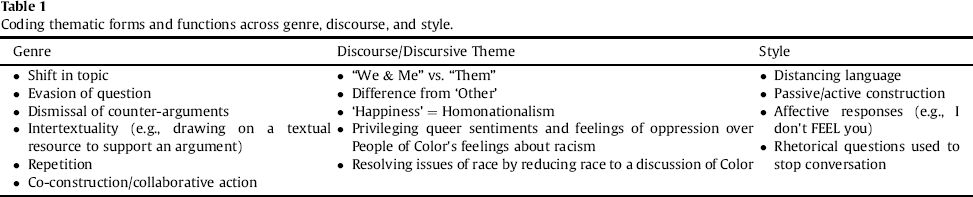
Coding thematic forms and functions across genre, discourse, and style.
As a multi-ethnic gay cisgender researcher and former GSA facilitator, I entered Center Ridge High School working to be read more as a caring adult and less as a teacher (e.g., regulating classroom activity or behavior). As a researcher, this entailed taking up what Paris (2011) calls a “humanizing” approach to data collection and analysis. Inquiry, according to Paris (2011), becomes “humanizing” when youth and young people provide researchers with entry and access to understanding their lifeworlds. Indeed, as I argued elsewhere (see, for example, Wargo, 2020), my “I-witnessing” (Breuer and Roth, 2003 positionality granted me with a paradoxical insider status with the young people. On the one hand, I was familiar with the struggle of being LGBTQ+ and navigating the at-times unequal footing of holding multiple identities of difference. I empathized with and understood the strife of growing up gay, poor, and Latino in the midwestern United States. On the other hand, I was a white-seeming adult researcher in a youth-centered space. Students, thus, at times guarded what they said and shared. Nonetheless, many LGBTQ + youths tested their proximity to me – as both an adult friend and ally – by asking if I was dating anyone or describing me with sexual innuendo (e.g., “He's thirsty.”). I raise these issues here as moments of racist rhetoric, sexism, and xenophobic talk – discursive tropes that were at times present in GSA youths’ conversation – became somewhat silenced when Janice or I grew uncomfortable interrogating the logics undergirding these comments. Thus, I find it essential to recognize that despite my best intentions of forwarding more dynamic forms of justice and equity, I made mistakes and at times perpetuated and reproduced oppression.
Findings
Critically reading against two “episodes” of civics-talk-as-pedagogical-text, findings highlight how participating youth constructed specific forms of queer citizenship against and in relation to other minoritized groups’ social struggles. Although unique insofar as they each independently complicate conceptions concerning racial equity, queer inclusion, and the place of the GSA in advancing civic discourse and reasoning, together they serve as what Davey (1991) calls a “critical instance case.” They detail a situation of unique interest (i.e., deficit-oriented talk in an asset and resource-oriented space) to highlight an instance of concern that may connect to a more significant social issue (i.e., the role and place of the GSA in advancing issues of social and civic concern for LGBTQ + youth).
Although the episodes presented here feature moments of racist rhetoric and xenophobia, it is essential to underscore that this was not typical of the type of talk making up the Center Ridge GSA share circle. In fact, students regularly used the routine time to converse and celebrate differences in ways that healed and refashioned the space of school for queer youth. Nonetheless, these moments – albeit abnormal– are vital. They mirror larger civic discourses (e.g., increased political polarization, violence undergirded by White supremacy, social and political protests) of the time. In selecting these critical incidents, hence, I followed Burawoy's (1991) suggestion to “treat social phenomena not as instances of some potential new theory but as counter instances of some old theory” (p. 9). That is, instead of selecting incidents serving as an exemplar, they can be understood as anomalies.
Following others who use facets of narrative analysis to transform talk into text (see, for example, Macaluso, 2016), I present findings by first describing the episode's context. Next, I highlight salient interactions between youth and the facilitator/s. After these non-evaluative details, I then use CDA to highlight how LGBTQ + youths became active agents giving voice to their subjective reality while simultaneously disavowing affinity to other minoritized communities and intersectional justice coalitions. I conclude by arguing that these episodes, together, signal the complexity that situates and inhibit equitable civic action and education for LGBTQ + youth and communities.
“Can I just BE a human?” navigating the racial politics and queer logics of a “happy” life
Context
Students sometimes used the space of the GSA to “read” and poke fun at one another. A queer colloquialism, “reading” was performed by one or more young people to point out a visible “flaw” in another. Done not to offend but to humor, in this episode, Antonio and Camille – two Black youths - read Gabe, a biracial young person, for not seeing himself as Black. Jokingly, Camille takes a compact mirror out and asks Gabe to examine his reflection. Tarek, a Black student who is not attending the GSA meeting but serving afterschool detention in the classroom, inserts himself to underscore Gabe's perceived color-evasiveness. Antonio marks the entrance of Tarek and includes him as an interlocutor in affirming his declaration.
Stanza 1: Reducing race to Color.

Although, as Tarek later asserts, he is not LGBTQ+, his interrogation of Gabe – as a Black peer – continues and serves as the impetus for the elongated episode and discussion below. In doing so, the youths and GSA facilitators (myself included) nuance what it means to be both Black and queer while untangling some of the preconceptions youth held towards living a “happy life.” This context becomes critical as Tarek continues to rebound Gabe's subordinate positioning of race, which leads to claims concerning who and what a queer subject and citizen is.
Episode 1: “can I just BE a human …”
Stanza 2:

In line 10 Gabe separates himself by indicating he is not Tarek's (“YOUR”) Black. After, in line 11, Tarek confirms this response by indicating that “his” Black, or perhaps his Black experience, is different insofar as he is not gay. Gabe confirms and the exchange continues. Tarek carefully implicates Gabe in larger discourses surrounding area racial injustice. For example, Tarek indicates that Gabe – despite his refusal and rejection – is “Black like [me] him” when he encounters Mr. Hammond, the White school police officer (line 14). He asserts that this is also true when he (Gabe) is around White people (line 13). Carefully noting how the GSA may advance Gabe's evasion of race, Tarek questions if Gabe is not seen as Black (line 15) in the space. Nevertheless, he reiterates Gabe's Blackness by using the nominative plural “we” when he ends his turn (line 17), signaling that they, together, are Black.
The back-and-forth continues when Gabe provides additional information to Tarek concerning his background and identity. As he notes, he is Black/White biracial (line 20) and gay. Thus, as he asserts, his “Black” is intersectional (line 22). After Janice unsuccessfully tries to intervene for the second time, the conversation continues as Gabe pushes back from being singularly categorized.
Stanza 3: Happiness and the “Good Life”.
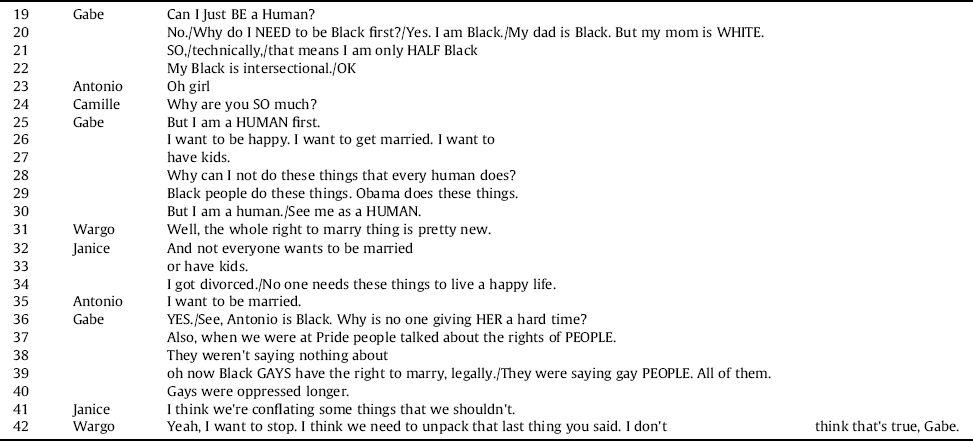
In this extended excerpt, we see Gabe underscore the central query that makes up the tension imbued in his exchange with Tarek and the small group. “Can I Just BE a human?” he asks. A question that serves as an interrogative examining how he understands himself in relation to his own racial and gender identity, Gabe goes on. In fact, through his talk, he creates an archetype of a “happy” queer subject. For Gabe, he wants to “get married” (line 26) and “have kids” (line 27). He says that indeed his humanity is entangled in these rights and wishes, as it is what other “humans do” (line 28). He reiterates how “Black people” and “Obama” do these things (line 29). Despite Janice's interjection (line 34), the register of talk shifts when Antonio amplifies Gabe's yearning for marriage (line 35).
Referencing the area PRIDE festival, a local summer parade that the Center Ridge GSA youths walked in, Gabe creates a distinction between “Black GAYS” and “gay PEOPLE” (line 39). In doing so, he looks past historical blockades that once worked against interracial marriage. Although he does not name it as such, he uses Obergefell v. Hodges and the central assertion that same-sex marriage is a right of society to contend that “Gays were oppressed longer” (line 40). As noted by Janice's interjection (line 41) and my invitation to step back (line 42), the rant ends.
Tarek, turning back towards the group, re-inserts himself to close the episode.
Stanza 4: “It's never getting better for Blacks”.

Signaling that he received Gabe's message, Tarek highlights how it is not a shared sentiment. Arguing that Blackness – as a racial identity but also as a conceptual category of personhood – encapsulates the non-White experience (line 45), he refutes Gabe's initial question. “You can't BE human,” Tarek says, “because you are Black” (line 47). Closing with an indirect object (us), Tarek ends with an intertextual referent (line 49) dismissing Dan Savage's popular “It Gets Better” claim. “It [is] never,” as Tarek ends the conversation, “getting better for us.”
Tarek, a same-age peer and newcomer to the GSA space, shifted the genre, discourse, and conversation style. He took up Gabe's perceived color-evasiveness through collaborative co-construction and refutation. It is here that we see the logic of homonationalism seep through Gabe's argument and claim of “not [YOUR] Black” (line 10). He, ironically, attaches his own identity to that of then-President Barack Obama (line 29) and measures his humanity according to the “right to marry” (line 39) decision forwarded by the relatively recent Obergefell v. Hodges ruling. Whether real or perceived, Gabe understood Tarek – as a Black straight cisgender man – as different and as an intolerant “Other.” Although one can infer an initial moment of perceived homophobia through Tarek's hypermasculine declaration that he is not gay (line 11), he passively assumed the role of listener and witness to Gabe's ongoing plea for “being” human.
Stylistically, it is here that we see Tarek try to teach and educate Gabe about the racial politics of the United States. Indeed, as he closed, Tarek used language that underscored his ability to “hear” Gabe but not “feel” his message. Whereas Gabe proposed an initial distance between Tarek and him, Tarek used “we” and “us” to signal proximity and shared affinity. This continued as he intertextually linked his messaging to the “It Gets Better” campaign, a slogan quite familiar to the GSA group. The episode closed with Tarek arguing that Gabe should not see racial injustice and White supremacy as coeval with LGBTQ + rights. Indeed, as he underscored, equity - as defined by Gabe - becomes a concept lodged in nationalism.
“This is NOT history class”: Advancing homonationalism through refuting coalitional action and intersectional justice
Context
Despite working at an area sandwich shop and being a full-time college student, Andi regularly returned to the Center Ridge GSA space. Pushing aside previous business, the December 10th, 2015 meeting was unique as it was the last one before the holiday break. It had a shortened schedule: white elephant gift exchange, pizza party, share circle. This episode builds from the start of share circle, a moment when Andi details a local community organizing event put on by Kilgore Community College's (KCC) office for diversity and inclusion.
Stanza 1: Defining Undocu-Queer.

Marked by thick Sharpied letters painted with rainbow colors, the flyer Andi circulated read “Chosen Families Know No Border.” An area event animated by worry surrounding undocumented Kilgore community members’ citizenship status, KCC was holding an Undocu-Queer rally on campus, a space just adjacent to the high school.
Episode 2: Interrogating Coalitional Action through intersectional justice

Interrogating what “undocumented” means (line 7), Camille quickly casts the event aside. She emphasizes her disregard by saying, “people got words for everything” (line 9). Zeke, a Black gay member of the GSA and close confidant of Camille's, quickly declares that she is “ignorant” (line 10). The description of the broader movement and mission continues, and the conversation is forwarded when Andi says:
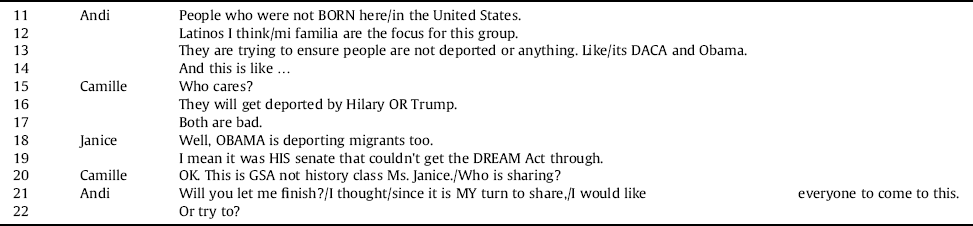
As a Latina lesbian parented by two Latina lesbian women, Andi here underscores the importance of the event by collapsing similar political advances for her family and community (e.g., Deferred Action for Childhood Arrivals). Immediately, Camille reiterates her disregard when she says that “Hilary OR Trump” (line 16) will deport “them” (undocumented citizens). Janice refutes Camille's claim by suggesting that the Obama administration also “deport [ed] migrants too” (line 18). Camille quickly tries to move the conversation, arguing that the tenor of discussion is too political and academic (line 20). Repositioning herself as lead facilitator of share circle, Andi pauses Camille's commentary.
Stanza 2: Driving Intersectional Justice.
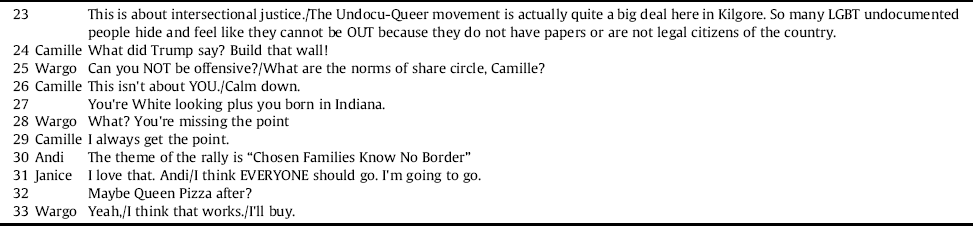
Highlighting how the Undocu-Queer movement is coalitional in its goal and vision for equity, Andi sympathetically tries to localize the problem (line 23). Immediately, however, Camille echoes then Republican candidate Trump yelling, “Build that wall!” (line 23) and shuts Andi down. I, inserting myself to reiterate group norms, am quickly dismissed. Camille makes connotative remarks suggesting that I – someone who is White/Latino multi-ethnic – am “White looking” and thus not included in the group Andi is referencing. Making one final plea, Andi uses language suggesting that her GSA colleagues are queer-kin. She underscores the rally's theme and states, “You're all MY family” (line 30).
Stanza 3: Us vs. THEM.

Highlighting a common misconception underscoring the “Black Lives Matter” statement and movement, Camille asserts that “this [rally] sounds like some ALL lives matter shit” (line 34). Refusing Camille's assertion, Zeke underscores how her language is making “US” sound ignorant. Trying to highlight the coalitional action and vision imbued in the Undocu-Queer movement, Camille dismisses Andi's claim and Zeke's declaration when she then points the finger at Cindi, a White 16-year-old lesbian who was also attending the GSA meeting. “You and I,” Camille suggests, “are fine. It's THEM we have to worry about. White gays are the WORST” (line 40).
The episode takes a turn when Zeke, an otherwise peripheral participant in the scene, enters to suggest that Camille is making “BLACK people” (line 38) look ignorant. Here, Camille quickly eschewed Zeke's claim by underscoring that not only are they “fine” because they are Black but because of their citizenship status (line 40). Using a distal to locate herself and Zeke away from Andi and the larger group, Camille asserted that it is “THEM” (i.e., White and White-presenting gays) who should make the group concerned. Through this, Camille highlights how perceived ideological homogeneity may ultimately result in epistemic blind spots concerning community action and participation. After, she re-attaches herself to the state and majoritarian identity of the so-called sanctioned citizen. In short, Camille disavowed the coalitional possibilities and intersectional plight Andi initially sought to share. Indeed, whereas the first episode underscored the homonormative logics undergirding what being a “happy” LGBTQ + human entailed for some, the second reroutes who and what counts as human in the social space of the Kilgore GSA.
Discussion
Queer citizenship, as the above episodes illustrate, is a dynamic process of becoming for LGBTQ + youth. As a referent, it cannot be categorized as a practice or politic of assimilation, nor can it be rendered solely through discursive means of transgression. This dichotomy, as Cossman (2007) suggests, “misses the messiness, ambivalence and multiplicity of the inclusions and exclusions of citizenship” (p. 160). Hence, being a queer citizen for some of the GSA youths was envisioned as a mode of homonormative desire and longing. Like Gabe, it propelled the imagination to expunge the here and now and travel to a future there and then. To debate and disavow racial injustice and instead locate a “happiness” that clings to state-sanctioned LGBTQ + rights and sexual assimilation. For others, like Camille, citizenship was situated in what Muñoz (2009) calls a “fake futurity,” or repressive political presentism (p. 55). Locating herself apart from and potentially in conflict with undocumented LGBTQ + subjects and her Latina peer Andi, Camille – a Black lesbian youth – used then-President Obama to underscore how, for her, the Black queer citizen-subject labors to live in a moment calibrated through existing rights-based protocols and majoritarian spheres of power. While, individually, these episodes provide distinct shifts in the discourse and accompanying style of being a queer civic subject, they underscore the urgency associated with interrogating the complicities, collusions, and costs of equity and inclusion in the social studies. A discipline that does not so much presume as but produces citizen subjects.
Reading LGBTQ + youths’ civics talk-as-text, a number of questions and pedagogical implications for advancing equity in queer-inclusive social studies remains. First, we must teach and acknowledge how homonationalism – as a concept and discourse – has generated new figures of citizenship. Like earlier critical citizenship frameworks (see, for example, Banks, 2008; Ladson-Billings, 2004), homonationalism underscores how rights-based discourses reconceptualize the liberal politics of identity to antagonize and re-create an “Other.” As evinced in the two episodes, certain ideals of queer citizenship folded into particular figures of life, whereas others became marked for disregard and destruction. Queerness – both as a concept and as a state of being – is always already imbricated in LGBTQ + youths’ civic imagination.
Second, each episode asks us to engage with the temporal dimensions of civic equity critically and to imagine what Muñoz, 2019 would call a “queer futurity,” a “structuring and educated mode of desiring that allows us to see and feel beyond the quagmire of the present” (p. 1). Not only were Andi, Camille, Zeke, Gabe, and the others managing the various civic discursive contexts of their lives, but so too were they managed by them. In thinking and feeling beyond, what then would a queer civic future, one not steeped in the fantasy of heteronormativity and Western liberalism, entail? How might we use civic education and social studies more broadly to map not only moments of queer repression, fragmentation, and alienation but also solidarity, alliance, and intersectionality? How, for instance, have certain LGBTQ + movements supported forms of heteronormativity and the racial and citizenship privileges they require all in the name of inclusion? How have others worked against them? Although these episodes do not purport to have exhaustive answers to those questions above, they underscore the necessity to interrogate and qualify equity even in asset-oriented and LGBTQ + -inclusive spaces. Indeed GSAs, much like school-sanctioned spaces and social studies classrooms, are equally at fault in resurrecting earlier articulations of who, to use Thornton's (2000) words, counts as human.
Conclusion
In a moment where LGBTQ + inclusive curriculum is gaining traction – from the six states requiring queer-inclusive history in public schools to Arizona's Republican governor vetoing a bill that would otherwise restrict LGBTQ education in the state – new dimensions for assessing and frames for understanding intersectional justice and equity in the social studies (both in and outside the classroom) are needed. 3 If civics, as a discipline, is concerned about the relational aspects of community life, then social studies educators and researchers interested in the lifeworlds of Queer, Transgender, Black, Indigenous, People of Color (QTBIPOC) must detach from attendant notions of democracy and citizenship. As Eng and Puar (2020) suggest, and as my analyses point to, this reliance on the nation-state highlights how “the continuing expansion of LGBTQ+ is predicated on a signifying chain of identity as analogy and the awarding of legal rights and entitlements through a politics of incremental recognition” (p. 5). Perhaps then, rather than forwarding a nationalistic vision of queer-inclusive civics, the more promising project is to promote a queer(er) and intersectional vision of civic discourse. Through re-constellating the LGBTQ + citizen subject, both as a historical figure and as a palimpsest for civic life, new topics for civic reasoning (e.g., U.S. empire, geopolitical exceptionalism, immigration) may emerge and cross-coalition building may form.
On Tuesday, April 20th, Arizona Governor Doug Ducey vetoed legislation that would restrict LGBTQ education. For more, see Pietsch, 2021.
Declaration of competing interest
The author has no known conflict to disclose.