







Abstract
OBJECTIVE: To evaluate the tonsils as a source of halitosis and to assess the efficacy of laser CO2 cryptolysis for the treatment of oral bad breath caused by chronic fetid tonsillitis.
METHODS: Fifty-three patients with halitosis originating from chronic fetid tonsillitis, who completed laser cryptolysis were enrolled in the study. The origin of halitosis was demonstrated by Finkelstein's tonsil smelling test, which included massaging the tonsils and smelling the squeezed discharge. All patients were treated by laser cryptolysis, an office procedure done under topical anesthesia. Subjective and objective postoperative assessment was based on self-and-family report and clinical assessment. Patients were reexamined 4 to 6 weeks post-treatment, and when the need for further laser treatment was determined.
RESULTS: Complete elimination of halitosis required one session in 28 patients (52.8%), 2 sessions in 18 patients (34%), and 3 sessions in 5 patients (9.4%). Follow-up period ranged from 3 to 36 months (mean, 20.8 ± 8.5 months). No adverse effects or complications were encountered.
CONCLUSIONS: After excluding dental or periodontal, sinonasal, oral, pulmonary, or gastroenterological diseases as the origin of halitosis, chronic fetid tonsillitis remains a common cause of halitosis. Patients suffering from halitosis should be treated relying on their examination including Finkelstein's tonsil smelling test. Laser CO2 cryptolysis is an effective, safe, and well-tolerated procedure for the treatment of halitosis.
When dental or periodontal disease, sinonasal, pulmonary, or even gastroenterological diseases are ruled out, the tongue 1,2 and the tonsils 3–5 remain optional sites for bad breath.
The palatine tonsils contain crypts that are twisted tubular invaginations extending from the tonsillar surface deeply through the parenchyma. Exfoliated epithelium, keratin debris, and foreign particles may be retained in the crypts. Therefore, the palatine tonsils are the most suitable sites for the activity of anaerobic bacteria in the upper airway system. The tonsils are known as a source of halitosis in a form of “caseous tonsillitis,” which is a variant of chronic tonsillitis. This disease is characterized by retention of caseous secretion in the tonsillar crypts, forming calcareous concretions that are known as tonsiloliths, or tonsillar calculi. Apart from having caseous tonsillitis, the majority of the patients suffering from “halitosis of unknown origin” have in fact chronic fetid tonsillitis. 5 Most of these patients suffer from what is termed by the first author the “skunk syndrome.” These patients have tonsils that may or may not be hypertrophied and are occasionally mildly “edematous.” In addition, the jugulodigastric lymph nodes may be mildly enlarged. As the result of the bad breath, part of the patients are continuously preoccupied with oral hygiene issues and religiously use cosmetic breath freshening products such as mouthwashes, candies, chewing gums, and sprays.
Clinical diagnosis and management of halitosis should rely on an accurate halitosis-oriented otolaryngologic examination. To successfully accomplish this examination, a maneuver we termed “Finkelstein's tonsil smelling test” that includes massaging the tonsils and smelling the squeezed discharge was designed. 5 Superficial vaporization of the tonsillar tissue by laser CO2 cryptolysis, which is an office procedure performed under topical anesthesia, was suggested for chronic fetid tonsillitis. 3–5 The aim of the present study was to investigate the tonsils as a source of halitosis and to assess the efficacy of laser CO 2 cryptolysis for the treatment of halitosis.
PATIENTS AND METHODS
Study Population
The study population consisted of 53 consecutive patients, who had laser cryptolysis. There were 30 men and 23 women, ranging in age from 18 to 61 years (mean ± SD, 33.6 ± 11.1). All patients had repeated dental and periodontal studies and completed treatment accordingly. An attempt to treat all patients with a tongue scraper for brushing off and reducing the number of bacterial film sticking to the tongue has provided only mild transient improvement in 17 patients (32.1%), or entirely failed in 36 patients (67.9%). Fifteen patients (28.3%) underwent gastroenterological studies elsewhere, including flexible upper digestive tract endoscopy. Except for chronic fetid tonsillitis, all patients had a normal medical background. Patients with a gag reflex, who could not tolerate laser cryptolysis, patients with sinonasal, oral, pulmonary, and gastroenterological diseases, were excluded from the study. All patients consented to participate in the study and undergo surgery after being informed that the benefit from the procedure has yet to be fully established and that bleeding and pain may follow treatment, also that serial-session to complete the treatment may be needed.
Preoperative Evaluation
Patients' detailed histories relevant to halitosis were obtained in structured interviews. Patients, partners, and/or family members were asked to rate the severity of halitosis. The specific symptoms were graded as (1) severe when bad breath was offensive and disturbed family members and social relationships, (2) moderate when bad breath was smelled only within close distance from the patient, disturbing partners or family members and social relationships only mildly, and (3) mild when bad breath was smelled intimately and disturbed only close relationships.
All patients underwent a complete otolaryngologic examination and 4 tests to establish the presence, source, and severity of halitosis. Test 1 patients were asked to sniff the air exhaled from the nares or the mouth, in an attempt to differentiate halitosis from its sinonasal, or oral origin. Test 2 patients were asked to smell the discharge sampled from the tongue dorsum by a metal tongue depressor. Test 3 patients underwent Finkelstein's tonsil smelling test, which is based on squeezing the tonsils and smelling the squeezed discharge. Performing this test, the examiner follows a step-by-step process. 5 The examiner puts on latex gloves, and then rinses the gloved hands in tap water. Both the examiner and the patient smell the gloves, i.e., the odor of the latex. Thereafter, the examiner squeezes separately each tonsil by the gloved index finger or the third finger. Unexpectedly, in many cases, the tonsils are palpated much more voluminous then appeared on peroral examination, because they are hidden laterally within the tonsillar fossae. The examiner and the patient now smell the glove on a clean finger and then smell the finger with which the tonsil was squeezed. This procedure is repeated for both tonsils. The diagnosis is established by smelling a fetid mucoid discharge on the examiner rinsed glove, a clearly different odor from the natural smell of the latex. The patient and, if possible, the partner or a close family member is asked to determine whether the smell of the glove is the patient's typical malodor. In many cases, bad breath exhaled by the patients is not clearly smelled, and the diagnosis is clearly made by the fetid smell of the normal-appearing mucoid discharge. It should be noted that in case of strong offensive bad breath, the patient is asked to brush the teeth without paste and to scrap the tongue before the examination. To avoid observer bias, it is required that two examiners smell the gloves, while blinded to the score of the other; then scores are matched and agreed upon. The severity of the halitosis was ranked as: (1) severe when bad breath is felt during conversation with the patient, (2) moderate when bad breath is felt when sniffing the air exhaled from the patient's nares or from his or her mouth, or smelling a strong fetid odor from the glove at a distance of 10 cm on Finkelstein's tonsil smelling test, and (3) mild when smelling a fetid odor bringing the glove near to the examiner's nose on tonsil smelling test, and no bad breath is smelled from patient's nares or mouth. Test 4 is based on flexible nasopharyngoscopy of the nose, nasopharynx, oropharynx, and hypopharynx including the tongue base. Thus, it was reconfirmed that sinonasal diseases were excluded as possible causes of halitosis.
Laser Cryptolysis Technique
Laser cryptolysis was done in the office setting while the patient was in an upright sitting position. Topical anesthesia included 1.5% lidocaine spray applied to the oropharynx and the oral cavity, followed by infiltration of 1% lidocaine and 0.01% adrenalin, or nordefrin to the lateral, medial, and superior aspects of the tonsillar pillars with a dental syringe. Notably, accurate infiltration to the pillars is very important and may be almost sufficient for preventing pain and the unpleasant sensation of the instrument's touch. Direct infiltration to the tonsils themselves was rarely needed.
Sharplan's (Laser Industries, Inc., Allendale, NJ) office ENT CO2 laser system was used. The system includes a portable 30 w CO2 laser with smoke evacuator, and Sharplan's 15251 Oral-Pharyngeal Delivery System. The built-in suction port in the laser hand-piece connected to the central vacuum system evacuates the fumes, thus minimizing odor in the room. The system also includes a luminous guide-spot mounted with an angled mirror tip, which deflects the laser energy to access and treats the tonsils under comfortable control, and a SwiftLase flashscanner (Laser Industries). The SwiftLase battery-powered flashscanner is placed between the articulated arm and the laser hand-piece. The SwiftLase emits the focused laser beam and delivers a 3- to 4-mm circle in 100 milliseconds spot to the treatment site, rotating the beam quickly over the surface area. This method allows vaporization of the tonsils without thermal damage to surrounding tissue and aggravation of postoperative pain. The power was continuously set between 10 and 20 W. A pharyngeal hand-piece with a reflective angled mirror tip is used when a straight delivery of the beam to the tonsil is impossible. It allows holding the tip medially to the tonsils and delivering the beam laterally. The treatment consists of superficial vaporization of the tonsils and lasted no more than 20 minutes.
Postoperative Evaluation
Postoperative care included brushing the teeth and tongue at least twice a day. Consuming of tepid nourishment was recommended. Oral analgesics were prescribed and no antibiotic treatment was given. Patients were reexamined 4 to 6 weeks post-treatment, and at this point the need for further laser treatment was assessed. The treatment was accomplished when bad breath disappeared. Patients, partners, and/or family members were asked to compare halitosis with its preoperative state and rate its postoperative severity, using previously determined criteria for evaluation. Follow-up ranged from 3 to 36 months (mean ± SD, 20.8 ± 8.5 months).
Tissue Preparation and Staining
Two patients (3.8%), who were treated with laser cryptolysis, had after 2 and 3 years, respectively, recurrent mild halitosis. At their request, they had tonsillectomy and their tonsils were retrieved. The specimens were collected and the tissues underwent standard histological processing. They were fixed in buffered formaldehyde, and dehydrated with graded alcohol solutions. Thereafter, embedded in paraffin blocks, serially cut into 5-μm-thick sections and put on glass slides. The sections were stained with hematoxylin-eosin (H&E) and investigated microscopically.
Statistical Analysis
Chi-square test was used to test the interrelationship between subjective and objective ranking of patients' halitosis severity. Measurements were expressed as mean ± SD; P-value lower than 0.05 was considered significant.
RESULTS
Most of the patients (44/53, 83%) had a partner or a close family member accompanying them to sessions. Twenty patients (37.7%) reported severe halitosis, 25 patients (47.2%) moderate halitosis, and 8 (15.1%) mild halitosis. Eight patients (15.1%) also reported intermittent expelling of calcareous stinking concretions (i.e., tonsiloliths).
On first examination, the tongue was not coated and Finkelstein's tonsil smelling test was positive in 50 patients (94.3%). Because of the fluctuant nature of halitosis, in 3 patients (5.7%) a positive test was established at a second visit. Halitosis was graded by the examiners as severe in 5 patients (9.4%), moderate in 32 patients (60.4%), and mild in 16 (30.2%). Complete agreement between the subjective and objective ranking was found only in 28 patients (52.8%). Whereas, 12 patients (22.6%) who defined halitosis as severe had moderate halitosis, 4 patients (7.6%) who defined halitosis as severe had mild halitosis, 7 patients (13.2%) who defined halitosis as moderate had mild halitosis, and 2 patients (3.8%) who defined halitosis as mild had moderate halitosis. The correlation between the subjective and objective assessment of halitosis severity was significant (P = 0.006).
Twenty-eight patients (52.8%) reported complete disappearance of bad breath after the first treatment, and had a negative smelling test. Sixteen patients (30.2%) reported insufficient improvement and 7 patients (13.2%) no change. The smelling test was positive in all these patients and a second treatment was advocated. The remaining 2 patients (3.8%) were hesitant regarding the outcome of laser cryptolysis, yet they agreed to a repeat treatment because the test was positive.
As noted, complete elimination of halitosis required one session in 28 patients (52.8%), 2 sessions in 18 patients (34%), and 3 sessions in 5 (9.4%). One patient from the latter, who was cured after the second treatment, returned after 14 months with recurrent mild halitosis and needed an additional session to eliminate symptoms. Two patients (3.8%), who returned after 2 and 3 years, respectively, with recurrent mild halitosis, underwent tonsillectomy at their request. Follow-up period ranged from 3 months to 36 months (mean ± SD, 20.8 ± 8.5 months).
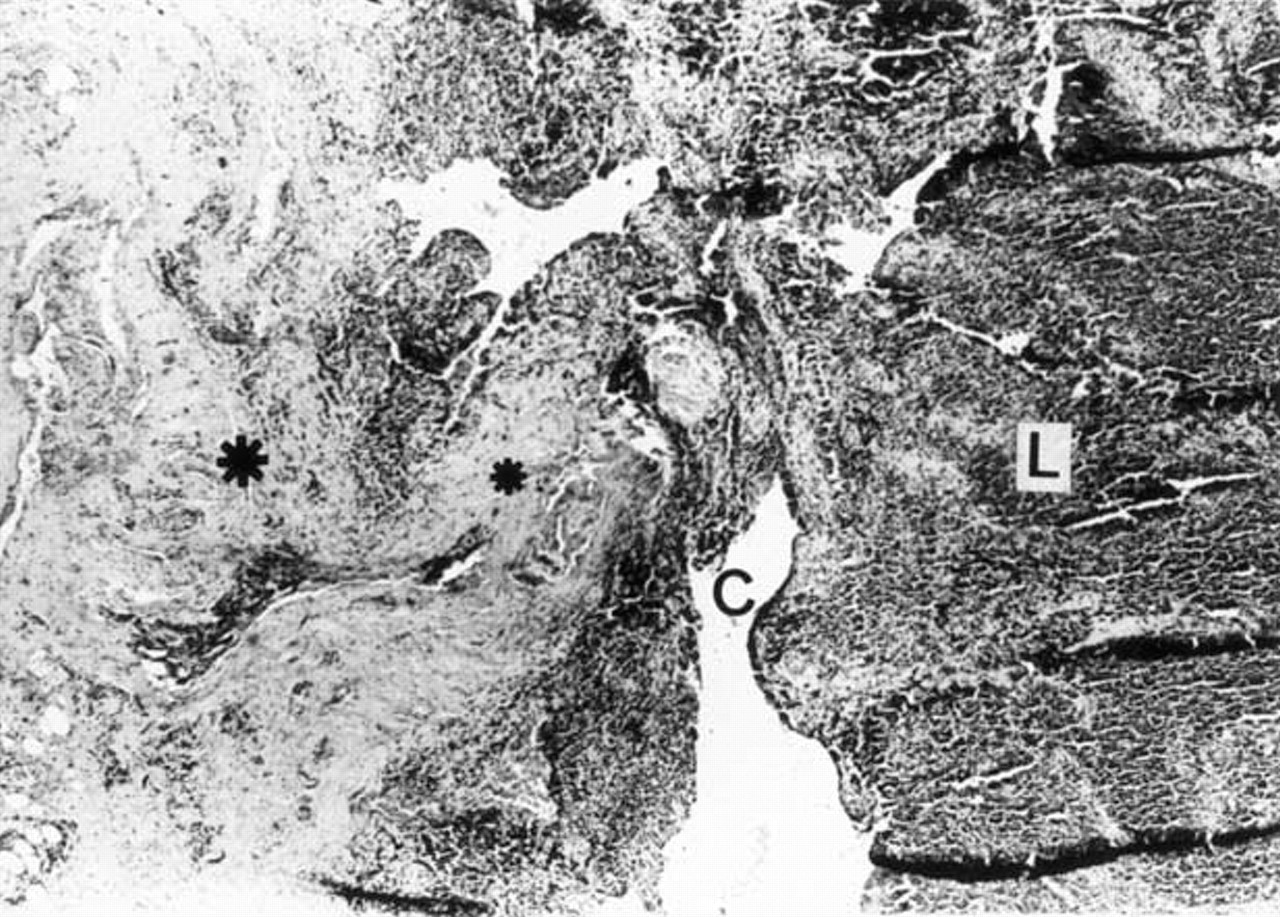
A section of the palatine tonsil from a patient after laser cryptolysis, showing extensive fibrosis of the tonsillar stroma. ∗ = fibrosis, C = crypt, L (on white background) = lymphoid tissue (H&E, original magnification x100).
Laser cryptolysis was performed in 1 to 3 sessions with an interval of 1 to 3 months between sessions. These intervals were longer than desired because of non-medical reasons. No patient had perioperative anesthesia-related complications, including early or delayed (perioperative) bleeding, infection, nasal regurgitation, or voice change. Sore throat was controlled with analgesics or non-steroidal anti-inflammatory drugs. Forty-seven patients (88.7%) immediately resumed regular work and routine activities. Only 4 patients (7.5%) who suffered pain reported sick on the day of treatment and another 2 patients (3.8%) for 2 days after treatment. In the latter, the uvula and the anterior pillars were also scatteredly lased because of gag reflex and anatomic limitations. On discharge, soft diet was advocated, yet patients advanced to a regular diet already 1 to 3 days after treatment.
Histological study of the tonsils excised from the 2 patients who had tonsillectomy showed that laser cryptolysis resulted in progressive flattening of the tonsillar crypts and replacement of the lymphoid tissue with extensive scar fibrosis (Fig 1).
DISCUSSION
The tonsils have been suggested as a potential target for halitosis, yet clinicians and researchers often tend to overlook their role in the formation of bad breath. The tonsils possess unique anatomical and microbiological characteristics, rendering them as the most suitable host for gas-producing bacteria and consequent bad breath in the upper airway. They play an important part not only in local infections and upper airway obstruction, but also in the occurrence of secondary diseases, providing a route of entry for bacteria and viruses. 6 Caseous tonsillitis, that is a variant of chronic tonsillitis, and chronic fetid tonsillitis, that may be part of the skunk syndrome, are an integral part of the spectrum of morbidity caused by the tonsils. Indeed, the findings show that the tonsils are a source of halitosis, and are effectively treated by laser vaporization. All our patients were cured from their bad breath, 51 by cryptolysis and only 2 patients by tonsillectomy. These findings support those of Krespi and Ling. 3,4
The palatine tonsils along with the adenoids, the tubal tonsils, and the lingual tonsil constitute the Waldeyer's ring. The palatine tonsils differ from other components of the ring by their characteristic anatomy, mainly the crypts that are multiple, narrow, epithelial, twisted, tubular invaginations penetrating from the tonsils' surface deeply inside, become ramified, enlarged, and tightly packed. 7 The volume of the tonsils may reach 50 cc, and the crypts considerably increase their surface area. Although the estimated surface area of the average pair of tonsils is about 45 cm 2 , the crypts add to the tonsils a surface of about 295 cm2. 8 The crypts are filled with organic material of exfoliated epithelium, keratin, and foreign particles, and thus provide a most suitable microenvironment for anaerobic microbes responsible for gas composition. A rich bacterial flora exists in the core of the tonsils, which is not reflected by the microbiotia on its surface. 9–12 Therefore, throat swabs do not necessarily reflect the flora within the tonsils. 12–15 The microbiology of chronic tonsillitis is different from acute tonsillitis. Under recurrent antibiotic treatments the flora is shifting to species resistant to penicillin. The flora composition changes from Streptococcus pyogenes to Haemophilus influenzae, Streptococcus pneumoniae, Staphylococcus aureus, Moraxella catarrhalis, and Bacteroides. 9–13 However, even in the core of a “normal” or apparently noninflamed tonsil, there is a florid mixed aerobic and anaerobic bacterial flora. 13 The most common organisms are aerobic gram-positive cocci such as staphylococci and streptococci. 11 Among the anaerobic bacteria are also Prevotella, Fusobacterium species, and Peptococcus, 11,14 which are known to produce volatile sulphide gas as H2S and CH3SH. 16,17 It should be noted that 15 of our patients (28.3%) underwent prior gastroenterological studies elsewhere, including flexible upper digestive tract endoscopy. The rational for this survey is not altogether clear, because there is no gastroenteric disease known to cause halitosis including Helicobacter pylori infection. 18 Therefore, we do not see a need for upper digestive tract endoscopy in the survey of halitosis in otherwise healthy patients.
Once the source of halitosis in the tonsils is established, the therapeutic management may begin with metronidazole for 10 days. In many cases the outcome of antibiotic treatment is initially satisfactory and the odor disappears, but reappears shortly following cessation of treatment. In case conservative treatment fails, laser cryptolysis may be suggested. If patients have a strong gag reflex, then the only feasible treatment is tonsillectomy. In patients with hypertrophic tonsils, tonsillectomy is preferable over multiple laser cryptolysis treatments. However, laser CO2 cryptolysis should be offered to a cooperative patient with a mild or well-controlled gag reflex, in order to progressively vaporize the tonsillar crypts. 3–5 The number of needed treatment sessions depends mainly on the tonsillar dimensions and varies from one to three. Elimination of symptoms depends on the amount of tissue ablated; yet the amount of vaporized tissue in each session is limited, since extensive vaporization may cause absorption of a large amount of thermal energy, and consequently deep and sharp annoying pain and discomfort. If adequately performed, the advantage of this therapeutic technique is the patient's ability to continue normal daily activity. Improvement after one session may be incomplete or short lived, therefore we recommend vaporizing less tissue with consequent minimal discomfort and adopting a multisession treatment. It also should be noted, that postoperative pain and discomfort are minimal if the tonsillar pillars are not lased. Using the reflective angled mirror tip, attention was paid not to lase the uvula and the pillars. Based on our experience and the Krespi and Ling 4 report complete healing was observed 7 to 10 days after treatment.
There is increasing evidence on the risks of laser applications. Fibrosis with scarring and concentric narrowing of the velopharynx, nasopharyngeal, and oropharyngeal stenosis were reported. 19,20 As to laser cryptolysis, the adverse effects of laser treatment could be utilized for the treatment of the tonsillar parenchyma. Following laser treatment, there is marked thermal damage to remaining tissue, which leads to fibrosis with deposition of new collagen and fibroblast in-growth. 19 Therefore in addition to the vaporised tissue and destruction of part of the crypts as seen in Fig 1, sterilization of surrounding tissue probably occurs.
Halitosis may persist even when a small quantity of tonsillar tissue remains. In some of the patients, the tonsillar tissue located within the tonsillar fossae is not accessible and its vaporization also involved the adjacent pillars. In others, tonsillotomy may lead to fibrosis and undesired contraction of the lateral pharyngeal walls. 5 Thus, when completion of laser cryptolysis is impossible or fails, tonsillectomy should be suggested.
The importance of careful patient selection for laser cryptolysis or tonsillectomy to treat halitosis is strongly advocated. Patients may complain of halitosis for many reasons, among which are behavioral disorders. Therefore, a systematic diagnostic approach including Finkelstein's tonsil smelling test to verify chronic fetid tonsillitis is needed. The correlation between subjective and objective assessment of halitosis severity was found to be statistically significant. Nevertheless, a complete agreement between the subjective and objective assessment was found only in 52.8% of the patients. These disparate results are attributed to the range of patient's personality and individual reactions to halitosis.
The authors also recognize that there is an inherent subjective nature to this study, because rating scales were based on physician or family member odor sensation. Thus, to minimize analysis bias we rigorously followed Finkelstein's tonsil smelling protocol, allowing the scores of the 2 examiners to be matched and agreed upon.
The patient who suffers from halitosis of “unknown origin” is most likely suffering from chronic fetid tonsillitis or even the skunk syndrome. The following characteristics may be found in the patient suffering from the skunk syndrome: (1) behavioral problems such as continuous occupation with oral hygiene issues, obsessive use of cosmetic breath freshening products such as mouthwashes, candies, chewing gums, and sprays, avoiding close contact with other people, and turning the head away during conversation; (2) healthy gums and teeth; (3) a superb mouth hygiene is usually maintained; (4) normal appearance of the tonsils that may be even small and sometimes mildly “edematous;” (5) mildly enlarged jugulodigastric lymph nodes associated with no pain; and (6) objectively verified halitosis, i.e., a positive Finkelstein's tonsil smelling test. A better understanding of the traits of the skunk syndrome is imperative to the clinical evaluation and treatment options of patients suffering from halitosis.
CONCLUSIONS
Patients who suffer from halitosis of apparently unknown origin are most likely suffering from chronic fetid tonsillitis, which may be part of the skunk syndrome. Finkelstein's tonsil smelling test is imperative for diagnosis and monitoring of therapy, and allows localizing the origin of the halitosis in the tonsils. Treatment should focus on the chronic fetid tonsillitis found in these patients. Laser CO2 cryptolysis has proven an effective, safe, and well-tolerated treatment for chronic fetid tonsillitis.
The authors thank Dorit Karsh, MA, from the Department of Information and Statistics, Clalit Health Services, Tel Aviv, Israel, for preparing the statistical analysis, and Rachel Berger, BA, Kfar Saba, Israel, for writing and editing assistance.