







Abstract

DISCUSSION
Schwannomas most frequently arise from the IAC and CPA and rarely occur in intralabyrinthine area. 1,2 In most patients (except for those with neurofibromatosis), intralabyrinthine schwannomas of the vestibular and cochlear nerves produce otologic symptoms such as unilateral hearing loss, decreased speech discrimination, tinnitus, or vague unsteadiness 1 A schwannoma that originates from either the IAC or intralabyrinthine area may extend laterally to present as a middle ear mass. 3,4 There has been no detailed case report of a patient with neorofibromatosis type 2 in which a schwannoma arising from the CPA extended into the middle ear cavity through the inner ear.
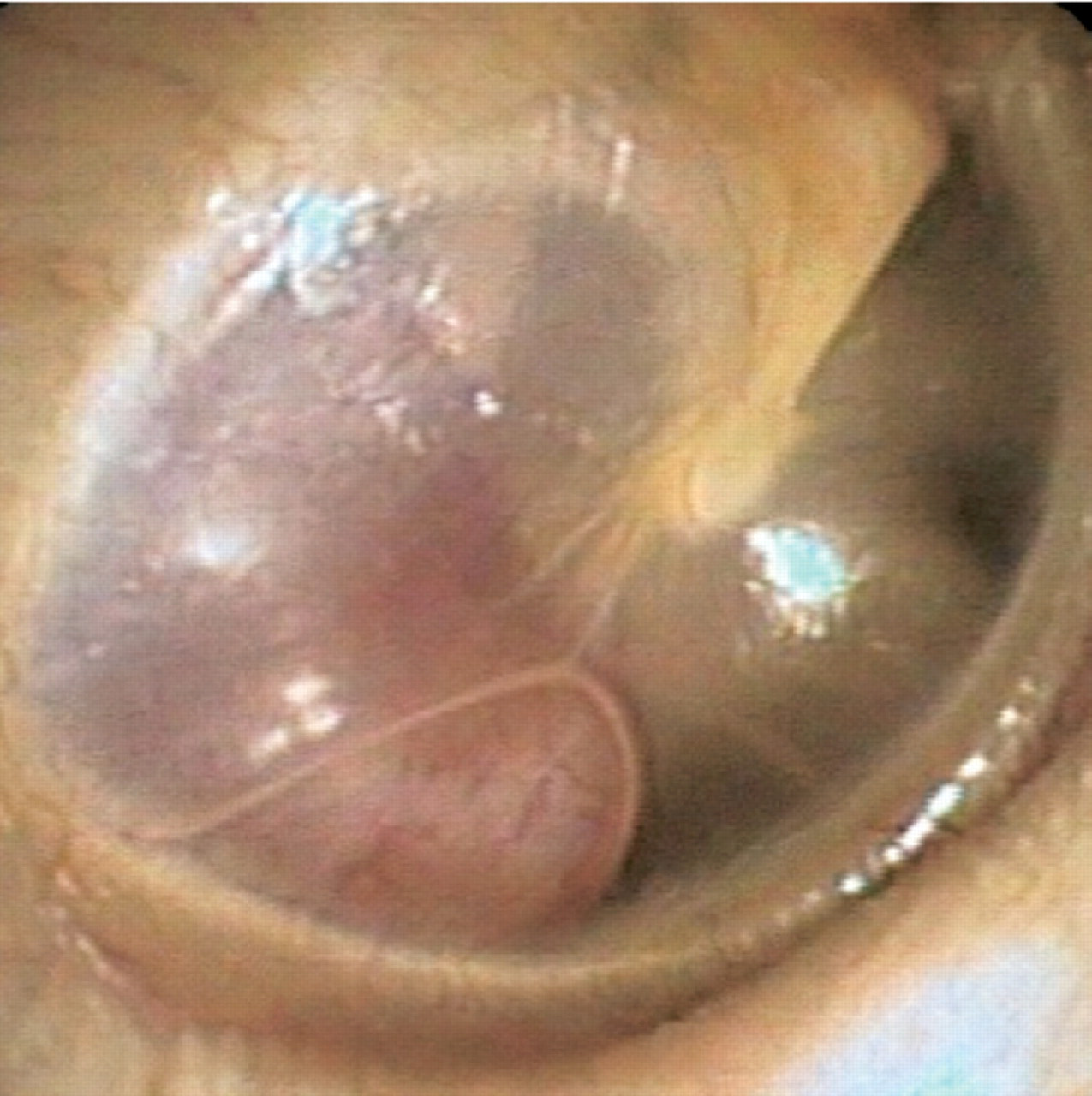
The mass in the middle ear cavity that was partially attached to the tympanic membrane.
An important feature of the present case was that the patient had no otologic symptoms related to her schwannoma in the middle ear, because her inner ear function had already been sacrificed. The patient had been followed up for two decades by neurosurgeons after the original surgery, and one of the co-authors of this paper happened to see her ears a few months before the first visit. Such masses can increase in size so as to extend into the external ear while remaining asymptomatic. When a residual schwannoma is present in the IAC or CPA, careful attention should be paid during the follow-up also in the middle and inner ear, especially in patients with neurofibromatosis. Another important consideration is how to treat schwannoma in the middle ear arising from residuals in the CPA. This may depend on the growth rate of the tumor, and radical surgery for total removal of a tumor in the temporal bone is not always necessary. As in patients with a labyrinthine schwannoma who have symptoms over several years 2 its growth may be slow. The round window appears to be the main route for a schwannoma in the inner ear to extend into the middle ear cavity, since the mechanical barrier of the stapes footplate makes tumor extension into the middle ear space via the oval window less likely 4 The schwannoma in the present case had been gradually increasing in size over several months, as also confirmed by CT. Once a schwannoma extends into the middle ear from the inner ear, its rate of growth may increase.
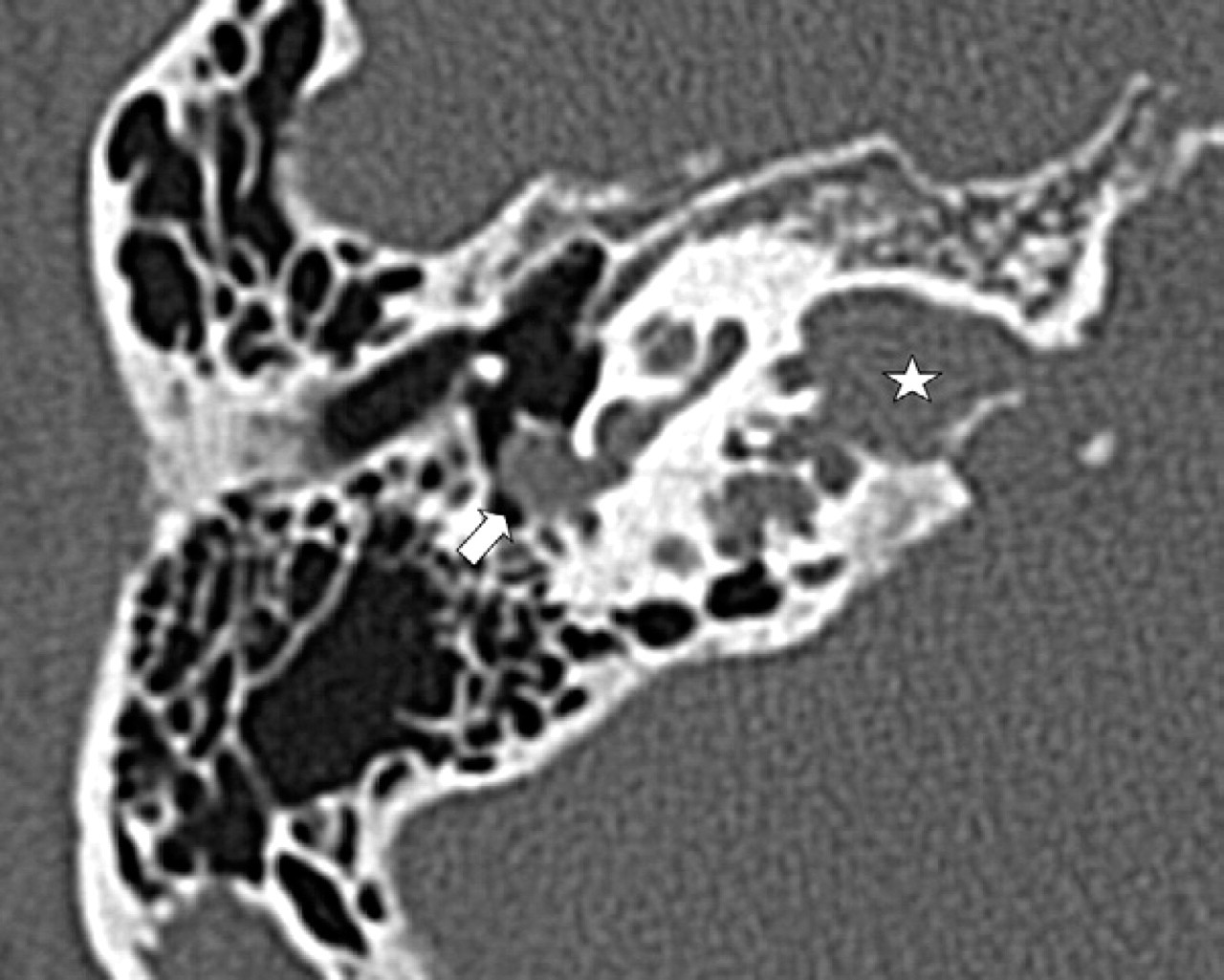
CT showed severe destruction of the IAC (star) and the mass lesion in the middle ear (arrow) adjacent to the round window. The otic capsule was preserved.
This demonstrates that a schwannoma in the CPA or the IAC may grow sufficiently so as to extend into the middle ear through the inner ear, and careful observation is necessary around these areas, especially in a patient with neuro-fibromatosis.
AUTHOR INFORMATION
From the Department of Otorhinolaryngology, Nagoya University Graduate School of Medicine (Drs Sone, Mizuno, and Nakashima) and Wakamiya Clinic, Japan College of Rehabilitation and Welfare Professionals (Dr Takimoto).
Corresponding author: Michihiko Sone, MD, Department of Otorhinolar-yngology, Nagoya University Graduate School of Medicine, 65 Tsurumaicho, Showaku, Nagoya 466–8550, Japan.
E-mail address:
FINANCIAL DISCLOSURE
None.