







Abstract

Typically diagnosed in the pediatric population, coup de sabre presents clinically as a linear ivory-colored depression of the parietal scalp and forehead of varying width and length. These lesions result in a furrowing of the forehead affecting the normal contour and profile of the face. Causing significant facial asymmetry and cosmetic deformity, lesions may persist for years and have led to the development of multiple therapeutic measures, both medical and surgical in nature. We report the use of AlloDerm tissue matrix implantation as a novel and successful treatment to improve cosmesis in a patient with scleroderma encoup de sabre. 1 , 2
A 53-year-old female presented with a 25-year history of a slowly progressing depressed linear forehead furrow, extending from the hairline to the patient's upper eyelid with localized alopecia and skin atrophy. Her past medical history was significant for intermittent migraine headaches and chronic fatigue. Punch biopsy of skin lesions reveals mild reticular dermal scarring with focal thickened collagen bundles in the subcutis as well as mild perivascular lymphocytic inflammation. These changes are consistent with manifestation of scleroderma en coup de sabre. The diagnosis of linear scleroderma was made through consultation with Rheumatology, which revealed normal laboratory values including a negative antinuclear antibody screen. Initial treatments with botulism toxin injections provided moderate cosmetic improvement but failed to fully address the forehead furrow. The patient subsequently underwent alloplastic implantation with AlloDerm tissue matrix, which was placed in a subgaleal plane and yielded significant improvements in the contour and symmetry of the forehead. Four months postoperatively, the patient received a one-time Restlayne injection along the borders of the implant in an effort to smooth the forehead contour. Follow-up at 8 months revealed maintained graft fullness and excellent overall cosmesis. Preoperative as well as 8- and 14-month follow-up clinical photographs highlight the observed results (Figs 1–3).
Discussion
Scleroderma is a disease of connective tissue without known etiology. It may be grouped as either localized or systemic in nature. Localized scleroderma may be differentiated from systemic scleroderma by the lack of Raynaud's phenomenon, acrosclerosis, or internal organ involvement. Localized scleroderma may be further divided by morphological features into three distinct groups: generalized morphea, morphea, and linear scleroderma. 3 Linear scleroderma present on the forehead and scalp is referred to as coup de sabre; these lesions are described as being ivory-like with a linear depression in the skin. Lesions of coup de sabre affect the normal contour of the face, necessitating treatment. With correlation of coup de sabre with neurological manifestations, a heightened vigilance may be required to address neurological abnormalities from remaining undiagnosed.
Treatment of coup de sabre is typically surgical excision and repair. The decision of which surgical technique to use is based upon the characteristics of the depression, with narrow lesions treatable by excision and primary closure without reconstruction. A wider lesion may necessitate reconstruction. Reconstructive efforts employ autologous and synthetic materials. Autologous fat grafting has been reported to achieve good cosmetic results with elevation of the depression within 3 months and without reabsorption for the period of 1 year. 4 This technique has been suggested to effectively correct small to medium-sized lesions. With wider deformities, the successful use of autologous bone grafts has been reported. 5 Additionally, reconstructive efforts have included tissue expansion and polyethylene implants with the advantages of malleability, flexibility, inertness, and strength. 6
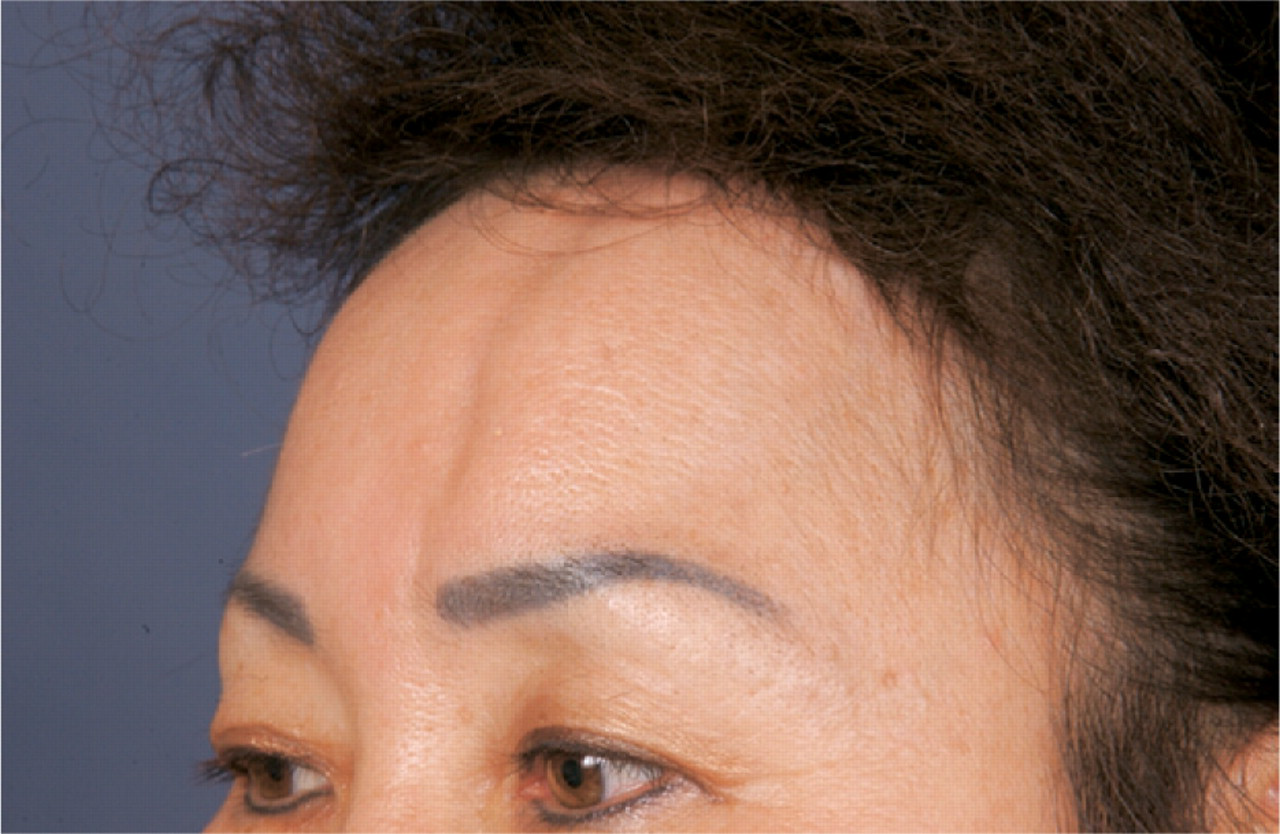
Preoperative clinical photograph demonstrating the linear vertical forehead furrow.
Our novel approach in cosmetic improvement negates the trauma of bone graft harvests and the repeated injections of dermal fat. AlloDerm is malleable, readily accessible, flexible, and inert, making it a promising implant material. We report excellent cosmetic outcome for the period of 14 months, offering the technique as a possible treatment for linear scleroderma en coup de sabre. Acknowledging that our surgical results currently only extend 14 months, we are optimistic of the technique's longevity in the context of the stability demonstrated thus far.
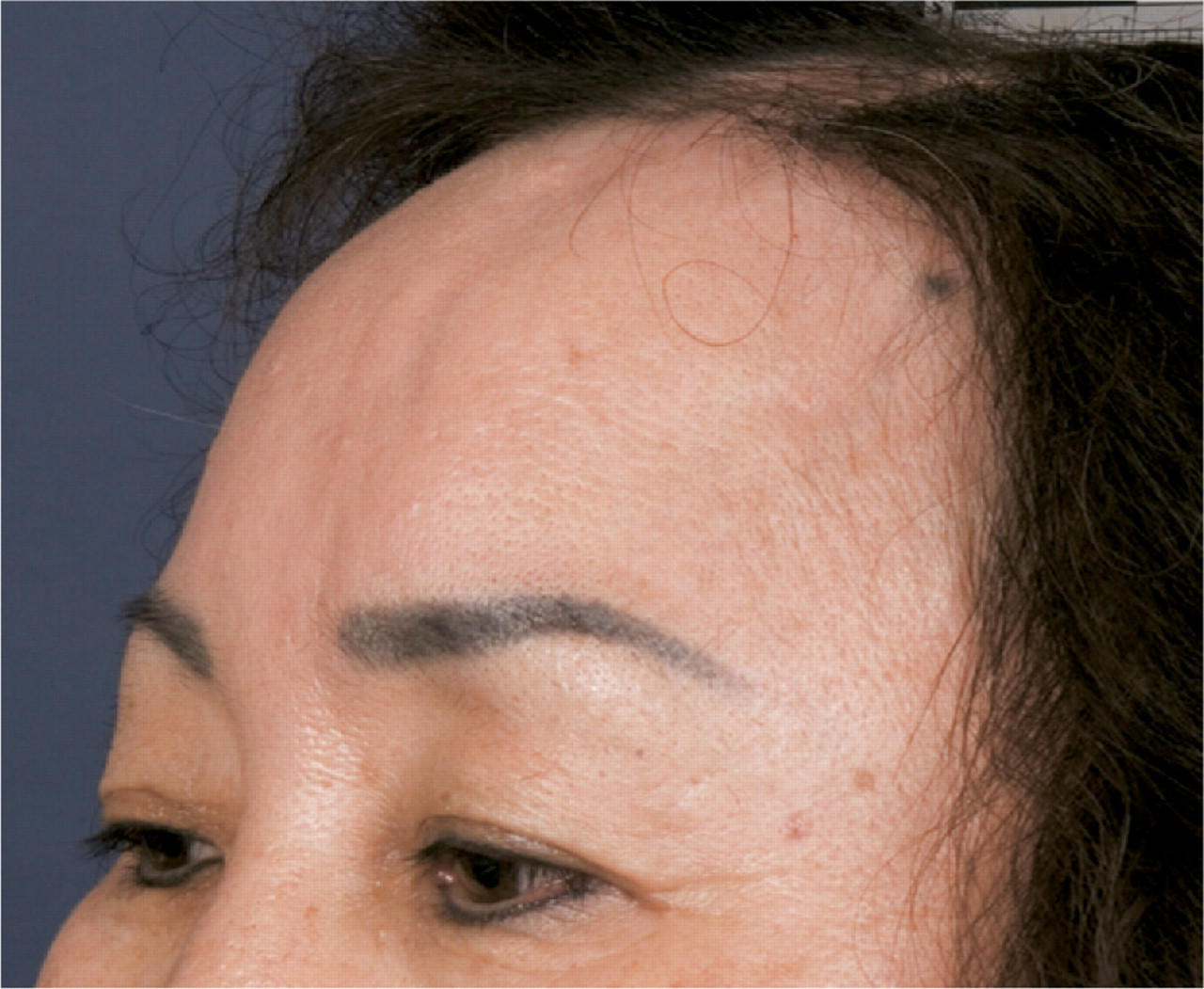
Postoperative clinical photograph obtained 8 months following alloplastic implantation with AlloDerm tissue matrix.
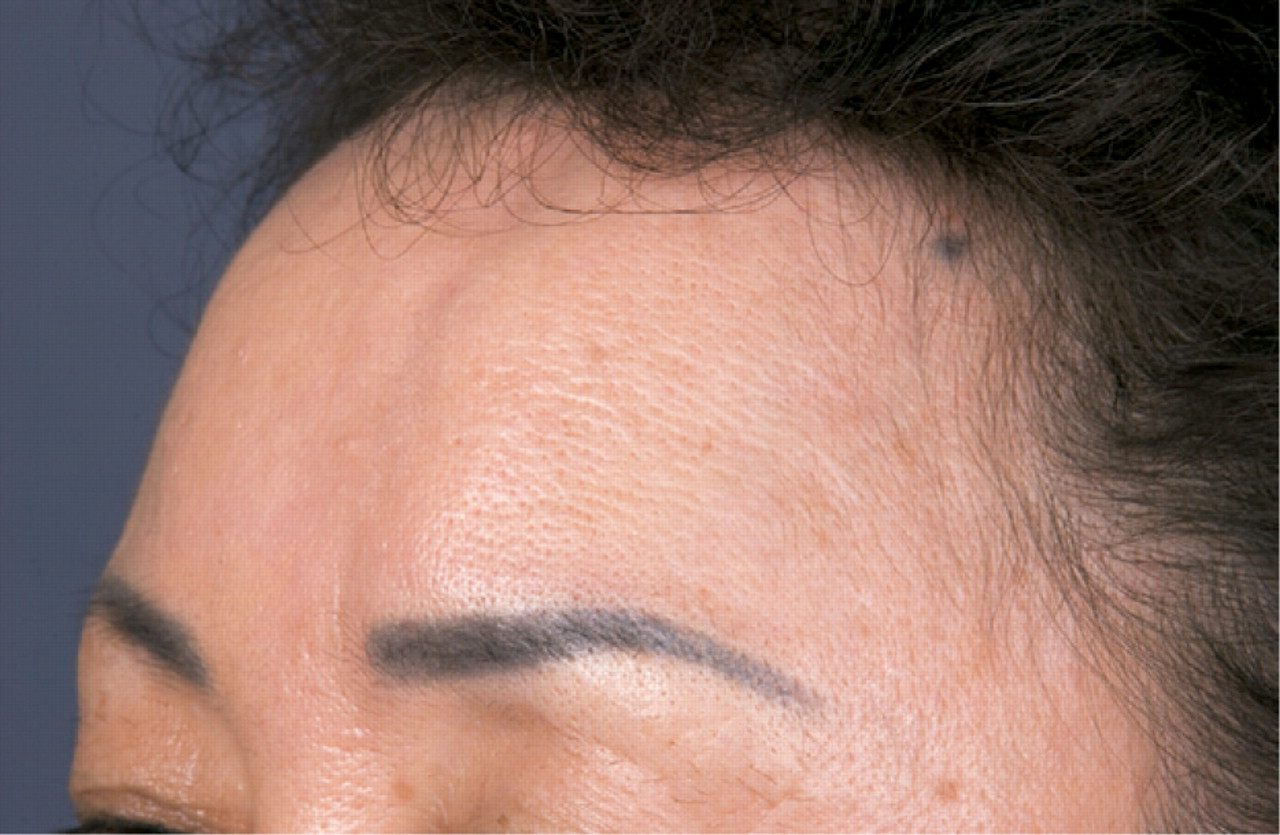
Postoperative clinical photograph obtained 14 months following alloplastic implantation with AlloDerm tissue matrix.
Author Information
Author Contributions
Financial Disclosure
None.