







Abstract

Absorbable biomaterials are commonly used for hemostatic considerations after endoscopic sinus surgery (ESS). Currently available agents persist amid healing sinus tissues for weeks. Animal experiments evaluating the effects of prolonged exposure of these substances on healing mucosa have demonstrated that they interfere with mucosal regeneration and incite an inflammatory reaction with evidence of frank incorporation of foreign materials within healing tissues. 1 , 2 Recent studies in humans have further demonstrated a significantly increased risk of synechiae formation with the use of absorbable biomaterials after sinus surgery. 3 The presence of foreign material during the early recovery period also complicates postoperative sinus debridements, which are performed 1 to 2 weeks postoperatively.
Microporous polysaccharide hemospheres (MPH) (commercially available as Arista and Hemaderm; Medafor, Inc, Minneapolis, MN) is a unique hemostatic agent that is very rapidly cleared. Previous work has shown that unlike other biomaterials, this starch-based powder does not interfere with healing or intact sinonasal mucosa in the rabbit model, 2 which prompted its evaluation in the present human study. The use of MPH in sinus surgery patients has not yet been described. The goals of this study were to review our initial experience with MPH and to assess the safety, efficacy, and key outcomes related to the application of this substance in patients after ESS.
Materials and Methods
Patients with medically refractory CRS who underwent ESS by the senior author (RS) were recruited and prospectively followed. Patients with massive nasal polyposis, a history of bleeding disorders or anticoagulant therapy, and those undergoing any concomitant procedures (eg, septoplasty) were excluded. At the conclusion of ESS, MPH was applied to the sinus cavities bilaterally per manufacturer's instructions. The MPH delivery device consists of a plastic billows-design container that comes preloaded with 2 gm of agent and a fenestrated applicator tube that is connected before use (Fig 1). Time to cessation of bleeding was noted. Patients were managed in a standard fashion both preoperatively and postoperatively and were discharged home on a 7-day course of antibiotics with instructions to begin saline irrigations 2 days after surgery. Demographic information, perioperative data, and surgical outcomes including adverse reactions to the material were recorded. Patients were followed with serial nasal endoscopy at 1, 4, and 12 weeks postoperatively. The presence of synechiae was graded as: 0 = absent, 1 = minor and located in an insignificant location, or 2 = major and located in a significant location and requiring lysis. This study was approved by the Institutional Review Board of Saint Louis University.
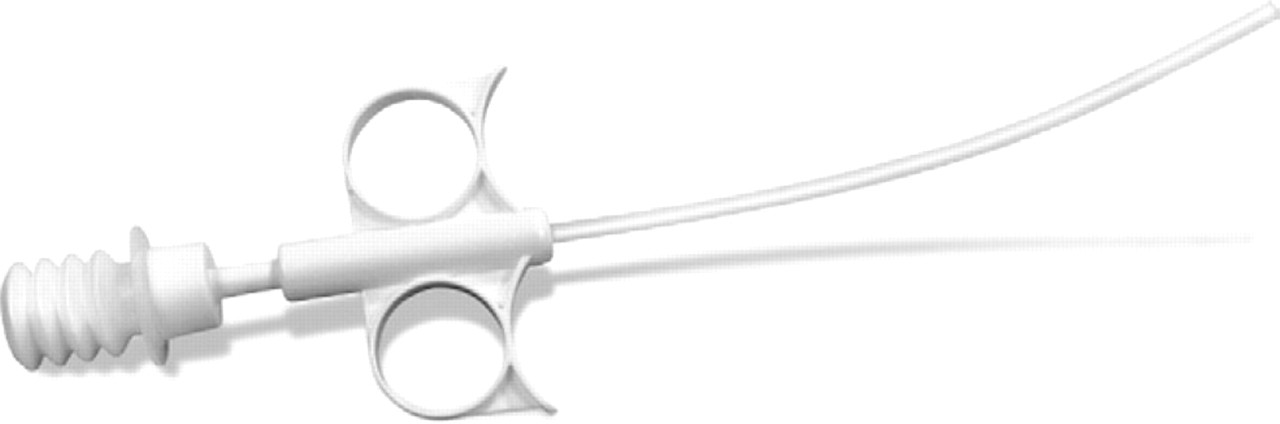
The billows-design container and Flexi-tip applicator with distal fenestrations used for MPH delivery.
Results
Sixty-five consecutive patients who underwent ESS for CRS were included. The average age (STD) of the patients was 46.4 years (±14.1); 48 percent of them were male. The mean preoperative Harvard CT stage (STD) was 3.2 (±0.78). Almost half (45%) of the 65 operations were revision procedures, and only 15 (23.1%) of 65 were performed without surgical navigation. The average intraoperative blood loss (STD) was 83.5 cc (±29.4). Hemostasis was quickly obtained (approximately 30 to 45 seconds) after the MPH material was applied to the sinus cavities (Fig 2). The surgical field was observed endoscopically for 5 minutes after treatment to ensure that there was no significant break-through bleeding. This was the case in all patients. No other packing materials were used. All patients were discharged home within a few hours after surgery. No significant postoperative bleeding that required an ER visit, hospital admission, or nasal packing/cautery was encountered. At the one week debridement, no gross MPH substance was detected in any of the sinus cavities. Synechiae formation was noted in eight (12.3%) of 65 patients during the study period. Of these, only two (3.1% overall) were grade 2 and required lysis, whereas the majority (6 of 8) were grade 1 and not clinically significant. There were no adverse reactions.
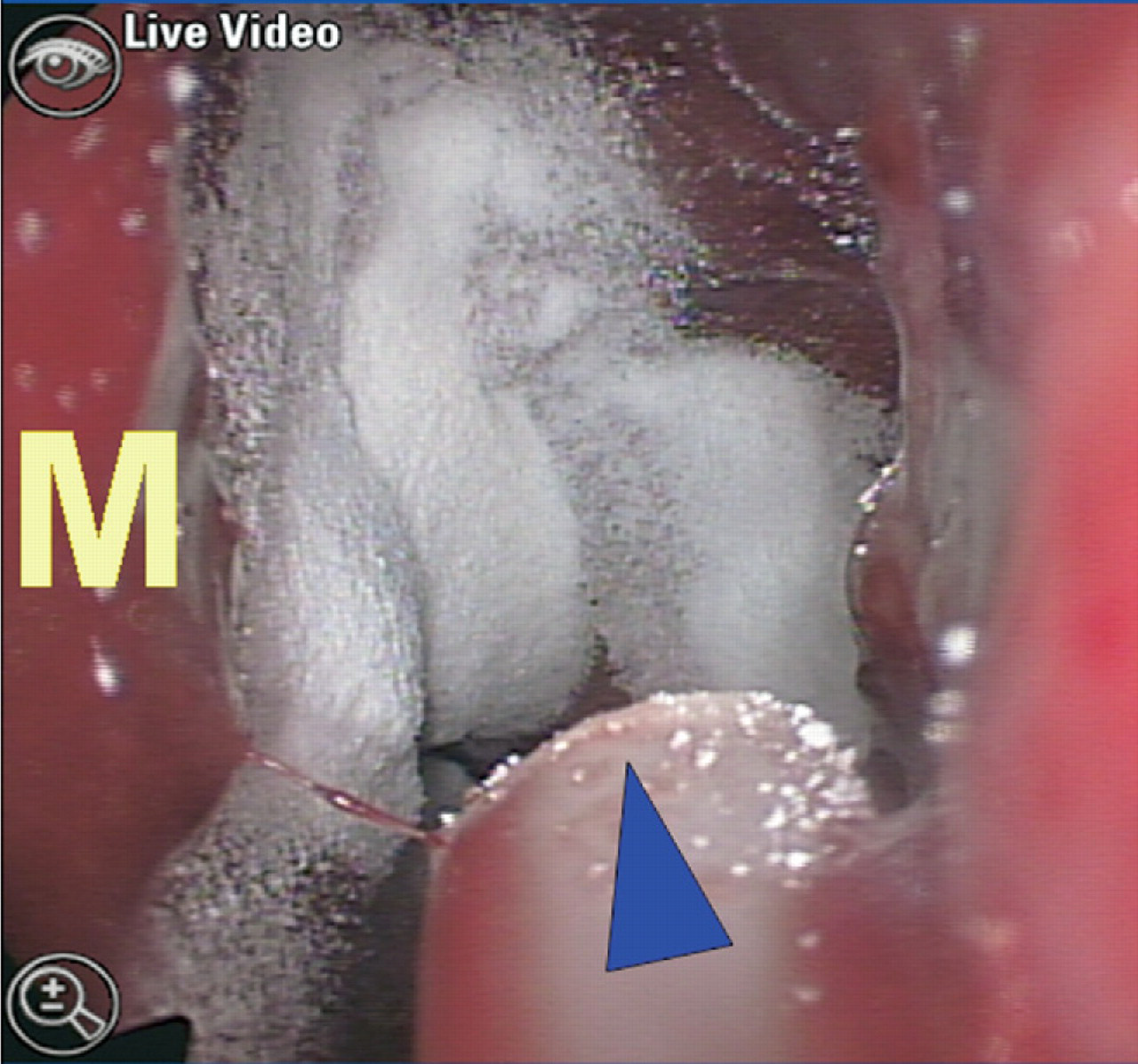
Endoscopic view of applicator (triangle) applying MPH powder into the left middle meatus (M = left middle turbinate) at the conclusion of sinus surgery.
Discussion
The use of MPH for hemostasis has been reported in a variety of specialties, but this is the first description of its use in otolaryngology. Available hemostatic agents function by either providing clotting components (eg, fibrin glues) or a surface for clotting to be stimulated (eg, collagen, gelatin sponge, oxidized cellulose). MPH particles have a diameter of 30 to 100 μm and act as a “molecular sieve” by extracting fluids from blood. This concentrates platelets and other elements that promote the formation of a fibrin clot. MPH powder is in a ready to use container that does not require any preparation, heating, or mixing. In comparison to other biomaterials that are derived from animal sources, MPH, which is made from purified potato starch, is hypoallergenic and carries no inherent risk of disease transmission. 4
Based on this initial study, MPH appears to be a safe hemostatic agent that works very quickly in sinus cavities. Its unique composition, mechanism of action, and resorption profile offer significant advantages over other biomaterials. Most notably, MPH is rapidly and completely cleared when placed within postsurgical sinus cavities, which limits its exposure to healing mucosa. The adhesion rates observed in this preliminary study are favorable in comparison with those reported in the literature for ESS performed without the use of any bioabsorbables. 5 Although promising, further data are needed to critically examine the potential risk of adhesion formation with the use of this product. Controlled studies to compare it against traditional nonabsorbable packing and to no packing at all are required to evaluate the efficacy and impact of MPH on surgical outcomes after ESS.
Conclusion
This is the first description of the use of hemostatic powder MPH after endoscopic sinus surgery. MPH appears to be an easy to use, fast-acting agent that is rapidly cleared from the sinuses. Its unique composition, mechanism of action, and clearance profile offer significant advantages. Further studies to examine the efficacy and potential risk of synechiae formation with the use of this product after sinus surgery are needed.