







Abstract

A 55-year-old woman presented to our clinic with a six-month history of a gradually enlarging mass on the left nasal vestibule. Physical examination revealed a slightly firm, painless mass located on the medial side of the left vestibular skin (Fig 1). It was approximately 1.2 × 0.9 × 0.7 cm in size, and the surface was smooth. Small, ectatic blood vessels were noted on the surface of the mass. Under local anesthesia, the mass was removed en bloc along with the vestibular skin, without destroying the underlying structure.
Histopathologically, the excised tumor showed irregular epithelial nests dispersed within a loose myxoid stroma. The epithelial areas were mainly formed of ductal type cells. There was no evidence of recurrence at 24 months after the operation.
DISCUSSION
Pleomorphic adenomas are benign, epithelium-derived tumors that have a biphasic appearance resulting from the mixture of epithelium and stroma. Although pleomorphic adenomas are the most common neoplasm of the salivary glands, they can occur at many sites in the body.1,2 This represents the only documented case report of a pleomorphic adenoma of the nasal vestibule.
The institutional review board at our institution approved this case for publication.
Pleomorphic adenomas of the minor salivary glands can be seen at any site where these glands are located: palate, lips, cheek mucosa, tongue, floor of the mouth, retromolar trigone, oropharynx, nasal cavities, and paranasal sinuses.3
In one review of 40 intranasal pleomorphic adenomas, 25 cases originated from the nasal septum, eight originated from the lateral nasal wall, and in seven cases the exact site within the nasal cavity was unstated.2
Although pleomorphic adenomas of the skin are rare, they can be found at various locations. The nose, upper lip, cheek, and scalp are the most frequently involved areas.1 Of the 19 reported tumors involving the nose, 17 have been in the external skin and two have been in the skin of the nares.1
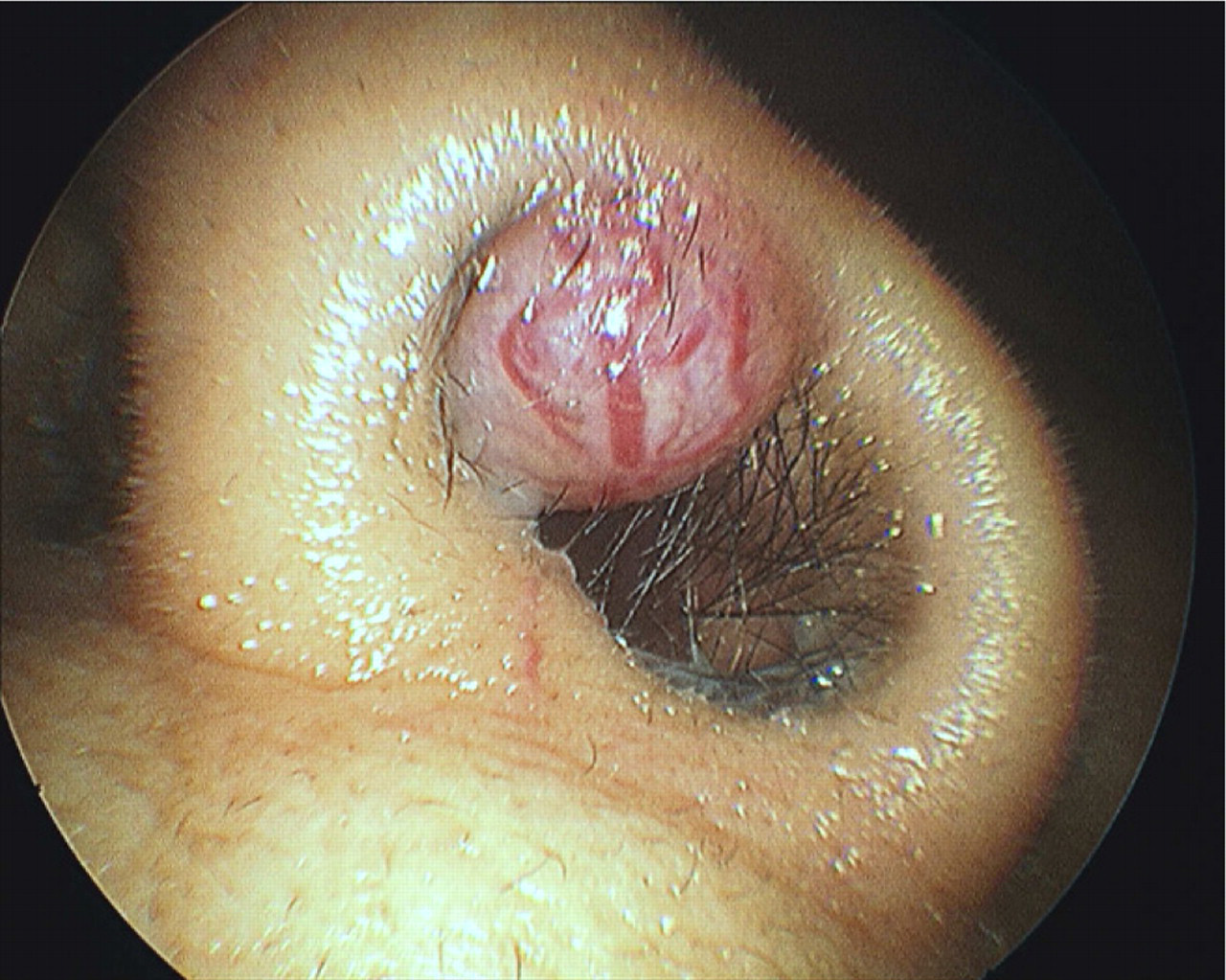
A pinkish-colored polypoid mass on the left nasal vestibule.
Pleomorphic adenomas of the skin in the head and neck region may originate from sweat glands, sebaceous glands, or ectopic salivary glands.1,4 In the present case, there was no evidence of ectopic salivary glands, and no other pleomorphic adenoma lesions could be found. The histological patterns seen in pleomorphic adenomas of the skin are similar to those seen in pleomorphic adenomas of the salivary glands.1 Complete surgical excision is the treatment of choice for pleomorphic adenomas, independent of the site of origin.