







Abstract

A 68-year-old man presented with progressive hoarseness and dyspnea. In his medical history, he had endoscopic resection of premalignant lesions of the vocal folds five years earlier, adenocarcinoma of the colon treated by surgical resection and chemotherapy five years earlier, and lobectomy for a pulmonary metastasis of colic cancer two years earlier.
Laryngeal fiberoptic examination revealed a large, pediculated polyp of the right vocal fold (Fig 1). He underwent carbon dioxide laser–assisted transoral resection of the polyp. Histological examination showed neoplastic cells forming an irregular tubular structure with atypical irregular nuclei in the luminal bases. Immunohistochemical markers were positive for cytokeratin 20 (Fig 2). It was a metastasis of the colic adenocarcinoma to the vocal fold.
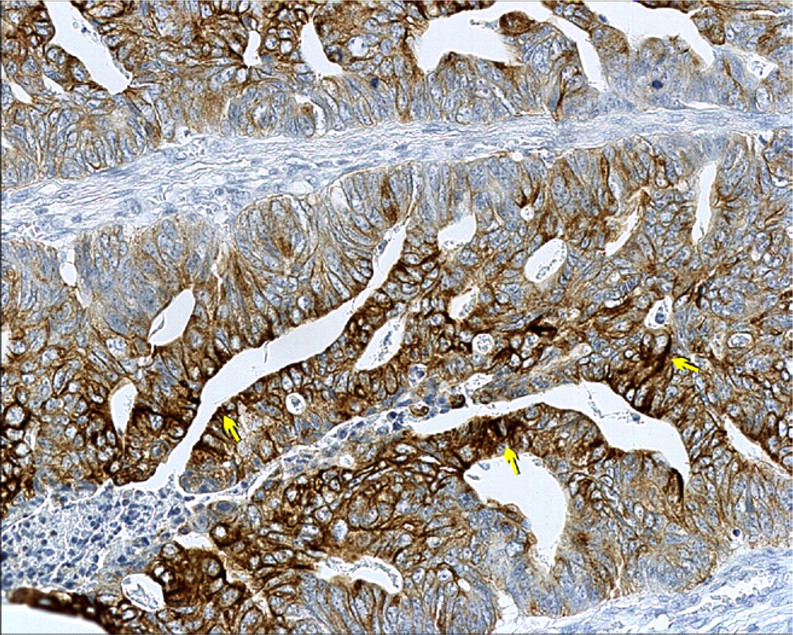
Strong positivity of immunohistochemical marker cytokeratin 20 shown by yellow arrows.
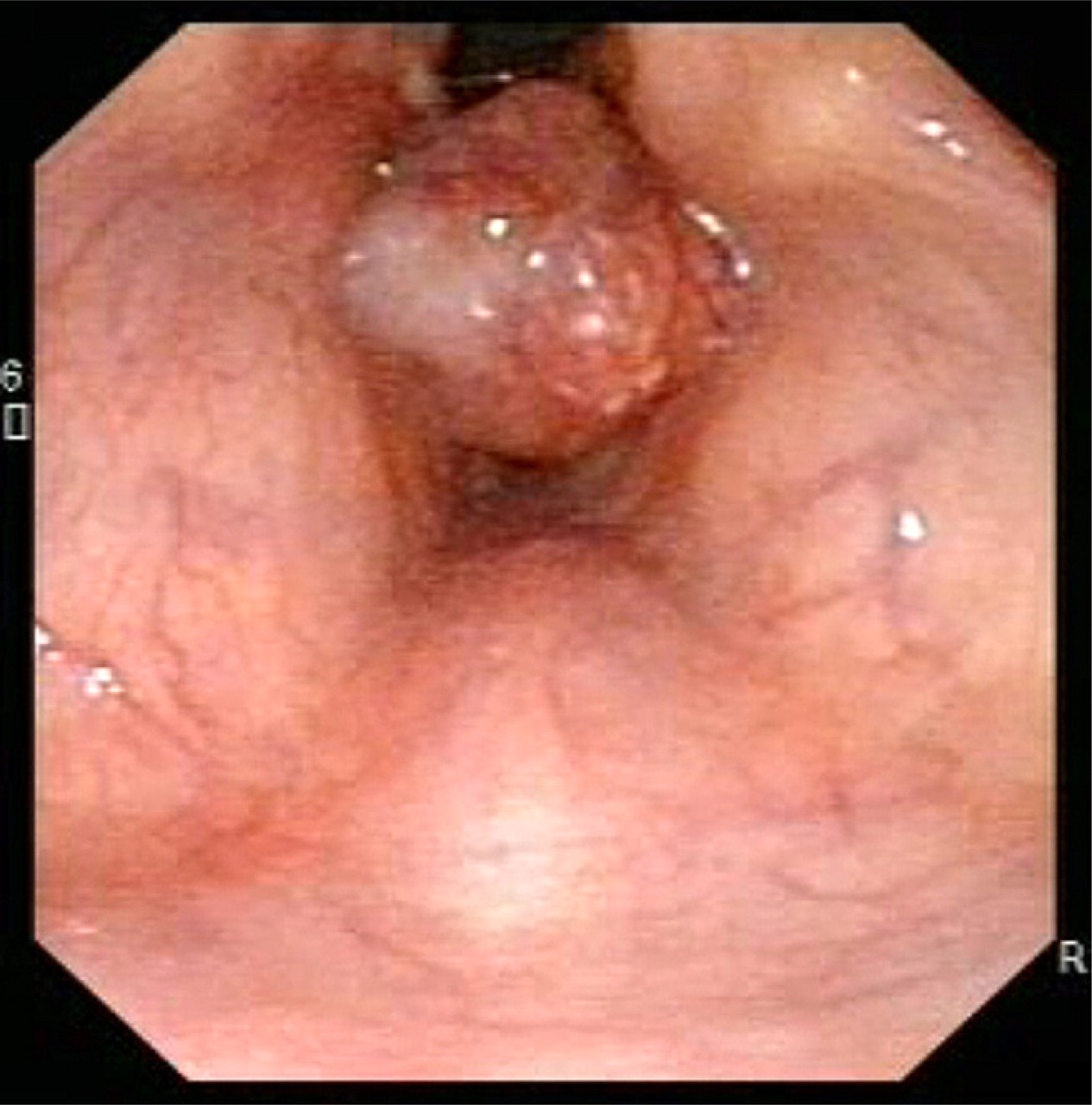
Laryngeal metastasis of a colon cancer.
University of Louvain institutional review board approval was obtained to publish this case.
Discussion
Secondary laryngeal tumors account for less than one percent of all laryngeal tumors. 1 The most frequent tumors metastatic to the larynx are skin melanoma and kidney carcinoma.
Distant metastasis of colon adenocarcinoma to the larynx is an extremely rare occurrence. The most common mechanism of metastatic spread to the larynx is through systemic circulation. 2
Fewer than 20 cases have been published in the literature. The laryngeal localization of colon adenocarcinoma metastasis was mostly subglottic and supraglottic 3 because of the presence of more developed lymphatic and blood circulation compared with the glottis. 4 In most of the cases, there were other distant metastases, primarily to the lungs; however, laryngeal metastasis can be isolated.
Therapy should be individualized according to the presence of other metastases and to the patient's respiratory symptoms. In case of disseminated disease, only palliative treatment is used to improve quality of life. Tracheotomy can secure the airway. But in our case, laser resection of the lesion was easy, with no perioperative or postoperative complications, as previously reported in the literature. 2
Author Contributions
Disclosures
Acknowledgments
The authors would like to thank Prof. Delos and Mr. Deneffe for providing the histological photograph.