







Abstract
Incomplete closure of the velopharynx, or velopharyngeal insufficiency (VPI), results in nasal emissions and hypernasal resonance during speech production of most consonant sounds. VPI in children is most commonly due to anatomical (i.e., cleft palate, post-adenoidectomy, velo-cardio-facial syndrome, etc.) or neuromuscular (i.e., hypotonia, cerebral palsy, etc.) etiologies. In addition to hypernasality, children with VPI may also exhibit nasal regurgitation, nasal congestion, or otitis media.
Clinical evaluation of the VPI patient includes perceptual speech evaluation by an experienced speech-language pathologist and instrumental assessment using nasal endoscopy and/or videofluoroscopy by an otolaryngologist. Perceptual speech evaluation has previously been shown to be predictive of velopharyngeal gap size. 1 Nasometry also provides an objective measurement of nasal emissions during speech evaluation. Nasal endoscopy and videofluoroscopy provide visual information to the surgeon to assess the size of the velopharyngeal gap and movement of the lateral pharyngeal walls and velum during speech. Lam et al 2 compared both techniques and found nasal endoscopy to be more predictive of VPI severity.
Treatment of VPI is primarily surgical, with prosthetic appliances typically offered to those patients considered poor surgical candidates. Furlow palatoplasty, posterior pharyngeal wall augmentation, posterior pharyngeal flap (PF), and sphincter pharyngoplasty (SP) are the most commonly described procedures for the correction of VPI. Furlow palatoplasty may be most appropriate for small velopharyngeal gaps as described by Dailey et al 3 and Perkins et al. 4 Posterior pharyngeal wall augmentation is uncommon today because Teflon injection results in chronic inflammation, mucosal lesions, and ultimately implant extrusion. A posterior pharyngeal flap involves the attachment of a superior pharyngeal wall flap to the nasal surface of the soft palate; previous studies have described obstructive sleep apnea (OSA) as a known complication of PF. 5 - 11 SP theoretically recreates a functional sphincter with two posterior lateral PFs to preserve circumferential orientation of the velar muscles and soft palate flexibility. 12 Additionally, patients with VPI following Furlow palatoplasty can undergo SP. 13
OSA following posterior PF or SP has been reported in previous studies. 5 - 11 , 14 - 19 Intuitively, the surgical reduction of the velopharyngeal gap may result in upper airway obstruction or occlusion. Of studies discussing outcomes following posterior PF or SP, three are prospective; Orr et al 7 and Sirois et al 8 demonstrated a relatively high prevalence of immediate and persistent OSA on polysomnography following PF. Raymond et al 17 found no significant change in apnea-hypopnea index or nocturnal oxygen saturation following SP; however, a reduction in slow wave sleep and increase in micro-arousals led the authors to hypothesize that SP does induce sleep fragmentation.
Given the possibility of upper airway obstruction after surgical repair for VPI, surgeons have historically observed patients postoperatively in the inpatient setting. However, there is a lack of data supporting this practice in these patients. Therefore, the aim of the current study was to retrospectively evaluate postoperative outcomes of SP with respect to upper airway obstruction events.
Methods
Prior to initiation of the study, approval from the institutional review board at the Medical University of South Carolina was obtained for study protocols. Patients were recruited among VPI clinic patients at one institution with a diagnosis of VPI after appropriate speech evaluation performed by an experienced speech-language pathologist and nasal endoscopic evaluation by a pediatric otolaryngologist. Patients then underwent SP by a pediatric otolaryngologist or plastic surgeon using the modified Hynes technique; 20 , 21 patients undergoing primary or revision/adjunctive SP were included in this study. A retrospective chart review of the inpatient medical record was performed to determine the following factors: age, gender, date of surgery, comorbidities and suspected etiology of VPI, intraoperative complications, postoperative oral and intravenous fluid intake, postoperative oral and intravenous pain medication requirements, emesis, apneic events, oxygen desaturation, supplemental oxygen requirements, length of hospital stay, other adverse events, and length of follow-up. Fisher's exact test was applied to data to compare outcomes at four and 24 hours postoperatively.
Results
Of 84 patients evaluated in a VPI clinic at one institution, 36 patients underwent SP from April 2003 to January 2009. Surgeons included two pediatric otolaryngologists and one plastic surgeon. The mean patient age was 8.1 (SD 4.3) years. Included in the study were 21 (58%) females and 15 (42%) males.
Cleft palate (13 patients or 36.1%), velo-cardio-facial syndrome (8 patients or 22.2%), and post-adenoidectomy (6 patients or 16.7%) were the most common causes of VPI. All cleft palate patients had undergone previous palatoplasty. Posterior PFs had been performed in two patients included in the study group with persistent VPI; one patient had prior takedown of the flap and one patient had concurrent takedown of the flap with SP.
All patients remained inpatient for overnight observation postoperatively. Mean hospital stay was 1.2 (SD 0.5) days. Five patients remained inpatient two or three days owing to fever (2 patients), bleeding ear after concurrent otoplasty (1 patient), a minimal amount of oropharyngeal bleeding with spontaneous resolution (1 patient), and medication allergy (1 patient). All patients had adequate oral intake prior to discharge. Pain control with weight-based oral narcotics was achieved in 27 (75%) patients. Nine (25%) patients received one to three doses of intravenous narcotics (dosage 0.1-2 mg morphine) for severe pain on postoperative day zero. Of these nine patients, only one remained inpatient for two days owing to pain; two remained inpatient for two or three days owing to a complication of a concurrent procedure or medication allergy. Five (13.9%) patients had one to four episodes of emesis postoperatively, requiring intravenous antinausea medication in one patient.
No patient had a documented apneic event or desaturation below 95 percent. Although no desaturations were documented, four patients received supplemental oxygen. Of these patients, three received blow-by oxygen immediately postoperatively in the postanesthesia care unit for less than two hours. One patient received 4 L of supplemental oxygen for “comfort” over 12 hours; however, no complications or desaturations were noted in the subsequent six hours after removal of the oxygen, and the patient was discharged on postoperative day one. Mean follow-up was 6.5 (SD 10.7) months.
Results comparing the incidences of bleeding, fever, emesis, apnea, oxygen desaturation, and requirement for supplemental oxygen at four and 24 hours postoperatively are included in Table 1. Fisher's exact test was used to evaluate the data, with significance P < 0.05. No significant difference was found between any of these factors, although confidence intervals range from 0 to 12.8 percent with respect to incidence of complications in this small sample size.
Postoperative incidence of adverse outcomes
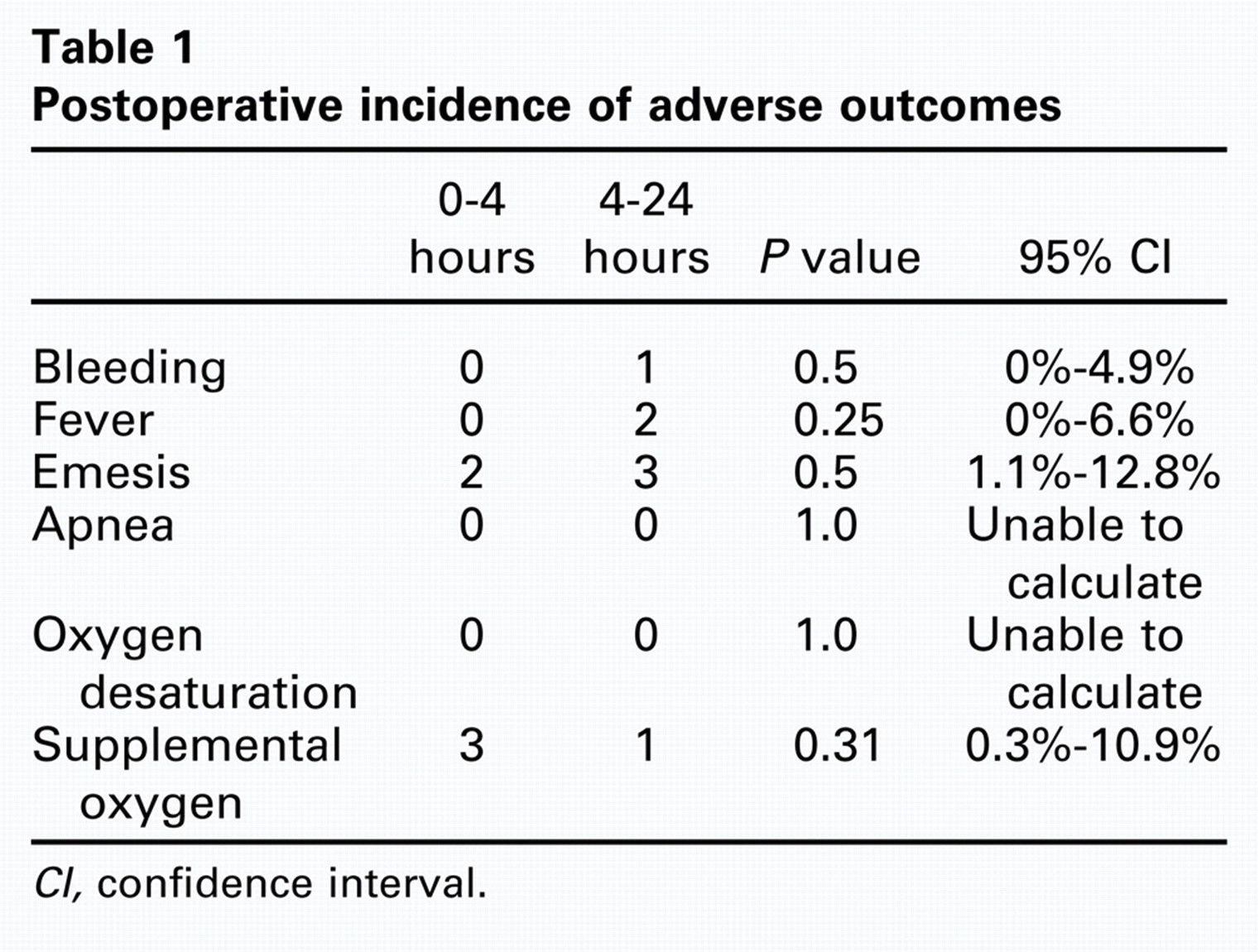
CI, confidence interval.
Discussion
SP for treatment of VPI results in a circumferential reconstruction of the velopharynx and a specific reduction of the transverse diameter of this structure. 12 , 18 This size reduction of the upper airway may produce upper airway obstruction. Moreover, oropharyngeal surgery lends itself to an inherent risk of hemorrhage and dehydration owing to decreased oral intake, which is of special concern in the pediatric population. In this study, we performed a retrospective review of patients undergoing overnight hospital observation after SP. No evidence of significant obstruction was seen in the postoperative observation period, and there was no significant progression of obstructive events in the immediate postoperative period. While minor episodes of emesis and fever were encountered, these were events that could be treated quite easily in the outpatient setting.
Tonsillectomy with and without adenoidectomy is a frequently performed procedure with complications similar to those of SP. Numerous studies have evaluated the appropriateness of outpatient tonsillectomy. Guida and Mattucci 22 performed a prospective study of 1000 patients that determined the greatest percentage of complications (2.1% overall including hemorrhage, fever, and protracted emesis) occurred within the first six postoperative hours following tonsillectomy. Similarly, Lalakea et al 23 demonstrated no difference between complication rates with respect to length of postoperative observation. Elective admission from the postanesthesia care unit was required in 8.2 percent of planned outpatient tonsillectomy patients, most commonly owing to respiratory compromise. Mills et al 24 reported a 4.7 percent rate of conversion to inpatient admission following tonsillectomy, which was attributed to postoperative vomiting in 2.65 percent and hemorrhage in 0.95 percent. Of patients with primary postoperative hemorrhage, 83 percent occurred within the four-hour observation period in recovery, and no patients who were discharged and returned with bleeding required reoperation or blood transfusion. Overall, the standard of care has progressed from hospital observation in the postoperative period to performance of adenotonsillectomy as an outpatient procedure unless specific problems are encountered in the immediate postoperative observation period.
Our study of SP patients demonstrates similar outcomes to the described studies. Low incidences of hemorrhage that did not require intervention (2.8%), of emesis (13.9%), and of fever (5.6%) support postoperative observation of patients with subsequent discharge when appropriate. As seen in Table 1, no significant difference was found between the incidence of these complications at four and 24 hours postoperatively; in our SP population, prolonged hospital stay did not result in improved patient care because few patients required additional treatment after a four-hour observation period. However, special consideration must be taken in the post-SP patient versus the post-tonsillectomy patient because the former potentially narrows the pharyngeal airway while the latter often improves the airway.
Studies in patients undergoing PF have clearly described airway obstruction, specifically OSA, as a complication postoperatively. 5 - 11 , 14 - 16 , 18 Lesavoy et al, 6 Orr et al, 7 Sirois et al, 8 Valnicek et al, 9 and Wells et al. 10 demonstrated high prevalence of sleep apnea in the acute postoperative period with persistent sleep apnea in 1 to 20 percent of patients following PF. This acute postoperative obstruction played a role in airway complications including need for reintubation and death. 9 , 10 Given the high complication rate following the use of PF for the treatment of VPI, patients have historically been observed postoperatively. Effectively, this practice has been transferred to patients undergoing treatment of VPI with SP, despite lack of evidence of acute airway obstruction and presence of evidence supporting the significantly decreased risk of postoperative sleep apnea in patients undergoing SP. 16 , 17 , 25 Witt et al 19 does describe a 13.8 percent incidence (8 of 58 patients) of postoperative airway obstruction following SP, although five of these patients had Pierre Robin sequence, six patients had complete resolution of symptoms within three days of surgery, and the remaining two patients were managed with continuous positive airway pressure.
Our study indicates there is little risk of acute airway obstruction in patients undergoing SP. There were no patients with either apneas or oxygen desaturations to indicate acute obstruction. While four (11.1%) patients required supplemental oxygen, the majority required this treatment only in the immediate postoperative period and had no further complications. As a retrospective chart review, there are inherent limitations to this study including the possibility of poor documentation in the inpatient record with respect to oxygen desaturation or other adverse events and subtle clinical signs of airway distress not addressed by the current parameters. However, the few complications in our study group were attributable to concurrent procedures or medication administration (which may be considered iatrogenic and thus less likely to occur in the outpatient setting); acute airway obstruction did not account for prolonged hospital care. A larger sample size is necessary to sufficiently address the safety of outpatient SP, given the low incidence of postoperative airway-associated events, and further investigation is certainly warranted to draw this conclusion.
Our current study demonstrates that upper airway obstruction following SP is uncommon. Overall, patients did not experience airway-associated complications. Therefore, in otherwise healthy patients, performing SP in an outpatient setting, given appropriate recovery room evaluation over four to six hours for airway concerns, oral intake, pain control, and nausea, should be considered.
Author Contributions
Disclosures