







Abstract
Purpose: Over the past decade, quality of life (QOL) of adults with a congenital heart disease has received increasingly attention. Because QOL is affected by different aspects of life, such as critical life events or changes in health status, it is supposed that QOL may evolve over time. To check this assumption, this study investigated the evolution of QOL over a period of one year and explored possible causes for this evolution.
Methods: One hundred and thirty patients (60% male; median age = 24 years) completed the questionnaires twice (T0 and T1), with an interval of approximately 1 year. Overall QOL was measured using a Linear Analogue Scale (LAS) and the Satisfaction With Life Scale (SWLS). Determinants of QOL were assessed by the Schedule for Evaluation of Individual Quality of Life-Direct Weighting (SEIQoL-DW). Perceived health was also assessed with a LAS. Based on changes in health status during the interval, as reported in the medical records, patients were assigned to 4 groups.
Results: Respondents perceived their overall QOL and health status as good. Comparing the scores at T0 and T1 in the overall sample, only for the SEIQoL-DW a significant improvement could be observed. Both in the subgroups of patients experiencing no changes in health status and patients who underwent an intervention between T0 and T1, no significant evolutions were detected. Patients who experienced complications between T0 and T1 showed a significant deterioration of the self-perceived health, but surprisingly demonstrated a significant increase of the SEIQoL-DW index. Respondents, whose health status changed just before T0, also demonstrated a significantly higher SEIQoL-DW index at T1.
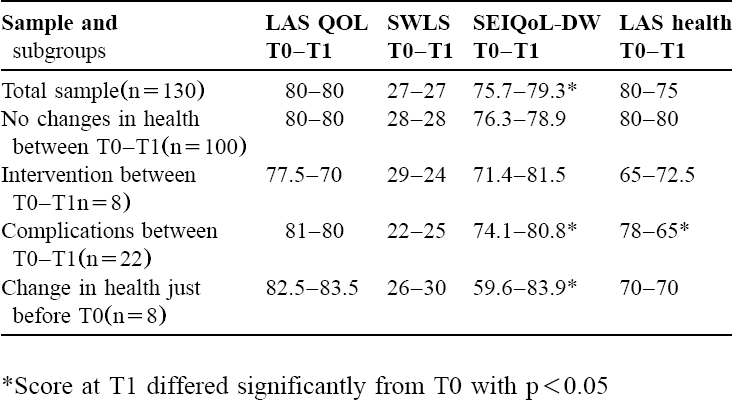
Score at T1 differed significantly from T0 with p<0.05
Conclusion: This study revealed that QOL is relatively stable in patients with a natural history of congenital heart disease. Changes in QOL can be induced by complications of the heart defect or by changes in health status in general. However, the impact on QOL is not consistent, because other components, such as personality, social support, or sense of coherence have probably a more prominent influence on the perception and the evolution of QOL.