







Abstract

Purpose: Chronic heart failure is a major problem in many countries.
The necessity for intravenous medication in the end stage of their live is an important reason for hospitalisation. However, these patients often prefer to stay in their home situation.
To meet this demand it was decided to treat patients with heart failure at home with intravenous medication of dobutamin.
By a single case study the feasibility to treat a patient in the end stage of his live at home was studied. Furthermore, the coordination between caregivers was described.
Method: For a patient, diagnosed with heart failure in the end stage of live, the degree of dyspnea and weight were followed during 21 days. His heart failure medication remained unchanged during the study. The patient was daily visited by a homecare nurse and weekly by a heart failure nurse. The homecare nurse paid attention to daily living activities and observed weight and dyspnea. She signalised if and when patients' condition worsened and contacted the heart failure nurse.
The heart failure nurse, in collaboration with the general practitioner and the cardiologist, initiated the treatment. She inspected his physical condition by physical examination.
Results: Patients' condition worsened and the home care nurse contacted the heart failure nurse. Based on the findings of the physical examination, the heart failure nurse established that the patient retained fluid. After contacting the cardiologist she raised the diuretics for a few days. She also informed the general practitioner.
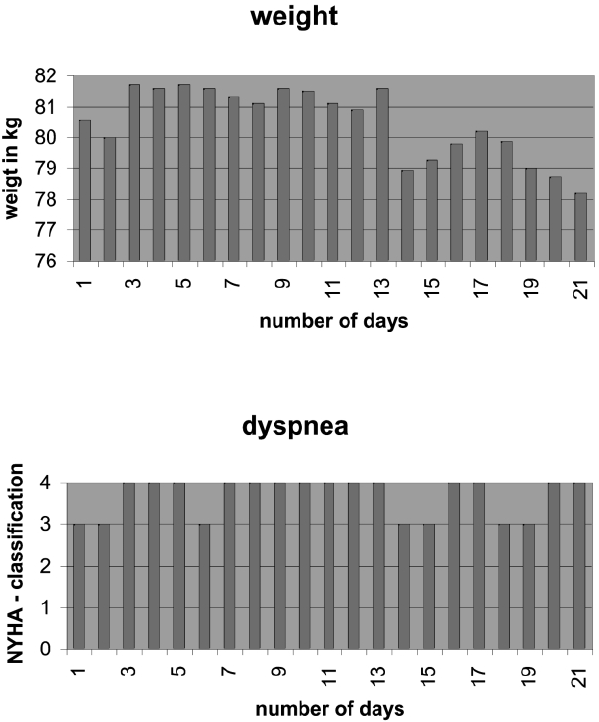
During the follow-up period, the mean weight was 80,5 kg, SD 1.14, with a minimum weight of 78.2 and a maximum of 81.8 kg. As a result of the temporary raise in diuretics, a decrease in weight occurred after day 14. The dyspnea NYHA classification differed between 3 and 4, but remained at NYHA IV from between 6th and the 13th day.
The collaboration between the different caregivers was found to be adequate.
Conclusion: From this study it was found that integrated care of a heart failure patient in the home situation, with adaptation of the medication at patients condition and continuation of intravenous medication, is feasible. The efforts of each caregiver and the collaboration between them resulted in a treatment of the patient in his home situation. Supporting family members are a precondition to succeed this way of care giving. This study shows the feasibility of treatment in the home situation. We need more investigation to proof the effectiveness of this care system.