







Abstract
Covert bullying behaviours are at least as distressing for young people as overt forms of bullying, but often remain unnoticed or unacknowledged by adults. This invisibility is increased in schools by inattention to covert bullying in policy and practice, and limited staff understanding and skill to address covert behaviours. These factors can lead to a school culture that appears to tolerate and thus inadvertently encourages covert bullying. This study explores these dynamics in Australian primary and secondary schools, including the attitudes of over 400 staff towards covert bullying, their understanding of covert bullying behaviours, and their perceived capacity to address these behaviours both individually and at a whole-school level. While most respondents felt a responsibility to intervene in bullying situations, nearly 70% strongly agreed with statements that staff need more training to address covert bullying. Only 10% of respondents described their current whole-school strategies as very effective in reducing covert bullying, and fewer than 40% reported their school had a bullying policy that explicitly referred to covert bullying. These results suggest an urgent need for sustainable professional development to enhance school staff understanding, skills and self-efficacy to address covert bullying through school policy and practice, and the need to identify and consolidate effective strategies to better address these behaviours.
Keywords
The harmful impact of bullying on young people's health and wellbeing is well-established and of significant concern to parents, school staff and counsellors, and wider communities. The one in four Australian students in Years 4–9 who are regularly bullied (Cross et al., 2009) face numerous physical (Frisén & Bjarnelind, 2010; Gini & Pozzoli, 2009; Srabstein & Piazza, 2008), emotional (Hemphill et al., 2011; Sourander et al., 2010), social (Nansel, Overpeck, Pilla, & Ruan, 2001; Sourander et al., 2010), and academic consequences (Andreou & Metallidou, 2004; Glew, Fan, Katon, Rivara, & Kernic, 2005), which may also be experienced by witnesses to bullying and aggressors themselves (Rivers, Noret, Poteat, & Ashurst, 2009; Sourander et al., 2010; Srabstein & Piazza, 2008). These consequences can extend into later life and contribute to ongoing psychological issues (Lund et al., 2009; Sourander et al., 2009), reduced employment outcomes (Farrington & Ttofi, 2011), and established patterns of aggressive and antisocial behaviour (Bender & Lösel, 2011; Farrington & Ttofi, 2011; Kim, Catalano, Haggerty, & Abbott, 2011). The prevention of these negative outcomes requires effective strategies to reduce bullying among children and adolescents.
Bullying prevention efforts have typically centred on the school and include school policies and procedures for responding to bullying incidents, often informed by international and Australian guidelines and frameworks (Ananiadou & Smith, 2002; Cross, Pintabona, Hall, Hamilton, & Erceg, 2004; DEEWR, 2011). School-based programs comprising individual and whole-school strategies (targeting all levels of the school community) to reduce student bullying have also been developed (Farrington & Ttofi, 2009b; Kärnä et al., 2011; Pearce, Cross, Monks, Waters, & Falconer, 2011). However, bullying prevention and intervention efforts in Australia and elsewhere have tended to focus on reducing the incidence of overt bullying (Cross et al., 2004; Smith, Ananiadou, & Cowie, 2003; Tremblay, 2006). These direct, face-to-face behaviours include punching, kicking and teasing, and are visible to observers and readily perceived to be deliberate, aggressive and harmful. While reducing overt bullying is undoubtedly important, it is also necessary to address more covert forms of bullying among students.
Covert forms of bullying are behaviours that are non-physical, subtle, disguised or hidden, but which nevertheless cause emotional distress and damage self-esteem, relationships and social status (Cross et al., 2009). While the identity of an aggressor may be hidden, many young people can identify the peer/s bullying them, even when bullying is covert (Xie, Swift, Cairns, & Cairns, 2002). It appears that for young people themselves, the visibility of behaviours to adults — particularly parents, teachers and other school staff — is key to defining the covert nature of bullying (Cross et al., 2009). Semi-structured interviews with Australian students indicated that students understood ‘covert bullying’ to mean harmful behaviours ‘invisible’ to adults, that is, difficult for adults to see, recognise or acknowledge (Cross et al., 2009). From this perspective, many forms of relational (damaging to relationships and social status), indirect and social aggression can be described as covert (Coyne, Archer, & Eslea, 2006), as well as bullying occurring in cyber contexts. Thus, for the purposes of this research, covert bullying behaviours were defined as those that are deliberate, repeated, intended to cause harm, characterised by an imbalance of power, and ‘hidden’ from, not easily recognised by and/or often unacknowledged by adults.
These covert behaviours are both widespread and harmful. One in six Australian students report being covertly bullied regularly (Cross et al., 2009); including being targeted by rumours or hurtful stories, being ignored or excluded, or being teased, threatened or otherwise harmed via text messages, emails, phone calls or social networking websites (Cross et al., 2009; Patchin & Hinduja, 2006; Underwood, 2004). These behaviours are as distressing as overt bullying behaviours for those who are targeted, and their social and emotional impact is often more significant (Espelage & Swearer, 2003; Kawabata, Crick, & Hamaguchi, 2010; Patchin & Hinduja, 2006). In particular, being socially ostracised or excluded is associated with loneliness, depression and suicidal ideation among adolescents (Abrams, Weick, Thomas, Colbe, & Franklin, 2011; Stillman et al., 2009).
Despite the harm caused by covert bullying, attention to these behaviours in school policy and practice is relatively limited (Cross et al., 2009). While most policies clearly outline the unacceptability of face-to-face verbal and physical bullying, covert bullying behaviours — by nature more difficult to detect and describe — are less likely to be explicitly and clearly outlined (Bauman & Del Rio, 2006). Similarly, whole-school strategies to discourage bullying may not specifically target covert behaviours. This is problematic, as school policy and practice that increases the likelihood of staff detection and intervention in incidents of overt aggression, without simultaneously implementing strategies to target covert bullying, may unintentionally encourage the emergence of these covert behaviours (Archer & Coyne, 2005). This unintended effect is explained by Borkqvist's effect-to-danger ratio (1994), whereby those who deliberately harm others tend towards behaviours with the greatest impact and smallest risk of punishment.
Covert behaviours are less likely to be noticed or acknowledged by adults than more overt behaviours as they are often deliberately hidden from external observation (Cross et al., 2009). Adult inattention to covert behaviours also results from the emergence of unfamiliar behaviours (e.g., cyberbullying) and the erroneous perception that covert bullying, while unpleasant, is less harmful than direct verbal or physical aggression (Byers, Caltabiano, & Caltabiano, 2011; Hazler, Miller, Carney, & Green, 2001; Jacobsen & Bauman, 2007). Previous research indicates that school staff may not include covert forms of bullying in their definitions of bullying (Holt & Keyes, 2004; Nishina, 2004; Nishina & Juvonen, 2005), and although attempts have been made to address this oversight (e.g., by producing national guidelines such as the National Safe School Framework (DEEWR, 2011)), the extent of their impact is unclear. Staff may continue to be uncertain whether covert behaviours constitute bullying, if it is their duty to intervene and how they should respond (Bauman & Del Rio, 2006), particularly in relation to cyberbullying (Shariff & Hoff, 2007). Subsequently, school staff may be less likely to intervene when bullying behaviours are covert than overt (Bauman & Del Rio, 2006; Byers et al., 2011; Jacobsen & Bauman, 2007).
These issues both contribute to and are complicated by the typically underreported nature of covert bullying, given that students are less likely to report covert bullying to adults than overt physical or verbal aggression (Doll, Song, & Siemers, 2004; Hazler et al., 2001). Students often report reluctance to approach school staff about bullying situations, as staff are perceived to ignore or dismiss the behaviour, or respond in ways that are ineffective or even exacerbate the situation (Bauman & Del Rio, 2006; Casey-Cannon, Hayward, & Gowen, 2001; Cross et al., 2009). This reluctance is likely to be amplified by a lack of school sensitivity to covert bullying.
Thus, staff inattention to, and ineffective school responses to, covert bullying contribute to the cultivation of a school culture that appears to tolerate covert bullying. Students may assume that staff do not respond or respond poorly to covert bullying because the behaviours are unnoticeable or tolerated (MacNeil & Newell, 2004; Swearer & Tam Cary, 2003). Aggressors may bully others covertly to avoid punishment, while bullied students are likely to feel even less empowered and avoid seeking help, if they perceive adults will respond poorly or not at all (Bauman & Del Rio, 2006; Casey-Cannon et al., 2001; Doll et al., 2004).
Therefore, effective school policy and other strategies to support staff understanding and responses to covert bullying are essential to preventing and reducing school bullying (Salmivalli, Kaukiainen, Voeten, & Sinisammal, 2004). School staff are major contributors to students’ social and behavioural development, and their perceptions of covert bullying are critical to school responses (Gini, 2006). Staff attitudes to covert bullying and their confidence in addressing these behaviours also contribute to the likelihood and effectiveness of their responses (Bauman & Del Rio, 2006), and while most preservice school staff report feeling concerned about bullying, few report feeling confident in the management of bullying incidents (Beran, 2005). A lack of clear policy and effective intervention strategies are also likely to be major barriers to the success of school-based bullying interventions (Vernberg & Gamm, 2003). Nevertheless, the perspective of staff in relation to covert bullying is relatively unexplored in comparison to overt bullying.
This study aimed to explore the attitudes, awareness and understanding of school staff in relation to covert bullying, as well as staff access to effective whole-school strategies and skills to address these behaviours. This will provide insight into the actions teachers and other staff, including school counsellors, might take to promote school environments that discourage covert bullying among Australian students. Consistent with previous research, staff were expected to report a poorer understanding of covert compared to overt bullying; underestimate the seriousness of covert bullying and the need to intervene; report less frequent inclusion of covert bullying behaviours in school policy; and report difficulty in responding effectively to these behaviours both individually and at the whole-school level.
Method
The data presented in this article were collected as part of the Australian Covert Bullying Prevalence Study (ACBPS), which investigated covert and other bullying behaviours among students aged 10–14 years from over 100 Australian schools (Cross et al., 2009). The ACBPS involved the collection of self-reported data relating to bullying experiences, attitudes and school responses from both students and school staff. This article describes only the staff data.
Participants
A stratified two-stage probability design was used to sample government and non-government primary and secondary schools in all Australian states/territories. Schools meeting the inclusion criteria (mainstream, non-remote, with 30+ students in each of Years 4–9) were stratified by state/territory and then by location (i.e., metropolitan or non-metropolitan). Some strata were further divided by school sector (i.e., government or non-government). Twenty-five strata were formed and the study aimed to randomly select and recruit two primary and two secondary schools from each. Schools were therefore not sampled proportionately, but rather to ensure that sufficient students were obtained in each stratum to generate prevalence estimates for the student survey (i.e., by state, sector and location). Six replacement schools were randomly selected within each stratum in case a school declined to participate.
The study recruited 106 schools from across Australia. Two senior administration staff and four teachers from each school, who taught the student year levels targeted in this study (i.e., Years 4–9), were asked to complete staff surveys.
Measures
A self-report, paper-based survey was developed for staff respondents to determine their knowledge and awareness of bullying behaviours, attitudes to bullying, perceptions of school policy and practice, skills to address covert bullying, and demographic characteristics. The survey's face validity was reviewed by an expert panel comprising education, psychology and technology practitioners and researchers. The survey was pilot tested with a convenience sample of teachers and school administrators. Several items were modified slightly to improve their clarity. No reliability data were collected for the items used in this paper.
Staff understanding of covert bullying behaviours.
To assess understanding of bullying behaviours in Australian schools, respondents indicated if specific behaviours were considered bullying by most staff in their school. The response options were don't know, yes, and no. Behaviour descriptions included four overt bullying behaviours (e.g., students hurting others physically) and 16 covert bullying behaviours (e.g., students spreading hurtful rumours), including seven cyberbullying behaviours (e.g., students sending nasty messages on the Internet).
Staff awareness of covert bullying.
Respondents indicated how frequently they observed or were informed (by students, parents or other staff) of four overt and 16 covert (including seven cyber) bullying behaviours among Years 4–9 students, which had been previously identified through qualitative interviews with Australian primary and secondary school students (Cross et al., 2009). Staff selected a frequency response option for each behaviour, including never, once or twice this term, every few weeks, about once a week, and most days this term. Mean scores were calculated to determine the perceived prevalence of overt bullying (four items), covert bullying excluding cyberbullying (nine items), and cyberbullying (seven items). During analysis, responses were collapsed into three categories: not bullied, once or twice this term, and every few weeks or more often. Respondents were asked if they became aware of other bullying behaviors, but none were reported.
Staff attitudes to covert bullying.
Staff attitudes towards bullying were explored using an adapted version of the Peer Relations Assessment Survey Form C (Rigby, 1997). The scale includes 16 items measuring pro-victim attitudes (e.g., teachers should help students deal with covert bullying) or pro-bully attitudes (e.g., students who are covertly bullied usually deserve what they get) using a 5-point Likert scale ranging from strongly disagree to strongly agree. During analysis, the responses were collapsed into three categories: disagree, neutral, and agree. This 16-item scale comprises two subscales: teacher acceptance of bullying, and the perceived role of staff in taking responsibility for preventing bullying. Items for each subscale were multiplied by existing factor scores and summed such that higher values represented greater acceptance of bullying and greater perceived staff responsibility in prevention of bullying, respectively. Staff attitudes were classified as above-average or below-average in relation to the mean scores of survey respondents. An ‘anti-bullying’ attitude was indicated by an above-average score for responsibility and a below-average score for acceptance of bullying.
School policy and strategies to address covert bullying.
Staff indicated whether their school had a bullying policy that incorporated covert bullying, by selecting from the response options: Yes, our bullying policy explicitly refers to covert bullying; No, our bullying policy does not explicitly refer to covert bullying; Unsure; No, our school does not have a bullying policy; and No, but specific reference to covert bullying is currently being developed. Respondents also indicated the extent to which their school had adopted 23 recommended whole-school strategies to reduce bullying. These strategies were identified from data collected in focus groups with teachers and from strategies drawn from the Successful Practice Principles for Bullying Prevention, previously developed and validated by this research team (Cross et al., 2004). The strategies typically form part of a Health Promoting School model, such as classroom learning activities, engagement with parents and the community, policy development and dissemination, targeted interventions, and ethos related activities. Four response options were given: not adopted; don't know; planned; and adopted or being adopted.
Perceived effectiveness of school strategies to address covert bullying.
Respondents rated the effectiveness of the 23 whole-school strategies in addressing covert bullying in their school using a 6-point nominal scale with the following categories: not effective, somewhat effective, effective, very effective, unsure, or we have not applied this strategy. Respondents provided an overall indication of the effectiveness of their current whole-school prevention strategies in reducing covert bullying, using the response options very effective, moderately effective, slightly effective, ineffective, unsure, and no whole-school strategies are in place.
Professional development needs of staff.
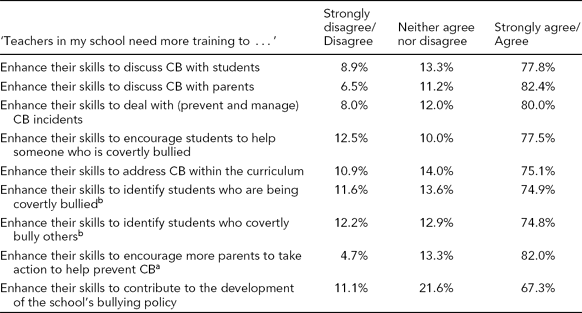
Respondents indicated their agreement with statements regarding professional development, using a 5-point Likert scale ranging from strongly disagree to strongly agree. Respondents were asked whether they felt teachers in their school needed more training to enhance their skills to: (1) discuss covert bullying with students; (2) discuss covert bullying incidents with parents whose children are involved; (3) deal with covert bullying incidents; (4) encourage students to help someone who is being covertly bullied; (5) address covert bullying within the curriculum; (6) identify students who are being covertly bullied; (7) identify students who covertly bully others; (8) encourage more parents to take action to help prevent covert bullying; and (9) contribute to the development of the school's bullying policy. During analysis, the responses were collapsed into three categories: disagree, neutral, and agree.
Self-perceived skills to address cyberbullying.
Staff reported the extent to which they felt skilled to deal with cyberbullying using a four-point ordinal scale ranging from very skilled to not at all skilled.
Procedures
A school-based study coordinator was selected in each school by the school principal. This coordinator nominated four teachers (of students in the year levels being surveyed as part of the ACBPS) and two senior administration staff members (such as the school's principal and deputy principal) to complete the staff survey. At least one teacher from each year level surveyed was asked to provide informed consent and complete the staff survey. Several follow-up letters and prompts were distributed by the school-based study coordinator to maximise staff response rates.
Data Analysis
The data were subject to rigorous quality assurance testing, with checks carried out on missing data and consistency of data. Descriptive statistics were generated using R v2.8.1. Using PASW v18.0, chi-square statistics were conducted to determine differences between individual and school-level variables according to school sector (government/non-government), region (metropolitan/non-metropolitan), type (primary/secondary) and staff gender and years of service.
Ethics Approval
The research protocol and consent procedures were approved by the Edith Cowan University Human Research Ethics Committee, and each of the state education sectors. Respondents were advised after receiving information about the purpose of the study that in completing the survey they consented to participate.
Results
Quantitative data were collected from 106 schools (55 primary and 51 secondary) in October/November 2007. Six hundred and twenty staff surveys were distributed and 453 were returned; an overall response rate of 74%. Completed surveys were returned by 12 staff from the Australian Capital Territory, 25 from the Northern Territory (NT), 126 from New South Wales, 97 from Queensland, 65 from South Australia, 41 from Tasmania, 65 from Victoria, and 62 from Western Australia (WA). The response rate was highest in NT (83%) and lowest in WA (65%). Most respondents were female (66.3%, n = 290) and 40 years or older (62%, n = 270). Just over half were secondary teachers (52%, n = 234) and 60% were from metropolitan schools (n = 274). The proportion of government (49%, n = 220) and non-government schools (51%, n = 233) was approximately equal.
Attitudes to Bullying
Staff Attitudes Towards Covert Bullying (CB)
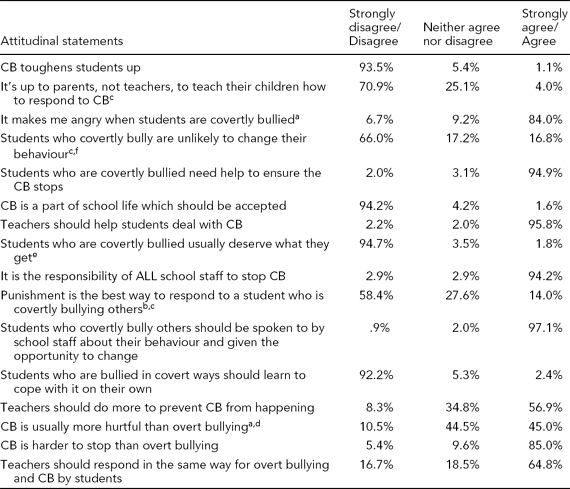
Note: a p < .01 for gender of staff, b p < .05 for gender of staff, c p < .01 for length of service, d p < .01 for area, e p < .05 for sector, f p < .05 for primary/secondary
There were also significant differences according to years of service. Fewer staff with under 10 years of service (59%) disagreed that It's up to parents, not teachers, to teach their children how to respond to covert bullying (χ2 = 24.420, p < .001), compared to staff with 1–19 years (76%) or over 20 years of service (79%). Similarly, fewer staff with under 10 years of service (35%) disagreed that Punishment is the best way to respond to a student who is covertly bullying others (χ2 = 36.230, p < .001) compared to staff with 10-19 (65%) or over 20 years of service (69%). Finally, more staff with over 20 years of service (75%) agreed that Students who covertly bully are unlikely to change their behaviour (χ2 = 14.941, p = .005) compared to staff with under 10 (60%) or 10–19 years of service (57%).
There were also significant differences by school sector, area and type. More government (4%) than non-government staff (1%) agreed that Students who are covertly bullied usually deserve what they get (χ2 = 6.238, p = .044). More non-metropolitan (15%) than metropolitan staff (8%) disagreed that Covert bullying is usually more hurtful than overt bullying (χ2 = 13.107, p = .001), and more primary (22%) than secondary staff (13%) neither agreed nor disagreed that Students who covertly bully are unlikely to change their behaviour (χ2 = 7.238, p = .027).
Understanding of Covert Bullying
Staff Perceptions of Overt and Covert (Including Cyber) Behaviours in Their School
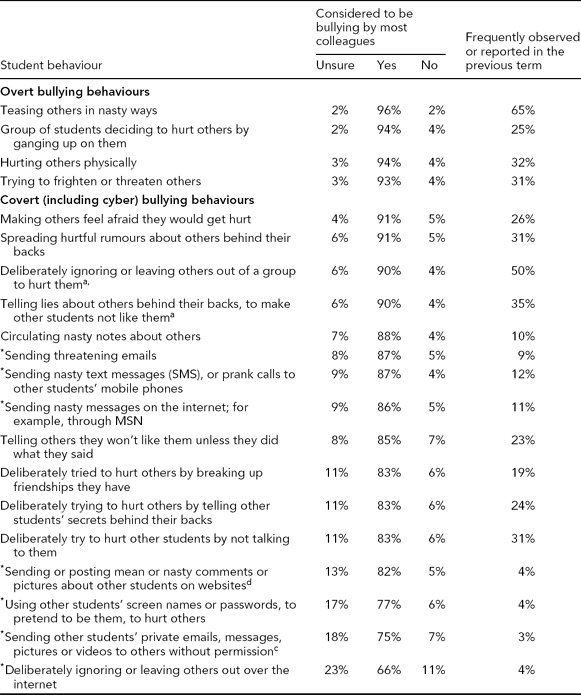
Note: *cyberbullying behaviours; a p < .05 for gender of staff, c p < .05 for length of service, d p < .01 for length of service (for ‘considered to be bullying’ variable)
There were significant differences by gender and years of service. More male (10%) than female staff (5%) were unsure if Students deliberately ignoring or leaving others out of a group was considered bullying by most staff in their school (χ2 = 8.321, p = .016). Similarly, more male (9%) than female staff (4%) were unsure if Students telling lies about others behind their back was considered to be bullying (χ2 = 6.562, p = .038). More staff with under 10 (22%) or 10–20 years service (23%) were unsure if Students sending other students’ private emails, messages, pictures or videos to others without permission was considered bullying (χ2 = 11.306, p = .023) compared to those with over 20 years service (12%). In addition, more staff with under 10 years service (9%) did not believe Students sending or posting mean or nasty comments or pictures about other students to websites was considered bullying (χ2 = 14.378, p = .006) compared to those with 10–20 (1%) or over 20 years service (4%).
Awareness of Covert Bullying
As shown in the final column of Table 2, a student being ignored or left out of a group (50%) was the covert behaviour most commonly observed by or reported to staff respondents, while the least frequent (excluding cyberbullying behaviours) was a friendship being deliberately damaged by others (19%). The most frequently observed/reported cyberbullying behaviour was a student receiving nasty text messages or prank phone calls (12%), and the least was a student's private emails or messages being sent to others without permission (3%).
Significant differences in awareness of these behaviours emerged in relation to staff gender. More female (30%) than male staff (18%) reported not becoming aware that students were frightened or threatened by another student (χ2 = 7.224, p = .027). In addition, more staff with under 10 years of service (54%) reported not becoming aware that students were told they wouldn't be liked unless they did what others said (χ2 = 13.668, p = .008) compared to teachers with 10–19 (41%) or more than 20 years service (44%). Finally, fewer staff with over 20 years service (56%) reported not becoming aware that students were sent threatening emails (χ2 = 10.986, p = .027) compared to teachers with under 10 (73%) or 10–19 years service (69%).
Nearly three quarters of respondents became aware of overt bullying every few weeks or more during the previous term (71.2%). Similarly, 69.7% of respondents reported becoming aware of covert (excluding cyber) bullying every few weeks or more, and 20.2% became aware of cyberbullying every few weeks or more often.
Adoption of School Policy and Strategies to Address Covert Bullying
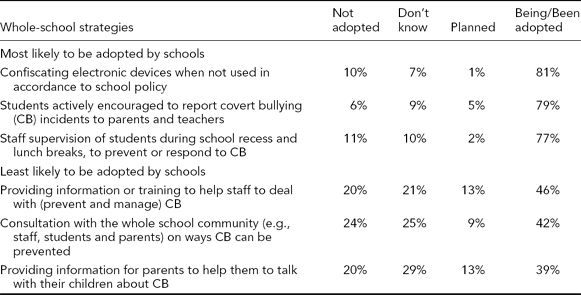
While fewer than 10% of staff reported no bullying policy at their school, nearly 25% were unsure if their school had a bullying policy. Just over two thirds (67%) of staff said their school did have this policy, but only 39% indicated their policy explicitly addressed covert bullying (Figure 1). As shown in Table 3, over three quarters of the respondents reported the strategies most likely to be adopted or being adopted were the confiscation of electronic equipment (81%), students encouraged to report bullying (79%), and staff supervision during breaks (77%). The strategies least likely to be adopted were staff training (46%), consultation with the whole community (42%) and providing information to parents (39%), also shown in Table 3. Responses of staff asked whether their school has a bullying policy that incorporates covert bullying (Cross et al., 2009) Whole-School Strategies Most Likely (Reported by More Than 75% of Staff) and Least Likely (Reported by Fewer Than 50% of Staff) to be Adopted by Schools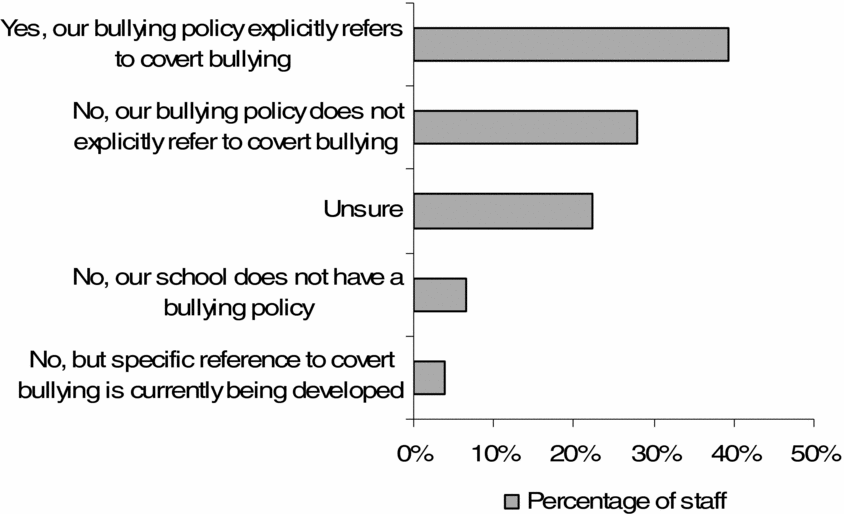
Perceived Effectiveness of School Strategies
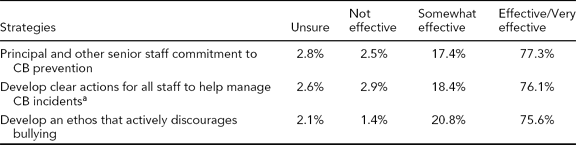
Whole-School Strategies Most Often Described as Effective or Very Effective in Addressing Covert Bullying (CB; Reported by More Than 75% of Staff)
Note: a p < .01 for length of service
Respondents were also asked to rate the overall effectiveness of their current whole-school bullying prevention strategies in reducing covert bullying. These were described as very effective by 10.4% of respondents and moderately effectively by 47%. However, 21.4% reported only slight effectiveness and 5.3% indicated that overall their school's strategies were ineffective; while 12.7% were unsure and 3.2% reported that no whole-school strategies to prevent bullying were in place.
Professional Development Needs of Staff
Staff Agreement With Statements Relating to the Need for Training to Address Covert Bullying (CB)
Note: a p < .05 for area, b p < .05 for primary/secondary
Skill to Address Cyberbullying
Many respondents indicated they lacked skills to deal with cyberbullying, with 19.2% reporting they felt not at all skilled, 31.6% reporting they felt poorly skilled, 41% moderately skilled, and 8.2% very skilled to deal with cyberbullying. There were significant gender differences. More female (23%) than male staff (12%) reported not being skilled to deal with cyberbullying (χ2 = 10.723, p = .013). In addition, more primary (23%) than secondary staff (16%) reported being not at all skilled at dealing with cyberbullying (χ2 = 12.591, p = .006).
Discussion
This study investigated whether Australian school staff have the necessary attitudes, understandings, strategies and skills to effectively address covert bullying among students. The findings suggest school staff need support to better understand and respond to covert bullying, through enhanced access to professional development and effective school policy and practices. The involvement of school counsellors and pastoral care staff in providing and advocating for this support would be invaluable.
School Policy and Practices
While most staff reported the presence of a bullying policy in their school, over a third indicated this policy did not explicitly address covert bullying. This finding is consistent with previous research indicating that school policies often do not address covert behaviours sufficiently (Bauman & Del Rio, 2006), and indicates that staff may not have clear guidelines to support their responses to covert bullying. This lack of regulatory acknowledgment inhibits the development of common understandings among staff, students and families about bullying, and lessens the likelihood of consistent school responses. Given that school policy is a key component of effective whole-school approaches to bullying prevention (Cross et al., 2004; Glover, Gough, Johnson, & Cartwright, 2000; Patton et al., 2000), the finding that a quarter of staff were unsure if their school had any bullying policy is of concern, especially as the Australian government requires all schools to have policies addressing all forms of bullying (DEEWR, 2011). It appears that increased emphasis on covert bullying in national guidelines has not been integrated comprehensively into school policies.
Overall, just over half of the respondents rated their current whole-school prevention strategies as moderately or very effective in reducing covert bullying. The strategies most likely to be adopted (confiscating electronic equipment, encouraging students to report bullying, and supervision during break times) were incongruent with those strategies perceived to be most effective (leadership commitment to bullying prevention, developing clear staff actions to manage bullying, and an ethos that discourages bullying). This inconsistency may reflect the considerable resources (including time and expense) required to implement the most effective strategies, hence their relative absence from practice. This is particularly evident in staff reports that the least adopted strategies were staff training and education, and community consultation. Schools should be encouraged and enabled to provide professional learning that enhances staff capacity to respond to all (and especially covert) bullying, as well as engage with the community, given the importance of these strategies in reducing bullying (Cross et al., 2004; Farrington & Ttofi, 2009a; Glover et al., 2000).
Staff Attitudes to Covert Bullying and the Need to Respond
Most staff reported a lack of acceptance for students engaging in bullying and felt a responsibility to intervene. Nevertheless, many staff, particularly male and non-metropolitan respondents, did not agree that covert bullying is usually more harmful than overt bullying (despite young people themselves reporting that covert bullying is often more harmful; e.g., Patchin & Hinduja, 2006; Kawabata et al., 2010; Espelage & Swearer, 2003). Reduced adult recognition of the distress resulting from covert bullying, particularly in comparison to overt bullying has also been found in previous research (Bauman & Del Rio, 2006; Byers et al., 2011; Hazler et al., 2001). Gender differences in attitudes to covert bullying may relate to the greater tendency of females than males to report experiencing covert bullying (Cross et al., 2009), though further study is needed to examine this relationship.
Further, many staff, particularly those with more years of service, believed students who covertly bullied others were unlikely to change their behaviour. Staff with under 10 years of service were less likely to disagree that punishment was the best way to deal with covert bullying, while male staff were more likely to agree that it was the best method. These attitudes, which imply that addressing covert bullying is an individual rather than school and community issue, may reduce the likelihood of schools utilising whole-school strategies to address covert bullying. Further, the effectiveness of punishment in addressing bullying is unclear, and the threat of punishment might actually promote covert forms of bullying (Cross et al., 2009).
These findings demonstrate the need to enhance awareness among Australian primary and secondary school staff of the seriousness of covert bullying and the need for effective staff responses and school practices. Special efforts could perhaps be made to engage older, male and non-metropolitan staff in these initiatives.
Staff Understanding and Awareness of Covert Bullying
Staff responses suggested uncertainty about the specific covert behaviours that constitute bullying, particularly in cyber contexts. For example, a third of staff disagreed or were uncertain if exclusionary behaviours on the internet were considered to be bullying by most staff in their school, and close to 20% disagreed or were uncertain if behaviours such as breaking up friendships, exposing secrets or ignoring others were considered to be bullying. This limited recognition and awareness of covert bullying is consistent with previous research (Holt & Keyes, 2004; Nishina, 2004; Nishina & Juvonen, 2005), and may lead to a failure by some staff to recognise covert bullying incidents and resulting harms. It also suggests that some respondents may have underestimated the actual prevalence of covert bullying, when reporting their awareness of bullying behaviours in their school. Nevertheless, the large proportion of respondents who reported becoming aware of covert bullying every few weeks or more often demonstrates that school staff are frequently faced with the need to determine whether and how to address covert bullying. Ensuring their ability to do so is crucial, given that a lack of effective intervention may encourage continued covert bullying.
Perceived Need for Professional Development
However, on average, nearly 70% of staff strongly agreed with statements suggesting that staff in their schools needed more training to deal with covert bullying. Further, 50% felt poorly or not at all skilled to address cyberbullying, and primary and female staff were particularly likely to feel unskilled to address cyberbullying. This lack of perceived skill is concerning, as self-efficacy to address bullying is strongly associated with the likelihood of effective intervention (Bradshaw, Sawyer, & O'Brennan, 2007). The ‘invisible’ nature of covert bullying is likely to negatively impact (and be influenced by) staff understanding, skill and confidence to intervene.
Strengths and Limitations
This study's major strength was the sample size and representativeness, with responses from over 400 school staff collected from over 100 schools throughout Australia. However, the self-reported nature of the data may contribute to social desirability bias, and/or an under- or over-estimation of some measures. While the questionnaire items were pilot tested and reviewed by an expert panel, item reliability was not assessed. Further, the cross-sectional study design means that causality among variables cannot be determined. Although there was an overall response rate of 74%, selection bias among respondents may result from the variation in response rates and involvement of the school-based study coordinator. Finally, the generalisability of these findings is limited to only those schools included in the study.
Implications for School Policy and Practices
Notwithstanding these limitations, this study demonstrates the need for clear policy and effective whole-school strategies in schools, to support staff in detecting, assessing the severity of and responding to covert bullying. In addition, respondents identified a strong need for professional development to enhance knowledge and skills.
School staff play an integral role in shaping school responses to bullying, and it is crucial that all staff — including new in-service and pre-service teachers — are provided with opportunities to access training to enhance their awareness of, capacity to deal with, and confidence in addressing covert bullying, including behaviours that occur in cyber contexts (Cross et al., 2009; Espelage & Swearer, 2003; Vernberg & Gamm, 2003). Most pre-service teachers express willingness to learn more about bullying in their pre-service education, and believe this to be as important as other issues addressed (Beran, 2005). Ongoing needs-based professional learning for experienced staff members and other allied staff such as school counsellors and bus drivers would also be beneficial (Espelage & Swearer, 2003; Hazler et al., 2001).
Professional development has also been shown to enhance school counsellors’ understanding of the seriousness of relational bullying and their likelihood of intervening (Jacobsen & Bauman, 2007). Further, school counsellors are well placed to advocate for enhanced awareness of covert bullying among staff and in school policy and practice, with positive outcomes for student behaviour and wellbeing. Enhancing staff capacity to support students, monitor social interactions, and intervene when problems occur, appears to positively impact students’ relationships, prosocial behaviour, and likelihood of being bullied or bullying others (Galloway & Roland, 2004). The enhancement of school capacity to support students’ social and emotional problem-solving without resorting to aggressive behaviour is likely to positively impact wellbeing and peer relationships.
Importantly, this study demonstrates suboptimal implementation of policies and effective practices to address covert bullying within broader bullying prevention programs. Improvement is necessary to ensure staff (and students) have access to strategies to assist their understanding and responses to all forms of bullying (Bauman & Del Rio, 2006; Vernberg & Gamm, 2003). Establishing whole-school definitions of covert bullying to ensure these behaviours are understood by all members of the school community is a critical first step (Cross et al., 2009). Schools may also need to reassess policies in accordance with changing ICT use in school curriculum and among students more generally (Shariff & Hoff, 2007).
International, national and state guidelines for policy and practice addressing covert (and cyberbullying) behaviours, as well as investment in professional learning, are necessary to support schools and staff in addressing covert bullying (Cross et al., 2011). Finally, continued research is needed to explore the reasons for school staff members' differing attitudes and responses to covert bullying, and to develop specific strategies to reduce covert bullying. Given the ‘invisible’ nature of these behaviours to adults, engaging young people to contribute to developing preventative strategies would be of great benefit.
Conclusion
These findings demonstrate the challenges Australian school staff face in addressing covert bullying. While many are motivated to address covert bullying, they may experience uncertainty in identifying covert behaviours, underestimate their impact on health and wellbeing, be supported by school policy or effective whole-school strategies, and identify lack of skill as a barrier to addressing covert and cyberbullying. Professional development to enhance staff understanding and skill to address covert bullying, as well as the identification and implementation of effective whole-school strategies to address these behaviours, is necessary to discourage covert as well as overt bullying behaviours in Australian schools.
Footnotes
Acknowledgments
The authors thank Therese Shaw, Laura Thomas, and Data Analysis Australia for their valuable contribution to the ACBPS. The participation of schools and their generous staff is gratefully acknowledged. This project was funded by the Western Australian Health Promotion Foundation and the Department of Education, Employment and Workplace Relations, who had no involvement in the study or its interpretation.
About the Authors