







Abstract
Acceptance and Commitment Therapy (ACT) offers school counsellors a practical and meaningful approach to helping students deal with a range of issues. This is achieved through encouraging psychological flexibility through the application of six key principles. This article describes our introduction to ACT, ACT's application to children and adolescents, and the creation and use of our ACT-based book for young people I Just Want To Be . . . Me!.
Belinda, a Year 12 student had come to see me. She told me that she was struggling with her personal marijuana usage — she was smoking it before school most days and after school every day. She had been seeing the visiting Ted Noff's Drug and Alcohol counsellor regularly, and was able to reel off to me all the reasons why she should stop smoking it — but she hadn't. She sat back, apparently waiting for me to give her some more reasons why she should stop.
Instead, I suggested to her that one of the things that affected our behaviour was the kind of things our mind says to us — the thoughts we have about ourselves. I shared with her that my mind sometimes beats me up, and says some pretty harsh things about me, and I wondered if she had the same experience. Oh yes, she said, she had horrible thoughts about herself.
I asked would it be okay for her to tell me some of the mean things her mind sometimes said? She started listing a few — dumb, boring . . . Then she said ‘Fat’. I noticed her face changed as she admitted to this one.
And what does her mind say about that? What does that mean? Her eyes filled with tears. ‘It means I'm ugly,’ she said. ‘And what does your mind say that means?’ I asked. ‘That no one will ever love me,’ she said. And she burst into tears.
When she had recovered, we went on to explore her thoughts some more, and found that she frequently compared herself to her friends, and judged that she came up short, especially as far as looks went. In fact, the only time she didn't think about it, the only time she felt all right about herself, was . . . when she was smoking pot.
So — how do you help a girl in this position to focus on the healthy aspects of quitting? Surely, no matter what plan you came up with to motivate her to change, this thought was going to sabotage her efforts again and again.
And here's the thing. Belinda was a pretty girl, and everyone told her so all the time. But these arguments didn't make that thought go away — in fact, it just stopped her talking to people about it, because she felt stupid or not listened to — and it in turn continually led back to that same pattern of behaviour. How can we help her?
Acceptance and Commitment Therapy
Sandra and I had both been counselling for a number of years when we first encountered Acceptance and Commitment Therapy (or ACT — as in ‘action’ — as it is known for short).
If you had asked us before then what sort of counsellors we were, we would probably have answered ‘eclectic’. This meant we didn't really know! We both had a collection of CBT, solution-focused and positive psychology techniques we used, but there was no central system tying them all together, no unifying principles supplying meaning to what we were doing, except trying to make the students we talked to ‘feel better’.
So when we first read an article by a doctor named Russ Harris (2006), in which he talked about an approach called Acceptance and Commitment Therapy, an approach that didn't actually try to get rid of symptoms, yet led to symptom reduction anyway; that focused on encouraging clients to live a valued, meaningful life even in the face of their pain; that said you were never going to be able to get rid of all your negative thoughts, and that indeed trying to do so was actually probably making your life worse not better, but that it was possible to come to have a different relationship with them . . . Well, we were intrigued, to say the least.
It was comforting, once we had attended some training courses, read some books and attended our first Australia/New Zealand ACT conference, to find what a solid research basis ACT rests on. Although the majority of it is based on studies with adults and a relatively complex underlying theoretical base (Greco & Hayes, 2008), enough research is emerging on its use with children and young people, in such diverse areas as anxiety, pain management and eating disorders, to warrant its use in the school setting. It also readily lends itself to a brief therapy approach, which is another plus for busy school counsellors who may not know how many times they will be able to see an individual student.
It was also comforting to find that here was a therapy style or life approach (it is also used in coaching situations under the name Acceptance and Commitment Training) we could embrace ourselves, in our own lives. We had both previously had the experience of talking to students about techniques such as thought stopping, all the while knowing that we ourselves were sometimes troubled by thoughts we could not get rid of. ACT now provided the opportunity to successfully apply what we were talking about to ourselves as well, bringing about a new level of genuineness with young people.
But wait, we're psychologists! Surely we are happy, well-balanced people! One of the key ideas in ACT is that the normal working of the mind will cause us psychological pain. That is worth considering for a moment: our mind's ability to picture multiple futures, to bring up details from the past, to evaluate what is going on right now; all of these cognitive skills have a great capacity for causing pain. Do we not all tend to dwell on our pain, imagine future failure, and judge ourselves now as not good enough? This is a different take to the more usual medical model, which would divide us into ‘well’ and ‘unwell’. Consider which you would rather hear from a counsellor you went to see as a young person: ‘You are mentally unwell’ or ‘Oh yes, that's what minds do sometimes, mine included. But it doesn't have to have that level of impact or intensity.’
One of the most striking things I have ever seen was at the ACT introductory course we did with Russ Harris, where he started by admitting to us how nervous he was, and that he was often bothered by the thought that he is ‘not good enough’ to be presenting to us. He asked the audience, if we were willing, to raise our hands if we had ever been bothered by the same thought in our professional life — that we weren't good enough, that we were somehow fakes and imposters, and someday somebody was going to realise it. With trepidation, we raised our hands — and so did everyone else in the hundred-strong crowd of psychologists in the room. Wow, I thought, if that is the case, if that is a thought that everyone has sometimes . . . then that changes something about that thought, doesn't it? It may not stop that thought from popping up (it still does), but it certainly changes the impact and the intensity of it.
At the heart of ACT lie six interconnecting principles. While these can be used as discrete areas to work through with a client, with associated metaphors and experiential exercises, the more we practise using ACT the more they blend together, so that in a single session many or all might be utilised. The processes, which appear in ACT literature on a hexagram renamed as the ‘hexaflex’ (which also reminds us we can be flexible in delivery) are: defusion, acceptance, present moment, self-as-context, committed action and values (Figure 1). In essence, these processes are all about encouraging us to accept the internal experiences that are outside of our control, while committing to taking action in line with our values. The ACT hexaflex.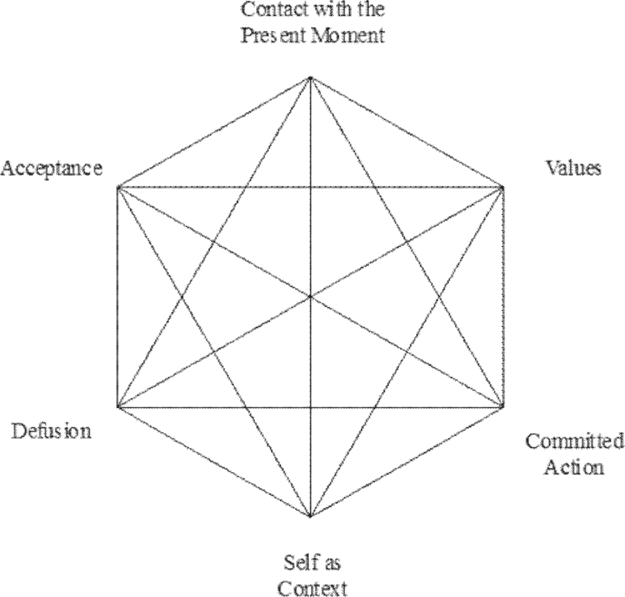
So how do we take these principles and make them practical?
First, these core principles can be used in a case conceptualisation context to help guide our approach with young people. First, looking at defusion, we may ask: What sort of unhelpful thinking is keeping this young person stuck? This could be rigid rules, self-limiting beliefs, harsh judgements (‘I'm ugly’) or reason giving (just to name a few). In terms of acceptance we may ask: What experiences (feelings, sensations) is the young person avoiding, and how? What are the costs of this avoidance? For present moment we can ask: How much time do they spend dwelling on/re-living the past, worrying about the future, getting lost in their thoughts? For self-as-context we can ask about how they see themselves — as just their current struggle, or more than that? Are they stuck in only seeing the situation from one problematic perspective? For committed action we can ask whether their current actions are helping them get where they want to be or to be the person they want to be. And finally, for values, we can ask: How connected or disconnected are they from what really matters to them?
All manner of presenting problems can be covered by this approach. A depressed young person may be fused with ideas such as ‘I'm not good enough’. Another student suffering anxiety may be avoiding school and social situations to try to escape from unpleasant sensations. In both cases, their actions may be out of alignment with what's important to them (for example, the anxious student may value relationships highly, but be withdrawing from them).
Any areas of difficulty will serve to highlight where we can take some action. Here is another great feature of ACT and the hexaflex model — we have flexibility with how we start and where we go, session by session. For example, there have been times, as I am sure you have experienced yourself, when a young person has quite frankly not been in the mood to talk about ‘the problem’. I remember how dull and lifeless some of those conversations would be in the past when I would forge ahead anyway. Now, I may choose to talk about values instead. It's great to see a young person's face come to life as they talk about the people/activities/places/things they are connected to, and what they mean to them. And even if there is pain in this discussion (and pain is never far away when talking values — that which we care most about makes us vulnerable), it is pain in the service of something, with the aim of finding meaning in this life.
The techniques we use in ACT to activate the six key principles can seem so simple, yet they can be so profound. At heart, they are centred on mindfulness, which in ACT is defined as paying attention with flexibility, openness and curiosity (Harris, 2009). Learning to see your thoughts for what they are — just thoughts — and defuse from them (that is, to create some space between them and yourself), can be incredibly powerful. The best thing about all the techniques is their grounding in experience — this is not just a therapy for talking about things. I often reflect back to my early days of counselling, when I would feel alarmed and helpless if a student I was talking to became distressed — now I fall back onto one of Russ Harris's metaphors: if you are going to learn to play the guitar, you need a guitar in the room with you. You can't just talk about playing one. So now I am comfortable to ask the person sitting with me what the pain is about, what is showing up for them, where it sits in their body — and in doing so help model that we don't have to flee from this pain, or sink into despair because of it. It is an experience — an unpleasant one, yes, one that we would rather not have . . . but if we have to have it, and we all do, then the only real choice is the way we have it.
We have found ACT to provide endless possibilities for visual and physical metaphor. We believe these are really important with young people as they help make the information more available to them in time of need. They also help get the session moving, and reduce that awkward pressure of too much eye contact (by having something to look at instead of the counsellor!). And sometimes they are just fun! As O'Brien, Larson and Murrell (2008) write:
The use of metaphors (such as the ‘monsters on the boat’, see later) and experiential exercises (such as mindfulness activities) render ACT an appropriate treatment for young people, as concepts that would normally be too abstract to understand become accessible through experience, and children's ability to think in less literal terms supports the use of metaphoric language. (p. 19).
When we first read Harris's book (2007), it seemed that this metaphor would be a great way to introduce some complex ideas to young people. A multi-use book appealed to us: one that could be used by therapists, or one that parents could use to talk to their children, or that young people could just read by themselves. The last we felt was very important. We know that for every student who will talk to us, there are many more who will not — but they may pick up a book and read it, especially one in comic book format, which is visually appealing and less daunting to read.
The book tells the story of Holly, a fairly typical teenage girl who is plagued by thoughts of not being good enough. She worries that her friends don't really like her, that she will fail and make a fool of herself in school, and that there is basically something wrong with her. She hasn't talked to anyone about how she feels, because whenever she has tried, no one has really listened — instead they give her advice, or discount her feelings, or even tell her not to say things like that. All this leaves her feeling even worse than before.
One day, unable to face school, she runs away to the seaside, and there something strange happens — a wind comes up, and she suddenly finds herself stuck on a boat in the middle of the ocean. But she isn't alone — every time she tries to sail the boat, a bunch of horrible monsters show up, that represent all her negative thoughts, unpleasant memories, predictions of future failure and all the horrible sensations that go along with these. She tries fighting, she tries giving up, but both leave her stuck going nowhere.
Help arrives in the form of a wise talking seagull, who introduces her to the basic principles of ACT. Holly learns that in order to do something important (in this case, get back to the people she cares about), she needs to accept having some monsters on deck with her. But she also learns that everyone else is sailing their own boat with their own monsters too, and there are more than just monsters for company; specifically Holly (and all of us too) can connect mindfully to her present: sunlight, wind, water, sounds of the boat moving and more. She learns to defuse from her unhelpful thoughts and see them for what they are — just thoughts, not necessarily facts. Holly learns to make room for the unpleasant sensations that are going to appear when she tries something difficult. And in so doing, by giving up fighting and just getting on with being herself, by allowing the monsters to be there with her, she finds that they get smaller and some even disappear. And in the meantime, she is able to do something meaningful.
To increase the teaching potential of the book, on our website
We love the truthfulness of ACT, the common humanity of it. The very pain that we all so often feel makes us different to everyone else, is actually the thing that links us. How reassuring for young people to hear that, yes, we feel pain something like they are describing, too, or our own version of it. But there is hope — we don't have to be damned to endless suffering. There is the possibility that this can all be about something, we can build lives worth living — and if in doing so, we feel better, well, that's cool too!
And what of Belinda? We worked on her being able to see her thoughts about herself as judgements, not facts, and to notice when she was doing it (‘Judging!’). We looked at her values: she strongly valued sharing experiences with her peers (she had a difficult family life), and while marijuana smoking was one way of acting on that, we explored other ways she could honour the same value. We also looked at other things she cared about, such as her health, and how minimising her smoking would bring that value to the fore.
Sadly, the year finished and Belinda moved on before I was able to see how this would pan out for her . . . but at least I could rest assured that she had glimpsed a way to live better rather than just feel better.
Footnotes
About the Authors
Timothy and Sandra have presented on using ACT with young people to school counsellors across New South Wales, as well as to teaching staff and health workers. They have presented at the 2010 Australia & New Zealand ACBS conference in Adelaide, and most recently at the 2012 ACBS World Conference in Washington DC. Their first book, I Just Want To Be. . .Me! (Exisle Publishing) was published in 2010. Their second book in the series is due out mid-2013.