







Abstract
The Wechsler Intelligence Scale for Children — Fourth Edition (WISC-IV) and the Stanford-Binet — Fifth Edition (SB5) are two of the most commonly used intelligence tests for children and adolescents. No comparative studies of the WISC-IV and SB5 have yet been published. In the current study the WISC-IV and SB5 were administered in counterbalanced order to 30 typically developing 12- to 14-year-old adolescents. There was a significant difference between Full Scale IQs on the two measures, with scores being higher on the WISC-IV. A significant difference was also found between Verbal IQs and there were large score differences for some participants. The article concludes that the WISC-IV and SB5 cannot be presumed to be interchangeable measures of intelligence.
The assessment of intellectual ability is an important part of a psychologist's role, particularly for those who work with children and adolescents. On the basis of intelligence test results, important decisions may be made about academic assistance, educational placement and access to various supports and services.
Several well-established and psychometrically sound measures of intellectual ability are available to psychologists, including the Wechsler Intelligence Scales, the Stanford Binet Intelligence Scales and the Woodcock-Johnson Tests of Cognitive Abilities. In practice, psychologists may prefer and use one specific test over others; however, it is essential that they have access to more than one measure, along with the necessary expertise in administration and interpretation. Retesting with an alternative measure may be required within a short time frame in order to examine a child's progress or to confirm the validity of results from a previous assessment. Although it often seems to be presumed that all intelligence tests produce the same results and can thus be used interchangeably, it would probably be surprising if that were the case, given the notable differences in structure and content across different tests. There is, however, a scarcity of published literature that contrasts the features of different intelligence tests and considers their concurrent validity — that is, the expected relationship between scores on one test to scores on another test that measures the same construct of general intelligence.
The Wechsler Intelligence Scale for Children — Fourth Edition (WISC-IV; Wechsler, 2003) is widely used for assessing the intellectual ability of children and adolescents and, according to various surveys of psychological test usage, the Wechsler continues to be the most frequently used measure of intellectual ability among school psychologists, neuropsychologists, and clinical psychologists (Wasserman & Tulksy, 2005). The Stanford-Binet — Fifth Edition (SB5; Roid, 2003a) is also used frequently (Sattler, 2008). Both instruments were most recently updated in 2003 (Roid, 2003a; Wechsler, 2003) and Australian norms for the WISC-IV were published in 2005.
Most robust measures of intellectual ability obtain concurrent validity scores of .7 to .8, a range that is considered acceptable and desirable for two instruments that measure the same construct (Urbina, 2004). No comparisons or concurrent validity studies of the WISC-IV and SB5 have yet been published. Previous studies comparing earlier editions of the two tests produced mixed results but, in general, moderate to high correlations were reported, with the majority ranging from .68 to .88 (Carvajal et al., 1993; Greene, Sapp, & Chissom, 1990; Hollinger & Baldwin, 1990; Lavin, 1996; Lukens, 1990; Lukens & Hurrell, 1996; Prewett & Matavich, 1994; Roid, 2003b; Rust & Lindstrom, 1996; Saklofske, Schwean, Yackulic, & Quinn, 1994; Simpson et al., 2002). At times, however, there have been relatively large differences between composite scores on the two tests, with the higher scoring instrument varying across studies (Brown & Morgan, 1991; Lukens & Hurrell, 1996; Minton & Pratt, 2006; Prewett & Matavich, 1994).
While there are no published reports using the most recent editions of both the WISC and SB, one study compared the SB5 with the WISC-III. Minton and Pratt (2006) tested 56 gifted children with the SB5 after they had been identified as gifted on the WISC-III. Composite scores on the SB5 were significantly lower than the Full Scale IQ (FSIQ) scores on the WISC-III, even after allowing for a 5-point difference due to the Flynn effect (Flynn, 1984). There was an average difference of 12 points for the gifted group and 18 points for the highly gifted group, and the correlation of FSIQs was only .46. Minton and Pratt suggested that statistical or sampling issues may have been responsible for the differences; alternatively, they argued, the SB5 and WISC-III could have been capturing different aspects of giftedness, a hypothesis which is consistent with SB5 studies that have reported lower than expected scores for gifted populations (Newton, McIntosh, Dixon, Williams, & Youman, 2008).
The aim of the current study was to provide comparative data for the WISC-IV and SB5 by administering the two tests to a sample of typically developing young adolescents. Specifically, we sought to determine concurrent relationships between scores on the two instruments and to consider any notable discrepancies in scores for individual participants.
Method
Participants
The participants were 30 adolescents (17 girls, 13 boys) aged 12 to 14 years (M = 12.90, SD = 0.35). The students attended a private, independent school in Brisbane where they were enrolled in the first year of high school. Information about the study, consent forms and a brief screening questionnaire were sent home to parents of all Year 8 students. The screening instrument requested details of the child's gender, age, first language and any significant difficulties with learning, attention, vision or hearing. No difficulties were reported, and of the 32 students who agreed to participate, all were taken into the study with the exception of two who had recently been tested with the WISC-IV.
Measures
Wechsler Intelligence Scale for Children — Fourth Edition Australian Standardised Edition (WISC-IV Australian; Wechsler, 2005)
The WISC-IV is an individually administered test of intelligence for children aged 6 to 16 years. It contains 10 core subtests that form four indexes: Verbal Comprehension (VCI), Perceptual Reasoning (PRI), Working Memory (WMI) and Processing Speed (PSI), and an overall composite Full Scale IQ (FSIQ). Supplementary subtests are also available. In the current study, the 10 core subtests were administered in the prescribed order, following the standard procedures shown in the Administration Manual.
Stanford-Binet — Fifth Edition (SB5) (Roid, 2003a)
The SB5 is an individually administered intelligence test for individuals aged 2 to 85 years and older. It consists of 10 subtests that provide verbal and nonverbal scores on five cognitive factors: Fluid Reasoning (FR), Knowledge (KN), Quantitative Reasoning (QR), Visual-Spatial Processing (VS), and Working Memory (WM). There are three composite scores: Verbal IQ (VIQ), Nonverbal IQ (NVIQ) and Full Scale IQ (FSIQ). All 10 subtests were administered following the standard procedures and instructions outlined in the Administration Manual.
Student Questionnaire
A short questionnaire was developed for use before and after each test administration. The questions prior to testing asked the students to rate how tired, excited and nervous they were feeling on a 6-point Likert scale, which ranged from 0 (Not at all) to 5 (Extremely). After the administration, students rated how tired they felt, how much fun the test was, and how difficult the activities were, using the same 6-point scale. The pressure they felt in timed tasks was measured by a 6-point Likert scale, which ranged from 0 (None at all) to 5 (Extreme pressure). The participants were also asked which set of activities they preferred and which activities in particular they liked or disliked, and the reasons for their preferences. Lastly, students were given the opportunity to provide some general comments about the tests.
Procedure
Participants were assessed individually by the examiner (the first author) in a quiet room at their school. Each student completed both the WISC-IV and the SB5 in a repeated measures design, with an interval between the two tests that ranged from 1 day to 3 weeks (M = 6.6 days). Although attempts were made to achieve a consistent interval of 1 week between the two administrations, this was not always possible because of absences caused by illness, school excursions, or holidays. The order of the tests was counterbalanced, and the time of day at which participants were tested was the same across the two testing sessions.
In each session, students first completed the pre-test questions. The intellectual assessment was then administered. At the end of the session, participants completed the post-test questionnaire.
Results
Preliminary Analyses
Preliminary analyses were conducted to examine skew and kurtosis. All test scores were found to have normal distributions and no adjustments were needed. Independent samples t tests showed that order of administration had no effect on any variables including FSIQ. There were no gender differences on any of the scores or ratings.
Comparison of WISC-IV and SB5 Composite, Factor and Subtest Scores
WISC-IV and SB5 Composite and Factor Scores
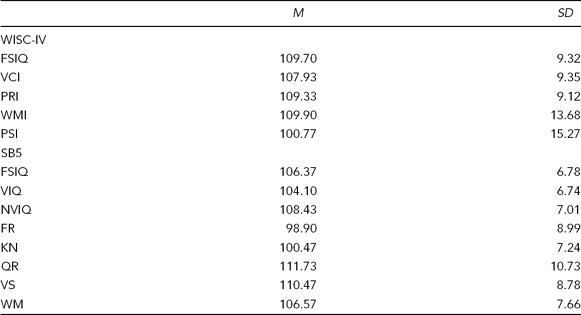
Note: FSIQ = Full Scale IQ, VCI = Verbal Comprehension Index, PRI = Perceptual Reasoning Index, WMI = Working Memory Index, PSI = Processing Speed Index, NVIQ = Nonverbal IQ, VIQ = Verbal IQ, FR = Fluid Reasoning, KN = Knowledge, Quantitative Reasoning, VS = Visual-spatial Processing, WM = Working Memory.
WISC-IV and SB5 Composite and Factor Score Correlations
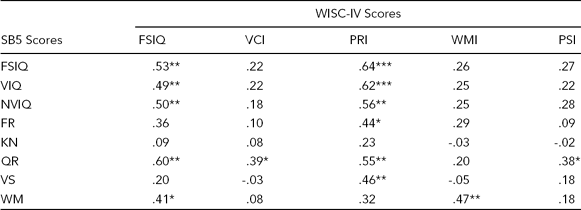
Note: FSIQ = Full Scale IQ, VCI = Verbal Comprehension Index, PRI = Perceptual Reasoning Index, WMI = Working Memory Index, PSI = Processing Speed Index, NVIQ = Nonverbal IQ, VIQ = Verbal IQ, FR = Fluid Reasoning, KN = Knowledge, Quantitative Reasoning, VS = Visual-spatial Processing, WM = Working Memory.
*p < .05, **p < .01, ***p < .001
Instrument Preference
Initial analyses found that 63.3% of students preferred the WISC-IV, compared to 33.3% who preferred the SB5, and 3.3% who liked the instruments equally. A chi-squared test for independence showed that order of administration had no effect on instrument preference. Independent t tests were conducted to examine the possible impact of instrument preference on WISC-IV and SB5 scores, and no significant differences were found.
Fifty-nine per cent of participants performed better on the instrument they preferred, compared to 31% who did worse on their preferred instrument and 7% who performed very similarly. A chi-squared test of independence found no significant relationship between preferred instrument and higher scoring instrument.
Length of Test Administrations
Using a paired samples t test, there was a significant difference between length of assessments, t(29) = 5.68, p < .001, 95% CI(0.10, 0.22), η2 = .53, with the SB5 (M = 1.60) taking longer than the WISC-IV (M = 1.44).
Post-Assessment Ratings
Paired sample t tests were conducted to examine differences between students’ ratings for the two instruments. A significant difference was found for ratings of difficulty by participants following the assessments, t(29) = -2.26, p = .031, 95% CI(-0.88, -0.05), η2 = .15. They rated the SB5 (M = 2.82) as more difficult than the WISC-IV (M = 2.35). A significant difference was found also for ratings of perceived time pressure during the assessments, t(29) = 3.01, p = .005, 95% CI(0.26, 1.37), η2 = .24. Students reported more time pressure during the WISC-IV (M = 1.72) than the SB5 (M = 0.90). There was no significant difference in their ratings of how much fun each assessment had been.
Within-Group Differences
Numbers of Participants Scoring in each Range for the Two Instruments
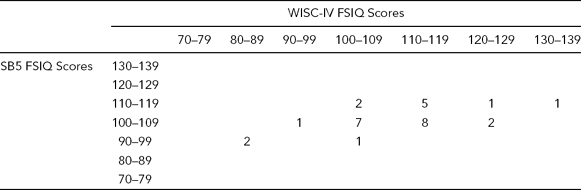
Note: FSIQ = Full Scale IQ
Score Differences Between WISC-IV and SB5 Composite Scores
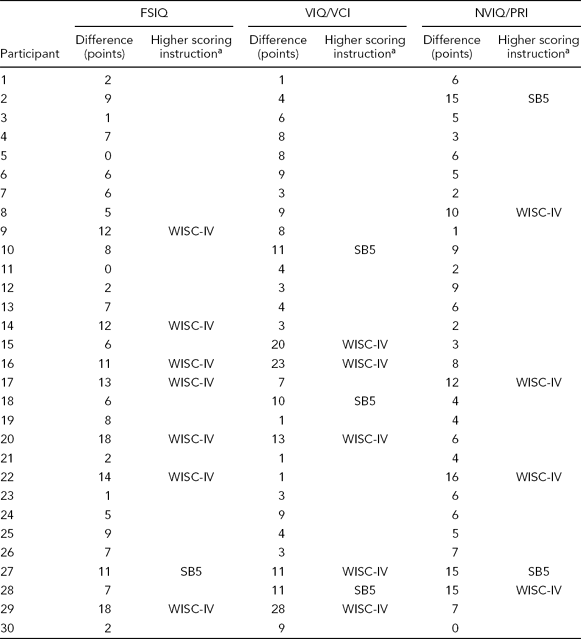
Note: FSIQ = Full Scale IQ, VCI = Verbal Comprehension Index, VIQ = Verbal IQ, PRI = Perceptual Reasoning Index, NVIQ = Nonverbal IQ.
aHigher scoring instrument is shown when there are differences of 10 or more points between scores on the two instruments.
Qualitative Information
Reasons for Preferred Instrument and Favourite and Least Favourite Subtests
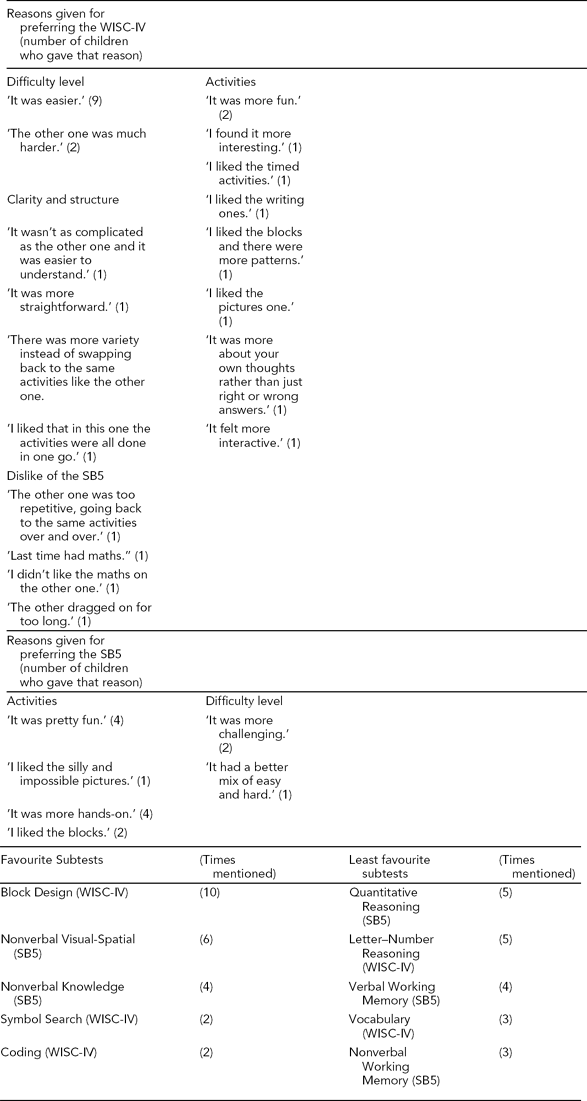
The favourite subtests were Block Design (WISC-IV) and Nonverbal Visual-Spatial (SB5), which were described as being ‘fun’ and ‘hands-on’. The least favourite activities included Quantitative Reasoning (SB5), which was often described as being difficult and ‘tricky’, and Letter-Number Sequencing (WISC-IV), which was reported to be confusing and hard.
Discussion
This study provides valuable comparative data for two of the most commonly used measures of intellectual ability in children. Although IQ is certainly not the only information obtainable from these instruments, an estimate of FSIQ is usually an important reason (and indeed sometimes the only reason) for administering an assessment of intelligence. The FSIQ score is frequently used to categorise children in some way (e.g., for intellectual impairment or intellectual giftedness) or to rule out low intelligence as the primary reason for a child's difficulties with learning. For these purposes, the WISC-IV and SB5 provide an overall composite score: the FSIQ. In the present study, however, there was a significant difference between FSIQs obtained from the two instruments. At the group level, WISC-IV FSIQs were higher by more than 3 points and the majority of participants obtained a higher score on the WISC-IV. This occurred despite the fact that the two tests were administered by the same examiner, in the same setting, with only a short time interval between assessments.
Despite the significant difference in scores, the FSIQs on the two instruments are significantly correlated. However, the correlation of .58 is lower than the reported correlations of .65 to .88 for earlier versions of the two instruments (Carvajal et al., 1993; Greene et al., 1990; Hollinger & Baldwin, 1990; Lukens, 1990; Lukens & Hurrell, 1996; Prewett & Matavich, 1994; Rust & Lindstrom, 1996; Saklofske et al., 1994; Simpson et al., 2002). Given that both tests provide estimates of g, moderately high to high correlations in the magnitude of .7 to .8 would be expected (Urbina, 2004). However, Minton and Pratt (2006) reported only a moderate correlation of .46 between the WISC-III and SB5 FSIQs in a sample of gifted children, with scores being higher on the WISC-III. The present findings, in combination with those of Minton and Pratt using the WISC-III, suggest that there may be specific features in the most recent revision of the SB that account for the less robust relationship.
The difference in FSIQs can be attributed largely to the difference between the two verbal composites. While the WISC-IV PRI and SB5 NVIQ did not differ markedly, the VCI and VIQ were significantly different, with an almost 4-point discrepancy and a nonsignificant correlation of only .22. There have been some notable changes in the structure of the SB5 compared with the previous 4th edition. Two composites (Verbal and Nonverbal) have replaced the previous four, one of which was Verbal Reasoning. Of the four SB:IV Verbal Reasoning subtests (Vocabulary, Comprehension, Absurdities and Verbal Relations), only Vocabulary and Absurdities have been retained and three new verbal measures have been added (visual-spatial processing, quantitative reasoning and working memory) to provide a direct comparison with the nonverbal scales of the same name.
In the SB:IV, Vocabulary, Comprehension and Verbal Relations were similar to the WISC-III/WISC-IV Vocabulary, Comprehension and Similarities subtests. These similarities may account for the higher correlations between the SB:IV and WISC-III (Carvajal et al., 1993; Lavin, 1996; Lukens & Hurrell, 1996; Prewett & Matavich, 1994; Roid, 2003b; Rust & Lindstrom, 1996; Saklofske et al., 1994; Simpson et al., 2002). By contrast, the SB5 Verbal subtests examine verbal abilities that are not directly assessed by the WISC-IV VCI (i.e., working memory, visual-spatial processing and quantitative reasoning). Perhaps the WISC-IV VCI and the SB5 VIQ now measure aspects of verbal intelligence which are too different to be strongly related.
Intriguingly, however, the only verbal tasks that should be directly comparable across the two instruments (WISC-IV Vocabulary and SB5 Verbal Knowledge) did not correlate significantly. A closer examination of individual scores on these two subtests shows that over half of the participants obtained scores within 1 point of each other on the two vocabulary subtests, and 24 of the 30 students scored within 3 points (i.e., one standard deviation). Where the difference was more than 1 point, the WISC-IV score was always the higher one. For the remaining six participants, the score difference was 4 to 7 points, with the WISC-IV producing the higher result. In particular, these students tended to miss points on the SB5 vocabulary subscale because they provided responses that were accurate, but not sufficiently complex to be scored as 2 points. Compared with the WISC-IV, the SB5 does not prescribe examiner querying as frequently, and the lower SB5 scores are probably at least partly due to this difference in administration procedure.
Another factor that may contribute to the discrepancy in scores across the two instruments is the higher ceiling on the SB5. It may be that the SB5 gives a more realistic portrayal of scores in young adolescents due to the greater range of more difficult items. The WISC-IV's lower ceiling may result in an overestimate of ability for those who are in the above average range of intelligence. It is possible also that the SB5's placement of verbal subtests following the more hands-on nonverbal tasks may lower scores on the VIQ due to increased fatigue, boredom or a lower level of interest in the second half of an assessment.
There were some particularly large differences between scores on the two tests for some individuals, and in a few cases there was a difference as great as two descriptive ranges. For the majority where there was a large difference, the WISC-IV was the higher scoring instrument. Interestingly, there was a larger spread of scores on the WISC-IV, with a range of 87 to 131, compared with 90 to 118 on the SB5. It seems that it may be more difficult to get a high score on the SB5, possibly because of the specific ceiling rules that are used. Minton and Pratt (2006) found that the SB5 produced lower than expected scores for a gifted sample and also did not distinguish between different levels of gifted children. The fact that the current sample did not contain any students who scored in the very low or very high ranges limits our ability to explore the different spread of scores on the two instruments. Nevertheless, this is an important aspect that should be investigated further in future research.
The majority of adolescents in the current study said they preferred the WISC-IV to the SB5, although they did not necessarily perform better on their preferred test. The most common reasons for preferring the WISC-IV were that it was easier and more enjoyable. By contrast, the SB5 was rated as being significantly more difficult than the WISC-IV. The perceived difficulty is probably related to the different structure and ceiling rules on the two instruments. For the WISC-IV, discontinuation on each subtest usually follows failure on four or five consecutive items in a graded series. The SB5, however, involves the administration of complete six-item sets for most subtests. If three or more items in the set are passed, the higher level set is administered in its entirety. Because there is often an abrupt increase in difficulty level from one set to the next, children who manage to pass a sufficient number of items at one level of difficulty are then faced with a set of six very much more difficult items at the higher level. This may affect children's perceptions about the test's difficulty, and perhaps also their enjoyment of the testing experience. The structure may also impact on the time taken to complete the test, as the SB5 session was significantly longer than the WISC-IV (1.60 hours compared with 1.44 hours).
The greater time pressure participants perceived on the WISC-IV was undoubtedly related to the fact that there are more timed tasks on this instrument than on the SB5. However, perceived time pressure did not seem to affect students’ test scores or enjoyment of the test. Simpson et al. (2002) hypothesised that the lack of time pressure on the SB5 should have a positive effect on test scores, and although this was not evident in the current study, it is possible that certain subgroups of children, such as those with learning or intellectual disabilities, would benefit positively from a lack of time pressure.
The results of the current study have implications for psychologists who assess the intellectual functioning of children and adolescents. They highlight the importance of gathering data from multiple assessments and at multiple time points. Clearly, considerable caution should be exercised when making important decisions about eligibility for services or entry into programs on the basis of a single IQ score from a single assessment. Triangulation of data from multiple sources and the inclusion of other measures of ability, such as work samples, achievement scores and functional and adaptive abilities and behaviours are highly desirable.
Two specific practice issues are raised by the findings of this study. One issue is related to test choice. What factors should a psychologist take into account when selecting the most appropriate instrument for assessing the intellectual ability of a specific child? In practice, it seems that choice is often restricted by the availability of a particular instrument and the practitioner's familiarity and confidence with its use. The WISC-IV tends to be a popular choice in the Australian context because Australian norms are available. Some children may be disadvantaged by the WISC-IV's inclusion of time limits for some subtests, whereas others who work quickly or perform better under time pressure may benefit. The fact that the SB5 takes longer than the WISC-IV to administer may have implications for test choice. Although an average of 10 minutes extra probably has little practical relevance, there is the increasing possibility of fatigue or inattention when testing is prolonged and, as mentioned earlier, this may contribute to the lower scores that were achieved on SB5 verbal subtests compared with the WISC-IV.
The SB5 may have particular value for children in the overlapping WPPSI/WISC or WISC/WAIS age ranges. For those aged 6 years 0 months to 7 years 3 months or 16 years 0 months to 16 years 11 months, choices between the WPPSI-III and WISC-IV or between the WISC-IV and the WAIS-IV can be challenging as the floors or ceilings may be too low or too high for the individual being tested. In these crossover ranges, the SB5 can provide a valuable alternative to the Wechsler scales. Another appealing feature of the SB5 is its structure, which comprises verbal and nonverbal subtests for each of the five factors, thus providing the capacity to contrast verbal and nonverbal performance within a particular domain.
A more complex issue arises when two intellectual assessments administered at different times produce markedly discrepant results. Irrespective of whether or not the results have come from the same or different instruments, how do psychologists reconcile substantial differences across test scores? There is a notable scarcity of literature to guide practitioners in dealing with such dilemmas. In general, it seems they rely on clinical judgment, drawing together other sources of information, and searching for possible explanations for the discrepant findings, in order to decide which test score is more reliable and valid, and how to interpret the pattern of results. This issue is particularly pertinent when children's intellectual functioning is being monitored over time because of degenerative conditions or to evaluate the effects of intervention or medication. The practice of alternating WISC-IV and SB5 assessments, with the unquestioning assumption that the two tests provide comparable scores, should be undertaken with considerable caution.
The present study has some limitations that should be kept in mind when interpreting the findings. The most important limitations involve the small sample size, the restricted age range of participants, and the somewhat higher than average intellectual ability of the sample compared to the general population. It is possible that more consistency in scores would be evident in a larger sample and in a group of children who are younger or older than those who participated in the current study. Furthermore, the sample was restricted to one private school where the socioeconomic status of families was higher than average, and the FSIQ means for the sample were well above 100 on both instruments. The fact that the group contained no participants in the borderline, intellectually impaired or extremely intellectually gifted ranges means that the results cannot be generalised to atypical groups. Given that children referred for intellectual assessment are usually atypical in that they have difficulties with learning or indications of possible intellectual impairment or giftedness, research comparing the use of the WISC-IV and SB5 in various atypical groups would be of considerable value to practitioners. It is also important for future research to focus on a wider range of ages and socioeconomic backgrounds.
Another factor to be kept in mind when interpreting the findings is that scores across the two instruments are not perfectly comparable because Australian norms are available only for the WISC-IV. These norms were used in the current study, whereas the SB5 results were based on norms from the USA. An exploratory analysis using American norms for the WISC-IV produced even greater score differences between the two instruments: WISC-IV FSIQ scores were almost one point higher when American norms were used, increasing the FSIQ difference between the two tests to 4.5 points.
Despite these limitations, the current study provides valuable information for psychologists who assess children's intellectual ability and raises issues that are worthy of further reflection and investigation. Overall, the results suggest that the WISC-IV and SB5 cannot be presumed to be interchangeable measures of intelligence, and therefore caution should be used when interpreting and comparing test results.