







Abstract
Studies have found that moral disengagement plays a significant role in the continuation of bullying situations (Bonanno, 2005); however, the moral stance of cyber-bystanders — those who witness online bullying — is not yet clear. While research into traditional face-to-face bullying reported that peers would probably or certainly intervene to support victims in 43% of cases (Rigby & Johnson, 2006) actual intervention is reportedly much less (Atlas & Pepler, 1998; Craig & Pepler, 1997). Little is known, however, about the attitudes and behaviours of bystanders or witnesses when online, or their probable intentions to intervene. This study employed three digital animations of typical cyberbullying scenarios to explore young people's views of cyber-bystanders. Youth from Years 8–12 (mean age 15.06, N = 961) from one metropolitan secondary school in Adelaide, South Australia, completed an online survey after watching vignettes. To shed light on the rationale and thinking behind their understanding of bystanders and moral dis/engagement when online, this article reports on the qualitative responses from young people in relation to one of these animations/vignettes. The findings suggest that young people perceive cyber-bystanders to have the capacity to morally engage in cyberbullying incidents; however, there are various barriers to their active positive engagement. The implications can inform educators and school counsellors about possible ways to support students to intervene when they witness cyberbullying.
Keywords
Cyberbullying, having no universal definition (Law, Shapka, Hymel, Olson, & Waterhouse, 2012), involves using information and communication technologies to support repeated and deliberate hostile behaviour from an individual or group to a victim (Spears, Slee, Campbell, & Cross, 2011). Some argue that the abuse of power in performing negative actions online does not necessarily need to be restricted to repeated incidences: that once is deemed enough due to the potential for repeated exposure across devices and via individuals forwarding on (Cowie & Jennifer, 2008; Menesini et al., 2012; Rigby, 2004). Increased cyberbullying reports globally, coincide with increased technology access (Slonje & Smith, 2008). Studies confirm an overlap between those who bully offline and those who bully online (Cross et al., 2009; Mishna, Khoury-Kassabri, Gadalla, & Daciuk, 2012). Consequences of cyberbullying include social anxiety, lower self-esteem, psychological disturbances and aggression (Armario, 2007) with potential to influence relationships in educational settings. When compared to traditional bullying, rates of cyberbullying remain lower (Rigby & Smith, 2011). However, cyberbullying causes more harm than traditional face-to-face bullying even though victims perceived that traditional bullying was worse (Campbell, Spears, Slee, Butler, & Kift, 2012). This finding provides impetus for investigating ways of mobilising cyber-bystanders to support those being victimised through technological means.
Bystanders
Bullying, whether face-to-face or online, is a group phenomenon involving others outside of the bully/victim dyad (Atlas & Pepler, 1998; Craig, Pepler, & Atlas, 2000; Salmivalli, Lagerspetz, Bjorkqvist, Osterman, & Kaukiuanen, 1996). Bystander roles within traditional bullying have been explored (Rigby & Johnson, 2006; Trach, Hymel, Waterhouse, & Neale, 2010). While peers have been reported to be present in 85% to 88% of traditional bullying situations, they have been found to intervene 11% to 25% of the time (Atlas & Pepler, 1998; Craig & Pepler, 1997). The term ‘bystander’ suggests that these individuals ‘stand by’. Active and passive roles adopted across the peer group during bullying incidents have been identified: assistants who help the bully; reinforcers who encourage and support the bully; defenders who actively help the victim; and outsiders who remain uninvolved (Salmivalli et al., 1996; Salmivalli, Huttunen, & Lagerspetz, 1997). Salmivalli, Lappalainen, and Lagerspetz (1998) found that 20–30% of students in traditional bullying situations actively assist or reinforce bullying, 26–30% of bystanders try to stay apart from the situation, and fewer than 20% attempt to stop the bullying and defend the victim. Rigby and Johnson (2006) found that peers would probably or certainly intervene to support victims in 43% of cases. Craig and Pepler (1997) found that: when peers did intervene on behalf of the victim, bullying stopped 57% of the time and in less than 10 seconds; peers intervened in 11% of playground incidents, significantly more often than adults who only intervened 4% of the time. Finally, Polanin, Espelage and Piggott's (2012) meta-analysis of 12 school-based bullying prevention programs found that increasing bystander intervention in bullying situations was effective.
However, witnessing bullying is not without its negative impacts, suggesting that there are severe consequences for individuals, which may contribute to their lack of action. Rivers, Poteat, Noret, and Ashurst (2009) found that observing bullying at school predicted risks to mental health above that predicted for those who were directly involved as either a perpetrator or a victim.
Recent studies explore the role played by bystanders or witnesses in cyberbullying situations. In a qualitative study on covert bullying, Spears, Slee, Owens, and Johnson (2009) noted that bystanders were not actively reported in young people's narratives about cyberbullying, suggesting lack of awareness of their role in online bullying. Thomas, Falconer, Cross, Monks, and Brown (2012) reported barriers to cyberbullying intervention similar to traditional bullying situations. These include: fear of becoming the next target, rejection from peers, lack of knowledge of the history of the situation to know who to support and how, and uncertainty about whom to tell (p. 2). Students were most likely reach out to assist a friend when they felt self-confident and had peer group support (p. 3). Slonje, Smith and Frisén (2012) found that 72% of cyber-bystanders who had been sent offensive material online did not distribute it further. When they did redistribute this material the intention was to help the victim by showing him/her what had been done (13%) rather than intending to further bully them (6%).
Moral Reasoning and Dis/Engagement
Moral reasoning is suggested to influence why bystanders may or may not choose to intervene in traditional bullying situations (Almeida, Correia, & Marinho, 2010; Hymel, Schonert-Reichi, Bonanno, Vaillancourt, & Rocke-Henderson, 2010; Menesini et al., 2003; Obermann, 2011). The aim of the current study was to explore moral reasoning in relation to cyber-bystanders.
Investigations into the moral reasoning and disengagement of participants in traditional bullying situations have employed Piaget's (1965) cognitive developmental theory and Kohlberg's (1969) cognitive–moral development theory. Bandura's theory of moral disengagement (1986, 2002) examines the socio-cognitive processes employed by individuals to avoid feelings of guilt, and to justify themselves when committing immoral or socially unacceptable acts.
Bullies, in contrast to non-bullies, report higher levels of moral disengagement and morally disengaged reasoning (Almeida et al., 2010; Hymel et al., 2010; Menesini et al., 2003; Obermann, 2011). Also, an absence of responsibility or moral emotions, including guilt and shame, are portrayed in comparison to victims or bystanders (Menesini et al., 2003). Bystanders (outsiders) have been less likely to attribute emotions of disengagement, including pride and indifference to the bully (Menesini et al., 2003). Hymel, Gregory, Trach, Shumka, and Lee (2012) found that adolescents who reported higher levels of moral disengagement were more likely to report feeling ‘happy’ or ‘nothing’ the last time they witnessed bullying. Those who reported intervening in a helpful way were more likely to report feeling morally engaged emotions such as being ‘angry’, ‘sad’ or ‘scared’.
Empathy is often associated with inhibiting anti-social behaviour. Almeida, Correia, Marinho, and Garcia (2012) reported cyberbullies and cyberbully-victims in the Grades 7–9 showed higher levels of moral disengagement than both victims and non-involved students. Contrastingly, those in Grades 10–12 showed no difference (p. 237). Wachs (2012) found that cyberbullies showed greater moral disengagement than traditional bullies. Of note, most bystander studies have been conducted in traditional bullying contexts and the emerging field of inquiry into cyber-bystanders is less robust. Exploration of moral reasoning and dis/engagement in relation to cyber-bystanders in online environments has not been subject to significant scrutiny. This current study aimed to explore the reasoning of youth in relation to the moral actions and responsibilities of cyber-bystanders through analysis of participant reactions to a digital representation of a typical cyberbullying scenario.
Method
Study Method
As part of a larger mixed method study examining the effectiveness of employing digital vignettes to explore bystander actions and attitudes, this article reports on young people's explanations of the moral decision-making processes they employ when online. Qualitative measures are increasingly being implemented within contemporary cyber/bullying research (Spears & Kofoed, in press) aimed at exploring the lived realities and experiences of individuals in online contexts. Capturing youth voice is particularly important for cyberbullying research (Spears et al., 2009; Spears et al., 2011; Spears, Kofoed, Bartolo, Palermiti, & Costabile, 2012), as adult perspectives may not necessarily reflect adolescent social relationships in online contexts, having not experienced it themselves while growing up.
Engaging student voice via qualitative means in conjunction with quantitative survey methodologies (Manefield, Collins, Moore, Mahar, & Warne, 2007; Spears et al., 2011; Spears et al., 2013) provides insight into youth perspectives of others, their thinking, attitudes, empathy and moral engagement, which drive their actions when online. This in turn may inform cyber-bullying interventions, the policies and practices of psychologists, educators and counsellors.
Three digital animations were shown prior to students completing an online survey. An interpretive qualitative approach (Berg, 2007) was adopted to analyse open text responses to one of these digitally animated vignettes.
Visual methods of data collection (Banks, 2007) increase participant engagement, enabling individual interpretations, while ensuring all participants respond to the same stimuli (Guzzell, 2001). This is particularly important for young people, who are members of the ‘touch screen’/wireless generation (Slee, Campbell, & Spears, 2012), and who socialise using online, largely image-oriented social media. The current research design provided an immediately engaging stimulus that did not require recall of past events (Kring & Gordon, 1998). This visual methodology provided a familiar online social context for youth to engage with, thus an appropriate platform to explore their understanding of cyber-bystander behaviour and moral engagement.
Participants
Youth from Years 8–12 (mean age 15.06, N = 961) from one large metropolitan secondary school in Adelaide, South Australia participated voluntarily in the study. Purposive sampling targeting one site was employed to capture a whole school cohort. This setting actively engages in youth participation, with student voice an important component of decision-making, has a mid-to-upper Index of Community and Socio-Educational Advantage (ICSEA), and has a quarter of its students speaking languages other than English.
Case study research facilitates understanding of complex issues:
empirical inquiry that investigates a contemporary phenomenon within a real-life context, when the boundaries between the phenomenon and context are not clearly evident, and in which multiple sources of evidence are used. (Yin, 1984, p. 23)
Procedure
The Broken Friendship animation was already in existence as part of an online anti-cyberbullying campaign by the United States, National and Missing Children's Centre (see
A scenario depicted a friendship which was broken when a teen (Katie) gives her best friend's password to other girls (the ‘beautiful people’), in order to be accepted by them. They then used it to create humiliating emails and images of the owner (Katie's original best friend), which were forwarded to others (older guys and others at school and online). The scenario depicted individuals who, at any point, could have done something to help the person being targeted. No one did. The purpose was to portray a situation where participants could reflect on whether bystanders were present and in what way; how positive bystander responses could have altered the outcome; and why individuals did not choose to intervene. The figures in the animations were deliberately shown in silhouette to ensure the removal of any identifying cultural context, allowing for personal identification and interpretation of the scenario from any situation.
After receiving ethical clearances from the relevant organisations, and informed parent and student consent, students were advised they could withdraw at any time, and choose to not answer any questions. Students participated at individual computers in computing pools during class time and were supplied with head phones. Members of the research team oversaw the process in each room with teachers generally present. Those not participating did their own work. The research outline and a definition of bystanders were provided at the beginning of the online survey, ethical considerations concerning anonymity and confidentiality were described and students instructed to begin their online activity. Online responses were automatically saved to a secure university server. The school was provided with a report at the end of the study for their own purposes.
Analysis
The aim of this study was to explore young people's understanding of cyber-bystanders through the use of relevant digital animations that accurately depicted cyberbullying scenarios. This article's focus is on the moral reasoning and justifications employed in relation to one typical cyberbullying vignette, capturing the qualitative voice of young people and providing sample descriptives. Quantitative data is presented in another article (Spears et al., 2013).
Selective manual coding of qualitative data incorporating lean coding (Creswell, 2008) was applied to the first review of data. Axial coding was then employed to move the preliminary coded themes to identification of key concepts. Specific examples were then sought through selective coding to illustrate the key themes and provide comparison. Intercoder agreement (Miles & Huberman, 1994) was established with a high level of agreement (>85%) across three key researchers. Discrepancies were discussed and coding resolved. A priori themes from the literature relating to Bandura's (2002) socio-cognitive theory of moral disengagement were also applied: that is, cognitive restructuring; minimising one's agentive role; the tendency to disregard or distort the negative impact; and dehumanising and/or blaming the victim.
Findings and Discussion
Gender X Year of Schooling
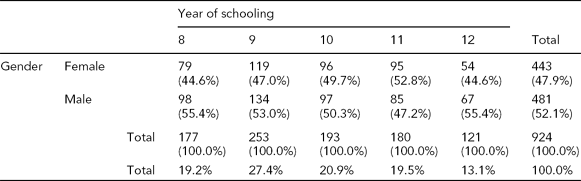
The digital vignette/scenario was broadly reflective of what is done to embarrass friends and others in school, with 43.4% of those who responded (n = 798) reporting that passwords were taken/used for this purpose at least once or twice (35.6%, n = 291), and up to several times a week (1.1%, n = 9). Most indicated that they would ‘probably or certainly object’ if it did occur (80.3%, n = 649); and 42.5% (n = 346) reported that they would probably not ignore it if it did.
Who are the Bystanders?
Of the 961 participants in this study, 746 (92.7%) identified that cyber-bystanders were present in the animation, with only 59 (7.3%) participants reporting that there were no bystanders. Of the 92.7% who identified cyber-bystanders, 472 (49.1%) subsequently identified Katie, the best friend. Their perception of Katie as a cyber-bystander is intriguing as Katie was the original instigator who had passed on her best friend's password to others at school. In this sense, she was actually an offline bystander: who stood by while the other girls proceeded to use her account to send images on to others. Katie appears to present as a new form of hybrid bystander: that is, participants in this study saw Katie as a protagonist offline, but identified her as becoming a bystander when she did not intervene as the situation moved online.
In addition to Katie, the best friend, participants identified cyber-bystanders to be: friends at school watching what was happening online (42.6%, n = 409), the guys in the older grades who forwarded the newly created humiliating image (34.9%, n = 335), the ‘beautiful people’ who demanded the password as entry to their group (27.3%, n = 262), and other people online who would have been sent the images (24.9%, n = 239). This raises issues regarding cyber-bystander identity and the interplay between off and online contexts.
Qualitative responses also identified bystanders to be: the manager of the website concerned; people laughing behind her back; people who stare; teachers; parents; the girl herself; as well as three responses that ‘everyone is a cyber-bystander’. These responses indicate awareness of bystanders in this scenario. Variations and confusion in young people's perceptions of who actually is a cyber-bystander appear, with both offline and online individuals being identified.
Who Would be Likely to Help?
Katie, the best friend, was deemed to be the person most likely to help, with 40.2%, (n = 386) of youth participants identifying her. Other friends at school and the ‘beautiful people’ were identified by 23% respectively as likely to help. Qualitative responses suggested others who might help, with teachers (52 responses) and parents (65 responses) identified. With these descriptive data in mind, the question for this article now concerns the dilemma facing them: to intervene or not, and what may activate or deter them from supporting others.
Qualitative Findings and Discussion
Open-ended survey questions related to this vignette explored who might be willing and able to offer help/support and why they may or may not engage. Lean coding established emerging themes in terms of their reasoning related to: emotional reasoning; relationships; removing personal responsibility; duty of care; prosocial reasoning; power relationships; law and order; moral attitudes; prevention; safety; blame; empathy; and agency.
When axial coding was applied, the key organising themes relating to young people's reasons for engaging as cyber-bystanders were determined as: social conventions and friendships; moral responsibility; personal agency; empathic reasoning and power relations.
Social Conventions/Friendships
She is her best friend and she was responsible for giving it out [. . . so she should fix it].
True friendships were recurringly described as a significant factor in responding as a bystander to cyberbullying. Complexity arose in distinguishing between offline and online behaviours. Katie, the best friend, was repeatedly identified as having moral obligations to act on behalf of her friend; however, Katie's behaviours began offline, and therefore not as a cyber-bystander initially. The complexity of interplay between off and online behaviours is evident here, and relates closely to the ‘messiness’ of cyberbullying in school settings, which Kofoed identifies (cited in Spears & Kofoed, in press). Participants described how Katie should have respected and adhered to the unwritten social and moral norms pertaining to genuine best friends, including being trustworthy and supportive: ‘Because she was trusted with the password, she has the responsibility to protect her friend.’ Clearly she had breached this when she passed the password to the group she aspired to belong to. In this context, Katie was therefore deemed a bystander as she did nothing to fix the situation. Participants then highlighted that Katie should have become morally engaged online as an active cyber-bystander, promoting the social convention of friendships through taking ‘responsibility’ to act in her role as best friend. Participants reported this was: ‘her duty as a friend’.
The Hybrid-Bystander
Participants identified an offline and online flow within cyberbullying incidences, whereby a bully's actions may occur initially offline, but quickly translate into online cyberbullying, supporting findings reporting the cycling of behaviours between both settings (Spears, Slee, Owens, & Johnson, 2009; Cross et al., 2009). However, in terms of bystander behaviours, a hybrid bystander emerges as the settings change from offline to online. Katie is an example of a hybrid-bystander and findings from this study strongly emphasise the moral responsibility and social convention of the best friend to act to support the victim, regardless of the setting. As a best friend, participants described how Katie's internal standards of conduct should create a conscience (Laible, Eye, & Carlo, 2008) to morally engage in supporting her friend.
Online cyber-bystanders who were distinct from Katie, were identified as other friends at school. Participants reflected group norms and membership characteristics of friendship groups including supporting friends in need. As one participant recorded, ‘. . . if her friends are REAL friends, then they would help her, and do whatever is best for her’. The role of friends as cyber-bystanders was to believe in their moral stature and support them by not believing comments. Moral obligations of believing and trusting friends were described as: ‘If they are friends then they would believe that the girl did not send the email’ and ‘Because they are friends and know the true her.’
The term ‘friend’ was repeatedly used as a justification for helping, implying a universal understanding of the social conventions of being a friend. The question, ‘Who is most likely to help?’ was repeatedly answered by ‘because they are her friends’. The importance of friendship as a cyber-bystander supports that youth are more likely to reach out to a friend (Thomas et al., 2012) and that they should exhibit first order responsibilities of knowing when and how to act, but also possess understandings, attitudes and aptitudes, including strength of will, to promote moral engagement (Hill, 2010). Elements of a duty of care (Kant, 2002) were also identified to protect friends, while conventional notions of the social conventions, norms and laws pertaining to friendship dominated responses.
Social conventions also pertained to the ‘beautiful people’, who were equally identified with ‘other friends’ as most likely to help. Popular identities were described as having a responsibility to ‘do something’ to support the victim. Guys in older grades should intervene because friendships would not be influenced. As potential outsiders, being distanced from the social conventions of friendships made them seemingly less susceptible to reprisal. Peer group characteristics significantly influenced reasoning for how individuals may respond (Jones, Manstead, & Livingstone, 2011). Self-confidence and support of one's peer group may engage cyber-bystanders; conversely, fear of being the next target and peer rejection may cause disengagement (Thomas et al., 2012). These responses identify cyber-bystanders as potential agents in counteracting cyberbullying through taking action to stop or prevent further incidences.
Agency
. . . remove [ing] the picture and report the situation to the counsellor.
Acting to support, help, report to authority (teachers, police and online sites) and problem solve for solutions were identified as elements of agency as a cyber-bystander. Predominantly, participants described measures to directly stand up to bullies to advocate on the victim's behalf: ‘[Also] . . . people online are most likely to help by giving some sort of word support due to the many people online’; ‘Stand up to the beautiful people. . . . tell the beautiful people to stop’.
Moral engagement by maximising agency distinct from Bandura's (2002) minimising agency were described as cyber-bystander strategies. Having confidence to engage directly with the victim was described by one participant: ‘they could ask if she was OK and ask what her real story was’. Agency also involved telling the victim to change their password, or for others to remove the picture, or report the situation.
Noticeably absent from participants’ responses were in relation to the ‘beautiful people’ having a moral obligation and sense of agency as cyber-bystanders, except for one: ‘they should be the ones to help as they have the power because they are popular and could use this agency to support the victim’. Conversely, personal agency employed by the victim was described as ‘she ultimately decides who goes on her account’. This could be interpreted as moral disengagement through blaming the victim (Bandura, 2002). Guys in older grades or other friends not involved were also identified as needing to act. This was viewed as more comfortable ‘because none of them are directly responsible and they are not singled out’. Peer pressures, social identity or bullying may cause participants to deflect their agency and moral responsibility from the victim, bullies and best friend to seemingly more distanced bystanders. One may argue that the participants were identifying that more distant bystanders have even more agency as ‘they are less involved’ and they could help from an ‘outsider's point of view’. One participant described that ‘they are not directly involved or at fault for this bullying so it might be easier to have fresh eyes’. Involving all cyber-bystanders, may create agency and build moral responsibility.
Moral Responsibility
It's the right thing to do.
Cognitive restructuring of harmful behaviour and distortion of negative consequences (Bandura, 2002) were reasoned as ‘no-one would suspect her of anything if the situation got serious’ or ‘because she [best friend] didn't mean for it to happen’. Such cognitive restructuring seemingly reduces the level of moral responsibility on the part of the best friend ‘. . . she didn't have bad intentions’.
Moral disengagement in relation to blaming the victim was evidenced as ‘because it was their fault’, ‘because she has no friends’, or similarly, ‘she was responsible for giving out the password [to her friend] in the first instance’. Some participants deflected moral responsibility for intervening towards being the responsibility or fault of the victim.
Cyber-bystanders were deemed to have a somewhat universal responsibility to intervene. It was described that if ‘anyone worldwide was online as a cyber-bystander, then they have a responsibility to do something about cyberbullying’. Participants described: ‘other people online can remain anonymous when they report the cyber abuse’ and ‘because they're not the people who did the stuff to the girl in the first place and they have nothing to do with the situation it wouldn't hurt them to help in any way’. Similarly other friends and older guys were identified as responsible to act ‘because they didn't do anything so they can stop it and get teachers involved’. The ‘beautiful people’ were likewise held morally responsible as cyber-bystanders ‘because they were the ones who did things wrong and they know the whole story’, and ‘it's up to the popular girls to apologise and help fix the problem’. These moral justifications reflect heteronomous principles (Piaget, 1965). Cyber-bystanders were described as knowing what is right and wrong, therefore deemed to all play a role in supporting the victim to make it right.
In addition to the social conventions and friendships, agency and moral responsibility that participants identified as influencing cyber-bystander actions, the emotional influences and empathy for victims was another common theme.
Empathy and Emotional Engagement
They might see how upset she is and try to help her out.
By contrast, participants suggested the popular group had little or no empathy for the victims through comments such as, ‘to make fun of her’ and ‘really want to know about her and bully with her body and stuff’.
Katie, the best friend, however, was described as experiencing feelings of guilt. Participants described her regret, need to confess, care for her friend, sorrow, and embarrassment: ‘Katie might feel guilty for deceiving her friend.’
Efforts to make amends for the grief she had caused reflected moral engagement. Similarly, the other groups, including popular groups, were reflected as portraying sympathy, care, kindness and worry for the victim. This was evidenced through comments such as ‘they feel sorry and don't believe it was her’ and ‘because they wouldn't want her to get hurt’.
These emotions were the driving factor for individuals and groups desire to comfort, help, support, listen and protect the victim. Further to this, suggestions to engage the support of people in authority and power to help were recorded.
Power Relations
. . . because they have more authority over the students.
Similarly parents were likely to help ‘because they are her parents and are unbiased’ and ‘because they don't want to see their kid being unhappy’. Guys in older grades were also identified ‘because they might not know the beautiful people and won't be intimidated by them’. This emphasises the power and hierarchical influence that social groups hold.
The overarching theme within these comments were that family and people with authority ‘have the knowledge to do something about it properly’ and thus youth participants expected them to do so.
One may argue participant responses reflected a degree of moral disengagement in minimising agency of those more directly involved as cyber-bystanders, by reverting to the agency of those in power; however, conversely, such moral engagement may be viewed as important to address cyberbullying.
Strengths and Limitations
While the findings from the current study support youth awareness of a range of cyber-bystanders and their moral engagement in addressing cyberbullying, some limitations need to be addressed. The focus of this article was to capture initial qualitative youth perceptions in relation to the moral engagement of cyber-bystanders, which provides scope to further analyse the quantitative responses. Exploring individual differences in moral responsibility, including gender, year level and cultural background, may provide further insight for the moral responsibilities, skills and capacities across groups (see Spears et al., 2013).
While the participants responded to recognisable and accurate depictions of cyberbullying events, and drew upon their direct understandings and experiences from a whole-school context, further investigation of attitudes and knowledge is warranted in the form of follow-up interviews. Similarly, analysis of the quantitative data in terms of the theory of planned behaviour (Ajzen, 1991) may shed some light on the links between beliefs and behaviour being transferred to real life situations.
These findings may be influenced by this school's approach to policy development. Further investigation of the in-practice policy initiatives will need to be undertaken to shed light on these findings.
Conclusion and Recommendations
The purpose of the study was to explore who youth identify as online bystanders and their moral reasoning for supporting cyberbullying victims. A significant outcome was that youth participants did not specifically differentiate between bystanders online and those offline, supporting how young people do not distinguish between the two settings (Spears et al., 2012). Katie, the best friend, was a bystander, but initially not a cyber-bystander. She played a unique role in contributing to the initial online bullying, and was perceived to be traversing the online and offline environments. This study proposes a new form of bystander when considering cyber-bullying: the hybrid-bystander — one who operates across both settings, possibly acting as the lynchpin between the two. As such, educators need to recognise the interconnectivity between the online and offline environments; young people's seeming lack of distinction between the two in terms of cycling to and fro; the moral thinking expressed by young people in terms of who should engage to support the victims; as well as the emergence of the so-called hybrid-bystander.
Contrary to high degrees of moral disengagement of bullies in traditional bullying research, the present study found that youth participants predominantly perceived cyber-bystanders to have the agency and responsibility to morally engage with cyber-bullying incidences. Whether they actually do morally engage, requires further exploration.
Social conventions, qualities and moral duties identified with true friendships, nested within complex influences of peer group membership, norms, power and the hierarchical nature of social groups, determine whether or not young people will intervene, much as they do in traditional bullying situations. However, the ‘messiness’ of cyberbullying (Kofoed, as cited in Spears & Kofoed, in press) with its off/online context, complicates our understanding.
Educational settings need to continue to promote moral responsibilities that characterise true friendship, skilling students in initiating and sustaining quality friendships. Additionally, as with offline bullying, exploring the nature of social groups, norms, membership, hierarchy and power, may empower students in navigating such complex influences.
Skilling individuals in awareness of their agency, social identity, influence on others, and levels of moral engagement and responsibility may potentially enhance the agency of every cyber-bystander and hybrid-bystander, ultimately not leaving action to others. The absence of agency of the ‘popular’ people may inform an educational focus on promoting moral responsibilities of social groups holding considerable power.
Consistent with the notion that affective and emotional dimensions influence moral engagement (Almeida et al., 2010), youth suggested cyber-bystanders are able to perceive others’ emotional states, especially if they have similar experiences. Such empathy and emotional awareness challenges notions that the online environment promotes moral disengagement due to the inability to see immediate reactions (Bauman, 2010). This warrants further investigation.
Finally, employing support from authority, including teachers, parents and family, reinforces current educational initiatives addressing cyberbullying. What contributes to the debate in this field is whether in actuality youth seek help or report to authority. Cyber-bystanders’ fear of reprisal, being labelled a dobber, or not wanting to be involved may influence moral engagement in cyberbullying situations. Understanding the moral engagement of bystanders who are present in 85% to 88% of bullying situations and their reasoning for only intervening 11% to 25% of the time (Atlas & Pepler, 1998; Craig & Pepler, 1997) and how this transfers to the online environment is of immediate concern. Further research needs to explore beyond traditional bullying to analyse cyber-bystanders’ as well as the newly coined hybrid-bystanders’ actual interventions in contrast to perceived intentions to intervene.
This article has identified that youth are aware of the wide range of bystanders that exist online and the need for them to be morally responsible employing empathy as digital citizens. Spears (2012), in her review of initiatives which use technology to promote cyber-safety and digital citizenship, noted that skills to participate online are not enough: that having a moral compass and personal values which support the emergence of informed digital citizens who act with ethical integrity are needed if the digital space is to move towards becoming a ‘mature’ space in the future (p. 201).
Findings identified that youth perceived cyber-bystanders as capable of employing moral engagement rather than disengagement behaviours (Bandura, 1986), suggesting a moral compass is in place, with proactive measures to address the online social context and circumstances. How youth acquire such skills, knowledge and moral responsibility is an area to be further addressed through broadening moral theoretical frameworks to include moral duty and justice (Kant, 2002) and cognitive–moral development (Kohlberg, 1969). Teaching a positive moral attitude in the use of the internet is important in education. Teaching higher levels of moral reasoning may advance altruistic behaviour such as social sensitivity and stronger feelings of responsibility for others (Krebs & Van Hesteren, 1994). As such, the implications for educators including school counsellors, teachers and school leadership as well as policy and curriculum designers suggest the need to incorporate online moral education to enhance the future generation of morally responsible digital citizens.