







Abstract
Factors contributing to academic achievement among recently arrived Chinese adolescents in Australia remain relatively underexplored. Previous studies focused on Asian migrants, including Chinese, but did not distinguish Chinese from other Asian migrants. The current study specifically looks at Chinese migrants who have recently arrived, as opposed to Asian migrants. This study aims to explore the role of social support, school belonging, and acculturative stress on academic achievement of recently arrived Chinese adolescents (n = 55). Questionnaires were administered to this sample. The results indicated that school belonging, interestingly, was negatively associated with academic achievement. Perceived social support and acculturative stress were not significantly associated with academic achievement. The findings provide insights into risk and protective factors influencing academic achievement of Chinese migrants. Implications of the findings are discussed.
Chinese migration has surged dramatically in recent decades, with Chinese Australians constituting the largest English as an Additional Language group (EAL; Australian Bureau of Statistics, 2011). Within Chinese culture, education is viewed as extremely important and as a means to future success (Dandy & Nettelbeck, 2002; Suarez-Orozco & Suarez-Orozco, 2001). As a result, Chinese parents prioritise education within the family. Academic achievement is considered an important developmental task of Chinese adolescents. In contrast to North America and Europe, little research has been undertaken in Australia to explore factors associated with academic achievement among Chinese migrant adolescents. Previous research has found that academic achievement among Chinese migrants was associated with individual factors, including attribution of success (believing in effort rather than luck or task difficulty), academic effort (more time studying), occupation aspirations (desiring an occupation requiring tertiary qualifications), and situational factors, such as higher level of social support, longer length of residence, and higher identification of Chinese culture (Dandy & Nettelbeck, 2000, 2002; Fan & Karnilowicz, 2000; Leung, 2001). However, previous studies often focused on Asian migrants, including Chinese, but did not distinguish Chinese from other Asian migrants. A few studies specified the number of Chinese participants, ranging from 18 to 78. Most studies, however, did not specify the number of Chinese migrants and grouped them under the Asian migrants. Previous studies often included first and second generations of Chinese migrants and did not focus specifically on recent adolescent migrants. The current study therefore specifically looks at Chinese migrants as opposed to Asian migrants, and focuses on recently arrived migrants. Nevertheless, previous studies have compared Chinese migrants to students in host countries instead of exploring individual differences among Chinese migrants, and found that Chinese migrants spent more time studying than students in host countries. In addition, the nature of the Chinese migrant population has changed in Australia, with a high proportion of migrants coming from Mainland China rather than Hong Kong or Taiwan.
The current study aims to explore the relationship between psychosocial variables and academic achievement in recently arrived Chinese adolescents within a specialised school environment. In the current study, ‘Chinese migrants’ refers to ethnic Chinese people, which includes migrants from Taiwan, Mainland China, Hong Kong, and Macau. The key variables are social support, sense of school belonging, and acculturative stress. ‘Recently arrived’ is defined as being in Australia for no more than two years. This is seen as an important transition period for the participants. Information on factors associated with academic achievement of Chinese migrant adolescents would provide helpful guidelines for teachers, school guidance officers, school counsellors, and psychologists.
The Model Minority Myth
In Australia, an assumption of model Chinese students assumes superior academic achievement with high levels of participation in tertiary education (Vialle, 2013). Researchers have explained the perception of superior academic achievement by reference to selective migration, motivational patterns (Vialle, 2013), parents’ strategies, and home practices (Watkins & Noble, 2013). The stereotype may obscure difficulties faced by individual Chinese students who may not achieve in accordance with this perception. As a result, it is important to explore factors associated with academic achievement of Chinese migrant adolescents during the early transition period.
An Ecological Risk and Protection Framework
The conceptual framework underpinning the study is based on a risk and protective theoretical perspective grounded in an ecological framework (Bogenschneider, 1996).
The existing literature on the effect of risk and protective factors on developmental outcomes has not led to conclusive results. What is protective for one group may not be protective for another (Rutter, 1987). The psychosocial factors that promote academic achievement in Western cultural groups may not be protective for other cultural groups.
Social Support and Academic Achievement
Social relations promote positive developmental outcomes, including academic achievement among adolescents (Stanton-Salazar, Chávez, & Tai, 2001). Social support provides assistance and information promoting academic achievement in adolescent migrants.
Perceived social support has been found to be positively associated with academic achievement among Asian migrant students in the United States (Witkow & Fuligni, 2010), including first, second, and third generations (Fuligni, 1997). These studies, however, did not distinguish Chinese from other Asian migrants. A study that investigated the adaptation of Chinese adolescents, although not recent migrants, in Canada and Australia found that academic achievement in English and mathematics was significantly associated with social support from parents and peers (Leung, 2001) for Chinese Canadian but not Chinese Australian students. This difference was explained by the presence of a large Chinese community in Canada, in which social support is perhaps more readily available (Leung, 2001). Thus, findings about the positive association between perceived social support on academic achievement among Asian migrants in the United States and Canada may not be appropriate to assume to exist in Australia. As a result, the current study explores the relationship between social support and academic achievement.
School Belonging and Academic Achievement
School belonging has been conceptualised as personal feelings of ‘being accepted, respected, included, and supported by others in the school social environment’ (Goodenow, 1993b, p. 80). School belonging has been reported to be crucial for adolescents’ developmental outcomes especially among migrant adolescents, as adolescents spend a large part of their day at school (Kia-Keating & Ellis, 2007). Western literature has demonstrated that students’ sense of school belonging is an important factor associated with academic achievement (Resnick, Harris, & Blum, 1993; Shochet, Smyth, & Homel, 2007; Wentzel, 1998). Feeling accepted and included in the school setting appears to help promote effort and putting time into school and academic work.
Previous studies on school belonging were undertaken almost exclusively in the United States (Liu & Lu, 2011). Although some studies included Asian migrant students (Goodenow, 1993a; Niehaus, Rudasill, & Rakes, 2012; Pittman & Richmond, 2007; Smerdon, 2002), the proportion of Chinese adolescents was either low or unspecified. A longitudinal study (Sciarra & Seirup, 2008) reported that emotional engagement, including feelings of belongingness, was significantly associated with high mathematics grades for White and Latino adolescents, but not for the Asian, African, and American Indian samples. The findings of the non-significance associations were explained by adolescents from minority racial groups achieving academic success for reasons other than feeling close to their school or otherwise (Sciarra & Seirup, 2008). Adolescents from minority groups, especially Asian migrants, may view academic achievement as a means to achieve social mobility and pursue future success (Sue & Okazaki, 1990). This provided an insight into potential racial differences in the relationship between school belonging and academic achievement.
The role of school belonging on academic achievement has been explored with a Chinese sample of 567 high school students in China. School belonging was not found to be significantly related to academic achievement in Chinese students (Liu & Lu, 2011). These results challenge Western findings that school belonging is a protective factor on academic achievement, but are consistent with findings about Asian migrant students, and therefore more studies are needed to examine the association between school belonging and academic achievement among Chinese student samples. This current study addresses the gap in the literature and explores the relationship between school belonging and academic achievement.
Acculturative Stress and Academic Achievement
A unique risk factor encountered by migrant populations is acculturative stress (Blanco-Vega, Castro-Olivo, & Merrell, 2008), which is defined as ‘a stress reaction in response to life events that are rooted in the experiences of acculturation’ (Berry, 2005, p. 708). Recent arrivals typically experience more acculturative stress than those who migrated earlier or second generation (Mena, Padilla, & Maldonado, 1987).
Few studies have investigated acculturative stress in relation to academic achievement among children and adolescents. Acculturative stress appeared to negatively impact self-esteem and was associated with poorer academic achievement among Hispanic adolescents in the United States (Schwartz, Zamboanga, & Jarvis, 2007). Acculturative stress was reported to be negatively associated with teacher-reported academic performance among Latino adolescents in United States (Albeg & Castro-Olivo, 2014). However, the findings are not consistent. Hawley, Chavez, and Romain (2007) did not find a significant relationship between acculturative stress and teacher-reported academic performance in either a group of 59 European American or 67 Latino American children and adolescents, although the sample size in this study was relatively small. The inconsistent findings in the literature raise interesting questions, and more research is therefore needed concerning the relationship of acculturative stress with academic achievement among different migrant groups. So far, there has been no research on the relationship between acculturative stress and academic achievement conducted with a Chinese migrant sample. The current study preliminarily explores the relationship between acculturative stress and academic achievement of recent Chinese migrant adolescents.
Hypotheses
The study aims to explore the relationship between three independent variables and academic achievement in a sample of Chinese migrant adolescents during the transition period in Australia. We hypothesise that perceived social support will positively correlate with academic achievement; second, that school belonging will positively correlate with academic achievement; and finally, that acculturative stress will be negatively correlated with academic achievement. A Risk and Protection Conceptual Framework of Academic Achievement Representing Three Psychosocial Variables: Social Support, Sense of School Belonging, and Acculturative Stress.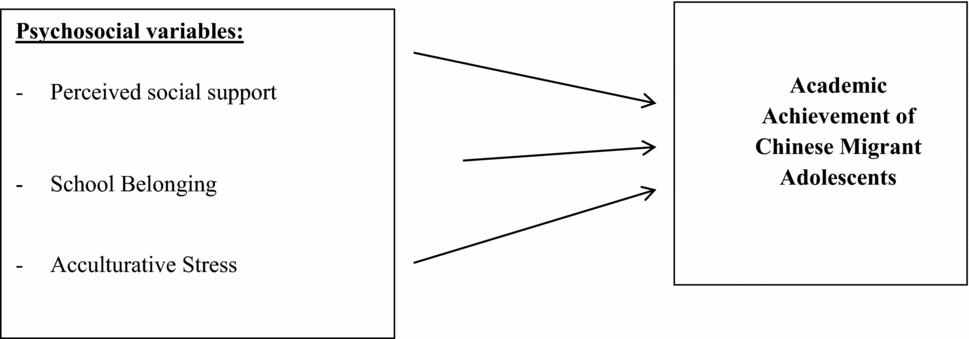
Method
Participants
Demographic Characteristics of Chinese Migrant Adolescents (N = 55)
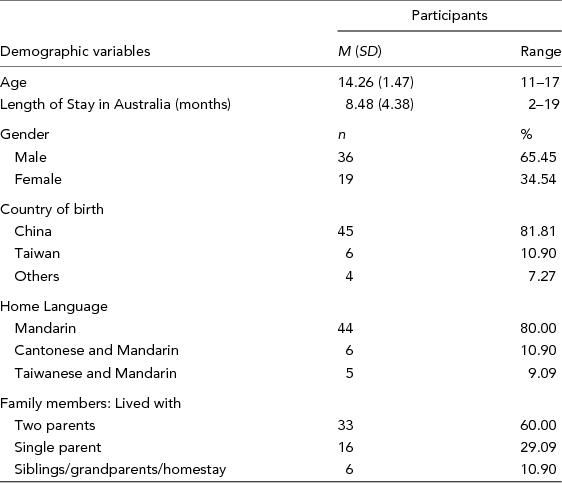
Note. N = Number of participants, M = mean and SD = standard deviation.
Design and Materials
A cross-sectional questionnaire was used to examine the relationship of the three psychosocial factors with academic achievement. Participants were requested to respond to items on demographic information (Table 1).
Perceived social support
The Index of Sojourner Social Support (ISSS) Scale is an 18-item scale used to assess the perceived availability of social support for a sojourning population (Ong & Ward, 2005). Nine items, with high factor loadings and relevant to the adolescents, were selected for the present study. The shortlisted items are internally consistent (α = .78). Each statement was rephrased to begin ‘There is someone to . . .’ (Dunst, Trivette, & Deal, 1988). One item which referred to Singapore was changed to Australia: ‘There is someone to tell me what can or cannot be done in Australia.’ The participants rated the degree of support available to them on a 3-point Likert scale from 1 = not at all to 3 = a lot. A total scale score was computed to each participant. A higher score indicates a greater perceived availability of supportive behaviours.
School belonging
The Psychological Sense of School Membership (PSSM) scale (Goodenow, 1993b) is an 18-item, self-report measure of a student's school belonging. Students rated how true each statement about their school experience was on a 5-point Likert scale from 1 = not true at all to 5 = completely true. Items addressed the students’ perceptions of being liked, accepted and included, and respected and encouraged to participate by peers, teachers and other school personnel (α = .87). The negative items were reverse coded. An average scale score was computed to each participant. A higher score indicates higher sense of school belonging.
Acculturative stress
The Multidimensional Acculturative Stress Scale (MASS) was developed to measure the level of acculturative stress of Pakistani migrants in Canada (Jibeen & Khalid, 2010). The authors identified five subscales with acceptable Cronbach alphas ranging from .87 to .64. The scale was adapted to a shorter, 14-item version based on a high factor loading, over .60, and relevance of items for adolescents, removing the dimension of the lack of opportunities for occupation and financial mobility. The adapted version modified the country name from ‘Canada’ to ‘Australia'and from ‘Pakistan’ to ‘my original country’. Items assess four acculturative stress dimensions: language-barrier, homesickness, discrimination, and threat to ethnic identity. Participants were asked to rate the degree of stress in response to the experience illustrated by each statement on a 3-point Likert scale from 1 = not true at all to 3 = a lot. A total scale score was computed to each participant, with higher scores indicating higher level of acculturative stress. The reliability of adapted MASS, though low, is within the acceptable range (α = .68). The relatively lower reliability coefficient of MASS reflects the nature of multidimensionality (Cortina, 1993; Schmitt, 1996).
Academic achievement
Bandscales (McKay, 2007) refer to a standardised rating scale used by teachers at school. Teachers rated students across four domains on a 12-point scale. These domains are spoken English, written English, reading the English language, and listening to the English language. The scores for each domain were added up to calculate the academic achievement of each student. It is a scale used with students whose English is a second language. The teachers evaluated the students at two time points: when students were admitted to the school, and their current score. Two scores for each student were obtained and the difference between the two scores reflects development of English proficiency across the domains.
Study duration
In order to control for study duration, study duration was measured by the number of weeks the student had been enrolled, and was included as a covariate in the analysis. This was necessary because the school has a rolling enrolment policy: students enter on arrival in Australia.
Procedure
Participants were recruited through a Brisbane high school with an educational and settlement mission that caters exclusively for recently arrived adolescent migrants from a non-English speaking background. The school is dedicated to the settlement and English language development of migrant students. Around 16% of the students are Mandarin- and Cantonese-speaking migrants. Teachers obtained informed consent from parents. The response rate was around 90%. The research team reviewed the battery to make it user friendly for the participants. A questionnaire written in English was administered during school time on a one-to-one basis by a multilingual researcher. To control for language and reading ability, all items were interpreted and read aloud to participants in either Mandarin or Cantonese.
Results
There were no missing data. Data were screened for violations of multivariate normality. The distribution of residuals was normal and there was no evidence of skewness or kurtosis. The independence of errors was met. The assumptions for regression analysis were met. Correlation analyses were carried out. Regression analysis of academic achievement was then carried out using the variables significantly correlated with the academic achievement.
Descriptive and Correlation Statistics
Means, Standard Deviations, Range, and Correlations on Variables (N = 55)
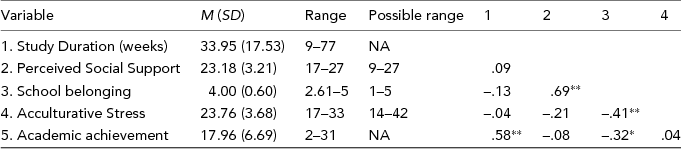
Note: N = Number of participants, M = mean and SD = standard deviation.
* p < .05 . ** p < .01.
In Table 2, correlation analyses using Spearman's rho revealed that study duration was strongly positively related to academic achievement (r = .580, p ≤ .000). School belonging was negatively correlated with academic achievement (r = −.317, p =.018). Perceived social support and acculturative stress were not significantly correlated with academic achievement.
Hierarchical Multiple Regression
Summary of Hierarchical Regression Analysis with Academic Achievement as Outcome Variable (N = 55)
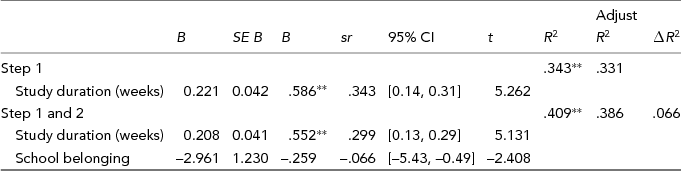
Note: * p < .05. ** p < .01.
Discussion
The aim of the current study was to explore the relationships of psychosocial variables with academic achievement. The findings highlight that academic achievement of the Chinese students was associated with lower sense of school belonging and longer duration at school. Interestingly, school belonging appeared to be a potential risk factor for Chinese migrant adolescents’ academic achievement. Perceived social support and acculturative stress did not predict academic achievement.
Social Support and Academic Achievement
Perceived social support did not significantly correlate with academic achievement, which is inconsistent with past studies of Asian migrants in the United States (Fuligni, 1997; Witkow & Fuligni, 2010). However, this finding is consistent with Leung's (2001) study that levels of social support did not associate with Chinese Australians’ academic achievement. This may indicate that findings relating to Asian migrants simply do not apply to Chinese migrants.
A possible explanation of the negligible association between perceived social support and academic achievement may be related to a threshold effect of social support, which has been identified in health and mental health fields (Heaney & Israel, 2002; Veiel, 1987). The level of perceived social support was generally high and no participant rated the level of perceived social support below 17 (see Table 2), which indicates that all participants perceived medium to high levels of social support. Above a threshold level, the effect of perceived social support on academic achievement may be limited.
School Belonging and Academic Achievement
School belonging was negatively correlated with academic achievement and thus raises some interesting questions. This finding contrasts with the majority of studies drawing upon predominately Caucasian and Latino American students (Gonzalez & Padilla, 1997; Sánchez, Colón, & Esparza, 2005; Smerdon, 2002). However, the current finding is consistent with studies involving Asian migrant students (Sciarra & Seirup, 2008) or Chinese adolescents (Liu & Lu, 2011), which may suggest a potential ethnic difference.
The inverse relationship of school belonging with academic achievement may be explained by the nature of the school context. The particular school in this study has a settlement mission and thus places emphasis on integration into the Australian community in a holistic way rather than an academically driven way. In the field interaction with participants, some of the adolescents commented that school assignments were not sufficient and the school education style was perceived as representing a ‘holiday camp’ style. It is possible that recently arrived Chinese adolescents were accustomed to a traditional structured and homework-driven learning style that is common in their homeland. Those who reported a low level of school belonging might have been groups of students who valued a Chinese educational style and were perhaps less interested or involved in the non-academically related activities.
Acculturative Stress and Academic Achievement
Acculturative stress did not significantly correlate with academic achievement among Chinese migrant adolescents. The findings are consistent with past literature in that acculturative stress appears to be relatively weakly associated with academic achievement of minority students (Schwartz et al., 2007). The effects of acculturative stress on academic achievement may operate through an indirect pathway; for instance, acculturative stress was reported to have a negative impact on adolescents’ self-esteem (Schwartz et al., (2007) or mental health (Wang, Schwartz, & Zamboanga, 2010) and thus indirectly influence academic achievement. Future research is needed to examine the mechanism among Chinese migrant adolescents.
The main limitations of this study were the small sample size and that all participants were from one high school; thus, generalisation of the current findings is limited. However, the sample included males and females, various family structures, and ages covering adolescence. Cross-sectional data limits causal inferences. However, the academic scores collected at two time points offered more support for the causal relationship than scores collected at one time point (Gutman & Midgley, 2000). The measures of ISSS, PSSM, and MASS have been validated for non-Western samples but not specifically for Chinese migrant adolescents. Although acceptable and reflecting the nature of multidimensionality, the reliability of MASS was comparatively low.
This study was not intended to be an extensive exploration of the risk and protective psychosocial variables that may be associated with academic achievement among recently arrived Chinese adolescents. Future research may examine additional variables from different levels of the young person's ecological system and school-related outcomes. Using a larger sample, future studies could also include Chinese students who are relatively well established in Australia to explore differences between newly arrived and the well-established groups.
The findings have implications for the schooling of Chinese adolescents and educators. Tension between schools and education learning philosophies in Western countries and migrant families — Chinese included — is well documented (Li, 2006). School personnel may benefit from training about the cultural implications of the association of school belonging and academic achievement. The challenge is to strike a balance in order to promote school belonging without devaluing the emphasis of Chinese cultural values that emphasise academic achievement. Chinese parents value intensive academic work, and students are driven to achieve academically regardless of social support available or stress. School personnel may attempt to satisfy Chinese adolescents’ learning needs, for example, by adjusting the amount of homework to meet their cultural expectations.
This study is, to our knowledge, the first to empirically explore factors associated with academic achievement of Chinese adolescent migrants in the transition period in Australia. The lack of research in a Chinese context and small sample size mean that the set of independent variables was relatively exploratory, and thus more research is need to gain a better understanding of the pedagogical journey of new migrants to Australia.