







Abstract
Abstract
Theoretical explanations suggest that insight might increase life satisfaction by helping individuals choose a suitable academic major, indicating that insight might facilitate life satisfaction through academic major satisfaction. The current study thus investigates the mediating role of academic major satisfaction in the potential relationship between insight and life satisfaction. The data collected from a sample of 206 undergraduate students majoring in education degree programs confirm that the relationship between insight and life satisfaction is fully mediated by academic major satisfaction, with a model explaining 23% of the total variance in life satisfaction. The findings have important implications for the design and implementation of career counselling and guidance services provided within high school and university settings, particularly in countries such as Turkey where career counselling services need improvement.
Keywords
Being conceptualised as the cognitive component of subjective wellbeing, life satisfaction indicates an evaluation of one’s current status, based on the standards identified by the individual’s own self (Diener, Emmons, Larsen, & Griffin, 1985). Life satisfaction has been proposed as being a good indicator of overall wellbeing due to being comprehensive of various domains and subdomains of life, such as work (e.g., Adams, King, & King, 1996; Bowling, Eschleman, & Wang, 2010; Judge, Bono, Erez, & Locke, 2005), leisure life (Ateca-Amestoy, Serrano-del-Rosal, & Vera-Toscano, 2008; Neal, Sirgy, & Uysal, 1999), romantic relationships (Gustavson, Røysamb, Borren, Torvik, & Karevold, 2016; Hawkins & Booth, 2005) and social relationships (Amati, Meggiolaro, Rivellini, & Zaccarin, 2018). It has therefore received significant attention from researchers and practitioners in different fields, such as counselling, education, psychology and business. Researchers who are interested in the academic and individual wellbeing of college students have paid particular attention to their life satisfaction and investigated these constructs with respect to the living conditions (Özgür, Gümüş, & Durdu, 2010), socio-economic status (Chow, 2005), academic performance (Chow, 2005) and personality traits (e.g., Capri, Ozkendir, Ozkurt, & Karakus, 2012) of this population.
One such study examining the life satisfaction of college students has considered the role of insight on life satisfaction and reported a positive correlation between the two constructs (i.e., Harrington & Loffredo, 2010). However, to date, no study has examined how insight increases life satisfaction among college students, which is important given that insight is a complex psychological construct. Theoretical formulations indicate that insight is characterised by various constructs, such as self-awareness (Kolk, 1998; Patterson & Welfel, 2000), self-reflection (Silvia & Phillips, 2011), self-understanding (Morin, 2011) and self-acceptance (Akdoğan & Türküm, 2018), which have been linked to positive wellbeing. However, some scholars have also proposed that insight does not lead to positive consequences unless it is followed by action (Kolk, 1998; Markova & Berrios, 2011), which is consistent with suggestions that insight leads to positive wellbeing because it can help individuals make better life choices (e.g., Barron, 2012; Sonstegard, 1998), such as choosing a suitable academic major. Therefore, it is possible that insight may increase the life satisfaction of college students by increasing their academic major satisfaction.
Choosing a satisfying career is a key developmental challenge that is faced during a life span (Super, 1953), making it reasonable to assume that those who successfully overcome this life task may feel more satisfied with their lives overall. Consistent with this, academic major satisfaction, which indicates one’s satisfaction with her/his choice of major, has been suggested as a potential predictor of life satisfaction among college students (Nauta, 2007). It has been found to predict positive current and future academic outcomes, such as a decreased dropout rate (Nauta, 2007) and an increased grade point average (GPA; Leach & Patall, 2013; Nauta, 2007), which have also been linked to increased life satisfaction among college students (e.g., Chow, 2005; Schenkenfelder, 2017).
Given that in certain countries, such as Turkey, the majority of high school students are required to decide on a specific major before starting their university education, an investigation of the role of academic major satisfaction in the relationship between insight and life satisfaction is likely to have important implications for career researchers and counsellors in such countries to better understand and address the career counselling needs of both high school and college students. As a result, this study investigates the mediating role of academic major satisfaction in the potential relationship between insight and life satisfaction. Because certain characteristics of insight that are related to self-understanding (Morin, 2011), self-reflection (Silvia & Phillips, 2011), and a holistic view (Akdoğan & Türküm, 2018) have been listed among the significant qualities of a good teacher (e.g., Combs, Blume, Newman, & Wass, 1974; Korthagen, 2004; Tickle, 2000), insight is particularly important for students majoring in education. Thus, the study sample was limited to university students majoring in education. Given the suggested importance of the potential career counselling implications of this study, a section on the current status of career counselling services within high schools and university settings in Turkey is presented in the following section, which is followed by a detailed discussion of the study variables.
Career counselling services within high schools and university settings in Turkey
In Turkey, compulsory education lasts 12 years and is divided into three levels: elementary school, middle school and high school, each lasting for four years (Yeşilyaprak, 2017). Counselling services across all three levels of compulsory schooling, including those associated with career guidance and counselling, are provided by school counsellors who are assigned to school counsellor positions by the Ministry of National Education (MoNE) in Turkey. Although the MoNE assigns more school counsellors to high schools in comparison to elementary and middle schools, the average student-to-school counsellor ratio remains as high as 2,786 (MoNE, 2016), while the recommended caseload size by the MoNE is 150 for high school counsellors. Moreover, practising school counsellors are trained at undergraduate level, and graduates of other programs (e.g., psychology, sociology and philosophy) are also being assigned to school counsellor positions by the MoNE. As a result, school counsellor caseload sizes are extremely large (Cimsir & Carney, 2017), counsellor training is limited (Cimsir & Carney, 2017; Korkut, 2007), and counsellors face difficulties with obtaining continuous professional development in Turkey (Cimsir, 2018). All of these issues appear to negatively influence the quality of career counselling and guidance services provided within high school and university settings in Turkey. This is despite an increased importance placed on providing students with appropriate access to career counselling and guidance services, with recent improvements being made in laws, regulations and curricula by the MoNE (2015).
In Turkey, deficiencies in career counselling services provided at high schools render the provision of career counselling services within university settings even more necessary and complicated. However, similar to those provided in high schools, career counselling services provided within the higher education system seem to be unsystematic and underdeveloped (Erdoğmuş Zorver, 2018). One major problem is that career counselling centres exist only in a small number of state universities and in a limited number of private universities (Erdoğmuş, 2001; Yeşilyaprak, 2016). Moreover, the majority of the services provided by universities are limited to the dissemination of information regarding employers and businesses, leaving out the design and provision of programs and services directed at self-discovery (e.g., discovery of interests, abilities and values) and adaptation of career development skills (Erdoğmuş Zorver, 2018).
Suggested problems with the extent and quality of career counselling and guidance services provided within high schools and university settings in Turkey seem to stem from certain issues that the field of counselling has been struggling with since the establishment of counselling services in schools in the 1970s (see Korkut, 2006). These include training counsellors at the undergraduate level with a focus on the school counselling option, lack of uniformity and consistency in counsellor education programs due to the lack of a professional accrediting body of counsellor education programs (Korkut, 2006), and insufficient autonomy given to the Turkish Psychological Guidance and Counselling Association by the MoNE and by the Higher Education Council (a corporate public body supervising higher education) in planning and organising counsellor education throughout the country. In such circumstances, an examination of the role of academic major satisfaction in the relationship between insight and life satisfaction is timely and necessary. The results of this study may not only help improve the quality of career counselling services provided within high school and university settings but can also help overcome challenges confronting the counselling profession in Turkey.
Study Variables
Insight
Although insight is a psychological construct that has been more widely discussed within the clinical psychology literature (e.g., Beck, Baruch, Balter, Steer, & Warman; 2004; Burton & Vella, 2011; Uchida et al., 2009) due to its importance in the treatment of psychiatric disorders, it has been suggested to be equally important in the daily lives of non-clinical populations (Akdoğan & Türküm, 2014, 2018). A literature review of non-clinical insight reveals that insight is a broad construct with dimensions in self-awareness (Kolk, 1998; Patterson & Welfel, 2000), self-reflection (Grant, Franklin, & Langford, 2002; Lyke, 2009; Silvia & Phillips, 2011), self-understanding (Morin, 2011), self-acceptance and a holistic view (Akdoğan & Türküm, 2018), along with a behavioural component (Kolk, 1998; Markova & Berrios, 2011). Akdoğan and Türküm (2018), who developed the insight scale that was used in this study, suggest that insight is a three-dimensional construct (i.e., a holistic view, self-acceptance and self-understanding) that involves understanding and accepting one’s positive aspects along with the negative ones, and analysing one’s own situation from all angles, with an awareness of surrounding individuals and circumstances.
Because insight has certain commonalities with self-reflection and rumination, a discussion of its relationship with these constructs seems necessary. Self-reflection is characterised by one’s engagement in the activity of thinking about feelings, thoughts and behaviours (Lyke, 2009). Insight differentiates from self-reflection in that it has been suggested as a consequence following self-reflection (Lyke, 2009), which means that self-reflection may or may not lead to positive consequences, while insight does lead to positive consequences (e.g., Harrington & Loffredo, 2010; Lyke, 2009). The fact that insight, as measured by the Self-Reflection and Insight Scale (SRIS; Grant et al., 2002), was found to be significantly correlated with subjective happiness (r = .38) as well as with life satisfaction (r = .38), while self-reflection showed almost zero correlation with the same constructs, clearly supports the suggested difference between insight and self-reflection (see Lyke, 2009). Rumination, which refers to one’s propensity to repeatedly focus on past actions (Trapnell & Campbell, 1999), also differs from insight despite the fact that both rumination (see Trapnell & Campbell, 1999) and insight (see Grant et al., 2002) seem to have a self-reflection component in common. The difference is evident in previous research only linking rumination to negative psychological outcomes, such as concentration difficulties (Lyubomirsky & Nolen-Hoeksema, 1995), depression (McLaughlin, Borkovec, & Sibrava, 2007; Nolen‐Hoeksema, 1991, 2000) and worry (Nolen-Hoeksema, 2000), while linking insight only to positive psychological outcomes, such as increased satisfaction with life and subjective happiness (e.g., Harrington & Loffredo, 2010; Lyke, 2009).
Although the majority of existing research regarding insight has focused on the importance of insight as a therapeutic modality and a goal in the recovery processes of individuals with psychiatric disorders (for a review, see Akdoğan & Türküm, 2018), research is still limited with regard to the position of insight in the daily lives of non-clinical populations, such as college students. Furthermore, although certain characteristics of insight that are related to self-understanding (Morin, 2011), self-reflection (Silvia & Phillips, 2011), and a holistic view (Akdoğan & Türküm, 2018) have been listed among the significant qualities of a good teacher (e.g., Combs et al,., 1974; Korthagen, 2004; Tickle, 2000), no study has examined the role of insight in the lives of college students majoring in education degree programs. Therefore, this study is thought to contribute to existing research with regard to the importance of insight in both academic major satisfaction and life satisfaction experienced by college students majoring in education.
Academic major satisfaction
Academic major satisfaction is a construct that is characterised by one’s satisfaction with her/his choice of major (Nauta, 2007). The construct has emerged with significant implications for career development (Deemer, 2015) as it has been found to be positively associated with academic performance (Graunke & Woosley, 2005; Nauta, 2007), intrinsic motivation for a subject (Deemer, 2015), career decision self-efficacy (Jadidian & Duffy, 2012; Nauta, 2007) and work volition (i.e., feeling that one is able to make her/his own occupational decisions despite barriers; Jadidian & Duffy, 2012). Research has also found that occupational engagement (Cox, Bjornsen, Krieshok, & Liu, 2015), self-regulated learning engagement (Kim & Kim, 2016) and perceived competence (Schenkenfelder, 2017) are positively associated with academic major satisfaction. Another study found identity (i.e., the extent to which one has a clear sense of goals, interests and abilities), a construct that is important in Holland’s vocational theory identity, to be a significant positive predictor of academic major satisfaction among students majoring in music (Allen, 1996). In other research, maximising (i.e., an increased focus on making the single best possible decision, creating propensity to doubt and regret about decision; Dahling & Thompson, 2012; Leach & Patall, 2013) and counterfactual thinking (i.e., thinking about other possible decisions/outcomes after a decision has been made; Leach & Patall, 2013) were found to be negatively correlated with academic major satisfaction.
Academic major satisfaction has also been proposed as a potential predictor of future job satisfaction (Astin, 1965; Nauta, 2007), which has been defined as ‘a positive (or negative) evaluative judgment one makes about one’s job or job situation’ (Weiss, 2002, p. 175). This argument was made based on the fact that many degree programs have commonalities with their respective occupational environments. Given that education degree programs also have occupationally engaging components, such as practicum, student teaching and interning (Zeichner, 2010), the results of this study may have important implications for career researchers and practitioners to better support college students majoring in education with their career planning process. Moreover, because academic major satisfaction has been suggested as a potential predictor of life satisfaction among college students (Nauta, 2007), studies empirically establishing the relevance of the two constructs can be used to develop strategies and services that can increase current and future wellbeing of college students.
Life satisfaction
Life satisfaction constitutes an individual’s cognitive evaluation of their lives (Diener et al., 1985) based on their own criteria (Schimmack & Lucas, 2010) and thus can be conceptualised as the cognitive component of subjective wellbeing (i.e., a product of both emotional and cognitive evaluations of life; see Diener, Oishi, & Lucas, 2003). It has been proposed to be comprehensive of all domains and subdomains of life, with research supporting the association between life satisfaction and various aspects of life, such as leisure life (e.g., Ateca-Amestoy et al., 2008; Neal et al., 1999), housing, income, health, and work (e.g., Van Praag, Frijters, & Ferrer-i-Carbonell, 2003), social relationships (e.g., Amati et al., 2018) and romantic relationships (e.g., Gustavson et al., 2016; Hawkins & Booth, 2005).
A large number of studies have investigated the determinants of life satisfaction among college students due to the importance that education places on its mission of strengthening students’ wellbeing (O’Neill, 1981). One study conducted with 354 university students reports a significant positive correlation between self-efficacy belief scores and life satisfaction (r = .31) and significantly negative correlations between life satisfaction and two of the subdomains of student burnout; namely, exhaustion (r = −.20) and cynicism (r = −.30; Capri et al., 2012). Another study conducted with 315 university students indicates that respondents who reported a higher SES and self-esteem achieved a higher GPA and indicated higher satisfaction with regard to their academic experience, relationship with significant other and living conditions, and experienced a higher level of life satisfaction (Chow, 2005). In another study conducted with 373 university students, respondents who reported a higher job expectancy and those who indicated being in a major that suited them well indicated higher life satisfaction (Gündoğar, Gül, Uskun, Demirci, & Keçeci, 2007). Living arrangements were also found to be related to life satisfaction among college students, with research revealing that those living in an apartment have higher satisfaction with life compared to those living in a dormitory (Özgür, Gümüş, & Durdu, 2010). Despite the abundance of studies investigating the dynamics of life satisfaction of university students, no study has investigated the relationship between insight and life satisfaction while modelling academic major satisfaction as a mediator of this relationship in a sample of university students majoring in education.
Goal and Hypothesis
Based on suggested gaps in the existing research, the goal of the current study is to examine whether academic major satisfaction acts as a mediator in the potential relationship between insight and life satisfaction in a sample of Turkish college students majoring in education degree programs. Thus, this study is designed to assess the hypothesis that academic major satisfaction will act as a mediator in the potential relationship between insight and life satisfaction.
Method
Study Design
A descriptive cross-sectional design was chosen in this study because descriptive cross-sectional designs make it possible for researchers to measure the distribution of one or more variables in a population at a given point in time and to speculate about the directionality of associations between the variables without the need to deliberately expose, treat or not treat the subjects (see Mann, 2003). Upon receiving approval from the University Institutional Review Board, data were collected in classrooms and volunteer students completed a survey in paper and pencil format. Consent was implied by volunteering and completing the survey.
Participants
The participants of this study consisted of 206 undergraduate students majoring in education who were enrolled in a large, public university in Turkey during the 2017–2018 academic year. The participants were deliberately selected among juniors (n = 119) and seniors (n = 87) because it might be harder for first-year and second-year university students to clearly define their feelings and opinions regarding their academic majors. The sample consisted of 130 (63.1%) females and 76 males (36.9%) with a mean age of 22.12 (SD = 1.57). The students’ programs of study included German Teaching (n = 25), French Teaching (n = 23), English Teaching (n = 21), Computer Technologies Teaching (n = 28), Mathematics Teaching (n = 28), Special Education Teaching (n = 24), Preschool Teaching (n = 18), Social Studies Teaching (n = 19) and School Counselling (n = 20).
Measures
Insight Scale for Non-Clinical University Students (ISNUS)
The ISNUS is a 20-item measure that was originally developed in Turkish to measure insight in non-clinical populations (Akdoğan & Türküm, 2018). Respondents identify the degree of descriptiveness of each statement (e.g., ‘I consider potential consequences before I behave in a certain way’) on a 5-point Likert-type scale ranging from 1 (never) to 5 (always). The possible score range for total insight combining all three factors is 20 to 100, with higher scores reflecting higher levels of insight. The ISNUS consists of three factors (i.e., Holistic View, Self-Acceptance, and Self-Understanding) that explain 45.24% of the total variance. The Cronbach’s coefficient for the scale was reported as .84 (in the current study, Cronbach’s α = .82) and the test–retest reliability statistic was calculated as .84 within a 6-week interval. The scale also demonstrated good convergent validity with the Mindful Attention Awareness Scale (MAAS; r = .64) and the Self-Compassion Scale (SCS; r = .49; Akdoğan & Türküm, 2018).
Academic Major Satisfaction Scale (AMSS)
The AMSS is a six-item measure of academic major satisfaction in college students (Nauta, 2007). Respondents report their agreement with each statement (e.g., ‘I wish I was happier with my choice of an academic major’) on a 5-point Likert-type scale ranging from 1 (strongly disagree) to 5 (strongly agree). The AMSS has a unidimensional factor structure with a possible score range for total academic major satisfaction of 5 to 30, with higher scores indicating greater academic major satisfaction. The internal consistency of the scale was reported to be well above the threshold with a Cronbach’s alpha coefficient of .90 (Nauta, 2007). The AMSS was adapted to Turkish by Akın, Odabaşı, and Özçelik (2015) in a sample of 302 teacher candidates. Neither convergent nor divergent validity of the scale was established in the adaptation study; however, results of the confirmatory factor analysis for the Turkish version (χ2 = 4.61, df = 8, root mean square error of approximation [RMSEA] = 0.00, normed fit index [NFI] = .99, relative fit index [RFI] = .99, goodness of fit index [GFI] = .99, adjusted goodness of fit index [AGFI] = .99, comparative fit index [CFI] = 1.00, standardised root mean square residual [SRMR] = .015) along with a Cronbach’s alpha coefficient of .86 (in the present sample, Cronbach’s α = .88) indicate that the AMSS is a valid and reliable scale.
Satisfaction With Life Scale (SWLS)
The SWLS is a five-item scale of satisfaction with life as a whole (Diener et al., 1985). Respondents report their agreement with each statement (e.g., ‘In most ways my life is close to my ideal’) on a 7-point Likert-type scale ranging from 1 (strongly disagree) to 7 (strongly agree). The SWLS was adapted into Turkish by Dağlı and Baysal (2016). Unlike the original version, which has a possible score range for total life satisfaction of 5 to 35 (with higher scores reflecting higher levels of life satisfaction), scores in the Turkish version of the scale range between 5 and 25 as the scale is scored on a 5-point Likert scale. Although the authors did not report any information on convergent and divergent validity for the Turkish version of the scale, results of the confirmatory factor analysis (χ2 = 5.87, df = 8, RMSEA = 0.030, NFI = .99, RFI = .99, GFI = .99, AGFI = .97, CFI = 1.00, SRMR = .019) established the Turkish version of the SWLS as a valid instrument (Dağlı & Baysal, 2016). Moreover, the Cronbach’s alpha coefficient for the Turkish version was reported as .88 (in the present sample, Cronbach’s α = .80) and the test–retest reliability was reported as .97, indicating good reliability.
Results
Preliminary Analysis and Descriptive Statistics
IBM SPSS-24 was used in the data cleaning/screening procedures. Little’s MCAR test indicates that the missing data is randomly missing, with a chi-square value of 433.079 (df = 418; p = .295). Thus, the missing values, which were equal to only 0.35 % of all values, were imputed through the Expectation Maximization Algorithm (see Schlomer, Bauman, & Card, 2010). Kurtosis and skewness values regarding the variables indicate that the scores on the study variables are normally distributed. Correlations between the three variables, along with other descriptive statistics, are shown in Table 1.
Descriptive statistics for the study variables (N = 206)

Note: **p <.001 level.
Table 1 demonstrates that all three variables are significantly correlated. The highest correlation is between academic major satisfaction and life satisfaction (r = .46), which is followed by a correlation between academic major satisfaction and insight (r = .26). Lastly, the correlation coefficient between insight and life satisfaction is also significant, yet is the smallest of the three (r = .20).
Mediating Effect of Academic Major Satisfaction on the Relationship Between Insight and Life Satisfaction
To examine the mediating effect of academic major satisfaction on the relationship between insight and life satisfaction, the SPSS PROCESS macro developed by Hayes (2013) was used. Gender and area of specialization in education were set as covariates due to their potential to influence relationships in the examined model during the mediation analysis. In the model that is shown in Figure 1, the arrows represent the paths of the tested model, and a, b, c, and c’ indicate the related path coefficients.
Mediation of academic major satisfaction between insight and life satisfaction and non-standardised beta values, N = 206.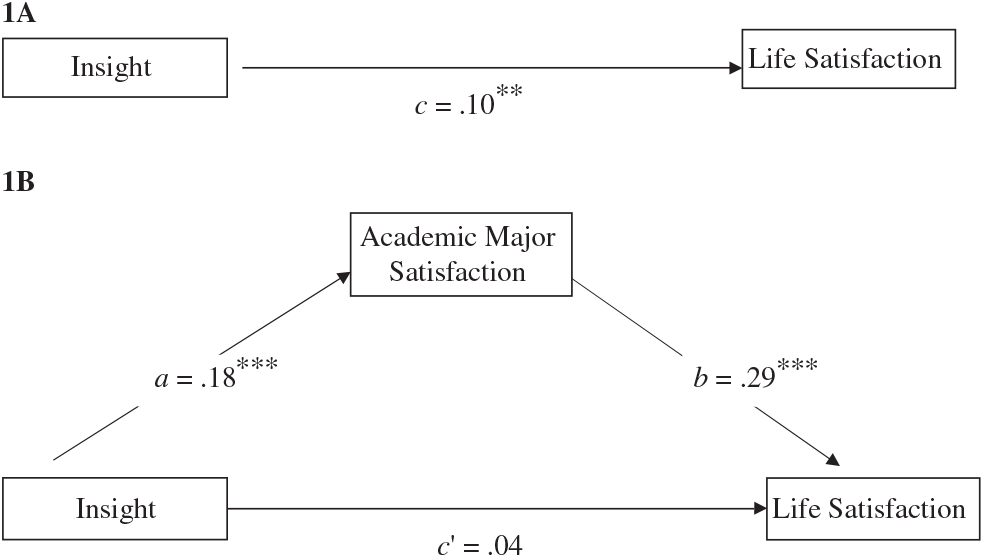
Figure 1A shows that the total effect of insight on life satisfaction is significant (c = .10, SE = .03, t = 3.14, p < .01). In addition, as shown in Figure 1B, the direct effect of insight on academic major satisfaction (a = .18, SE = .05, t = 4.06, p < .001) and the direct effect of academic major satisfaction on life satisfaction are both significant (b = .29, SE = .04, t = 6.65, p < .001). The mediation effect (i.e., indirect effect) of academic major satisfaction in the relationship between insight and life satisfaction (a × b = .18 × .29 = 0.05) does not include zero in the 95% confidence interval [0.03, 0.09], indicating that this indirect effect is significant, based on the 5,000 bootstrap method (Hayes, 2013). Further supporting the mediation effect is that when academic major satisfaction is added to the analysis as a mediator, the path coefficient between insight and life satisfaction becomes non-significant (c’ = .05, SE = .03, t = 1.49, p = .14). These findings support the full mediation effect of academic major satisfaction on the relationship between insight and life satisfaction. Additionally, the model with insight, academic major satisfaction as the mediator and the two covariates (gender and area of specialisation in education) significantly explain 23% (F 4–201) = 15.11, p < .001) of the total variance in life satisfaction, which was initially 13% (F 3–202) = 10.44, p < .001) without the mediator (academic major satisfaction) in the model. Table 2 shows the values regarding the total, direct and indirect effects.
Total, direct and indirect effects of insight on life satisfaction through academic major satisfaction, N = 206
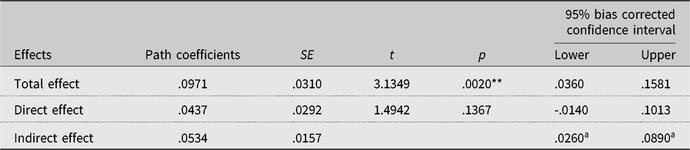
Note: a5000 bootstrap sample, Covariates: gender, area of specialisation in education.
*p < .05, **p < .01.
Discussion
The main purpose of this study was to investigate whether academic major satisfaction acts as a mediator in the potential relationship between insight and life satisfaction in a sample of Turkish college students majoring in education degree programs. The findings demonstrate that there are positive significant relationships between insight, academic major satisfaction and life satisfaction, and that academic major satisfaction mediates the relationship between insight and life satisfaction at a significant level. Although insight has been theoretically recognised as a significant therapeutic goal in counselling and psychotherapy (see Prochaska & Norcross, 2010), there has been a need for more empirical research regarding the role of insight in the daily lives of individuals with no severe psychological disorders, as only a few studies have focused on the importance of insight for such populations (e.g., Harrington & Loffredo, 2010; Lyke, 2009). Therefore, the findings of this study provide further empirical research as to the role of insight in the daily lives of non-clinical populations by suggesting that insight is associated with both academic major satisfaction and life satisfaction.
The positive relationship between insight and life satisfaction found in the current study is consistent with existing research, revealing a positive relationship between the two (e.g., Harrington & Loffredo, 2010; Lyke, 2009), and with counselling and psychotherapy approaches, placing insight at the heart of good psychological health (see Prochaska & Norcross, 2010). On the other hand, the relationship between insight and life satisfaction loses its significance when academic major satisfaction is included as a mediator in the model, which suggests that insight plays a role in life satisfaction because of its positive contribution to academic major satisfaction. This means that insight might be increasing college students’ academic major satisfaction through its a priori positive impact on their career planning process while in high school. Alternatively, insight might increase academic major satisfaction by helping college students use strategies that increase their success and academic and social integration into their majors, which in turn might be elevating their life satisfaction. Regardless of the mechanism behind it, the positive impact of insight on life satisfaction found in this study is consistent with the suggestion that insight plays a positive role in psychological wellbeing, particularly when it is supported by action (see Kolk, 1998; Markova & Berrios, 2011), which, in the current study, seems to occur through choosing an academic major that suits the individual.
Since college students majoring in education are the focus of this study, the results specifically add to an understanding of insight’s role in the life satisfaction of this specific population. The findings suggest that insight facilitates life satisfaction through its relationship with academic major satisfaction, meaning that insight increases life satisfaction among the participants either through having directed them to choose an area of academic study where they feel satisfied, which is education in this study, and/or through currently helping them employ strategies that increase their academic major satisfaction. Both these formulations support the proposition that insight may be functioning as an instrumental psychological construct helping individuals to make more effective decisions in life, such as a suitable academic major, and to flourish in these decisions, leading to an increase in overall life satisfaction.
Lastly, the fact that academic major satisfaction and life satisfaction have been found to be associated in the current study indicates that academic major satisfaction is not only an important index of certain academic outcomes, such as academic performance (Graunke & Woosley, 2005; Kim & Kim, 2016; Kim & Lee, 2015), self-regulated learning engagement (Kim & Kim, 2016) and career decision self-efficacy (Jadidian & Duffy, 2012), but also an important indicator of wellbeing among college students majoring in education. This is consistent with previous research suggesting that life satisfaction is associated with various domains and subdomains of life such as work (e.g., Adams et al., 1996; Bowling et al., 2010; Judge et al., 2005), leisure life (Ateca-Amestoy et al., 2008; Neal et al., 1999), romantic relationships (Gustavson et al., 2016; Hawkins & Booth, 2005), and social relationships (Amati et al., 2018).
Practical Implications for Career Counselling
The implications of this study appear to be specifically important for career counselling. The significant role that academic major satisfaction plays in life satisfaction highlights the importance of the career decision-making process for high school students, as it seems to be a potential predictor of the life satisfaction that they will experience later in higher education. As highlighted previously, in certain countries such as Turkey, most high school students have to choose a specific major before university, and thus they enter higher education having already decided on a major. Therefore, the results of the study underline that it is important for high school students to have access to career counselling services so that they can have support in choosing suitable academic majors by the time they start university. In addition, the fact that the life satisfaction of college students is highly associated with academic major satisfaction underscores the importance of college counselling services supporting students with academic challenges and choices faced throughout their university lives. Therefore, higher education institutions should place extra importance on the establishment and/or continuance of on-campus career counselling services for students struggling with academic choices and problems.
The finding of the study, that insight plays a role in academic major satisfaction, makes it especially important for career counsellors to take into consideration the place of insight in the academic decision-making process of high school students. Career counsellors should, in particular, consider the fact that students who are low on insight may need extra support with academic decision-making. This is where certain approaches, such as constructivist and narrative career counselling, which place an emphasis on developing insight through self-reflection, self-understanding and personal meaning, may be particularly useful (see McIlveen & Patton, 2007; Miller, 2004). In addition, the fact that insight is also an antecedent of life satisfaction highlights the importance of the development of insight in children and adolescents for their future wellbeing. Thus, it seems important that parental and educational approaches and practices are also designed to promote in children and adolescents a desire to understand the meanings and motivations underlying their own actions, feelings and cognitions, along with an ability to generate new perspectives regarding events and problems around them. This can help them grow into individuals who are able to make better life choices with which they feel satisfied and/or develop strategies that increase their satisfaction with their choices, which in turn increases their overall life satisfaction.
Limitations and Future Directions
One limitation of the present study is the use of self-evaluation tools in the collection of data, which risks internal consistency. As a result, future studies could use multiple data collection methods to overcome this limitation. Another limitation is the cross-sectional nature of the study design, which does not guarantee causal inferences, but rather provides an ability to speculate about the directionality of associations. In order to eliminate this limitation, future studies could use a longitudinal research design.
The sample’s composition of college students consisting only of students majoring in education poses another limitation regarding the current study, which may prevent the generalisability of the results to the general population and students majoring in programs other than education. On the other hand, it is important to remember that Lyke’s (2009) study with a community sample of 208 respondents and Harrington and Loffredo’ (2010) study with 121 college students both yielded similar results regarding the nature of the relationship between insight and life satisfaction, suggesting that external validity may not be as limited. Another limitation regarding the sample composition is the heterogeneity of the programs that make up the education degree programs of the study participants, which may limit the applicability of the results to students majoring in a specific education major. To achieve better internal validity, future studies could recruit participants from the specific major to which study results are sought in order to be specifically applicable.
Conclusion
Although previous research has indicated a positive relationship between insight and life satisfaction among college students (i.e., Harrington & Loffredo, 2010), no study has examined exactly how insight increases life satisfaction. Based on suggestions that insight might result in positive wellbeing because it can help individuals make better life choices (e.g., Barron, 2012; Sonstegard, 1998), such as choosing a suitable academic major, this study was conducted to examine whether insight increases life satisfaction through increasing academic major satisfaction in a sample of college students majoring in education. The results confirm that insight facilitates life satisfaction by increasing academic major satisfaction, with a model accounting for 23% of the total variance in life satisfaction. The findings reveal significant implications for the planning and provision of career counselling and guidance services provided within high school and university settings in countries such as Turkey, where career counselling services have certain deficiencies.
Footnotes
Author ORCIDs
Elif Cimsir
Acknowledgments
This research was supported by Anadolu University (grant number 1805E140).
Conflicts of interest
None.