







Abstract
Abstract
School counsellors implement preventative programs to build student resilience and coping skills to counteract the rising mental health needs of children in Australia. School-based meditation programs are effective for individuals and groups, with documented benefits. Most literature examines mindfulness meditation, and the current, exploratory study aimed to add to the research breadth by considering stillness meditation. The stillness program ‘Let’s be Still’ is a 10-week, class-based program that was conducted between 2015–2020 by the school psychologist in a regional, independent New South Wales school. Data were collected from questionnaire responses of 169 Year 2 (7–9 years) and five teachers to document what the children had learnt and how it helped them. Thematic analysis of the responses revealed an emphasis on stillness promoting positive emotions and behaviours. Both students and teachers articulated that learning and practising stillness provided the students with tools to be calm, relaxed and settled, to deal with conflict and to have a break from the busyness of the school day. While the study design does not allow generalisability of the program’s effectiveness, this study may offer input for school counsellors considering the implementation of a school-based meditation program.
Rationale
Student wellbeing is important for schools and for school psychologists, as increased psychological wellbeing leads to better educational outcomes and improved behavioural and emotional functioning (Anderson, 2005). Psychoeducational preventative programs in schools are helpful for maintaining and enhancing student wellbeing and resilience by teaching psychological strategies and coping skills (Chodkiewicz & Boyle, 2017; Hudson et al., 2020). Stillness meditation shows promise as a primary preventative mental health strategy in schools as it is cost effective, flexible, suitable for all ages, effective for individuals or groups, and easy to learn (Renshaw, 2019; Sattarshetty, 2016).
The necessity of effective psychological programs is indicated by recent studies highlighting the mental health needs of young people. A recent report by Mission Australia (2019) reports the top three personal concerns of Australian young people as coping with stress, school and study problems, and mental health. In particular, steady increases in childhood anxieties over the past decade (Danchin et al., 2019) point to a generation in need of psychological intervention.
Australian young people are most likely to seek help from accessible frontline workers such as general practitioners and school counsellors, especially in rural areas (Boyd et al., 2007). According to the Mission Australia (2019) report, three in ten students stated they would turn to a school counsellor for help, which is evidenced by the continual rising demand for school counselling (Campbell & Colmar, 2014). Programs that promote resilience and coping can potentially reduce long-term counselling needs and help manage the rising demands.
School counsellors are well positioned to incorporate both broad and targeted preventative interventions because of their social and emotional learning role within the school system (Bernard et al., 2017). Being positioned within the school system, practitioner-based school psychology studies provide a real-world understanding by offering insight into the views of students and teachers and offering practical solutions to student issues. Research that considers the effectiveness of preventative programs is fundamental to ensuring best practice for social and emotional wellbeing (Amundsen et al., 2020).
What is Stillness Meditation?
Stillness meditation has its roots in ancient prayer and meditation that has been practised for thousands of years. In the 1960s, Australian psychiatrist Dr Ainslie Meares established the use of stillness to treat anxiety and fears in the therapeutic setting without drugs (Meares, 1967). Stillness meditation, which may not be widely practised (Woods et al., 2020), involves simply allowing oneself to experience the natural ‘contentless’ stillness of the mind and body for a period of time, as a reprieve from the busyness of the everyday (McKinnon, 2002; Woods et al., 2020). Stillness is an opportunity to be open to the present moment and to simply ‘be’, without judgment or focus on particular thoughts, sensations or reactions (Fisher, 2006). During the process of being still and mindful, the individual allows the suspension of emotionality and invites emotional regulation and acceptance as well as self-monitoring and attentional return (Flook et al., 2015). As the author of the ‘Let’s be Still’ stillness meditation program states: ‘all systems of meditation can bring positive life change if genuinely practiced’ (McKinnon, 2002, p. 13).
Mindfulness and stillness are distinct forms of meditation. The practise of stillness, where one’s mind ceases activity, is different to mindfulness, which focuses on conscious awareness (McKinnon, 2016). The stillness experience is one of effortlessness, allowing the physical body to become heavy and still, leading to mental regression that involves the suspension of thought and sensation, allowing the brain to rest from input of stimuli (McKinnon, 2016). While both are forms of meditation, stillness has been described by Sattarshetty (2016) as the ‘experience of mental silence’ (p. 11), whereas mindfulness is defined as conscious awareness (Huppert & Johnson, 2010).
Benefits of School-Based Meditation Programs
Various meditation programs have been used in schools for the reduction of mental health risks (Sattarshetty, 2016) or to increase emotional-behavioural skills (Renshaw, 2019), with demonstrated benefits for primary school-aged children (Amundsen et al., 2020; Sattarshetty, 2016). Most studies about school-based mindfulness meditation report benefits such as relaxation (McCabe et al., 2017) and improvements in engagement and academic behaviour (Felver et al., 2013), emotional health (Joyce et al., 2010), socio-emotional learning (Fleshner, 2020), self-regulation (Flook et al., 2015) and metacognition (Vickery & Dorjee, 2015). Further, studies also report that school-based mindfulness can decrease disruptive behaviour (Flook et al., 2010; Klingbeil et al., 2017) and negative affect (Dove & Costello, 2017; Vickery & Dorjee, 2015), including the regulation of fear, worry, anger, annoyance and frustration (Bannirchelvam et al., 2017).
There are a few classroom-based studies that specifically examine the effectiveness of teaching stillness meditation for wellbeing (Bornstein, 2012; Fisher, 2006; Sattarshetty, 2016; Terjestam, 2011). In particular, stillness has been shown to help children to develop insight (Crawford & Willhoff, 2013), generate thought and reflection (Fisher, 2006) and spiritual engagement (Lees, 2013), and to reduce mental health risk (Sattarshetty, 2016).
Research Needs
Previous studies report that children find mindfulness meditation programs both useful and acceptable (Joyce et al., 2010; McCabe et al., 2017), as well as enjoyable and appreciated (Amundsen et al., 2020). An examination of the literature suggests a need for further research that considers the effectiveness of meditation programs in schools (Fisher, 2006; Semple et al., 2017), especially for primary school-aged children (Amundsen et al., 2020). In particular, research that incorporates the opinions of the primary stakeholders — namely, the child participants — affirms the importance of hearing the voice of the child (McCabe et al., 2017). As stillness meditation is not well known or studied (Woods et al., 2020), such research can contribute to a wider breadth of understanding of meditation for children, complementing the existing mindfulness research.
Study Purpose
This study aimed to consider the voices of children and teachers in examining the subjective benefits of a 10-week Australian stillness psychoeducational program called ‘Let’s be Still’ (McKinnon, 2002). Broadly, the study sought to add to the literature on the effectiveness of stillness meditation. Specifically, the purpose of the study was to answer the question ‘Does a preventative stillness program have helpful or positive impacts for participants?’
Methods
Stillness Program
‘Let’s be Still’ (McKinnon, 2002) is an Australian stillness program for primary school-aged children. The 10-week program includes a structured weekly lesson (45 minutes duration) that is comprised of reading and discussing the recommended groups of chapters of the novel called Quiet Magic (McKinnon, 1992), learning and practising stillness, and drawing. The program was conducted by a school psychologist.
In reading the novel, the class follows the journey of a young boy called Jimmy Candlestick, who initially relies too much on technology and does not have any connection with other people, animals, nature or himself. As the novel progresses, the class learns, as does Jimmy, that true happiness is about being in touch with yourself and your surrounds through ‘stillness’, and not by focusing on technology. As Jimmy learns to practise stillness, he also learns to recognise his emotions and how to regulate them. Jimmy learns to stop and notice his surroundings and to relate to nature and others. In doing so, he gains self-confidence and is able to authentically connect with his true self.
Participants
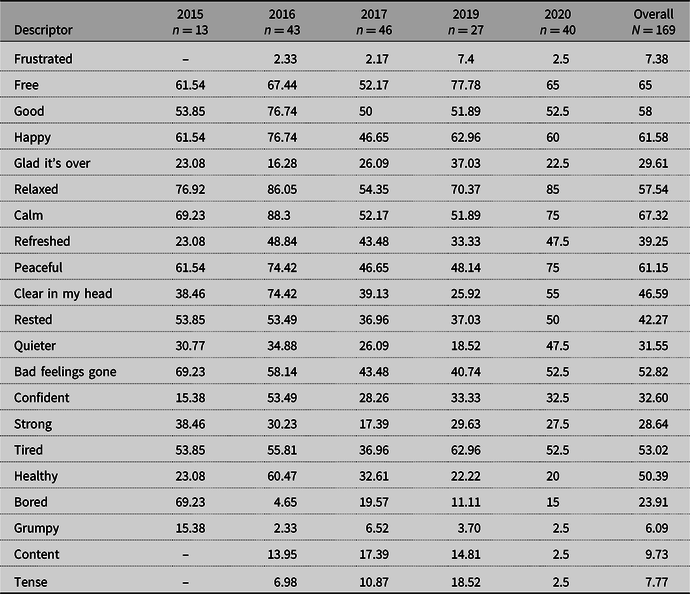
Participants were 169 Year 2 students (aged 7–9 years old) and five teachers from a private independent school in a regional area in New South Wales, Australia. The Year 2 cohort from five years (2015, 2016, 2017, 2019 and 2020 1 ) were included. There were variations in student numbers within the cohort each year, as shown in Table 1. The teachers who participated in the study were involved in the program in at least one of the study years.
Percentage of student participants choosing the descriptor in response to ‘How do you feel after stillness? Circle as many as you like.’
Data Collection
Data were collected via a simple, anonymous student questionnaire that was administered to the students by the teacher in the final lesson of the 10-week stillness program in each of the following five years: 2015, 2016, 2017, 2019, 2020. A qualitative survey was utilised in order to ask simple identical questions while still enabling individual comments, thus raising few ethical issues (Braun & Clarke, 2013). The questionnaires were initially administered for the purpose of ongoing program evaluation. 2 Teacher feedback was also comprised of an anonymous survey and was administered to teachers in 2020.
Questionnaires
To maximise comprehension of the survey, given the young age of the students, the questions were developed in conjunction with teachers. To minimise response bias, leading questions were avoided, and straightforward simple questions were used. The questionnaires were administered by the class teacher rather than the psychologist to reduce acquiescence bias, and all child participants were surveyed to decrease sampling bias.
The student questionnaire included three simple survey questions. How do you feel after stillness? (circle as many descriptive words as apply). What have you learnt from being still? (write a short response). How can stillness help you in your life? (write a short response).
The teacher questionnaire included three simple survey questions. I was able to practise stillness with my class through the week (apart from the ‘Let’s be Still’ lesson time) (YES/ NO). I found stillness was helpful for my class (YES/NO). Please explain (write a short response).
Data Analysis
Descriptive statistics (percentages of responses) were calculated for student question 1. Thematic analysis of the responses to questions 2 and 3 of the student survey and question 3 of the teacher survey was conducted using NVivo12 (Mac). An essentialist approach by the researcher allowed the participants’ subjective meanings and perceptions to be voiced. This approach also acknowledged that the researcher was also the school psychologist conducting the program and thus was an active part of the interpretation of the data. Inductive thematic analysis at the semantic level was employed to identify and report patterns through Braun and Clarke’s (2013) six-step process. The student responses were read and reread to enable familiarity, and initial codes of interest were manually scribed and mapped to identify patterns (Braun & Clarke, 2013) across the data before being clustered to form themes and subthemes (Belotto, 2018). Reliability and rigour were pursued by the verification step of reviewing for discrepancies and errors. The results are displayed as the number of comments that were coded to each theme accompanied by representative quotes to allow participant voices to illustrate the results (Belotto, 2018).
Results
Student Feedback About the Stillness Program
The most frequently chosen descriptors in a given year were generally the most chosen overall. From all the students combined, the most common descriptor was ‘calm’, chosen by 67% of participants, followed by ‘free’ (65%) and ‘happy’ and ‘peaceful’ (both at 61%). The descriptors ‘good’, ‘relaxed’, ‘tired’ and ‘bad feelings gone’ were chosen by more than half of all participants to describe stillness. These words often also appeared in both the student and teacher short responses.
Frequently used words in the student responses are displayed in Figure 1, where the use of the word is indicated by its size. For example, the word ‘calm’ was mentioned 87 times in responses. Therefore, it is the largest word in the word cloud; the word ‘helps’ was mentioned 47 times and is shown as the next biggest word.
Student-participant responses to short answer questions are displayed in a word frequency cloud (the size of each word represents the overall frequency of use of that word in all responses combined).
The students were able to articulate both how stillness helped them and what they learnt from the program. The context around students’ use of the word ‘stillness’ in their responses outlined how and when stillness helped them to manage difficult situations and emotions (Figure 2).
The word tree visualises the range of student-participant responses that incorporate the word ‘stillness’.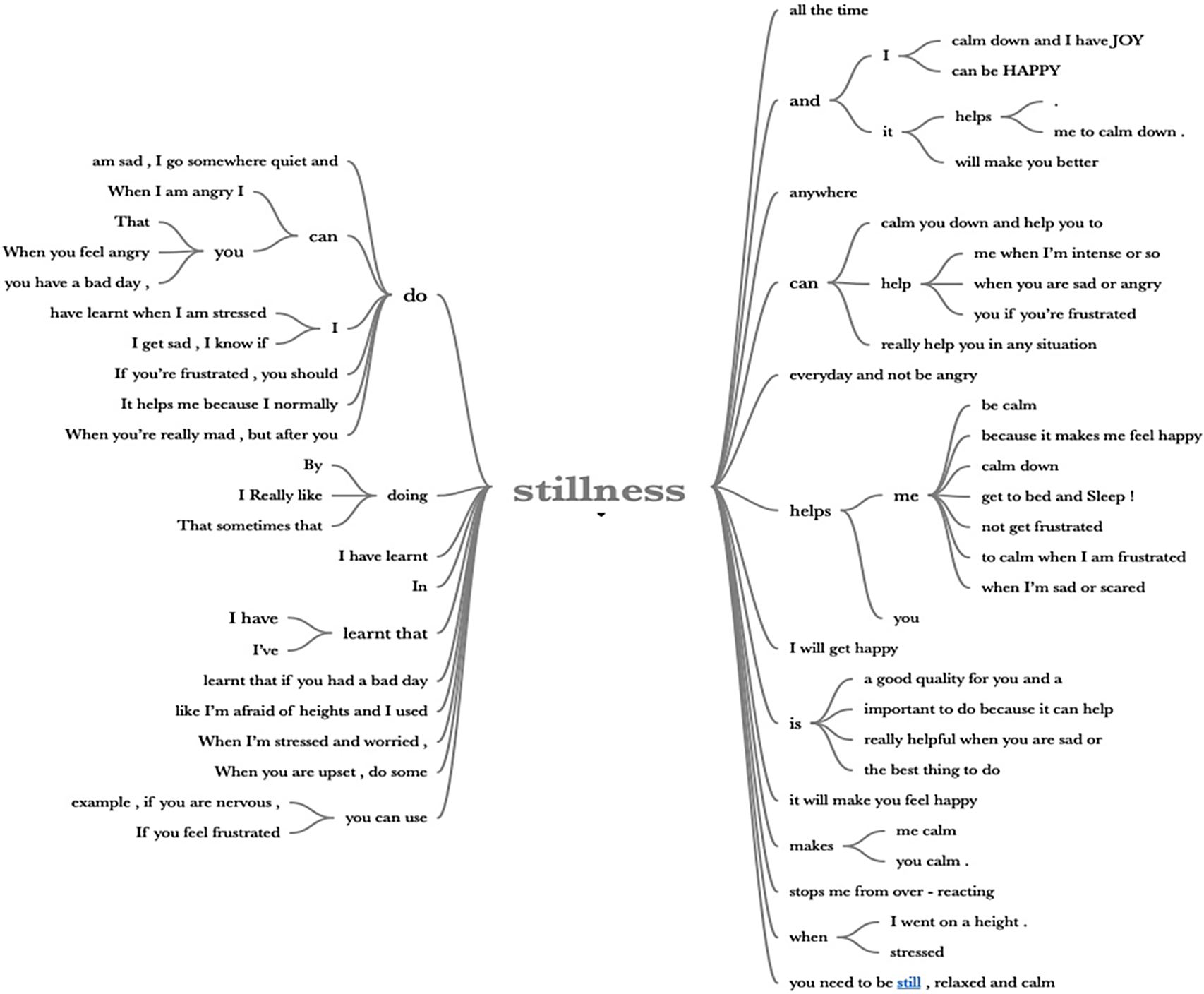
The children’s responses largely clustered into two main groups: increases in helpful behaviours and emotions and decreases in difficult behaviours. Thematic analysis of the responses revealed three main themes with the promotion of helpful emotions as the highest ranking theme (see Table 2). Several subthemes emerged from themes and included specific aspects of improvements (refer to Figure 3).
Themes emerging from the student responses to question 2 and the number of comments to each theme

Themes arising from short responses.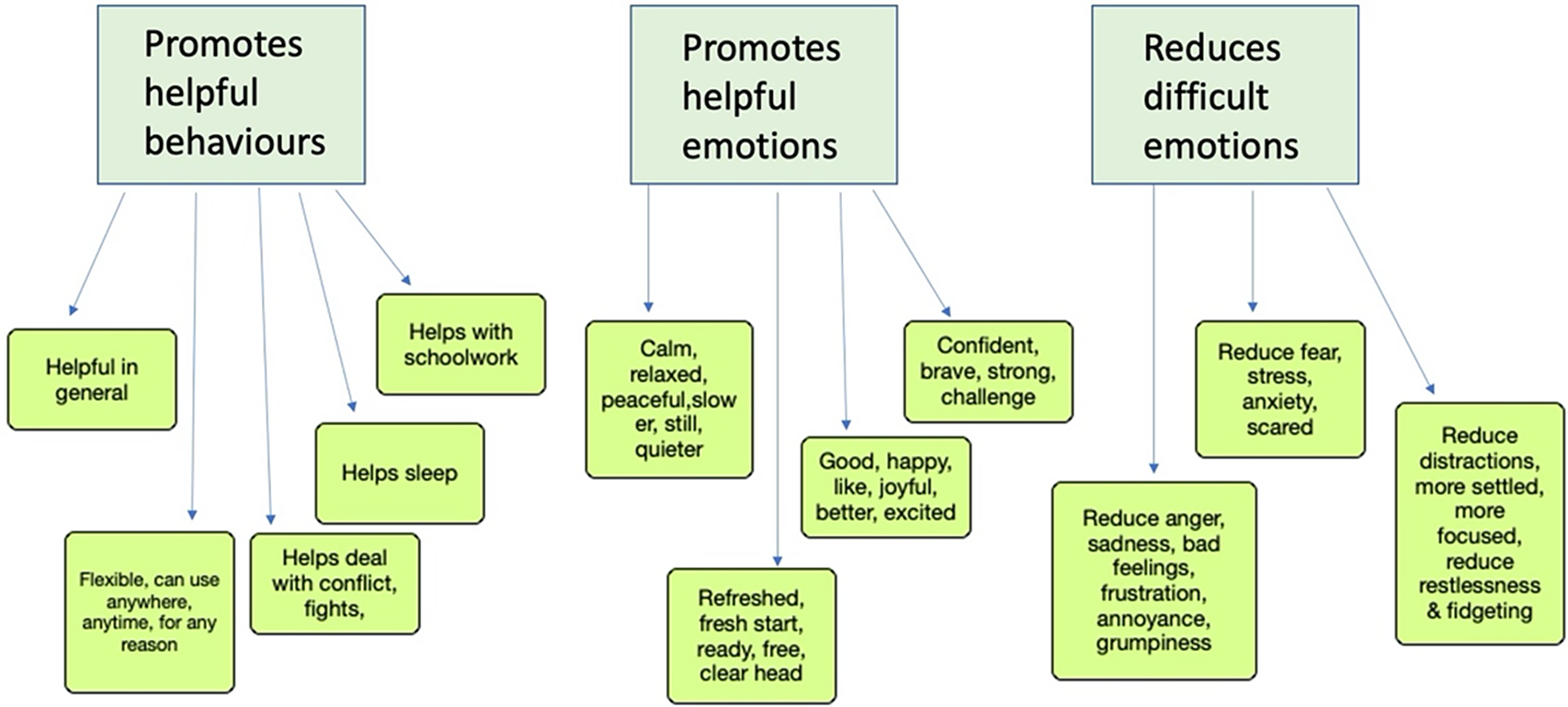
The majority of student responses pertained to an increase in helpful emotions (82 references), and in particular to being calm or relaxed: ‘I have learnt from being still that when you have some quiet time, you feel new and calm.’
Comments about feeling confident or brave also featured; for example: ‘It makes me feel confident and strong.’
Some students highlighted the flexibility and generality of stillness meditation: ‘I’ve learnt that stillness can really help you in any situation.’ And some students learnt that stillness could help with specific aspects of life: ‘I learnt it helps me concentrate on my work and relax’ and ‘That being still can help you sleep.’
Themes emerging from the student responses to question 3 and the number of comments for each theme

Of the references to the theme of positive emotions, most comments were about how stillness helped encourage calmness, relaxation, peace and happiness: ‘Stillness helps me because it makes me feel happy and good.’
Many participants wrote about how stillness can reduce negative feelings, such as fear, worry or anxiety, and that stillness gave them tools to cope: ‘It stops me worrying and helps me thinking of the world around me’ and ‘Stillness can help me when I’m intense or so worried that I don’t know what to do, it could let me know what to do.’
Sometimes, students gave specific examples: ‘It can help when you feel scared, like I’m afraid of heights and I used stillness when I went on a height.’
Other students reported that stillness helped them manage their difficult behaviours or emotions in particular situations, such as: ‘Stillness stops me from over-reacting’ and ‘When we have fights and I am sad, I go somewhere quiet and do stillness.’
Teacher Feedback About the Stillness Program
The five participating teachers unanimously responded ‘Yes’ to both questions 1 and 2, reporting that they all practised the stillness with their classes and all found the program helpful. Using the same thematic analysis process as used for the students, the teacher responses were coded under the three main themes and various subthemes (Table 4).
Themes emerging from the teacher responses to question 3 and number of comments for each theme

All of the teachers’ responses demonstrated how stillness promoted helpful behaviours and emotions. In particular, they reported that stillness helped in general, and chiefly promoted calmness and relaxation. Two teachers commented specifically about stillness helping with playground issues: ‘There are a lot of playground skirmishes that sit heavily on the children when they get back to class. By learning stillness, the children are learning to give space to problems so that they don’t grow bigger but they have time to think it though and react more appropriately’ and ‘Stillness enabled them to unwind from a hectic play time (lunch/recess) where there could have been some conflict.’
One teacher commented on the class being more settled during transitions: ‘… the skill of being able to calm ourselves down to move around the school quietly by going into an internal space — thinking of our own feelings and connecting with nature around us as we walked from place to place.’
Three teachers commented that learning stillness was a process that required practice and that some children found the skills more difficult to master than others: ‘As I practised stillness with my class, I noticed improvements in the amount of time they were able to be still.’
All of the teachers commented that the skills and program were advantageous: ‘The children benefitted from being able to take some time out from the busyness of the day’ and ‘I believe an increase in this ability is most likely to have positive effects on their general wellbeing.’
Discussion
The benefits of the ‘Let’s be Still’ stillness program for Year 2 students at the participating school are highlighted in this study. The derived benefits reported by teachers and students included increases in positive emotions and behaviours and reductions in unhelpful or difficult emotions and behaviours.
The evaluation of this program in a school setting supports previous studies that indicate that meditation training in schools can be effective and beneficial (Flook et al., 2015; Flook et al., 2010), especially if practised consistently (Huppert & Johnson, 2010). In particular, the current study adds to the literature about how stillness meditation may have emotional and behavioural benefits for some young children in an educational setting.
The various ways that the children applied stillness skills, even when no adult direction was present, arose in both the teachers’ and students’ comments. Analysis of student and teacher responses provided evidence of how practising stillness assisted students by promoting helpful or positive emotions, especially feelings of calm, relaxation and being settled, as well as happiness and good feelings. Reduction in unhelpful feelings such as anger and sadness, and unhelpful behaviours such as distractibility were also reported benefits of practising stillness. Further, stillness skills helped with the process of conflict management by allowing space for insight, which suggests increased resilience and coping skills. These results build on previous studies into school-based mindfulness meditation that report improvements in social, emotional and behavioural aspects of wellbeing (Bannirchelvam et al., 2017; Dove & Costello, 2017; Vickery & Dorjee, 2015)
Applications for School Counselling Practice
This study was successful in showcasing the views of both teachers and students regarding the benefits of a several years long meditation program. The student and teacher responses in this study align with the literature suggesting that children are receptive to meditation and are able to incorporate the practices into their daily lives (Joyce et al., 2010), particularly when the program is experiential focused (Bannirchelvam et al., 2017). From stakeholder feedback, this study provides an indication that a stillness meditation program such as ‘Let’s be Still’ could have positive wellbeing benefits for other schoolchildren, depending on the context and resources. Learning meditation can be challenging (McCabe et al., 2017), and for some students in the present study, this was the case. The majority of students, however, were able to adapt to sitting quietly and having a body and brain break, which supported previous findings (Bornstein, 2012). Because of its ease in presentation, associated low costs and resources, as well as fitting with reported national wellbeing priorities, (Mission Australia, 2019), meditation may be a promising option for the implementation of preventative school programs that build student resilience and coping skills.
Limitations and Future Directions
While the author acknowledges the limited ability of young students to comprehensively account for the benefits of a program, this study allowed their voices to be heard. A subjective, evaluative study is not necessarily generalisable to other cohorts, ages, programs, schools or situations, as has been previously pointed out by Semple et al. (2017). As an applied practitioner study, it is further limited as it did not include a control group or preprogram data and did not collect data on within-group differences. Subsequent research could use an experimental design to allow more definitive conclusions to be made. Longitudinal designs with larger groups of students across several schools may also contribute to generalisability and information regarding long-term effectiveness. Consideration of whether the implementation of similar programs decreases the demand for counselling at school may also be a relevant outcome measure. While most of the responses from participants were positive, there were a few comments from participants about the program being boring and hard to master. Although beyond the scope of this study, a more comprehensive study may wish to consider different opinions of such programs in more depth.
This exploratory study provides a preliminary evaluation of the potential emotional and behavioural benefits of the ‘Let’s be Still’ stillness meditation program for young children, using the voices of key stakeholders.
Footnotes
Acknowledgments
The author would like to acknowledge the author of the ‘Let’s be Still’ program, Pauline McKinnon, for her guidance, support and wisdom. The author would like to thank the school, the staff and the students who participated in the program and completed the surveys. Finally, the author appreciates the time and constructive feedback from the editor and reviewers of this journal.
Conflicts of interest
None.
1
Year 2 students in 2018 completed the ‘Let’s be Still’ program but surveys were not conducted.
2
In 2020, permission was granted by the school principal to use the data collected from student surveys and teacher surveys in order to describe the effects of the Let’s be Still program. The research met the NHMRC (section 5.1.22) ethics exemption requirements for research of ‘No more than low risk’ (i.e., negligible risk and using existing nonidentifiable data). Therefore, ethics approval was not pursued for this study.