







Abstract
Abstract
The importance of social emotional learning (SEL) has been well acknowledged as a significant feature of education and emotional development across the life span. School psychologists play an important part as innovators, implementers and evaluators of resources in the social emotional domain. When it comes to the early years in the education system, social emotional aspects of the curriculum form the basis of the learning experience. Teachers utilise resources that enhance their classroom practice. Coping research and practice has had a long history in the literature, but the translation to early childhood educational practice, supported by school psychologists, is a more recent development. This article details three innovations, namely, The Early Years Coping Cards, Families Coping and the COPE-Resilience Program. Development, applications, and evaluations are considered to highlight the significant role school psychologists and trainee psychologists can play.
Having practised for several decades as a school psychologist, and a similar period involved in the training of school psychologists, the work that I was engaged in always had to meet two requirements; namely, to be evidence based, and to have practical applications. In 2010 I was invited into the Early Learning Centre at the University of Melbourne, located kilometres from the university in a leafy suburb, to bring the research on coping that I had been associated with to the Centre and to its community. The invitation was an attractive one in that it enabled me to progress the research on stress and coping and bring school psychology trainees on board as researcher practitioners. The richness of learning in such a setting was a gift to those who are interested in child development, prevention and intervention. We embarked on a journey of discovery and productivity. In describing the journey, it is possible to share both the tangible outcomes and the published evidence that are linked to particular aspects of the project.
My coping research journey started some three decades earlier when, as an education professional, I became aware of the work of Richard Lazarus from Berkley, California, who had moved from stress research to coping (Lazarus, 1993). For me this was a ‘lightbulb’ moment that helped to focus my research on what people do and can do rather than what they cannot — that is, coping. For several decades that followed, my colleague Ramon Lewis and I researched the coping construct and developed tools to measure coping in adolescents and adults and to consider what was helpful and unhelpful coping, and both how to teach about coping and how to develop the skills required to cope effectively.
In simple terms, coping comprises the thoughts, feelings and actions that individuals employ in response to a particular situation. While the empirically derived constructs had been found to be relevant for adults and adolescents, it became clear that the younger the children were when they developed good coping skills, the better the outcomes in terms of their resource building and adaptation. Thus, in 2010, I jumped at the opportunity to work with young children, their teachers and parents, and to bring educational psychology students on the journey. Thus began the Early Years Coping Project. It was underpinned by the growing appreciation of the importance of Social Emotional Learning (SEL) in the educational context.
SEL has always been self-evident to counsellors and school psychologists in that both relationships and emotions are core skills and capacities that need to be fostered in the context of child development, whether it be in the home, the school or beyond. It now features as an essential requirement in school curricula guidelines, although this was not always the case. Much of the credit for bringing SEL to the forefront of education can be accredited to the Collaborative of Academic Social Emotional Learning (CASEL), who for several decades have clearly articulated five broad areas of Social Emotional Competence (SEC); namely, self-awareness, self-management, social awareness, relationship skills, and responsible decision making (CASEL, 2020). These five competences can be taught and applied at various developmental stages from childhood to adulthood and across diverse cultural contexts. Coping skills, the area that I had been researching since the mid 1980s, was clearly an important vehicle for teaching SEL and was an important feature of SEC.
The project was organic, with an average of two postgraduate trainee psychologists joining the project each year over a 10-year period. There were three broad phases, each extending over a number of years. First, we set about establishing what concerned children 3–6 years of age, and then sought to establish how they coped. This was much like the process that we had followed when developing the Adolescent Coping Scales (Frydenberg & Lewis, 1993, 2011) and the Coping Scales for Adults (Frydenberg & Lewis, 1997, 2014), by first perusing the literature and then going to the population involved. Having established how adults and children cope, we were then able to incorporate the tools and insights about children’s coping into a parenting program so parents were able to reflect on their own coping as well as that of their children, using a shared language (Frydenberg & Deans, 2012). The third phase was to incorporate our knowledge into a coping skills resiliency program that focused on age-appropriate social emotional development. Each of these phases are outlined in this article. It is important to note that educational psychology students were engaged in various stages and phases of the program, such as design of a component to be investigated, interviews with teachers, parents and children where relevant, data collection and analysis, and reporting. Their work is acknowledged in the publications that carry their names, and where appropriate as lead author.
Phase 1: Children’s Concerns and Coping
In the first instance, having investigated the literature, we captured children’s coping in a 29-item Children’s Coping Scale (Deans et al., 2010). Using a ‘question-answer’ interview with children to identify coping responses, and using an online survey with parents, we were able to match parents’ understandings of their children’s coping responses. The coping strategies reported by children and their parents were grouped into active, passive, and relational coping. Children spontaneously provided more coping strategies than those listed in the parent survey. Children reported using more active coping than passive coping. Parents reported that their children used more passive coping than their children actually used. It was clear that children have the capacity to articulate their understanding of coping. Children are capable of comprehending and talking about complex topics. Educators can draw on these capacities to further children’s social and emotional development.
We then went to children of that same age group, and using thematic analysis we encoded children’s descriptions of their coping in response to seven age-appropriate challenging situations displayed on visual images (Chalmers et al., 2011; Frydenberg & Deans, 2011). The majority of children could articulate several of the productive coping skills that they applied across a few different challenging situations. Separation anxiety was found to be the most challenging situation for children to apply productive coping skills. We engaged parents (44 mothers and 23 fathers) and teachers (4 females) of 46 four-year-old preschoolers to establish cross-information of their children’s coping. Mothers reported more passive coping for their children than did the teachers, which might be related to the differences in relationship and perspective. Fathers were more likely to rate their children as working hard at solving problems than did the mothers. The implication is that regardless of the different perspectives taken by parents and teachers, once there is a language and appreciation of what constitutes helpful and unhelpful coping, they can contribute to creating environments that support productive or unhelpful coping in children.
Children’s anxiety is increasingly a key concern for parents and teachers, so we were interested to consider the relationship between coping and anxiety in the expectation that we could impact and reduce anxiety in the process of talking about coping. Within anxiety research it is well established that avoidant coping is a central feature of anxiety in children (Baldwin & Dadds, 2007; Beesdo et al., 2009). Ninety-four parents reported on the 29-item Children’s Coping Scale — Revised, using a 3-point Likert-type scale, how frequently their child used a particular coping strategy (Yeo et al., 2014). Examples of items on the scale include ‘Notice what others are doing’, ‘Keep feelings to self’ and ‘Ask a teacher for help’. The same strategies were presented for situation-specific coping questions in which parents rated how often the child used each of the strategies in two different situations, namely, separating from parents and being asked to do something he/she does not like. These two situations were selected as they were common stressful situations for this population of children. In addition, they are thought to represent a low-control situation (separating from parents) and a high-control situation (doing something he/she does not like). The Spence Preschool Anxiety Scale (SPAS) was used to measure parent-reported anxiety in children. A list of 34 symptoms of anxiety (e.g., ‘Afraid of meeting unfamiliar people’ and ‘Spends a large part of each day worrying’) are included in this questionnaire in which parents are asked to rate how true each symptom is of their child on a 5-point Likert-type scale (Spence et al., 2001). Three distinct coping dimensions were derived by analysing the factor structure of the Children’s Coping Scale — Revised, that is, positive coping, negative coping–emotional expression, and negative coping–emotional inhibition.
The positive coping dimension in that study consisted of both problem- and emotion-focused coping strategies as well as primary- and secondary-control coping strategies. Positive coping included emotion-focused strategies such as ‘Be happy with the way things are’ and ‘Hope’. It also included a number of coping-by-distraction strategies such as ‘Go out and play and forget about their problem’ and ‘Chat to friends’. These distraction strategies would typically be considered secondary-control coping in adult research, but in this sample, both primary- and secondary-control strategies were categorised under a single positive coping dimension.
As predicted, preschoolers who rated higher on anxiety were more likely to engage in negative forms of coping while less anxious preschoolers were more likely to engage in a positive form of coping. This suggests an early pattern of maladaptive coping among more anxious children.
Contrary to adult and adolescent models, preschoolers in general were more likely to use negative coping in a more controllable situation and to use positive coping in a less controllable situation. There was a significant effect in the opposite direction, suggesting that preschoolers in this sample engaged in both forms of negative coping, namely, negative coping–emotional expression and negative coping–emotional inhibition, to a greater extent in the high-control situation (doing something he/she does not like) than in the low-control situation (separation from parents). One possible explanation for these findings is more theoretical — the difference in preschoolers’ coping may not be differentiated on the basis of the level of control, as young children may simply have difficulty judging the controllability of a situation (Compas, 1998; Fields & Prinz, 1997). The concept of controllability may not be as applicable for children in this developmental stage.
Although these taxonomies of coping have been used in research with children and adolescents (Band & Weisz, 1988; Steele et al., 1997), the study of coping in children requires a developmental perspective as broad adult-based dimensions of coping may not be applicable to children. For example, the primary-secondary control distinction may not be valid for young children as they may have less control over circumstances (Fields & Prinz, 1997). Even when they have control over the situation, young children may not understand the distinction between exerting control over situational events and control over internal events (such as thoughts and emotions). Alternatively, secondary control coping may have yet to develop in early childhood because of the concrete operational or preoperational level of children’s cognitive capacity (Piaget, 1970). Band and Weisz (1988) suggest that secondary control may result from efforts to provide some measure of control when primary approaches have failed or are deemed unworkable. It is only with development that children come to appreciate the unworkability of primary control in various situations (e.g., learning that screaming in the doctor’s office will not prevent a shot).
There may also be qualitative differences in the coping methods employed by children and adults, and the same coping behaviour may serve different functions. For example, a child who cries when distressed is seemingly using emotion-focused coping but may actually be employing problem-focused coping in that crying often brings the attention of adults who may then resolve the stressor (Rudolph et al., 1995). Similarly, Amirkhan and Auyeung (2007) suggested that a coping strategy such as ‘Fantasised how things could be different’ may represent a rudimentary form of problem solving for young children. Alternatively, other unexamined variables (e.g., how enjoyable or important the task is perceived to be) may influence coping to a greater degree.
The Early Years Coping Cards
Having identified descriptions of coping, we engaged an educational psychology student to visually represent the coping constructs that we then called the Early Years Coping Cards, a teaching and learning tool that depicts a range of seven visual representations of challenging situations and 22 coping strategies used by the children (Frydenberg & Deans, 2011). While the tools are readily available from the Australian Council of Educational Research, it is the concepts of concerns and coping that are relevant, as any practitioner, teacher or parent can take these concepts and make their own visual apparatus with which to engage children to begin a conversation about concerning situations and coping strategies.
The 22 cards provide clinicians and educators with a visual tool to help focus the attention of either individual children or groups of children on seven challenging everyday situations that may cause uncertainty or fear and strategies for coping with these situations. The cards have been designed to stimulate discussion and support effective learning outcomes in the social emotional domain, and include children learning about friendship, making choices, expressing and regulating emotions, resolving conflicts and developing empathy. Clinicians and educators use such images to teach social emotional skills in the course of their professional practice with individuals and with groups.
Application of the Early Years Coping Cards in multiple settings with teachers and parents (Deans et al., 2012) and parents’ use of the Early Years Coping Cards (Frydenberg et al., 2014) are described elsewhere.
The Situation Cards depict the following events that are commonly encountered by young children: A change (in food)/Try new things Saying goodbye Scared of the dark Being told off by the teacher Wanting to play with others or choosing a group to play with Bullied Get hurt.
The Coping Cards provide visual cues about the different ways in which children may respond to the situations presented. They include: Think happy thoughts Hug a toy Blame others Blame self Scream/Cry/Tantrum Talk to an adult/someone Worry/Scared Keep feelings to self/Stay quiet Run away (leave home) Stop and think Hide Help others Cry Broken toy Get angry Work hard (play) Complain of pain.
There are various ways to use these and any such images as a tool (Frydenberg & Deans 2011).
There is what we have described as the ‘I see, I think, I feel’ approach, when the situation or coping images can be presented one at a time to either individuals or groups of children and users can ask questions such as: What do you see? What do you think is happening? How does the child in the picture feel? What do you think this child would do? Has this happened to you? How would you feel if that was you? What would you do when you feel like this? What would you do to make yourself feel better?
What we term as the ‘see and tell’ approach encourages the practitioner to ask whether there is anything else ‘you would like to do to deal with the situation?’.
The ‘scatter and select’ approach invites the child or children to first select one card from the Situation Cards. It is then suggested that, as a form of problem solving, the child or children can select a way of coping with the situation from the range of Coping Cards provided. The ‘sort and group’ approach invites the child to place three piles of Coping Cards on the floor or the table and the child or children are shown three groups that are labelled the ‘a lot or often’ group, the ‘a little or sometimes’ group, and the ‘not at all or never’ group.
In the ‘display and discuss’ approach, the user can stimulate conversation by displaying the Situation and Coping Cards either on a screen, noticeboard or table-top. It is helpful to be able to visually refer to both the Situation Cards and the Coping Cards over the course of a day or a few weeks. Users can ask children ‘How would you do it next time?’ and ‘Who would you like to get help from or work with next time?’
Theoretically, there are an infinite range of situations that children find themselves in, and likewise an infinite range of coping strategies that can be called upon. The range of situations and coping strategies are often determined by the context, and the person using the cards is encouraged to augment the list of what is considered appropriate to meet the needs of individuals or groups of children. Indeed, the situation and coping concepts or constructs, which are generally universal in nature, can be represented in any age-appropriate visual format that is appropriate for the community where the concepts are used.
Phase 2: Families Coping
Beyond classroom and clinical practice, professionals in schools are increasingly being asked to support families in building capacity for adjustment and coping. Historically, early parenting programs such as Parent Effectiveness Training (Gordon, 1970) and Systematic Training for Effective Parenting (Dinkmeyer et al., 1989) were underscored by core principles of good communication skills and the notion that all children’s behaviour is intentional (Dreikurs, 1958), with aims of enhancing parenting skills, knowledge and positive attitudes towards parenting. Since that time, research and community-based projects have produced a range of programs that include the Triple P Positive Parenting Program (Sanders et al., 2000), The Incredible Years (Webster-Stratton et al., 2008) and Parent Management Training (Pearl, 2009), to name a few of the abundance of parenting programs that are available. However, since we know the relationship between anxiety and negative coping has been recognised (Yeo et al., 2014), it has become increasingly evident that parenting programs need to incorporate coping skills for children as well as for parents in order to develop resilience in the early years. Families Coping: Effective Strategies for You and Your Child (FC; Frydenberg, 2015) incorporates the elements of the early programs, such as good communication skills, positive psychology principles, coping skills, and mindfulness. The elements are underscored by a guiding principle, that it is important to have adults and children share an understanding of the language of coping so that social learning and modelling can take place both in the home and in the school setting.
We were able to draw on our understanding of children’s coping and the tools with which to teach coping skills and utilise ways to develop a shared language of coping between teachers, parents and children. It was possible to build on these understandings, research insights and tools to engage parents in developing parenting skills in a comprehensive way. Like much of our work in coping, the parenting program is underpinned by positive psychology in that it focuses on strengths rather than incapacities. From the outset of the program in Session 1, parents are introduced to the core principles of positive psychology. They are then asked to consider their subjective wellbeing in a range of areas such as physical, emotional and relational wellbeing, and personal strengths. There is a recognition and acknowledgment of stress in everyday life, particularly in the context of family life. Session 2 introduces the concepts and language of coping, particularly in the context of what is helpful and unhelpful coping. While everyday worries of the participating parents are considered, the concerns of their children at different ages and stages of the child’s development are also addressed. Parents are introduced to the Early Years Coping Cards and are encouraged to use them or similar images with their children and talk about their experiences in subsequent sessions. Sessions 3 and 4 focus on core communication skills that build the skills of reflective listening, assertiveness or taking charge as a parent, and problem solving. Parents then have a framework within which to teach such skills to their children. In the final session, parents reflect on their personal experiences in relationship to parenting and coping. They reflect on their parenting journey as the skills from the earlier sessions are reinforced and complemented by an introduction to mindfulness practice as both a contributor to their own wellbeing and that of their children, since mindfulness is increasingly being incorporated into educational practice.
When the program was evaluated both qualitatively and quantitively (Gulliford et al., 2015), parents reported changes in their own coping behaviour. More specifically, there was a greater use of productive strategies such as improving relationships, physical recreation and relaxing diversions, with a concurrent reduction in worry, tension reduction, self-blame and keep to self. Parents reported an improvement in both their own coping practices and that of their children. Additionally, improvements in both in their own and in their child’s wellbeing were reported.
In a subsequent small-scale study, we were interested to see whether gender and/or partner attendance made a difference in program outcomes, such as coping styles and wellbeing. In that study, 14 parents (3 fathers, 11 mothers) attended the FC parenting program in 2013 along with 9 parents (2 fathers, 7 mothers) who participated in the following year in the FC parenting program and attended a minimum of three out of five sessions (Thomson et al., 2015). A mixed methods design was employed, where parents completed pre- and post-program questionnaires on coping and wellbeing. Results were considered with respect to gender and partner attendance. A one-way repeated-measures multiple analysis of variance (RM-MANOVA) showed a significant increase in one productive parenting style (Dealing with the Problem), a significant decrease in nonproductive parent coping, and a significant increase in parent wellbeing. Comparison of results between gender and partner attendance groups showed minimal differences in program effectiveness. Qualitative data mostly confirmed the key findings.
Families from Culturally and Linguistically Diverse Backgrounds
Families from culturally and linguistically diverse (CALD) backgrounds and disadvantaged communities, particularly those with young children, may be more vulnerable to experiencing multiple and complex life problems and hence benefit from community resources that support their everyday needs; in particular, their parenting. We wanted to see how a generic parenting program like FC could be adapted to a CALD community of parents. Seventeen families from a community playgroup in inner city Melbourne participated in a five-session Early Years Productive Parenting Program (EYPPP; Deans et al., 2016). The program was delivered by two educational psychologists along with the Director of the Early Learning Centre who was associated with the community drop-in facility. The sessions brought families together with the psychologists, who delivered the core messages for the week and led group discussions, as well as undertaking one-on-one conversations with parents.
Areas where parents commented that they had acquired new knowledge included a focus on wellbeing, learning new ways to deal with challenging situations, and acquiring communication and problem-solving skills as well as mindfulness strategies. Parents also commented that the program provided them with an opportunity to talk to and learn from the program facilitators as well as other parents. Additionally, the program provided parents with resources such as the session summary tip sheets as a reminder of the lessons learnt. These were in the form of video clips and visual prompts. The participants’ workbooks were used by parents to record their parenting concerns and practices throughout the week. The program focused on shared experiences and an opportunity to have one-on-one follow-up with a professional psychologist where guided support was provided as required.
Program evaluation data suggests that a flexible-delivery parenting program such as the EYPPP has the potential to strengthen productive coping capacities in families and in doing so contribute to the overall wellbeing of young children. While parenting programs do not generally include coping skills, the design of the FC program enables it to be used flexibly; for example, as a self-help program for enhancing the adult’s coping skills, or with a psychologist/counsellor with or without an early childhood educator. There may be two parent participants or one, and the program is able to be adapted for linguistically diverse populations.
Phase 3: The COPE-Resilience Program
The marketplace is increasingly being offered programs to help build resilience in children. The emphasis is generally through the building of skills, attitudes and behaviours that are known to be linked to resilience, such as gratitude and empathy (see Domitrovich et al., 2007; Webster-Stratton et al., 2001).
Young Children’s Social Emotional Learning
The COPE-Resilience Program (Frydenberg et al., 2021a) was developed in response to a request to provide resources to help develop empathy in children during their preschool years and beyond. A team of five Master of Educational Psychology postgraduate student-researchers developed the first draft of the program, which was subsequently trialled, evaluated, and adapted over a six-year period before being published.
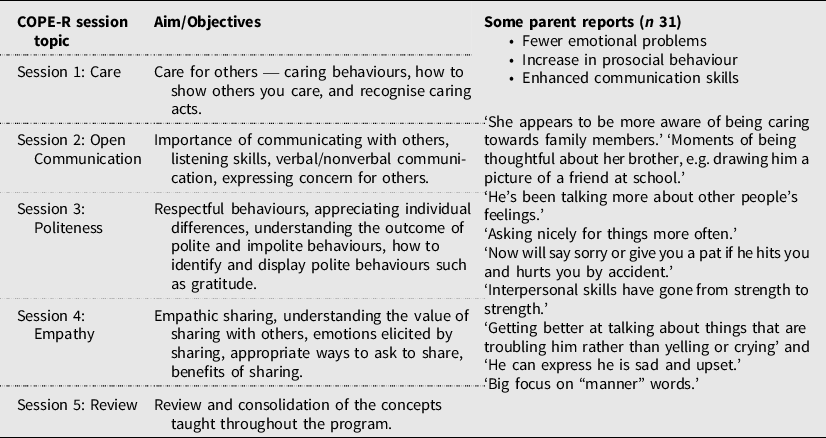
The program comprises activities on Caring for Others (C); Open communication (O); Polite/Respectful behaviours (P); Empathise/Sharing behaviours (E) and a Review (R) incorporated with the Early Years Coping Cards, along with explicit empathy and prosocial skills. It has been developed to incorporate coping skills and utilise them to teach empathy and prosocial skills to children aged 4–8 years of age. The topics are taught through discussion and activities and are designed to be implemented in the classroom or in small groups; there are core activities along with additional resources for the instructor, be they teacher or counsellor, to use. The program and its evaluation (Cornell et al., 2017; Deans et al., 2017) are summarised in Table 1.
Content and evaluation for each of the five COPE-R sessions
In a subsequent study, Wu et al. (2020) were able to establish whether and in which ways teacher experience made a difference. Ninety-one preschool children from three classrooms in an early learning centre in Melbourne, Australia were allocated to receive the six-week COPE-Resilience intervention by experienced COPE-Resilience facilitators (n = 33), first-time program facilitators (n = 29), or participate as a nonintervention comparison group (n = 29). Results indicated that children undertaking COPE-Resilience with an experienced teacher facilitator demonstrated the greatest improvements in teacher-rated empathy, prosocial behaviours, coping styles, inhibitory control, and problem behaviours. These results indicate that the level of program facilitation experience enhances implementation success.
In a further study (Soliman et al., 2021) 69 preschoolers (M = 54 months) participated in either the manualised COPE-Resilience program (n = 35) or alternative experiential SEL program (n = 34) over six weeks. The study indicated that the COPE-Resilience group showed more significant improvements in prosocial behaviour and positive coping following the intervention. Preschoolers, who were rated as more prosocial and used more positive coping strategies by their teachers, were also found to be more empathic. Evidence of the consolidation of empathic understanding was found in the preschoolers’ artwork and teacher interviews. Teachers from both groups in their interviews reported anecdotal improvement in the use of children’s SEL skills, with the COPE-Resilience teacher noting children’s enjoyment of prosocial opportunities to share kindness.
Taiwanese Adaptation
The COPE-Resilience program has also been adapted and trialled with a Chinese preschool population in Taiwan (Frydenberg et al., 2021b). Like many Asian cultures, attitudes towards education in Taiwan have been heavily influenced by the Chinese culture and the Confucian paradigm, where the explicit teaching of emotion understanding and regulation skills is still a new area for many educators. Taking into consideration the cultural context and language, and working closely with the early childhood educators in Taiwan, a Chinese version of the COPE-Resilience manual was created for trialling the program sequentially in three different preschools/kindergarten, in which each stage was built upon the previous one. The Wu et al. (2020) study shows that children undertaking the program demonstrated significant improvements in measures on emotional labelling, empathy, prosocial, coping style, and inhibitory control. The study also found that children who participated in the program demonstrated greater school readiness and fewer problem behaviours. Moreover, teachers also reported an increase in their understanding of emotions and ways to deal with challenging behaviours. Overall, it was found that even in culturally contrasted environments the implementation achieved beneficial outcomes for both the teacher and the children.
Concluding Remarks
Early childhood settings provide unique opportunities for trainee psychologists to get a deep first-hand experience of observing and interacting with children at that developmental level, prior to commencement of formal schooling. They also provide a unique opportunity to work with parents who are at an early stage in the parenting journey and highly receptive and appreciative of input that can have long-term benefits rather than providing remediation for parenting difficulties. A further benefit for the school communities, including psychology and counselling professionals, is the development of resources that teachers, parents, and professionals such as school psychologists can use in their respective roles. As we continue our engagement with the early childhood setting, there are ongoing opportunities for trainees to evaluate innovative programs such as an intergenerational program (Kirsh et al., 2021; Stirling, 2020) and environment education (Deans & Deans, 2018). During the process of evaluation, students acquire a deeper understanding of the curriculum content that is provided in the early years and the diverse skills required for evaluating such programs — skills that include questionnaire design, ethics application procedures, and data gathering in diverse formats. While quantitative assessment, along with qualitative data gathering, is more commonplace, interpreting children’s artworks and interviewing young children individually or in small groups is particularly rewarding. The challenges provide unique learning experiences and rich datasets for the education profession at large, and the counsellor or educational psychologist in particular. It is hoped that this three-phase approach has illustrated how the collaboration with educational psychologists along with trainee psychologists can contribute to social emotional learning in the early childhood years as we continue to learn together.