







Abstract
The present article is a sympathetic appraisal of Gardner Murphy's (1895–1979) “biosocial” psychology. Biosocial psychology is presented not as a personality theory but as one attempt to conceptualize the respective influences of heredity and environment on behavior. Murphy's use of the term biosocial is differentiated from that of A. P. Weiss (1930) and other theorists. For Murphy, biosocial psychology referred to a double-aspect monism in the tradition of Spinoza and William James and informed by the contributions of Herbert Spencer and the emerging post-Euclidean worldview of his own era. Canalization and other tenets of biosocial psychology are outlined and related to contemporary findings. Murphy's views are distinguished from postmodern psychology, cognitive–representational theories, evolutionary psychology, and interactionism.
Nothing human is alien to me. —Terence
It is likely that Gardner Murphy's (1895–1979) ideas are now forgotten in most textbooks because, when his works were published, they were received as restatements of widely held views rather than as original contributions. His was an organismic theory at a time when organismic theories were quite popular, received by most psychologists as “just good common sense,” and his position became neither a rallying ground nor a battlefield (Hall & Lindzey, 1957, p. 533). As Hall and Lindzey noted, some theories of personality, such as Freud's, were epochal in that they signified, when they were introduced, a decided break from the received wisdom of the time. One may easily divide the field of psychology into the pre-Freudian and post-Freudian eras. Other theories borrow from the “common stockpile of concepts, principles, laws, axioms, and assumptions which have accumulated over a period of years” (Hall & Lindzey, 1957, p. 508). Although their continuity with the past is clear, these theories remain original contributions. “Their originality consists of a new organization or framework which is provided for the old ingredients, the addition of new material, and the relative emphases placed upon the various components of the theory” (Hall & Lindzey, 1957, p. 503). Murphy's biosocial theory of personality, Hall and Lindzey noted in 1957, was the “most vivid” example of the latter type.
Grouping biosocial theory with other organismic theories will, of course, mute what is original in Murphy's thinking. Viewing him as merely a personality theorist likewise obscures the broader applicability of his ideas. Murphy need not be read as a personality theorist; nor does this article focus on his personality theory as such. In Murphy's writings, one finds a remarkably sophisticated and clear-headed treatment of the question of how environment and heredity contribute to behavior. This question is no less urgent today than it was in the 1930s, when Murphy's writings first started appearing in books and professional journals.
Murphy was obliged to defend a biologically based theory against attacks from two fronts. One one hand, he faced the extreme positions represented by Lewis Terman and other advocates of eugenics and racial theories of intelligence. On the other hand, he faced the cultural relativism of Franz Boas and Margaret Mead. His answer was not particularly satisfying for partisans of either camp. “If it is true that nothing is acquired in the popular sense,” Murphy wrote, “it is equally true that nothing is inherited” (1947, p. 51). This is the case, he argued, because the particular manifestation of hereditary dispositions depends on “specific environmental forces” such that the manifestation is “as much a function of the environing pressures as it is of the latent or potential dispositions” (Murphy, 1947, p. 52).
Today, evolutionary psychologists are still confronted by extreme views that nonetheless appear to be at the same end of the continuum as their own. Even before the furor created by Richard Herrnstein and Charles Murray's (1994) book The Bell Curve, E. O. Wilson and others had proposed a new discipline called “sociobiology.” For most, the causal link suggested by Herrnstein and Murray between innate intellectual ability and observed IQ was patently simplistic, yet it nonetheless raised concerns about the nature of biological explanations. After one rejects reductionism and biological determinism, the question still remains: How does one admit biological factors at all without, on some level, mitigating the role of environment? Once one asks this question, it is a short distance to the realization that the question itself may be poorly posed.
To attempt to dismember the individual into “biological” versus “nonbiological” aspects … is to embrace and perpetuate an ancient dualism endemic to the Western cultural tradition: material/spiritual, body/mind, physical/mental, natural/human, animal/human, biological/social, biological/cultural. This dualistic view expresses only a premodern version of biology, whose intellectual warrant has vanished. (Tooby & Cosmides, 1992, p. 21)
It is far easier to criticize dualism than to commit oneself to its alternative (Gadlin & Rubin, 1979). Donald Hebb declared that attempts to partition influences on behavior into the categories of “environmental” and “heredity” were “exactly like asking how much of the area of a field is due to its length, how much to its width” (1953, p. 44). This has become something of a platitude in academic circles, one used to concede a point by individuals who do not necessarily accept all of its implications. Symons (1987) used exactly the same metaphor in his defense of an evolutionary psychology. Yet, in the same article, he proceeded to defend a role for unlearned behavior, and spoke favorably of a rebirth of faculty psychology. Even if one does not agree with everything Murphy proposed, he succeeded in developing an internally consistent and systematic presentation of a non dualistic metatheory, and his work remains instructive inasmuch as it charts many of the landmarks and pitfalls of this difficult terrain.
Murphy called his theory a biosocial approach, although he did not coin the term. The origins of the term can be traced back to systems theorist A. P. Weiss (1930, 1939). It is Weiss who inspired the “biopsychosocial” model in health and counseling psychology appearing in Ackerman (1958) and later popularized by Engel (1977; 1980) and Schwartz (1982). Weiss believed that each stage of physiological development affected the immediate physical and social environment of the individual, creating a new set of variables to which the individual then responded. Yet, it is clear that Weiss granted primacy to genetic factors. “The concept of a postfunctional, acquired, character of nervous organization has been steadily controverted … those properties of the nervous system which enable it to perform its regular functions are developed prior to, and in the absence of, all function” (Weiss, 1939, p. 559).
Since Weiss, the term biosocial has been used in various ways, and these instances are worth pointing out as examples of what Gardner Murphy did not mean. Prothro and Teska (1950) presented a view that anticipated by a few years Albert Bandura's social learning theory. They emphasized imitation and learning while taking into account the reality that human beings differ in terms of stature, appearance, and health and that they respond idiosyncratically to events such as puberty or pregnancy and hence cannot be expected to respond in a uniform way to environmental contingencies (at the time, an important corrective to Watsonian behaviorism). Others used the term biosocial to denote a dispositional theory that admits a role for environmental influences (Cloninger, Svrakic, & Przybeck, 1993; Van Den Berghe, 1975).
For Murphy, the term biosocial denoted “that which is biological and at the same time social” (1947, p. 981). In this paradoxical definition, he wanted to convey in the strongest terms the idea that biology and culture are isomorphic. This was a signal to the reader that one may not fairly approach his views without putting aside for the moment the habit, deeply ingrained in those of us who have been educated in Western schools, of assessing an argument by first placing the various pieces in reciprocally exclusive categories.
In the present article, Murphy's ideas and the evidence on which he relied are discussed; in addition, examples from the current literature are cited both to illustrate biosocial principles and to demonstrate that some contemporary researchers share Murphy's dissatisfaction with the epistemological presuppositions of the conventional social science model. Finally, Murphy's ideas are compared with postmodern, cognitivist, and evolutionary theories, with attention to both the common ground and the differences among these viewpoints.
Historical Background of Murphy's Thinking
Objective Relativism and Functionalism
Murphy wrote, “The observer puts himself into the equation, simply because, as Einstein so well put it, there are no ‘privileged positions' from which observations can be made. As the philosophy of science and the sociology of knowledge make clear, the science which emerges is just as much a matter of the man as of the external event” (1958, p. 313). Murphy's views share much in common with the views that now fall under the umbrella of “postmodernism”; however, there is a key difference. Murphy construed Einstein's persuasive challenge to the traditional notion of the objective observer not as a warrant for the skeptical rejection of the possibility of knowledge but as an affirmation of the authority of individual judgment.
Einstein had remarked that, in some experiments, the granular or corpuscular properties of light were clearly demonstrated, whereas, in other experiments, it was just as clear that light exhibited the properties of a wave (Einstein & Infeld, 1938/1966).
It seems as though we must use sometimes the one theory and sometimes the other, while at times we may use either. We are faced with a new kind of difficulty. We have two contradictory pictures of reality; separately neither of them fully explains the phenomena of light, but together they do! (Einstein & Infeld, 1938/1966, p. 263)
A highly complex phenomenon existing simultaneously in time and space may be impossible to comprehend in its totality or capture within a single construct. Our constructs may bring some aspects of the phenomenon into sharper focus while obscuring other aspects. Einstein's theory of relativity was also provocative in its implications. As he noted, two observers of an event are separated in space, and because the light that enables them to see the event moves at a finite rate of speed, there is no hope that they will see exactly the same event. By introducing the temporal dimension of physical reality, Einstein also introduced the essentiality of the relationship between the observer and the percipient object.
One philosophical position that arose in the wake of Einstein's theories was “objective relativism,” according to which
a thing can be truly understood only in the light of all its relations. Knowledge is more “objective” in proportion as a fragment of reality is viewed from many standpoints … and “truth” is approximated in so far as these diversities of aspect are taken account of in all their multiplicity, yet synthesized into a coherent unity. (Lovejoy, 1955, p. 98)
The standpoint of objective relativism resonated with Murphy on a personal level. He objected to the heated debates between psychologists of different theoretical schools and the efforts of some professionals to sweep “their adversaries off the board” and leap to final interpretations (1974, p. 334); he believed instead that one should “feel one's way into an opposing point of view in order to deal with it honestly” (1974, p. 326). The philosopher Georg Hegel believed that, in the clash between two opposing ideas and their resulting synthesis, elements of both ideas would be integrated. This stands in contrast to the conventional view that one substantiates the alternative hypothesis by rejecting in toto the null hypothesis. One finds something of Hegel in the thinking of Murphy. Recognizing the diversity of perspectives, Murphy (1949a) spoke of a “reality which expresses itself at times in antithetical forms” (p. 443).
The objective relativist integrates the observer into the world and posits that reality exists at the intersection of the perceiver and the percipient object. This contrasts with the conventional social science model, which relies on a representational theory of the relation between observer and object. These representations (“schemas” or “stereotypes”) are understood to contain inaccuracies; in other words, the observer is a source of error, and it is appropriate to control for this contaminating variable as much as possible. Postmodernism, although it has been posed as a radical viewpoint, has simply provided a fresh intellectual warrant for this perspective.
The representational model rests on the Cartesian presupposition that the mental and the physical represent two natural kinds and do not possess common attributes. This conclusion is, in turn, derived from Aristotelian logic: The law of noncontradiction stipulates that a single referent cannot be both “A” and “not A.” This presupposition remains in existence today for two reasons. First, like the Newtonian model in physics, it successfully approximates reality much of the time. By applying the law of noncontradiction, it is possible to identify lack of agreement in the specification of one's terms and inconsistencies in one's analysis. Second, arguably, Aristotelian logic serves a psychological need to reduce ambiguity; information that is indecipherable as a result of its lack of inherent organization can be supplied with a structure. Data that seem to fit in more than one category are redefined and analyzed until the proper taxonomic location can be established.
In modern times, this approach has been eloquently defended by Karl Popper (1962), whose “commonsense” approach to epistemological problems in the sciences resonates with the image (relished by the unlikely bedfellows Freud and Skinner, among others) of the scientist as fundamentally unphilosophical. Contemporary social constructionist psychologists also propose, ironically, that they have achieved “criticism without philosophy” (Fraser & Nicholson, 1994). What Popper defended—and what has long been the standard investigatory mode of the social sciences—is what he characterized as critical dualism. This approach contrasts two plausible hypotheses with the goal of eliminating the less defensible of the two. It is based on the premise that there is a single theoretically optimal account of a phenomenon that is objective and equally valid for all parties. Alternative explanations, insofar as they fall short of this optimal account, are assumed to be less accurate.
Murphy, as he himself noted (1974), was influenced by the double-aspect philosophy of Spinoza. However, the strongest influence on Murphy was another avowedly Spinozistic philosopher named William James, and in James one may get the most concise statement of what is meant by double-aspect theory. Against representational theories, James wrote:
I maintain … [that] a given undivided portion of experience, taken in one context of associates, plays the part of a knower, of a state of mind, of “consciousness”; while in a different context the same undivided bit of experience plays the part of a thing known, of an objective “content.” In a word, in one group it figures as a thought, in another group as a thing. (James, 1904/1976a, p. 7)
James added, “The puzzle of how the one identical room can be in two places is at bottom just the puzzle of how one identical point can be on two lines. It can, if it be situated at their intersection” (1904/1976a, p. 8). In other words, there is a correspondence between physiological events in the brain and mental events, but mental events are not reducible to physiological events (see Davidson, 1980, for a contemporary restatement and refinement of this view). Murphy argued, “The percept, or the thought, develops as an organized response to a matrix of stimulation, in which the structure of the environment and the structure-giving tendencies of the perceiver converge in the determination of a unitary response” (1945, p. 4).
Social Darwinism
Murphy (1947) acknowledged an intellectual debt to Herbert Spencer. Like Spencer, Murphy spoke of a process of “progressive differentiation” by which an organism becomes increasingly efficient at meeting its needs within the context of its social and physical environment. According to this view, the ends to which an organism strives do not change, but the level of sophistication and discrimination with which it achieves need gratification does change. Murphy was not alone in his admiration of Spencer; Spencer's view that behavior is best understood as “the continuous adjustment of internal relations to external relations” (Spencer, 1879, p. 21) became the leitmotif of James's masterwork, The Principles of Psychology (James, 1983).
While he studied at Columbia, one of Murphy's professors was anthropologist Albert Galloway Keller. Keller also shared the functionalist beliefs of Spencer and James. He wrote, “The chief use of the human mind is to find reasons, or subsequent justification, for doing what its possessor wants to do” (Keller, 1929, p. 95). He was quick to point out, however, the flaws and the political conservativism of Spencer's theories, and he was particularly uncomfortable with the assertion that the bourgeois social climate of Victorian England was an instantiation of the Darwinian principle of selective pressures promoting the survival of the “fittest.” Keller (1929) counted Spencer an “untrustworthy guide” to a proper understanding of the implications of Darwin's ideas for the study of behavior.
What Keller and, in turn, Murphy found intriguing in Spencer's thinking was the core idea that phenotypical expressions are instantiated by cultural practices. This contrasts with the view, which can be traced from Judeo-Christian scriptures all the way through the writings of Freud, that people's biological urges and their civilized mores and customs are antithetical. Yet, Spencer himself displayed inconsistency on this point. Although arguing that cultural institutions mirror biological predispositions, Spencer nonetheless advocated the idea of “counterselection.” Counterselection is the belief that advances in medicine and the creation of charitable organizations have a deleterious effect by allowing unfit members of society to survive and reproduce. The laws of natural selection are, in this scenario, frustrated by the effects of civilization, which implies that civilization is something other than a species-typical activity on the part of humans. Keller did not make this mistake. “Under such conditions,” Keller scoffed, “even the wearing of clothes and living in houses are counterselective” (1929, p. 182). He asserted, instead, that helping the poor and infirm members of society and finding means to counteract diseases and shortages in food reflected highly adaptive traits, specifically, cooperation and innovation.
The idea that culture is an instantiation of biological predispositions contradicts one of the most influential ideas in the development of cognitive psychology. The idea of functional autonomy, developed by Gordon Allport (1937), dictates that instrumental activities, over time, become ends in themselves. Allport gave the example of someone who originally dresses well or acquires expensive automobiles in the interest of sex but later enjoys these activities on the basis of their intrinsic rewards, without a sexual motive. Jean Piaget's constructivist model of development, encapsulated in the concept of decentering, holds that individuals acquire skills that replace their early, impulsive, consummatory, and egocentric behavior with logicohypothetical principles and rule-based guides to behavior (Gruber & Vonèche, 1977). Instinct is described as “incapable of inventing anything” (Gruber & Vonèche, 1977, p. 856) and antithetical to the development of sophisticated cognitive skills. Piaget spoke of bursting, or the “almost total disappearance, in the case of anthropoids and man,” of “hereditary programming” (Gruber & Vonèche, 1977, p. 856). As a consequence of this bursting, human beings “start at zero,” having to discover the world rather than being equipped with an internal map of it.
Murphy (1947) explicitly rejected the principle of functional autonomy. Returning to Allport's example, Murphy would have argued that, whereas the satisfaction of owning a car may indeed originate as a means of sexual display, this primal association between the cultural activity and the biological urge does not disappear during the course of maturation. The association will remain viable for as long as automobiles continue to differentiate their owners in terms of social status.
Across cultures, material objects have the same function of denoting the status of their owners, and the link between status and success in competition for mates is clear (Symons, 1979). Among the Ponapaens of Micronesia, a man's ability to cultivate yams to enormous size—sometimes as large as 9 feet—is a highly prized skill, carrying the reassurance that villages with men such as he will never experience hunger, and the man with the largest yam is assumed to be an exemplary citizen in every respect, typically elevated to a ranking position in the community (Bascom, 1948, cited in Boyd & Richerson, 1985). Indeed, in any species in which there is competition among males for mates, there is a reliance either on elaborate displays intended to make males more attractive to females or on direct competition among males for access to females. In these competitions one witnesses, on one hand, the biological imperative to mate and, on the other hand, idiosyncratic behaviors of the individual organisms, which appear to serve a functional role in helping the organism distinguish itself from its rivals. Nishida (1994) observed an adult male chimpanzee that had learned to make a novel sound by drawing a blade of bamboo grass through its hand, and this technique was an attention getter that gave the chimpanzee a distinct advantage in mating with females.
Biosocial Theory: Basic Principles
Canalization
The term canalization today is probably most closely associated with the name of Charles Waddington, although, in the 1950s and 1960s, most people would have probably associated the term with the name of Gardner Murphy. Waddington (1953, 1962) used the term to refer to predetermined pathways along which development takes place, conveying the idea that there is a certain amount of plasticity in development but that this plasticity is within limits prescribed by the genotype. This view has more in common with Weiss's model than with Murphy's. The most comprehensive statement of Murphy's thinking is his 1947 book, Personality: A Biosocial Approach to Origin and Structure. It is here that he presented a model of personality development in which canalization plays a key role, and the term became associated with Murphy's name.
Murphy had followed E. B. Holt's (1931) usage. For Holt (1931), canalization meant the cumulative effect of the passage of nerve impulses “from a certain sense-organ (or group of sense-organs) to a certain muscle (or group of muscles),” resulting in “a reflex path of lowered resistance” to stimulation (p. 91). Murphy gave the term a broader relevance, however, by defining it as an instance in which “a non-specific craving is given a specific satisfaction” (Murphy, Murphy, & Newcomb, 1937, p. 191) through a process of discriminative learning and enculturation. As an example, the need for food is biological, but it is culture that defines what eatable objects are considered food, what is an acceptable way to prepare food, where is an appropriate place to eat it, and when is an acceptable time.
Following C. S. Sherrington, Murphy believed that responses are either preparatory, in the sense of the instrumental responses intensively studied as instances of operant and classical learning, or consummatory and directly linked to the satisfaction of a need. Consummatory responses include, of course, eating, drinking, and copulatory behavior. Conditioned preparatory responses are said to be readily modified or extinguished, whereas learned consummatory responses (i.e., canalized responses) resist modification or extinction. The construct of canalization relies on the view—long resisted by learning theorists sympathetic to the operant model of conditioning (notably Premack, 1965)—that, to the extent that the rewarding stimulus effectively satiates a preexisting biological need, the association will be more rapidly established and more resistant to extinction than a simple conditioned response. Illustrating this effect, Kurtz and Jarka (1968) found that rats rewarded at location A while moderately hungry and at location B while extremely hungry later showed a marked and persistent preference for feeding at location B, even when location A was closer. Animals as simple as bumblebees are far more likely to return to a flower of the same color as one rich with nectar after only a single experience of reward (Real, 1991).
Gottlieb (1991), who cited Holt but not Murphy in his writings, nevertheless developed the concept of canalization along the same lines that Murphy did. Gottlieb defined “experiential canalization” as “the developing organism's usual or typical experience … that brings about species-specific behavior but also prevents the developing organism from being susceptible to non-species-typical forms of stimulation” (1991, p. 6). Gottlieb's example, based on his own studies, involved mallard ducklings. These organisms, at birth, selectively attend to mallard vocalizations and not to wood duck vocalizations. This has a clear adaptive benefit in terms of ensuring that the mallard stays with its conspecifics and, on the face of it, could justify a explanation relying on inherited predispositions. However, Gottlieb further discovered that by preventing the mallards, before hatching, from hearing their own vocalizations or those of their brood mates, he could eliminate any signs of preference for conspecific calls.
As noted by Murphy (1958), the two principal mechanisms involved in canalization are regularity, “by which one experience arouses expectation of another,” and relevance, meaning “the relationship of the object to temporally proximate affects or needs” (p. 55). The themes of regularity and relevance in the formation of canalized response patterns draw support from Maslow's (1937) studies on “familiarization”: the effect of repeated exposure to a stimulus on preference for that stimulus, or what is better known as the “mere exposure effect” (Zajonc, 1968). Murphy further suggested that, through perseveration, or the tendency of the organism to repeat its previous behaviors in similar settings, initially weak preferences could become gradually intensified and integrated into the organism's repertoire of behaviors.
Subsequent research has substantiated the generality of the mere exposure effect and how it may play a key role in the shaping of enduring preferences that are traitlike in their manifestation. Janiszewski (1993) found that even when individuals are unaware of previous exposure to a brand, subsequent exposures to the same brand increase liking. Passages of speech recited by mothers during their last 6 weeks of pregnancy were found to be reinforcing stimuli when presented to newborns (DeCasper & Spence, 1986). In a remarkable study of social behavior, rhesus monkeys reared in one of three conditions (no contact, visual and auditory contact, or complete and normal contact) later showed a preference for interacting with monkeys raised under the same conditions (Pratt & Sackett, 1967). Pfennig and Sherman (1995), in a comparative analysis of several species, found that exposure and familiarization may be the proximate mechanism through which animals learn to distinguish kin from nonkin, and this is, of course, of key significance in terms of incest avoidance 1 and, among cannibalistic species, the avoidance of kin as prey.
Lorenz (1965) identified what he called path habits: Animals explore their environments following a systematic pattern, venturing a short distance from the nest and racing back to the nest at the slightest disturbance. Later, the animal will venture out again, in precisely the same direction, this time traveling slightly farther from home. One may draw parallels between this phenomenon and the response of human infants to the unfamiliar: It has been observed that the exploration behavior of infants, whether visual or locomotor, consists of forays away from the mother followed by periodic returns to her side, and if the infant is confronted by an object that is too far removed from its expectations or prior experience, this will excite a sudden and urgent desire for maternal contact (Ainsworth, Blehar, Waters, & Wall, 1978). As the mechanism by which an organism maps the subjective boundaries of its habitat, one sees the additive effects of numerous microevents involving habituation and sensitization over an extended period of time, coupled with behavioral choices of the animal.
Conventional theories measure performance on a predefined, criterial task. However, some ecological theorists have brought to light the importance of the individual's subjective sense of familiarity and comfort in a given setting. An example is Ceci and Bronfenbrenner's (1985) research, in which the authors found that the memory ability of children on a given task was enhanced when the setting was moved from a physics laboratory to a home economics laboratory and again when the setting was moved to the child's own home. These findings throw into question what is meant by “skills”; skill implies an attribute of the person and not of the person–situation relationship. Similarly, Ceci and Roazzi (1994) observed that child street vendors in Brazil are capable of sophisticated financial calculations when bargaining with customers and suppliers but find themselves at a significant disadvantage in the classroom when asked to perform basic arithmetic. Research that has relied on the construct of social skills or aptitudes overlooks the contextual dimension of performance. To obtain the optimal improvement in performance, what is required is not only the teaching of skills but the slow process of familiarization, through which individuals acquire a sense of basic competence and comfort in the physical and social contexts in which these skills are to be applied.
Operational Constructs in Murphy's Theory
As Murphy himself granted in his discussion of canalization, the “process by which general motives (which are at first rather non-specifically related to a class of stimuli) tend, upon repeated experience, to become more easily satisfied through the action of the specific satisfier than of others of the same general class, has been known so long that it would be impossible to name its discoverer” (1947, p. 162). Yet, it was Murphy's particular contribution to, first, grant this process a key role in a theory of personality development and, second, propose a specific biological basis.
Murphy was, beyond question, a motivational theorist. Canalization is one result of biological needs intersecting with the affordances of the environment. He maintained that the organism is at once receptive to objects in its sensory environment as potential need satisfiers (i.e., in being able to recognize the affordances of eatable objects) and constructive (i.e., in the selection of surrogate objects, as rats will gnaw on wood chips when hungry). This model avoids both the Watsonian “trial-and-error” view of learning and strict theories of instinct. Murphy, although accepting the idea that biological predispositions exist, considered them neither specific nor immutable and argued that their expression is contingent on the availability of suitable satisfiers in the environment and the gradual stamping out of suboptimal satisfiers (the Jamesian notion of “learning by selection”). He argued that the inborn predispositions of human beings consist of four complexes: (a) visceral needs related to nutrition and respiration; (b) activity needs, referring to a baseline level of physical exertion as well as exploratory behavior; (c) sensory needs, referring to requirements for sensory stimulation, the establishment of perceptual constancies, and the reduction of ambiguity; and (d) avoidance of pain or threat, which is self-explanatory (Murphy, 1947, 1958). Although positing a need for activity, Murphy also believed that needs competed with each other; an animal experiences need gratification when running in an activity wheel, but if it is experiencing acute hunger, obtaining food will be its central motivation to the exclusion of all else. Murphy (1947) rejected the view that organisms seek an overall reduction in need-induced tension, believing instead that the satisfaction of one need merely makes another need more salient. He did, however, believe that organisms are motivated to find increasingly efficient means of satisfying their needs. The needs Murphy described are more specific than those posited in behaviorist or social learning accounts and less specific than those posited by evolutionary psychologists.
Activity and sensory needs were of key importance in Murphy's model, and it is helpful for the understanding of their biosocial significance to frame them in terms of what is known in the contemporary literature as “behavioral energetics” (Brener, 1987). In a series of experiments, Brener found that animals performing the same instrumental task on repeated occasions experienced a decrease in the amount of energy expenditure (measured in calories) required to perform the task, even though the task itself did not change. He also noted that there is a “reliable tendency” for task-related responses to “recede toward the minimum levels required for task compliance” (Brener, 1987, p. 506) as the animal learns to eliminate extraneous movements and effort. At the same time, autonomic activity is significantly augmented when (a) organisms anticipate a response, (b) organisms are required to change their mode of responding, and (c) there are a high number of possible responses (behavioral uncertainty).
The model of behavioral energetics may be extended to perceptual behavior. Matlin (1970) presented evidence that the mere exposure effect is the result of a decline in what she termed response competition. An organism confronted by an unfamiliar object will experience a heightened level of arousal and uncertainty about how to respond. Each subsequent exposure to the object is, consequentially, rewarding inasmuch as the organism experiences a somewhat higher level of familiarity and mastery. Krueger's (1975) finding that as familiarization increases, individuals are able to process visual stimuli more quickly and more accurately supports this view. The response competition hypothesis ties in with Murphy's emphasis on regularity and relevance as key factors in the phenomenon of familiarization.
In some of the key mechanisms of biosocial psychology outlined by Murphy, one may observe his consistent practice of presenting constructs that take the organism–organism or organism–environment encounter as their basic unit of analysis. One may also discern his dependence on what has since been termed behavioral energetics.
Symbolization or conventionalization
This is described by Murphy as the process in personality development by which the individual settles on “appropriate responses to standard signals” (1949b, p. 18); stated differently, in situations in which many different responses are possible, the organism tends, over time, to favor one response over all others. Whereas social learning explanations emphasize the role of imitation in the acquisition of communicative gestures and the linking of meanings with certain culturally established signs, symbolization stresses the role of both need and intention. The symbolization construct is identical to what has been called by more recent authors conventionalization (Smith, 1977; Tomasello, 1994). This theory proposes that a gesture may originate as a direct attempt at need gratification and is later modulated in the course of reciprocal social interaction. In Tomasello's example, a juvenile may pull itself toward its mother's breast, roughly grabbing her arm in the process. On a subsequent occasion, the mother may anticipate the juvenile's behavior and become receptive to suckling at the point the juvenile touches her arm. Through this process, the juvenile learns to achieve its desired goal more easily, and the mother learns how to reduce the uncertainty involved in the interaction by reading the juvenile's intentions.
Autism
Murphy, along with Leo Postman, Jerome Bruner, and others, was a pioneering member of the “New Look” school. In his empirical research, Murphy along with his associates, observed that hunger increases the likelihood of labeling an ambiguous object as food; he also found that stimuli recently associated with success are more salient than stimuli associated with failure and that individuals are more likely to forget written information advocating a certain position if the position is contrary to their own beliefs (J. Levine & Murphy, 1943; R. Levine, Chein, & Murphy, 1942; Proshansky & Murphy, 1942; Schafer & Murphy, 1943). Accordingly, in his writings Murphy emphasized autistic perception, or perception influenced by need states. He wrote:
The molding of perception or thought or memory in the drive-satisfying direction follows directly from the satisfying or frustrating quality of past perception; one learns to perceive, think, or remember in this way or that because such a habit is satisfying, just as one learns to behave in this way or that because such behavior is satisfying. (Murphy, 1947, p. 364)
Murphy (1945) also described “socially shared autisms” common to a particular subculture, in which realities that do not correspond with the perceptions of the larger population become, in the minds of the subculture, increasingly obvious and beyond question. He referred to the specific processes of the exchange of nonveridical information within a subculture and the bolstering effect of the supposed credibility of in-group members as the “standardization of error.” He argued that these socially shared autisms are a compensatory response in an environment that is “unstructured,” “confused,” “rapidly changing,” and subject to “value conflict” (Murphy, 1945, p. 9). Autistic responding, then, may be viewed as a compensatory response to situations in which the level of information has exceeded the organism's ability to comprehend it or to establish, through familiarization, the reduction of anxiety to a comfortable level. Milgram (1970) would later propose a similar model in his discussion of stimulus overload.
Autism was not a concept that Murphy originated, but it was nonetheless a key component of his model. It is therefore necessary to make a digression here to speak of the contributions of Kurt Lewin (1935) and Heinz Werner (1948/1961) and to provide some contemporary evidence illustrating the generality of this mechanism. Barker, Dembo, and Lewin (1941), in a well-known study, found that children who were frustrated in their expectation to interact with desired toys exhibited behavior patterns consistent with those of younger children (e.g., using a toy telephone as a mallet as opposed to using it to hold imaginary conversations). Heinz Werner (1948/1961) cited this research as evidence for what he called primitivation. He noted that the normal adult, “even at our own cultural level, does not always act on the higher levels of behavior. His mental structure is marked by not one but many functional patterns, one lying above the other” (Werner, 1948/1961, p. 38). He characterized the “primitive personality” as concrete in its thinking, rigid, neophobic, syncretic (meaning that objective attributes tend to be merged with subjective meanings), undifferentiated, and emotionally labile; this pattern is evoked in the following passage from Hobbes: “Irrational creatures cannot distinguish between injury and damage” (Leviathan, part II, chap. 17).
Werner suggested a link between objective levels of stimulation in the environment and certain personality or behavioral traits. The primitive personality, occupying an environment fraught with risk and uncertainty, remains in a mode of interaction with the world that is defensive and fearful (hence, the lurid cosmology of evil spirits and curses that is common among primitive cultures). Members of technologically advanced civilizations, particularly those who are relieved from acute economic uncertainty, have a greater latitude to explore alternative conceptions of the world. These basic principles occur in other species; conditions in which resources are plentiful promote different forms of interaction than conditions in which resources are scarce, and, suggestive of an evolutionary link, these conditions promote distinct patterns of reproduction (Pennisi, 1996).
Obviously, the definition of whether an environment contains uncertainty, scarcity, or threat depends in part on the expectations of the individuals living in that environment. Widespread hunger and high mortality are relatively fixed metrics; however, relatively affluent individuals may experience a sense of deprivation if they observe others enjoying an even higher standard of living (Blau & Blau, 1982). Historical precedents also determine, to a large extent, what is considered a comfortable or minimal standard of living. It is argued here that both objective and subjective experiences of uncertainty or threat may potentially contribute to the phenomenon of primitivation.
The effect of fear or threat on attitudes has been explored by more contemporary researchers. It has been found that fear increases the level of conformity behavior (Darley, 1966). Under conditions of stress, human beings may experience the recovery of fears and phobias to which they had previously become desensitized (Jacobs & Nadel, 1989). It has been shown that, in individuals for whom mortality has been made salient, there is a stronger tendency to both behave in a punitive manner toward individuals who violate cultural values (Rosenblatt, Greenberg, Solomon, Pyszczynski, & Lyon, 1989) and behave more favorably toward those who share one's cultural values (Greenberg, Pyszczynski, Solomon, Simon, & Breus, 1994). And, to the extent that an individual feels vulnerable to another person's victimization, there is a heightened tendency to attribute blame to the victim (Thornton, 1984).
Environmental stressors also have an impact on attitudes and judgments. Gilbert, Tafarodi, and Malone (1993) found that, under conditions of stress, participants in a mock trial were more likely to use information that had been identified as false in deciding the guilt of a criminal defendant. Rogers and Prentice-Dunn (1981) observed that, under conditions of stress, White students who were progressive in their racial attitudes reverted to thinking of Black individuals in racial terms; as compared with their reactions to fellow White students, they were both more angered by Black individuals' insults and less willing to treat them harshly. The recovery of invalidated information under stress implies that the mere existence in one's memory of certain propositions about reality predisposes belief in these propositions (Gilbert, 1991).
Correlations between behavioral style and environmental stress factors have been explored by Suedfeld (1979), who argued that environmental characteristics such as information overload, time pressure, rapid change, lack of control, or the prospect of high risk or high gain may promote reduced integrative complexity manifesting as “premature closure” to activities, stimulus-boundedness, “all-or-nothing” responses, reduced information search, intolerance of disagreement, failure to consider alternative perspectives, and belligerence. In political crises, Suedfeld noted, the level of integrative complexity in government documents decreases. Suedfeld's associate, Philip Tetlock, has expanded this model in his psychopolitical research and has found, among other things, a relationship between political conservatism and the tendency to frame complex issues in terms of simplistic good versus bad terms (1981).
Not only do particular physical settings or situational demands predispose certain constellations of behaviors, but these exogenous influences may induce physiological changes that, in turn, perpetuate such behaviors. Subordinate rats, it has been shown, are subject to chronic defensiveness in their behavior, shorter life spans than dominant males, adrenal enlargement, and lowered testosterone levels (Blanchard, Sakai, McEwen, Weiss, & Blanchard, 1993). Among bonnet macaques, Rosenblum et al. (1994) observed that environments that were unpredictable in terms of the availability of food promoted anxiety and affective disorders and had long-term effects on the animals in regard to noradrenergic and serotonergic functioning. Furthermore, these effects were correlated with the behavior of the offspring of these anxious macaques, even under stable feeding conditions. Offspring of anxious mothers themselves have been shown to exhibit excessive levels of reactivity to stimuli (see also Peters, 1990; Rosenblum et al., 1994; Smythe, McCormick, Rochford, & Meaney, 1994).
Inasmuch as the idea of primitivation relies on the premise that there are objective conditions of threat and uncertainty that influence behavior patterns, it accords with Hegelian thinking. Hegel asserted that primitive societies live under conditions of absolute constraint, whereas civilized societies enjoy greater degrees of freedom (this contradicts the view, typical of Marxist, Boasian, and postmodern thinkers, that primitive, precapitalistic societies were typically communalistic or “sociocentric” and nonexploitive). The Hegelian view was shared by Murphy (1958). He noted a resemblance between the mentality of Western individuals facing extreme trauma and stress and the mentality of primitive peoples under typical circumstances.
Decision conflicts
Murphy (1949b) spoke of situations in which individuals are faced with several drives or needs that must be satisfied at once, such that “satisfaction of one alters the situation in which satisfaction of the others may be expected” (p. 20). Essentially, the decision conflicts of which Murphy spoke reflect the same stressors described earlier as contributing to autistic behavioral responses. In this case, however, the emphasis is not on the organism's contribution but on the contribution of the environment.
Murphy (1947) presented three generalizations about the relationship between the economic environment and cultural expressions. First, he noted that “the economic situation can limit the possibilities of personality growth in certain directions” (Murphy, 1947, p. 775). Certain facets of culture (e.g., academics, a leisure class, or philanthropic giving) are unlikely to manifest in conditions in which subsistence is a constant struggle. Likewise, only certain types of personalities are likely to manifest. Second, as an inverse of the first proposition, where conditions provide ample resources, one may expect the advent of philanthropy, a leisure class, and academics. Third, “economic behavior does not result solely from the economic situation” (Murphy, 1947, p. 776). Murphy described, as an example, the likelihood that characteristically individualistic societies will react differently than collectivist societies to an unexpected surplus (Murphy, 1947, p. 776). This line of thinking, applied here to cultures, is reminiscent of what Maslow (1968, 1970), speaking of individuals, described as a “hierarchy of needs.”
In an outstanding contribution that is very much in line with this premise, Casimir (1992) examined the concept of territoriality. He noted that, traditionally, theorists have attempted to make the distinction between territorial and nonterritorial species, including Homo sapiens. Noting that this trait-based thinking is premised on incorrect assumptions, he argued that it should instead be acknowledged that “flexibility in behaviour can be understood as the result of [human] … evolution. Based on the cognitive ability to link cause and effect, this flexibility can be applied when solving the problem of how to secure localised resources” (Casimir, 1992, p. 3). Casimir identified dimensions of the environment that have a directional influence on behavioral outcomes. These are the dimension of certainty–uncertainty (the degree of foreseeability of future events, including migratory patterns of hunted animals) and the dimension of low risk–high risk (the subjective confidence associated with the predictability of events). Bonner (1980) speculated that dominance hierarchies among primates vary according to the strictures of the environment: In the harsh, competitive environment of the savannah, baboons exhibit a rigidly enforced dominance hierarchy, whereas in the sheltered canopy of the jungle, surrounded by a plentiful and predictable food supply, howler monkeys have a very relaxed hierarchy. There are, in addition, within-species variations in the rigidity of the dominance hierarchy depending on the availability of resources or the presence of external threats.
Natural symbols
Murphy believed that “we may call the body, as experienced by the infant, the first core of the self” and that our “system of verbal symbols, one's personal philosophy, and one's social attributes” all refer back to the embodied experience of self (1949b, p. 19). The developing organism canalizes on the body or the self and draws on this basic topography as it turns its attention outward toward the world (Murphy, 1947). Individuality is seen as part of a broader need for independence, a need to resist “invasion by the environment” and the shattering of personal boundaries (Murphy, 1947, p. 923). The metaphors used to make experience intelligible tend to draw on states such as hunger and satiation, fatigue and vitality, illness and wellness, warmth and cold, and the “struggle against.” M. Johnson (1987) has also argued that experiences such as hunger, thirst, and having overeaten teach the concepts of “too much” and “not enough” (p. 75). He suggested, furthermore, that an extensive range of experiences (e.g., moving toward a goal, blockage of this movement, or a counterforce directed against this forward movement) find their conceptual basis not in propositional or linguistic knowledge that is acquired but in directly experienced proprioceptive sensations beginning early in life, when the individual learns to stand and move and retain posture despite the pull of gravity.
The construction of reality based on the experience of embodiment extends beyond perception of self to perception of the surrounding world. Douglas (1966), in a masterful work, described how uncleanliness, across cultures, shares the connotation of moral disorder and the blurring of boundaries, just as purity denotes the successful remaking of nature in the image prescribed by the group. Arbitrary effects of nature, particularly animate effects such as clouds moving in the sky or water currents, are understood to be purposive (Piaget, 1966). Indeed, this appears to be the case even in close relatives of humans; among the chimpanzees of the Gombe Stream in Tanzania, it has been observed that the dominant males ward off approaching thunderstorms by using the same threatening gestures, howls, and tree shaking they use to ward off intruders (Von Lawick, 1991).
Biosocial Theory Today: The Neglected Alternative
Contemporary Perspectives on the Culture–Biology Question
Little has changed in the 40 years since Leslie White (1959), in his book The Evolution of Culture, wrote that culture is “suprabiological” and “extrasomatic.” White confined biological factors to, first, the anatomical equipment that is common to all human beings and, second, to regional adaptations affecting particular populations, such as dark skin among equatorial peoples. He noted that anatomical traits do not result in cultural differences, nor do cultural changes result in physiological alterations; furthermore, he rejected any biological basis of personality. Cultural factors were summarized by White (1959) as “tools, techniques, attitudes, and beliefs” (p. 8), each of which is the product of learning. “We may consider man, the biological factor, to be a constant; culture the variable” (White, 1959, p. 12).
The Whitian dichotomy, as suggested, typifies the thinking of much of the contemporary literature and is not confined to environmentalist social scientists. According to evolutionary psychologists Kenrick and Trost (1993), “Cultural customs … can exaggerate [genetic] predispositions, they can act against them, or they can be irrelevant” (p. 165). Geis (1993) spoke of biological predispositions being overriden by cognitive processes. Sociobiologists have bifurcated biological evolution and cultural evolution. The former is dependent on genes, and the latter is dependent on “memes” or “culturgens” (units of information transmitted through learning and imitation; Bonner, 1980; Boyd & Richerson, 1985; Wilson, 1980). These views are predicated on a dualism between biology and culture; moreover, they suggest that the two are—or are potentially—antagonistic.
William James noted that social scientists and philosophers tended to fall into one of two camps: rationalists and empiricists.
Rationalism tends to emphasize universals and to make wholes prior to parts in the order of logic as well as in that of being. Empiricism, on the contrary, lays the explanatory stress upon the part, the element, the individual, and treats the whole as a collection and the universal as an abstraction. (James, 1904/1976b, p. 22)
Tooby and Cosmides argued that research in the empiricist tradition, by its choice of measures, is designed to “bring out the maximum in particularity, contingency, and variability” (1992, p. 44).
Yet, evolutionary psychologists are just as likely to exaggerate universality, lawfulness, and immutability. This is evident in the following passage:
So, in viewing cases of behavior, the adaptationist question is not, “How does this or that action contribute to this individual's reproduction?” Instead, the adaptationist questions are, “What is the underlying panhuman psychological architecture that leads to this behavior in certain specified circumstances?” and “What are the design features of this architecture—if any—that regulate the relevant behavior in such a way that it would have constituted functional solutions to the adaptive problems that regularly occurred in the Pleistocene?” (Tooby & Cosmides, 1992, p. 55)
The postulated “panhuman psychological architecture,” the implication that highly specific behavioral predispositions may be governed by inherited mechanisms, and the corollary belief that there are behavioral mechanisms that have remained unchanged since the dawn of humanity are strong clues to the rationalism of even the more enlightened members of the school of evolutionary psychology. It is also the thinking referred to by Gould and Lewontin (1979) and others as “adaptationist.”
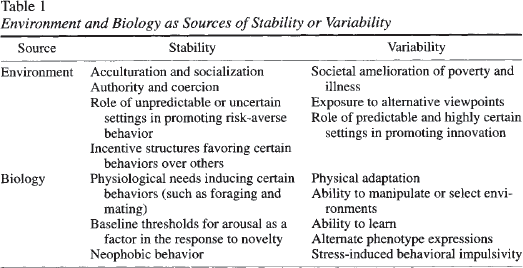
Murphy proposed a middle course between rationalism and empiricism. He argued that both stability and variability could be attributed to biological factors and that both could be attributed to environmental factors. Murphy proposed that there is a “first human nature” characterized by the ability of the organism to “learn, adapt, adjust, and remake the world in the image of his needs” (1958, p. 16), implying that innovation and cultural behavior are inherently biological phenomena. “Second human nature” is the result of socialization and canalization on familiar objects and promotes a “stylized, habit-bound, culture-bound way of seeing which represents the (nearly) irreversible acquired pattern of a human nature which man has learned but cannot unlearn” (Murphy, 1958, p. 56). Table 1 outlines some of the channels through which biological influences and environmental influences each contribute to both stability and variability in the behavior of an organism.
Environment and Biology as Sources of Stability or Variability
Some contemporary biologically oriented theorists are beginning to think along the same lines as Murphy. Oyama (1989) identified what she calls the “central dogma” of evolutionary perspectives in psychology. The central dogma is based on Crick's (1957) assertion that information can flow outward from the genes to the proteins but cannot flow in toward the genes. If one attempts to extend this idea to the study of behavior, what may result is a deterministic theory positing that behaviors are inherited and immutable. She noted, however, that each genotype has a norm of reaction and is expressed in various ways, and “nature,” or what are considered innate tendencies, is not transmitted but constructed in the course of developmental interactions with the environment. She also argued that “nurture,” rather than being a source of variability, is just as likely to promote stable, universal characters.
Beyond Interactionism
One misleading characterization of Murphy's thinking, found in Endler and Magnusson (1976) and elsewhere, is that his views reflect an “interactionist” position. It is assumed that Murphy was an interactionist because he gave equal weight to both person and situation. Yet, as Gadlin and Rubin (1979) pointed out, interactionist theorists generally believe that the categories of person and situation are reciprocally exclusive; Lewontin, Rose, and Kamin (1984) similarly argued that, for the interactionist, “the organism is alienated from the environment” (p. 272). Another characteristic of interactionist theories is that, even while attempting to strike a balance between two very distinct sources of influence, they remain either rationalistic or empiricist, and thus the true bias of the theorist is clear. What Murphy proposed as the basic unit of analysis was the field of the organism-in-environment, with the understanding that the organism itself is a feature in the environment and a reactive focalization of the environment (see Hallett, 1972). In recent years, a similar line has been developed by biologists; “just as there is no organism without an environment, so there is no environment without an organism” (Lewontin et al., 1984, p. 273). Gottlieb (1991) noted:
Behavioral … outcomes of development are a consequence of at least two specific components of coaction (e.g., person-person, organism-organism, organism-environment, cell-cell, nucleus-cytoplasm, sensory stimulation-sensory system, activity-motor behavior). The cause of development … is the relationship of two components, not the components themselves. (p. 7)
Recent findings in neuroscience support Murphy's basic premise that the organism progresses over time from a state of relative nondifferentation to a state of increasing differentiation based on the coaction of inchoate behavioral dispositions and specific environmental stimuli. In the face of these same findings, physicalistic reductionism and rationalistic faculty psychology, which stress physical structures but minimize the importance of the developmental history of the individual organism, are unsupportable positions. Indeed, the accumulated research is beginning to reveal in sharp detail the interdependence between neuronal architecture and situationally and biologically relevant stimuli.
Schultz, Dayan, and Montague (1997) found that, in primates, fluctuations in dopaminergic neurons are reliably correlated with the animal's prediction, based on learned associations, of rewarding events. Cahill, Prins, Weber, and McGaugh (1994) found a relationship between the degree of emotionality of the memorial event and the strength of the memory. LeDoux (1996) showed that animals acquire a fear response to a visual stimulus even when the optical pathway to the cortex is severed, suggesting that it is the precortical pathways to emotional centers of the brain, such as the amygdala, that play a key role in the learning of fear responses and that learning may occur in the absence of information.
The effects of experience on the brain result in long-term changes that affect the organism's subsequent interactions with the environment. According to studies cited in Rosenzweig and Bennett (1996), bird species that store food in a variety of locations have significantly larger hippocampal formations than other, related bird species. However, this formation does not appear in nestlings or in birds that have not had the experience of storing food. Adult sheep possess, in their brains, specific neuronal receptors for the recognition of horns (the role of horns in competition for mates conferring on them a high biological relevance), but they do not possess these receptors at birth (Kendrick & Baldwin, 1987). Recanzone, Schreiner, and Merzenich (1993) found that neurons of owl monkeys became increasingly reactive to a specific auditory tone when attending to this stimulus was instrumental to a reward but not when the monkeys passively listened to the stimulus tone. This increased responsivity also resulted in the physical enlargement of this area of the brain. Similarly, in a study of guinea pigs, Weinberger (1993) found that the pairing of an electric shock with a tone resulted in neurons that had been responsive to other tones shifting and becoming more responsive to the stimulus tones.
Inasmuch as the traditional distinction between the environment as the source of variability and biology as the source of constancies reflects Aristotelian categories, Aristotle's law of noncontradiction has been challenged by empirical observation. Levins and Lewontin (1985) have noted:
As a preliminary analysis, the separation of organism and environment or of physical and biological factors of the environment … has proved useful. But it eventually becomes an obstacle to further understanding; the division of the world into mutually exclusive categories may be logically satisfying, but in scientific activity no nontrivial classifications seem to be really mutually exclusive. (p. 53)
Yet, this quintessentially biosocial perspective is not the norm. The social sciences remain indebted to the standpoint of critical dualism, and the critical dualist, who considers paradoxes to be merely examples of confused thinking, inevitably settles on a partisan resolution. If one believes that it is meaningless to say that what is biological is at the same time social, one's beliefs will break in either the biological or sociological direction. As a result, there are, at one extreme, the postmodern psychologists who have pushed the notion of sociological determinism to the point of utterly relativizing any element of human experience said to be universal, including the experience of emotions such as anger or sorrow (Gergen, 1994; Harré, 1986). At the other extreme, in neuropharmacology and psychophysiology, affective experience is described as a physiological mechanism that is not only universal but centrally located. If an endocrinological state persists in an organism, it is assumed to be the result of an endogenous, presumably genetic predisposition rather than being attributed to eliciting factors in the environment that may also be constant over periods of time. Research efforts such as those detailed in Mednick, Muffitt, and Stack (1987) have attempted to correlate autonomic reactivity and hyperactivity with criminal behavior, focusing on “biological” causes. The reader soon understands that the term biological refers to those aspects of behavior that are heritable (the authors traced family histories of unusual autonomic reactivity) and immutable (the authors expected to find longitudinal constancies in this behavior regardless of differences in the participants' environments). Although it is beyond the scope of this article to recount the controversial aspects of the attention deficit–hyperactivity disorder diagnosis, it is evident that, to the extent that “learning disabilities” and affective disorders can be linked to distinctive neurological indications and can be alleviated through pharmacological intervention, environmental factors tend to be deemphasized (Coles, 1987).
Pseudorationality and Sociological Determinism
As Flax (1990) characterized the postmodernist view, a “person,” according to Westerners, is simply a “social, historical, or linguistic artifact” (p. 32). Lyotard (1993) described the person as “existing in a fabric of relations,” as a “nodal point” in social processes (p. 15). Recalling Durkheim's exhortation to view society and not the individual as the elementary unit of analysis, the individual is conceived as a receptacle of socially constructed meanings, and the notion of the individual as an insightful observer, so important to Murphy's thinking, is maintained to be a sentimental or even politically motivated fiction.
Postmodern analysis is, in the words of Kenneth Gergen, “aimed at disclosing ideological, moral, or political purposes within seemingly objective or dispassionate accounts of the world” and revealing “the underlying intent of the truth teller to suppress, to gain power, to accumulate wealth, to sustain his or her culture above all others” (1994, p. 36). Factual talk is seen as manipulation, and there is no mistaking the reduction of knowledge to ideology. Although there is reliance on the notion of oppression or self-interest as the impetus of dominant groups in presenting an ideology that serves their interests, it is not supposed that any one individual has the knowledge or the influence to perpetrate this ideology of domination. Therefore, any reference to rationality relates not to the individual but to what Popper (1962) called the logic of the situation or “pseudorationality.” It is referred to as pseudorationality because it resembles the calculative mental processes of a rational actor but is posited outside of the actor. Pseudorationality consists of the structural and supraindividualistic forces that determine what is a reasonable, fair, or moral course of action, positing a peculiar dichotomy between the individual and faculties of judgment believed to be quintessentially personal.
For sociological determinists, what is most important to bear in mind is that this pseudorationality is arbitrary with respect to the objective conditions in which members of a society find themselves and is instead driven by the inertial force of history. Shweder and Bourne (1984) went so far as to propose an explicit arbitrariness principle as a tenet of the sociocultural standpoint: “Knowledge … is without foundation; what is of value and importance is a matter of consensus” (p. 165). The biosocial theorist, as noted earlier, relies instead on the notion of an insightful observer who has direct access to the pool of experiences that are shared by all human beings and is in fact incapable of being anything other than a positive contributor to collective knowledge. Individual testimony is a true portrait, if not of the objective circumstances of the individual, then of the emotional climate of that individual situated within a given setting.
The postmodern trend in contemporary thinking is the most recent instantiation of the empiricist's skeptical reduction of experience to the cognitive moment, as Descartes established with his dictum cogito ergo sum. It is in this sense that postmodernism is simply another manifestation of the representational theories that compose the mainstream intellectual tradition in psychology. The postmodernist further presupposes that ideas, abstracted from their biological hosts, are causal agents and that the individual is merely a conduit of perceptions and beliefs that are essentially social and political in origin. The motivating ideal of the postmodernist is that of human freedom, to unmask traditional theories of knowledge and morality as tools of subjugation and to enfranchise those groups that have been, in one way or another, marginalized by the dominant ideology. This premise requires the postmodernist to point out instances of subjugation in which even its victims are unaware of the structural conditions that stand in the way of their achieving their fullest potentials. By rejecting the notion of personal agency, however, the postmodernist also rejects any real prospect for freedom or progressive social change. As Kenneth Gergen (1994) pointed out:
Without believing that individuals can accurately reflect on the world around them, it is difficult to see what value derives from individual decision making in the arenas of morality, politics, economics, family life, and so on. If knowledge is not an individual possession, then individual choices in these domains can be little trusted. (p. 5)
For the postmodernist, the free decision, if it exists at all, is an “arbitrary fiat, a true creation ex nihilo” (Bergson, 1908/1994, p. 186) that could not conceivably have an impact on the entrenched ideology.
Postmodern theorists celebrate the equal validity of alternative perspectives but at the same time devalue them. The imperial doubt of the postmodern skeptic is, itself, a foundational epistemological claim conferring on the individual maintaining this posture a privileged standpoint by which he or she can make characterizations about the strength of claims to truth made by these alternative perspectives. More to the point, declaring that all beliefs are equally arbitrary allows an apologia for standing fast by the beliefs of one's own culture. Gergen (1994) cited Feyerabend's assertion that Western medical science is considered superior to shamanistic healing customs of prescientific cultures only because the Western “apostles of science” are the conquerors and have suppressed the wisdom of the shaman. Gergen conceded, however, that
as a participant in Western culture, I would prefer to take my child to a Western doctor. I would do so not because Western medical knowledge is transcendentally superior, but because I participate in relationships where Western values predominate, and I code events as “illness” and “cure” in ways that are congenial to local medical practices. (1994, p. 74)
The burden of attempting to discover what aspects of shamanistic practices do, in fact, reflect reality is removed, again, because the skeptic has foreclosed the possibility that one may know reality. There is no requirement to engage the shaman in a discussion among equals except out of a notion of fairness or, one might suggest, paternal benevolence toward those who still benightedly possess convictions. In this sense, postmodernists may be characterized as politically and socially conservative.
There is, as suggested, common ground between postmodern perspectives and Murphy's. Gergen examined critically the notion of the autonomous individual that is presented as an ideal in Western societies, and Murphy also questioned the adequacy of the “cult of self-contained, self-defined individuality” (1947, p. 922) in meeting human needs. Gergen questioned the traditional standard of objectivity, in which “the individual's psychological states are contrasted with an external, material world” (1994, p. 167). Murphy likewise doubted the adequacy of relying on, as a standard of selfhood, the “clear and obvious boundary between person and non-person, namely, the capsule, the envelope, the spatial boundary, essentially the skin of the living individual” (1956, p. 88). He suggested instead that there is a gradient between self and nonself, that the self may be conceived, in large measure, in terms of the individual's social relationships and interactions with the world, as indeed a “node” of intersecting forces.
For the postmodernist, one “sphere of intelligibility” is exclusive of all others (Gergen, 1994). Individualism may be only one of many possibilities, but it does not coexist with these other possibilities within a given community. Hence, the communalistic or sociocentric viewpoint disappeared in the West once the egocentric viewpoint emerged (Sampson, 1991; Shweder & Bourne, 1984). This position follows ineluctably from, first, the assumption that domination is the principal mechanism of cultural change; second, the assumption that individuals are not free to choose between intelligibilities (ruling out the notion of a plurality); and, third, the assumption that the dominant ideology is a monolithic and coherent set of values.
The biosocial theorist takes quite a different view, that the individualistic valorization of the self, on one hand, and nonindividualistic experiences (e.g., merging into a crowd of celebrants or worshipers or self-escape through meditation or absorption in a creative process), on the other hand, constitute a “natural dialectic” of human needs and may be encountered in any society. These tendencies compensate each other. “A life of frenzied individualism leads to the need for a nonindividualized … form of experience” (Murphy, 1947, p. 923), or, as Koestler (1967) put it, people possess the need for both “wholeness” and “partness.” Murphy pointed out, however, that these two forms of experience are not dualistic categories; rather, the individual is a “node or point of relative distinctness in a super-individual context” (1947, p. 924) such that, in any given instance, either reality is available as a tool to understanding. Certain environments may consistently favor the expression of one form of experience over the other, but never to the point of exclusivity.
Finally, postmodern as well as cognitivistic theorists, by relying on ideology or stereotypes, implicate incorrect or distorted information as the primary cause of inegalitarian or prejudiced thinking. The postmodernist, by rejecting the notion that emotions are universal and by taking the view that people's behaviors are essentially arbitrary, rules out the possibility that there is a distinctively human response to feelings of threat or anxiety that manifests in the form of exaggerated in-group identification and vilification of an out-group. Therefore, the tendency is to attempt to “correct” people's thinking, without consideration of how these belief systems are functional in a given setting.
Perhaps the greatest contribution of social constructionist philosophy is its encouragement to think past the received wisdom of one's own culture. It is easy for standards of adjustment or normality to mirror cultural prescriptions, and the field of psychology is at constant risk of becoming merely another institution enforcing the prevailing norms of society.
Conventional Evolutionary Psychology
The reliance on the construct of pseudorationality is shared by both sociological and biological determinists; however, in each instance, it appears in a different guise. Evolutionary psychologists depend on the premise that individuals are guided in their actions by the interests of reproductive success, to the extent that they are willing to risk death to promote the survival of their offspring. They do not assume, however, that individuals consciously weigh the benefits of making personal sacrifices for the benefit of their genes, in the manner of J. B. Haldane when he facetiously suggested that, if need be, he would lay down his life for three of his brothers or nine of his cousins (cited in Barash, 1979). Instinct, in particular, is an example of pseudorationality; according to the Oxford English Dictionary, an instinct is “an innate propensity in organized beings (esp. in the lower animals), varying with the species, and manifesting itself in acts which appear to be rational, but are performed without conscious design or intentional adaptation of means to ends.”
Lorenz (1965) avoided the term when he presented his own view of the influence of biology on learning; nevertheless, what he described was not different in any meaningful sense from what is referred to as instinct. He asserted:
It is … an inescapable logical necessity to assume that learning, like any other organic function regularly achieving survival value, is performed by organic structures evolved in the course of phylogeny under the selection pressure of just that survival value. [However], the assumption that learning “enters into” every phylogenetically adapted behavior mechanism is neither a logical necessity nor in any way supported by observational and experimental fact. (Lorenz, 1965, p. 18)
In other words, although behavioral adaptations are the result of natural selection and are, in that sense, modifiable, Lorenz did not believe that it is warranted to claim that these behavioral adaptations are contingent on experience.
Lorenz's model is unidirectional and presupposes that the innate response will always occur in the presence of the releasing stimulus, even when this response is, in fact, inappropriate. His famous example is that of the graylag goose, in which imprinting, or strong approach and following behavior, is exhibited toward any large moving object that offspring see immediately after hatching. This is clearly an adaptive behavior as long as the large object that the animal sees is its mother. If it turns out to be an ethologist or even a rolling ball, however, this behavioral tendency still manifests. Of course, one must answer the question of whether imprinting is a suitable model for human behavior or whether imprinting itself, as framed by Lorenz, is an accurate characterization (for alternative views on imprinting, see Hoffman & Solomon, 1974; T. Johnson & Gottlieb, 1981).
Lorenz's model permeates adaptationist thinking. There is a presupposition that behaviors may occur in the “wrong” environment, which suggests that there is such a thing as a “correct” environment corresponding to the environment in which the behaviors evolved. This leads to one of the key foundational assumptions of ethological and sociobiological theory: that of the “environment of evolutionary adaptedness” (Bowlby, 1982; Buss, 1994; Goleman, 1995; Tooby & Cosmides, 1992). The environment of evolutionary adaptedness of human beings is believed to be the African savannah, where, until a few thousand years ago when “cultural evolution” began to accelerate exponentially, human beings traveled in small hunter-gatherer bands in which males were dominant and females foraged close to home (Wilson, 1980). Not only did cultural evolution accelerate; to the extent that the natural habitat was replaced by a “softer” and more forgiving artificial environment in which the wounded, diseased, or handicapped received care rather than being selected out by predation or abandonment, biological evolution “slowed down” (Barkow, 1978). This is no different from Spencer's notion of counterselection.
This presupposition has led to the romantic notion that human beings exist in a world that nature never anticipated. Ardrey (1966), for example, spoke of territorial instincts that functioned adaptively in the wide-open plains but are maladaptive in urban environments. Bowlby (1982) and Tooby and Cosmides (1990) argued that the human appetite for fat and salt is adaptive in environments where these nutrients are scarce but is decidedly contrary to the interests of health in a world where McDonald's franchises exist almost at every street corner. Goleman (1995) asserted that “we too often confront postmodern dilemmas with an emotional repertoire tailored to the urgencies of the Pleistocene” (p. 5). Orians (1980) suggested that human beings share an innate preference for landscapes that resemble the savannahs of their common Pleistocene origins. So, for evolutionary psychologists, it is reasonable to speak of “atavisms” or “vestiges” in human behavior, a view that collides with the statement by evolutionary psychologists that the most important of evolved human abilities is that of behavioral plasticity (Boyd & Richerson, 1985; Wilson, 1980).
David Buss (1993; 1994) has developed a theory of human mating based on the principles of evolutionary psychology. His own approach, to his credit, does not take the Lorenzian view of behavioral adaptations. He accepted the familiar axiom in evolutionary psychology that “females … seek to mate with males who show the ability and willingness to invest resources connected with parenting such as food, shelter, territory, and protection,” because these traits provide both immediate and long-term advantages to the female's offspring (Buss, 1993, p. 251). This, Buss hastened to add, tells only half of the story. The human phenotype contains alternative mating strategies and preferences, and environmental factors help to determine which of these alternatives find expression. Females, Buss (1993) asserts, should exhibit the mating preferences just described only under certain conditions: “(a) where resources can be accrued, monopolized, and defended, (b) where males of the species show some nontrivial degree of parental investment or resource provisioning, (c) where males tend to control such resources, and (d) where male variance in ability or willingness to provide resources is sufficiently high” (p. 251).
Buss has admitted that there are still gaps in his formulation. Particularly, he has not provided a satisfactory explanation of how something as specific as mating preferences could be encoded in the genes. Although he has cited studies showing cross-cultural agreement in ratings of physical attractiveness, there are many more cues involved in mate selection, such as “chastity” in females, a trait that is not directly observable and cannot be reliably tested. And there are other cues, such as emblems of status or prestige, that vary widely from one culture to another. Is it plausible to suppose that natural selection has provided females with a “status detector” that is sensitive enough to discern status, whether it is measured by the size of the kill that is brought back to the village or by the materials and tailoring of a three-piece suit?
At this stage of his argument, Buss can only go back to his starting point, that human beings have the potential to express alternative mating strategies. “Knowledge of the conditions that favor each mating strategy,” he suggested, “gives us the possibility of choosing which to activate and which to leave dormant” (Buss, 1994, p. 209). To the extent that these strategies are said to be voluntaristic and knowledge based, it is more difficult to make the claim that they are “hard wired”; on the other side, to the extent that they are hard wired, it is more difficult to explain how it is people come to have conscious knowledge of these strategies and choose between them. The awkwardness of evolutionary theorizing arises from (a) the attempt to draw a direct connection from ultimate or distal theories to the vagaries of individual behavior and (b) the attempt to make evolutionary theory all-encompassing and a substitute for theories that are based on sociocultural mechanisms.
As Murphy (1947) stressed, it is impossible to observe dispositions; it is only possible to observe dispositions as realized, or as the outcome of a developmental process. The statement that females seek males who are high in status is problematic inasmuch as “status” is an outcome of cultural forces. Female preference for high-status mates may be more parsimoniously stated as the tendency of females to attend to a wider range of criteria than males in selecting a mate. Indeed, because males directly benefit in terms of number of offspring by having multiple partners while females do not, there is a sound evolutionary argument to be made that males are simply less choosy.
Murphy (1947) noted, “all traits are acquired by some kind of reaction with environmental forces” (p. 51). In place of the Environment of Evolutionary Adaptedness argument, it is more likely that human beings over the course of their evolutionary history have had to display adaptive behavior in a range of environments and have developed alternative strategies. Buss (1994) only mentions parenthetically the important arguments of Belsky, Steinberg, and Draper (1991), who suggest that experiences in one's childhood environment contribute to the formation of predictable patterns of behavior that remain relatively stable into adulthood. A stressful upbringing promoting an “avoidant” attachment pattern is correlated with precocious sexuality, failure to establish long-term commitments, and diminished investment in child rearing. Being raised in a secure environment, on the other hand, increases the likelihood that the individual will either prefer committed relationships or have the requisite skills to achieve this type of relationship (see also Main, 1990).
Main (1990) speculated that the mating behaviors observed in unstable environments may enhance reproductive success in these environments. Acting on impulse, having children sooner and in greater numbers, and devoting less time to each child are all behaviors that may be advantageous if the future is uncertain. Entering long-term relationships, deferring gratification, having fewer offspring, and allocating a high level of resources to each are behaviors that are advantageous if the future is predictable. The most conspicuous example of the relationship between an insecure environment and sexual behavior is the evidence that, consistently across cultures, endowment (i.e., level of property and status) and life expectancy are each inversely related to the number of offspring individuals produce (Cassen, 1978; Vining, 1986).
The relation between quality of environment and attachment behavior is observed even among primates. Among bonnet macaques, it has been observed that the offspring of mothers that live in a setting in which food supplies are unpredictable are more likely to demonstrate a low level of exploratory behavior and an exaggerated need for maternal contact (i.e., anxious or avoidant attachment) than the offspring of mothers living in a setting where food supplies are predictable (Andrews & Rosenblum, 1991).
The implications of Andrews and Rosenblum's (1991) study and their focus on the relation between generalized biological tendencies (such as a fear of social isolation or the conflicting needs for exploration and safety) and experiences in the environment (availability of resources and maternal availability and responsiveness) touch on the basic themes of Murphy's biosocial theory. First, there is a process by which animals developed a characteristic mode of responding to the environment (canalization), and, second, there is the assumption that there are objectively stressful conditions that yield predictable behavioral responses (autism).
In a critique of Belsky et al.'s (1991) article, Maccoby (1991) pointed out that one does not need an evolutionary explanation to explain why girls from unstable home environments may exhibit precocious sexuality and a lack of commitment to relationships. She presented a fairly stark picture of these homes. They are characterized by looser surveillance, and mothers in these environments are said to present poor role models, being themselves sexually active with more than one partner. Girls may seek out sexual relationships in a desperate ploy to escape their home environment. This criticism misses the point that, if one views the organism-in-environment as a constellation in which multiple influences operate, and if one rejects the dualistic distinction between social factors and biological factors, the alternative explanations considered here support rather than contradict each other.
Nor, it should be pointed out, does the proposed relation between environmental stress and mating behavior require an adaptationist explanation. Impulsivity in the face of uncertain environments may increase the organism's rate of reproduction but does not rely on the existence of a direct link between a specific pattern of behavior and preexisting representation in the genotype. Implying as it does that these patterns are resistant to change, the adaptationist view frequently takes on an alarmist tone. Vining (1986), speaking of the tendency of poor, uneducated people to reproduce in greater numbers than successful, educated people, feared that culture contains within it a “self-dissolving tendency”; in this respect, and despite his disavowals, he echoed turn-of-the-century advocates of eugenics.
Murphy (1949b) noted, of the shifts in opinion observed in the social sciences, that “one swings from paranoid hereditarian theories to paranoid environmentalist theories, and from paranoid biological determination to paranoid social determination. The truth, instead of lying ‘somewhere between these two extremes,’ seems to lie rather in gradual assimilation of each system by the other; each one ‘takes the other in' until the essential truth in both systems appears in an integration” (p. 443). Some 40 years ago, he helped point the way to this goal.
Conclusion
The biosocial perspective of Gardner Murphy was inspired by the intellectual climate of his day. Einstein had demonstrated in physical science the essentiality of the relationship between the observer and the percipient object. Functionalist philosophers and psychologists, particularly William James, provided a framework in which the relativism of Einstein could be operationalized for the social sciences. Furthermore, they offered a perspective on mind that located the organism within the environment, as opposed to representational theories of mind, which would later become dominant in the form of cognitive psychology. Murphy's distinctive contribution was to apply the insights of Einstein and James to a systematic and eclectic metatheory of personality development.
Conventional theoretical traditions have taken either the course of biological determinism, which presupposes the existence of a static and rule-based universe and is dedicated to uncovering lawlike regularities in human behavior across cultures, or the course of sociological determinism, which presupposes that the relationship between the world and the individual is arbitrary and defined by historical forces. Interactionist views maintain the categorical distinction between biology and culture even while attempting to establish a more reciprocal relation between the two. Murphy's biosocial theory, in the Spinozistic tradition of James, maintains that an idea is not a representation of the object but an effect of the object on the perceiver. Furthermore, inasmuch as the organism is integral with its environment, human beings are counted as insightful observers possessing valid, if incomplete, knowledge of the world.
The purpose of this article has been, first, to outline Murphy's biosocial perspective and, second, to distinguish it from other theoretical viewpoints. Evolutionary psychology and postmodern psychology have points in common with biosocial psychology, as well as points of divergence. Murphy's viewpoint offers an intriguing alternative to both of these perspectives, inasmuch as Murphy maintained a “middle position” that integrated both situational and biological factors. Most important, Murphy was fully aware that simple interactionism was not a tenable course of action, and he undertook a systematic effort to examine the epistemological foundations of conventional social science with the goal of identifying the presuppositions that have traditionally caused practitioners to continually resort to a dualistic conception of the biology–environment relation.
Footnotes
1
The role of familiarity in incest avoidance was first suggested by Westermarck (1891), who speculated that once a certain threshold of familiarity has been reached, such as among brood mates, members of the opposite sex tend not to be viewed as potential sexual partners. This is borne out by observations of nonrelated individuals raised together in kibbutzim (Tooby & Cosmides, 1990). By implication, uncertainty or risk plays a role in sexual attraction, and this may go a long way in explaining the desire for a variety of sexual partners that is observed in males. The same desire for variety may exist in females but is offset by the risk of pregnancy and the coercive tactics used by males to horde mates.