







Abstract
Furthering the cause of consilience in the social sciences a model is proposed in which Eriksonian life span theory and life history theory are integrated. The model explains individual differences in the Eriksonian developmental stages as a function of the individual differences in developmental trajectories of life history theory as conceptualized by Belsky, Steinberg, and Draper (1991). Erikson's fifth stage of identity formation is used to examine the model, with the results of three studies presented to illustrate the viability of the model. Future research should examine other aspects of the model and the relationship between the developmental trajectories in life history theory and the Eriksonian stages in greater detail.
Evolutionary accounts of human behavior offer the field of psychology a functional metatheory under which findings from different areas of study can be unified (Buss, 1995; Wilson, 1998). From such a stance the failure of traditional psychological theories to incorporate evolutionary accounts are problematic, because if evolution is the overarching phenomena then every accurate theory of behavior should be compatible with evolutionary principles. Of course, evolutionary approaches to psychology are not without critics (see Segerstråle, 2000, for review). For example, in their recent assessment of evolutionary psychology, Lickliter and Honeycutt (2003) posit that evolutionary psychological approaches are too static and have failed to incorporate the epigenetic nature of human development. Reflecting the influence of evolutionary accounts of development they conclude that, “The mechanisms of evolution are now considered to be essential to understanding development…” but also stress their point on the need for understanding individual ontogeny, “…and the mechanisms of development have likewise become essential to understanding evolution” (Lickliter & Honeycutt, 2003, p. 866). While one could argue that ontogeny has been the focus of research in evolutionary psychology (Bjorklund & Pellegrini, 2002), increasing that focus, as suggested by Lickliter and Honeycutt, could prove fruitful. To study psychological ontogeny from an evolutionary perspective it makes sense to reexamine currently accepted theories and findings; combining the insights offered by both traditional theory and evolutionary psychology. This paper represents an attempt at such an integration; one between Erik Erikson's (1968) life span theory of human psychosocial development and life history theory (LHT) using the example of identity formation.
Erikson's Life Span Theory
Erik Erikson's theory is one of the most influential theories in the field of human development. His stages of development are included in most introductory psychology textbooks and are a central focus of chapters in social development in many undergraduate human development textbooks. Not only is it historically important (research into Erikson's theory began even prior to its full conception; e.g., Block, 1961; Marcia, 1966), but research using this perspective continues to the present day (Schwartz, 2001).
Erikson's theory of psychosocial development is based on the epigenetic principle, which states that development unfolds in a series of predetermined stages, that there is an optimal time for the ascendancy of a stage, and that the resolution of early stages greatly influences the outcomes of later stages. Based on this principle, Erikson (1950) posited that there were eight psychosocial tasks or crises and they become most salient at different times throughout the life span. Each stage (see Table 1) should be viewed as a continuum not as categories, even though the versus used by Erikson would suggest otherwise. Furthermore, Erikson (1950) suggests that optimal psychological health is reached when a “favorable ratio” between poles is reached. The first stage is trust versus mistrust. If caretakers are responsive development tends toward a basic sense of trust, if caretakers are not responsive the infant develops a basic sense of mistrust. Note that a “favorable ratio” indicates that one can be too trusting. Additionally, psychosocial strengths are gained at each stage when the crisis is successfully addressed. For basic trust versus mistrust a marked tendency toward trust results in hope.
Approximate Period in Life and the Corresponding Eriksonian Crisis
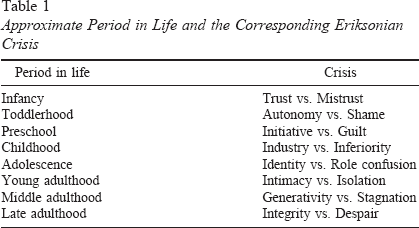
The second stage is autonomy versus shame and doubt. In this stage as a child's mobility increases and they explore their world a sense of autonomy develops if the child is appropriately guided and restricted by caregivers. The psychosocial strength that can be gained at this stage is willpower/self-control. The third stage of initiative versus guilt becomes salient as the child is able to initiate goal-directed actions and success and praise increase the sense of initiative and the psychosocial strength of purpose. The fourth stage is industry versus inferiority and children try to hone and master culturally important skills. The achievement of these skills results in a sense of industry and the psychosocial strength of competence. The fifth stage is the most important in Erikson's theory and is identity versus role confusion. Here an adolescent is faced with the task of developing a sense of self-continuity. Identity formation results in the psychosocial strength of fidelity. The sixth stage is intimacy versus isolation and represents the ability to share with and commit to another, most often in the form of romantic relationships. The psychosocial strength that can be gained in the sixth stage is love. The seventh stage is generativity versus stagnation and at this stage the adult is faced with the task of being productive and working to shape the next generation; often ones own children. The psychosocial strength that is gained is care. The final stage is integrity versus despair where in old age the person must look back on their lives and have a sense of satisfaction or regret. The psychosocial strength that goes along with integrity is wisdom. The stages build upon one another and the manner in which each task is resolved impacts the rest of development in a profound way. For example, the development of a basic sense of trust makes it more likely the individual will develop along a path that includes a sense of autonomy, industry, identity, intimacy, generativity, and integrity.
LHT
Another developmental perspective, LHT examines the manner in which individuals differentially invest material and bioenergetic resources (e.g., time, money, metabolic energy, cognitive energy) in somatic and reproductive effort (MacArthur & Wilson, 1967). Somatic effort includes investments that go into the maintenance and longevity of the individual organism (i.e., survival) and their genes (i.e., inclusive fitness), whereas reproductive effort includes investments in the production or maintenance of new organisms that possess copies of their genes. Reproductive effort may further be subdivided into mating effort and parental effort, where mating effort refers to behaviors that focus on producing new offspring, and parental effort focuses on investment into already existing offspring.
At its core, LHT is an evolutionary theory that illustrates that natural selection has shaped the diversity of reproductive strategies between species. Moreover, it is based on an interaction between genetic predispositions (evolutionary time) and environmental cues experienced in an individual's lifetime (ontogenetic time), suggesting that subtle but measurable natural variations between individual reproductive strategies will exist within species as well (Hill & Kaplan, 1999).
Traditionally, LHT was illustrated through r/K theory, which examines the tradeoff organisms make between behaviors that focus on long-term somatic effort (K-selection) and behaviors that focus on short-term reproductive effort (r-selection). As outlined by MacArthur and Wilson (1967) and further explained by Pianka (1970), this comparison focused on between species differences based on the evolutionary selective pressures of the organism in relation to its environment. Specifically, K-selected species are described as having evolved in predictable environments where the production of long-lived, slow reproducing organisms (K) was a better solution to ecological conditions than production of short-lived, rapidly reproducing organisms (r) that are better suited for unpredictable environments.
A recent resurgence in the study of life-history strategy to study differences has generally discarded the use of the r/K terminology. The issues and controversies surrounding the use of r/K (Rushton, 1985) or different models is beyond the scope of the article, but are addressed Hill and Kaplan (1999) and Surbey (1998). Believing that discussing this controversy would obfuscate the issues we wish to address, we turn to the model that was proposed by Belsky et al. (1991) and that was the inspiration for the current article. This model is described in the subsequent section.
Reproductive Strategies within LHT
According to LHT, human life cycles have a set sequence of the timing of developmental events that are ordered to optimize survival and reproductive needs (Hill & Kaplan, 1999). For example, reproductive ability is typically delayed in humans (relative to other mammals and primates), thereby increasing the allocation of resources to growth and development, allowing for a large brain and a greater capacity for learning (MacDonald & Hershberger, 2005). However, provisions have to be made to manage the division of resources among the competing demands of personal growth and development, and reproduction. Belsky et al. (1991) proposed two prototypal developmental trajectories that represent strategies for divvying up the resources put toward the demands of growth, development and reproduction. A summary of these trajectories can be seen on Table 2; a Type I strategy represents a path of fast development and quantity in mates and offspring and Type II represents slower maturation with a greater emphasis on the quality of mates and offspring.
Prototypical Life History Theory Life History Developmental Trajectories
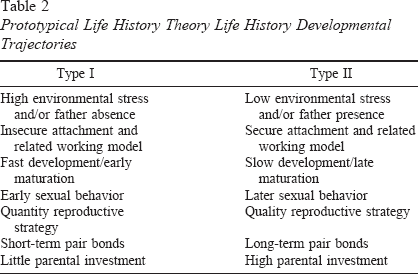
Belsky et al. (1991) based their theoretical paper on earlier work by Draper and Harpending (1982), in which father absence was identified as the environmental cue directing children's developmental and reproductive strategies. It was proposed that father absence signals, even in the presence of surrogate father figures, low investment/resources in the child and the instability of pair bonds and thus increases the likelihood of a Type I strategy being taken. Some research has supported the view, in which it is argued that a low-resource/high-stress household environment leads to a Type I strategy, while others have argued that it is father absence specifically, not the associated cues, that leads to such a strategy.
Surbey (1990) found a relationship between both father absence and age of menarche and exposure to stress and age of menarche. Quinlan (2003) analyzed retrospective data from over 10,000 women and found that early parental divorce was associated with early menarche, age of first sexual intercourse, first pregnancy, and shorter duration of first marriage. Likewise he found that unpredictability of parental care was associated with early menarche and age of first sexual intercourse, greater number of sexual partners, and shorter duration of first marriage. The relationship between these indicators of exposure to early stressful environments and indicators of a Type I strategy held regardless of whether the women lived with their mother or father. Likewise Chisholm, Quinlivan, Petersen, and Coall (2005) found that in a sample of pregnant women that uncertain early environments were associated with early menarche and age at the birth of their first child.
Alternatively, Ellis et al. (2003) found that in two large cross-cultural samples father absence predicted age of sexual activity and likelihood of teenage pregnancy even after controlling for a large number of possible early childhood stressors. In a study of early adolescent girls Maestripieri, Roney, DeBias, Duarante, and Spaepen (2004) found father absence was associated with early menarche, and Bogaert (2005) found that father absence predicted pubertal timing for both boys and girls.
In one of the earliest tests of the hypotheses about father absence, stress, and menarche Moffit, Caspi, Belsky, and Silva (1992) found that father absence and family conflict were associated with early menarche. Likewise, Hoier (2003) found that both childhood stress and father absence predicted early menarche which in turn was related to the number of sexual partners desired and age of beginning intimate relationships.
LHT posits that the strategies have been shaped, through natural selection, to work as functional composites (Figueredo et al., 2005). LHT therefore predicts that these composites will be detectable using multivariate correlational techniques (e.g., latent variable modeling, factor analysis). For example, using factor analytic techniques based on self-report questionnaires, Figueredo et al. (2005) identified a single multivariate factor representing the LHT strategies. This factor is comprised of a large array of characteristics including parental investment, support and contact with friends and family, altruism toward friend, family, and community, adult romantic attachment, mating effort, risk taking behavior, and Machiavellianism (Figueredo, Vásquez, Brumbach, & Schneider, 2004). This factor has been found to vary across individuals and to correlate with a large body of other individual difference variables such as physical and psychological health (e.g., Figueredo et al., 2005; Sefcek, Miller, & Figueredo, 2005), reproduction (e.g., Bogaert & Rushton, 1989), longevity (Rushton, 2004), and delinquency (e.g., Charles & Egan, 2004).
Taken as a whole, these studies have focused on the environmental cues that tend to account for differences in reproductive strategy. However, ignored from the purely environmental explanations of these phenomena are explanations due to individual variation in genetic predisposition. Rowe (2002) has suggested, contrary to environmental conditional approaches, that variation in life history strategy is largely heritable. Figueredo, Vásquez, Brumbach, and Schneider (2007) employed behavior genetic twin models and results showed strong genetic correlations among proposed indicators of a Type II strategy, with high heritability of the life history strategies (h 2 = .65) and accounting for 61% of the genetic variance in its component scales.
Eriskon's Life Span Theory and LHT
LHT and Eriksonian life span theory share the same set of underlying principles: (1) there are a set of predetermined developmental stages, (2) the stages follow a given sequence, and (3) the outcomes of previous stages profoundly impact the outcomes of current and subsequent developmental tasks and issues. Explicit in LHT is the idea that the stages of development are a product of selection, but little attention has been paid to Erikson's writings concerning the origins of the life span stages. He appears to have thought that the stages were fashioned through selection. For example, in talking about the psychosocial strengths that could be gained at each stage he comments, “I have since attempted to formulate… a blueprint of essential strengths which evolution has built into the ground plan of the life stages and into that of man's institutions” (Erikson, 1950, p. 274).
Given these points of agreement between the two approaches, it is proposed that Eriksonian life span theory can be accurately viewed from a life history approach. Figure 1 represents the proposed relationship between the Eriksonian stages and the life history developmental trajectories. As seen in the illustration as someone moves through life the different psychosocial questions become more salient with resolution of the questions falling along a continuum. Thus there are eight horizontal lines in the figure each representing one of Erikson's stages. Moving vertically through these stages are the life history strategies with the Type I path moving through (mistrust, shame, inferiority, role confusion…) and the Type II path moving through (trust, autonomy, industry, identity…). Consistent with research on the determinants of individual differences in life history strategies and suggested by Erikson's theory, the proposed model stresses both genetic and environmental influences in determining which path is taken.
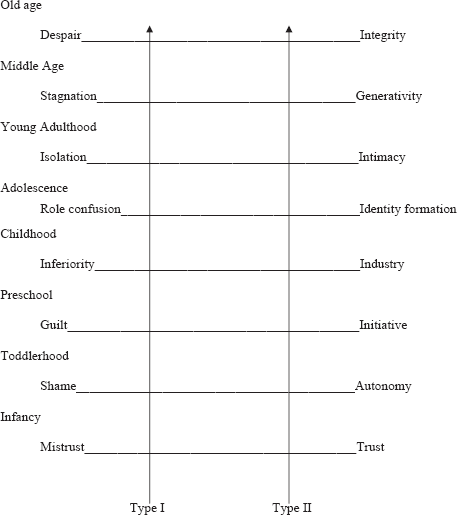
Eriksonian life span stages and the life history developmental trajectories.
The Example of Identity Formation
“… Fidelity is that virtue and quality of adolescent ego strength which belongs to man's evolutionary heritage, but which—like all the basic virtues-can arise only in the interplay of a life stage with the individuals and the social forces of a true community” (Erikson, 1963, p. 2).
Driven by Erikson's focus on identity, the continued importance of the construct in understanding human behavior, and most likely the availability of convenience samples of students at universities a great deal more research has been conducted on the stage of identity formation versus role confusion than the other Eriksonian stages. Given the amount of research on the stage of identity formation a thorough comparison with the life history approach is possible. Additionally, identity formation is a good choice for a comparison because it is a task that becomes salient during adolescence the time at which reproductive capacity begins, signaling some shift in resource allocation to mating (Charlesworth, 1988). Lastly, reflecting the importance of the construct recent theorizing has put identity at the center of understanding personality development in adulthood also making it a good choice (Roberts & Caspi, 2003).
In terms of the proposed model this means that a Type I strategy should be associated with role confusion. 1 If this is accurate, then role confusion should be associated with (1) the same antecedents as a Type I mating strategy, (2) the reproductive characteristics of a Type I reproduction strategy, and (3) and the broader psychosocial characteristics of a Type I strategy.
As previously described, insensitive parenting, parental divorce, insecure attachment, and quite possibly and specifically father absence steer development toward a Type I trajectory. If role confusion is reflective of a Type I trajectory, then the same family characteristics should be associated with role confusion. While we know of no prospective longitudinal studies examining the relationship between early childhood household environment and identity formation, there is an abundance of studies looking at the concurrent offspring/parent relationship and identity formation.
Research has shown that role confusion is associated with low levels of parental and adolescent connectedness (Campbell, Adams, & Dobson, 1984), parental and adolescent communication (Grotevant & Cooper, 1985; Papini, Micka, & Barnett, 1989; Reis & Youniss, 2004), family cohesion (Papini et al., 1989; Mullis, Brailsford, & Mullis, 2003), parental identification (Cramer, 2001; Dignan, 1965; Knafo & Schwartz, 2004), trust and degree of parental care (Hoegh & Bourgeois, 2002), parental support (Sartor & Youniss, 2002), and authoritative parenting (Adams, Ryan, & Keating, 2000; Berzonsky, 2004; Waterman, 1993). Summarizing the research on the type of parenting related to identity confusion Waterman stated that parents whose children have role confusion are, “seen as indifferent, inactive, detached, not understanding and rejecting” (Waterman, 1993, p.62).
Belsky (1997) proposed that attachment quite possibly occupies a unique space in setting the developmental trajectory. Although the results of some studies differ (e.g., Faber, Edwards, Bauer, & Wetchler, 2003; Quintana & Lapsley, 1987) the majority of studies in the area have found a relationship between insecurity of attachment and role confusion (e.g., Bartle-Haring, Brucker, & Hock, 2002; Benson, Harris, & Rogers, 1992; Lapsley, Rice, & Fitzgerald, 1990; Matos, Barbosa, Milheiro De Almeida, & Costa, 1999; Reich & Siegel, 2002; Samuolis, Layburn, & Schiaffino, 2001; Schultheiss & Blustein, 1994; Zimmerman & Becker-Stoll, 2002). Also notable is the consistency across earlier stage resolution which implicate parental/child relationships (e.g., trust vs. mistrust) and role confusion (Boyd & Koskela, 1970; Hoegh & Bourgeois, 2002; Logan, 1986; Rothman, 1978). Finally, some early findings suggest that father absence specifically may be a determinant of role confusion (Oshman & Manosevitz, 1976) although the results of subsequent studies have contradicted the earlier results (Grossman, Shea, & Adams, 1980; St. Clair & Day, 1979).
A Type I trajectory is further defined by earlier sexual promiscuity and a dearth of intimacy and stability in romantic relationships (Draper & Belsky, 1990). Thus, role confusion should be associated with promiscuity and relationships with low levels of intimacy.
In a survey of college students Dunkel and Papini (2005) found that role confusion was associated with greater interest in short-term mating (i.e., one night stands) and a desire for a greater number of lifetime sexual partners. In fact, identity accounted for more variance in the number of sexual partners desired than gender. King (1993) reported small but significant positive correlations between role confusion and risky sexual behavior. Schenkel and Marcia (1971) found that beliefs surrounding premarital sex were an important component of identity formation, with role confusion being associated with a lack of standards guiding sexual behavior.
Erikson (1950) posited an important link between identity formation and intimacy by placing the psychosocial stage of intimacy versus isolation directly after the stage of identity formation. Erikson (1968) stated that only upon knowing oneself could intimacy and adult love become possible. Given the important theoretical relationship between identity and intimacy a number of studies have been conducted on the association between the two constructs, and it has consistently been found that role confusion is associated with lack of intimacy (e.g., Dyk & Adams, 1990; Fitch & Adams, 1983; Kacerguis & Adams, 1980; Hoegh & Bourgeois, 2002; Orlofsky, 1993).
Finally, if role confusion is representative of a Type I trajectory, then it should be associated with the individual differences characteristics of said trajectory. The following are a list of characteristics that are associated with role confusion that also reflect this type of LHT strategy as reported by Figueredo, Vásquez, Brumbach, & Schneider (2007) and Figueredo et al. (2005). The personality traits of high neuroticism, low conscientiousness, and low agreeableness (Clancy & Dollinger, 1993; Dollinger, 1995); personality disorder symptoms (Crawford, Cohen, Johnson, Sneed, & Brook, 2004); low levels of religiosity (Hunsberger, Pratt, & Pancer, 2001); poor academic performance (Berzonsky & Kuk, 2005; Robinson, 2003); drug abuse (Adams, Munro, Munro, Doherty-Poirer, & Edwards, 2005; Jones, 1992); short-term focus (Berzonsky & Kuk, 2005; Dunkel, 2000; Kerpelman & Mosher, 2004); low levels of empathy (Soenens, Duriez, & Goossens, 2005); low levels of altruism (Skoe & Marcia, 1991); anxiety (Balistreri, Busch-Rossnagel, & Geisinger, 1995; Berzonsky, 1989; Howard & Kubis, 1964); impulsivity (Soenens, Berzonsky, Vansteenkiste, Beyers, & Goossens, 2005); criminal behavior (Adams et al., 2005; White & Jones, 1996); low levels of moral reasoning (Skoe & Marcia, 1991; Podd, 1972); emotional and behavioral problems (Adams et al., 2001; Block, 1961; Wires, Barocas, & Hollenbeck, 1994); and low well-being (van Hoof & Raaijamakers, 2002). The breadth of the associations in common with role confusion, and a Type I trajectory is consistent with the proposition that role confusion is a reflection of a Type I trajectory.
Pilot Study
To test the feasibility of the integration, a simple correlational study was undertaken with measures of identity and LHT included in a questionnaire packet. Measures of the two constructs should be associated for the investigation into the integration of theories to more forward.
The identity styles (Berzonsky, 1989) were used to measure identity. There are three identity styles that represent individual differences in the orientation toward and processing of identity related information. The informational style is defined by the active exploration and evaluation of identity information; the normative style represents a tendency to use those in authority as guides when evaluating identity information; and the diffuse style is defined by the avoidance of identity related information and procrastination when forced to answer identity related questions. The identity styles are one of the most often used methods for examining identity formation (Berzonsky & Adams, 1999
Future time perspective was used to measure life history strategy (Zimbardo & Boyd, 1999). Future time perspective is defined by the cognitive focus on the future and goals and has been used as a proxy for a Type II strategy in research on LHT (e.g., Kruger, Reischl, & Zimmerman, 2008; Thornhill & Fincher, 2007).
Method
Participants
Eighty-six undergraduate university students between the ages of 18 and 25 years (M = 20.26, SD = 1.47) participated. The majority was female (n = 60) and white (n = 60).
Procedure and measures
Participants completed the questionnaires packets in small group settings.
Future time perspective was measured using the future subscale of the Zimbardo Time Perspective Inventory (Zimbardo & Boyd, 1999). The future subscale includes 13 items rated using a Likert-type scale. A sample item is, “I complete projects on time by making steady progress.” The internal consistency for the future subscale was α = .81.
The informational, normative, and diffuse subscales of the identity style inventory-4 (ISI-4; Berzonsky, Soenens, Smits, Luyckx, & Goossens, 2007) were used to measure identity style. The informational subscale includes 7 items such as, “Talking to others helps me explore my personal beliefs” and has an internal consistency of α = .76. The normative subscale includes 8 items and includes items such as, “I prefer to deal with situations in which I can rely on social norms and standards” and has an internal consistency of α = .70. The diffuse subscale includes 9 items such as, “I'm not sure where I'm heading in life; I guess things will work themselves out” and has in internal consistency of α = .77. The ISI-4 uses a Likert-type scale.
Results and Discussion
A regression analysis was performed using the three identity styles to predict future time perspective. The results showed that the combined linear function of the identity styles accounted for a significant and large amount of variance in future time perspective, R2 = .48, F(3, 82) = 25.52, p < .001, and also that the informational style, β = .50, t(82) = 5.73, p < .001; normative style, β = .29, t(82) = 3.56, p < .01; and diffuse style, β = −.22, t(82) = 2.54, p < .05 all accounted for unique variance in future time perspective. The results suggest that there is an association between the two constructs of identity and life history strategy, the association is strong (i.e., the effect size is large), and the association follows the anticipated direction with a link between role confusion and a Type I strategy and identity formation and a Type II strategy. Because the results of the pilot study were consistent with the proposal, further research was undertaken.
Where the pilot study utilized measures of future time perspective and identity style as proxies for life history strategy and identity formation, Studies 1 and 2 utilize measures that were designed to directly measure life history and the identity stage continuum proposed by Erikson. In addition, Study 1 was undertaken to see whether individual differences in life history strategy help explain parental influence on adolescent identity formation and Study 2 was undertaken to examine the relationship between individual differences in life history strategy and the four Eriksonian stages from identity to integrity.
Study 1
Study 1 was conducted to examine the relationship between parenting, identity, and life history strategy. As reviewed, it has been shown that there is a positive association between indices of parental investment and identity. Study 1 was conducted to examine how parenting and identity relate to life history strategy. Most basically, it is hypothesized that both identity and indices of high investment parenting will be positively correlated to the Type II strategy. Second, following the presented reasoning that parenting influences life history strategy and the life history strategy influences identity formation, it is thought that the life history strategy mediates the established relationship between parenting and identity. Third, because LHT posits a special role for the father in determining life history strategy, parenting influences from both the mother and father are examined.
Method
Participants
One-hundred forty-three college students (female, n = 101) participated in study for extra course credit. All participants were between 18 and 25 years of age (M = 19.41, SD = 1.64), which represents the age at which identity is most dynamic (Waterman, 1982). One-hundred thirty-one were White, 7 Black, 3 Hispanic, and 1 marked other regarding a demographic question on race.
Procedure and measures
All of the questionnaires were included in a questionnaire packet that the participants were instructed to complete at their leisure. One participant's data was removed after initial analyses because their responses consistency showed up as an outlier.
Parenting
A measure of authoritative parenting (a parenting orientation defined by a high degree of both warmth and control) and a measure of emotional closeness to parent were used as indicators of parental investment. Authoritative parenting and emotional closeness were measured for both the participants’ relationship with their mother and father.
The subscales measuring authoritative parenting of the Parental Authority Questionnaire (PAQ; Buri, 1991) were utilized. A sample item from the PAQ is, “As the children in my family were growing up, my father/mother consistently gave us direction and guidance in rational objective ways.” The internal consistency for the two 10-item Likert-type scales were mother (α = .92) and father (α = .94).
The subscales of the Relationship with Father/Mother Questionnaire measuring emotional closeness (RFMQ; Mayseless, Wiseman, & Hai, 1998) were administered. A sample item from the RFMQ is, “My father/mother tends to show love for me.” The internal consistency for the two 10-item Likert type scales was as follows: mother (α = .95) and father (α = .94).
Identity
Identity versus role confusion was measured by using the identity versus role confusion scale (IDS) developed by Ochse and Plug (1986). A sample item from the IDS is, “I feel my way of life suits me.” The internal consistency for the 19-item Likert-type scale was α = .84.
Life history strategy
Life history strategy was measured using the mini-K (Figueredo et al., 2007). The mini-K was designed so that higher scores represent a life history strategy as seen in the Type II trajectory. The original mini-K consists of a 20-item Likert-type scale, but 2 items were removed for the current study because earlier research indicated that these items had an adverse impact on the scales reliability in the studied population. One item concerned one's relationship with one's own children and the other one's relationship with one's sexual partner. The vast majority of the participants have neither a sexual partner nor children. A sample item from the mini-K is, “I am closely connected to and involved in my community.” The internal consistency for the mini-k was α = .71.
Results and Discussion
Descriptive statistics and bivariate correlations for each measure can be seen in Table 3. Replicating much of the previous work, significant correlations between the two indices of parenting for both mother and father and identity were found. As predicted, there were positive correlations between life history strategy and parenting, and life history strategy and identity. The association of most interest is the correlation between the mini-K and the IDS. Correcting for the unreliability of the identity measure and the mini-K (Schmidt & Hunter, 1999), r = .66, indicating the predicted strong relationship between the two constructs.
Scale Means, SDs, and Bivariate Correlations
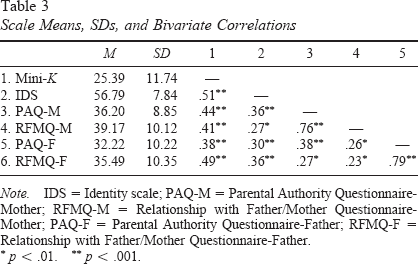
Note. IDS
p< .01.
p< .001.
The significant positive correlations between the measures of parenting, identity, and life history strategy also meet the required first steps for establishing mediation (Baron & Kenny, 1986). The last step in establishing mediation necessitates that regression analyses are conducted in which the mediator (life history strategy) when added as a predictor variable renders the mediated predictor variables (parenting measures) no longer significant as predictors of the dependent variable (identity). Regressions were calculated to test for mediation and additionally to separately examine paternal and maternal influences.
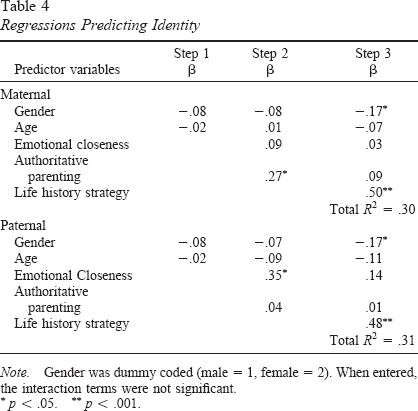
Mediation was examined using regression analyses; the results of which can be seen in Table 4. Two separate regression analyses predicting identity were calculated. Age and gender were entered on Step 1, on Step 2 the parenting measures were entered (in the first regression the maternal measures were entered and in the second regression the paternal measures were entered), on Step 3 the life history strategy measure was entered. Consistent with mediation the parenting measures predicted identity (authoritative parenting for the maternal measures and emotional closeness for the paternal), but when the life history strategy was entered on Step 3, the beta weights were no longer significant and life history strategy was a significant predictor. The results of the regression analyses lend support to the hypothesis that life history strategy mediates the relationship between parenting and identity. However, the more precise hypothesis that the mediation would be particular to the relationship with father was not supported.
Regressions Predicting Identity
Note. Gender was dummy coded (male
p < .05.
p < .001.
Study 2
Although the basis for the integration of the two theories has focused on the relationship between identity and life history strategies (for reasons cited earlier), as seen in the Figure 1 individual differences in life history strategies are thought to explain individual differences in the other Eriksonian stages as well. The purpose of Study 2 was to examine the relationship between life history strategies and individual differences in the Eriksonian stages from identity formation through integrity in a sample of adults.
Method
Participants
One hundred thirty-seven community college students between the ages of 25 and 63 years of age (M = 35.57, SD = 8.83) volunteered. Ninety-three participants were female. One hundred six considered themselves White, 21 Black, 3 Hispanic, 4 Asian American, 2 American Indian, and 1 marked “other” in reference to the demographic question on ethnicity. Sixty-one participants reported being married, 56 single, and 20 divorced.
Procedure and measures
All of the questionnaires were included in a questionnaire packet that the participants were instructed to complete at their leisure.
Life history strategy
Life history strategy was measured using the mini-K (Figueredo et al., 2007). The internal consistency for the mini-K was α = .73.
Identity
Identity versus role confusion was measured by using the IDS, developed by Ochse and Plug (1986). The internal consistency for the IDS was α = .84.
Intimacy
Intimacy versus isolation was measured using the 12-item Likert type intimacy subscale of the Erikson Psychosocial Stage Inventory (EPSI; Rosenthal, Gurney, & Moore, 1981). A sample item from the EPSI is, “I prefer not to show too much of myself to others.” The internal consistency for the EPSI was α = .73.
Generativity
Generativity versus stagnation was measured by using the 20-item Likert-type Loyola Generativity Scale (LGS; McAdams & de St. Aubin, 1992). A sample item from the LGS is, “I have important skills that I try to teach others.” The internal consistency for the LGS was α = .79.
Integrity
The Psychosocial Inventory of Ego Strengths (PIES; Markstrom, Sabino, Turner, & Berman, 1997) was used to measure integrity versus despair. The subscale of the PIES that was used was an 8-item Likert-type scale designed to measure wisdom, the ego strength that emerges from a sense of integrity. A sample item of the PIES wisdom scale is, “I can accept the fact that I made mistakes in my life.” The internal consistency for the PIES wisdom scale was α = .74.
Results and Discussion
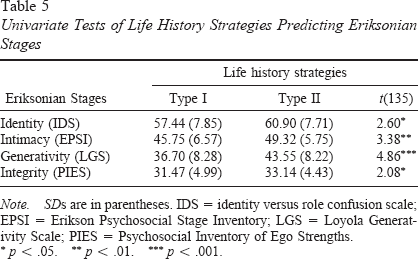
Using a median, split the sample was categorized into two groups (Type I and Type II) based on the mini-K scores. A multivariate analysis of variance was performed using the groups to predict scores on the linear function of the combined scores from the identity, intimacy, generativity, and integrity measures. The results showed that the groups differed significantly, F(4, 132) = 7.53, p < .001, η2 = .19. As seen in Table 5, subsequent analyses showed that the groups also differed on each of the stage scores individually.
Univariate Tests of Life History Strategies Predicting Eriksonian Stages
Note. SDs are in parentheses. IDS
p < .05.
p < .01.
p < .001.
Examining the relationship between life history strategies and the Eriksonian stages in adulthood enabled a test to see whether the relationship between the two theories was specific to identity. These results provide clear support for the proposal that individual differences in life history strategies are associated with individual differences in a number of Eriksonian stages, not just identity.
Discussion
Following the example of MacDonald and Hershberger (2005), this article represents an attempt to integrate an influential theory in developmental psychology with an evolutionary approach to development. Evolutionary approaches to the study of psychology have changed the discipline (Buss, 1995) and offer the opportunity for consilience (Wilson, 1998) by unifying apparent disparate psychological approaches and theories. Evolutionary approaches to normative personality change (Costa & McCrae, 2006) and individual differences based on life history strategies have been proposed (Draper & Belsky, 1990), and the recasting of psychoanalytic ideas in terms of evolutionary psychology has met with some success (Badcock, 1998; Westen & Gabbard, 1999). Consistent with this previous work, the proposed model furthers the ends of consilience by integrating the Eriksonian model of psychosocial development with a life history perspective.
Granted there are significant and important differences between the Erikson's life span theory and LHT. Erikson identifies a certain path of development as being superior and reflecting greater mental health, while LHT being derived from evolutionary theory does not allow for such judgments to be made. However, we believe that integration offers opportunities to advance the understanding of human psychosocial development and that the review of the research on identity development supports this contention. Both developmental trajectories may lead to reproductive success and each may be superior given the broader environment. Using the example of identity development, role confusion appears to have the same antecedents, characteristics, and associations as a Type I developmental trajectory. Role confusion and a Type I trajectory are associated with poor parent/child relationships, unstable shallow pair bonds, and share an array of correlates with broad indices of psychological difficulties. The studies presented lend further support to the belief that the two constructs are related, but, of course, further empirical research is needed to examine the proposed relationship between identity (and all of the Eriksonian stages) and LHT.
By putting an unduly amount of emphasis on cultural factors, nonevolutionary approaches to Erikson's model are limited to a specific time and location; the western world in the second half of the 20th century (the time and place the theory was developed). Contrary, to that view Eriksonian scholars continue to find insight in his writings. Adolescents’ use of Internet technology in the task of identity formation (Subrahmanyam, Smahel, & Greenfield, 2006) shows that cultural change affects the manner in which the psychosocial task is managed, but the task itself remains. Cross-cultural research on the generalizabilty of Erikson's insights has also been successful (e.g., Markstrom & Iborra, 2003; Ochse & Plug, 1986) Erikson (1950), himself, often relied on cross-cultural observations and historical analysis in the formation of his ideas. Erikson's writings and current research imply that Erikson's developmental tasks transcend time and culture; that they are a part of human nature.
Erikson appears to have taken this view. He writes that although the interaction between the developing individual and other persons and institutions vary across cultures, “… it must remain within ‘the proper rate and the proper sequence’ which governs all epigenesis” (Erikson, 1968, p. 93). This is not to say that cultural influences can or should be ignored, because the coevolution of humans and culture is largely recognized (Lumsden, & Wilson, 1981) and because we have tried to stress LHT emphasizes the role of the environment in the direction taken by the developing organism. The proposed model leads to research questions that could focus the field in interesting and new directions.
Footnotes
1
The studies listed utilize a number of different measures of role confusion versus identity formation. The most often used include Marica's (1966) identity statuses and Berzsonsky's (1989) identity styles. In these cases, role confusion is represented by identity status diffusion and identity style diffuse. Role confusion is the focus of the example because the proper representation of identity formation is less clear. For example, in his conceptualization Marcia (1966) placed the statuses on a continuum with identity Achievement nearest the pole of identity formation. Others (e.g., MacDonald, 1988), including us, see Foreclosure as representing identity formation, with Achievement representing the balance and identity flexibility  wrote about. Therefore, the focus of the article is the examples of role confusion.