







Abstract
The purpose of this paper is to discuss cultural similarities and differences in the processes of forgiveness. Forgiveness is a complex construct without a consensual definition. Generally speaking, forgiveness is the process that involves a change in cognitions, emotions, motivations, and behaviors regarding the transgressor (R. D. Enright & R. P. Fitzgibbons, 2000). Scientific interest in forgiveness has rapidly increased in the recent years, but whether the conceptualizations and underling mechanisms of forgiveness are similar across cultures still remain unclear. A dynamic process model of forgiveness is proposed in this paper, which includes the sociocultural, cognitive, emotional, motivational, and behavioral aspects of forgiveness processes. Particular processes that are likely to differ across Eastern–Western cultures are identified.
Social conflict is a rising problem that threatens the security and well-being of societies globally. There are over 30 wars and violent conflicts being waged around the world; approximately 40% of intrastate armed conflicts have lasted for 10 years or more, and 25% of wars have lasted for more than 25 years (Marshall & Gurr, 2005). These conflicts often lead to immeasurable harm, such as division of families and communities, and extreme violence, and mental problems of individuals (Vallacher, Coleman, Nowak, & Bui-Wrzosinska, 2010). Forgiveness—with its ability to facilitate beneficial emotion regulation processes, such as merciful thoughts, feelings and behaviors (Witvliet, Ludwig, & Laan, 2001)—is one of the most effective tools for restoring positive and cooperative relationships following these conflicts (McCullough, Root, Takbak, & Witvliet, 2009).
Although research on forgiveness has proliferated in Western populations in the past decade, little is known about the concepts of forgiveness and its underlying mechanism in non-Western populations. Theory and research on intergroup relations provide insight into some of the universal causes of and resolutions to interpersonal and intergroup conflict (Liu, 2004). However, research on forgiveness is largely culture free. Culture may shape the forms of intergroup interaction (Kashima et al., 2004). Therefore, it is important to understand the underlying mechanisms of forgiveness across cultures. The objective of this paper was to investigate the processes of forgiveness in both East and West.
Cultural Similarities and Differences in Forgiveness
On the one hand, some researchers have argued that there are trends in the globalization of forgiveness (Enright & Fitzgibbons, 2000). For example, Huang and Enright (2000) postulated that the development of moral reasoning about forgiveness is similar across cultures. Adolescents (ages 20–23) are more intrinsically forgiving than are their younger counterparts (ages 12–14), who are hypothesized to be more extrinsically motivated. Moreover, common predictors of forgiveness such as apology, intentionality, and offense consequence have been found across cultures (Girard & Mullet, 1997; McCullough & Witvliet, 2002).
On the other hand, other researchers have noted cultural differences in forgiveness (Kadiangandu, Gauche, Vinsonneau, & Mullet, 2007). For instance, Azar and Mullet (2001) argued that there are culturally unique trends in the dimensions or components of forgiveness. Kadiangandu et al. (2007) further posited that forgiveness is viewed as an interpersonal construct (e.g., focus on the expression of forgiveness to the transgressor) in collectivistic cultures, whereas it is conceived as an intrapersonal construct (e.g., focus on the internal emotional process) in individualistic cultures. In addition, the correlations between forgiveness and personality variables of neuroticism and agreeableness found by researchers in individualistic cultures (McCullough, Bellah, Kilpatrick, & Johnson, 2001) were not supported in collectivistic cultures (Fu, Watkins, & Hui, 2004).
Empirical research has further demonstrated that interpersonal variables that are related to forgiveness vary across cultures. A study by Takaku, Weiner, and Ohbuchi (2001) showed that Americans paid more attention to the perceived controllability of the transgression, whereas Japanese paid more attention to recidivism and their relationship to the transgressor. Although there is evidence for both similarities and differences in forgiveness across cultures, the degree of convergence or divergence between Western and Eastern views and experiences of forgiveness is still ambiguous. In this paper, we attempt to shed light on areas in which cross-cultural divergences may occur by reviewing the conceptualizations of forgiveness in terms of Gross' (1998) emotion regulation model.
The Conceptualizations of Forgiveness
Forgiveness is a complex construct without a consensual definition. Researchers have conceptualized forgiveness very differently. Forgiveness is defined as a process. According to Enright and Fitzgibbons (2000), forgiveness is the process that involves a change in cognitions, emotions, and behaviors regarding the transgressor. In particular, it refers to the transformation from negative cognitions, emotions, and behaviors to positive ones. Forgiveness is conceptualized in this paper as a process: Forgiveness is not achieved immediately; it is a journey and takes time (Smedes, 1997). Forgiveness is a complex psychological phenomenon, which involves affective, cognitive, and behavioral processes. The emotional components concern the replacement of negative emotions (e.g., resentment, hostility, hatred) toward the transgressor by positive emotions (e.g., empathy, compassion) (Kadiangandu et al., 2007). The cognitive components compose the positive motivational state toward the harmdoer and the absence of a negative motivational state toward the harmdoer (Fincham, 2000), and this transformation usually occurs through elaboration or reappraisal of the event or the transgressor. Last, the behavioral components are manifested in the expression of forgiveness (either verbal or nonverbal) and more conciliating behaviors. Although researchers have distinguished forgiveness from reconciliation (Worthington, 2005), there is no doubt that reconciliation is a behavioral manifestation of forgiveness.
As was suggested by Sandage, Hill, and Vang (2003), forgiveness processes are heavily influenced by social and cultural underpinnings. However, a wider social and cultural context is omitted from Enright and Fitzgibons's (2000) model. Thus, it is crucial to understand forgiveness in cultural context. In this review, a new dynamic process model of forgiveness is proposed, which expands the process model by incorporating social–cultural, emotional, cognitive, and behavioral aspects of forgiveness.
Influence of Social and Cultural Context on Forgiveness
Because interpersonal conflicts often occur in social contexts (e.g., cultural group, society, social group, family), forgiveness should be contextualized in social and societal interactions involving transgression. On the basis of sociocultural theory, a person's development cannot be understood by a study of the individual, but instead by examining the external social world with which that individual interacts (Vygotsky, 1986). As individuals are embedded in a larger social world, kinship, structure, social mobility, contacts among in-groups and out-groups, corporate power, class structure, and religious practice may affect the processes of social interactions; hence, the processes of forgiveness may be somewhat different across cultures.
In addition, cross-cultural psychologists have posited that cultural values shape the way people perceived the world. In particular, cultural values on the self, thinking patterns, emotional expression, conflict resolution, social harmony, and virtues may influence the processes of social interactions, including forgiveness. The dimension of individualism–collectivism is one of the major cultural variables that has been widely used in behavioral studies (Hofstede, 1980; Triandis, 1988), and it may help us to understand possible cultural differences in the processes of forgiveness. Individualism is a social pattern that involves individuals' perceptions of themselves as relatively independent of others; emphasizes individual preferences, needs, and rights; gives priority to personal goals over group goals; and encourages rational cost–benefit analyses of social relationships and contractual relationships. In contrast, collectivism is a social pattern consisting of closely linked individuals viewing themselves as interdependent with others; emphasizes social norms, obligations, and duties; and values social connectedness and social harmony (Triandis, 1995). A review by Hook, Worthington, and Utsey (2009) indicated that several features of a collectivistic worldview, such as societal pressure to maintain social harmony and minimize conflict, might influence the conceptualizations and processes of forgiveness.
Emotion Regulation and Forgiveness
Apart from the process model, the emotion regulation model is also adopted to examine the process of forgiveness. We do so because people almost always regulate their emotional responses following a transgression. When conflict emerges in social relationships, people frequently have to exert themselves to control their gut-level impulses (e.g., anger and hostility). These gut-level impulses are often in conflict with relational well-being, and create a nonequilibrium state. People have to override these impulses to behave in ways that promote relational interest.
Both the interdependence theory and the proxy theory of emotions help to explain why emotion regulation is important in the process of forgiveness. On the basis of the interdependence theory, although the immediate gut response to wrongdoing is characterized by vengeance motives and angry emotions (Rusbult, Hannon, Stocker, & Finkel, 2005), most people restrain these responses in order to maintain the relationship. Some of them may experience cognitive and emotional motivations that move them toward prorelationship behaviors. Furthermore, according to the proxy theory of emotions, sociomoral emotions (e.g., love, loneliness, fear, shame, and guilt) motivate adaptive relational actions that tend to create and sustain important social relationships (Fiske, 2002). Because conflict is inevitable in social relationships, emotion regulation seems to be an appropriate strategy in building and maintaining healthy interpersonal relationships.
Culture and Emotion Regulation
Emotion regulation is highly dependent on both the culture and the specific social context of the situation. Previous studies have shown cultural differences in emotion regulation. For example, Europeans resist suppression of their emotions, whereas Asian women are more likely to suppress their negative emotions (Butler, Lee, & Gross, 2007). The proxy theory also posits that emotions are based on implicit assessment of adaptive, strategic, culturally appropriate responses to relational states and social needs (Fiske, 2002).
Socialization processes also shape the development of emotion regulation. For instance, socialization processes influence how individuals interpret and appraise their emotions, learn about strategies for emotion management, and acquire cultural expectations for emotion regulation (Thompson & Meyer, 2007). To the extent that these socialization processes differ across cultures, cultural differences in emotion regulation may result. In fact, some researchers have also introduced the idea of cultural regulation of emotion. Culture regulates emotion at the individual level by promoting emotional responses that are consistent with cultural values (Mesquita & Albert, 2007). For example, high-activation happiness is valued in the United States, but it seems to be discouraged in many East Asian cultures, because high- activation happiness does not fit their cultural goal of maintenance of harmonious relationships.
A Dynamic Process Model of Forgiveness
As is reviewed above, there is evidence that culture shapes forgiveness and emotion regulation. However, the influence of social and cultural contexts on forgiveness and emotion regulation has rarely been investigated systematically. Hence, this paper proposes a dynamic process model of forgiveness, which provides a systematic view on how sociocultural factors may influence the cognitive, emotional, motivational, and behavioral aspects of forgiveness processes. This model is making reference to the emotion regulation model, and identifies processes of forgiveness that may be under the influence of social and cultural contexts (see Figure 1).
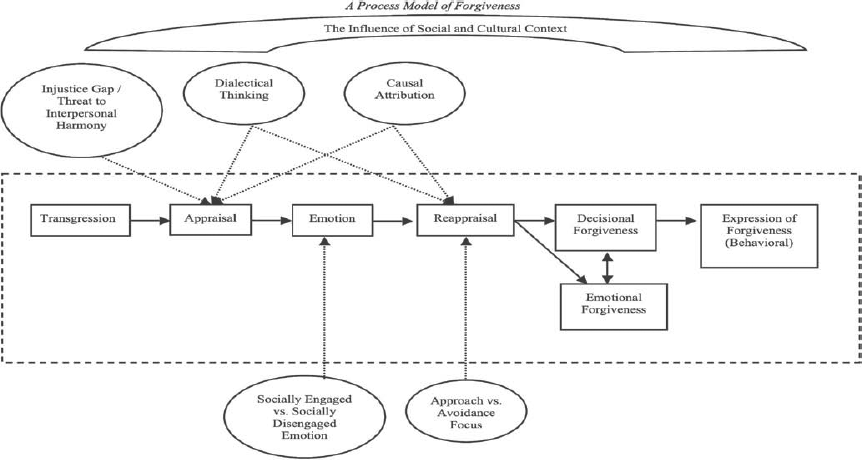
A process model of forgiveness.
The emotion regulation model proposed by Gross (1998) suggests that emotion begins with an evaluation of emotion cues, and this leads to a coordinated set of emotional, physiological, and behavioral response tendencies. According to this model, emotion arises in the context of person–situation interaction. The dynamic process of model of forgiveness expands the emotion regulation model by specifying a sequence of processes involved in emotion regulation—cognitive, motivational, and behavioral changes—which eventually give rise to forgiveness. This sequence begins with a situation or event that is psychologically relevant (i.e., transgression). An individual attends to this situation and appraises the situation's familiarity, valence, and value relevance, such as the transgressor's intention, the severity of the transgression, and closeness to the transgressor (Boon & Sulsky, 1997; McCullough et al., 1998). Emotion responses (e.g., anger and hostility or empathy and compassion) are then generated by these appraisals. Individuals regulate or change their emotions, cognition, and behavior by reframing the emotional events (cognitive reappraisal). According to Gross (1998), cognitive reappraisal is an antecedent-focused emotion regulation strategy that alters the emotional response tendency before it becomes fully activated by changing one's interpretation of a situation. This strategy effectively decreases negative emotion and without physiological costs (Gross, 2001), and is frequently used by individual in everyday life (Mauss, Cook, Cheng, & Gross, 2007).
This model also identifies variables that may moderate the process of forgiveness across cultures, including perceptions of transgression, dialectical thinking, causal attribution, approach- versus avoidance-focused motivation, and socially engaged versus socially disengaged emotion. The reasons for selecting these five variables as potential moderators are that these variables have been found to correlate with relationship outcomes and to vary across cultures. The following section will discuss how these variables may intervene at different points in the process of forgiveness to give rise to differences in forgiveness across cultures.
The Perceptions of Transgression
As was mentioned earlier, the framework of individualism and collectivism can be used to explain cultural differences in the processes of forgiveness, such as the perceptions of transgression. Individualists are more concerned about protecting their identities or maintaining justice regarding what is fair, whereas collectivists are more concerned about maintaining a good relationship with others or maintaining social norms regarding how one ought to behave in a particular social situation (Takaku, Weiner, & Ohbuchi, 2001).
In individualistic cultures, people want to seek justice after a transgression. When a transgression occurs, people may perceive it as unfairness or injustice. In this sense, a transgression creates an injustice gap—the perceived gap between the present situation and a just outcome (Worthington, 2003). Interpersonal transgression often generates perceptions of injustice in individualistic cultures; therefore, the motivations to forgive are restoring justice or personal healing. On the contrary, in collectivistic cultures, people put much emphasis on positive interpersonal relations. They are more likely to avoid conflict and minimize the outward expression of conflict (Hook et al., 2009). When a transgression occurs, collectivists may perceive it as a threat to interpersonal harmony; hence, their motivations to forgive are maintaining and restoring social harmony. In summary, individualists view transgression as an injustice gap, whereas collectivists view transgression as a threat to interpersonal harmony. The perception of what happened may precede the cognitive appraisal of transgression. Hence, the perceptions of transgression are thought to influence the processes of cognitive appraisal in the proposed model.
Dialectical Thinking
Cross-cultural psychologists (Masuda & Nisbett, 2001) have noted different ways of perceiving the world in the East and West. Analytical thinking prevails in Western cultures. Western perception and cognition focus exclusively on the focal object. In contrast, holistic thinking prevails in Eastern cultures. Eastern perception focuses on the broader context or field. Behavior is understood in terms of relationships, and it takes into account the interaction between the object and the surrounding field (Nisbett, 2007). Previous studies have shown that Asians pay more attention to the field, whereas Westerners pay more attention to salient objects. For example, Japanese mentioned information about the field almost twice as often as did Americans, and observed almost twice as many relations between objects and the field as did Americans (Masuda & Nisbett, 2001). According to Chiu (1972), Chinese are situation centered; they are obliged to be sensitive to their environment, whereas Americans are individual centered; they tend to overestimate their distinctiveness and to prefer uniqueness.
In comparison with nondialectical thinkers, dialectical thinkers have a more balanced view of costs and benefits (Wong, Rindfleish, & Burroughs, 2003) and are more tolerant of contradiction (Spencer-Rodgers & Peng, 2005). Consequently, they may have more complex cognitive, emotional, and behavioral reactions to self-relevant experiences (i.e., transgression), such as causal attribution (Nisbett, 2007) and subsequent mixed emotions (Bagozzi, Wong, & Yi, 1999). Thus, cultural differences in dialectical thinking may influence the cognitive processes of forgiveness, particularly in the appraisal/reappraisal of transgression.
Dialectical thinking plays a crucial role in the cognitive processes of forgiveness, because it requires a person to be more relativistic and dialectic in the way he or she approaches reality (Leadbeater, 1986). Dialectical thinking refers to the ability to view problems from multiple perspectives and to reconcile seemingly contradictory information (Manzo, 1992). Dialectical thinking implies the recognition of the contextual relativism of all knowledge that leads to transformation in cognitions (Perry, 1968). In complex interpersonal interactions, it is impossible to rule out the fact that conflict includes not just problem solving but problem finding, contradiction, unresolvability, and the like (Riegel, 1973). In this context, conflict is not totally negative but are the driving forces of relationship development.
A dialectical approach to forgiveness is possible through continuing transformation in cognitions—the appraisal/reappraisal of transgression. This approach focuses on change, instability, and the continuous and interpenetrating nature of social interactions. This approach also involves growth and transition via contradictions and conflicts, which lead to a transitory resolution or provide opportunities for further development (Riegel, 1973). Moreover, dialectical thinkers construct social knowledge through active processes, including both constitutive and interactive relationships with others. Dialectical thinkers reconcile contradictions by forming a synthesis, a new higher-order relation among apparently opposed ideas (Basseches, 1989). For example, following a transgression (e.g., broken promise), dialectical thinkers may appraise the situation as not static (e.g., on a single occasion only), and to see the wrongdoer in a positive light (e.g., he or she has done his or her best to keep that promise). In general, dialectical thinking may be seen as cognitive processes that are central to forgiveness, including expecting change in people's way of thinking, considering problems from multiple perspectives, and creating ways of relating and synthesizing issues that seem to be in contradiction.
Causal Attribution
Causal attribution is considered as another cognitive variable that involves in the processes of forgiveness. Attribution theory concerns how individuals interpret events and how this relates to their thinking and behavior (Heider, 1958). An individual's causal attributions may give rise to emotional reactions, which in turn may influence behavioral intentions or behavior (Weiner, 1995). According to the attribution theory, positive and benevolent attributions on the part of the victims lead to benevolent affective reactions (e.g., reduction of negative affects: anger, resentment; and increment of positive affects: sympathy, compassion, love), which in turn increase the likelihood of positive behavior toward the transgressor (Rusbult, Verrete, Whitney, Slovik, & Lipkus, 1991).
The cognitive processes of forgiveness can be influenced by individual's explanatory or attribution style, on how he or she attributes an event. The two main types of attributions are personal (internal) and contextual (external) attribution (Heider, 1958). When a personal attribution is made, the cause of the given behavior is assigned to personal factors, such as an individual's personality, attitudes, character, or disposition. When a contextual attribution is made, the cause of the given behavior is assigned to situational factors, such as the surrounding environment or social situation (Weiner, 1995). These two types of attribution lead to very different perceptions of an individual's behavior. Individuals who attribute an event to personal factors (personal attribution) would be less likely to forgive than those who attribute an event to situation factors (contextual attribution). It is because personal attribution is an explanation that holds a person accountable for a given event, whereas contextual attribution is an explanation that takes the context into account (Fincham, 2000).
Researchers have pointed to the fact that people tend to make personal attributions more often than contextual attributions; this is known as the fundamental attribution error (FAE). FAE refers to the tendency to overestimate personal factors and underestimate situational factors in explaining others' behavior (Ross, 1977). In this case, when observing a transgression (e.g., deception), a victim is more likely to assume that the transgression is primarily caused by the transgressor (e.g., slickness) and not by the situation (e.g., under social pressure). Correcting FAE may be a conflict prevention tool and a strategy of forgiveness. The appraisal/reappraisal of transgression depends on explanatory or attribution style, in particular, on how an individual attributes a transgression and a transgressor's behavior.
Interestingly, cultural differences in FAE have been found in cross-cultural studies. The FAE seems to be more prominent in individualistic cultures than in collectivistic cultures. For example, Americans are more likely to explain murders by individual traits, abilities, or characteristics, whereas Chinese are inclined to explain the same event with reference to contextual and historical factors (Morris & Peng, 1994). Americans demonstrate higher FAE than do Asians; it is because Americans understand behavior in terms of individual dispositions, whereas East Asians view social behavior as complex interactions between the person and the social context (Norenzayan & Nisbett, 2000).
Overall, attributions describe how people explain the causes of others' behavior. Those who attribute the transgression to contextual factors report higher levels of forgiveness (Fincham, Paleari, & Regalia, 2002). Causal attribution plausibly influences the cognitive processes of forgiveness (i.e., appraisal/reappraisal of transgression), which also vary across cultures.
Socially Engaged and Socially Disengaged Emotions
On the basis of the emotion regulation model, emotion responses are generated after the appraisal of transgression. The individual experiences a complex combination of negative emotions (e.g., resentment, bitterness, hostility, hatred, anger, and fear) at some time after a transgression. According to Worthington and Scherer (2004), forgiveness is the emotional juxtaposition of negative emotions against positive other-orientated emotions (e.g., empathy, sympathy, compassion, and love). Emotions seem to play a vital role in forgiveness. Specifically, positive emotions that facilitate the processes of forgiveness should be given more attention.
Researchers have examined the interpersonal or social functions of emotions, and how emotions structure relationships and guide social interactions (Keltner & Haidt, 1999). Oatley and Jenkins (1996) proposed that emotional responses serve two broad social functions. First, emotion provides an assessment of specific events; for example, feeling of anger informs the individual about the lack of fairness of the events (Solomon, 1990). In addition, emotion also prepares the individual to respond to threats that arise in social interactions; for example, anger heightens sensitivity to injustices, which facilitates responses to problems (Keltner, Ellsworth, & Edwards, 1993).
Researchers have further investigated the social functions of emotions at the cultural levels (Keltner & Haidt, 1999). They have focused on how emotions are shaped by cultures, and cultural norms and scripts for appropriate expression and experience of emotions. Culture-specific emotions serve as a motivation for culturally proper behaviors (Thoits, 1985) and socialization of cultural norms (Dunn & Munn, 1985). The social functions of emotions at both the individual and the cultural levels seem to be related to interpersonal relationships, and may influence the emotional processes of forgiveness.
In cross-cultural studies, emotions have been classified as encouraging the independent or the interdependent self (Kitayama, Markus, & Matsumoto, 1995). Some emotions tend to make individual attributes more salient and contrast those attributes against the relevant social context. These emotions are referred to as socially disengaged emotions, such as pride, superiority, and anger. Other emotions encourage the interpersonal bond and are known as socially engaged emotions, such as respect, friendliness, indebtedness, and guilt. A study by Matsumoto (1990) showed that Asians reported experiencing considerably more socially engaged emotions than socially disengaged emotions, whereas such a difference was much smaller among Westerners. Furthermore, “good feelings” were associated more with socially disengaged positive emotions for the American but with socially engaged positive emotions for the Japanese (Markus & Kitayama, 1991).
The breadth of cross-cultural research on emotions also provides insight on how cultural variances in emotions influence the emotional processes of forgiveness. People with interdependent self-construal are more likely to experience socially engaged emotions (e.g., guilt and respect) after a transgression, which in turn may lead to more forgiving responses. It is because people with interdependent self-construal are believed to hold strong benevolence values—characterized by helpful, honest, forgiving, responsible, loyal, friendly and mature loving—and they seek to understand, tolerate, and accept others (Schwartz, 1992), so they may experience emotions that fit their social goals (i.e., socially engaged emotions) even in the face of transgression. In contrast, people with independent self-construal are more likely to experience socially disengaged emotion (e.g., anger and pride) after a transgression, which in turn may lead to more unforgiving responses. It is because people with independent self-construal are believed to place a high value on seeking self-direction, characterized by independent behaviors, including creatively, freedom, and choosing own goals, and they enjoy being independent and outside the control of others (Schwartz, 1992), so they may experience emotions that fit their personal values (i.e., socially disengaged emotions).
Approach and Avoidance Motivations
Cultures also differ in approach and avoidance motivations. For example, Elliot, Chirkov, Kim, and Sheldon (2001) found that Asian Americans adopted more avoidance goals than did non-Asian Americans, and people from collectivistic cultures (South Korea and Russia) adopted more avoidance goals than did those from an individualistic culture (the United States). The distinction between approach and avoidance motivation has been applied to explain and understand human behavior and may affect forgiveness. In approach motivation, behavior is energized or directed by a positive event or possibility, whereas in avoidance motivation, behavior is energized or directed by a negative event or possibility (Elliot, 1999). The distinction between approach and avoidance is based on the focus of goals. Approach goals are focused on a positive outcome or state, and involve reaching or maintaining desired outcomes (e.g., make friends); avoidance goals are focused on a negative outcome or state, and involve avoiding or eliminating undesired outcomes (e.g., avoid losing friends) (Elliot et al., 2001). Approach motivation regulates behavior toward potential rewards, and avoidance motivation regulates behavior away from potential threats. As a result, individuals with approach motivation are more responsive to cues of reward, whereas individuals with avoidance motivation are more responsive to cues of threat (Carver, Sutton, & Scheier, 2000).
There is evidence that approach and avoidance motivations are involved in developing and maintaining social bonds. These processes are greatly influenced by social motives and goals. Social motives and goals can focus on attaining the positive end-state (approach), or the prevention of the negative end-state (avoidance) (Elliot et al., 2001). Some researchers operationalize forgiveness in terms of decreasing negative motivation (e.g., avoidance) and increasing positive motivation (e.g., problem focused and benevolence) toward the transgressor (McCullough et al., 1998). Forgiveness can be viewed as overcoming the avoidance motivations toward the harm doer, as well as providing the motivational foundation for approach behaviors (e.g., problem solving) (Fincham, Beach, & Davila, 2004).
The two types of motives and goals predict different social outcomes. For example, individuals who endorsed greater withdrawal and lower benevolence in response to partner transgressions had partners who reported higher levels of ineffective conflict resolution in the relationships (Fincham et al., 2004). Gable (2006) has proposed a hierarchical model of approach–avoidance social motivation. In this model, approach social motives, such as hope for affiliation, energize individuals toward potential positive relational outcomes (e.g., deepen one's relationships). In contrast, avoidance motives, such as fear of rejection, energize individuals away from potential negative relational outcomes (e.g., avoid conflict in one's relationships). In a similar vein, people who endorse approach goals are more likely to solve the conflict and maintain a positive relationship with the transgressor, whereas people who endorse avoidance goals may be more likely to avoid conflict and suppress their emotion. Approach motivation that underlies efforts to facilitate beneficial emotion regulation processes, therefore, may be more adaptive in forming and maintaining social relationships even after a transgression.
Decisional and Emotional Forgiveness
In terms of the final behavioral outcome, the proposed process model of forgiveness includes decisional, emotional, and behavioral forms of forgiveness. Decisional forgiveness is a behavioral intention to eliminate negative behavior and to increase positive behavior toward the transgressor. Emotional forgiveness is the replacement of negative unforgiving emotions with positive other-oriented emotions (Worthington, Witvliet, Pietrini, & Miller, 2007). Nevertheless, one may sincerely decide to forgive and continue in those benevolent behavioral intentions yet still may not experience full emotional forgiveness (Hook et al., 2009).
Researchers have compared forgiveness in collectivistic societies with that in individualistic societies and have noted differences in cultural goals of forgiveness (Hook et al., 2009). In individualistic cultures, individuals emphasize distinguishing oneself from others and striving for personal goals such as personal/emotional well-being; thus they may endorse more emotional forgiveness. Indeed, although forgiveness has been conceptualized as an interpersonal construct (Kadiangandu et al., 2007), studies conducted in Western cultures mainly focused on how forgiveness could be experienced intrapersonally (e.g., a replacement of negative emotions with positive emotions).
On the contrary, in collectivistic cultures, individuals emphasize collective norms and relationships. Social well-being seems to be more important for them. They may thus endorse more decisional forgiveness. Because the motivation to maintain and restore social harmony is strong for collectivists, collectivistic worldview may be more strongly related to decisional forgiveness than would emotional forgiveness. The view of social relationships from a collectivistic framework is more communal and preserves interpersonal harmony (Sandage & Wiens, 2001); therefore, a decision or motivation to forgive would be highly emphasized.
Conclusions
In this paper, forgiveness is conceptualized as a process, which involves changes in cognitions, emotions, motivations, and behaviors regarding the transgressor. This paper highlights the influence of social and cultural contexts in the processes of forgiveness, and proposes a dynamic process model of forgiveness. To understand the pathways of forgiveness, we expand the emotion regulation model by taking culture into account. Specifically, perceptions of transgression, dialectical thinking, and causal attribution are considered as cognitive variables that affect the processes of forgiveness. Socially engaged versus socially disengaged emotion and approach versus avoidance motivation are regarded as emotional and motivational variables, respectively. Because these variables have been found to vary across cultures, future research can investigate whether these variables affect different processes and forms of forgiveness (i.e., decisional and emotional forgiveness) across cultures.