







Abstract
How are multiple variables integrated into a unitary response? This fundamental problem— integration of multiple variables—faces every field of psychology. Solid support for three exact mathematical integration laws—averaging, adding, multiplying—has been given by extensive empirical work by investigators in many countries. These three integration laws operate in almost every area of human psychology: person science, social attitudes, child development, learning/memory, language, psychophysics, and judgment—decision. These laws have nomothetic generality across persons and cultures together with idiographic capability for true measurement of personal, individual value. These integration laws are thus a foundation, both conceptual and empirical, for unifying psychological science.
Keywords
Every field of psychology faces the same fundamental problem—multiple variables. Virtually every thought and action results from joint operation of multiple variables. This problem of multiple variables is recognized in the widespread use of analysis of variance and multiple regression. But these are merely statistical methods; they have not led to general laws of multiple variables. A conceptually new approach is possible, based on psychological laws of information integration. These integration laws have been well established by many investigators in nearly every area of human psychology—a base for unified science.
Information Integration Diagram
The fundamental problem of multiple determination is shown in the Integration Diagram of Figure 1. Two stimuli, SA and SB, impinge on a person and are transmuted by the valuation operation into goal-oriented values, ψA and ψB. These values are integrated by the integration operation into a unitary response, ρ, which is externalized by the action operation to become the observable response, R.
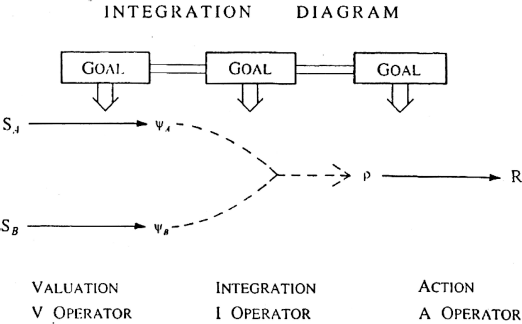
Information integration diagram. Chain of three operators, V – I – A, leads from observable stimulus field, {S}, to observable response, R. Valuation operator, V, transforms stimuli, S, into subjective representations, ψ. Integration operator, I, transforms subjective field, {ψ}, into internal response, ρ. Action operator, A, transforms internal response, ρ, into observable response, R. A similar diagram holds for more than two stimuli. (After N. H. Anderson, Foundations of information integration theory, 1981.)
Is it possible to determine what law—if any—governs the integration operation? This might seem impossible. We can observe only the stimuli, SA and SB, and the response, R. But three unobservables lie between these two observables. The same response could result from very different combinations of these three unobservables. By an inestimable beneficence of Nature, this problem has a simple solution.
Parallelism Theorem
A complete solution to the three unobservables is possible with the simple parallelism theorem. Vary SA and SB in an integration design so that each of several values of SA is combined with each of several values of SB. This yields an ordinary row × column factorial design. The response R is measured for the row—column, SA–SB, combination in each cell of the design.
The parallelism theorem requires two premises:
Premise 1: ρ = ψA + ψB (additivity);
Premise 2: R = c0 + c1 ρ (response linearity),
where c0 and c1 are inessential zero and unit constants. These two premises imply that the row curves in the row × column integration graph will be parallel. Proving this parallelism theorem and its five benefits is straightforward (Anderson, 1981, 1996) and is omitted here.
Observed parallelism in an integration graph (Figures 2–5 below) supports five benefits.
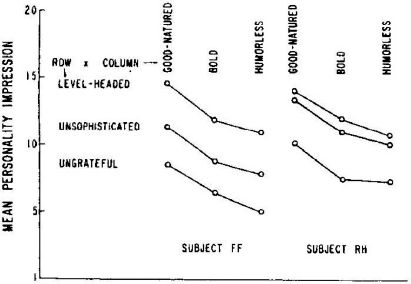
Parallelism pattern supports adding-type rule in person cognition. Subjects judged likableness of hypothetical persons described by trait adjectives listed in the Row × Column design: row adjectives of level-headed, unsophisticated, and ungrateful; column adjectives of good-natured, bold, and humorless. Each of these 3 × 3 = 9 person descriptions corresponds to one data point. (Data averaged over third trait for simplicity; complete data given in Figure 1.4 of Anderson, 1982). (After Anderson, 1962. Application of an additive model to impression formation, Science, 138, 817–818. Copyright, 1962 by American Association for Advancement of Science. Adapted with permission.)
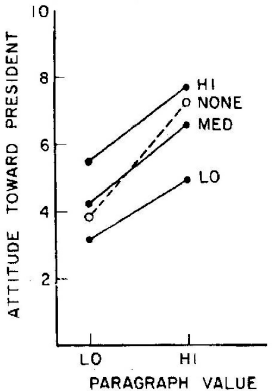
Attitudes about statesmanship of U.S. presidents obey averaging theory. Factorial graph shows judgments about statesmanship of U.S. presidents described by two (or one) biographical paragraphs. Parallelism of solid two-paragraph curves supports adding-type rule. (Crossover of one-paragraph dashed curve eliminates summation rule, supports averaging rule: MED row paragraph averages up (down) the LO (HI) column paragraph). (From Anderson, 1996. A functional theory of cognition. Mahwah, NJ: Erlbaum.)
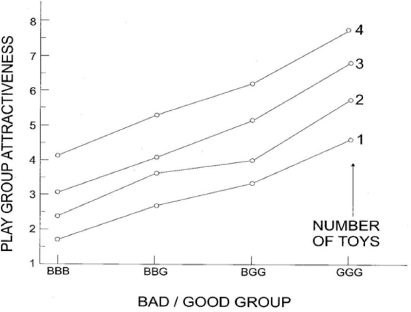
Indian children, 5–7 years of age, judge attractiveness of playgroups of 3 children characterized as good (G) or bad (B) on horizontal axis and number of toys the group has to play with. All conversations in Hindi. (Adapted from Singh, 2011.)
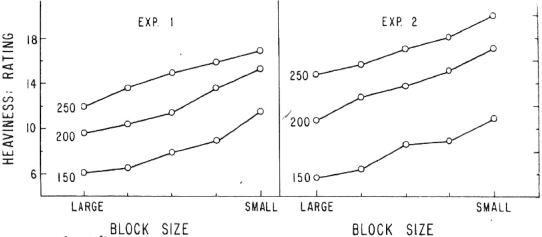
Parallelism supports adding-type rule for size-weight illusion. Subjects lift and judge heaviness of cubical blocks in 3 × 5, Gram Weight × Block Size design. Verbal rating in left panel, graphic rating in right panel. (From Anderson, 1981, p. 35).
Benefit 1: Integration obeys an adding-type law (premise 1).
Benefit 2: The observable R is a true (linear) measure of unobservable ρ (premise 2).
Benefit 3: True measures of the unobservable ψA and ψB are readily available. These are just the marginal row and column means of the integration design.
Benefit 4: Meaning Invariance. Parallelism implies meaning invariance—each stimulus has a constant value, regardless of which other stimulus it is combined with. If stimuli interacted to change one another's meanings, parallelism would in general be violated.
Benefit 5: Cognitive Unitization. A stimulus, SA, may be complex or configural, yet function as a cognitive unit—whose value can be exactly measured (e.g., Law of Blame below).
Of course, this parallelism theorem is not too useful unless (a) Nature blesses us with additive laws and (b) the investigator can develop a linear response measure, commonly called an equal interval scale. Both these conditions have been well grounded (e.g., Figures 2–5; see also Anderson, 1991).
Three Mathematical Laws of Information Integration
Three mathematical laws— averaging, adding, multiplying—have received extensive empirical support in nearly every field of human psychology. An adding law yields parallelism (Benefit 1 of the parallelism theorem). The averaging law, by far most frequent, obeys the parallelism theorem under the equal-weight condition, that is, when every instance of a given variable has equal importance weight. Equal weighting usually requires experimental precautions to ensure that each instance of any variable carries the same amount of information and receives equal attention as in experiments of the following figures (see Anderson, 1981). 1
These three integration laws rest on an extensive empirical foundation. They appear to involve innate capabilities as shown by their commonality across nearly every area of human psychology. Indeed, adding-type laws appear in children even younger than 4 years of age and multiplication laws in children as young as 5+ years. These integration laws underlie a general theory of information integration (IIT) developed by many investigators.
Psychological Measurement Theory
True measurement in psychology can be achieved with the empirical laws of information integration. Note that measurement is needed at two levels: response and stimulus. True measurement of response follows from Benefit 2 of the parallelism theorem. True measurement of stimulus values follows from Benefits 3–5. Measurement at nonconscious levels is necessary, as illustrated with the size-weight illusion (Figure 5). This is called functional measurement because these values were functional in the reaction (Mullet, Makri, Morales, Rogé, & Muñoz-Sastre, 2012).
Of course, this functional measurement depends squarely on the two premises. The first premise, additivity, is a remarkable blessing of Nature, which made adding-type laws common throughout human psychology. The second premise, response linearity, depends on experimental procedure. Most work on IIT has used the method of functional rating, which employs simple experimental procedures to avoid well-known biases of common rating methods. This metric method has succeeded. Other approaches to psychological measurement have relied on nonmetric choice data and have not succeeded in measuring anything (e.g., Chapter 5; Anderson, 1981). Metric cognition is a consequence of goal-oriented behavior in a metric world.
The ubiquity of integration is recognized in the widespread use of multiple regression and analysis of variance, which have great practical value. But these statistical methods completely missed the numerous adding-type laws. They were roadblocked by lack of theory of true psychological measurement.
Motivation and Psychological Measurement
Motivation, represented by GOAL in the Integration Diagram, functions in stimulus valuation. Unlike physics, stimulus values are not in the stimulus itself. Instead, stimulus value is constructed by the valuation process in relation to operative motivations and goals. As a homely example, your food is more desirable before than after eating. Goal-oriented measurement, essential for psychological theory, is possible with benefits 2 and 3 of the parallelism theorem (see Goal theory in Anderson, 2012, Chapter 7).
Idiographic Values and Nomothetic Integration
Value differences have been a roadblock to general theory. Different persons have different values, often very different, as in troubled marriages and in liberal—conservative political views. How can general theory be developed to handle such large value differences?
One answer is that the integration laws have nomothetic generality across individuals yet allow personal values for each individual. Thus, the parallelism theorem makes no assumption about the values ψA and ψB. On the contrary, it can provide true measures of these values for each individual person (Benefit 3 of parallelism theorem). The empirical success of these laws of information integration is thus a base for unified nomothetic—idiographic psychological science.
Person Science
Person science is the most important area of psychology. Much of our life involves interactions with other persons, as in family and work. All of our life involves our self. The laws of information integration provide an effective base for person science.
Person Cognition
The first sign of algebraic law appeared in a study of person cognition that obtained likableness judgments of hypothetical persons described by three trait adjectives. The integration graphs showed parallelism, evidence for a simple averaging model (Figure 2).
This parallelism also supports meaning invariance (Benefit 4 of parallelism theorem). Meaning invariance has been widely disbelieved; however, being contrary to strong phenomenal feeling that the adjectives interact to change one another's meanings as they are integrated. But such interaction would produce deviations from parallelism, contrary to fact.
No unbeliever has explained the many findings of parallelism, but it may be useful to add one confirmation in which one group of participants wrote a paragraph describing the hypothetical person in their own words before they judged likableness. This paragraph writing gives ample opportunity for meaning interaction among the adjectives. But these data still showed parallelism. Indeed, these data were little different from the no-paragraph comparison group. Related work by diverse investigators is given in Meaning constancy in person perception, Chapter 3, Anderson (1981).
Functional Theory versus Personality Trait Theory
Functional approaches to personality study goal-directed thought and action in living. Theoretical capability with valuation and integration of multiple variables should thus be a prime concern. Instead, personality has been conceptualized as a small set of basic traits within the person. Unfortunately, these traits have meager predictive power or capability for dealing with the multiple variables of everyday life. A different direction is available as the nomothetic—idiographic laws of IIT.
Clinical Judgment
The theory of information integration can help improve clinical judgment. It is commonly assumed that skilled clinicians diagnose and integrate variables in highly configural ways. This claim can be put to experimental analysis with the parallelism theorem, just as with meaning invariance in the personality adjective task (Anderson, 1972). This approach could be useful for training students in clinical and counseling psychology.
Self: I and ME
The self is the most important concern of person science. Functional theory follows William James’ distinction between I, our momentary motivations, feelings, and thoughts in operating memory, and ME, our largely nonconscious habits and knowledge systems that operate in constructing I. “In a very real sense, therefore, people do not know their own minds. Instead, they are continually making them up” (Anderson, 1974, p. 88).
This construction of I follows algebraic laws in nearly every field of human psychology. These laws can go below James’ stream of consciousness to analyze the mass of nonconscious cognition, the ME that operates in constructing I. These laws are a foundation for person science.
Unified Person Science
Person science is far more general than traditional personality theory. The integration laws bridge the chasms between and within personality theory, social psychology, and life span development, of which many have complained. These laws go further to include learning, memory, and judgment—decision, as shown in later sections.
Functional Theory of Attitudes
Attitudes are currency of everyday thought and action. We have attitudes about life goals, about family members and friends, about work, politics, religion, and so on. These attitudes are learned knowledge systems that help us deal with the goal-directedness of living.
Functional theory studies how strong attitudes function in thought and action. The idea of functional theory goes back to the 1950s and its merit is generally acknowledged. It has received only lip service, however, owing to lack of effective theory. Effective theory is available with the three laws of information integration. The primary function of strong attitudes is in the valuation operation of the Integration Diagram. True measurement of these functional values is possible (Benefit 3 of the parallelism theorem). Integration laws are thus a base for functional theory.
Person versus Persuasion
Mainstream attitude theory is focused on persuasion; the 20th century was dubbed “the age of persuasion.” This focus on persuasion rose from early concerns with changing social prejudice. But such prejudices are typically strong, hard to change. To get results, investigators insensibly deviated to weak attitudes on such issues as dental flossing or city parks. Group means were standard, but group means lose sight of the often large individual differences in strong social attitudes, as with same-sex marriages, abortion, or religion. Functional focus on strong attitudes requires within-person experiments.
Within-Person Experiments
The shift from persuasion to attitude function entails a corresponding shift from standard between-person experiments to within-person experiments, in which each person responds to multiple stimulus combinations. Averaging across persons with widely different attitudes about women's roles, for example, or parenting, may be useful for persuasion but can say little about underlying attitude knowledge systems.
One within-person design studied attitudes toward past U.S. presidents described by brief biographical paragraphs varied from Low to High in statesmanship value shown in Figure 3. The parallelism of the solid curves supports an adding-type integration.
Attitude Integration Theory
Attitudinal responses, which are what are observed, are generated from underlying attitude knowledge systems that construct goal-oriented values. Observed responses are thus integral of multiple variables.
This integration problem was recognized by Wilson, Aronson, and Carlsmith (2010, p. 79) in their chapter in the Handbook of social psychology:
The alternative research modes in social psychology seem, for the most part, to function in isolation from each other. What is needed now is a new attempt of synthesis… Such a synthesis… will require an emphasis on assessing the relative importance of several variables, which all influence an aspect of multiply determined behavior.
Such synthesis of “multiply determined behavior” has been made with the three laws of IIT. These laws have made definite progress on unifying social psychology (Anderson, 1974, 2008).
Moral Science
Morality makes societies possible, from family to nation, finding expression in custom, religion, and law. Much moral thought and action obeys algebraic laws as shown by investigators in many countries. These laws are a foundation for moral science (Anderson, 2012).
Fairness
The concept of moral algebra appears in the universal moral axiom people should get what they deserve. Aristotle conjectured an algebraic model for fair division between two persons, A and B, who had contributed to a mutual project:
A's share ÷ B's share = A's contribution ÷ B's contribution.
Experimental interest in this issue of fairness, or equity, began in the 1950s and delineated numerous variables that could influence deserving, such as need, effort, and status, as well as actual work contribution. Further progress was roadblocked, however, by lack of theory to determine how these multiple variables were measured and integrated to yield net deserving. This integration problem was resolved with IIT, which revealed an exact algebra of fairness, a close relative to Aristotle's model, already present in young children.
Unfairness, a frequent feeling in everyday life, is complicated by the unfairness paradox— that two persons who make equal objective contributions will both feel they deserve more than a half share. Unfairness algebra, however, has done well in work to date.
Law of Blame
“Who's to blame?” is almost a reflex when something goes wrong. Children and adults follow the basic blame law,
Blame = Intent + Harm,
for the harm caused by some act performed with some intent. This blame law is revealed by observed parallelism in an Intent × Harm integration design.
Note that Intent is a subjective attribution by the blamer. This subjective attribution, which depends on the blamer's personal knowledge systems and diverse aspects of context, may be exactly measured by virtue of Cognitive Unitization (Benefit 5 of the parallelism theorem).
Social Healing
Harmful actions are common. Social healing processes are vital for maintaining society. One healing process is apology, which follows the extended blame law,
Blame = Intent + Harm − Apology
Forgiveness is a second process of social healing, and has attracted recent attention in marriage and in recovery after civil war. Remarkable work by Etienne Mullet and associates includes an experiment showing that forgiveness for a gunman who shot a child during the civil wars in Lebanon followed the parallelism theorem—the same for gunmen of same or opposed religion, Christian or Muslim (see Algebra of forgiveness, Chapter 7, Anderson, 2012).
Stage Theory of Moral Development
The dominant psychological approach to morality has been Kohlberg's theory of moral stages. Content analysis of verbal justifications for choices in moral dilemmas was claimed to demonstrate qualitatively distinct stages, beginning with obedience to authority and leading to equalitarian cooperation.
This stage theory suffers severe inadequacies. It is not applicable under 12 years of age; younger persons lack the necessary verbal capabilities to justify their choices. Stage theory is thus blind to an important period of moral development. Moreover, although stage theory explicitly recognizes the importance of integration of pros and cons, it is devoid of any capability with this problem. The integration laws offer an effective alternative well grounded by a number of investigators (see, e.g., Figure 4).
Legal Judgment and Decision
Integration experiments have shown promise in the legal field. Wilfried Hommers showed how to assess the 7-year age limit for legal responsibility using an objective integration task in place of idiosyncratic clinical judgment. Arduous, pioneering work by Ebbesen and Konečni found that bail setting by Superior Court judges followed an adding law in the privacy of their chambers, giving highest weight to community ties, as is entirely appropriate. But judges completely ignored community ties in their actual bail setting in court (see Konečni & Ebbesen, 1982; see further Chapter 4 in Anderson, 2012).
Legal judgment and decision are prime examples of information integration. The three integration laws can help ground legal judgment and decision on a scientific base.
Social Betterment
Social betterment should be the main goal of moral science. Social betterment is much needed as shown by distressed marriages, school dropouts, crime, and other social problems. Morality should be a focal concern in primary and secondary schools, not just in history and civics, but in every course. Even mathematics can play a role. The simple parallelism theorem could be used by high school students to study their schoolmates’ attitudes about fairness and blame. And to show how the hidden workings of the mind become visible in an integration graph as in Figures 2–5 (see Education in Chapter 7, Anderson, 2012).
Child Development
The parallelism theorem has revealed an adding-type law as early as 3[1/2] years of age. The linear fan theorem has revealed multiplication laws as early as 5+ years. These laws can measure and compare development of knowledge systems and personal values across the life span.
The nomothetic generality of the integration laws extends across culture as well as age. In the study of Figure 4, 5- to 7-year old children in India judged attractiveness of 3-child play groups characterized by proportion of good and bad members (horizontal axis) and number of toys the group had to play with. The parallelism of these four curves supports an adding-type model, one of many ingenious experiments on IIT in India by Ramadhar Singh (see Singh, 2011).
Piaget's Theory
Besides IIT, one other theory, that of Jean Piaget, has grounded itself on information integration. Piaget's basic choice paradigm requires a choice of the larger of two objects, A > B on one dimension, A < B on a second dimension. Correct choice depends on following physical laws for valuation and integration of A and B.
Two basic flaws in Piagetian doctrine were revealed in the very first empirical assessment with IIT. First, young children do not center on a single variable as Piaget claimed; they integrate—following mathematical laws. Second, proportional judgment, which Piaget claimed does not appear before his stage of formal operations at 10–12 years of age, is already operative at 4 years of age. Young children thus have far higher capabilities than recognized by Piaget (see Cognitive Development, Chapter 8, Anderson, 1996).
Functional Theory of Learning/Memory
Nontraditional conceptions of memory and of learning are entailed by the Integration Diagram.
Functional Memory
Rote memory is time-honored, beginning with Ebbinghaus’ nonsense syllables and continuing with mountains of work on rote verbal memory in the 20th century. The basic concern was accuracy: reproducing given stimulus materials using measures of recall or recognition, a concern continued with studies of “gist.”
But the main function of memory lies in construction of goal-oriented values. This construction function is represented by the leftmost GOAL in the Integration Diagram. The same stimulus informer may have very different values for different goals. Traditional accuracy measures of recall and recognition say little about this main function of memory.
This functional conception of memory arose in integration studies of person cognition in the 1960s. Participants heard a sequence of adjectives that described a person, judged the person on likableness, and then recalled the adjectives that remained in memory. At that time, it was an “article of faith” that the person judgment would be based on the recalled adjectives.
Results disagreed completely with traditional memory theory. The recall curve showed standard recency. But the judgment curve showed pure primacy—the most recent adjectives had least effect (Figure 11.1 in Chapter 11, Functional memory, Anderson, 1996). This result has been well supported. Traditional memory theory got stuck in the narrow accuracy rut from failure to recognize a main memory function—construction of goal-oriented values.
Functional Learning
Traditional learning has narrow place for the integration operation of the Integration Diagram. What is learned is often an integral of multiple goal-oriented values relative to the then-operative goal. In the person judgments just discussed, for example, the value of the trait adjective critical would differ for the goals of judging likableness or research ability. This valuation—integration paradigm represents much human learning of which traditional learning theory seems unaware.
Functional measurement theory provides new capability for learning theory. Traditional learning curves commonly rest on repetition of the same stimulus over successive trials. In one simple alternative, two sequences of learning trials would be given, with different stimuli at one serial position. Such differences can be comparable across serial position by virtue of the integration law (see Figure 8.3 in Anderson, 2012).
Studies with such integration designs show that the response may consist of two components, surface and basal. The labile surface component may vanish by the next trial whereas the basal component lasts to the end. An experimental example with attitudes toward U.S. presidents is given in Anderson (1996, Figure 5.4, p. 148).
Learning as Goal-Oriented Information Integration
Traditional learning research has narrow historical origins: verbal memory and conditioned reflexes. Attempts to break free have been constricted by this heritage. Learning is an integral component of and should contribute to every area of psychology. The algebraic laws can help unify all these areas because all involve integration of multiple variables.
Integration Psychophysics
Our sensory/perceptual systems enable us to represent the external world within our personal internal world. These systems do remarkably well to facilitate our physical survival in this external world. They are even more remarkable in grounding a mental life that includes self, outdoor life, social relations, science, and literature. These sensory/perceptual systems were the focus of the earliest work on psychological science.
Measurement of Sensation
Can we measure simple sensations, such as felt heaviness of a lifted weight? We can say whether one weight feels heavier than another, so heaviness seems a measurable dimension. Accordingly, we might ask you to lift a sequence of weights and rate how heavy each one feels. In terms of the Integration Diagram, your heaviness feeling is ρ whereas your rating response is R. But how can we determine whether R is a true measure of ρ?
The standard line of attack on this question sought some simple mathematical function relating ρto R. Well over a century was spent on this blind alley of presumed psychophysical law with such functions as ρ = log R or ρ = R n .
Psychophysical Integration Laws
A conceptually new approach to sensation measurement was based on laws of information integration. The logic is simple, illustrated by the parallelism theorem. Success, of course, depends on existence and elucidation of such empirical laws.
One such law of psychophysical integration is the well-known size—weight illusion shown in Figure 5. Participants lifted a cubical object varied in size (horizontal axis) and gram weight (curve parameter) and rated its felt heaviness.
The parallelism of the curves supports an additive law: size + weight (Benefit 1 of parallelism theorem). Also, the rating response R was a true measure of ρ, the unobservable heaviness sensation (Benefit 2 of parallelism theorem). Indeed, the upward slope of the curves in Figure 5 measures the nonconscious heaviness value of the physical appearance (Benefit 3 of parallelism theorem). This integrationist approach has done well with diverse issues with contributions by many workers (see Integration psychophysics, Chapter 9, Anderson, 1996).
Nonconscious Measurement
The size effect in the size—weight illusion is nonconscious. What people become aware of is the unitary conscious heaviness of their lifting. The valuation and integration operations of the Integration Diagram both occur at preconscious levels. What becomes conscious is the integrated resultant.
Nonconscious measurement is needed in every field of psychology. Much valuation and integration occur at preconscious levels in person science and attitude theory. The three laws of information integration provide an effective grip on nonconscious measurement.
Functional Theory of Judgment–Decision
Algebraic integration models are stock-in-trade in the field of judgment—decision. But analysis of these models was roadblocked by lack of true psychological measurement. Thus, the various conjectures that the objective multiplication law, expected value = probability × value, had a subjective counterpart were roadblocked by lack of true measurement of subjective value and subjective probability. This roadblock was removed with the linear fan theorem of functional measurement used to establish psychological multiplication laws by several investigators (e.g., Figures 1.13–1.19 in Anderson, 1981; Figure 10.1, 10.4–10.6 in Anderson, 1996).
Multiattribute analysis, widely used to choose among alternative courses of action, is a second example of the need for true psychological measurement. The idea is simple. Represent each course of action by a set of independent attributes, measure weight and value of each attribute, and choose the action with the largest weighted sum. We all do something of this sort, however roughly, in our decisions.
True measurement is critical for multiattribute analysis. But the several common methods for measuring attributes (e.g., point allocation, part-worth, rating, tradeoff) give different results, often very different. The best action prescribed by one method may be poor using another.
Functional measurement theory can resolve this measurement crux. This approach found biases up to 50% in the popular method of point allocation. Part-worth showed promise (see Cognition theory of judgment—decision, Chapter 10, Anderson, 1996).
Judgment and decision operate in every field of psychology. They are universal cognitive activities. Judgment–decision theory can thus provide a unifying influence for our field. This unification can be aided with the three laws of information integration.
Toward Unification of Psychology
The psychological field can be unified around the problem of information integration. Every area faces this same basic problem—valuation and integration of multiple variables.
An analytical foundation for unified theory is offered by the three laws of information integration. These laws are nomothetic. They have shown promise in most fields of human psychology. They operate across the life span and in diverse cultures. This nomothetic generality is complemented by their idiographic capability for true measurement of individual values.
A substantive foundation for unified theory seems possible with person science. Person science goes far beyond traditional personality theory to include attitudes—social, moral, and self—as well as life span development. Person science also led to functional conceptions of learning/memory and judgment—decision within a framework of motivated purposiveness—goal-oriented thought and action.
This foundation rests on work by dedicated investigators in many countries (see footnote 1). Their work has also raised important new issues. As yet, little is known about structure of knowledge systems or the nature of valuation processes. Most important is social betterment, especially with family life, social morality, and education (Anderson, 2012).
Footnotes
1
With unequal weights for any one variable, the averaging law generally yields nonparallelism. Unequal weighting, initially undesired, turned out to have notable advantages. Thus, the negativity effect (greater importance of more negative information) was discovered in this way. Indeed, unequal weight averaging has unique capability for measuring importance weight separately from polarity value. This capability can resolve the concept—instance confounding that invalidates nearly all common methods of measuring “relative importance” including main effects in factorial design, most effect sizes, and regression weights (see Section 6.1, Comparison and measurement of importance, in Anderson, 1982).