







Abstract
This meta-analysis examined the relationship between moral identity and moral behavior. It was based on 111 studies from a broad range of academic fields including business, developmental psychology and education, marketing, sociology, and sport sciences. Moral identity was found to be significantly associated with moral behavior (random effects model, r = .22, p < .01, 95% CI [.19, .25]). Effect sizes did not differ for behavioral outcomes (prosocial behavior, avoidance of antisocial behavior, ethical behavior). Studies that were entirely based on self-reports yielded larger effect sizes. In contrast, the smallest effect was found for studies that were based on implicit measures or used priming techniques to elicit moral identity. Moreover, a marginally significant effect of culture indicated that studies conducted in collectivistic cultures yielded lower effect sizes than studies from individualistic cultures. Overall, the meta-analysis provides support for the notion that moral identity strengthens individuals’ readiness to engage in prosocial and ethical behavior as well as to abstain from antisocial behavior. However, moral identity fares no better as a predictor of moral action than other psychological constructs.
Moral identity has been defined as “the degree to which being a moral person is important to an individual's identity” (Hardy & Carlo, 2011a, p. 212). In other words, if individuals feel that moral values such as being honest, compassionate, fair, and generous are central for defining their personal identity, they have a strong moral identity. Individuals with a strong moral identity are generally supposed to engage more in moral action (cf. Hardy & Carlo, 2011a; Jennings, Mitchell, & Hannah, 2015). Various psychological mechanisms rooted in the importance of morality to an individual's sense of self were proposed to account for this effect. Blasi (1983) argued that moral identity influences individuals’ judgment of moral responsibility and fosters self-consistency and moral integrity (see also Schlenker, Miller, & Johnson, 2009). Stets and Carter (2011) showed that a moral identity strengthens self-evaluative emotions (e.g., guilty feelings following a moral transgression), which in itself is an important predictor of moral action (Johnston & Krettenauer, 2011). According to sociocognitive accounts, a strong moral identity enhances the accessibility of knowledge structures and schemata that guide self-regulation and foster moral action (Lapsley & Hill, 2009). In line with this view, moral identity was shown to render mechanisms of moral disengagement less effective (Aquino, Reed, Thau, & Freeman, 2007; Hardy, Bean, & Olsen, 2015).
The list of various accounts presented here for why moral identity predicts moral behavior is not exhaustive. Nor are these accounts incompatible. While employing different concepts and theories, all of them try to explain what appears to be highly intuitive: Individuals with a strong moral identity truly care about matters of morality. As a consequence, these individuals more often engage in moral actions. This claim is supported by many empirical studies and, thus, seems to be footed on solid empirical grounds. However, it can be easily challenged by a counterclaim that is no less credible: Individuals’ self-views and their actual behavior do not necessarily match. Individuals may be mistaken about what truly matters to them. Or, they may want make up a moral identity in order to leave a good impression on others. As a consequence, moral identity and actual behavior would be largely unconnected.
There is growing empirical evidence from various research programs in social psychology and behavioral economics that demonstrate the weaknesses of identity-based moral motivation. In a series of experiments, Batson and colleagues demonstrated that individuals are primarily motivated to maintain a positive moral self-view while avoiding the costs of actually behaving morally (Batson, Thompson, & Chen, 2002; Batson, Thompson, Seuferling, Whitney, & Strongman, 1999). Individuals want to appear moral without acting morally. Based on these experiments, Batson (2011) argued that individuals are motivated by moral hypocrisy rather than moral integrity.
Dana, Weber, and Kuang (2007) found that leaving individuals with moral “wiggle room” to behave on their own self-interest while maintaining the illusion of fairness in a dictator game makes their behavior less generous. According to Dana and colleagues, individuals’ primary motivation is to appear being fair rather than to actually be fair. Frimer, Schaefer, and Oakes (2014) studied individuals’ personal goals on different levels of self-description invoking an actor–agent distinction. When taking the perspective of an actor (“watched self”), people's goal descriptions were found to be more moral than when adopting the agent-perspective (“self as executor”). Based on these findings, Frimer and colleagues proposed a dualistic self-model according to which people are motivated to behave selfishly while appearing moral.
Taken together, these studies suggest that individuals’ moral identities may be a weak source of moral motivation, perhaps too weak to exert a noticeable impact on moral behavior. In addition, research on moral licensing (Sachdeva, Iliev, & Medin, 2009) demonstrated that the positive confirmation of a person's moral identity is able to undermine readiness for future moral action. If people believe that their past behaviors have been consistent with their moral identity, they feel licensed to act immorally (see also Conway & Peetz, 2012; Monin & Jordan, 2009). Thus, whereas research on moral hypocrisy predicts a zero correlation between moral identity and actual behavior, research on moral licensing suggests that this correlation even may be negative under certain circumstances. In any case, both lines of research strongly question the positive influence of moral identity on moral behavior, which has been a guiding principle for moral identity research.
In the present study, we intended to put this guiding principle to an empirical test by performing a meta-analysis on all available empirical research that has been conducted on the relationship between moral identity and moral behavior, to date. In performing this meta-analysis, we first and foremost wanted to investigate whether the notion that moral identity positively predicts moral behavior is empirically sound. Second, we wanted to compare the size of this effect with the impact of other psychological constructs, notably moral judgment and moral emotions. Third, we wanted to investigate potential moderators of this effect in order to identify promising avenues for future research.
It is important to note that addressing the relationship between moral identity and behavior in a quantitative meta-analysis cannot confirm or invalidate any of the theories and findings described above. The meta-analysis demonstrates whether or not there is a net effect of moral identity on moral behavior, even when mechanisms of moral hypocrisy and moral licensing may well be in place. It investigates whether this effect is similar to or substantially different from other well-known predictors of moral action. Much of moral identity research has been driven by the assumption that moral identity is a stronger predictor of moral action than moral judgment (cf. Bergman, 2002; Hardy & Carlo, 2005; Walker, 2004). Some authors even argued that moral identity is the best psychological construct available for predicting moral behavior (Damon & Hart, 1992). As Walker (2004) noted, the idea that moral judgment and moral behavior are largely unrelated dimensions is not supported by quantitative meta-analyses (see also Stams et al., 2006). However, the overall effect of moral judgment appears to be small, explaining no more than 10% of the variance.
Malti and Krettenauer (2013) reported a small to moderate overall effect size of r = .18 between children's and adolescents’ anticipated emotions following (im)moral actions and their actual behavior. Similar findings were obtained by Eisenberg and Miller (1987) with regard to the relationship between empathy and prosocial behavior. These effects are close to the average effect size of r = .21 that is typically reported in meta-analyses of social psychological studies (Richard, Bond, & Stokes-Zoota, 2003). Does the moral identity construct fare better as a predictor of moral action than these benchmarks? If so, researchers appear to be well justified in prioritizing moral identity as a predictor of moral behavior. However, if not, the moral identity construct may be better considered as one factor among others that needs to be integrated in a broader theoretical framework for explaining moral action.
Meta-analyses allow for an investigation of potential moderators of effect sizes and in this way may point at important avenues for future research. A common concern of moral identity research that is fueled by the “moral hypocrisy” and “wiggle room” arguments described above is in its reliance on explicit self-reports. Explicit measures of moral identity are susceptible to self-presentation biases (self-deception, impression management), which may restrict their validity (Walker, 2014). Moreover, explicit measures of moral identity are often used in combination with self-report questionnaires to assess moral behavior (54% of studies included in the present meta-analysis were of this type, see below). If explicit measures of moral identity are used in combination with self-report data of moral behavior, the resulting correlation might be inflated by self-presentation biases. As a consequence, studies may overestimate the actual effect of moral identity. This does not apply to studies that use behavioral observations or third-party behavioral ratings as dependent measures, which may result in much smaller effect sizes. On the other hand, if explicit measures of moral identity are of restricted validity (as research on moral hypocrisy suggests), studies that combine explicit moral identity measures with observational data would tend to underestimate the actual effect of moral identity. This would not be the case for implicit measures of moral identity. Thus, by comparing effect sizes of various types of studies, it becomes possible to investigate whether explicit approaches to the moral identity construct are in fact as problematic as some argue it to be.
In addition to type of study, the following moderators were investigated: (a) moral behavior outcome, (b) moral identity measure, (c) moral behavior measure, (d) age of participants, (e) culture, and (f) publication status. In the following, a brief rationale for the inclusion of each moderator in the meta-analysis is provided. Please note that for some moderators we formulated specific hypotheses, whereas others were more exploratory. Moderators (b) moral identity measure and (c) moral behavior measure were combined to identify the different study types discussed in the previous paragraph.
Moral Behavior Outcome
Moral behavior is not homogenous. On the most general level, the term refers to two different categories of behavior and types of rules that involve fundamentally different motivational processes: approach versus avoidance (see Janoff-Bulman, Sheikh, & Hepp, 2009). There are things people are expected to do (dos) and things people should not do (donts). These two contexts correspond with the philosophical distinction between positive (imperfect) and negative (perfect) duties (see Fishkin, 1982), as well as the psychological differentiation between prosocial and antisocial behavior (and avoidance thereof). Correspondingly, moral behavior can manifest itself in avoidance of harmdoing or in actively promoting others’ well-being by helping, sharing and caring for others. Whereas antisocial behavior is typically prohibited and sanctioned, prosocial behavior is more often considered a matter of personal choice (at least in Western societies; see Miller, Das, & Chakravarthy, 2011). As prosocial behavior tends to be less obligatory and less enforced by external circumstances it might be more reflective of a persons’ actual moral identity than antisocial behavior. As a consequence, moral identity might be more predictive of prosocial behavior than of antisocial behavior. This expectation is consistent with the results of a meta-analytic study summarizing findings from hundreds of studies about the relationship between attitudes and behavior (Wallace, Paulson, Lord, & Bond, 2005). In this study, it was found that attitudes are more predictive of actual behavior when situational constraints (such as social pressure) are weak.
Moral Identity Measure
Jennings et al. (2015) noted that the majority of moral identity research is based on the Self-Importance of Moral Identity Questionnaire (SMI-Q; Aquino & Reed, 2002). This measure provides participants with a list of nine attributes that are characteristic of a highly moral person (caring, compassionate, fair, friendly, generous, helpful, hardworking, honest, kind). Participants are then asked to visualize a person who has these characteristics. Once they have a clear image of a person with these characteristics, participants are asked to rate 10 items that reflect how strongly they aspire to be like this person. Items form two different scales labeled internalization and symbolization. Whereas internalization expresses the self-importance of moral identity as a personal striving (e.g., I strongly desire to have these characteristics), symbolization focuses on demonstrating these characteristics in public (e.g., The types of things I do in my spare time clearly identify me as having these characteristics). In 65.3% of studies included in the present meta-analysis the SMI-Q was used (for details see below). Although this demonstrates the great success of this instrument, it also indicates a potential problem, given that the measure reflects a particular conceptual and empirical approach to the moral identity concept. The Good Self Assessment developed by Arnold (1994), for instance, relies on a different list of core moral values presented to the participants (fair, truthful, kind, respectful, loyal, compassionate, sincere, generous) and asks participants to directly rate the importance of these values to the self. This assessment strategy has been used with minor modifications in various studies (Barriga, Morrison, Liau, & Gibbs, 2001; Johnston & Krettenauer, 2011; Pratt, Hunsberger, Pancer, & Alisat, 2003).
The SMI-Q and Good Self Assessment are explicit measures of moral identity. Implicit measures do not rely on participants’ verbal reports but use RTs. Participants are presented with various stimuli on a computer screen (e.g., ME and HONEST). The speed of responding to these pairs is taken as an indicator of the strength of the implicit association between morality and the self.
Taken together, there is a range of different measurement strategies to assess moral identity. These strategies may be more or less valid for predicting moral behavior. In the present study, we will compare effect sizes based on the SMI-Q with other explicit measures (e.g., Good Self Assessment) as well as studies that used implicit measures (e.g., Implicit Associations Test).
Moral Behavior Measure
Similar to the moral identity construct, moral behavior can be assessed in different ways, either through self-reports of past behavior and behavioral intentions, or through other-reports and behavioral observations. As discussed above, self-reports of past behavior are more susceptible to self-presentation biases and therefore may yield larger effect sizes than other-reports and behavioral observations. At the same time, self-reported past behavior typically addresses greater variety of situations across extended periods of time than self-reported behavioral intentions. Self-reported past behavior therefore may be a better indicator of people's actual readiness to engage in moral behavior than self-reports of behavioral intentions.
Age of Participants
Moral identity is a dimension of individual differences and an important developmental construct. No child is born with a moral identity. Moral identity emerges at a certain point in time and matures as individuals grow older. It is typically assumed that moral identities are formed in the age period of adolescence and consolidate in adulthood (see Krettenauer & Hertz, 2015). Owing to this developmental process, moral identity may become more predictive of actual behavior in adulthood.
Culture
Like many other psychological constructs, the moral identity concept is rooted in a Western cultural context that stresses individualism and an independent self (Henrich, Heine, & Norenzayan, 2010). In this context, moral actions result from a desire to be consistent with one's self-concept through which individuals are motivated to gain independence from external pressures, social conventions, and others’ opinions. While this account may be a valid description of identity-based moral motivation in individualistic cultures, it is an open question whether it applies equally well to collectivistic cultures (cf. Miller, 2007). In these cultures, people tend to define themselves in the context of social relationships and group membership (Markus & Kitayama, 1991). This interdependent self-construal is linked to the motivation to adjust to the demands of others and to maintain harmony within one's group (Markus & Kitayama, 2003). As a consequence, moral actions may be more reflective of group norms than of an individual's moral identity. This would result in a lower effect size of moral identity as a predictor of moral action in collectivistic cultures.
Publication Bias
A common concern for any meta-analysis is the fact that studies with significant findings and larger effect sizes are easier to publish. As a consequence, effect sizes from published papers may be higher than effect sizes from unpublished studies (e.g., unpublished thesis projects) and thus these papers would provide a biased view of the actual effect size of moral identity as a predictor of moral behavior.
Method
Study Selection
The initial literature search for studies investigating the relationship between moral identity and moral behavior was conducted through ProQuest and included documents published up to July 2015. Databases selected included those representing psychological, sociological, business, and educational fields. The search was inclusive of unpublished dissertations and book chapters. The term used for the initial search was “moral identit*” AND “action OR behavior OR volunteer* OR engagement.” As the primary search term, moral identity/ies was selected as being the most representative of the concept under scrutiny. The terms representing moral behavior were selected to be sufficiently broad and inclusive of potentially relevant research, including research on volunteerism and moral (dis)engagement. In addition to the automated literature search, prominent reviews, along with their reference lists, were consulted (Hardy & Carlo, 2005, 2011a; Jennings et al., 2015). The combination of these searches resulted in an initial list of 446 publications. After removing conference proceedings and duplicate data records, a list of 232 publications was obtained for further scrutiny and application of inclusion criteria.
Inclusion Criteria
To be selected for inclusion in the meta-analysis, a study would have to meet four requirements: First, studies needed to report an independent empirical assessment of moral identity as well as moral behavior, effectively excluding research when moral behavior was used as a proxy for moral identity (e.g., Hart, Atkins, & Ford, 1998). Second, the behavior reported had to qualify unambiguously as moral. Thus, the behavior under study had to be harmful or helpful to others or to be related to an existing ethical code in a profession or organization. As a consequence, self-directed health-related risk-taking behaviors (e.g., drug use, unsafe sex) were excluded because avoidance of these behaviors may be primarily prudential and not morally motivated. Third, studies had to be based on a sample with participants of at least 12 years of age. This age requirement was based on the generally accepted theoretical assumption that moral identities do not emerge before adolescence. Younger children may exhibit a moral self-concept (Kochanska, 2002; Krettenauer, Campbell, & hertz, 2013), and while this may be a precursor of a moral identity (see Krettenauer, 2014), for the purpose of this meta-analysis it was assumed to be a separate construct. Finally, studies had to report original data. Dissertations were excluded if their findings were later published in a peer-reviewed journal or book chapter. In case of multiple publications, peer-reviewed articles were given priority over book chapters.
Copies of all suitable manuscripts were obtained. In one case, information given in the paper was inconsistent and the corresponding author was contacted for additional information. This process did not yield full clarification. As a consequence, the study (Atif, Charfi, & Lombardot, 2013) was excluded from further consideration.
On the basis of these selection criteria, the initial result was culled to the final number of 80 publications, of which 31 included multiple studies or effect sizes. The publications included a broad range of journals representing various fields from psychology, business, sociology, sport sciences, development, and education.
Coding of Moderators
To examine potential moderators of the relation between moral identity and moral behavior each study was coded for seven characteristics. These characteristics reflect the type of study, the constructs and measures that were used in the particular study, the cultural context and age of participants, as well as publication status.
Moral behavior outcome
As described in the introduction, morality consists of two general rule contexts: dos and don'ts. Correspondingly, moral behavior can manifest itself in avoidance of harmdoing or in promoting others’ well-being through helping, sharing, or caring. While these two groups represent prototypical cases of moral behavior they are not exhaustive (see Graham et al., 2011). In the context of the present study, three types of moral behavior were distinguished: (a) avoidance of antisocial behavior (including aggression), (b) prosocial behavior (including volunteering), and (c) ethical behavior. The inclusion of the third category (ethical behavior) was necessitated by several studies reporting behavior that was not directed toward individuals, but toward organizations. These behaviors generally reflected a proorganizational stance and/or the desire to meet ethical standards within a specific profession or organization (e.g., organizational citizenship).
Moral identity measure
Moral identity can be assessed using either explicit or implicit measures. The most widely used explicit measure of moral identity is the Self-Importance of Moral Identity questionnaire (SMI-Q) developed by Aquino and Reed (2002). Even though other explicit measures exist (notably the Good Self Assessment), they are used less often. Moreover, it is not uncommon that researchers use modifications of existing measures or develop their own ad hoc scales that appear to be more suitable for the research question at hand. Correspondingly, moral identity measures as used in the studies were grouped into three categories: (a) explicit (SMI-Q), (b) explicit (unspecified), and (c) implicit.
Moral behavior measure
Moral behavior can be either observed or reported verbally. Correspondingly, moral behavior measures were classified as (a) observational (e.g., behavior was documented in an experiment), (b) other-reported (behavior was reported by an individual other than the participant or the study administrator), and self-reported. The self-reported category was further subdivided into (c) self-reported–retrospective (participants reported past behavior) and (d) self-report–prospective (participants reported behavioral intentions).
Study type
Study type was derived from the two moderators moral identity measure and moral behavior measure. Studies that used explicit measures of moral identity (SMI-Q or unspecified) and self-report data for moral behavior (retrospective or prospective) were classified as (a) self-report only. Studies that were based on explicit measures of moral identity and observational data or other-reports for behavior were classified as (b) self-report/observational. Finally studies that used implicit measures in combination with self-reported behavior or behavioral observations were classified as (c) implicit. Note, that the latter category also included studies where priming techniques were used for eliciting individuals’ moral identity to investigate its effect on moral behavior.
Culture
The country from which the study's sample was drawn was coded according to the individualism versus collectivism dimension proposed by Hofstede (e.g., Hofstede, Hofstede, & Minkov, 2010). Collectivism versus individualism can be considered a major dimension of cultural differences that has a bearing on various aspects of moral judgment, emotions, and action (Miller, 2007). For the present purpose, each study was assigned the country-specific score as provided by Hofstede et al., with higher scores indicating a more individualistic culture. For one sample recruited in Samoa (Stevens & Hardy, 2013), the country specific individualism-collectivism score was not available. However, various geographical, cultural and historical indicators suggest that Samoa qualifies as a collectivistic culture (cf. Podsiadlowski & Fox, 2011). Correspondingly, the neighboring islands closest to Samoa (Fiji Islands) received a very low score on individualism in Hofstede's 78-country list. Samoa was therefore considered a collectivist culture.
Assigning an individualism–collectivism score to each study sample, yielded a highly skewed distribution as the vast majority of studies that investigated the relationship between moral identity and moral behavior were conducted in Western, individualistic countries from North America and Europe. Only few studies were conducted in collectivist countries (mostly from South and East Asia). In order to avoid spurious effects due to outliers, the sample was split into two groups along the midpoint of the individualism–collectivism scale. Thus, in the present meta-analysis culture was represented as dichotomous variable based on low versus high scores in cultural individualism. Whereas this dichotomy does not adequately reflect the variability of cultural orientations in general, it represents the distribution of the individualism–collectivism score as obtained in the present study fairly well.
Participants’ age
Based on the study's sample descriptions, the mean age of participants in the study was coded as a continuous variable. For three studies, exact age information of the sample was not available. Two of these studies (Birtch & Chiang, 2014; Wang & Tong, 2015) were based on samples with university students. The missing age information was imputed by using the mean age of studies with the same demographic group (M = 21.51 years). One study with missing age information was based on an adult sample (Chowdhury & Fernando, 2014). In this case, the missing information was replaced by the group mean of all studies that were based on adult samples (M = 36.4 years). The grand mean of all samples in the present meta-analysis was M = 25.3 years.
Publication status
Dissertation data were coded as unpublished, whereas peer-reviewed journal papers and book chapters were coded as published.
Interrater Reliability
To assess the reliability of the coding scheme, 21 publications (26%) were selected at random and coded by two coders (first and second author). All moderators were included in the reliability analysis except for age as it was directly reported and study type, which was derived from two other coding dimensions. Cohen's κ for the moderators were as follows: Moral behavior outcome κ = .76, moral identity measure κ = 1.00, moral behavior measure κ = .89, culture κ = 1.00, publication status κ = 1.00. All disagreements were discussed between the two coders, and the final values were unanimous.
Data Analysis
Many studies on the relationship between moral identity and moral behavior included more than one measure of the dependent variable. Moreover, the SMI-Q, which is by far the most common measure of moral identity, typically includes two different dimensions (internalization and symbolization), for which correlations with behavior on occasion were reported separately. As a consequence, many studies included in the meta-analysis reported multiple effect sizes. Overall, 112 independent studies were included in the meta-analysis. For these studies, 218 effect sizes were reported.
In order to reduce statistical dependency between effect sizes, the following steps were taken: If more than one measure of the dependent variable (e.g., antisocial behavior) was used, the one measure that was chosen represented actual behavior best. For example, if a study included a measure of both behavioral intentions and actual behavior, only the effect size for actual behavior was included in the analysis. Alternatively, if studies included self-reported and other-reported behavior, other-reported behavior was the measure of choice as it is likely less influenced by self-presentation biases. If it was not possible to prioritize one of the behavioral measures, the effect sizes of a single study were combined (Schlenker, 2008; Stevens & Hardy, 2013; Wowra, 2007).
Moreover, if studies separately reported effect sizes for internalization and symbolization only the effect size for internalization was included in the analysis. Internalization generally has been found to be more predictive of moral outcomes than symbolization (cf. Jennings et al., 2015). The desire to express one’ moral identity in public behavior as it is assessed with the symbolization subscale can take many different forms, of which the actual measure by Aquino and Reed (2002) lists only few (wearing clothes, having hobbies, reading books and magazines, membership in organizations). Thus, the symbolization subscale likely has less internal validity than the internalization subscale, which may account for its lower predictive effect.
Note, that 12 out of 112 studies (Cohen, Panter, Turan, Morse, & Kim, 2014; DeCelles, DeRue, Margolis, & Ceranic, 2012; Hardy, Bean, & Olson, 2015; Johnston & Krettenauer, 2011; Kavussanu, Stanger, & Broadley, 2013; Krettenauer & Casey, 2015; Matherne, 2009; Ormiston & Wong, 2013; Reynolds & Ceranic, 2007; Sage, Kavussanu, & Duda, 2006) reported separate effect sizes for different behavioral outcomes (prosocial behavior, avoidance of antisocial behavior, ethical behavior). These effect sizes were combined for calculating the overall effect size, but kept separate for analyzing moderator effects. Thus, although statistical dependency between effect sizes was greatly reduced, it was not fully eliminated in the present data set.
All effects reported in the studies (correlations, Kendall's tau, t-values for correlations, F values, mean differences between independent groups) were transformed into Fisher's Z values using Comprehensive Meta-Analysis 2.2 software (Borenstein, Hedges, Higgins, & Rothstein, 2009). In cases where only regression coefficients were reported and no bivariate correlations, standardized β were transformed into correlations (r) using the formula defined by Peterson and Brown (2005).
For all analyses, random effects models were used. Random effects models allow for variability in true effects across studies and thus do not assume that there is one common (fixed) effect that characterizes all studies. Random effects models are most adequate in meta-analyses of studies gathered from a larger body of research employing a broad range of methods and samples (Borenstein et al., 2009). Please note that the moderator variable study type was logically dependent on moral behavior measure and moral identity measure. Consequently, moderator analyses were run separately and each moderating effect was tested individually.
A complete list of all studies with their corresponding moderator codings and effect sizes is provided as online supplementary material to this study.
Results
Study Characteristics
The meta-analysis included 112 studies from 80 publications that generated 124 effect sizes and included 34,662 participants. Mean age for participants in all 112 studies was 25.29 years (SD = 9.73 years), ranging from 14.20 to 55.60 years. As the majority of samples where either North American (United States, Canada) or European, the average individualism score for all studies was M = 82.92 (SD = 16.93), with the lowest score of 18 (South Korea) and the maximum of 91 (United States). Out of the 112 studies, 10 were classified as being from countries with a collectivistic cultural background (Korea, China, Hong Kong, India, and Samoa), whereas the remaining studies were from individualistic cultures.
Prosocial behavior was the behavioral outcome under study in 51 instances (41.1%). Similarly, avoidance of antisocial behavior was investigated in 51 studies (41.1%), and ethical behavior was the dependent measure in 22 cases (17.7%). The majority of effect sizes (81, 65.3%), were based on the SMI-Q, whereas 33 effect sizes (26.6%) were based on other explicit measures (e.g., Good Self Assessment). Ten out of 124 effect sizes (8.1%) were based on an implicit measure of moral identity. For measuring moral behavior, 34 effect sizes (27.4%) were based on observational data, 21 (16.9%) used reports from third parties other than the participant or study administrator, 51 (41.1%) used participants’ retrospective self-reports about past behavior and 18 effect sizes (14.5%) were based on participants’ self-reported behavioral intentions. Combining moral identity measure and moral behavior measure to study type yielded 67 studies (54.0%) that were exclusively based on self-report; 47 studies (37.9%) combined self-report of moral identity with observational behavioral data of behavior and 10 studies (8.1%) had employed implicit methods or priming techniques (6 out of 10 studies) for investigating effects of moral identity on moral behavior.
In 99 instances (79.8%), effect sizes were published in peer reviewed journals or book chapters, whereas 25 effect sizes (20.2%) were drawn from unpublished sources.
Identification of Outliers
Before running the main analyses, the study sample was scrutinized for potential outliers by applying the three criteria discussed in Hedges and Olkin (1985). The graphic display of effect sizes and their confidence intervals revealed one study (Study 2 in Reed, Aquino, & Levy, 2007) for which the effect size estimate was included in the 95% confidence intervals only of two other studies. This study evidenced the largest standardized residual by far (z = 4.09). Removing this study from the sample yielded the largest drop of heterogeneity, ΔQ = 82.57, which was much smaller for any other study, ΔQ ≤ .21.17. The study was therefore considered an outlier and excluded from all further analyses.
Overall Effect Size
The meta-analysis yielded a significant overall correlation between moral identity and moral behavior of r = .22, p < .01, 95% CI [.19, .24]. This mean effect should be interpreted cautiously, however, as effect sizes were heterogeneous across studies Q(110) = 558.59, p < .01. The I 2 statistic yielded a score of 82, 95% CI [77, 83], indicating that 82% of the variability in effect sizes is substantial and not due sampling error. According to Higgins, Thompson, Deeks, and Altman (2003), an I 2 score larger than 75% can be considered to be high. Thus, an analysis of potential moderators was warranted.
Moderators
In an attempt to explain the significant heterogeneity of effect sizes, separate moderator analyses were run for all moderator variables described above. Findings of these analyses are summarized in Table 1.
Summary of Moderation Analyses
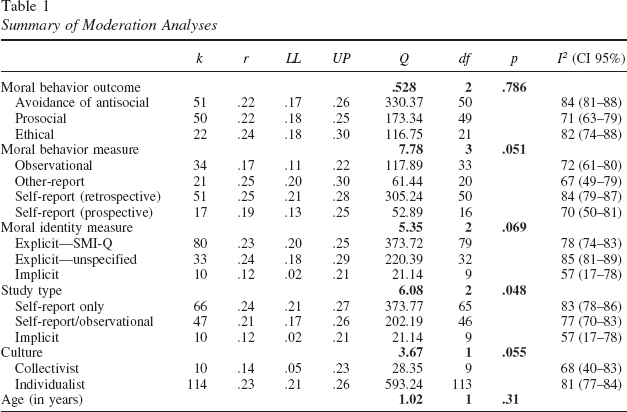
The relationship between moral identity and behavior was not moderated by moral behavior outcome. Thus, moral identity predicted pro-social behavior, avoidance of antisocial behavior and ethical behavior in the same way. For prosocial behavior, the overall effect size was r = .22, for avoidance of antisocial behavior it was r = .22 and for ethical behavior it was r = .24 (for further details see Table 1).
For moral behavior measure a marginally significant effect emerged. Larger effect sizes were obtained for other-reports and retrospective self-reports, r = .25, whereas observational measures yielded the smallest effect size, r = .17. Measures of behavioral intentions (self-report prospective) yielded an effect size of .19 (for further details see Table 1).
Similarly, a marginally significant effect emerged for moral identity measures. Explicit measures evidenced higher effect sizes, rs = .23 and .24, respectively, than implicit measures, r = .12 (for further details see Table 1).
Combining moral behavior measure and moral identity measure into the moderator variable study type (self-report only, self-report/observational, implicit) yielded a significant effect. The largest effect size of r = .25 was obtained for studies that were exclusively based on self-reports, followed by studies that were based on self-report measures of moral identity and other-reports or observations as behavior measures, r = .21. The lowest effect size, r = .11, was found for studies that were based on implicit measures of moral identity or used priming techniques to elicit individuals’ moral identity.
No significant effect of age as a moderator of the relationship between moral identity and moral behavior was found.
Finally, a marginally significant effect of culture indicated that studies conducted in collectivistic cultures tended to report smaller effect sizes than studies from Western, individualistic countries, r = .14 versus r = .23.
Publication Bias
Various measures were taken to analyze publication bias. First, publication status of studies was considered as a potential moderator. It was found that publication status (published vs. unpublished) did not account for heterogeneity in effect sizes, Q(1) = 0.004, p = .950. Second, a funnel plot was created in order to examine whether study size was related to the magnitude of reported effect sizes. The funnel plot (not presented here) depicted a slight tendency of smaller studies to report stronger positive effect sizes. However, the overall shape of the plot was symmetrical. Finally, classic failsafe N was calculated. It was found that 5,066 studies with an effect size of zero would be needed to render the estimated effect size nonsignificant (p < .05). As a rule of thumb for calculating the minimum number of studies that should be exceeded, Becker (2005) suggested the formula N = 5k + 10. According to this formula, failsafe N in the present study should be larger than 565.
Discussion
The present meta-analysis summarized 111 studies investigating the relationship between moral identity and moral behavior. Overall, a positive correlation was found that was significantly different from zero. This correlation did not differ for various behavioral outcomes (prosocial behavior, avoidance of antisocial behavior or ethical behavior in an organizational context). Thus, the study clearly supports the idea that moral identity predicts moral behavior. However, this predictive effect was small to moderate in size and close to the average effect size that is common for social psychological studies of any type. Moral identity, thus, does not appear to be an extraordinarily strong predictor of moral behavior.
Overall, there was significant heterogeneity in effect sizes, which was partially explained by moderating effects of measures and study type. A marginally significant moderating effect for moral behavior measure was found. Behavioral observations and self-reported behavioral intentions tended to be less strongly correlated with moral identity than self-reports and other-reports of past behavior. This may be a result of behavioral observations and self-reported intentions typically being tied to specific situations or scenarios, whereas self- and other-reports of past behavior cover a greater variety of situations across extended periods of time. Thus, it appears that moral identity tends to be a better predictor of general behavioral dispositions rather than of actual behavior in highly circumscribed situations.
In line with this conclusion it was found that implicit measures of moral identity tended to yield lower effect sizes as a predictor of moral behavior as compared to explicit measures. This finding does not support the notion that implicit measures of moral identity are generally more valid than explicit measures because they are less affected by self-presentation biases. Six out of 10 studies that used implicit measures (Conway & Peetz, 2012; Gladden, 2012; Kavussanu, Stanger, & Ring, 2015; O'Fallon & Butterfield, 2011; Verplanken & Holland, 2002; Wang & Tong, 2015) were laboratory studies that employed priming techniques to elicit participants’ moral identity. Although these priming techniques are generally effective (as indicated by manipulation checks), their impact may be small compared to individual differences in moral identity that exist independently of whether or not moral identity was primed. As a consequence, these studies may have yielded lower effect sizes. At this point, it should be noted that the widely used Self-Importance of Moral Identity-Questionnaire did not yield a stronger effect size than any other explicit measures. This finding corresponds with results reported by Hardy et al. (2015) showing that various self-report moral identity scales tap equally well into the moral identity construct.
When combining the moral behavior and moral identity measure into study type as a single moderator variable, a significant effect emerged. Not surprisingly, studies that were entirely based on self-report data (explicit measures of moral identity as well as self-reported moral behavior) yielded the strongest effect. Thus, there is evidence in support of the notion that self-presentation biases potentially inflate the association between moral identity and behavior. However, it is important to note that the effect size of studies combining explicit measures of moral identity with behavioral observations or third-party behavior ratings was not much lower. Thus, the inflation in effect sizes due to self-presentation biases is modest. By far the lowest effect size was obtained for studies that used implicit measures of moral identity or priming techniques to elicit individuals’ moral identity. As study type was a combination of moral behavior measure and moral identity measures, all possible explanations for these effects discussed above apply. Thus, the smaller effect size of studies that used implicit measures of moral identity or priming techniques to elicit individuals’ moral identity may be due to (a) lower validity of implicit measures, (b) more circumscribed assessment of moral behavior in experimental settings, or (c) due to limited effectiveness of priming techniques. In the present meta-analysis it was not possible to disentangle these effects.
All findings discussed so far need to be considered in the context of a marginally significant moderating effect of culture suggesting that the predictive effect of moral identity may be lower in collectivistic than in individualistic cultures. More studies are needed to corroborate this finding given that the number of studies from collectivistic cultures available for the present meta-analysis was small. As a consequence, culture was merely represented as dichotomous variable, neglecting the full variability in cultural orientations. If the finding turns out to be valid, it may indicate that common measures of moral identity may lack validity in collectivistic cultures, or it may indicate that the moral identity construct in its present form is culturally limited and needs to be expanded in order to accommodate to cultures different from the West.
Contrary to our theoretical expectations, moral behavior outcome and age did not account for the heterogeneity in effect sizes. Theoretically, it was expected that moral identity is more strongly associated with prosocial behavior due to the less obligatory nature of this type of moral behavior. This expectation was not corroborated empirically. Engaging in antisocial behavior is often considered a more severe moral transgression than the failure to act prosocially (cf. Krettenauer & Jia, 2013). As a consequence, differences in effect sizes for prosocial and antisocial behavior owing to different degrees of obligatoriness of both types of behavior may have been offset by the severity of moral transgressions.
It was also expected that moral identity is a better predictor of moral behavior in older age groups due to a developmental process that leads to higher integration of self and morality with age. Again, this expectation was not confirmed. This result may be attributable to the fact that standard measures of the moral identity such as the SMI-Q and the Good Self Assessment are not sensitive to age related differences in moral identity and neglect important developmental features of this construct (for an extended discussion see Krettenauer & Hertz, 2015).
Overall, three major conclusions can be drawn from this meta-analysis. First, considering all empirical evidence available it seems impossible to deny that moral identity positively predicts moral behavior in individuals from Western cultures. Although this finding does not refute research on moral hypocrisy, it put the claim that people want to appear moral, rather than be moral into perspective (Batson, 2011; Frimer et al., 2014). If this were always true, why would people who feel that morality matters to them engage more readily in moral action? Second, explicit self-report measures represent a valid and valuable approach to the moral identity construct. This is an important conclusion because many scholars feel that more effort should be invested into developing moral identity measures (e.g., Hardy & Carlo, 2011b; Jennings et al., 2015). Third, although moral identity positively predicts moral behavior the effect is not much stronger than the effects of other constructs, notably moral judgment or moral emotions. Thus, there is no reason to prioritize the moral identity construct as a predictor of moral action at the expense of other factors. Instead, it seems more appropriate to consider moral identity in a broader conceptual framework where it interacts with other personological and situational factors to bring about moral action. This approach is well underway in studies that investigate the moderating and mediating role of moral identity as a predictor of moral action (e.g., Aquino et al., 2007; Hardy et al., 2015). As part of this endeavor, it might become necessary to give up an overly homogenous notion of the moral identity construct in order to acknowledge that moral identities may consist of different motivations and goal orientations. Recently, Krettenauer and Casey (2015) provided evidence for two different types of moral identities, one that is primarily concerned with demonstrating morality to others, and one that is more inwardly defined by being consistent with one's values and beliefs. This differentiation has important ramifications for moral emotions and moral action and helps to explain why moral identities sometimes strengthen individuals’ motivation to act morally and sometimes undermine it.
Supplementary Material
Supplementary material
References
Supplementary Material
Please find the following supplemental material available below.
For Open Access articles published under a Creative Commons License, all supplemental material carries the same license as the article it is associated with.
For non-Open Access articles published, all supplemental material carries a non-exclusive license, and permission requests for re-use of supplemental material or any part of supplemental material shall be sent directly to the copyright owner as specified in the copyright notice associated with the article.
