







Abstract
The assumption that personality makes a difference in people's everyday lives is probably the main reason why investigating personality seems worthwhile at all. Although the number of empirical studies addressing the everyday consequences of personality is considerable, an overarching conceptual framework is missing. We present such a framework, using a version of the SORKC model from cognitive-behavioral therapy. Our version of the model incorporates a full account of how personality may influence the ways in which people perceive and respond to situations, which may ultimately have important consequences for them and others. However, not everything that formally qualifies as a consequence of personality is equally relevant. In choosing criterion variables for their own research, researchers interested in personality consequences seem to have strongly relied on implicit assumptions regarding a “good life.” We review a sample of recent studies from the personality literature, using our own conceptualization of important personality consequences to assess the current state of the field, and deduce recommendations for future research.
Although personality psychology undoubtedly is a fascinating and increasingly complex field of study, it might be worthwhile to pose a somewhat provocative question: What is the point of investigating personality at all? Our answer would be that the relevance of personality (and thus of personality research) hinges to a large extent on the effect that personality has on people's own lives and the lives of others. If personality was just “noise”—if it did not matter to people's everyday lives—there would probably be little reason for scientists to be interested in it.
A wealth of studies over the past few decades showed that personality does matter because it predicts various variables that are commonly deemed important. For instance, studies show that personality predicts people's subjective well-being (Little, 2015; McCrae & Costa, 1991; Ozer & Benet-Martínez, 2006) and mortality (Roberts, Kuncel, Shiner, Caspi, & Goldberg, 2007; Turiano, Chapman, Gruenewald, & Mroczek, 2015) as well as different aspects of their social relationships (Back, 2015) and occupational performance (Lüdtke, Roberts, Trautwein, & Nagy, 2011; Ozer & Benet-Martínez, 2006; Roberts, Kuncel, Shiner, Caspi, & Goldberg, 2007). At the same time, studies differ considerably in what they consider to be the most important consequences of personality and often even in what they consider to be a consequence of personality.
A certain lack of conceptual clarity is also evident in the different terms that are used to designate the variables to be predicted by personality. Some authors speak of “(life) outcomes” or “consequential outcomes” (Hampson, 2012; Moeller, Robinson, & Bresin, 2010; Ozer & Benet-Martínez, 2006; Roberts et al., 2007), some examine “(clinical/social) consequences” (Back, 2015; Vall et al., 2015), and some refer to “(stressful) life events” or “life experiences” (Hammen, 1991, 2005; Iacovino, Bogdan, & Oltmanns, 2016; Lüdtke et al., 2011; Vaidya, Gray, Haig, & Watson, 2002). A brief review of dictionary entries yields only minor semantic differences between outcomes and consequences: Both terms refer to effects—that is, the things they reference follow from something else (e.g., an action) in a (more or less) causal way (American Heritage Dictionary of the English Language, 2011). Unlike consequences and outcomes, the terms life event and life experience concern things that may happen for unknown reasons. In the present paper, we will speak of “consequences of personality” because we want to include the notion of causality while at the same time consequences have a less terminal ring to them than outcomes (which is important in regard to the nonrecursive nature of consequences, see below). Still the use of the term consequence varies considerably between studies and researchers. This includes using the term for other constructs (e.g., behavior) or inappropriately in a formal sense (e.g., when the predictor does not actually precede the consequence).
The purpose of the present paper is to help establish a conceptual framework for addressing these issues in a more stringent manner. Specifically, we aim to locate personality consequences within a semantic network comprising situations, personality, and responses (including behavior). Although diverse in their conceptualizations and explanations of personality, in one form or another these latter variables are featured in most contemporary models of personality (e.g., DeYoung, 2015; Fleeson & Jayawickreme, 2015; Mischel & Shoda, 1995), with strong overlap in how the different models conceptualize their interplay. However, the consequences of that interplay seem to have been somewhat neglected so far, and only some of the models allude to them in passing (e.g., DeYoung, 2015; Fleeson & Jayawickreme, 2015). We use a version of the SORKC model from cognitive-behavioral therapy (CBT) in an attempt to establish that missing link. By doing so, we also hope to pave the way for better integration between the subdisciplines of psychology (i.e., social, personality, and clinical psychology in particular). As an example of such integration, we briefly discuss the case of the so-called “personality disorders”.
Traditionally, the SORKC model has not been used as a research tool in social and/or personality psychology. Rather, it is used in psychotherapy with individual patients to assess the contingencies among a patient's (organism; O) problematic responses (R), certain precedents (stimuli; S), and subsequent conditions (consequences; C). We propose that a version of the SORKC model may in fact be surprisingly helpful as a conceptual framework for research in personality and social psychology because it reflects a relatively complete account of how personality and situations interact in shaping people's responses, which may ultimately bring about important consequences for themselves and others.
As a first step, we will present our version of the model, highlighting the role of personality and consequences and pointing out several links to existing personality models. In a second step, we have a closer look at the consequences themselves. Here, we first discuss a few important properties that set different kinds of consequences apart from each other. We then investigate the personality consequences that were included in previous studies, asking which ones were deemed particularly important. As a third step, we review a sample of recent studies from the personality literature in light of our conceptual analyses, to assess the current state of the field, and we provide some recommendations for future research.
Formal Clarification of Consequences of Personality
Using the SORKC Model as a Framework
We propose to define consequences as causal effects of a person's personality on him-/herself and his or her (social) environment that are mediated by cognitive processes and internal and/or external responses. We use a version of the SORKC model as a framework for coherently organizing these components. Figure 1 displays our version of the model, which is heavily inspired by influential accounts within the CBT literature (e.g., Bartling, Echelmeyer, & Engberding, 2008; Kanfer & Saslow, 1969; Kanfer & Schmelzer, 2005). Several things should be noted. First, the SORKC model is usually displayed with simple arrows pointing from one component to the next component (S → O → R → K → C). However, this notation deviates significantly from contemporary modeling conventions (e.g., in personality and social psychology). Most important, the arrows in this traditional version of the model reflect the order in which the five components are typically highlighted in analyses of individual cases, whereas in a structural equation model they would stand for the strengths of associations between variables. In our version of the model the arrows connecting the variables symbolize the causal influence of one variable on another. By “causal” we mean that there has to be a temporal precedence for the influencing variable as compared with the one that is influenced (that is why all arrows have a direction) and that this influence would vanish if the causing variable were held constant. For the sake of simplicity, we use the same arrow shape for all of these relationships, although the relationships may of course be of different strengths (including zero). Second, in the SORKC model one of the letters (K) stands for an association between variables (the so-called contingency between R and C) whereas the other letters stand for variables. Although the strength of this association is of particular interest to us as well, we avoid highlighting this one association in particular by assigning it a letter of its own (see Figure 1) because we are also interested in all other associations between variables. Third, in our version of the model, the components represent whole groups of variables, out of which specific ones must be selected depending on the respective research question. For example, situations may be distinguished from one another in terms of dozens or hundreds of different variables (Rauthmann et al., 2014), but it is impossible—and probably unnecessary—to include all of them in an empirical study. For the sake of parsimony, we only use a single instant for each type of variable in the subsequent presentation. Fourth, the model is not meant to be deterministic. All variables are also affected by influences other than the ones depicted in the model (i.e., measurement error). For the sake of simplicity, these other influences are ignored in Figure 1. In the following we will demonstrate how the SORKC model may be presented in accordance with contemporary modeling conventions while preserving its basic structure.
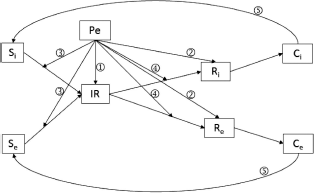
The model explains consequences of personality in terms of main and interaction effects among personality, situational aspects, their internal representation, and responses. Arrows represent the causal effect of one component on another component. Pe = Personality; Si = internal aspects of the situation; Se = external aspects of the situation; IR = internal representation of the situation; Ri = internal response; Re = external response; Ci = internal consequence; Ce = external consequence. The encircled numbers (① to ⑤) represent the five major ways in which personality may exert its influence.
We begin our description of the model with the situations that people encounter. In line with Bartling and colleagues’ (2008) account of the SORKC model, and with several established personality models (e.g., Fleeson & Jayawickreme, 2015; Mischel & Shoda, 1995), we distinguish between external (Se) and internal (Si) aspects of situations. The latter comprise aspects that exist inside of the target person (e.g., level of physiological arousal) whereas the former characterize the person's current environment (e.g., the distance between him/her and a stranger). To elicit the responses that may ultimately bring about consequences, these situational stimuli or “cues” from the “physical reality” (Rauthmann, Sherman, & Funder, 2015) must be (consciously or unconsciously) perceived and interpreted, resulting in what we call internal representations (IRs) of the situation. The main effect of Se/Si on IRs represents how stimuli are generally perceived (e.g., that a smaller distance between myself and a stranger is generally perceived as more threatening). Murray (1938) established this important distinction between the “real” situation (i.e., Alpha press) and the “perceived” situation (i.e., Beta press) as early as in 1938. The IRs (cf., intermediates, Fleeson & Jayawickreme, 2015; psychological situation, Rauthmann et al., 2015) then influence people's internal responses (Ri; targeting the person himself/herself) and/or external responses (Re; targeting the environment). Here, the main effects of IR on the two response variables represent the average person's responses to different representations of situations (e.g., the extent to which a situation is perceived as threatening is associated with an increased likelihood that the person will run away, Re). The distinction between internal and external responses aligns perfectly with the psychoanalytic concepts of “autoplastic” versus “alloplastic adaptation” (cf., Tyson & Tyson, 1993). Note that in line with the SORKC model, we use the term responses here because it is broader than behavior (Furr, 2009) and may also include internal reactions.
The internal (Ci) and/or external (Ce) effects of those responses may be called consequences of personality (CP) to the extent that they are rooted in stable interindividual differences in how people think, feel, and behave (i.e., personality, Pe; see, e.g., Pervin & John, 2001). The effects of these stable personality differences are mediated by more transient differences in people's internal representations of situations (IRs) and/or by differences in their responses (Re/Ri; cf., Back, 2015). This view is in line with trait theories postulating a causal influence of personality (Costa & McCrae, 2006) and resembles Caspi's (1998) description of reactive person–environment transactions: If we put a different person in the exact same situation, different IRs of the situation, different responses, and different consequences might be the result.
According to the model, personality does not elicit its consequences directly, but indirectly through influencing other variables in different ways. First, personality may have a main effect on how people interpret situations in general. For example, neuroticism (Pe) may entail a tendency to interpret all sorts of stimuli as more threatening (IR; see Figure 1, ①). Second, personality may have a main effect on how people react to situations in general. For example, neuroticism (Pe) may entail a tendency to flee (Re) more often (see Figure 1, ②). Third, personality may moderate the effect of aspects of the situation on people's interpretations (i.e., differences in what cues and how cues are perceived; Rauthmann et al., 2015). For example, speakers’ level of social anxiety (Pe) may interact with their familiarity with an audience (Si) in predicting how much they feel evaluated (IR). That is, people on average may feel more evaluated when speaking in front of less familiar audiences, but that association may be stronger in people with higher social anxiety (see Figure 1, ③). Finally, personality may also moderate the association between certain interpretations of the situation and subsequent responses. For example, social anxiety (Pe) may interact with the feeling of being evaluated (IR) in predicting how much speakers apologize to the audience (Re) for their own mistakes. That is, the feeling of being evaluated may lead to more apologies in the average person, but that association is stronger in people with greater social anxiety (see Figure 1, ④). According to the model, these are the four major ways in which stable interindividual differences (i.e., Personality) may bring about consequences through different process variables (IR, Re/Ri).
Of note these consequences may themselves become, or at least influence, relevant aspects of the situations that the same persons are exposed to in the following. This idea—that the consequences of people's responses may influence the situations that these people subsequently encounter—is represented by the arrows pointing from the consequences to the stimuli. To the extent that personality shapes people's responses and responses shape situations, the situations that people encounter are also partly an expression of their personalities (see Figure 1, ⑤). For example, more neurotic persons (Pe) may be exposed to dangerous situations (Se) less often (CP) because they notice signs of danger more easily (IR) and manage to get out of harm's way (Re). This possible link has been acknowledged before. For example, Rauthmann, Sherman, Nave, and Funder (2015) call it “situation contact,” including the deliberate selection of situations, as well as manipulative, evocative, and proactive person–environment transactions (see also Caspi, 1998).
Models in which variables ultimately feed back into themselves are commonly called “nonrecursive” (Kline, 2016), and most contemporary personality models account for these circular effects in one form or another (e.g., DeYoung, 2015; Fleeson & Jayawickreme, 2015; Mischel & Shoda, 1995). Mechanisms such as these are particularly relevant with regard to nonexperimental (“field”) studies using self-report measures only: In such studies it is impossible to disentangle personality-driven situation contact from personality-driven situation processing: For example, if more “narcissistic” persons brag more about their own accomplishments than others—is this because they just interpret all situations as opportunities for bragging, or because they seek (or create) situations in which there actually are more opportunities for bragging, or both? To disentangle these two possibilities, it is necessary to either collect additional assessments of the same situations by other persons or to conduct experimental studies in which all participants are exposed to the same situations.
Potential for Integration
The model we presented is essentially a version of CBT's SORKC model. The order in which we presented the individual components of the model was somewhat arbitrary in that we started with the situation and then introduced personality as an additional variable that “makes the difference.” Reversing this order of presentation would be perfectly reasonable. However, we opted for the first approach to adhere to the tradition in the SORKC literature. Whereas CBT practitioners use the model to help individual patients, we pointed out how compatible it is with many contemporary personality models. The most important difference between other personality models and the SORKC model is that the latter explicitly contains the consequences of people's responses that, by way of several distinct mechanisms described above, may partly be an expression of their personalities. And the extent to which personality—one way or another—accounts for important events in people's lives is probably a direct measure of how important it is to investigate personality at all.
By incorporating both stable differences between persons (Pe) and the current situations they encounter (Se, Si), the model we presented may be used to account for phenomena that are described in personality psychology and in social psychology. Whereas personality psychology was traditionally concerned with how different people react to the same situation, social psychology focused more on how the average person reacts to different situations. In the meantime, both subdisciplines have come to accept the relevance of person effects, situation effects, and person-by-situation interactions.
According to our knowledge, the current presentation is the first attempt to bridge personality and social psychology on the one hand and clinical on the other, and establishing the link seems quite simple. A prime example of how such integration may be helpful is the diagnosis of so-called “personality disorders.” In terms of the model, a personality disorder could be framed as the systematic association between some personality disposition(s) (i.e., tendencies to interpret situations, and respond to situations, in particular ways) and a (set of) important but undesirable consequence(s), (Leising & Zimmermann, 2011). No further components are needed. How “undesirable” some consequence is ultimately depends on the values one endorses (see section “Importance of Consequences”).
And there is yet another way in which this model may be used to integrate different strands of research. When used in a hierarchical fashion, the model may assess (a) relationships between variables within individual persons, with (b) the strengths of these associations differing between persons. At the level of individual persons, each variable would essentially reflect repeated assessments (e.g., a given aspect of the situation at time 1, 2, 3, and so on). The arrows in the model would then reflect how strongly changes in one variable (e.g., Se) predict changes in another variable (e.g., IR) for one specific person. At this level of analysis, no personality variable would be needed. At the sample level, however, the average levels of the variables, as well as the strengths of associations between variables may differ from person to person. These differences may either themselves be considered “personality”, or they may be predicted by other “personality variables” (e.g., a rating scale).
A Closer Look at the Consequences of Personality
Formal Properties of Consequences
Obviously, psychologists are—and probably should be—most interested in the long-term consequences of people's personality. For example, if some personality disposition (e.g., arrogance) had some kind of short-term effect (e.g., angering others), but this effect tended to dissipate quickly without leaving any longer lasting “traces” in the person's life or other people's life, personality psychologists would probably not be interested much in the phenomenon. In contrast, effects that last and/or accumulate over time would be of much greater interest. For example, an arrogant person's behavior might tend to anger others so much and/or so often that the person's relationships with others becomes jeopardized. Thus, it seems vital to take time into account as a crucial variable when conceptualizing consequences of personality. This is in line with standard applications of the SORKC model. For example, phobic avoidance is considered a problem because of its long-term negative consequences, although it also accounts for short-term positive consequences (i.e., fear relief).
Four types of consequence variables seem to be most relevant. First, a variable may only switch its state once and then remain unchanged (Figure 2a). The most obvious example is mortality: It is not possible to lose one's life more than once. Second, a variable may also have only two possible states (0, 1), but switching back and forth between the states is possible (Figure 2b). An obvious example is “being married.” Third, a variable may have more than two possible levels, but it will never fall below the level it previously had (Figure 2c). An obvious example is the number of people one gets to know personally in the course of one's life. Fourth, a variable may have more than two levels, and these levels may vary freely over time (Figure 2d). An obvious example is subjective well-being.
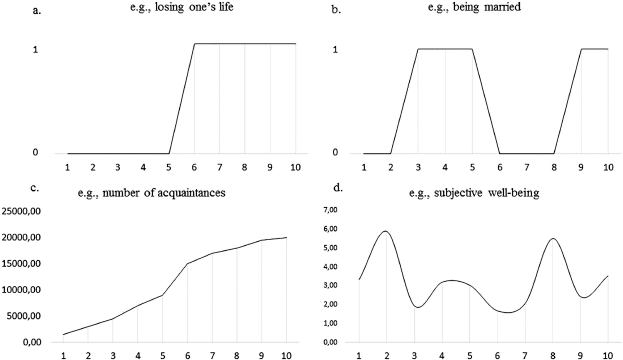
The four main types of curve trajectories of consequences with fictitious values. The x-axes represent measurement points. (a) An example of a consequence that has two possible states (0, 1) and may only switch its state once. (b) An example of a consequence that has two possible states (0, 1) and may switch back and forth between them. (c) An example of a consequence that has more than two possible levels but will never fall below the level it previously had. (d) An example of a consequence that has more than two levels, and these levels may vary freely over time.
We argue that psychology should be most interested in the consequences accounted for by personality “in the long run.” Ideally, one would measure the variables of interest often and over long intervals. However, in reality such multioccasion measurement will often be impossible. At least three other approaches may serve as proxies. First, it is possible to gather repeated assessments of the variable of interest over a shorter time span and then extrapolate the future course of that variable for each target person on the basis of the available data. Second, it is possible to retrospectively assess the overall development of the variable in hindsight after letting elapse a longer time interval. Third, it is possible to study whether personality (measured at t1) predicts the level of the respective variable at a given point in time (t2). This latter approach might appear somewhat simplistic, especially when it is compared to the ideal described before, yet in principle it does have the potential to detect causal effects of personality.
Another important question to be asked in regard to consequences is whether they are more proximal or distal in nature. Sometimes a response is enough to immediately bring about some important consequence, as for example when a person commits suicide (Brezo, Paris, & Turecki, 2006). We would call this a “proximal” consequence. In other cases, the number of intermediary steps between a response and an important consequence may be higher. For example, personality may predict the number of cigarettes that a person smokes, which may predict the amount of tar that accumulates in the person's lungs, which may then predict the person's chances of developing emphysema. If a research project focused on the latter variable, we would call this variable a more “distal” consequence. Depending on the respective research question, the researchers would then have to decide whether they only want to study the critical response and the distal (“ultimate”) consequence or also take intermediary variables into account. These would then have to be inserted in between the response variable and the most distal consequence variable.
Importance of Consequences
The formal considerations presented so far constitute only the first steps in our attempt to structure the wealth of variables that might possibly be studied as consequences of personality. Another issue that needs to be considered, while being of a decidedly different nature, is the relative importance of consequences. There is very little explicit information on the criteria that were applied in selecting the specific sets of consequences studied in previous research. However, two influential reviews both mention the crucial role of social values in making these decisions. Roberts et al. (2007) examined the effects of personality traits on mortality, divorce, and occupational attainment, stating (p. 314), “Although we could have chosen many different outcomes to examine, we selected these three because they are socially valued” (italics added). Ozer and Benet-Martínez (2006) stated that providing an exhaustive list of important personality consequences was impossible because they are “[…] constitutive of values” (p. 402). But what does this mean more precisely?
In their influential theory of the structure of human values, Schwartz et al. (Schwartz, 1992; Schwartz & Bilsky, 1990; Schwartz & Boehnke, 2004; Schwartz & Sagiv, 1995) identify 10 basic human values (or value types), all of which “pertain to desirable end states” (Schwartz, 1992, p. 4). We argue that the relative importance of personality consequences (and thus their chances of being selected for investigation in a research study) is closely linked to such desirable end states—states that should be attained according to some normative ideals. And these normative ideals, yet rarely explicated (for an exception see Leising, Rogers, & Ostner, 2009), largely overlap with the general ideas about a “good life” that members of a society share. Thus, on a conceptual level, research on the consequences of personality necessarily requires two independent kinds of deliberations: (a) formal deliberations, as exemplified by our use of the SORKC model to clarify the roles of situational variables, personality variables, responses, consequences, temporal order, and so on, and (b) value-based deliberations as to whether a given consequence is actually relevant and worthy of scientific study. The latter kind of deliberation is of a decidedly different nature because it presupposes an endorsement of some set of basic values. This is what sets this research apart from other sciences (e.g., physics), in which the studied phenomena exist independent of the researchers’ opinions. The selection of personality consequences as important is ultimately based on value judgments that transcend merely formal criteria or empirical verifiability.
So what “desirable states” were (implicitly) referred to in previous studies of personality consequences? Our screening of the relevant literature published over the past few decades reveals that studies tend to focus on interpersonal and societal functioning. Specifically, the selection of outcome variables implies that people should be (a) physically (Friedman, 2000; Hampson, Goldberg, Vogt, & Dubanoski, 2006; Luo & Roberts, 2015; Murray & Booth, 2015; Shanahan, Hill, Roberts, Eccles, & Friedman, 2014) and (b) psychologically healthy (e.g., Kotov, Gamez, Schmidt, & Watson, 2010; Sowislo & Orth, 2013). They should live a long life (e.g., Kern & Friedman, 2008; Roberts et al., 2007; Turiano et al., 2015) characterized by (c) high subjective well-being (e.g., Diener, 2012; Fulmer et al., 2010; Little, 2015; Ro & Clark, 2009; Schimmack, Schupp, & Wagner, 2008). They should be satisfied with their own work (Judge, Heller, & Mount, 2002; Thoresen, Kaplan, Barsky, Warren, & de Chermont, 2003) and with their interpersonal relationships (e.g., Mund, Finn, Hagemeyer, Zimmermann, & Neyer, 2015; Sadikaj, Moskowitz, & Zuroff, 2015; Schaffhuser, Allemand, & Martin, 2014; Vater & Schröder-Abé, 2015; Wilson, Harris, & Vazire, 2015), and those relationships should be (d) stable and harmonious (e.g., Asendorpf & Wilpers, 1998; Back et al., 2011; Robins, Caspi, & Moffitt, 2002). Furthermore, people should (e) be successful in their own education (e.g., Bratko, Chamorro-Premuzic, & Saks, 2006; Poropat, 2009; and Richardson, Abraham, & Bond, 2012) and at work (e.g., Barrick, Mount, & Judge, 2001; Mullins-Sweatt & Widiger, 2010; Roberts et al., 2007; Thoresen, Bradley, Bliese, & Thoresen, 2004). Finally, they should (f) not get into conflict with social norms and rules (e.g., Frick, Cornell, Barry, Bodin, & Dane, 2003; Moffitt, Caspi, Harrington, & Milne, 2002; Taylor & Eitle, 2015).
It is interesting to note that very similar normative assumptions regarding desirable end states in a person's life may be found in clinical diagnostics, as for instance in the Level of Personality Functioning Scale (LPFS) in Chapter III of the Diagnostic and Statistical Manual of Mental Disorders (fifth edition [DSM–5]; American Psychiatric Association, 2013), the World Health Organization Disability Assessment Schedule 2.0 (WHODAS 2.0; Ustün et al., 2010), or the Global Assessment of Functioning (GAF) scale (American Psychiatric Association, 2000). Similar to the bulk of research studies on the consequences of personality, these diagnostic measures (implicitly) reflect the view that “good” functioning is characterized by people being healthy, happy, socially active, and successful at work/school. The more a person's dispositions interfere (or may interfere) with the attainment of such goals, the greater the level of “impairment” that is attributed to the person will be. The fact that such normative prescriptions are basically rooted in an endorsement of values is rarely acknowledged, possibly because it may make the respective diagnostic system appear less “scientific.” However, the substantial overlap between the broad value categories that are featured in the literature on personality consequences and in the literature on clinical diagnostics suggests that the potential for integration between these disciplines is considerable.
A Review of Recent Literature on Consequences of Personality
We will conclude this paper with a systematic review of recent studies into the consequences of personality. This review will be structured along the lines of what we discussed so far and serve different purposes. First, we want to obtain a somewhat representative picture of what contemporary research into the consequences of personality is about. Second, by structuring our review along the lines of our version of the SORKC model, we aim to demonstrate how this may help improve clarity with regard to (a) the concepts employed and (b) how those concepts may be translated into concrete research designs. We will also deduce some recommendations regarding methodological improvement for future research.
Method
A systematic, keyword-search–based review of the literature in this field is an almost insurmountable task. A Web of Science search for articles with the terms personality or Big Five or Five-Factor Model plus consequences or outcomes or predict in the title, abstract, and/or keywords yields more than 30,000 results just for the past 20 years, even after having limited the search to English language articles and the fields of psychology and psychiatry. Given the many possible ways to define and measure personality, and the indefinite number of variables that may possibly be studied as consequences (without necessarily naming them this way), this search strategy still overlooks many relevant papers. Thus, to gain an up-to-date and systematic overview of research in the field, we decided to review all 2015 issues of two of the most influential journals in the area of personality psychology—the Journal of Personality and Social Psychology and the Journal of Personality.
On the basis of the abstracts, we first selected all articles examining how personality—broadly defined as relatively stable individual differences in experience and behavior (see, e.g., Pervin & John, 2001)—supposedly predict one or more other variables. We kept all articles that in the title, abstract, and/or text included a statement that personality predicts one or more variables, or the terms consequences or outcomes in relation to personality. Of the 181 articles published in the two journals in 2015, 39 (∼21%) articles reporting a total of 89 separate studies 1 met at least one of these criteria. Thus, research into the consequences of personality obviously accounts for a sizable proportion of the studies published in the field at present.
The individual articles reported between one and eight separate studies. In accordance with the model presented in the first part of this article, we classified the main variables that were measured in each study as “personality,” “situation,” “inner representation,” “response,” or “consequence.” We also recorded what kind of design was used. Here, we were particularly interested in whether the personality assessment preceded the assessment of personality consequences. Finally, we broadly categorized the consequence variables by content.
Results
Personality variables
The personality characteristics of interest varied considerably across the 89 studies, but there was a strong focus on the Big Five (26 studies, 28.9%) and on aspects of self-control (13 studies, 14.4%). Other studies investigated various more specific personality variables, such as the dispositional tendency to experience awe (Piff, Dietze, Feinberg, Stancato, & Keltner, 2015) or the parental care motivational system (Buckels et al., 2015). Of note, most personality variables (83.1%) were measured using self-report questionnaires. Only 6 of the 89 studies measured personality also or exclusively by other-report, whereas another 10 studies measured personality in yet a different manner (e.g., by means of experimental variation). These findings closely mirror the situation in personality psychology as a whole, in which self-report is still the predominating method of assessing personality (e.g., Connelly & Ones, 2010; Vazire, 2010). However, it is now widely acknowledged that self-report measures of personality tend to yield incomplete and/or biased information. Again mirroring a widespread sentiment in personality psychology, it seems thus strongly advisable to use more diverse—and most importantly non-self-report—measures in future studies of personality consequences. Empirical studies consistently show that greater methodological diversity makes it possible to tap systematic personality variance that would otherwise be missed (e.g., Connelly & Ones, 2010; Leising, Krause, Köhler, Hinsen, & Clifton, 2011; Vazire & Mehl, 2008). It may be especially useful to obtain personality ratings from people who do know the target persons well but have no reason to portray them in a particularly favorable light. That is because positive perceiver attitudes—which are the rule in perceivers who were recruited by the targets themselves—may lead to variance restriction (Leising, Erbs, & Fritz, 2010; Peabody & Goldberg, 1989).
Consequence variables
Altogether, 121 consequences of personality (thereof 93 different ones) were investigated in the set of 89 studies that we analyzed. Similar to the personality variables, consequences of personality were also assessed by means of self-report measures in the vast majority of cases (71.1%). For only 20 consequences, other-reports were used (e.g., popularity; Dufner, Reitz, & Zander, 2015), sometimes in addition to self-reports. It is interesting to note that for only 15 consequences even more objective measures were used, such as non-self-reported academic grades or first-year college persistence (Galla & Duckworth, 2015). According to our view, this apparent lack of objective outcome data constitutes a serious shortcoming for two reasons. First, as with self-report measures of personality, the predominant use of self- (and other-) measures of consequences may leave relevant variance untapped. Second, when personality and its consequences are assessed using self-report, shared method effects may create spurious correlations (Podsakoff, MacKenzie, Lee, & Podsakoff, 2003). For example, the target persons’ attitudes toward themselves (i.e., self-esteem) may be expressed in how they describe their own personalities and in how they describe their own life circumstances later on. Formal response styles (e.g., a tendency to endorse the extremes of a scale) may create spurious correlations as well (Austin, Deary, & Egan, 2006; Wetzel, Carstensen, & Böhnke, 2013). As long as only one source of information is used in a study, these problems cannot be ruled out. Unfortunately, this is the case for most studies that we reviewed. An obvious solution would be to use different sources of information for the assessment of personality and its consequences.
Situation variables
As for situation variables, 31.4% of the studies included in our review did consider external (e.g., parental socioeconomic status; Damian, Su, Shanahan, Trautwein, & Roberts, 2015) and/or internal (e.g., previous trauma; Boals, Southard-Dobbs, & Blumenthal, 2015) aspects of the situation. With 22 external (Se) versus 7 internal (Si) situational aspects studied, the vast majority of situational aspects considered were external. However, because many studies (46.5%) used self-reports for assessing the situation, the objective or real characteristics of the situation could often not be distinguished from how they were internally represented (IRs). This makes it impossible to discern whether personality predicts consequences because personality (a) influences how situations are interpreted by different people (i.e., situation construal) and/or (b) determines the actual situations that people encounter (i.e., situation contact). Of the studies, 25.6% used an experimental or quasi-experimental design to independently assess the influence of specific objective stimuli, thus ruling out possible effects of “situation contact” (Rauthmann, Sherman, Nave, et al., 2015). For instance, Sverdlik and Oreg (2015) randomly assigned participants to one of two conditions (imposed vs. voluntary organizational change; Se) and then assessed how the conditions interacted with the Big Five (Pe) in predicting organizational identification (Ci).
Process variables
Only 22 of the 89 studies reviewed (24.7%) did consider mediators between personality and its consequences. Of these, 31.8% could be classified as cognitive processes (IRs). As expected, because of the nature of the construct, IRs were exclusively measured by self-report. At 50.0%, most of the studied mediators were external responses (Re), such as eating, study and homework habits (Galla & Duckworth, 2015), agentic or antagonistic behavior (Leckelt, Küfner, Nestler, & Back, 2015), or procrastination (Job, Walton, Bernecker, & Dweck, 2015). Most external responses were assessed by means of self-report measures (70.0%). Again, important variance might be missed, actual associations between variables may be obscured, or spurious ones created when researchers rely only on self-report information. For example, we know that people tend to overestimate the extent to which their behavior in a given situation converges with their general self-concept (Leising, Gallrein, & Dufner, 2014). Obtaining independent ratings of an individual's responses may be particularly helpful in personality disorder research because some of the problems encountered by people with personality disorders may be rooted in how they perceive their own responses as compared to how those responses are perceived by others. It is interesting to note that no study considered internal responses as mediators, suggesting that they do not play a role in contemporary personality research. In clinical research, however, internal responses are often considered highly important (e.g., in the context self-verbalizations). We believe that future research on consequences of personality might benefit greatly from considering internal responses as mediators.
Longitudinality as a formal requirement
An important condition for a variable to be considered a consequence of personality is that the personality variation of interest exists before changes in the consequence variable take place. The best way of ensuring this is to assess personality before assessing its consequences. However, only about one third (29 studies) of the studies we reviewed met this criterion, using longitudinal designs that covered measurement intervals ranging from 1 week to 23 years (the vast majority covered intervals of <1 year). At least 12 of these 29 longitudinal studies (41.4%) used more than two measuring points, with some implementing daily (max 21 days; Girme, Overall, Simpson, & Fletcher, 2015), weekly (max 10 weeks; Gucciardi, Hanton, Gordon, Mallett, & Temby, 2015), or monthly (max 4 months; van Zalk & Denissen, 2015) measures. In contrast, a greater number of studies (42.2%) used cross-sectional designs, making it impossible to determine whether personality actually predicted the consequence. It should be noted that because we intentionally chose two of the most prestigious journals in the field (presumably publishing the highest quality studies in terms of methods and design) the numbers just reported may still be positively biased. That is, we would expect to find an even lower proportion of experimental and/or longitudinal studies in less prestigious journals. In the remainder of this section we will limit our discussion to those studies that did use longitudinal designs. In total, of the 43 “consequences” that were measured longitudinally, 53.5% were classifiable as external consequences (Ce), 32.6% as internal consequences (Ci), and the rest (13.9%) as internal or external responses (e.g., cross-situational variability of social behavior, Erickson, Newman, Peterson, & Scarsella, 2015; obedience, Begue et al., 2015). However, responses are the central mechanism that brings consequences about; thus, they need to be clearly distinguished from the latter. We excluded these studies from further analyses, leaving us with 37 consequence variables.
Content of consequence variables
We classified the content of the remaining 37 consequences (a) according to the six core “desirable end states” that we previously identified and (b) according to the 11 categories that Ozer and Benet-Martínez (2006) had used in their unsystematic literature review. Only six of these latter categories were deemed applicable to the present sample of variables, and they largely overlapped with the desired end states that we had identified in our own analysis. In the following we list these categories (with the respective end states in parentheses) ordered by occurrence frequency: 29.7% occupational choice and performance (success in education/work), 24.3% psychopathology (psychological health), 21.3% peer and family relationships (functioning interpersonal relationship), 10.8% happiness and subjective well-being (well-being/satisfaction with life), 10.8% romantic relationships (functioning interpersonal relationship), and 2.7% physical health and longevity (physical health). Five of Ozer and Benet-Martinez's categories were not applicable, suggesting that they may be of minor importance in contemporary research on the consequences of personality: spirituality and virtues, self-concept and identity, political attitudes and values, volunteerism and community involvement, and criminality (adherence to norms/rules/expectations).
Conclusion and Outlook
The purpose of the present paper was to clarify what the term consequences of personality refers to, to give an overview of contemporary research on the issue, and to derive recommendations for future studies. Our clarification was twofold. First, we showed how the SORKC model from CBT—when used as a research framework—may enable a rather complete account of the relevant phenomena because it comprises all of the necessary components, including personality variables, aspects of situations, internal representations of situations, responses (including behavior), and consequences. The model also incorporates the most important paths connecting the individual variables with one another, which is what researchers are usually most interested in (i.e., effect sizes). Some of these paths were highlighted in previous research within personality and social psychology, using various labels (e.g., beta press, situation construal, situation contact). We think that translating them into the simple language of linear models (main and interaction effects, moderators and mediators) may add significantly to conceptual clarity. The SORKC model is traditionally used for heuristic analyses of individual cases in psychotherapy, but we showed how easily it may be adapted as a conceptual framework for empirical research. The overlap between the SORKC model and many contemporary personality models (e.g., Mischel & Shoda, 1995; Rauthmann et al., 2015) is considerable, suggesting that a better integration across the subdisciplines of social, personality, and clinical psychology should be possible. Second, we argued that psychological research on personality consequences necessarily differs from the “harder” sciences (e.g., physics) in that the choice of “important” consequences hinges on which set of values one endorses. In choosing the relevant variables for their own research, psychologists seem to have largely based their selection on shared and broad societal values, such as subjective well-being, health, and productivity.
Our systematic review of the recent literature on personality consequences showed how helpful it is to have a clear conceptual framework for this kind of research. Most studies in the field report analyses of single-occasion single-source (mostly self-report) data, and the framework enables an identification of typical pitfalls in regard to the interpretation of such data (e.g., regarding the distinction between situation and internal representation). Because the consequences of personality may be the primary reason why studying personality is deemed worthwhile, the field should aim to move toward more stringent research designs to foster the validity of its conclusions. Specifically, validity will be improved by (a) taking the temporal sequence of the SORKC variables into account; (b) assessing the complete sequence (i.e., all components); (c) where possible, using more than one source of information; and (d) using the most appropriate sources of information for each component (e.g., self-report for IR, observer ratings for Re, objective measures of C) and (e) studying consequences long term. By taking measures such as these, personality researchers will ultimately be enabled to make a stronger case in favor of the relevance of their own subject.
Footnotes
1
This number only includes those studies within the selected articles that were relevant regarding the topic of the present paper.