






Abstract
The present work proposes an evolutionary model of externalizing personality that defines variation in this broad psychobiological phenotype resulting from genetic influences and a conditional adaptation to high-risk environments with high extrinsic morbidity-mortality. Due to shared selection pressure, externalizing personality is coadapted to fast life history strategies and maximizes inclusive fitness under adverse environmental conditions by governing the major trade-offs between reproductive versus somatic functions, current versus future reproduction, and mating versus parenting efforts. According to this model, externalizing personality is a regulatory device at the interface between the individual and its environment that is mediated by 2 overlapping psychobiological systems, that is, the attachment and the stress-response system. The attachment system coordinates interpersonal behavior and intimacy in close relationships and the stress-response system regulates the responsivity to environmental challenge and both physiological and behavioral reactions to stress. These proximate mechanisms allow for the integration of neuroendocrinological processes underlying interindividual differences in externalizing personality. Hereinafter I further discuss the model's major implications for personality psychology, psychiatry, and public health policy.
Personality is among the most important extractable explanatory factors underlying human quality of life, health and social functioning, which makes it an indispensable target for health policy and practice (Barlow, Sauer-Zavala, Carl, Bullis, & Ellard, 2014; Cuijpers et al., 2010; Israel et al., 2014; Moffitt et al., 2011; Reidy et al., 2015; Roberts, Kuncel, Shiner, Caspi, & Goldberg, 2007). In the recent literature, personality commonly rests upon the Five-Factor or Big Five model (Digman, 1990; Goldberg, 1993; McCrae & John, 1992). The Big Five are supposed to provide a comprehensive set of mostly independent personality traits. However, due to substantial intercorrelations between the Big Five, there is growing interest in higher-order personality domains such as stability and plasticity (DeYoung, 2006; Digman, 1997) or internalizing and externalizing personality (Hengartner, Graf, & Schreiber, 2017; Wright & Simms, 2014). Moreover, personality is not unique to humans and apparently has a long phylogenetic history. Within biological specialties such as behavioral ecology, evolutionary biology and ethology, scientists are now intensively studying animal personality traits (Reale, Reader, Sol, McDougall, & Dingemanse, 2007). That work has also focused on the interdependence between the two externalizing traits of boldness and aggressiveness, which are apparent in many animal taxa and which are considered to have important implications for ecology and evolution (Sih, Bell, & Johnson, 2004; Wolf & Weissing, 2012). That proliferous field has made major contributions published in leading scientific journals, but unfortunately evidence from animal personality is hardly considered in human personality science (Gosling, 2008; Nettle & Penke, 2010). Given that there is now a compelling body of literature on bold-aggressive animal personality (Reale et al., 2007; Sih, Bell, Johnson, & Ziemba, 2004; Wolf & Weissing, 2012), integrating that rich literature into an evolutionary model of human externalizing personality is worthwhile.
A comprehensive understanding of a psychobiological phenotype requires an explanation of its origins, that is, why did that phenotype evolve and what is its evolutionary purpose (Buss, 2009; Gluckman, Low, Buklijas, Hanson, & Beedle, 2011; Nesse & Stein, 2012). To date, however, models of human personality are mostly descriptive and research elaborates chiefly on proximate mechanisms rather than on ultimate mechanisms. That is, most research is aimed at how human personality is structured (Markon, Krueger, & Watson, 2005), how personality influences behavioral expressions (Fleeson & Gallagher, 2009), how personality develops across the life-course (Caspi, Roberts, & Shiner, 2005), and how personality processes are reflected on a neurobiological level (DeYoung, 2015). In contrast to that rich literature, there is a dearth of research on how personality traits evolved and why personality functions that way. Only a few notable exceptions provide an ultimate evolutionary account of personality traits (de Vries, Tybur, Pollet, & van Vugt, 2016; MacDonald, 1995; Nettle, 2006; Penke, Denissen, & Miller, 2007). There are, in addition, some influential evolutionary theories on human psychosocial and sexual development (Belsky, Steinberg, & Draper, 1991; Chisholm, 1996; Ellis, 2004) as well as on stress responsivity and coping strategies (Del Giudice, Ellis, & Shirtcliff, 2011; Ellis, Boyce, Belsky, Bakermans-Kranenburg, & van Ijzendoorn, 2011). Externalizing personality, which comprises aggressive dominance, hostility and impulsive sensation seeking as thoroughly detailed below, has far-reaching individual and public consequences. These include criminal offending, socioeconomic difficulties, mental disorders, and physical diseases (Jokela, Pulkki-Raback, Elovainio, & Kivimaki, 2014; Lynam, Miller, Vachon, Loeber, & Stouthamer-Loeber, 2009; Moffitt et al., 2011; Walton et al., 2017). In the following I will introduce an evolutionary model of externalizing personality that combines both proximate and ultimate mechanisms. Such a model may allow for more precise predictions of these consequential outcomes, as it tries to answer both why and how externalizing personality develops. The ideas expressed in this work are not necessarily new and some have been reviewed before (Ellis et al., 2012; Glenn, Kurzban, & Raine, 2011). However, the present work proffers a synthesis of various interrelated theories and combines them into a novel evolutionary model of externalizing personality. I further believe that this is the first work to systematically integrate the literature on animal personality, which provides a comprehensive framework and new avenues for future research on externalizing personality.
As the model presented hereinafter is based on evolutionary life history (LH) theory, I will first introduce LH theory (Outline of Evolutionary Life History Theory). Afterward I will describe how LH traits relate to personality in both humans and nonhuman animals (Life History Strategy as Determinant of Stable Personality Trait Variation) and then I specifically focus on externalizing personality (Nomological Network of Externalizing Personality And Relation to Life History Traits). It follows a discussion of adaptation, plasticity and heritability of personality and LH traits in order to introduce basic assumptions of the model (Adaptiveness, Plasticity, and Heritability of Personality And Life History Traits). I will then describe two proximate psychobiological mechanisms through which personality processes and LH traits are connected (Psychobiological Systems Underlying Externalizing Personality And Life History Traits), followed by a detailed depiction of the LH model of externalizing personality (The Evolutionary Life History Model of Externalizing Personality). I will complete this paper by providing an account of practical, mostly clinical, implications (Model Predictions And Practical Implications) and by discussing strengths and limitations of this evolutionary model of externalizing personality (Strengths And Limitations).
Outline of Evolutionary Life History Theory
LH theory (Roff, 2002; Stearns, 1992) is a midlevel theory of evolutionary biology, meaning that the LH framework offers a narrow focus on circumscribed fitness determinants as part of the overarching evolutionary theory. LH theory is aimed at examining fitness components that affect reproduction and survival over the life-course of an organism. Those fitness components are called LH traits and encompass age at sexual maturity, age-specific fertility, and age-specific survival (Roff, 2002; Stearns, 1992). LH theory postulates that organisms, in order to increase inclusive fitness, must allocate finite resources such as time and energy to competing demands, specifically somatic efforts (i.e., investments in personal growth and health maintenance) versus reproductive efforts (i.e., investments in mating and parenting). Because resources are limited, trade-offs emerge so that investment toward one LH trait diminishes resources available for the others (Ellis, Figueredo, Brumbach, & Schlomer, 2009; Roff, 2002). As a result, allocation of resources to traits that increase reproductive fitness typically have a negative effect on traits underlying health and survival, and vice versa. The other major LH trade-offs are current versus future reproduction (producing offspring at young vs. at older age), and mating versus parenting efforts (quantity vs. quality of offspring; Ellis et al., 2009; Roff, 2002). Finally, due to correlations between coadapted morphological, physiological and behavioral traits, clusters of distinct LH strategies (LHS) emerge. On the highest level of abstraction lies the fast-slow continuum (Ellis et al., 2009; Promislow & Harvey, 1990; Reale et al., 2010). A fast LHS (formerly referred to as r-type strategy) comprises fast growth rate, early sexual maturity and young age at first reproduction, intensive mating efforts, large number of offspring with high mortality, and a short life span. In contrast, a slow LHS (formerly referred to as K-type strategy) comprises slow growth rate, late maturity and older age at first reproduction, intensive parenting efforts, small number of offspring with low mortality, and a long life span (Promislow & Harvey, 1990; Reale et al., 2010; Roff, 2002; Stearns, 1992). Among mammals, a prototypical species that follows a fast LHS are for instance rabbits, whereas primates follow a slow LHS. Specifically among primates, prosimians are situated at the fast end of the LHS continuum, monkeys at an intermediate level, and apes at the slow end. Humans are situated at the extreme pole of slow LHS due to slow growth rate, advanced age at first reproduction, and a long life span (Gage, 1998; Jones, 2011). Most importantly, the LHS continuum also emerges at the population level, that is, it also captures intraspecies differences (Figueredo et al., 2006; Reale et al., 2010).
As stated above, as a species humans follow a slow LHS, that is, humans grow very slowly and reach sexual maturity late, produce few but high-quality offspring, invest heavily in parenting, and have a long life span, although, paradoxically, humans have much higher fertility than great apes (Jones, 2011). However, there exists a lot of interindividual variability in how strongly humans invest in slow LHS (Belsky et al., 1991; Ellis, 2004; Figueredo et al., 2006). Therefore, on the population level, humans can also be described on a fast-slow continuum. Originally, Pianka (1970) proposed that unpredictable but resource-rich environments with low intra- and interspecific competition select for a fast LHS (referred to r-selection), whereas stable environments with high competition over resources select for a slow LHS (referred to K-selection). After various revisions and expansions of this theory it is now assumed that selection for slow versus fast LHS is a complex interaction between resource availability, population density and, in particular, mortality rates (Ellis et al., 2009; Metcalfe & Monaghan, 2001; Reznick, Bryant, & Bashey, 2002; Roff, 2002). Extrinsic morbidity-mortality is arguably the most important single cause and refers to death from risk factors which are not affected by allocation of resources to distinct LH traits, including predation, and exposure to toxins and pathogens. In risky or uncertain environments, where extrinsic morbidity-mortality is high and life-expectancy low, natural selection will act upon psychobiological mechanisms that accelerate life-course (Ellis et al., 2009; Reznick et al., 2002; Roff, 2002). For a striking empirical test of this notion, see for instance Stearns, Ackermann, Doebeli, and Kaiser (2000). That is, when offspring is unlikely to survive to reproductive age due to extrinsic morbidity-mortality, then reproducing as early as possible and maximizing the number of offspring in the current generation may be the optimal strategy to ensure that at least some offspring manage to survive and reproduce so that the lineage does not become extinct (Ellis et al., 2009). Also, when parents cannot raise offspring with high reproductive value due to a lack of material or psychobiological resources, then reduction of parenting efforts and increases of mating efforts (i.e., shifting investments toward offspring quantity instead of quality) also optimizes cross-generational reproductive fitness (Chisholm, 1996).
As in other animal taxa, humans that denote the slow end of the LHS continuum grow relatively slowly, reach sexual maturity later and reproduce at an older age (reviewed in Ellis, 2004). Harsh and unpredictable environmental conditions therefore select for fast LHS, which comprises precocious timing of puberty and high adolescent fertility (Belsky, Schlomer, & Ellis, 2012; Belsky, Steinberg, Houts, & Halpern-Felsher, 2010; Ellis & Essex, 2007; Placek & Quinlan, 2012), younger age at first reproduction (Nettle, Coall, & Dickins, 2011; Painter et al., 2008; Wilson & Daly, 1997), and lower parental investment (Nettle, 2010; Quinlan, 2007). For reviews, see (Chisholm, 1996; Del Giudice, Gangestad, & Kaplan, 2015; Ellis et al., 2009; Figueredo et al., 2006). In addition to these biometric measures of LHS, several original studies have adopted psychometric measures of LHS to search for psychosocial covariates. This work showed that psychometric measures of fast LHS (which typically include adverse rearing conditions) relate to increased impulsivity, sensation seeking, aggression, delinquency, short-term mating, sexual coercion, substance-abuse, and both mental and physical disorders (Figueredo, Vasquez, Brumbach, & Schneider, 2007; Figueredo et al., 2005; Gladden, Sisco, & Figueredo, 2008; Hurst & Kavanagh, 2017; Jonason, Koenig, & Tost, 2010; Jonason, Li, Webster, & Schmitt, 2009). However, note that psychometric measures of LHS have been criticized due to a possible lack of validity (Copping, Campbell, Muncer, & Richardson, 2017).
Life History Strategy as Determinant of Stable Personality Trait Variation
In this section I will first review the evidence from research on animal evolutionary ecology and biology, and proceed with a synopsis of research on human LHS and personality. Work on animal personality has proliferated among the biological sciences during the last decade and has substantially improved our understanding of personality trait variation and its consequences for ecology and evolution (Sih, Cote, Evans, Fogarty, & Pruitt, 2012; Wolf & Weissing, 2012). It has been demonstrated that reliable personality trait variation exists in various animal taxa, including mice, apes, ants, dogs, birds, fishes, sheep, spiders, and so on (Gosling, 2001). Personality traits that have repeatedly been replicated across animal taxa are shyness-boldness, exploration, activity, aggressiveness, and sociability (Reale et al., 2007). We can therefore conclude that broad personality traits are not restricted to humans, but rather mirror an evolved biological mechanism inherent to all animal taxa (Bouchard & Loehlin, 2001; Buss, 2009; Nettle, 2006). By now there are also various theoretical models that can explain the maintenance of adaptive personality differences and why stable animal personality traits evolved through natural selection (Dingemanse & Wolf, 2010). Some of these models explicitly linked personality trait variation to LH theory (Stamps, 2007; Wolf, van Doorn, Leimar, & Weissing, 2007). For instance, in their pioneering article published in Nature, Wolf, van Doorn, Leimar, and Weissing (2007) propose an evolutionary model based on the fundamental trade-off between current and future reproduction. This trade-off produces polymorphic populations in which some individuals focus on future fitness returns by first allocating resources to somatic functions, while others attempt to increase current fitness by reproducing at young age. Those different LHS produce variants in stable behavioral predispositions, hence differences in coadapted personality traits. Individuals with high future expectations, that is, those who invested first in somatic functions instead of immediate reproduction, tend to be more risk-averse, less aggressive, more sociable and cooperative because these individuals need to survive long enough to reproduce in the future. On the other hand, individuals who want to reproduce immediately benefit from aggressive dominance, hostility, and risk-taking in order to attract mates and to outcompete rivals (Wolf et al., 2007). Mounting evidence from original studies in various animal taxa now supports the view that personality has important fitness consequences depending on contingent ecological and environmental demands (Dingemanse, Both, Drent, & Tinbergen, 2004; Kontiainen et al., 2009; Patrick & Weimerskirch, 2014; Pruitt, Riechert, & Jones, 2008; Reale, Martin, Coltman, Poissant, & Festa-Bianchet, 2009). Animal studies have further revealed that fast LHS correlates with so-called proactive personality traits, which comprise high aggressiveness and boldness, superficial exploration, poor sociability and low docility (Biro & Stamps, 2008; Koolhaas, de Boer, Coppens, & Buwalda, 2010; Reale et al., 2010; Schjolden & Winberg, 2007).
With respect to human life-course, earlier accounts have already stressed that distinct LHS might directly affect personality development (Belsky et al., 1991; Rushton, 1985). Empirically, these ideas have stringently been tested only at the beginning of the 21th century. Because most research has been conducted based on Big Five traits, I will first briefly touch on these before I proceed with externalizing personality in the next section. For instance, one study revealed strong positive correlations of a psychometric measure of slow LHS with the Big Five traits of conscientiousness and agreeableness (i.e., psychoticism reversed according to Eysenck, 1992) and to a lesser extent also with emotional stability (neuroticism reversed), while both extraversion and openness were unrelated (Figueredo et al., 2005). In contrast to that, Gladden, Figueredo, and Jacobs (2009) found that all Big Five traits, including extraversion and openness, correlate substantially with psychometric LHS. The covariance between conscientiousness, agreeableness, and emotional stability constitutes the metatrait referred to as alpha/stability (DeYoung, 2006; Digman, 1997). These traits differentially predict the LH traits of longevity (Chapman, Fiscella, Kawachi, & Duberstein, 2010; Deary, Batty, Pattie, & Gale, 2008; Jokela et al., 2013) and both long-term mental and physical health (Hengartner, Kawohl, Haker, Rossler, & Ajdacic-Gross, 2016; Israel et al., 2014; Jokela, Pulkki-Raback et al., 2014; Krueger, 1999); for reviews see (Bogg & Roberts, 2013; Hengartner, 2015; Lahey, 2009; Smith & MacKenzie, 2006). Extraversion and openness correlate substantially and their covariance constitutes a metatrait referred to as beta/plasticity (DeYoung, 2006; Digman, 1997), but both traits have not been consistently linked to psychometric LHS due to heterogeneity in underlying facets (Manson, 2017). For instance, though extraversion correlates with some markers of slow LHS such as relationship quality, attachment security, and social support (Donnellan, Burt, Levendosky, & Klump, 2008; Hengartner et al., 2016; Neyer & Asendorpf, 2001), on the other hand extraversion also positively relates to markers of a fast LHS such as unrestricted sociosexuality, impulsive sensation-seeking and mating efforts (Holtzman & Strube, 2013; Schmitt, 2004; Zuckerman, Kuhlman, Joireman, Teta, & Kraft, 1993). The main implication is that extraversion does not uniformly related to LHS. Extraversion facets of dominance and experience-seeking tend to relate to fast LHS, whereas facets of warmth and sociability relate to slow LHS (Del Giudice, 2014a; Manson, 2017). Similar inconsistencies in association with LHS also pertain to openness (Manson, 2017), but these are not detailed here.
Nomological Network of Externalizing Personality and Relation to Life History Traits
The construct of externalizing personality may help to resolve inconsistencies in associations between personality and LHS outlined above. An externalizing personality domain has been derived from inventories of normal (Big Five) personality (Hengartner, Graf et al., 2017), pathological personality (Kushner, Quilty, Tackett, & Bagby, 2011), and combined normal and pathological personality (Wright & Simms, 2014). Externalizing personality bears some resemblance with alpha/stability, but deviates from this metatrait as it does not include the neuroticism facets of self-consciousness and anxiousness. It does, however, cover some facets from extraversion and openness, including activity, assertiveness, excitement-seeking, and adventurousness (Hengartner, Graf et al., 2017; Wright & Simms, 2014). The most salient features of externalizing personality are anger, hostility, impulsivity, disinhibition, manipulativeness, dominance, risk-taking, opportunism, deceitfulness, rudeness, noncompliance, grandiosity, callousness, immoderation, and antagonism (Hengartner, Graf et al., 2017; Kushner et al., 2011; Wright & Simms, 2014; Wright et al., 2012). The nomological network of externalizing personality therefore corresponds closely to the traits underlying the construct of psychoticism (Eysenck, 1992; Zuckerman et al., 1993), borderline, antisocial, narcissistic, and paranoid personality disorder (Samuel & Widiger, 2008) and, most importantly, psychopathy (Lynam et al., 2005; Neumann & Hare, 2008; for a review, see Hare & Neumann, 2008). In the following I will therefore also draw on the extensive literature on psychoticism, personality disorders and, in particular, psychopathy. With respect to animal personality it is worthy of note that an almost identical metatrait has been extracted from a comprehensive set of personality traits in chimpanzees (Latzman, Hopkins, Keebaugh, & Young, 2014). In that particular study an externalizing factor loaded strongly on the personality traits of aggression, bullying, reckless, gentle (negative loading), defiant, dominant, stingy, cautious (negative loading), irritable, impulsive, jealous, submissive (negative loading), sympathetic (negative loading), persistent, erratic, excitable, dependent (negative loading), stable (negative loading), independent, and friendly (negative loading). Substantial genetic and phenotypic correlations between traits underlying externalizing personality, specifically boldness, risk-taking, activity, superficial exploration, dominance, mating efforts and aggressiveness have been documented in many other animal taxa (Groothuis & Carere, 2005; Reale et al., 2009; Schurch & Heg, 2010; Taylor et al., 2012).
Several reviews linked externalizing personality and psychopathy to human development and suggested that it would constitute a marker of fast LHS (Belsky et al., 1991; Ellis et al., 2012; Glenn et al., 2011; Mealey, 1995). Most original studies, however, provide only indirect evidence for an association between externalizing personality and biometric measures of LHS. For instance, in an influential study, Wilson and Daly (1997) showed that across distinct neighborhoods in Chicago, cause-deleted average male life expectancy related to increased homicide rates and to women's younger age at first childbirth. Similarly, based on the total Swedish population, Yao, Langstrom, Temrin, and Walum (2014) showed that criminal offenders had more biological children, more reproductive partners, and more frequently a medical prescription for genital warts. Given that psychopaths are markedly overrepresented in violent offenders (Reidy et al., 2015), these studies provide indirect evidence for an association between externalizing personality and increased reproductive efforts. In addition, several prospective longitudinal studies provide evidence for associations between early environmental risk, reproductive efforts (including precocious menarche, early sexual debut and higher number of sexual partners), and externalizing behaviors (including risk-taking, aggression and delinquency; Belsky, Steinberg et al., 2010; Brumbach, Figueredo, & Ellis, 2009; Simpson, Griskevicius, Kuo, Sung, & Collins, 2012). Another group of studies used controlled experimental designs to demonstrate associations between cues of reduced life expectancy (a proxy for environmental risk) and increased risk-taking and criminal intent, lower self-control, and increased reproductive efforts (Dunkel, Mathes, & Beaver, 2013; Griskevicius, Delton, Robertson, & Tybur, 2011; Griskevicius, Tybur, Delton, & Robertson, 2011). Finally, research directly examining externalizing personality, including psychoticism and psychopathy, has further shown that it correlates considerably with sexual coercion, number of sexual partners, short-term mating, and psychometric measures of fast LHS (Figueredo et al., 2005; Gladden et al., 2009; Jonason et al., 2010; Jonason et al., 2009). However, it needs to be considered that all these correlational studies were cross-sectional and relying on psychometric measures of LHS instead of the more stringent biometric measures such as age at first childbirth and number of offspring detailed above.
Despite different methodological approaches, it is reasonable to conclude that, consistent with theory, externalizing personality meaningfully relates to early environmental adversity, to various indicators of fast LHS and to trade-offs between reproductive and somatic efforts in both humans (Ellis et al., 2012; Figueredo et al., 2006) and nonhuman animals (Biro & Stamps, 2008; Reale et al., 2010). In the present work, maintenance of variance in externalizing personality is therefore largely seen as resulting from balancing selection, specifically an adaptation to different environmental niches (Penke et al., 2007), which is also referred to as niche specialization (Montiglio, Ferrari, & Reale, 2013). That model proposes that genetic polymorphisms are maintained because resulting variance in phenotypes conveys different fitness benefits across environments. It is further acknowledged that extreme variants of externalizing personality, in particular psychopathy, could be subjected to negative frequency-dependent selection (Glenn et al., 2011). According to this model, fitness benefits of a given phenotype varies as a function of its frequency in the population, suggesting that the exploitative strategies of psychopaths may only convey fitness benefits when they are shown by a small minority in the population (Mealey, 1995). A personality model based on balancing selection was recently proposed by de Vries et al. (2016). These authors linked fitness pay-offs attributable to interindividual differences in personality traits to domain-specific situational affordances that underlie situation, trait, and outcome activation mechanisms.
Adaptiveness, Plasticity, and Heritability of Personality and Life History Traits
An externalizing personality profile as a broad phenotype coadapted to fast LHS does not necessarily need to be adaptive in most contemporary Western societies. It is important to understand that evolution acts very slowly on the distribution of phenotypes, which were formed and shaped through natural selection in the environment of evolutionary adaptedness, that is, mainly during the Paleolithic age. However, during the last 10,000 years and in particular since industrialization approximately 200 years ago, human culture, and as a consequence, life expectancy and infant mortality, has experienced such fundamental shifts, that the adaptiveness and fitness consequences of evolved traits may have changed drastically (Ellis et al., 2012; Gluckman et al., 2011). Therefore, traits that correlated reliably with inclusive fitness during the Paleolithic age may be uncorrelated with fitness in contemporary environments due to, for instance, effective medical treatments and birth control that suppress effects of natural selection. Conversely, in contemporary environments, evolved adaptive traits may cause severe socioeconomic problems and diseases in individuals at an advanced age that did not occur in our ancestors because they did not exhibit such long postreproductive lifespans (Gluckman & Hanson, 2004). Our contemporary social environments and cultural lifestyles are so completely different to those of the environment of evolutionary adaptedness, that some forms of illness, in particular mental disorders, arguably reflect psychobiological dysfunctions caused by environmental challenges that are beyond our evolved capacity to cope (Gilbert, 2006; Gluckman et al., 2011; Nesse & Stein, 2012). Moreover, it is important to realize that natural selection is aimed at increasing fitness, that is, reproductive success, and not wellbeing or happiness. On the contrary: Quite often maximizing fitness comes at the expense of enduring individual health problems across adulthood (Gluckman et al., 2011; Korte, Koolhaas, Wingfield, & McEwen, 2005; Nesse, 1999). Adult health, in particular postreproductive adult health, are of minor fitness relevance, as in human's survival to reproductive age has the distinctly greatest effect on inclusive fitness (Jones, 2009). Therefore, from an evolutionary perspective, investing all resources in early reproductive success at the cost of increased adult morbidity and mortality makes perfectly sense and must be viewed as adaptive strategy under adverse environmental conditions (Ellis et al., 2009).
The most important reasons for maladaptation and pathology are as follows: Evolutionary adaptive traits can be expressed at maladaptive high levels due to environmental events that disrupt developmental processes; adaptive traits may yield maladaptive outcomes or increase vulnerability to dysfunction because of exaggerated defense mechanisms; or adaptive traits may be regarded as pathological because of developmental mismatch due to environmental change that affects the whole species (i.e., phylogenetic change) or because the environment has changed over an individual's life span (i.e., ontogenetic change; Bateson et al., 2004; Cosmides & Tooby, 1999; Frankenhuis & Del Giudice, 2012; Gluckman et al., 2011; Nesse, 1999). For instance, a prototypical example of an extreme externalizing personality trait profile that possibly served an adaptive function in the environment of evolutionary adaptedness and that may often, but not necessarily has to, cause mismatch and hence dysfunction in contemporary societies, is psychopathy (Glenn et al., 2011; Mealey, 1995). Also, fetal undernutrition and prenatal stress due to, for instance, a severe mental disorder in the pregnant mother, may calibrate long-term LHS during the highly plastic fetal period to adapt the neonate to an anticipated adult life in an impoverished and harsh environment. However, such a forecast can turn out wrong: when that child is eventually born into an affluent and resource-rich environment, it will unnecessarily be at increased risk of a metabolic syndrome including obesity and Type 2 diabetes due to a fundamental mismatch between adverse states during fetal development that serve as the basis for the prediction of the adult environment and the effectively encountered postnatal environment (Bateson et al., 2004; Gluckman & Hanson, 2004; Gluckman, Hanson, & Beedle, 2007).
In both human and nonhuman animals, LHS, coadapted personality traits, and other fitness-related phenotypes such as stress-responsivity or attachment, are remarkably stable or even irreversible subsequent to sensitive periods of early psychobiological development (Boyce & Ellis, 2005; Del Giudice, 2009). Reasons for reduced plasticity with increasing age involve trade-offs between LH traits, neurophysiological constraints on plasticity of phenotypes, and both epigenetic and antagonistic pleiotropic effects (Chisholm, 1996; Del Giudice et al., 2011; Ellis et al., 2009; Meaney, 2010). According to Burton and Metcalfe (2014), the fetal phase, infancy, and childhood are the most consequential sensitive periods, because during these early stages of development environmental conditions can produce irreversible phenotypes that are transmitted across several generations. According to Del Giudice and colleagues (Del Giudice, 2014b; Del Giudice, Angeleri, & Manera, 2009), the transition from early childhood to juvenility is another main switch point in the development of stable interindividual differences in LHS. Subsequently, adolescence is perhaps the last major behavioral and neuroendocrinological switch point for the adjustment of adult LHS (Del Giudice et al., 2011; Ellis et al., 2012) before LHS and related phenotypes become differentially highly stable or fixed. Personality traits, likewise, are plastic during infancy and early childhood but become differentially highly stable during late childhood and adolescence. Across adulthood, they are perhaps the most stable noncognitive psychological traits altogether (Caspi et al., 2005; Ferguson, 2010). Even in adult clinical samples that undergo intensive pharmacological and psychological treatments, personality traits remain remarkably stable (De Fruyt, Van Leeuwen, Bagby, Rolland, & Rouillon, 2006; Ferguson, 2010; Roberts et al., 2017). That is, while LH traits and other fitness-relevant phenotypes such as stress-responsivity, attachment, and personality are moderately developmentally plastic during prenatal stage (conception to birth), infancy (birth to about 2 years), and childhood (about 3–11 years), these phenotypes usually become differentially highly stable after adolescence, as evidenced by greater resistance to trauma or treatment and diminishing plasticity over time (Boyce & Ellis, 2005; Del Giudice et al., 2011; Ferguson, 2010; McEwen, 2007). For instance, Ogle, Rubin, and Siegler (2014) showed that individuals exposed to severe traumas during childhood or adolescence had higher levels of midlife neuroticism than did individuals who experienced trauma after the transition to adulthood. In addition, Simpson, Griskevicius, Kuo, Sung, and Collins (2012) demonstrated that environmental risk during early childhood (age 0–5), but not later childhood (age 6–16) prospectively related to increased reproductive efforts and externalizing behaviors at age 23 (for similar results, see also Placek & Quinlan, 2012). These adaptive processes during early life allow for genotypic variation to be preserved through transient environmental changes (Burton & Metcalfe, 2014; Del Giudice et al., 2011; Gluckman et al., 2007). The ability of a given genotype to form distinct phenotypes based on early life environmental conditions has been referred to as facultative adaptations (Chisholm, 1996; Nesse, 2011), predictive adaptive responses (Gluckman & Hanson, 2004; Nettle, Frankenhuis, & Rickard, 2013), or conditional adaptations (Boyce & Ellis, 2005; Del Giudice et al., 2011). Though termed differently, all three concepts basically define the same evolutionary process. Nevertheless, it is important to state that personality traits do change over shorter and longer time intervals across adulthood, arguably due to epigenetic effects (Roberts, 2017), as consistently suggested by a growing body of evidence from animal research (Burton & Metcalfe, 2014; Meaney, 2010).
Approximately half of the variance in human personality (Bouchard & Loehlin, 2001; Briley & Tucker-Drob, 2014), and to a slightly lesser extent also attachment and coping (Kato & Pedersen, 2005; Picardi, Fagnani, Nistico, & Stazi, 2011), is heritable. That is, to a considerable portion the variance in personality and other phenotypes is independent of contingent environmental conditions. However, the heritability of externalizing traits appears to be lower than that of other traits, suggesting that these are predominantly caused by environmental factors. For instance, Wright, Pahlen, and Krueger (2017) showed that genetic factors accounted for only 38% and 30% of variance in antagonism and disinhibition. Likewise, heritability of primary traits such as altruism (30%), anger (31%), emotionality (25%), excitement-seeking (38%), immoderation (40%), morality (29%), orderliness (35%), sympathy (37%), or trust (29%) was significantly below 50%. Furthermore, heritability estimates vary with age. In most behavioral traits investigated, including aggression and prosocial behavior, heritability estimates increase markedly across childhood and adolescence, suggesting that environmental effects are strongest during early childhood and lessen afterward (Knafo & Plomin, 2006; Tuvblad & Baker, 2011). Heritability estimates for personality traits across early childhood largely depend on model-selection criteria. According to one model, heritability is around 68% at birth and decreases steadily across childhood (0–15 years). Based on the alternative model, heritability is around 54% at birth, increases sharply across early childhood (0–3) and drops steadily afterward from age 3–15 (Briley & Tucker-Drob, 2014). With respect to personality development across the life-course, it appears that environmental influences contribute to increasing differential (i.e., rank-order) stability in personality traits from early childhood to middle adulthood, whereas genetic effects on stability remain mostly constant (Bleidorn, Kandler, & Caspi, 2014; Briley & Tucker-Drob, 2014). These findings are likely due to mutual reinforcement between personality and critical life events (Jeronimus, Riese, Sanderman, & Ormel, 2014; Specht, Egloff, & Schmukle, 2011), resulting in increasing environmental influences as life event accumulate in dynamic interaction with personality change across the life-course. For instance, Robins, Caspi, and Moffitt (2002) showed that negative emotionality prospectively predicts conflict and abuse in intimate relationships, whereas both conflict and abuse prospectively predict increases in negative emotionality.
Finally, heritability of interindividual differences in personality (h2) is not uniform within populations. For instance, as shown by Krueger, South, Johnson, and Iacono (2008), perceived parental regard and conflict substantially moderate the heritability estimates of personality traits in youths. In adolescents who perceived very low parental regard (h2 = .28) and very high parental conflict (h2 = .20), the heritability of negative emotionality was considerably lower than in adolescents who perceived very high parental regard (h2 = .56) and very low conflict (h2 = .55). These findings suggest that under adverse environmental conditions, variance in negative emotionality (and other traits such as aggression, see Tuvblad & Baker, 2011) is mostly caused by environmental influences rather than by genetic factors. According to Rutter, Moffitt, and Caspi (2006) this is a basic feature of heritability, and they state that “the population variance attributable to genetic factors may be expected to be lower in any subsection of the population exposed to a major adverse environmental influence known to impact on the trait being investigated” (p. 235). Other important aspects of gene-environment interplay are gene-environment correlations and gene-environment interactions (Champagne & Mashoodh, 2009; Rutter et al., 2006), but a detailed discussion of these issues is beyond the scope of this article.
Psychobiological Systems Underlying Externalizing Personality and Life History Traits
In this section I will introduce two major psychobiological systems that are supposed to regulate and mediate behavioral and neuroendocrinological expressions of (externalizing) personality. Those proximate psychoneuroendocrinological systems are the stress-response system and the attachment system. Both have a long-lasting tradition in personality, social, and clinical psychology as well as medical research. However, it is only very recently that the stress-response system has been given a comprehensive ultimate evolutionary explanation (Boyce & Ellis, 2005; Del Giudice et al., 2011; Korte et al., 2005; Porges, 2001), while with respect to the attachment system, stringent implementation within LH theory has been accomplished during the nineties (Belsky, 1997; Belsky et al., 1991; Chisholm et al., 1996, 1993). Note that the two systems are neither mutually exclusive nor exhaustive. In fact, in both humans and nonhuman animals they show overlapping neuroendocrinological, physiological, genetic, and behavioral features and are therefore synergistically interrelated (Cameron, Shahrokh, et al., 2008; Del Giudice et al., 2011; Koolhaas et al., 2010; McEwen, 2012; Taylor et al., 2000). Further note that additional proximate mechanisms are certainly involved in personality functioning. However, to date both the stress-response and attachment systems provide the most promising proximate mechanisms inherent to personality functioning that have been linked systematically to LH theory. The two systems are assumed to cover two important domains of human life, that is, responsivity to environmental stimuli and consequent stress reactions (as mainly regulated by the stress-response system) and habitual behavior in intimate relationships with parents, partner, and close friends (as mainly regulated by the attachment system). Based on a consistent body of evidence (Allen, Moore, Kuperminc, & Bell, 1998; Hengartner et al., 2015; Mallinckrodt & Wei, 2005), here I expand the scope of attachment and suggest that it is also crucially involved in general interpersonal functioning, though, worthy of note, interpersonal processes are also substantially influenced by stress responsivity (Taylor, 2006), while stress physiology significantly affects attachment behavior (Robles & Kane, 2014). Most importantly, integration within LH theory has fueled articulation and empirical testing of novel hypotheses that have substantially advanced our understanding of human health and social functioning above and beyond established developmental theories from psychology, sociology and medicine (Belsky & Pluess, 2009b; Ellis & Del Giudice, 2014; Ellis et al., 2012). Evolutionary biology and ecology have also provided new insights on animal personality (Reale et al., 2007; Sih, Bell, & Johnson, 2004; Wolf & Weissing, 2012), which can be translated to humans to further advance our understanding of the origins, and consequences, of human personality trait variation (Gosling, 2008; Nettle, 2006; Nettle & Penke, 2010). The understanding of evolutionary mechanisms that shape and modulate stress and psychosomatic functioning has far-reaching consequences for human health and medicine (Bateson et al., 2004; Gluckman et al., 2007; Nesse & Stein, 2012; Stearns, Nesse, Govindaraju, & Ellison, 2010). A thorough outline of evolutionary mechanisms is therefore worthwhile. However, a detailed account of proximate neuroendocrinological mechanisms underlying externalizing personality with respect to stress-response and attachment is beyond the scope of this article. For an overview of neurobiological bases of personality, the interested reader is referred to the literature (Allen & DeYoung, 2017; Depue & Fu, 2011; DeYoung, 2010). Moreover, there is a growing body of research focusing on specific personality domains such as for instance neuroticism/negative affectivity (see reviews by Ormel et al., 2013; Shackman et al., 2016) or psychopathy (see reviews by Blair, 2013; Glenn & Raine, 2008).
The Stress-Response System
The stress-response system involves a host of physiological and behavioral processes that are by no means restricted to acute neuroendocrinological and behavioral reactions to novel or threatening stimuli. As comprehensively advanced in models of neuroendocrine allostasis (McEwen, 2012; McEwen & Stellar, 1993) and homeostasis (Smith & Vale, 2006; Ulrich-Lai & Herman, 2009), the stress-response system can induce persistent alterations in biological and behavioral phenotypes that go beyond acute stress reactions. Those eclectic effects very broadly affect general mental and physical health. Therefore, in this article the stress-response system is conceptualized as a evolved multifaceted psychobiological mechanism that regulates an individual's survival and reproduction strategies, including detection, avoidance, and reaction to acute physical hazards, pathogens, and social threats, menaced by conspecifics and other species, metabolism and physiology following acute or chronic stress, reproductive endocrinology, sensing and realization of mating opportunities, stress management and coping, as well as interpersonal affiliation, social dominance, and social coalition formation (Del Giudice et al., 2011; Ellis, Jackson, & Boyce, 2006; Korte et al., 2005; Porges, 2001; Taylor et al., 2000). Sometimes, or given severe environmental adversity rather quite often, the psychobiological outcomes of this complex stress-response system may be expressed as manifest severe mental and somatic diseases (Dimsdale, 2008; McEwen, 2012; McFarlane, 2010; Shonkoff et al., 2012), though note that evolutionary forces do not directly cause disease, but rather alter the vulnerability to disease in specific environments (Gluckman et al., 2011). Conversely, alternative outcomes of the stress-response system, specifically under favorable, secure, and supporting environmental conditions, are expressed as health promotion and resilience (Belsky & Pluess, 2009a; Boyce & Ellis, 2005; Ellis et al., 2011), but these are not further evaluated here. A detailed description of the neuroendocrinological functioning of the stress-response system is likewise beyond the scope of this article. Interested readers are referred to the following literature (Lupien, McEwen, Gunnar, & Heim, 2009; McEwen, 2007; Smith & Vale, 2006; Ulrich-Lai & Herman, 2009).
According to Del Giudice, Ellis, and Shirtcliff (2011) the broad stress-response system can by roughly separated into three anatomically different, but functionally closely interrelated neuroendocrinological systems. These are the hypothalamic-pituitary-adrenal (HPA) axis and two components of the autonomic nervous system, specifically, the sympathetic nervous system (SNS) and the parasympathetic nervous system (PNS). Their main proximate biological functions are: (a) coordination of an individual's homeostatic and allostatic response to both physical and psychosocial environmental challenges; (b) decoding and filtering of sensory inputs about an individual's environment; and (c) regulation of an individual's physiology and behavior in fitness-relevant domains such as social dominance and competition, cognitive development and learning, reproductive development, and interpersonal attachment and affiliation. The PNS provides the fastest and most immediate stress response, followed by the SNS and the HPA axis (Del Giudice et al., 2011). The proximate physiological function of the PNS is to promote vegetative functions, social engagement, and relaxation. By suppressing SNS activation it reduces physiological arousal and alertness. Its main function is thus commonly also referred to as “rest and digest.” When subjected to acute stressors, the PNS deactivates and stops counterbalancing SNS-induced physiological arousal. Following PNS disengagement, effective coping may require further activation of the SNS. This second, more intense response prompts the adrenal medulla to secrete epinephrine and norepinephrine, which accelerate heart rate, respiration, muscular blood flow, and energy supply, while these hormones simultaneously suppress vegetative functions. Psychologically, pending on the norepinephrine to epinephrine ratio, SNS activation thus mediates “fight or flight,” “freeze and hide,” or, mainly in women, “tend and befriend” responses (Del Giudice et al., 2011; Korte et al., 2005; Taylor et al., 2000). These three responses are considered behavioral socioaffective reactions that involve dominance and aggression, subordination and coalition, or fear and retreat (for comprehensive reviews of the autonomic nervous system, see Porges, 2001, 2007; Ulrich-Lai & Herman, 2009).
The HPA axis involves a circuit of anatomical components, involving hypothalamus, anterior pituitary, and adrenal gland of the kidney, that communicate through a complex system of neurochemical and endocrine activation and corresponding inhibitory feedback loops. These, ultimately, prompt cortisol secretion in the adrenal cortex (Smith & Vale, 2006; Ulrich-Lai & Herman, 2009). In order to ensure homeostasis of this system, cortisol suppresses activation of both the hypothalamus and the pituitary. Corticotropin-releasing hormone (CRH) and, foremost, cortisol, impact on all major regulatory systems, including the metabolic system, cardiovascular system, immune system, reproductive system, and central nervous system. Cortisol elevation starts about 5 min after the triggering event and peaks within 10 to 30 min (Del Giudice et al., 2011). The proximate psychobiological function of cortisol is energy release, attention and vigilance, anti-inflammation, and learning and memory (Ellis et al., 2006; Korte et al., 2005; McEwen, 2007). Autonomic nervous system and HPA are functionally integrated and connected through various neuroendocrine structures and circuits, including noradrenergic pathways regulated through the locus coeruleus, and, perhaps most importantly, through limbic structures, involving in particular the amygdala and the hypothalamus (Smith & Vale, 2006; Ulrich-Lai & Herman, 2009). The major tenet of neuroendocrinological stress models is that the psychobiological stress reaction is a dynamic process aimed at enhancing an individual's adaptation to both social and physical environmental threats and challenges (referred to as allostasis) in order to cope, behaviorally and physiologically, more effectively with these stimuli and to engage actively with the environment through mobilization of metabolic and psychological resources (Del Giudice et al., 2011; Korte et al., 2005; Lupien et al., 2009; McEwen, 2007). However, chronic or repeatedly reoccurring severe stressors may also lead to a wear and tear on an individual's neuroendocrinological system (referred to as allostatic load), resulting, eventually, in severe mental and somatic health problems.
Of particular interest for the present work are stable interindividual differences in both environmental sensitivity and coping with stressful conditions that involve variation in stable personality traits (Carver & Connor-Smith, 2010; Ellis et al., 2006; Korte et al., 2005). Specifically, coping strategies and stress responsivity have been linked to traits of externalizing personality (Hengartner, Muller, Rodgers, Rossler, & Ajdacic-Gross, 2013; Hopwood, Zimmermann, Pincus, & Krueger, 2015; Lee-Baggley, Preece, & DeLongis, 2005; Vollrath, Alnaes, & Torgersen, 1998). In a comprehensive meta-analysis, Connor-Smith and Flachsbart (2007) showed that neuroticism and conscientiousness both meaningfully relate to different coping strategies such as problem solving (mainly conscientiousness) or negative emotion focus (mainly neuroticism). In addition, both normal and pathological personality traits have shown to moderate the effects of stressful life events (Hengartner, van der Linden, Bohleber, & von Wyl, 2017; Kendler, Kuhn, & Prescott, 2004; Seivewright, Tyrer, Ferguson, Murphy, & Johnson, 2000; Vinkers et al., 2014). On a neuroendocrinological level it has been suggested that externalizing personality traits relate to the neurobiological mechanisms underlying PNS, SNS, and HPA responsivity, including the medial orbitofrontal cortex, medial and dorsolateral prefrontal cortex, cingulate cortex, amygdala, the hypothalamus, hippocampus, locus coeruleus, epinephrine and norepinephrine, testosterone, CRH, ACTH and cortisol, as well as the neurotransmitters serotonin and dopamine and corresponding receptor encoding genes (Blair, 2013; Depue & Collins, 1999; Depue & Fu, 2011; DeYoung, 2010; Ormel et al., 2013). Associations between externalizing personality and the stress-response system, comprising metabolism, immunity and behavior under stressful conditions, have also been emphasized in both original (Biro & Stamps, 2008; Careau, Bininda-Emonds, Thomas, Reale, & Humphries, 2009; Niemela, Vainikka, Hedrick, & Kortet, 2012) and theoretical research (Careau, Thomas, Humphries, & Reale, 2008; Kortet, Hedrick, & Vainikka, 2010; Reale et al., 2010) on animal personality. As in humans, those processes involve various neuroendocrinological pathways and structures, including hippocampus and hypothalamus, the autonomic nervous system, the HPA axis, and sex hormones.
We will now turn to the question, whether allostatic load processes are simply maladaptive and results of a pathological dysregulation of the stress-response system, or whether they may have served an adaptive solution over human evolutionary history (i.e., the ultimate function). Evolutionary approaches to stress responsivity have been advanced by various authors, including foremost and ordered chronologically: Nesse (1999); Porges (2001); Korte, Koolhaas, Wingfield, and McEwen (2005); Boyce and Ellis (2005); Flinn (2006); Ellis, Jackson, and Boyce (2006); Belsky and Pluess (2009a), and ultimately, Del Giudice et al. (2011). Also to mention are pioneering contributions from Gluckman, Bateson, and others from the field of evolutionary medicine, clinical epidemiology and public health on the evolutionary origins of disease vulnerability (Bateson et al., 2004; Gluckman & Hanson, 2004; Gluckman et al., 2007). An evolutionary LH model of the stress-response system emphasizes that morphological and physiological alterations in body structures or processes are not simply pathological or maladaptive, as commonly purported by the traditional allostatic load models (for a discussion, see Ellis & Del Giudice, 2014). Instead, they are seen as evolved psychobiological mechanisms to adapt an organism to the demands and selection pressure of adverse environments (also referred to as [social] niche specialization; Ellis et al., 2006; Montiglio et al., 2013).
Relying mainly on Korte et al. (2005) and the work of Koolhaas (2008), but also on Ellis et al. (2006) as well as Del Giudice et al. (2011), I propose a continuum of responsivity to environmental stressors ranging from high to low that aligns with the slow-fast continuum of LHS. Importantly, responsivity in this context refers to the sensitivity toward environmental challenges and behavioral adaptation to perceived external stimuli as detailed by Wolf, van Doorn, and Weissing (2008) and not to physiological and behavioral reactivity consequent to stimulation. In fact, both responsive and unresponsive individuals may show strong physiological and behavioral responses, but these may differ dependent of environmental responsivity (e.g., high SNS reactivity and anger in environmentally unresponsive individuals as opposed to high PNS reactivity and caution in environmentally responsive individuals; Korte et al., 2005). The lower end of the continuum, converging on slow LHS, will be termed sensitive-reactive stress response (in animals referred to as dove strategies by Korte et al., 2005; and to reactive coping style by Koolhaas, 2008). This pole of the broad phenotype is characterized by relatively high PNS reactivity, low SNS reactivity, and high HPA reactivity. Sensitive-reactive individuals are supposed to be responsive to environmental stressors and to show high flexibility in their behavioral repertoire. They are cautious and avoid danger. The opposite pole converges on fast LHS and is termed rigid-proactive stress response (in animals referred to as hawk strategies by Korte et al., 2005, and to proactive coping style by Koolhaas, 2008). At this upper end of the continuum, the stress-response system is characterized by comparably low PNS reactivity, high SNS reactivity, and low HPA reactivity. Rigid-proactive individuals are supposed to be unresponsive to environmental stressors and therefore show poor behavioral flexibility and high routine-formation. They are careless and defiant and seek violent confrontation.
Note that the proposed stress-response model is composed of a bipolar dimension characterized by poor environmental responsivity at one pole (i.e., rigid-proactive) and high environmental responsivity at the other pole (i.e., sensitive-reactive). The terms rigid-proactive and sensitive-reactive are descriptors for these extreme poles, but they do not define categorical entities. Such a dimensional approach is consistent with the proactive-reactive distinction by Koolhaas, de Boer, Coppens, and Buwalda (2010), but deviates from the adaptive calibration model by Del Giudice et al. (2011) as it does not assume distinguishable types along this continuum. Further note that the physiological characteristics detailed above are tentative due to the inconclusive and largely inconsistent literature on the associations between human stress physiology, personality and psychopathology (Chida & Hamer, 2008; Lorber, 2004; Ormel et al., 2013). In nonhuman animals, HPA reactivity in insensitive-proactive individuals is relatively low compared with sensitive-reactive individuals according to most (Carere, Caramaschi, & Fawcett, 2010; Korte et al., 2005; Reale et al., 2010; Schjolden & Winberg, 2007), but not all reviews (Koolhaas et al., 2010). As in humans (see Ehlert, Gaab, & Heinrichs, 2001; Marceau, Ruttle, Shirtcliff, Essex, & Susman, 2015), animal HPA reactivity appears not to relate uniformly to behavioral outcomes (Koolhaas et al., 2010). However, research on animal personality has provided strong evidence in support of the notion that bold-aggressive personalities and fast LHS relate to high SNS activity/reactivity and low PNS activity/reactivity (Carere et al., 2010; Koolhaas et al., 2010; Reale et al., 2010; Schjolden & Winberg, 2007). Also, the fitness consequences of altered stress responsivity and their link to personality have been replicated in diverse animal taxa (Koolhaas et al., 2010; Reale et al., 2010; Schjolden & Winberg, 2007). For instance, in rats, low maternal licking and grooming, hence adverse early rearing conditions, enhance offspring stress reactivity and learning under stressful conditions (Champagne et al., 2008) as well as early reproductive fitness, including for instance increased sexual receptivity (Cameron, Fish, & Meaney, 2008; for reviews, see Cameron, Shahrokh et al., 2008; Carere et al., 2010; Meaney, 2001). That is, as in humans, in nonhuman animals, too, adverse early life environmental conditions foster the development of fast LHS, comprising LH traits such as learning under stressful conditions, proactive hostility, precocious timing of sexual maturity, and aggressive mating. These adaptations appear to increase inclusive fitness under adverse environmental conditions. The physiological architecture underlying behavior (e.g., metabolism, stress-reactivity) is crucial, as only systematic payoffs related to physiology give rise to stable interindividual differences in personality traits and correlations between personality traits when subjected to frequency-dependent selection (Wolf & McNamara, 2012). In accordance, physiological states are supposed to give rise to stable personality traits through positive feedback-loops (Sih et al., 2015).
In sum, research on stress responsivity has demonstrated that, across animal taxa, alternative adaptations of LHS provide the optimal setup to maximize inclusive fitness under adverse environmental conditions, where emphasis is put on fast growth rate and reproductive efforts (traded-off against somatic efforts) and mating efforts (traded-off against parenting efforts; Ellis et al., 2009; Reale et al., 2010; Roff, 2002). Over several hundred thousands of years, evolution has acted on human organisms to provide an adaptive solution to hostile environments where extrinsic morbidity-mortality is high and life expectancy low. That is, when there is hardly enough time to reproduce and raise offspring before the average individual dies within a given population, then the optimal solution is to discount the future and instead to put full emphasis on immediate fitness returns by setting a behavioral and neuroendocrinological predisposition that ultimately facilitates risk-taking, aggressive mating and early reproduction (Del Giudice et al., 2011; Ellis et al., 2012; Wolf et al., 2007). This solution is as simple as it is effective and comes down to living fast and dying young (Nettle, 2010; Promislow & Harvey, 1990). However, as stated above, speeding up the pace of life comes at a price: somatic growth, including neurocognitive development and acquisition of cognitive skills (Hill & Kaplan, 1999) and bodily maintenance, that is, cell repair and immunity, is substantially reduced, which compromises enduring health and longevity (Charmantier, Perrins, McCleery, & Sheldon, 2006; Day, Elks, Murray, Ong, & Perry, 2015; Figueredo et al., 2006; Reale et al., 2010).
The Attachment System
John Bowlby (Bowlby, 1969, 1973, 1980) conceptualized attachment as a child's pattern of expectations, needs, affection, and social behavior in interaction with its caretaker (originally, mainly the mother). According to attachment theory a child is innately motivated to emotionally bond with its principal caretakers, in order to calibrate social adjustment, emotion regulation, interpersonal behavior, and mental representations thereof to contingent rearing conditions (Bowlby, 1988; Cassidy & Shaver, 1999; Main, Kaplan, & Cassidy, 1985). To this end, children adapt their needs to their caretaker's behavior to ensure receiving maximal protection, attention, and care from the very same attachment figure. The notion of interindividual differences in attachment is reflected in the construct of quality of attachment (Ainsworth, 1978; Main et al., 1985). More specifically, quality of attachment has been differentiated into secure and insecure attachment styles, reflecting the child's security (or lack thereof) in the caregiver's emotional responsivity (Bowlby, 1988; Chisholm, 1996; Waters, Merrick, Treboux, Crowell, & Albersheim, 2000). Children of sensitive, responsive, and nurturing caregivers develop a secure attachment; they explore their environment, knowing that there is an attachment figure at place to protect and comfort them when confronted with unexpected danger or threat. In doing so, they learn that they can rely on help and support from their caretakers, which fosters their interpersonal bonds, relational motivations, and their social skills. In contrast, children of rejecting and unresponsive parents are supposed to develop an insecure-avoidant attachment style; parent's inconsistent availability and sensitivity causes a child to develop an ambivalent attachment style, while frightening, disrupting, or violent parenting induces a disorganized attachment style (Ainsworth, 1978; Main, 1996). Details on behavioral expressions of insecure attachments are provided below. The main point advanced here is that an insecurely attached child has adopted the expectation, mostly subconsciously, that it cannot unconditionally rely on its caretaker and that it will need either up- or down-regulation of affective expression to satisfy his needs. The socioemotive consequences are that the developing child will either avoid close interpersonal relationships (insecure-avoidant attachment), respond with excessive emotional arousal (insecure-ambivalent) or disruptions in emotional display (insecure-disorganized) in close interpersonal relationships.
The concept of attachment was later expanded to address adult interpersonal behavior and relational cognitive working models toward the self and particular others (Bartholomew, 1997; Sibley, 2007). In close adulthood relationships, attachment style has likewise been classified as secure and insecure, though the latter comprises slightly different subtypes than in child attachment (e.g., preoccupied, fearful, and dismissing, see Bartholomew, 1997). More recently, adult attachment has also been conceptualized by two moderately interrelated dimensions of attachment behavior, that is, anxious attachment and avoidant attachment (Fraley, Waller, & Brennan, 2000; Sibley, Fischer, & Liu, 2005). Worthy of note, the innate motivation to bond with others, also coined the “need to belong,” is by no means restricted to childhood but rather considered a lifelong universal phenomenon, which points toward an evolved domain-general adaptation that increased inclusive fitness across human evolutionary history (Baumeister & Leary, 1995). That is, the attachment system involves psychobiological processes regulating an adult person's emotional and sociocognitive development, sexual activity, mating and parenting, interpersonal behaviors and capacities, relationship quality as well as global social functioning (Belsky, 1997; Bowlby, 1988; Chisholm, 1996). Both adult attachment style and attachment behavior dimensions correlate substantially with personality traits (Noftle & Shaver, 2006; Shaver & Brennan, 1992), general personality functions (Hengartner et al., 2015), and externalizing personality pathology (Brennan & Shaver, 1998; MacDonald, Berlow, & Thomas, 2013; Nakash-Eisikovits, Dutra, & Westen, 2002). Attachment anxiety correlates particularly strong with neuroticism, whereas substantial negative correlations with attachment avoidance have been reported for agreeableness, conscientiousness, and extraversion (Noftle & Shaver, 2006). MacDonald, Berlow, and Thomas (2013) showed that various externalizing personality disorders, including paranoid, borderline, and histrionic, correlate r ≥ .35 with attachment anxiety. Of particular interest, adult attachment style has been shown to mediate the relationship between childhood abuse and adult personality pathology (Cohen et al., 2017), which further supports the view that attachment is a proximate mechanism underlying personality functioning. Because attachment behavior, interpersonal capacities, and personality pathology are closely interrelated, various authors see them as different manifestations of the same underlying latent construct (Brennan & Shaver, 1998; Crawford et al., 2007; Hengartner et al., 2015). In accordance, personality disorders have also been conceptualized as disorders of attachment (Meyer & Pilkonis, 2005). Finally, the neurobiological underpinnings of the attachment system, as comprehensively reviewed by Vrticka and Vuilleumier (2012) and Robles and Kane (2014), involve a host of sociocognitive, neurophysiological, and endocrinological pathways. Those include for instance the limbic system, the prefrontal cortex, the dopaminergic reward system, or the HPA axis. A detailed account is beyond the scope of this article, but the main point advanced here is that the very same neuroendocrinological processes are also involved in personality functioning, including neuroticism (Ormel et al., 2013), extraversion (Depue & Collins, 1999), psychopathy (Blair, 2013), sensation seeking (Steinberg, 2008), and other relevant traits such as conscientiousness and agreeableness (Depue & Fu, 2011; DeYoung, 2010). For an overarching neuroscientific framework of personality, see Allen and DeYoung (2017).
Secure attachments unequivocally (and undisputedly) serve an evolutionary adaptive function, which was already noted by its founder Bowlby (1969, 1988). However, as I will detail below, secure attachments are not unconditionally adaptive: In children their adaptiveness largely depends on contingent socioenvironmental rearing conditions, that is, on the principal caretaker. In a related vein, a commonly expressed misbelief held by many attachment theorists is that insecure attachments are maladaptive or markers of a profound interpersonal pathology (discussed in Chisholm, 1996). As evolutionary-minded scholars have suggested, not only secure attachments, but also insecure attachments can be adaptive strategies pending on specific environmental conditions. Belsky, Steinberg, and Draper (1991) were the first to comprehensively integrate attachment theory within evolutionary LH theory. LH accounts of the attachment system were subsequently refined and expanded by other authors, including Chisholm (1996), Ellis (2004), and Del Giudice (2009). The LH approach does not only provide an ultimate explanation for secure attachment style, which is intuitively apparent given its association with high-investment parenting, but also for insecure attachment styles and behaviors (Belsky, 1997; Del Giudice, 2009). That is, it has been demonstrated that, given early environmental harshness and unpredictability as reflected by unresponsive parenting and lack of caretaking, insecure attachment, and its innate psychobiological processes may provide an adaptive solution in order to make the best of a bad situation (Belsky et al., 1991; Chisholm, 1996; Del Giudice, 2009). Specifically, it has been advanced that insecure attachment may increase survival in children of unresponsive caretakers and initiate calibration of reproductive strategies in order to match predicted future socioenvironmental demands that reliably correlated with adverse rearing conditions in the environment of evolutionary adaptedness. The attachment system is therefore a plastic phenotype that adapts to different environmental demands by providing alternative survival and reproduction strategies matched to these early life rearing conditions (Belsky, 1997; Chisholm et al., 1993; Del Giudice, 2009; Ellis, 2004). When a caretaker is inconsistently available and ambivalently sensitive, then a child who develops an insecure-ambivalent attachment style, as characterized by poor exploration behavior, increased wariness, and increased expression of anger and helplessness, has a better chance to survive and subsequently reproduce than a securely attached child. Similarly, when the principal caretaker is chronically rejecting and unresponsive, then a child who develops an insecure-avoidant attachment style, as characterized by ignorance of the caretaker and suppression of emotional needs, may also fare batter from an evolutionary perspective than a securely attached child that unconditionally relies on its principal caretaker. In accordance, Chisholm (1996) sees insecure-avoidant attachment as a facultative adaptation to parental unwillingness (including unconscious motivation) to invest in offspring and insecure-ambivalent attachment as a facultative adaptation to parental inability to invest in offspring.
As stated above, it was further proposed that patterns of attachment differentially predict reproductive strategies in adolescence/adulthood, meaning that the attachment system directly affects timing of reproduction and the trade-off between mating and parenting efforts (Belsky, 1997; Chisholm, 1996; Del Giudice, 2009). Empirical evidence supports the view that both insecurely attached children as well as adverse rearing conditions and lack of parental care (as proxies for insecure attachment style) relate to an earlier onset of puberty (mainly in girls), to earlier and increased sexual activity in adolescence, earlier pregnancies and younger age at first childbirth, and both instable and insecure adult relationships (Belsky, Houts, & Fearon, 2010; Belsky et al., 2007; Belsky, Steinberg et al., 2010; Brumbach et al., 2009; Dunkel, Mathes, Kesselring, Decker, & Kelts, 2015; Ellis & Essex, 2007; Ellis, McFadyen-Ketchum, Dodge, Pettit, & Bates, 1999; Nettle et al., 2011; Pesonen et al., 2008; Quinlan, 2003). These findings have also been replicated in rats, where low levels of maternal licking and grooming predict earlier sexual maturity and increased sexual activity in offspring (Cameron, Fish et al., 2008; Cameron, Shahrokh et al., 2008). Therefore, it is concluded that secure attachments relate to slow LHS, while insecure attachments relate to fast LHS (for reviews, see Belsky, 1997; Chisholm, 1996; Del Giudice, 2009).
According to tenets of the evolutionary resource-control theory (Hawley, 1999; Hawley, Shorey, & Alderman, 2009), different attachment styles may be seen as stable behavioral predispositions toward distinct interpersonal strategies to gain and maintain material resources that increased inclusive fitness over human evolutionary history through social dominance. Taken together these findings provide consistent support for the notion that LH theory may be an ultimate evolutionary explanation for distinct attachment styles. Based on contingent early environmental conditions and both genetic and epigenetic influences, the attachment system functions to maximize inclusive fitness by altering basic LH trade-offs such as reproductive versus somatic efforts, early versus delayed reproduction, and mating versus parenting efforts (Cameron, Shahrokh et al., 2008; Del Giudice, 2009; Ellis, 2004). When the environment is harsh or unpredictable, as indicated by poor caretaker responsivity, the child will develop insecure attachments and its LHS shifts toward the fast end, that is, it invests early in reproductive efforts instead of somatic efforts (as evidenced by early sexual maturity traded off against psychobiological growth and health maintenance) and develops both manipulative and coercive interpersonal strategies that facilitate early reproduction and attainment of social dominance. However, as detailed in the previous section on the stress-response system, each gain comes at a price. According to prevailing norms in contemporary Western societies, attachment behaviors related to fast LHS such as interpersonal opportunism, social coercion and exploitation as well as sexual promiscuity, are almost exclusively considered undesirable and problematic, even though they may be adaptive from an evolutionary perspective (Ellis et al., 2012; Figueredo et al., 2006; Hawley, 2011). Finally, and worthy of note, due to different selection pressures between men and women and distinct LH trade-offs that each sex faces, important sex differences in LH traits emerge (Del Giudice, 2009; Ellis et al., 2012; Kruger, 2008). Specifically, Del Giudice (2009) suggests that women more frequently develop insecure-ambivalent attachments, while in men insecure-avoidant attachments are more prevalent. These different styles of insecure attachment are supposed to maximize fitness in each sex (for a thorough discussion, interested readers are referred to the literature; Del Giudice, 2009).
The Evolutionary Life History Model of Externalizing Personality
In this section I will synthesize the literature reviewed above and formulate the evolutionary LH model of externalizing personality. A graphical sketch of this model is shown in Figure 1 and detailed information is provided below. First, it is important to note that the evolutionary LH model of externalizing personality is fully dimensional. That is, environmental risk, LHS, personality traits, as well as patterns of stress responsivity and attachment all represent continuous constructs. Broad distinctions such as slow versus fast LHS do not comprise exhaustive distinct categories, and it is important to realize that there are many intermediate standings between these extreme poles, just as there are not only introverts or extraverts, but many persons with moderate trait-scores. On the highest level of abstraction lies the fast-slow continuum of LHS, which comprise clusters of correlated LH traits as detailed in section Outline of Evolutionary Life History Theory. As consistently documented by research in humans (Belsky, Steinberg et al., 2010; Nettle et al., 2011; Placek & Quinlan, 2012) and nonhuman animals (Promislow & Harvey, 1990; Reznick et al., 2002; Stearns et al., 2000), adverse rearing environments, which are mainly characterized by high extrinsic morbidity-mortality, predispose to fast LHS (Ellis et al., 2009). Across animal taxa, including us humans, relative to slow LHS, the fast pole of the LHS continuum is characterized by fast growth rate, early reproduction, high mating efforts, poor parenting efforts, and a short life span (Ellis et al., 2012; Figueredo et al., 2006; Reale et al., 2010). Therefore, it is proposed that adverse environments lead to a fast LHS (top of Figure 1). Such a constellation of LH traits ensures, on a population level, fitness optima in the face of environmental adversity (Ellis et al., 2009; Roff, 2002; Stearns, 1992).
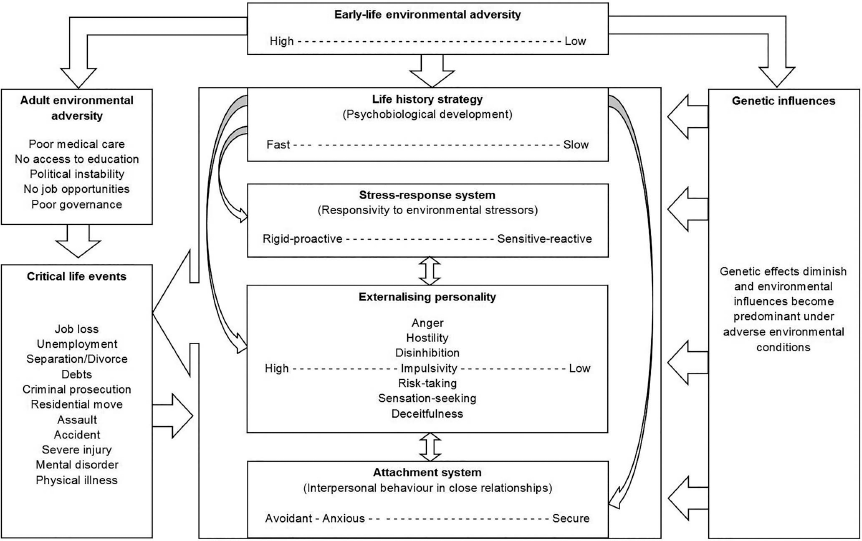
The evolutionary life history model of externalizing personality.
Early environmental risk may affect an adult's life-course independent of LHS, given that environmental factors such as medical care, health policy, education, political stability, and economics strongly impact on an individual's wellbeing across the life-course (Erola, Jalonen, & Lehti, 2016; Kawachi, Kennedy, Lochner, & Prothrow-Stith, 1997; Machin, Marie, & Vujic, 2011; Mollica et al., 2001; Nordt & Stohler, 2006; Ott, 2011; Smith & Hart, 2002). These cultural factors also constrain an individuals’ life-course in terms of experienced life events, including job loss, separation/divorce, severe accidents, and both mental and physical diseases. These influences are depicted on the left side of Figure 1. The average heritability of personality is around 50% (Bouchard & Loehlin, 2001) and the heritability of attachment and coping ranges approximately between 20% and 40% (Crawford et al., 2007; Kato & Pedersen, 2005; Picardi et al., 2011). With population estimates of 50%–70%, heritability of LH traits such as age at menarche are substantial (Sorensen et al., 2013; Towne et al., 2005; van den Berg & Boomsma, 2007). These causal genetic influences on LHS, externalizing personality, attachment, and stress-response are indicated on the right side of Figure 1. However, it is important to state that under adverse environmental conditions, heritability (i.e., additive genetic effects) markedly declines and environmental effects become the major source of variance in personality and other phenotypes (Krueger et al., 2008; Rutter et al., 2006; Tuvblad & Baker, 2011).
Next, it has been proposed that fast LHS is coadapted to externalizing personality traits in both human and nonhuman animals (Ellis et al., 2012; Stamps, 2007; Wolf et al., 2007). In support of this notion, various studies have revealed that externalizing personality traits, and indirect measures thereof, relate to earlier sexual debut, sexual coercion, unplanned pregnancies, higher number of reproductive partners, and younger age at first childbirth (Berg, Rotkirch, Vaisanen, & Jokela, 2013; Dunkel, Summerville, Mathes, & Kesserling, 2015; Gladden et al., 2008; Wilson & Daly, 1997; Yao et al., 2014). Therefore, a direct causal pathway from adult LHS leads to externalizing personality (center of Figure 1). Here I further argue that quantitative sex differences in selection pressure, LHS, and related trade-offs between LH traits (Clutton-Brock & Huchard, 2013; Del Giudice, 2009; Kruger, 2008) are the main cause for the consistently replicated sex differences in externalizing personality across cultures. In general, women score higher on neuroticism facets of anxiety, self-consciousness, and vulnerability, lower on extraversion facets of assertiveness and excitement-seeking, and higher in both agreeableness and conscientiousness than men (McCrae & Terracciano, 2005; Schmitt, Realo, Voracek, & Allik, 2008; Soto, John, Gosling, & Potter, 2011). Therefore, men score significantly higher in externalizing personality and are markedly overrepresented among psychopaths.
The proximate mechanisms underlying externalizing personality outlined in this model involve the stress-response system and the attachment system as detailed previously. Noteworthy, though depicted as separate regulatory systems, stress response and attachment are by no means mutually exclusive or independent. Both systems overlap substantially and are closely interrelated due to coevolutionary forces resulting in common underlying neurobiological structures and processes (Del Giudice et al., 2011; Nolte, Guiney, Fonagy, Mayes, & Luyten, 2011; Robles & Kane, 2014), including, for instance, the social engagement system (Porges, 2001) or oxytocin-mediated affiliative reactions to acute stress (Taylor, 2006). Further note that these systems are not exhaustive. Additional mechanisms possibly underlie personality functioning which could be added to the model in subsequent revisions. Both the stress-response (Del Giudice et al., 2011; Ellis et al., 2006) and the attachment system (Chisholm, 1996; Del Giudice, 2009) are ultimately shaped by LHS and function to adapt survival and reproductive strategies to distinct environmental conditions encountered across human evolutionary history. Causal pathways from adult LHS onto both stress-response and attachment system are therefore depicted in Figure 1. In this respect personality may be seen as a regulatory mechanism, kind of a psychobiological control device, at the interface between the organism and its environment. In this role, personality trait variation mediates the responsiveness to environmental changes and stressors as discussed in the literature on animal personality (Koolhaas et al., 2010; Korte et al., 2005; Wolf et al., 2008). Externalizing personality is therefore assumed to relate bidirectionally to both stress-response and attachment system (indicated by two-headed arrows in the upper center and at the bottom of Figure 1).
The development of LH traits, personality, and both the attachment and stress-response system, depend on contingent early environmental influences that serve as a forecast of the environment that the developing child most likely encountered as an adult across human evolutionary history (Bateson et al., 2004; Boyce & Ellis, 2005; Chisholm, 1996; Gluckman et al., 2007). This external prediction model has recently been revised and complemented by internal predictions, where environmentally induced alterations in somatic state serve as a prediction for future morbidity-mortality (Nettle et al., 2013; Rickard, Frankenhuis, & Nettle, 2014). Because this is a probability function derived from correlations of inclusive fitness (in particular reproductive success) with environmental cues and their biological substrates, prediction of the optimal LHS is prone to errors and may result in mismatch. Hence, a stable psychobiological predisposition based on early life environmental influences and genetic transmission does not necessarily answers to the effectively encountered adult environment (Frankenhuis & Del Giudice, 2012; Gluckman et al., 2011). Though early life environment strongly predicts adult environment, they do not need to be equivalent. Sometimes people grow up in very impoverished and hostile environments but then live in affluent and secure adult environments. Further note that externalizing personality traits and their underlying proximate regulatory systems, that is, stress-responsivity and attachment, exhibit only limited plasticity after the sensitive early life stages (i.e., perinate to puberty). Therefore, marked variance in intraindividual personality change during adulthood are unlikely, as indicated by the literature (Anusic & Schimmack, 2016; Ferguson, 2010). In adulthood, even trauma exposure appears to have, on average, no more than a small effect on personality change (Lockenhoff, Terracciano, Patriciu, Eaton, & Costa, 2009; Ogle et al., 2014; Sutin, Costa, Wethington, & Eaton, 2010). The main point advanced here is that, during adulthood, personality traits generally exert a greater effect on adult life events than life events on personality change (Jeronimus et al., 2014; Neyer & Asendorpf, 2001; Sutin & Costa, 2010). That is, personality predicts subsequent life events, whereas the latter generally only weakly, though still meaningfully (Jeronimus, Ormel, Aleman, Penninx, & Riese, 2013; Jokela, Hakulinen, Singh-Manoux, & Kivimaki, 2014; Specht et al., 2011), predict intraindividual change in personality traits across time. Likewise, environmental risk during early childhood has a substantial effect on the acceleration of LHS, whereas environmental risk during adolescence has not (Placek & Quinlan, 2012; Simpson et al., 2012). The causal path from the psychobiological scaffolding of LHS, externalizing personality, and regulatory systems on adult life events is therefore depicted with a large arrow, whereas the causal effect of adult life events on the LHS-personality system is depicted with a smaller arrow. Finally, research has consistently pointed toward age-specific personality development (Caspi et al., 2005). On a population-level, agreeableness, conscientiousness, and emotional stability (i.e., neuroticism reversed) are lowest during adolescence and then increase steadily with age (Roberts, Walton, & Viechtbauer, 2006; Soto et al., 2011). Likewise, personality pathology, personality measures of fast LHS as well as specific externalizing traits such as sensation seeking and impulsivity appear to reach their peak during late childhood and early adolescence and to level off afterward (Kubinski, Chopik, & Grimm, 2017; Shiner, 2009; Steinberg et al., 2008). Such characteristic change in personality over time is explicable from an evolutionary life-course perspective, as externalizing personality helps to attract mates and to outcompete same-sex conspecifics through aggressive and impulsive risk-taking (Ellis et al., 2012). When individuals grow older, they face different challenges, including provisioning resources for offspring and spouse, and maintenance of social coalitions. These developmental tasks are facilitated through cooperation, prudence, thoughtfulness, and self-control, hence the increases in emotional stability, agreeableness and conscientiousness, which is referred to as the biological maturation principle (Costa & McCrae, 2006; McCrae et al., 2000).
With respect to the stress-response system, I propose that rigid-proactive coping denotes poor stress responsivity and hence relates to externalizing personality, as mostly evidence by research on animal personality (Carere et al., 2010; Koolhaas, 2008; Korte et al., 2005). These studies also suggest that rigid-proactive coping should relate to increased SNS reactivity and to reduced PNS reactivity, though, noteworthy, in humans these associations appear to be largely inconsistent (Chida & Hamer, 2008). Important sex differences that have been discussed involve an increased tendency to react with fight responses to acute stress in men as contrasted with an increased tendency to flight responses in women (Del Giudice et al., 2011). These authors further suggest that this sex-difference in behavioral response tendency may account for the increased externalizing psychopathology observed in men as opposed to the increased internalizing psychopathology commonly found in women. In addition, Taylor and colleagues (Taylor, 2006; Taylor et al., 2000) proposed a women-specific response to acute threat termed “tend and befriend,” which contrasts the “fight and flight” response commonly found in men. These sex differences in specific stress reactions converge with sex differences in broad personality predisposition reported above (McCrae et al., 2005; Schmitt et al., 2008; Soto et al., 2011). As for the attachment system, the literature suggests that externalizing personality traits and general personality pathology correlate with insecure attachments, in particular with anxious attachment behavior (Brennan & Shaver, 1998; Hengartner et al., 2015; MacDonald et al., 2013; Noftle & Shaver, 2006). In contrast to that, Crawford et al. (2007) and Nakash-Eisikovits, Dutra, and Westen (2002) found that externalizing personality pathology is mostly unrelated to attachment. Nevertheless, across various studies it was shown that externalizing personality positively relates to interpersonal conflicts, relationship dissatisfaction, intimacy problems, and poor social support (Clark & Ro, 2014; Cramer, Torgersen, & Kringlen, 2006; Hengartner, Müller, Rodgers, Rössler, & Ajdacic-Gross, 2014; Malouff, Thorsteinsson, Schutte, Bhullar, & Rooke, 2010; Robins et al., 2002). It is therefore proposed that externalizing personality relates to insecure attachment. An interesting sex difference in attachment patterns was stressed by Del Giudice (2009), suggesting that insecurely attached men more frequently show avoidant attachment, whereas insecurely attached women rather demonstrate anxious attachment. There is further evidence for such a sex difference given that psychopathy, which relates strongly to avoidance of intimate relationships, is more prevalent in men (Coid, Yang, Ullrich, Roberts, & Hare, 2009; Colins, Fanti, Salekin, & Andershed, 2017).
Model Predictions and Practical Implications
In this section I will first postulate specific predictions derived from the model and then I focus on implications of this externalizing personality model for the field of clinical psychology, psychiatry, and public health. Note that additional predictions are posited in Figure 1 (e.g., adult environmental adversity predicts critical life events), but for the sake of parsimony in this section I focus exclusively on predictions concerning personality:
P1: Environmental risk during early childhood predicts fast LHS, that is, precocious sexual maturity, younger age at first childbirth, and higher mortality rates across adulthood. P2: Fast LHS correlates with externalizing personality. P3: Men have higher externalizing personality scores than women. P4: Externalizing personality is moderately heritable, but under adverse environmental conditions, environmental influences predominantly account for phenotypic variance. P5: Individuals high in externalizing personality show predominantly rigid-proactive stress responses, whereas individuals low in externalizing personality largely show sensitive-reactive stress responses. P6: Sensitive-reactive stress-responsivity correlates predominantly with problem solving and both instrumental and emotional social support. P7: Externalizing personality correlates with insecure attachments. P8: Extreme, mostly male variants of externalizing personality, correlate more strongly with attachment avoidance than with attachment anxiety. P9: There are reciprocal associations between externalizing personality and critical life events across adulthood, but the prospective effect of externalizing personality on the subsequent occurrence of critical life events is larger than the prospective effect of critical life events on subsequent change in externalizing personality.
Various authors, including myself, have suggested that personality, including personality disorders, should be the major target of psychiatric and preventive public health interventions (e.g., Hengartner, 2015; Israel et al., 2014; Lahey, 2009; Moffitt et al., 2011; Tyrer, 2015). However, a growing body of research has now accumulated demonstrating that personality traits are remarkably stable even in clinical samples that undergo extensive therapeutic interventions (Costa, Bagby, Herbst, & McCrae, 2005; De Fruyt et al., 2006; Ferguson, 2010; Roberts et al., 2017). Ferguson (2010) therefore concludes “Relatedly, the current results found that patients in therapy were no more likely to see personality change than were nonpatients. These results suggest that therapeutic outcomes targeted toward changing fundamental personality structures in patients may be unrealistic.” (p. 665). The coadaptation of externalizing personality to enduring fast LHS following their sensitive developmental period during fetal phase, infancy and childhood, may help to explain why intensive treatment of adult personality disorders have, on average, almost no impact on long-term social and interpersonal functioning (Clark, 2009; Morey & Hopwood, 2013), although they may reduce psychopathological symptoms (Clark, 2009; Gunderson et al., 2011; Skodol et al., 2005). Unfortunately, most recent scientific evidence paints a rather pessimistic picture for patients with externalizing personality pathology. Based on a comprehensive meta-analysis on the effects of psychotherapy in borderline patients, Cristea et al. (2017) concludes “Psychotherapies, most notably dialectical behavior therapy and psychodynamic approaches, are effective for borderline symptoms and related problems. Nonetheless, effects are small, inflated by risk of bias and publication bias, and particularly unstable at follow-up” (p. 319). Psychopathy, which possibly constitutes an extreme variant of externalizing personality, is also resistant to most treatments in adults, but, fortunately, prevention and intervention in youths may be more promising (Reidy et al., 2015; Salekin, Worley, & Grimes, 2010). More research on both the treatability and treatment-effects of externalizing personality traits is therefore required. As externalizing personality traits and corresponding predispositions toward fast LHS wane with increasing age in most persons (Gunderson et al., 2011; Kubinski et al., 2017; Steinberg et al., 2008), effective interventions are mostly required in youths and young adults (see also Reidy et al., 2015). However, note that a minority of persons, including foremost psychopaths, presumably show persistently high levels of externalizing traits.
From an evolutionary perspective it has been argued that directly treating a proximate mechanism, for instance personality or stress-reactivity, without considering its ultimate function, may be problematic and even increase the targeted biopsychosocial problems (Ellis et al., 2012; Gluckman et al., 2011; Nesse & Stein, 2012). As a remedy, experts in evolutionary psychology and medicine recommend to carefully evaluate the early life environmental conditions that are supposed to trigger the development of a given psychobiological phenotype. Also, it is advised to take into particular consideration the evolved function that a mechanism serves in the environment for which it was selected for over human evolutionary history, and not merely to consider the outcome that it produces in the contemporary environment to which it is currently exposed to. As repeatedly emphasized throughout this article, harsh and unpredictable environments select for stable phenotypes that increase current reproductive fitness at the expense of phenotypes that convey mainly future fitness expectations (Biro & Stamps, 2008; Daly & Wilson, 2005; Del Giudice et al., 2011; Ellis et al., 2009; Reale et al., 2010; Roff, 2002). In addition, it is important to realize that across human evolutionary history and until very recently, the major trade-off between reproductive and somatic efforts was presumably not that obvious, because humans tended not to live long enough, on average, to be affected by a diminished postreproductive life span or poor health during late adulthood. Our higher life expectancy, which has so drastically increased during the last 200 years, therefore confronts contemporary humans with evolutionary novel biomedical problems such as many cancers that usually develop during late adulthood (Finch, 2010; Gluckman et al., 2011).
What are the major implications of these ultimate evolutionary findings for policy and practice? Of course, first of all, reduction of adverse early life conditions will certainly prove a promising target for prevention and intervention, because phenotypes are most plastic and malleable during those early sensitive stages of human development (Boyce & Ellis, 2005; Del Giudice et al., 2009; Gluckman et al., 2007; Placek & Quinlan, 2012; Simpson et al., 2012). Moreover, because early life adversity such as undernutrition or abuse may irreversibly alter phenotypes across several generations through epigenetic effects (Burton & Metcalfe, 2014; Gluckman et al., 2007; Meaney, 2001), preventing their occurrence is a top priority. However, recent research also suggested that interventions targeted at early environmental adversity may convey only small public health benefits, whereas altering personality traits in middle adulthood promises much stronger effects (Richardson et al., 2017). This leads back to the crucial point outlined above: Effective interventions for personality are urgently required, as these may indeed produce large public health benefits (Cuijpers et al., 2010; Hengartner, 2015; Moffitt et al., 2011). Second, in adolescents/adults with severe social, behavioral, and health problems related to externalizing personality, interventions should not try to alter the problematic psychobiological mechanism per se, but the contingent socioenvironmental reinforcers. For instance, aggressive and impulsive behaviors mainly serve to attract mates and to attain social dominance. As a result, alternative reward systems should be created that help aggressive persons to gain reputation and socioeconomic status without involving in criminal or health-impairing behaviors (for a thorough discussion, see Ellis et al., 2012). Third, the stress-response and the attachment system hold particular promise to target behavioral and neuroendocrinological interventions. As these are supposed to mediate environmental effects on the development of externalizing personality, they could effectively suppress problematic outcomes related to externalizing personality (though not necessarily the personality structure per se). For an evolutionary informed psychiatric treatment approach, see for instance Gilbert (2009). Fourth, both men and women can score high in externalizing personality, but increased selection pressure for social competition in men (Clutton-Brock & Huchard, 2013) biases male sex toward extreme variants. This holds particularly true for young men who just reached sexual maturity and who violently compete for a reproductive partner. However, sexually premature and promiscuous young women are also at increased risk for increased competition under adverse environmental conditions such as deviant peer groups and poor parental control. Restructuring of psychosocial incentives and environmental triggers is therefore recommended. As both the attachment system (Ogilvie, Newman, Todd, & Peck, 2014; Robles & Kane, 2014; Shorey & Snyder, 2006) and the stress-response system (Lupien et al., 2009; McEwen, 2012; Shonkoff et al., 2012) have important implications for social functioning as well as mental and physical health, modification of these systems could aid in alleviating problematic consequences such as delinquency, teenage pregnancies, interpersonal violence, and ill-health.
Strengths and Limitations
Placing externalizing personality trait variation into an evolutionary biological framework offers several strengths. First, it allows for integrating a growing body of evidence from research on animal personality. In contrast to humans, some animal species such as fish and rats can be subjected to stringent experimental control. Thus, linking human personality to animal personality offers novel opportunities of investigation and may provide important insights for biomedicine and clinical psychology (Gosling, 2001; Koolhaas et al., 2010; Korte et al., 2005). Imbedding evolutionary reasoning into concepts of social, psychological, and medical problems provides an enhanced understanding of disease vulnerability, aetiopathology, and social dysfunction in general (Ellis et al., 2012; Gluckman et al., 2011; Nesse & Stein, 2012; Stearns et al., 2010). The model further incorporates two established psychobiological systems supposed to mediate personality processes and to account for person-environment interactions, that is, the attachment system and the stress-response system. These proximate mechanisms link personality research with various scientific fields and specialties. Inclusion of these psychobiological systems also allows for examining neuroendocrinological substrates of personality, as both attachment (Robles & Kane, 2014; Vrticka & Vuilleumier, 2012) and, in particular stress responsivity, (Lupien et al., 2009; Smith & Vale, 2006; Ulrich-Lai & Herman, 2009) have been extensively researched on a neurobiological level.
However, there are also various caveats that need to be acknowledged. Evolutionary principles are generally based on inductive reasoning, which is prone to misinterpretation and confirmation bias. Also, evolutionary LH models of human development almost exclusively rely on observational, often retrospective data that complicate interpretation because they are merely correlational. Only experimental designs allow for stringent causal conclusions. However, it comes without saying that such randomized controlled trials aimed at testing predictions from LH theory are not possible in humans due to both ethic concerns and methodological constraints. However, some particular historical events have made it possible to conduct quasi-experimental studies in humans (Painter et al., 2008; Pesonen et al., 2008). Moreover, behavioral and molecular genetics (Meaney, 2010) as well as comparative and experimental animal studies (Gluckman et al., 2007) have provided further support for evolutionary developmental models. As comprehensively reviewed and discussed by Gosling (2001, 2008), models of animal personality can therefore advance our understanding of human personality. Another complementary approach that generates novel ideas and a promising avenue for empirical research in both human and nonhuman personality trait variation are mathematical evolutionary models (e.g., McNamara, Barta, Fromhage, & Houston, 2008; Wolf et al., 2007; Wolf et al., 2008). Though prominently published in the leading scientific journals such as Nature and PNAS and thus broadly acknowledged in the field of evolutionary biology and ecology, these theoretical models are often ignored in human personality psychology. More translational and interdisciplinary research is therefore needed. As stated by Gluckman, Low, Buklijas, Hanson, and Beedle (2011), of further concern in human cohorts is cultural as opposed to biological evolution. Cultural evolution implies that ultimate explanations and examination of inclusive fitness are complicated in contemporary humans due to cultural factors that impact on reproductive success, including medically assisted reproduction and birth control. Finally, recent research on psychometric measures of LHT has revealed that a single dimension of LHS may not fit the data well (Richardson et al., 2017). However, this may be a specific limitation of psychometric LHS and not generalized to biometric data. Despite these caveats and limitations, I believe that the evolutionary model of externalizing personality holds promise for research, social policy, and clinical practice.